Embracing Social Media for
Research and Practice:
The WoMMeN experience
19/2/13
Formed
multi-prof
team
2014
User
Centred
Design and
data
collection
2015
Created hub,
linked to
Twitter and
Facebook
2016
Hub launched
Explored
what
practitioners
feel & what
employers say
2017:
Digital
Marketing
&Evaluation
• 1 book chapter
• 5 Peer-reviewed articles
• 12 Conference presentations/posters (one commended)
• Numerous blogs
• Featured on Academy of NHS Fab stuff, Aunt Minnie.com,
PHE Healthy Conversations
• College of Radiographers UK Team of the year 2016
• Finalist AHP Health Innovations Award 2017
Our journey
Research
question
WoMMeN:
Our (multi-disciplinary) team
plus 89 women on a ‘private’ Facebook User Design Group
Breast education leads
at:
• Kingston University
• University of Leeds
• Nottingham
•Llandudno breast units
WoMMeN: What and why?
• Our 2012 study:
– Women feel poorly informed/prepared
– Results in anxiety > increased perception of pain
– Prefer Word of Mouth methods to printed materials
• Ofcom statistics on media use1
• NHS communication strategy2
1. Ofcom (2015) Adults’ Media Use and Attitudes Report
2. DoH (2012) The Power of Information: putting all of us in control of the health and care information we need
How to address this?
Improve ‘patient’ information
Content?
Format?
Include patients and practitioners: “User Centred Design”
Light bulb moment:
Could we engage patients and
practitioners in User Centred Design
using social media?
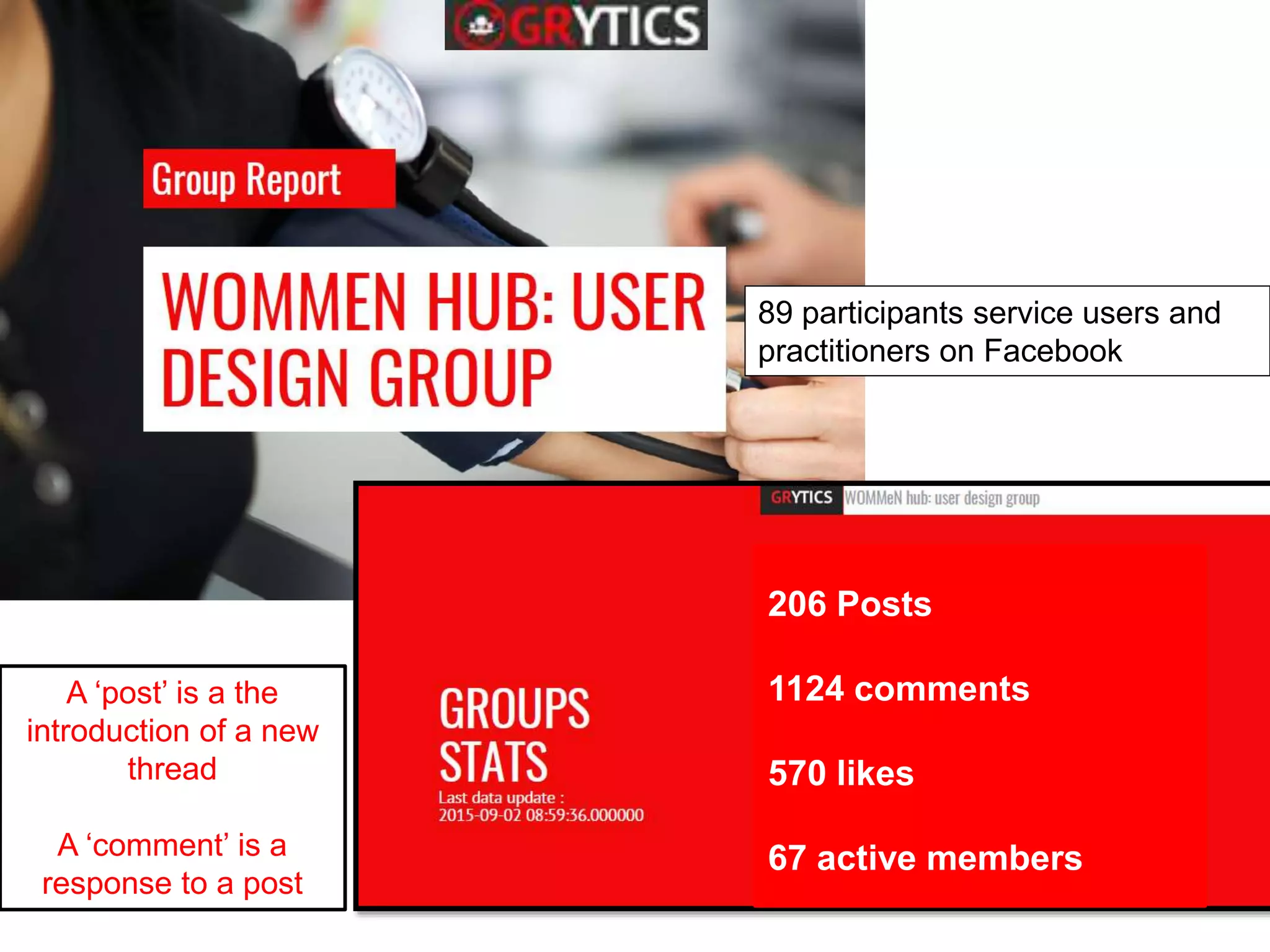
89 participants service users and
practitioners on Facebook
A ‘post’ is a the
introduction of a new
thread
A ‘comment’ is a
response to a post
206 Posts
1124 comments
570 likes
67 active members
Participants can join in as and when it is convenient to
them...and they did!
Thematic Framework Analysis
Screening in
general
Screening in
breast
Mammogram
procedure
Mammog’s
Other health
professionals
Clients
Others
Themes (n =52)
Groups
Thematic Framework Analysis
Features women want:
• Communication with other women
• Communication with health professionals
• Personal experience balanced with evidence base
• Key topics
– Screening in general
– Screening for breast cancer
– Risks, false positives, DCIS
– After the mammogram, results
– The mammogaphic examination
– Breast health, self-examination
Galpin A, Meredith J, Ure C and Robinson L (2017) “Thank you for letting us all share your mammogram experience
virtually”: developing a web-based hub for breast cancer screening JMIR Cancer Published on 27.10.17 in Vol 3, No 2
(2017): Jul-Dec
www.wommen.co.uk
Features: communication with other women and health
professionals
WoMMeN hub forum: 96 members signed up so far
Links to our Twitter and Facebook accounts
1948 likes
Features: Patient experience blogs
Information
19/2/13
Formed
multi-prof
team
2014
User
Centred
Design and
data
collection
2015
Created hub,
linked to
Twitter and
Facebook
2016
Hub launched
Explored
what
practitioners
feel & what
employers say
Our journey
Research
question
Implementation -
challenges
Challenges
SoMe bringing patients/public and practitioners
together?
• Patients want to use SoMe to support health decisions,
talk to practitioners, effect change
• Practitioners are anxious to use SoMe in their practice for
fear of litigation
• Employers policies cause some confusion
Scragg B., Shaikh S., Robinson L., Mercer C. (2017) Mixed messages: an evaluation of NHS Trust Social Media
Policies in the North West of England Radiography 23 (3) pp235-241
Scragg S., Shaikh S., Shires G., Stein Hodgins J., Mercer C., Robinson L., Wray J. (2017). An exploration of
mammographers’ attitudes towards the use of Social Media for providing breast screening information to clients
Radiography 23 (3) pp249-255
19/2/13
Formed
multi-prof
team
2014
User Design
and data
collection
2015
Created hub,
linked to
Twitter and
Facebook
2016
Hub launched
Explored
what
practitioners
feel & what
employers say
2017: Digital
Marketing
&Evaluation
What next?
Research
question
This is proving exciting!
Using digital marketing to
target hard to reach screening
populations through Social
Media
Watch this space
1. Initiate &
collaborate
2. Explore
3. Recruit
participants
4. On-line data
collection
5. Data
analysis
6. Write-up
7. Disseminate
‘Open’
publicity
‘Open’
publicity
‘Closed’ User
Design Team
(participants)
Project management
‘Closed’ User
Design Team
(participants)
Summary
SoMe in Research
• SoMe enables convenient patient and public
involvement in User Centred Design
• User Centred Design ensures outputs are relevant
• SoMe can be used at all stages of the research cycle
• Patients/public are ahead of the game!

Dr Leslie Robinson - #EngageWell 7 November

  • 1.
    Embracing Social Mediafor Research and Practice: The WoMMeN experience
  • 2.
    19/2/13 Formed multi-prof team 2014 User Centred Design and data collection 2015 Created hub, linkedto Twitter and Facebook 2016 Hub launched Explored what practitioners feel & what employers say 2017: Digital Marketing &Evaluation • 1 book chapter • 5 Peer-reviewed articles • 12 Conference presentations/posters (one commended) • Numerous blogs • Featured on Academy of NHS Fab stuff, Aunt Minnie.com, PHE Healthy Conversations • College of Radiographers UK Team of the year 2016 • Finalist AHP Health Innovations Award 2017 Our journey Research question
  • 3.
    WoMMeN: Our (multi-disciplinary) team plus89 women on a ‘private’ Facebook User Design Group Breast education leads at: • Kingston University • University of Leeds • Nottingham •Llandudno breast units
  • 4.
    WoMMeN: What andwhy? • Our 2012 study: – Women feel poorly informed/prepared – Results in anxiety > increased perception of pain – Prefer Word of Mouth methods to printed materials • Ofcom statistics on media use1 • NHS communication strategy2 1. Ofcom (2015) Adults’ Media Use and Attitudes Report 2. DoH (2012) The Power of Information: putting all of us in control of the health and care information we need
  • 5.
    How to addressthis? Improve ‘patient’ information Content? Format? Include patients and practitioners: “User Centred Design”
  • 6.
    Light bulb moment: Couldwe engage patients and practitioners in User Centred Design using social media?
  • 7.
    89 participants serviceusers and practitioners on Facebook A ‘post’ is a the introduction of a new thread A ‘comment’ is a response to a post 206 Posts 1124 comments 570 likes 67 active members
  • 8.
    Participants can joinin as and when it is convenient to them...and they did!
  • 9.
    Thematic Framework Analysis Screeningin general Screening in breast Mammogram procedure Mammog’s Other health professionals Clients Others Themes (n =52) Groups
  • 10.
    Thematic Framework Analysis Featureswomen want: • Communication with other women • Communication with health professionals • Personal experience balanced with evidence base • Key topics – Screening in general – Screening for breast cancer – Risks, false positives, DCIS – After the mammogram, results – The mammogaphic examination – Breast health, self-examination Galpin A, Meredith J, Ure C and Robinson L (2017) “Thank you for letting us all share your mammogram experience virtually”: developing a web-based hub for breast cancer screening JMIR Cancer Published on 27.10.17 in Vol 3, No 2 (2017): Jul-Dec
  • 11.
  • 12.
    Features: communication withother women and health professionals WoMMeN hub forum: 96 members signed up so far
  • 13.
    Links to ourTwitter and Facebook accounts 1948 likes
  • 14.
  • 15.
  • 16.
    19/2/13 Formed multi-prof team 2014 User Centred Design and data collection 2015 Created hub, linkedto Twitter and Facebook 2016 Hub launched Explored what practitioners feel & what employers say Our journey Research question Implementation - challenges
  • 17.
    Challenges SoMe bringing patients/publicand practitioners together? • Patients want to use SoMe to support health decisions, talk to practitioners, effect change • Practitioners are anxious to use SoMe in their practice for fear of litigation • Employers policies cause some confusion Scragg B., Shaikh S., Robinson L., Mercer C. (2017) Mixed messages: an evaluation of NHS Trust Social Media Policies in the North West of England Radiography 23 (3) pp235-241 Scragg S., Shaikh S., Shires G., Stein Hodgins J., Mercer C., Robinson L., Wray J. (2017). An exploration of mammographers’ attitudes towards the use of Social Media for providing breast screening information to clients Radiography 23 (3) pp249-255
  • 18.
    19/2/13 Formed multi-prof team 2014 User Design and data collection 2015 Createdhub, linked to Twitter and Facebook 2016 Hub launched Explored what practitioners feel & what employers say 2017: Digital Marketing &Evaluation What next? Research question This is proving exciting! Using digital marketing to target hard to reach screening populations through Social Media Watch this space
  • 19.
    1. Initiate & collaborate 2.Explore 3. Recruit participants 4. On-line data collection 5. Data analysis 6. Write-up 7. Disseminate ‘Open’ publicity ‘Open’ publicity ‘Closed’ User Design Team (participants) Project management ‘Closed’ User Design Team (participants)
  • 20.
    Summary SoMe in Research •SoMe enables convenient patient and public involvement in User Centred Design • User Centred Design ensures outputs are relevant • SoMe can be used at all stages of the research cycle • Patients/public are ahead of the game!

Editor's Notes

  • #6 The road map of the Center for eHealth Research and Disease Management (CeHRes) described by van Gemert-Pijnen et al [11] provides arguably the most comprehensive framework for applying UCD to eHealth product design. The CeHRes road map promotes (1) gaining an understanding of the lives of end users and other stakeholders (contextual inquiry), (2) seeking a deeper understanding of the values of key stakeholders (value specification), (3) involving users in the development of a product (design), (4) developing an operational plan for the implementation of the technology (operationalization), and (5) evaluating the product (summative evaluation).
  • #8 The Grytics analysis showed that between March 2015 and September 2015 (approx 6 months) we had a very engaged community of women talking about breast screening. As well as providing us with information to inform the final hub this gave us confidence that the idea of social networking for breast screening was a good idea
  • #9 So the user design group was very engaged. Grytics showed us they were engaged all days and all hours of the day. This supports our use of social media as a research tool for gathering data from people who can’t attend face-to-face.
  • #10 Quantitative data is not relevant for informing the hub, only to show that the research process was working We had to analyse the 1124 posts to identify what women talked about and therefore what should be on the hub. Two researchers independently identified the themes and then arrived at a consensus of 52 themes or topics. A framework analysis also enabled us to split the topics into ‘cases’ to identify who talked about the themes, were they important to all or just certain groups. This would help us to determine whether the final hub should have separate areas for different groups
  • #11 In terms of features: Users did support the need to talk to other women on line Clients and practitioners felt there should be a ‘practitioner’ voice present to provide balance However, all were keen that experiences (good and bad) should be acknowledged. In terms of information, of the 52 themes, these were the ones most talked about and the groups. This supports the need for a separate practitioner space on the WoMMeN hub.
  • #12 So here is the final hub and address. Let me highlight a number of features to demonstrate how the research has informed the hub
  • #13 Features for discussion feature strongly. There is an open hub for practitioners and clients A separate hub just for practitioners There are also links and feeds to and from our WoMMeN Twitter and Facebook accounts for women who don’t want to register on a the hub forum
  • #15 There are patient experience blogs
  • #16 There is an information link to the topics identified in the themes. We have not created new information, except where it did not exist, but we have curated the best of what is already on the internet, e.g the BSP links.
  • #21 The road map of the Center for eHealth Research and Disease Management (CeHRes) described by van Gemert-Pijnen et al [11] provides arguably the most comprehensive framework for applying UCD to eHealth product design. The CeHRes road map promotes (1) gaining an understanding of the lives of end users and other stakeholders (contextual inquiry), (2) seeking a deeper understanding of the values of key stakeholders (value specification), (3) involving users in the development of a product (design), (4) developing an operational plan for the implementation of the technology (operationalization), and (5) evaluating the product (summative evaluation).