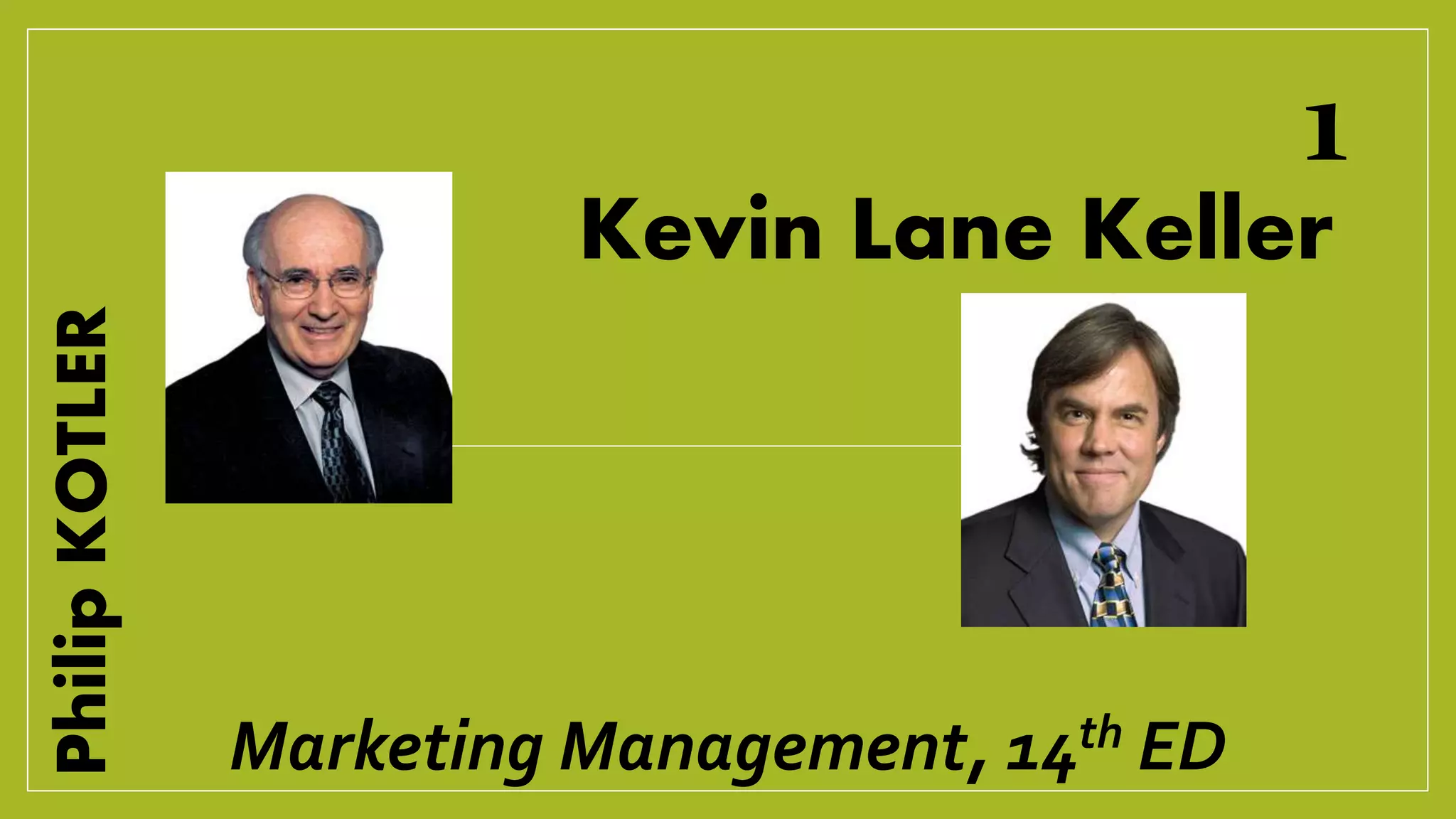
1 
Marketing Management, 14th ED 
Philip KOTLER 
Kevin Lane Keller
DEFINING MARKETING 
FOR THE 21ST CENTURY 
One of the key factors in Barack 
Obama’s victory in the 2008 U.S. 
presidential election was a well-designed 
and well-executed marketing 
program.
GOOD MARKETING IS NO ACCIDENT 
Good marketing is no accident, but a result of careful planning and 
execution using state-of-the-art tools and techniques. It becomes both an 
art and a science as marketers strive to find creative new solutions to often-complex 
challenges amid profound changes in the 21st century marketing 
environment. In this book, we describe how top marketers balance 
discipline and imagination to address these 
new marketing realities. In the first chapter, we lay the foundation by 
reviewing important marketing concepts, tools, frameworks, and issues.
Q2 WHY MARKETING IS IMPORTANT? Or IMPORTANCE OF MARKETING? 
 Financial success often depends on marketing ability. 
 Many companies have now created a CMO (Chief Marketing Officer) position to put marketing on a 
more equal footing with other C-level executives such as CEO & CFO. 
 Marketers decision plays an important role in marketing such as 
 what features to design into a new product or service 
 what prices to set& sell 
 where to sell products or offer services 
 and how much to spend on advertising, sales, the Internet or mobile marketing. 
 They must make those decisions in an Internet-fueled environment where consumers, competition, 
technology, and economic forces change rapidly, and the consequences of the marketer’s words 
and actions can quickly multiply. 
 Market leaders such as Microsoft, Wal-mart, Intel, and Nike recognize that they cannot afford relax. 
 GE’s brilliant former CEO, Jack Welch, repeatedly warned his company “Change or die”.
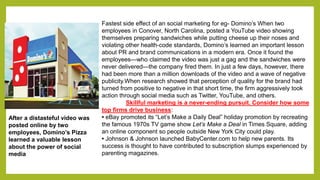
Fastest side effect of an social marketing for eg- Domino’s When two 
employees in Conover, North Carolina, posted a YouTube video showing 
themselves preparing sandwiches while putting cheese up their noses and 
violating other health-code standards, Domino’s learned an important lesson 
about PR and brand communications in a modern era. Once it found the 
employees—who claimed the video was just a gag and the sandwiches were 
never delivered—the company fired them. In just a few days, however, there 
had been more than a million downloads of the video and a wave of negative 
publicity.When research showed that perception of quality for the brand had 
turned from positive to negative in that short time, the firm aggressively took 
action through social media such as Twitter, YouTube, and others. 
Skillful marketing is a never-ending pursuit. Consider how some 
top firms drive business: 
• eBay promoted its “Let’s Make a Daily Deal” holiday promotion by recreating 
the famous 1970s TV game show Let’s Make a Deal in Times Square, adding 
an online component so people outside New York City could play. 
• Johnson & Johnson launched BabyCenter.com to help new parents. Its 
success is thought to have contributed to subscription slumps experienced by 
parenting magazines. 
After a distasteful video was 
posted online by two 
employees, Domino’s Pizza 
learned a valuable lesson 
about the power of social 
media
The scope of marketing 
To prepare to be a marketer, you need to understand what marketing is, how it 
works, who does it, and what is marketed. 
1. WHAT IS MARKETING? 
Marketing is an organizational function and a set of processes for Creating, 
Communicating, and Delivering value (CCD) to customers and for managing 
customer relationships in ways that benefit the organization and its stakeholders. 
Marketing deals with identifying and meeting human & social needs. One 
shortest definition of marketing is “marketing needs profitably.” 
For eg:-When eBay recognized that people were unable to locate some of the items 
they desired most, it created an online auction clearinghouse.
WHAT IS MARKETED? 
Marketers market 10 main types of entities: goods, services, events, experiences, persons, places, properties, 
organizations, information, and ideas. Let’s take a quick look at these categories. 
1) GOODS 
2) SERVICES 
3) EVENTS 
4) EXPERIENCES 
5) PERSONS 
6) PLACES 
7) PROPERTIES 
8) ORGANIZATIONS 
9) INFORMATION 
10) IDEAS
WHO MARKETS? 
MARKETERS AND PROSPECTS:- A marketer is someone who seeks a response attention, a purchase, a vote, a 
donation from another party, called the prospect. If two parties are seeking to sell something to each other, we call 
them both marketers. 
Marketers are skilled at stimulating demand for their products, but that’s a limited view of what they do. Just as 
production and logistics professionals are responsible for supply management, marketers are responsible for 
demand management. They seek to influence the level, timing, and composition of demand to meet the 
organization’s objectives. Eight demand states are possible: 
1. Negative demand:-Consumers dislike the product and may even pay to avoid it. 
2. Nonexistent demand :-Consumers may be unaware of or uninterested in the product. 
3. Latent demand:-Consumers may share a strong need that cannot be satisfied by an existing product. 
4. Declining demand:-Consumers begin to buy the product less frequently or not at all. 
5. Irregular demand:-consumer purchases vary on a seasonal, monthly, weekly, daily, or even hourly basis. 
6. Full demand:-Consumers are adequately buying all products put into the marketplace. 
7. Overfull demand:-More consumers would like to buy the product than can be satisfied. 
8. Unwholesome demand:-Consumers may be attracted to products that have undesirable social consequences.
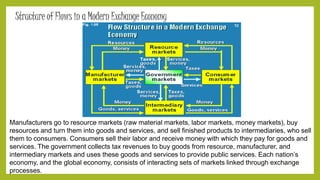
Structure of Flows in a Modern Exchange Economy 
Manufacturers go to resource markets (raw material markets, labor markets, money markets), buy 
resources and turn them into goods and services, and sell finished products to intermediaries, who sell 
them to consumers. Consumers sell their labor and receive money with which they pay for goods and 
services. The government collects tax revenues to buy goods from resource, manufacturer, and 
intermediary markets and uses these goods and services to provide public services. Each nation’s 
economy, and the global economy, consists of interacting sets of markets linked through exchange 
processes.
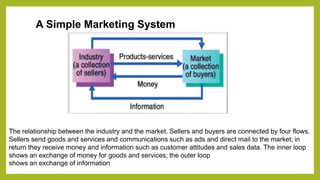
A Simple Marketing System 
The relationship between the industry and the market. Sellers and buyers are connected by four flows. 
Sellers send goods and services and communications such as ads and direct mail to the market; in 
return they receive money and information such as customer attitudes and sales data. The inner loop 
shows an exchange of money for goods and services; the outer loop 
shows an exchange of information
Concept Of Marketing 
 The Production Concept 
 The Product Concept 
 The Selling Concept 
 The Marketing Concept 
 The Holistic Marketing Concept
1. Marketing is an organizational function and a set of 
processes for creating, communicating, and delivering 
value to customers and for managing customer 
relationships in ways that benefit the organization and its 
stakeholders. Marketing management is the art and science 
of choosing target markets and getting, keeping, and growing 
customers through creating, delivering, and communicating 
superior customer value. 
2. Marketers are skilled at managing demand: they seek 
to influence its level, timing, and composition for goods, 
services, events, experiences, persons, places, properties, 
organizations, information, and ideas. They also operate in 
four different marketplaces: consumer, business, global, and 
nonprofit. 
3. Marketing is not done only by the marketing department. It 
needs to affect every aspect of the customer experience. To 
create a strong marketing organization, marketers must think 
like executives in other departments, and executives in other 
departments must think more like marketers. 
4. Today’s marketplace is fundamentally different as a result 
of major societal forces that have resulted in many 
new consumer and company capabilities. These forces have 
created new opportunities and challenges 
and changed marketing management significantly as 
companies seek new ways to achieve marketing 
excellence. 
5. There are five competing concepts under which 
organizations can choose to conduct their business: 
the production concept, the product concept, the selling 
concept, the marketing concept, and the holistic 
marketing concept. The first three are of limited use today. 
6. The holistic marketing concept is based on the 
development, 
design, and implementation of marketing programs, 
processes, and activities that recognize their breadth and 
interdependencies. Holistic marketing recognizes that 
everything matters in marketing and that a broad, 
integrated perspective is often necessary. Four 
components of holistic marketing are relationship 
marketing, integrated marketing, internal marketing, and 
socially responsible marketing. 
7. The set of tasks necessary for successful marketing 
management includes developing marketing strategies 
and plans, capturing marketing insights, connecting with 
customers, building strong brands, shaping the market 
offerings, delivering and communicating value, and 
creating long-term growth. 
SUMMARY

Slideshare

  • 1.
    1 Marketing Management,14th ED Philip KOTLER Kevin Lane Keller
  • 2.
    DEFINING MARKETING FORTHE 21ST CENTURY One of the key factors in Barack Obama’s victory in the 2008 U.S. presidential election was a well-designed and well-executed marketing program.
  • 3.
    GOOD MARKETING ISNO ACCIDENT Good marketing is no accident, but a result of careful planning and execution using state-of-the-art tools and techniques. It becomes both an art and a science as marketers strive to find creative new solutions to often-complex challenges amid profound changes in the 21st century marketing environment. In this book, we describe how top marketers balance discipline and imagination to address these new marketing realities. In the first chapter, we lay the foundation by reviewing important marketing concepts, tools, frameworks, and issues.
  • 4.
    Q2 WHY MARKETINGIS IMPORTANT? Or IMPORTANCE OF MARKETING?  Financial success often depends on marketing ability.  Many companies have now created a CMO (Chief Marketing Officer) position to put marketing on a more equal footing with other C-level executives such as CEO & CFO.  Marketers decision plays an important role in marketing such as  what features to design into a new product or service  what prices to set& sell  where to sell products or offer services  and how much to spend on advertising, sales, the Internet or mobile marketing.  They must make those decisions in an Internet-fueled environment where consumers, competition, technology, and economic forces change rapidly, and the consequences of the marketer’s words and actions can quickly multiply.  Market leaders such as Microsoft, Wal-mart, Intel, and Nike recognize that they cannot afford relax.  GE’s brilliant former CEO, Jack Welch, repeatedly warned his company “Change or die”.
  • 5.
    Fastest side effectof an social marketing for eg- Domino’s When two employees in Conover, North Carolina, posted a YouTube video showing themselves preparing sandwiches while putting cheese up their noses and violating other health-code standards, Domino’s learned an important lesson about PR and brand communications in a modern era. Once it found the employees—who claimed the video was just a gag and the sandwiches were never delivered—the company fired them. In just a few days, however, there had been more than a million downloads of the video and a wave of negative publicity.When research showed that perception of quality for the brand had turned from positive to negative in that short time, the firm aggressively took action through social media such as Twitter, YouTube, and others. Skillful marketing is a never-ending pursuit. Consider how some top firms drive business: • eBay promoted its “Let’s Make a Daily Deal” holiday promotion by recreating the famous 1970s TV game show Let’s Make a Deal in Times Square, adding an online component so people outside New York City could play. • Johnson & Johnson launched BabyCenter.com to help new parents. Its success is thought to have contributed to subscription slumps experienced by parenting magazines. After a distasteful video was posted online by two employees, Domino’s Pizza learned a valuable lesson about the power of social media
  • 6.
    The scope ofmarketing To prepare to be a marketer, you need to understand what marketing is, how it works, who does it, and what is marketed. 1. WHAT IS MARKETING? Marketing is an organizational function and a set of processes for Creating, Communicating, and Delivering value (CCD) to customers and for managing customer relationships in ways that benefit the organization and its stakeholders. Marketing deals with identifying and meeting human & social needs. One shortest definition of marketing is “marketing needs profitably.” For eg:-When eBay recognized that people were unable to locate some of the items they desired most, it created an online auction clearinghouse.
  • 7.
    WHAT IS MARKETED? Marketers market 10 main types of entities: goods, services, events, experiences, persons, places, properties, organizations, information, and ideas. Let’s take a quick look at these categories. 1) GOODS 2) SERVICES 3) EVENTS 4) EXPERIENCES 5) PERSONS 6) PLACES 7) PROPERTIES 8) ORGANIZATIONS 9) INFORMATION 10) IDEAS
  • 8.
    WHO MARKETS? MARKETERSAND PROSPECTS:- A marketer is someone who seeks a response attention, a purchase, a vote, a donation from another party, called the prospect. If two parties are seeking to sell something to each other, we call them both marketers. Marketers are skilled at stimulating demand for their products, but that’s a limited view of what they do. Just as production and logistics professionals are responsible for supply management, marketers are responsible for demand management. They seek to influence the level, timing, and composition of demand to meet the organization’s objectives. Eight demand states are possible: 1. Negative demand:-Consumers dislike the product and may even pay to avoid it. 2. Nonexistent demand :-Consumers may be unaware of or uninterested in the product. 3. Latent demand:-Consumers may share a strong need that cannot be satisfied by an existing product. 4. Declining demand:-Consumers begin to buy the product less frequently or not at all. 5. Irregular demand:-consumer purchases vary on a seasonal, monthly, weekly, daily, or even hourly basis. 6. Full demand:-Consumers are adequately buying all products put into the marketplace. 7. Overfull demand:-More consumers would like to buy the product than can be satisfied. 8. Unwholesome demand:-Consumers may be attracted to products that have undesirable social consequences.
  • 9.
    Structure of Flowsin a Modern Exchange Economy Manufacturers go to resource markets (raw material markets, labor markets, money markets), buy resources and turn them into goods and services, and sell finished products to intermediaries, who sell them to consumers. Consumers sell their labor and receive money with which they pay for goods and services. The government collects tax revenues to buy goods from resource, manufacturer, and intermediary markets and uses these goods and services to provide public services. Each nation’s economy, and the global economy, consists of interacting sets of markets linked through exchange processes.
  • 10.
    A Simple MarketingSystem The relationship between the industry and the market. Sellers and buyers are connected by four flows. Sellers send goods and services and communications such as ads and direct mail to the market; in return they receive money and information such as customer attitudes and sales data. The inner loop shows an exchange of money for goods and services; the outer loop shows an exchange of information
  • 11.
    Concept Of Marketing  The Production Concept  The Product Concept  The Selling Concept  The Marketing Concept  The Holistic Marketing Concept
  • 12.
    1. Marketing isan organizational function and a set of processes for creating, communicating, and delivering value to customers and for managing customer relationships in ways that benefit the organization and its stakeholders. Marketing management is the art and science of choosing target markets and getting, keeping, and growing customers through creating, delivering, and communicating superior customer value. 2. Marketers are skilled at managing demand: they seek to influence its level, timing, and composition for goods, services, events, experiences, persons, places, properties, organizations, information, and ideas. They also operate in four different marketplaces: consumer, business, global, and nonprofit. 3. Marketing is not done only by the marketing department. It needs to affect every aspect of the customer experience. To create a strong marketing organization, marketers must think like executives in other departments, and executives in other departments must think more like marketers. 4. Today’s marketplace is fundamentally different as a result of major societal forces that have resulted in many new consumer and company capabilities. These forces have created new opportunities and challenges and changed marketing management significantly as companies seek new ways to achieve marketing excellence. 5. There are five competing concepts under which organizations can choose to conduct their business: the production concept, the product concept, the selling concept, the marketing concept, and the holistic marketing concept. The first three are of limited use today. 6. The holistic marketing concept is based on the development, design, and implementation of marketing programs, processes, and activities that recognize their breadth and interdependencies. Holistic marketing recognizes that everything matters in marketing and that a broad, integrated perspective is often necessary. Four components of holistic marketing are relationship marketing, integrated marketing, internal marketing, and socially responsible marketing. 7. The set of tasks necessary for successful marketing management includes developing marketing strategies and plans, capturing marketing insights, connecting with customers, building strong brands, shaping the market offerings, delivering and communicating value, and creating long-term growth. SUMMARY