NIMS DENTAL COLLEGE AND HOSPITAL
FACIAL KEYS TO ORTHODONTIC DIAGNOSIS
AND TREATMENT PLANNING
G.William Arnett .American journal of orthodontics and
dentofacial orthopaedics .1993;5:299-411
Presented by : Dr. Deeksha Bhanotia
MDS 1ST Year PG
Department of orthodontics and
dentofacial orthopaedics
Guided by : Dr Mridula Trehan
Principal & HOD
Department of orthodontics and
dentofacial orthopaedics
INTRODUCTION
 The purpose of this articleis to present an organized,
comprehensive clinical facial analysis
 To discuss the soft tissue changes associated with
orthodontic and surgical treatments of malocclusion.
 Facial examination leads to avoidance of potential
orthodontic and surgical facial imbalance.
 Treating the bite based on model analysis or on
osseous cephalometric standards without
examination of the face is not adequate.
 Diagnosis is the definition of the problem.
 Treatment planning is based on diagnosis and is the process of
planning changes needed to eliminate the problems.
 Treatment is execution of the plan.
 Correction of the bite does not always lead to correction, or even
maintenance, of facial esthetics.
 Several lines and angles have been used to evaluate soft tissue
esthetics
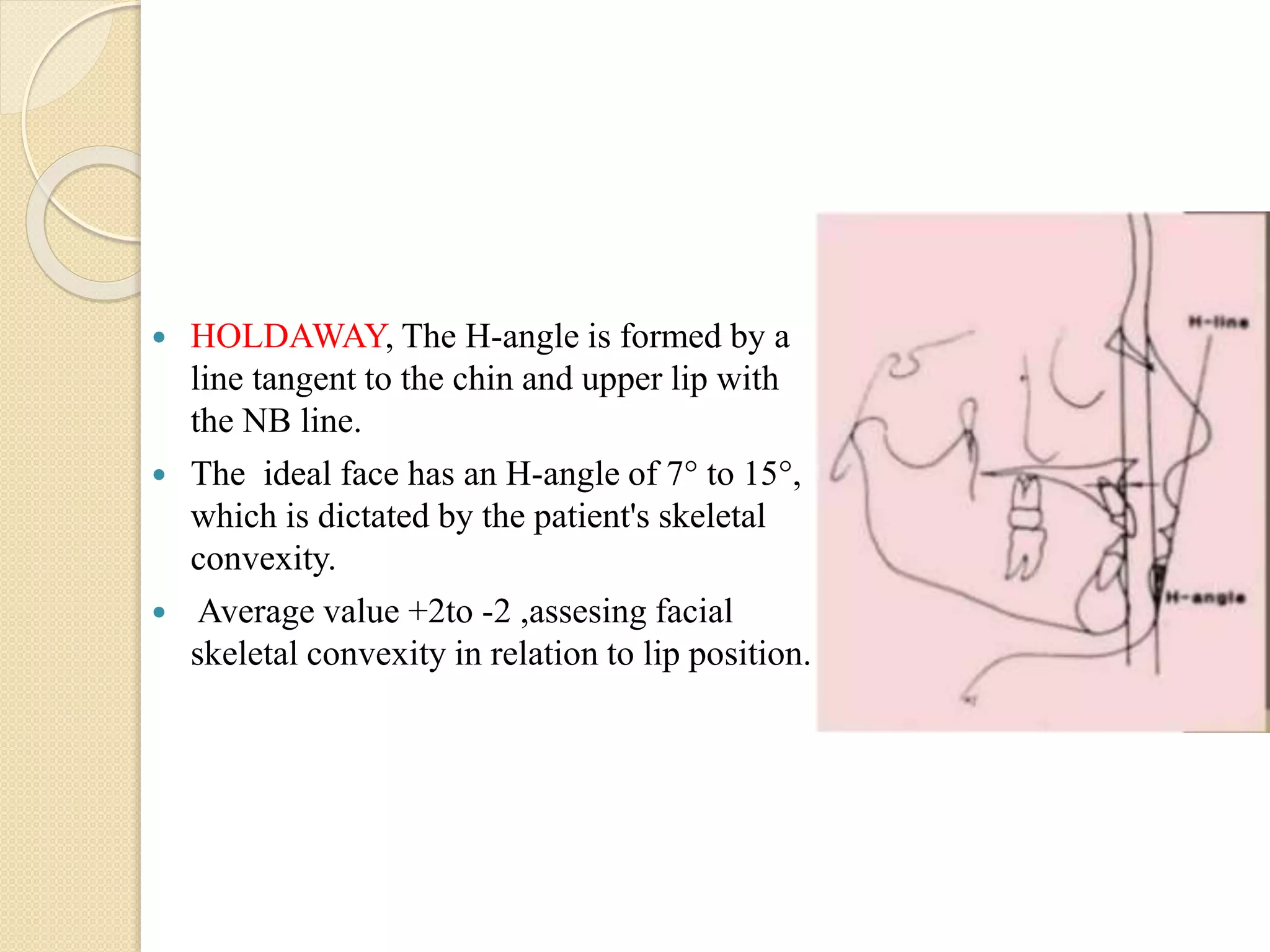
 HOLDAWAY, The H-angle is formed by a
line tangent to the chin and upper lip with
the NB line.
 The ideal face has an H-angle of 7° to 15°,
which is dictated by the patient's skeletal
convexity.
 Average value +2to -2 ,assesing facial
skeletal convexity in relation to lip position.
 RICKETTS, E line also called as
esthetic line.
 It is formed by joining tip of nose
and soft tissue pogonion .
 The ideal position of the lower lip
as two millimeters behind the E-
line.
 The divine proportion was used by
the ancient Greeks (ratio of 1.0 to
1.618) and was applied by Ricketts
to describe optimal facial esthetics.
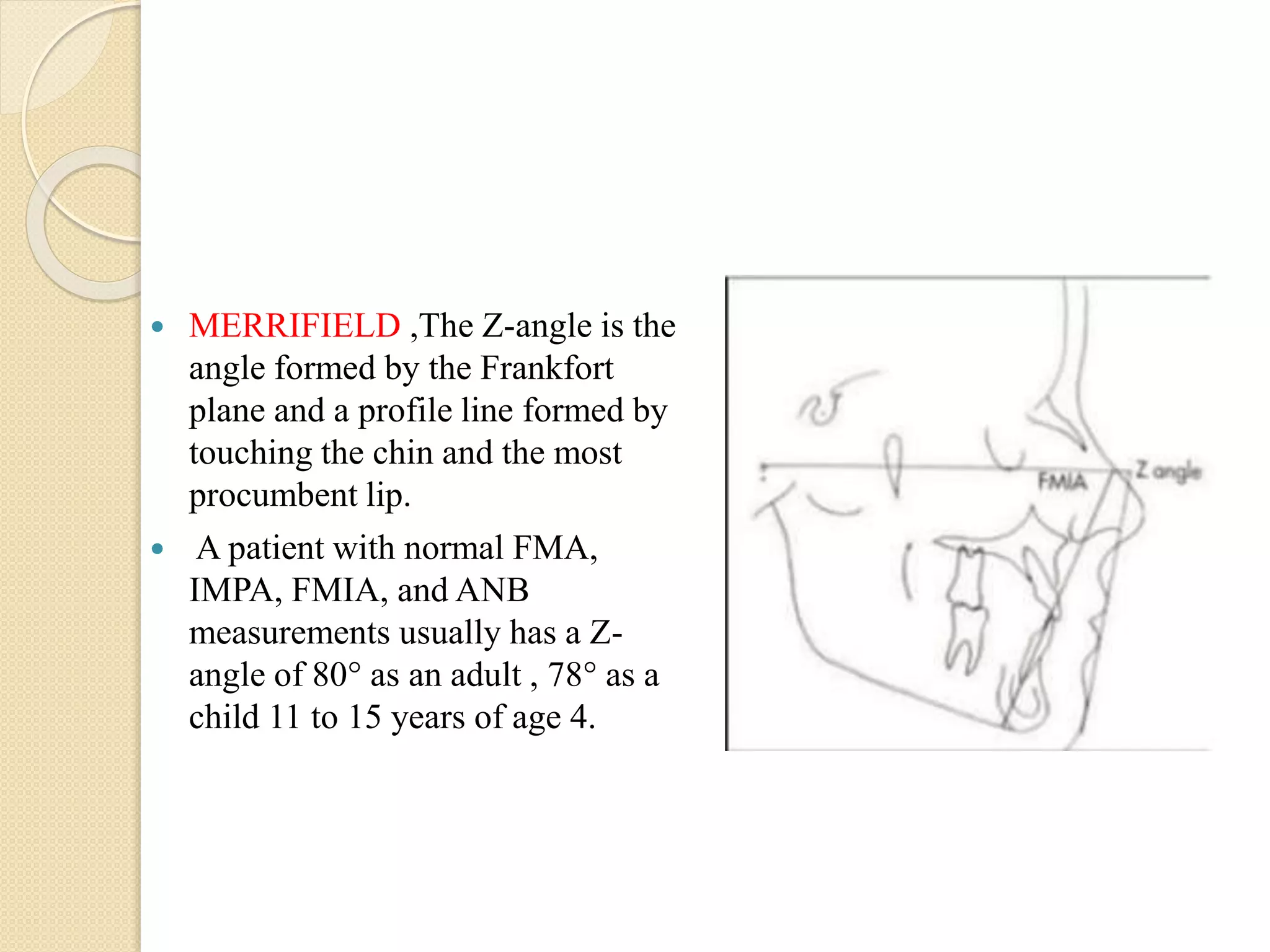
 MERRIFIELD ,The Z-angle is the
angle formed by the Frankfort
plane and a profile line formed by
touching the chin and the most
procumbent lip.
 A patient with normal FMA,
IMPA, FMIA, and ANB
measurements usually has a Z-
angle of 80° as an adult , 78° as a
child 11 to 15 years of age 4.
 WORMS,LEGAN HL, Assessment for proportionality, interlabial
gap, lower face height, upper lip length, and lower lip length .
 The Steiner esthetic plane and the Riedel plane have also been used
to describe the facial profile.
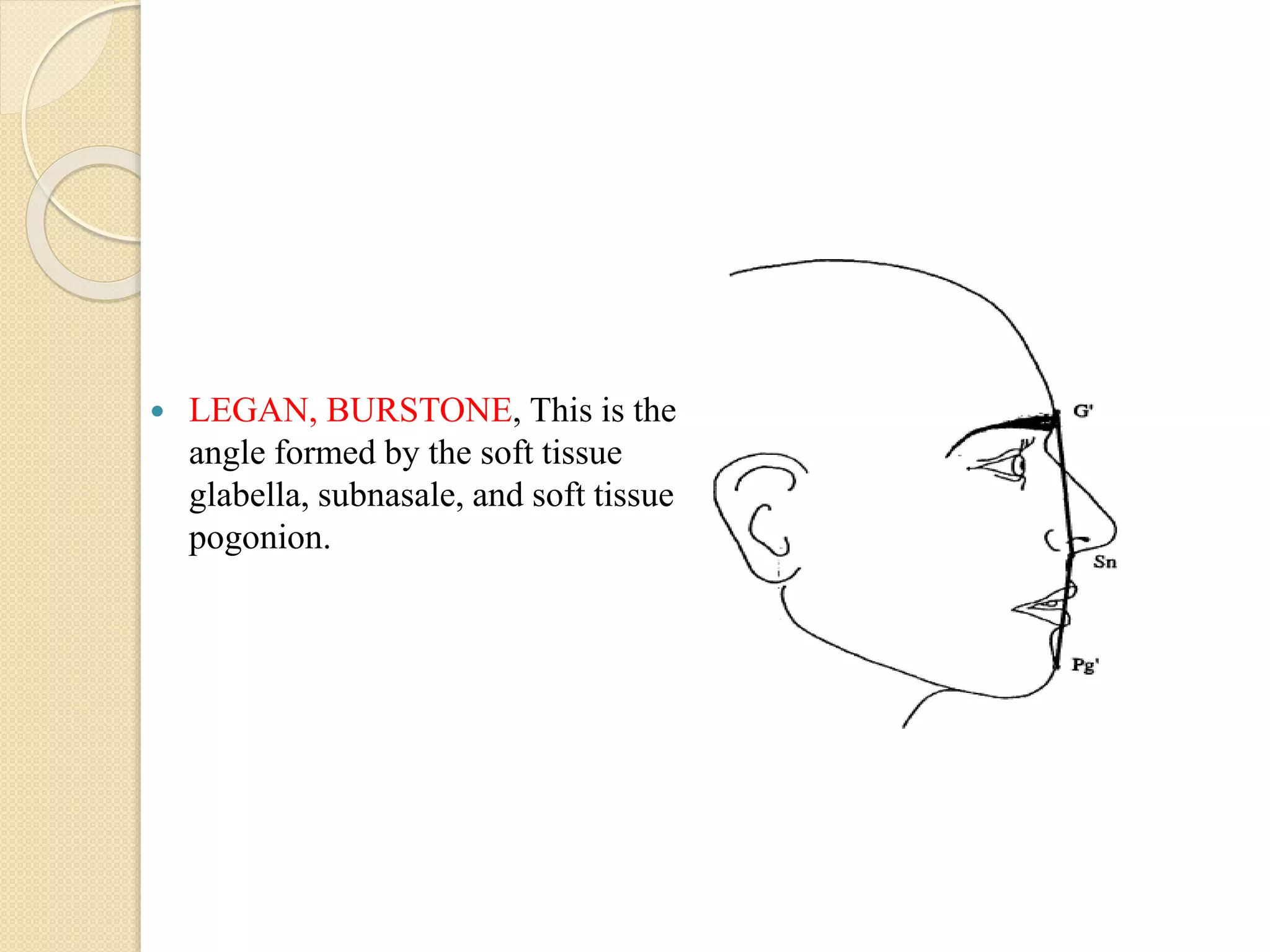
 LEGAN, BURSTONE, This is the
angle formed by the soft tissue
glabella, subnasale, and soft tissue
pogonion.
 The Powell analysis,which is
made up of the nasofrontal
angle, nasofacial angle,
nasomental angle, and
mentocervical angle, has been
developed to give insight into
an ideal facial profile.
 GONAZALES –ULLOA ,The zero meridian line,
 Is a line perpendicular to the Frankfort horizontal, passing through
the nasion soft tissue to measure the position of the chin.
 The chin should lie on this line or just short of it
 Variation indicates protrusion and retrusion of maxilla and
mandible seperately.
 TWEED,concentrated on the position and inclination of the
mandibular incisors in relation to the basal bone.
 As a standard, lateral cephalometric headfilms have been used to
diagnose, treatment plan and predict hard tissue and soft tissue
responses to orthodontic treatment.
 Cephalometric x-ray films and photographs may improperly
position the patient's head orientation, condyle position, and lip
posture. This can lead to inaccurate diagnosis, treatment planning,
and treatment. These variables can be controlled by the doctor
during clinical examination of the patient.
 G William arnett in his article facial keys to orthodontic diagnosis
and treatment planning part II has been given nighteen facial traits
which are used in facial examination.
FRONTAL VIEW
 Natural head posture has a 2° standard deviation compared with a
4° to 6° standard deviation for the various intracranial landmarks in
use.
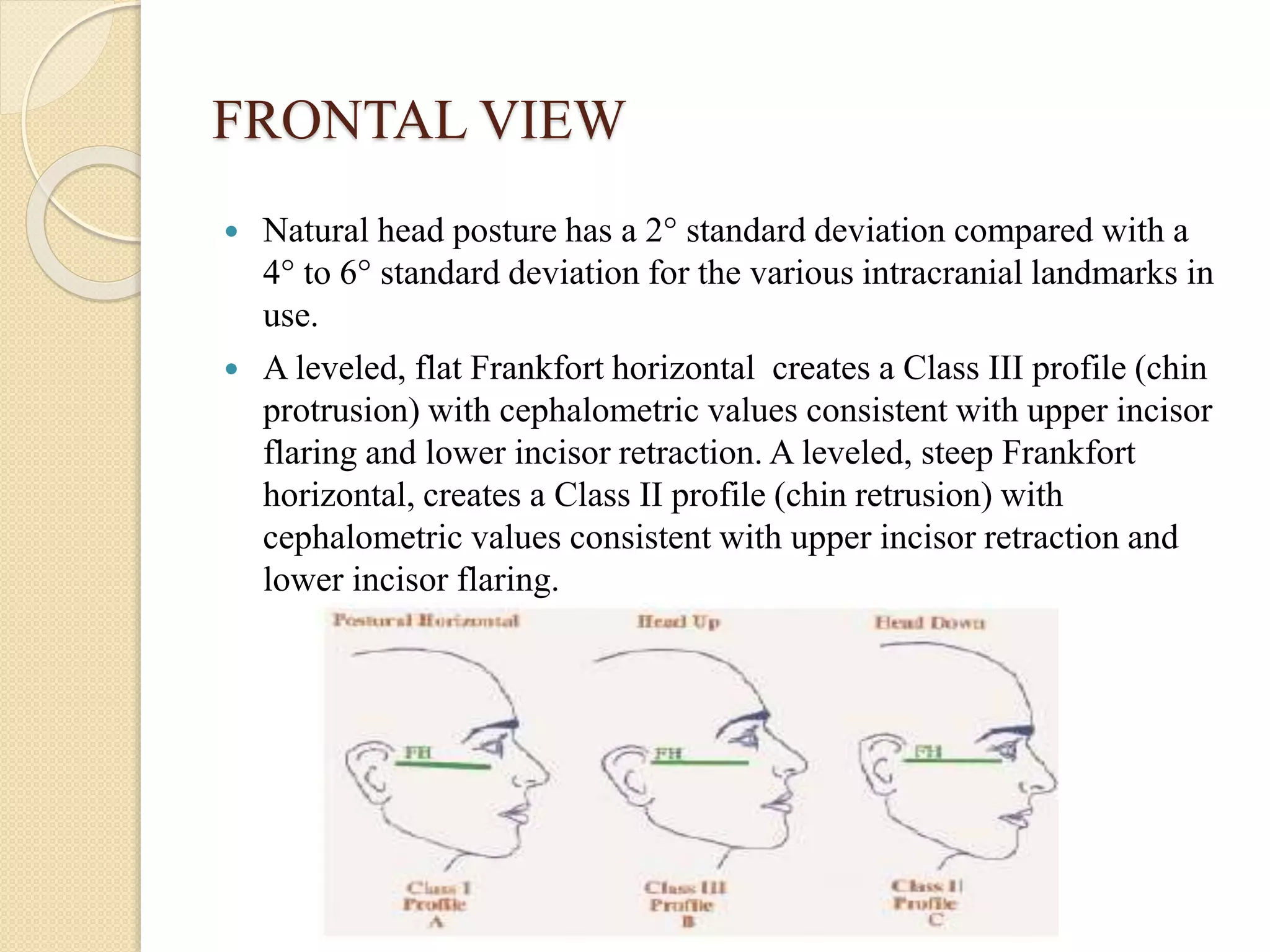
 A leveled, flat Frankfort horizontal creates a Class III profile (chin
protrusion) with cephalometric values consistent with upper incisor
flaring and lower incisor retraction. A leveled, steep Frankfort
horizontal, creates a Class II profile (chin retrusion) with
cephalometric values consistent with upper incisor retraction and
lower incisor flaring.
 All examination data should be recorded in centric relation since
orthodontic and surgical results are strictly in this position to
produce precise function
 Posturing of the mandible can decrease the severity of Class II and
increase the severity of Class III relationships .
 The only direct evidence of posturing is tomographic representation
of the condyle on the eminence rather than in the glenoid fossa.
Centric relation can be established as follows:
 1. Patient in a 45° sitting position.
 2. Use a warmed, double-thickness piece of pink base plate wax.
 3. Guide the opening and closing to first tooth contact, nondeflected
position.
 4. Trim the wax bite to the buccal surfaces of the teeth.
 5. Repeat step three.
 6. Wash the wax bite in cold water.
 7. Repeat step 3
The relaxed lip position is obtained while the patient is in centric
relation by the following method:
 1. Ask the patient to relax.
 2. Stroke the lips gently.
 3. Take multiple measurements on different occasions.
 4. Use casual observation while the patient is unaware of being
observed.
.
Outline form and symmetry
 The bigonial width is
approximately 30% less than
the bizygomatic dimension.
 The height to width proportion
is 1.3:1 for females and 1.35:1
for Males
 Short, square facial outlines are indicative of deep bite Class II
malocclusion, vertical maxillary deficiency, and in some cases,
masseteric hyperplasia.
 Long, narrow faces are associated with vertical maxillary excess or
mandibular protrusion with dental interferences leading to open
bite.
 Chin lengthening to increase the facial height (H to Me'),
 Cheekbone augmentation to increase the bizygomatic width (Zy to
Zy),
 Augmentation of the mandibular angles to increase the bigonial
dimension (Go' to Go').
FACIAL LEVEL
 If the pupils are at level,
they are used as the
horizontal reference line and
adjacent structures are
measure relative to this line .
Structures compared with
the pupil line are
 (1) upper canine level,
 (2) lower canine level,
 (3) chin and jaw level.
 Constructed horizontal
reference line is formed by
drawing line through pupil
area parallel to floor.
 This line is used when the
pupil plane is not parallel to
the floor (eyes are not
inlevel) when the head is in
frontal postural horizontal.
MIDLINE ALIGNMENT
 The relative positions of
soft tissue landmarks
(nasal bridge, nasal tip,
filtrum, chin point)
 Dental midline landmarks
(upper incisor midline,
lower incisor midline)
Needed changes are
incorporated into the
orthodontic treatment
plan.
 Dental midline shifts are the result of multiple dental factors
including:
1. Spaces
2. Tooth rotations
3. Missing teeth
4. Buccally or lingually positioned teeth
5. Crowns or fillings which change tooth mass
6. Congenital tooth mass difference from left to right
 Asymmetric premolar extractions may be necessary to align dental
and skeletal midlines.
 Skeletal midline shifts are not corrected orthodontically , surgery is
employed
 Attempts to orthodontically correct the bite when the etiologic
factor is skeletal can produce buccal plate violation and gingival
recession.
 Vertical disharmony between lip lengths and skeletal height
(vertical maxillary excess, vertical maxillary deficiency, mandibular
protrusion, mandibular retrusion with deep bite) can not be assessed
without the relaxed lip posture.
 Existing positions and needed changes in upper incisor exposure,
interlabial gap, lip length, and proportion are lost in the closed lip
position.
FACIAL ONE THIRD
 The hairline is variable, and the
upper third is frequently in low
range.
 The thirds are within a range of
55 to 65 mm, vertically
 Increased lower one-third
height is frequently found with
vertical maxillary excess and
Class III malocclusions
 Decreased lower one-third
height is associated with
vertical maxillary deficiency
and mandibular retrusion deep
bites.
 The appearance of the landmarks (incisor exposure, interlabial gap)
within the lower third are more important in assessing balance than
are the equality of the middle and the lower thirds.
LOWER ONE THIRD
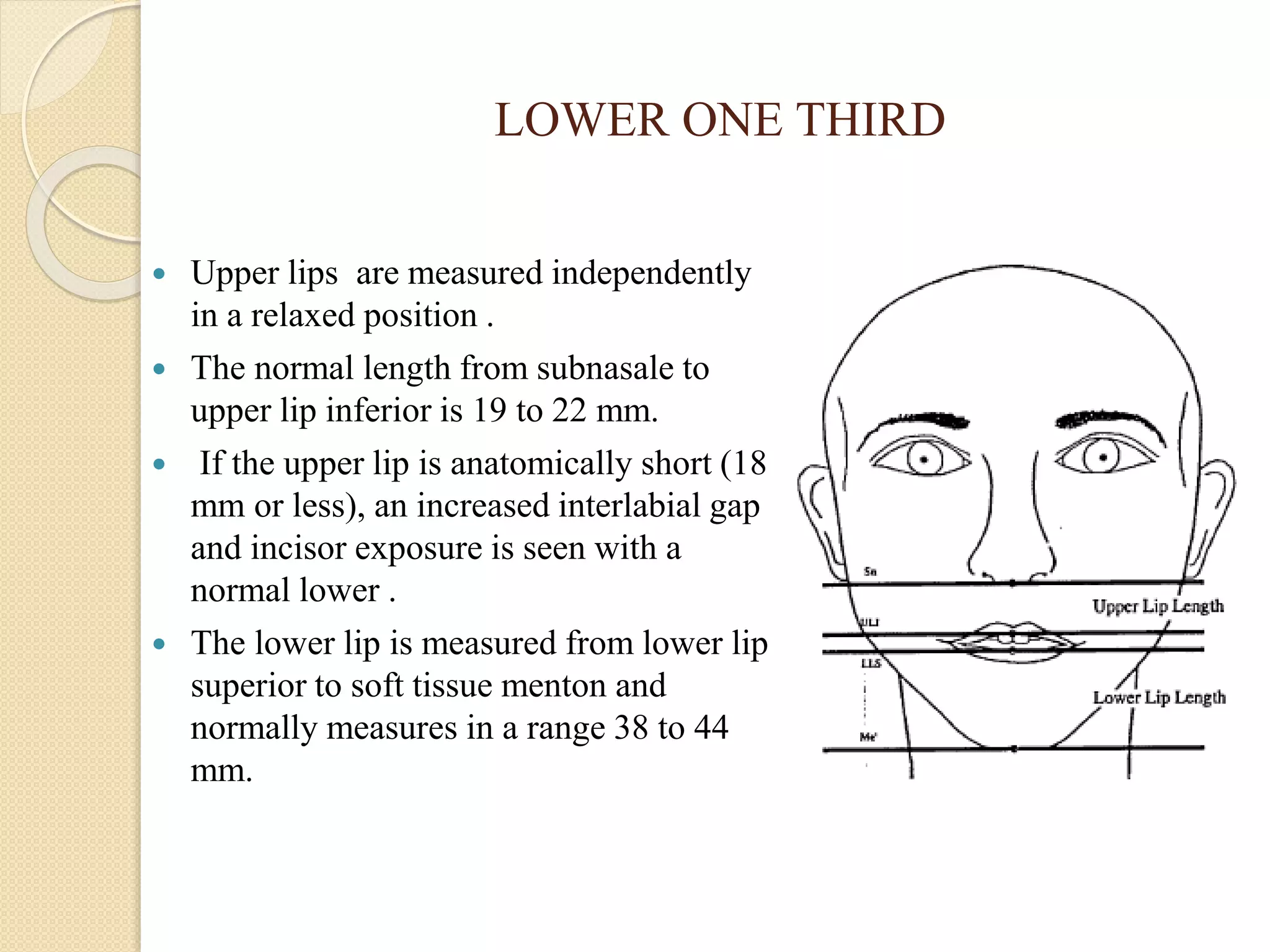
 Upper lips are measured independently
in a relaxed position .
 The normal length from subnasale to
upper lip inferior is 19 to 22 mm.
 If the upper lip is anatomically short (18
mm or less), an increased interlabial gap
and incisor exposure is seen with a
normal lower .
 The lower lip is measured from lower lip
superior to soft tissue menton and
normally measures in a range 38 to 44
mm.
 The normal ratio of upper to lower lip is 1:2.
 Anatomic short lower lip is sometimes associated with Class II
malocclusion.
 Anatomic long lower lip can be associated with Class III
malocclusions.
 Anatomic short lower lip can be lengthened with a lengthening
genioplasty
 Interlabial gap , when the lips are relaxed, a space of 1 to 5 mm is
seen between upper lip inferior and lower lip superior is present
Females show a larger gap within the normal range.
 This measurement is also dependent on lip lengths and vertical
dentoskeletal height.
 Increases in interlabial gap are seen with anatomic short upper lip,
vertical maxillary excess, and mandibular protrusion with open bite
secondary to cusp interferences.
 Decreased interlabial gap is found with vertical maxillary
deficiency, anatomically long upper lip and mandibular retrusion
with deep bite.
Smile position lip level
 Ideal exposure with smile is three-quarters of the crown height to 2
mm of gingiva, in females more than males.
 Variability in gingival exposure is related to
 (I) lip length,
 (2) vertical maxillary length,
 (3) maxillary anatomic crown length
 (4) magnitude of lip elevation with smile
PROFILE VIEW
PROFILE
ANGLE
Class I occlusion presents a total
facial angle range of 165 to
175 .
Class II angles are less than 165.
Class III are greater than 175 .
 When values are less than 165
or greater than 175 skeletal
malocclusions needs surgery
NASOLABIAL ANGLE
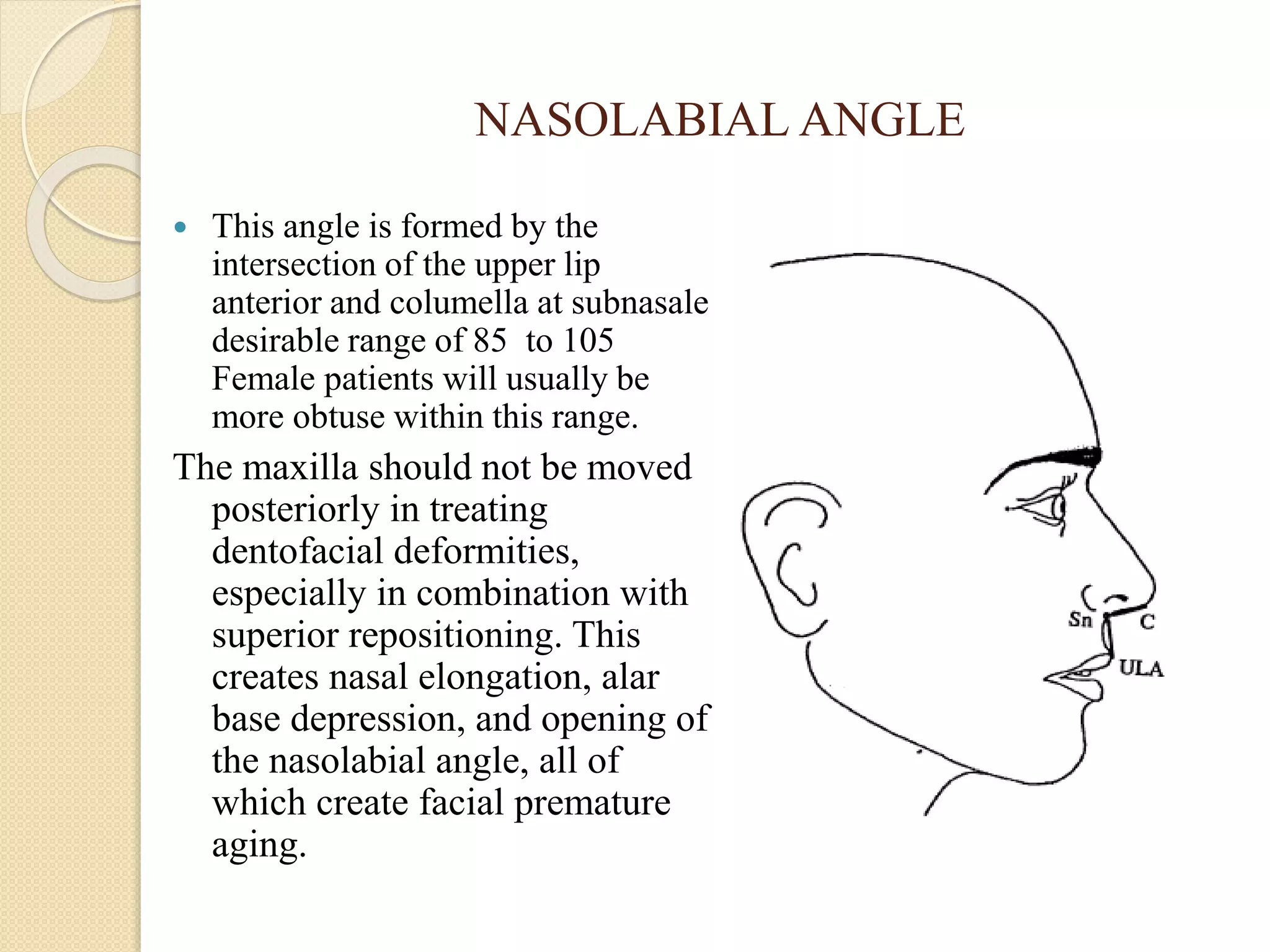
 This angle is formed by the
intersection of the upper lip
anterior and columella at subnasale
desirable range of 85 to 105
Female patients will usually be
more obtuse within this range.
The maxilla should not be moved
posteriorly in treating
dentofacial deformities,
especially in combination with
superior repositioning. This
creates nasal elongation, alar
base depression, and opening of
the nasolabial angle, all of
which create facial premature
aging.
MAXILLARY SULCUS CONTOUR
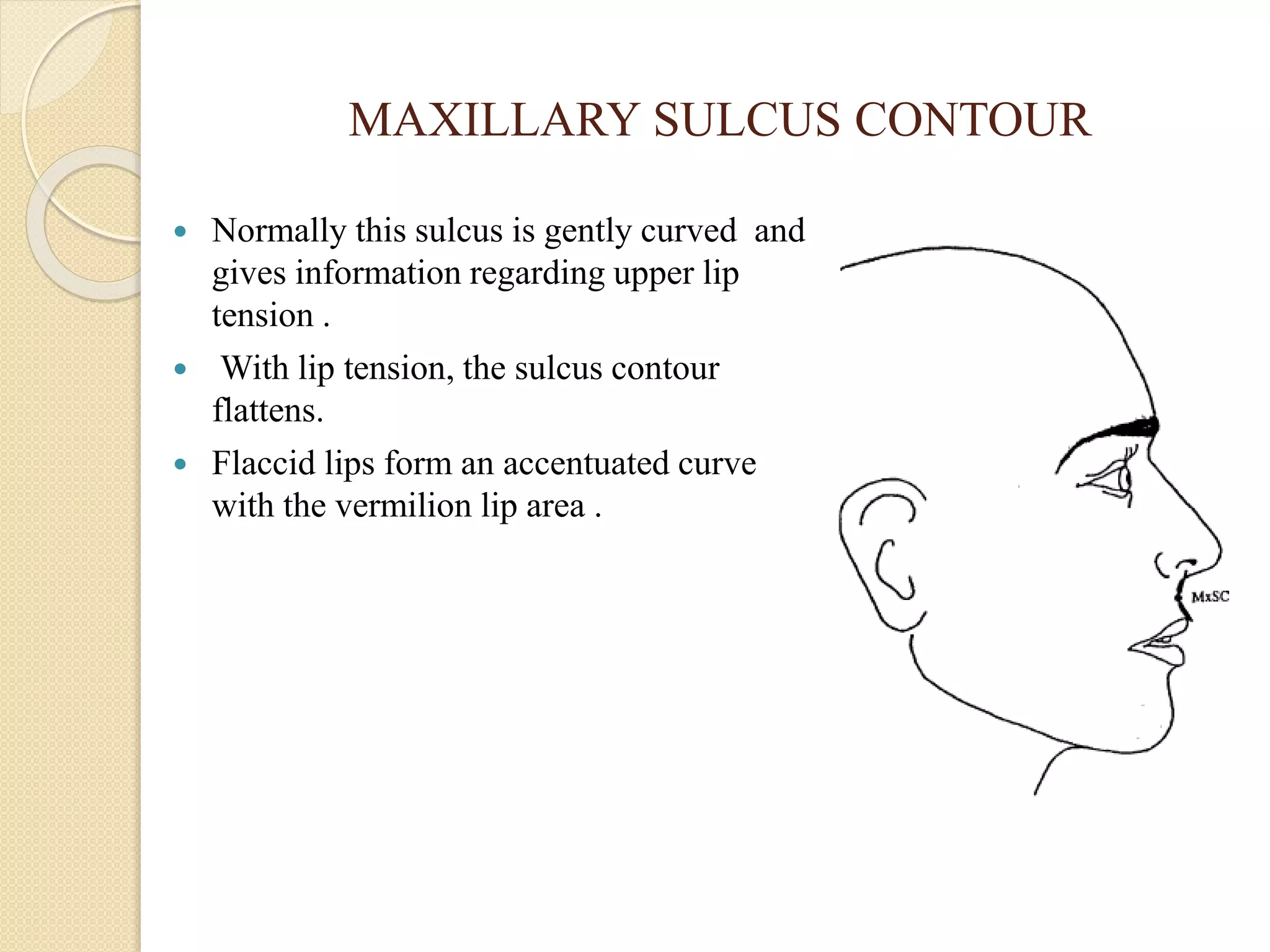
 Normally this sulcus is gently curved and
gives information regarding upper lip
tension .
 With lip tension, the sulcus contour
flattens.
 Flaccid lips form an accentuated curve
with the vermilion lip area .
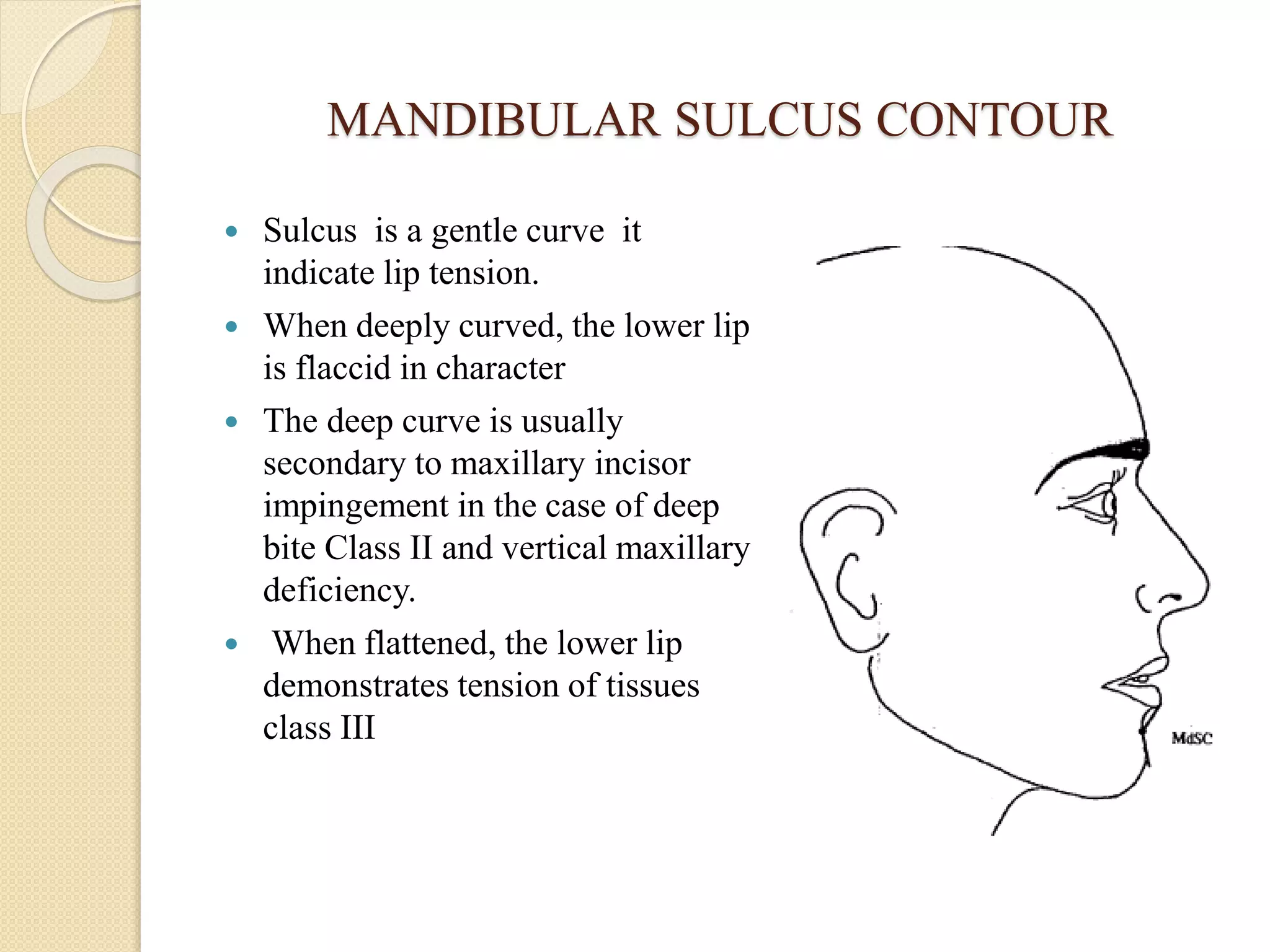
MANDIBULAR SULCUS CONTOUR
 Sulcus is a gentle curve it
indicate lip tension.
 When deeply curved, the lower lip
is flaccid in character
 The deep curve is usually
secondary to maxillary incisor
impingement in the case of deep
bite Class II and vertical maxillary
deficiency.
 When flattened, the lower lip
demonstrates tension of tissues
class III
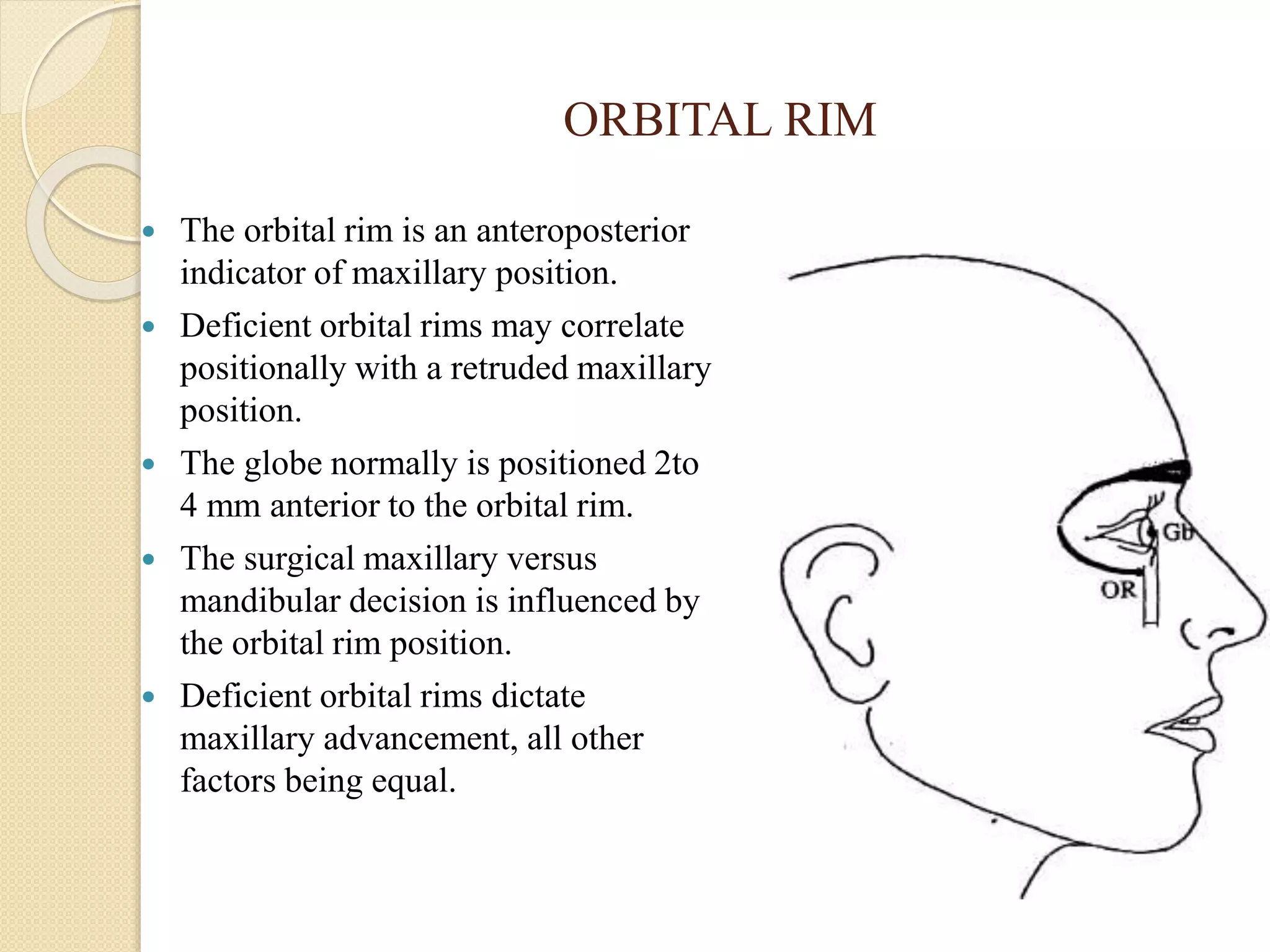
ORBITAL RIM
 The orbital rim is an anteroposterior
indicator of maxillary position.
 Deficient orbital rims may correlate
positionally with a retruded maxillary
position.
 The globe normally is positioned 2to
4 mm anterior to the orbital rim.
 The surgical maxillary versus
mandibular decision is influenced by
the orbital rim position.
 Deficient orbital rims dictate
maxillary advancement, all other
factors being equal.
CHEEK BONE CONTOUR
 Cheek bone contour is used
as one of the main indicators
of maxillary retrusion .
 This area should have an
apex at the cheekbone point
(CP) and not appear fiat.
 The CP is located 20 to 25
mm inferior and 5 to 10 mm
anterior to the outer canthus
(OC) of the eye when
viewed in profile.
 When viewed frontally the
CP is 20 to 25 mm inferior
and 5 to 10 mm lateral to the
OC
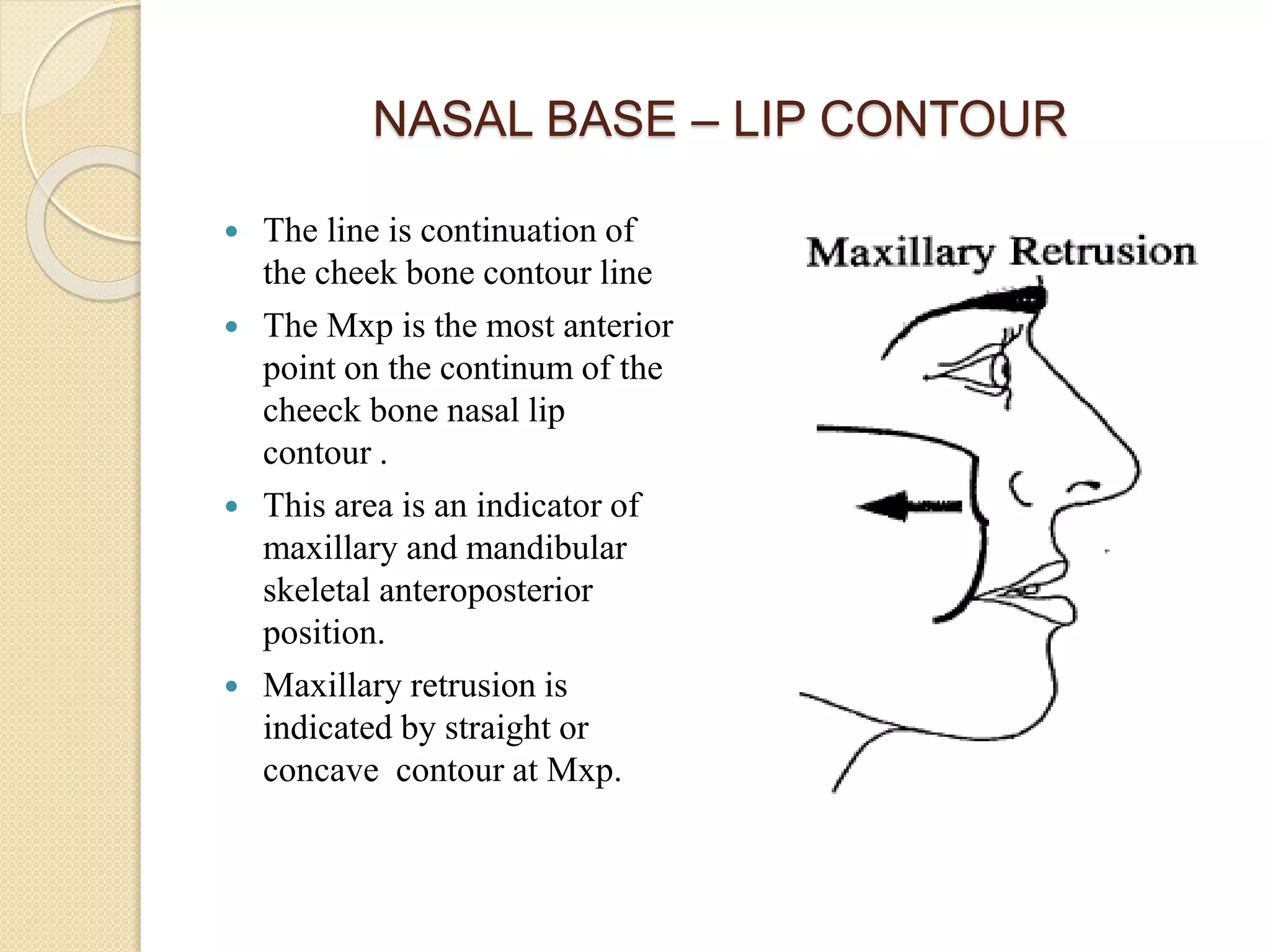
NASAL BASE – LIP CONTOUR
 The line is continuation of
the cheek bone contour line
 The Mxp is the most anterior
point on the continum of the
cheeck bone nasal lip
contour .
 This area is an indicator of
maxillary and mandibular
skeletal anteroposterior
position.
 Maxillary retrusion is
indicated by straight or
concave contour at Mxp.
 Mandibular protrusion interrupts
the nasal base-lip line in the
length of the upper lip .
 When the line is interrupted
within the height of the upper lip
a mandibular setback may be
indicated.
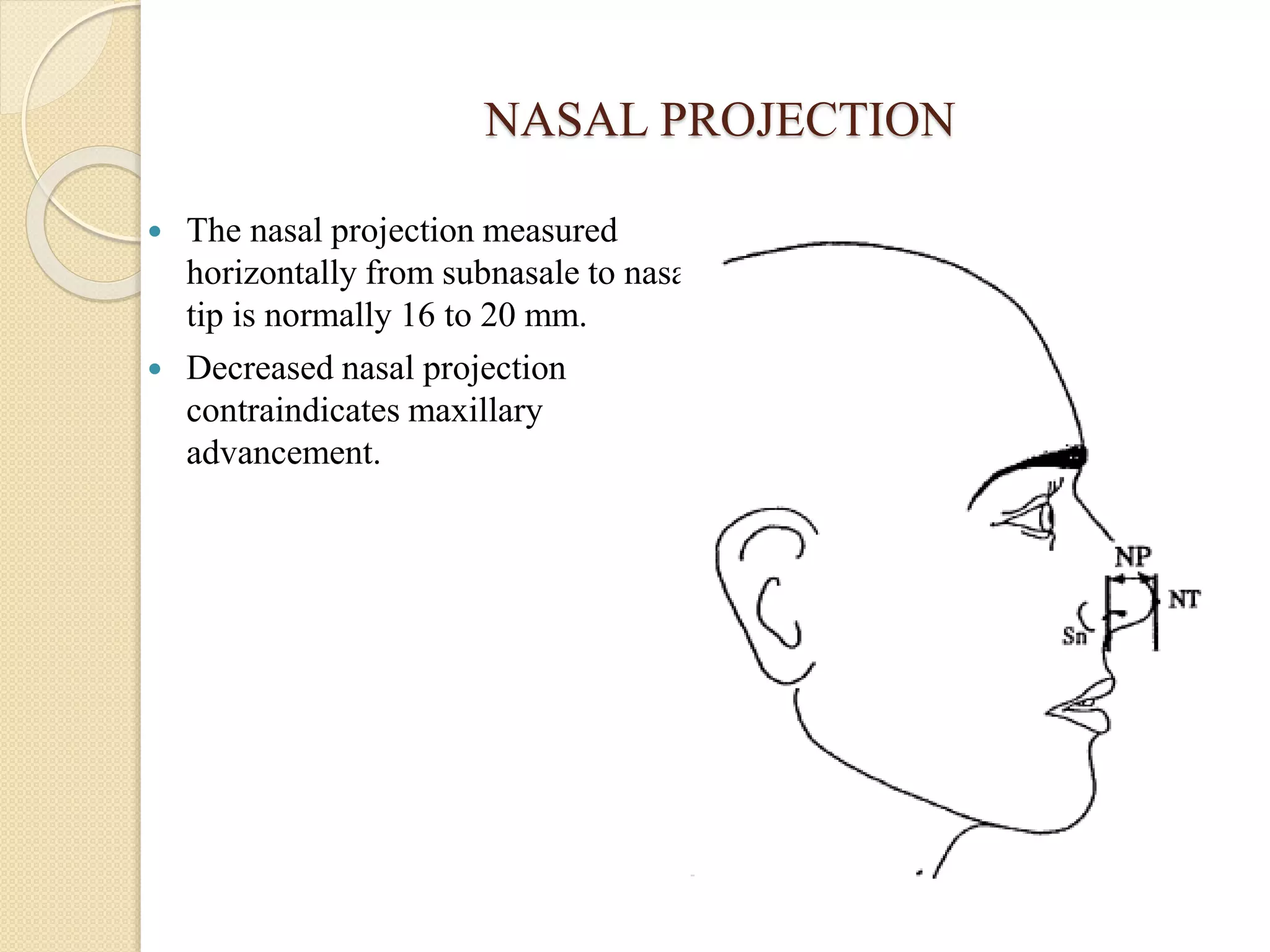
NASAL PROJECTION
 The nasal projection measured
horizontally from subnasale to nasal
tip is normally 16 to 20 mm.
 Decreased nasal projection
contraindicates maxillary
advancement.
THROAT LENGTH AND CONTOUR
 The distance from the neck-throat
junction to the soft tissue menton.
 A patient with a short, throat
length is not a good candidate for
mandibular setback.
 A long, straight throat length is
amenable to mandibular setback
SUBNASALE –POGONION LINE
 BURSTONE ,that the upper lip is in
front of the Sn-Pg' line by 3.5 mm
_+1.4 mm, and the lower lip is in
front of the line by 2.2 _+1.6 mm.
 The relationship of the lips to the Sn-
Pg' line is an important aid in
orthodontic soft tissue analysis and
treatment.
 The Sn-Pg' line is ideally drawn to
the lips through subnasale.
 If Pg' is significantly posterior to
the line, a chin augmentation is
indicated.
 Female chins are softer relative to
this line.
SOFT TISSUE CHARACTERISTIC OF COMMON
SKELETAL DEFORMITIES
With the 19 facial keys, 8 pure skeletal deformities with predictable
soft tissue appearances can be defined.
A. Class I facial and dental (facial angle Class l)
1. Vertical maxillary excess
2. Vertical maxillary deficiency
B.Class II facial and dental (facial angle Class II)
3. Maxillary protrusion
4. Vertical maxillary excess
5. Mandibular retrusion
C. Class III facial and dental (facial angle Class III)
6. Maxillary retrusion
7. Vertical maxillary deficiency
8. Mandibular protrusion
common characteristic features in Vertical maxillary excess are:
 Increased lower one-third
 Increased interlabial gap
 Increased incisor exposure
 Increased gingival smile
 Mentalis strain
 Decreased total profile angle*
 Accentuated mandibular sulcus contour
 Decreased throat length
 Normal nasal projection
 Normal nasotabial angle n plans derived from these
measurements will be correct
common characteristic features in Vertical maxillary deficiency
are:
 Decreased lower one-third
 Decreased interlabial gap
 Decreased incisor exposure
 Decreased incisor exposure with smile
 Lip redundancy
 Straight to Class Ill profile angle*
 Accentuated mandibular sulcus contour
 Normal nasal projection
 Normal to decreased nasolabial angle
 Increased throat length
 Normal cheekbones, alar base
common characteristic features in Maxillary protrusion are:
 Normal lower one-third
 Normal interlabial gap
 Normal incisor exposure
 Normal smile
 Decreased profile angle
 Normal mandibular sulcus contour
 Normal throat length
 Normal to short nasal projection
 Decreased nasolabial angle
common characteristic features in Maxillary retrusion are:
 Normal lower one-third
 Normal interlabial gap
 Normal incisor exposure
 Normal smile
 No mentalis strain
 Straight to Class I!I profile angle
 Normal mandibular sulcus contour
 Increased nasal projection
 Nasal base deficiency
 Cheekbone/orbital rim deficiency
 Normal to increased nasolabial angle
 Normal throat length
common characteristic features in Mandibular protrusion are:
 Normal to increased lower one-third
 Normal to increased interlabial gap
 Normal inciso~" exposure
 Normal tooth exposure with smile
 No increased mentalis strain
 Straight to Class III profile angle
 Normal to flat mandibular sulcus contour
 Normal nasal projection, alar base, and cheekbones
 Normal nasolabial angle
 Increased throat length
common characteristic features in Mandibular retrusion are:
 Decreased or normal lower one-third
 Decreased or normal interlabial gap
 Normal incisor exposure
 Normal smile
 Normal-to-lip redundancy
 Decreased profile angle
 Accentuated mandibular sulcus contour
 Decreased throat length
 Normal nasolabial angle
 Normal nasal projection
CONCLUSION
 Orthodontists use dental and facial keys to diagnose and to treat
malocclusions.
 Dental keys include overjet, canine occlusion, and molar occlusion.
 Facial keys used by orthodontists include the relative positions of
the upper lip, lower lip, and chin.
 The ideal treatment plan must be formulated that affects the
facial traits in the most positive fashion, while correcting the
bite.
 The treatment plan should be orthodontic or surgical
orthodontic as determined by facial examination.
 Orthodontic tooth movement may satisfy bite and facial
correction or surgery of one or both jaws may be necessary.
 Four possible treatments exist for each patient:
(1) orthodontics alone
(2) orthodontics plus lower jaw surgery
(3) orthodontics plus upper jaw surgery
(4) orthodontics plus both upper and lower jaw surgery.
The treatment that optimizes occlusion (bite and TMJ harmony),
facial balance, stability, and periodontal health is chosen. If
treatment harms the patient, it should not be rendered.
Other relavent article
 Reed A. Holdaway ;A soft-tissue cephalometric analysis and its use
in orthodontic treatment planning. Part I .AM J ORTHODONTIC
1983;84(1):1-28 A soft-tissue analysis which demonstrates the
inadequacy of using a hard-tissue analysis alone for treatment
planning.
 The findings indicate that, in general, for adolescents the normal or
usual thickness of the soft tissue at point A is 14 to 16 mm. As point
A is altered by tooth movement, headgear, etc.,
 When there is taper in the maxillary lip immediately anterior to the
incisor, as in protrusive dentures, the tissue will thicken as the
incisors are moved lingually until the tissue approaches the
thickness at point A (within 1 mm of the thickness at point A).
 .
 When the lip taper has been eliminated, further lingual movement of
the incisor will now cause the lip to follow the incisors in a one-to-
one ratio. These concepts are predictable in adolescents
 when the lip thickness at point A is within the normal range. Even if
there is lip taper, if the tissue thickness at point A is very thin (for
example, 9 to 10 mm.), the lip may follow the incisor immediately
and still retain the taper. If the tissue at point A is very thick (for
example, 18 to 20 mm.), the lip may not follow incisor movement at
all
 Drobocky, Richard J. Smith, Changes in facial profile during
orthodontic treatment with extraction of four first premolars.AM J
ORTHOD DENTOFAC ORTHOP 1989;95(5):220-30Soft-tissue
profiles were examined in 160 orthodontic patients treated with
removal of four first premolars. Changes in facial profile during
orthodontic treatment with extraction of four first premolars
 The mean changes for the total sample included an increase of 5.2”
in the nasolabial angle, and retraction of the upper and lower lips
3.4 and 3.6 mm to the E line.
 When profile changes were compared to values representing normal
(or “ideal”) facial esthetics, it was evident that extraction of four
first premolars generally did not result in a “dished-in” profile.
facial keys to ortho JC

facial keys to ortho JC

  • 1.
    NIMS DENTAL COLLEGEAND HOSPITAL FACIAL KEYS TO ORTHODONTIC DIAGNOSIS AND TREATMENT PLANNING G.William Arnett .American journal of orthodontics and dentofacial orthopaedics .1993;5:299-411 Presented by : Dr. Deeksha Bhanotia MDS 1ST Year PG Department of orthodontics and dentofacial orthopaedics Guided by : Dr Mridula Trehan Principal & HOD Department of orthodontics and dentofacial orthopaedics
  • 2.
    INTRODUCTION  The purposeof this articleis to present an organized, comprehensive clinical facial analysis  To discuss the soft tissue changes associated with orthodontic and surgical treatments of malocclusion.  Facial examination leads to avoidance of potential orthodontic and surgical facial imbalance.  Treating the bite based on model analysis or on osseous cephalometric standards without examination of the face is not adequate.
  • 3.
     Diagnosis isthe definition of the problem.  Treatment planning is based on diagnosis and is the process of planning changes needed to eliminate the problems.  Treatment is execution of the plan.
  • 4.
     Correction ofthe bite does not always lead to correction, or even maintenance, of facial esthetics.  Several lines and angles have been used to evaluate soft tissue esthetics
  • 5.
     HOLDAWAY, TheH-angle is formed by a line tangent to the chin and upper lip with the NB line.  The ideal face has an H-angle of 7° to 15°, which is dictated by the patient's skeletal convexity.  Average value +2to -2 ,assesing facial skeletal convexity in relation to lip position.
  • 6.
     RICKETTS, Eline also called as esthetic line.  It is formed by joining tip of nose and soft tissue pogonion .  The ideal position of the lower lip as two millimeters behind the E- line.  The divine proportion was used by the ancient Greeks (ratio of 1.0 to 1.618) and was applied by Ricketts to describe optimal facial esthetics.
  • 7.
     MERRIFIELD ,TheZ-angle is the angle formed by the Frankfort plane and a profile line formed by touching the chin and the most procumbent lip.  A patient with normal FMA, IMPA, FMIA, and ANB measurements usually has a Z- angle of 80° as an adult , 78° as a child 11 to 15 years of age 4.
  • 8.
     WORMS,LEGAN HL,Assessment for proportionality, interlabial gap, lower face height, upper lip length, and lower lip length .  The Steiner esthetic plane and the Riedel plane have also been used to describe the facial profile.
  • 9.
     LEGAN, BURSTONE,This is the angle formed by the soft tissue glabella, subnasale, and soft tissue pogonion.
  • 10.
     The Powellanalysis,which is made up of the nasofrontal angle, nasofacial angle, nasomental angle, and mentocervical angle, has been developed to give insight into an ideal facial profile.
  • 11.
     GONAZALES –ULLOA,The zero meridian line,  Is a line perpendicular to the Frankfort horizontal, passing through the nasion soft tissue to measure the position of the chin.  The chin should lie on this line or just short of it  Variation indicates protrusion and retrusion of maxilla and mandible seperately.
  • 12.
     TWEED,concentrated onthe position and inclination of the mandibular incisors in relation to the basal bone.  As a standard, lateral cephalometric headfilms have been used to diagnose, treatment plan and predict hard tissue and soft tissue responses to orthodontic treatment.
  • 13.
     Cephalometric x-rayfilms and photographs may improperly position the patient's head orientation, condyle position, and lip posture. This can lead to inaccurate diagnosis, treatment planning, and treatment. These variables can be controlled by the doctor during clinical examination of the patient.
  • 14.
     G Williamarnett in his article facial keys to orthodontic diagnosis and treatment planning part II has been given nighteen facial traits which are used in facial examination.
  • 15.
    FRONTAL VIEW  Naturalhead posture has a 2° standard deviation compared with a 4° to 6° standard deviation for the various intracranial landmarks in use.  A leveled, flat Frankfort horizontal creates a Class III profile (chin protrusion) with cephalometric values consistent with upper incisor flaring and lower incisor retraction. A leveled, steep Frankfort horizontal, creates a Class II profile (chin retrusion) with cephalometric values consistent with upper incisor retraction and lower incisor flaring.
  • 16.
     All examinationdata should be recorded in centric relation since orthodontic and surgical results are strictly in this position to produce precise function  Posturing of the mandible can decrease the severity of Class II and increase the severity of Class III relationships .  The only direct evidence of posturing is tomographic representation of the condyle on the eminence rather than in the glenoid fossa.
  • 17.
    Centric relation canbe established as follows:  1. Patient in a 45° sitting position.  2. Use a warmed, double-thickness piece of pink base plate wax.  3. Guide the opening and closing to first tooth contact, nondeflected position.  4. Trim the wax bite to the buccal surfaces of the teeth.  5. Repeat step three.  6. Wash the wax bite in cold water.  7. Repeat step 3
  • 18.
    The relaxed lipposition is obtained while the patient is in centric relation by the following method:  1. Ask the patient to relax.  2. Stroke the lips gently.  3. Take multiple measurements on different occasions.  4. Use casual observation while the patient is unaware of being observed. .
  • 19.
    Outline form andsymmetry  The bigonial width is approximately 30% less than the bizygomatic dimension.  The height to width proportion is 1.3:1 for females and 1.35:1 for Males
  • 20.
     Short, squarefacial outlines are indicative of deep bite Class II malocclusion, vertical maxillary deficiency, and in some cases, masseteric hyperplasia.  Long, narrow faces are associated with vertical maxillary excess or mandibular protrusion with dental interferences leading to open bite.  Chin lengthening to increase the facial height (H to Me'),  Cheekbone augmentation to increase the bizygomatic width (Zy to Zy),  Augmentation of the mandibular angles to increase the bigonial dimension (Go' to Go').
  • 21.
    FACIAL LEVEL  Ifthe pupils are at level, they are used as the horizontal reference line and adjacent structures are measure relative to this line . Structures compared with the pupil line are  (1) upper canine level,  (2) lower canine level,  (3) chin and jaw level.
  • 22.
     Constructed horizontal referenceline is formed by drawing line through pupil area parallel to floor.  This line is used when the pupil plane is not parallel to the floor (eyes are not inlevel) when the head is in frontal postural horizontal.
  • 23.
    MIDLINE ALIGNMENT  Therelative positions of soft tissue landmarks (nasal bridge, nasal tip, filtrum, chin point)  Dental midline landmarks (upper incisor midline, lower incisor midline) Needed changes are incorporated into the orthodontic treatment plan.
  • 24.
     Dental midlineshifts are the result of multiple dental factors including: 1. Spaces 2. Tooth rotations 3. Missing teeth 4. Buccally or lingually positioned teeth 5. Crowns or fillings which change tooth mass 6. Congenital tooth mass difference from left to right
  • 25.
     Asymmetric premolarextractions may be necessary to align dental and skeletal midlines.  Skeletal midline shifts are not corrected orthodontically , surgery is employed  Attempts to orthodontically correct the bite when the etiologic factor is skeletal can produce buccal plate violation and gingival recession.
  • 26.
     Vertical disharmonybetween lip lengths and skeletal height (vertical maxillary excess, vertical maxillary deficiency, mandibular protrusion, mandibular retrusion with deep bite) can not be assessed without the relaxed lip posture.  Existing positions and needed changes in upper incisor exposure, interlabial gap, lip length, and proportion are lost in the closed lip position.
  • 27.
    FACIAL ONE THIRD The hairline is variable, and the upper third is frequently in low range.  The thirds are within a range of 55 to 65 mm, vertically  Increased lower one-third height is frequently found with vertical maxillary excess and Class III malocclusions  Decreased lower one-third height is associated with vertical maxillary deficiency and mandibular retrusion deep bites.
  • 28.
     The appearanceof the landmarks (incisor exposure, interlabial gap) within the lower third are more important in assessing balance than are the equality of the middle and the lower thirds.
  • 29.
    LOWER ONE THIRD Upper lips are measured independently in a relaxed position .  The normal length from subnasale to upper lip inferior is 19 to 22 mm.  If the upper lip is anatomically short (18 mm or less), an increased interlabial gap and incisor exposure is seen with a normal lower .  The lower lip is measured from lower lip superior to soft tissue menton and normally measures in a range 38 to 44 mm.
  • 30.
     The normalratio of upper to lower lip is 1:2.  Anatomic short lower lip is sometimes associated with Class II malocclusion.  Anatomic long lower lip can be associated with Class III malocclusions.  Anatomic short lower lip can be lengthened with a lengthening genioplasty
  • 31.
     Interlabial gap, when the lips are relaxed, a space of 1 to 5 mm is seen between upper lip inferior and lower lip superior is present Females show a larger gap within the normal range.  This measurement is also dependent on lip lengths and vertical dentoskeletal height.  Increases in interlabial gap are seen with anatomic short upper lip, vertical maxillary excess, and mandibular protrusion with open bite secondary to cusp interferences.  Decreased interlabial gap is found with vertical maxillary deficiency, anatomically long upper lip and mandibular retrusion with deep bite.
  • 32.
    Smile position liplevel  Ideal exposure with smile is three-quarters of the crown height to 2 mm of gingiva, in females more than males.  Variability in gingival exposure is related to  (I) lip length,  (2) vertical maxillary length,  (3) maxillary anatomic crown length  (4) magnitude of lip elevation with smile
  • 33.
    PROFILE VIEW PROFILE ANGLE Class Iocclusion presents a total facial angle range of 165 to 175 . Class II angles are less than 165. Class III are greater than 175 .  When values are less than 165 or greater than 175 skeletal malocclusions needs surgery
  • 34.
    NASOLABIAL ANGLE  Thisangle is formed by the intersection of the upper lip anterior and columella at subnasale desirable range of 85 to 105 Female patients will usually be more obtuse within this range. The maxilla should not be moved posteriorly in treating dentofacial deformities, especially in combination with superior repositioning. This creates nasal elongation, alar base depression, and opening of the nasolabial angle, all of which create facial premature aging.
  • 35.
    MAXILLARY SULCUS CONTOUR Normally this sulcus is gently curved and gives information regarding upper lip tension .  With lip tension, the sulcus contour flattens.  Flaccid lips form an accentuated curve with the vermilion lip area .
  • 36.
    MANDIBULAR SULCUS CONTOUR Sulcus is a gentle curve it indicate lip tension.  When deeply curved, the lower lip is flaccid in character  The deep curve is usually secondary to maxillary incisor impingement in the case of deep bite Class II and vertical maxillary deficiency.  When flattened, the lower lip demonstrates tension of tissues class III
  • 37.
    ORBITAL RIM  Theorbital rim is an anteroposterior indicator of maxillary position.  Deficient orbital rims may correlate positionally with a retruded maxillary position.  The globe normally is positioned 2to 4 mm anterior to the orbital rim.  The surgical maxillary versus mandibular decision is influenced by the orbital rim position.  Deficient orbital rims dictate maxillary advancement, all other factors being equal.
  • 38.
    CHEEK BONE CONTOUR Cheek bone contour is used as one of the main indicators of maxillary retrusion .  This area should have an apex at the cheekbone point (CP) and not appear fiat.  The CP is located 20 to 25 mm inferior and 5 to 10 mm anterior to the outer canthus (OC) of the eye when viewed in profile.  When viewed frontally the CP is 20 to 25 mm inferior and 5 to 10 mm lateral to the OC
  • 39.
    NASAL BASE –LIP CONTOUR  The line is continuation of the cheek bone contour line  The Mxp is the most anterior point on the continum of the cheeck bone nasal lip contour .  This area is an indicator of maxillary and mandibular skeletal anteroposterior position.  Maxillary retrusion is indicated by straight or concave contour at Mxp.
  • 40.
     Mandibular protrusioninterrupts the nasal base-lip line in the length of the upper lip .  When the line is interrupted within the height of the upper lip a mandibular setback may be indicated.
  • 41.
    NASAL PROJECTION  Thenasal projection measured horizontally from subnasale to nasal tip is normally 16 to 20 mm.  Decreased nasal projection contraindicates maxillary advancement.
  • 42.
    THROAT LENGTH ANDCONTOUR  The distance from the neck-throat junction to the soft tissue menton.  A patient with a short, throat length is not a good candidate for mandibular setback.  A long, straight throat length is amenable to mandibular setback
  • 43.
    SUBNASALE –POGONION LINE BURSTONE ,that the upper lip is in front of the Sn-Pg' line by 3.5 mm _+1.4 mm, and the lower lip is in front of the line by 2.2 _+1.6 mm.  The relationship of the lips to the Sn- Pg' line is an important aid in orthodontic soft tissue analysis and treatment.
  • 44.
     The Sn-Pg'line is ideally drawn to the lips through subnasale.  If Pg' is significantly posterior to the line, a chin augmentation is indicated.  Female chins are softer relative to this line.
  • 45.
    SOFT TISSUE CHARACTERISTICOF COMMON SKELETAL DEFORMITIES With the 19 facial keys, 8 pure skeletal deformities with predictable soft tissue appearances can be defined. A. Class I facial and dental (facial angle Class l) 1. Vertical maxillary excess 2. Vertical maxillary deficiency B.Class II facial and dental (facial angle Class II) 3. Maxillary protrusion 4. Vertical maxillary excess 5. Mandibular retrusion C. Class III facial and dental (facial angle Class III) 6. Maxillary retrusion 7. Vertical maxillary deficiency 8. Mandibular protrusion
  • 47.
    common characteristic featuresin Vertical maxillary excess are:  Increased lower one-third  Increased interlabial gap  Increased incisor exposure  Increased gingival smile  Mentalis strain  Decreased total profile angle*  Accentuated mandibular sulcus contour  Decreased throat length  Normal nasal projection  Normal nasotabial angle n plans derived from these measurements will be correct
  • 48.
    common characteristic featuresin Vertical maxillary deficiency are:  Decreased lower one-third  Decreased interlabial gap  Decreased incisor exposure  Decreased incisor exposure with smile  Lip redundancy  Straight to Class Ill profile angle*  Accentuated mandibular sulcus contour  Normal nasal projection  Normal to decreased nasolabial angle  Increased throat length  Normal cheekbones, alar base
  • 51.
    common characteristic featuresin Maxillary protrusion are:  Normal lower one-third  Normal interlabial gap  Normal incisor exposure  Normal smile  Decreased profile angle  Normal mandibular sulcus contour  Normal throat length  Normal to short nasal projection  Decreased nasolabial angle
  • 52.
    common characteristic featuresin Maxillary retrusion are:  Normal lower one-third  Normal interlabial gap  Normal incisor exposure  Normal smile  No mentalis strain  Straight to Class I!I profile angle  Normal mandibular sulcus contour  Increased nasal projection  Nasal base deficiency  Cheekbone/orbital rim deficiency  Normal to increased nasolabial angle  Normal throat length
  • 53.
    common characteristic featuresin Mandibular protrusion are:  Normal to increased lower one-third  Normal to increased interlabial gap  Normal inciso~" exposure  Normal tooth exposure with smile  No increased mentalis strain  Straight to Class III profile angle  Normal to flat mandibular sulcus contour  Normal nasal projection, alar base, and cheekbones  Normal nasolabial angle  Increased throat length
  • 54.
    common characteristic featuresin Mandibular retrusion are:  Decreased or normal lower one-third  Decreased or normal interlabial gap  Normal incisor exposure  Normal smile  Normal-to-lip redundancy  Decreased profile angle  Accentuated mandibular sulcus contour  Decreased throat length  Normal nasolabial angle  Normal nasal projection
  • 55.
    CONCLUSION  Orthodontists usedental and facial keys to diagnose and to treat malocclusions.  Dental keys include overjet, canine occlusion, and molar occlusion.  Facial keys used by orthodontists include the relative positions of the upper lip, lower lip, and chin.  The ideal treatment plan must be formulated that affects the facial traits in the most positive fashion, while correcting the bite.  The treatment plan should be orthodontic or surgical orthodontic as determined by facial examination.
  • 56.
     Orthodontic toothmovement may satisfy bite and facial correction or surgery of one or both jaws may be necessary.  Four possible treatments exist for each patient: (1) orthodontics alone (2) orthodontics plus lower jaw surgery (3) orthodontics plus upper jaw surgery (4) orthodontics plus both upper and lower jaw surgery. The treatment that optimizes occlusion (bite and TMJ harmony), facial balance, stability, and periodontal health is chosen. If treatment harms the patient, it should not be rendered.
  • 57.
    Other relavent article Reed A. Holdaway ;A soft-tissue cephalometric analysis and its use in orthodontic treatment planning. Part I .AM J ORTHODONTIC 1983;84(1):1-28 A soft-tissue analysis which demonstrates the inadequacy of using a hard-tissue analysis alone for treatment planning.  The findings indicate that, in general, for adolescents the normal or usual thickness of the soft tissue at point A is 14 to 16 mm. As point A is altered by tooth movement, headgear, etc.,  When there is taper in the maxillary lip immediately anterior to the incisor, as in protrusive dentures, the tissue will thicken as the incisors are moved lingually until the tissue approaches the thickness at point A (within 1 mm of the thickness at point A).  .
  • 58.
     When thelip taper has been eliminated, further lingual movement of the incisor will now cause the lip to follow the incisors in a one-to- one ratio. These concepts are predictable in adolescents  when the lip thickness at point A is within the normal range. Even if there is lip taper, if the tissue thickness at point A is very thin (for example, 9 to 10 mm.), the lip may follow the incisor immediately and still retain the taper. If the tissue at point A is very thick (for example, 18 to 20 mm.), the lip may not follow incisor movement at all
  • 59.
     Drobocky, RichardJ. Smith, Changes in facial profile during orthodontic treatment with extraction of four first premolars.AM J ORTHOD DENTOFAC ORTHOP 1989;95(5):220-30Soft-tissue profiles were examined in 160 orthodontic patients treated with removal of four first premolars. Changes in facial profile during orthodontic treatment with extraction of four first premolars  The mean changes for the total sample included an increase of 5.2” in the nasolabial angle, and retraction of the upper and lower lips 3.4 and 3.6 mm to the E line.  When profile changes were compared to values representing normal (or “ideal”) facial esthetics, it was evident that extraction of four first premolars generally did not result in a “dished-in” profile.