Lean Agile Leadership Workshop
Agenda
2
• Defining the Lean-Agile Leadership problem
• Leading Change: A level deeper!
• Cultivating a Leadership Culture
• Developing your Lean-Agile leadership style
What SAFe tells us
3
Leadership Defined
4
lead·er·ship
ˈlēdərˌSHip/
noun
noun: leadership
the action of leading a group of people or an organization.
"different styles of leadership”
synonyms: guidance, direction, control, management, superintendence, supervision; More
• the state or position of being a leader.
"the leadership of the party”
synonyms: directorship, governorship, governance, administration, captaincy, control,
ascendancy, supremacy, rule, command, power, dominion, influence, “the leadership of the
Coalition”
• the leaders of an organization, country, etc.
plural noun: leaderships
"a change of leadership had become desirable"
Exercise: Define Leadership
Have you known a great leader?
Find a partner and create your
definition of “Leadership”
5
Discuss: 5 minutes Share: 5 minutes
Leading Change
6
A “SAFe” level deeper on Kotter
What to do
7
1. Start with Kotter’s Leading Change
2. ID the right launch opportunity
3. Cast the right characters
4. Enable people to lead within their context
#1. Establish a sense of urgency
8
1. Transformation
1. Compelling business reason
2. Executive-driven
2. Adoption – we can/need to improve
#2. Create a powerful guiding coalition
9
o Participants
• Key leaders in organization who will champion the agile adoption
• Representatives from multiple aspects of the business (cross functional)
• Sufficient influence in the organization to drive change – authority to change the system
• Passion for Lean Agile and desire to drive change
• Skillset: may vary but well organized, good soft skills, good knowledge of their domain
• Ideally dedicated but part-time is feasible if consistent
o Responsibilities
• Own and act on Transformation Backlog
• Vision and context for change
• Stimulate conversation in organization
• Allocate capacity/engage people
• Set & communicate goals
• Engage broad audience
• Address people issues and impediments
#2. Create a powerful guiding coalition
10
1. Types of guiding coalitions
1. Centralized: Executive committee performs function or leads from the front with
an empowered execution group
2. Decentralized: Groups/business units figure out their own path
3. Combo: Centrally managed/funded best practices enablement group with
internal “customers”
#3. Develop the Vision and Strategy
11
1. Scenario 1: Business Vision is the Change Vision
2. Scenario 2: Change Vision describing Lean-Agile contributions to the Business Vision
• Leader/Sponsor can organize a set of working sessions to develop the vision.
• Visioning is an art, not a science!
• Needs to be aspirational but provide enough direction to be tangible
• Link to people’s sense of purpose!
#3. Develop the Vision and Strategy
12
1. What specific results are we achieving
and how are they
defined/communicated?
1. OKR – Objectives and Key
Results
2. Management By Objectives
2. Put a system in place to evaluate and
pivot
1. SAFe cadence (I&A!) or other
such review structure for the
guiding coalition
Objectives and Key Results Example
Objective Improve the efficiency of the Biz
value stream (concept to cash) by 25%
(yearly)
Key Results
• Decrease wait time between ‘approving’
and ‘starting’ work from 120 days to less
than 30 days
• Decrease wait time between
dev/component test and UAT from 75
days to 30 days
• Maintain or improve current defect
density profile on a project by project
basis
#4. Communicate the Vision (and Strategy)
13
1. Leverage existing change infrastructure/process etc (ADKAR, customized)
2. Establish communication plans and communicate 100x more than you think you need
to
Group Communications Frequency
Agile Lead Workshops,
Newsletters,
Planning Sessions,
As scheduled
Monthly
As scheduled
CIO Common cadence
events
Quarterly as
scheduled
Functional Leads Team Events 2-Weeks as sched.
Business Execs Common cadence
events
Quarterly as
scheduled
Contract
Stakeholders
Contract Demos
Cadence Events
Monthly
As scheduled
#5. Empower employees for broad-based action
14
From a delivery/product perspective:
1. Value Stream map to establish value-based delivery structures
2. Set up cross-functional teams
3. Employ the SAFe Lean-Agile work management system
4. ‘Feed the system’ with Improvement items (i.e., set aside specific capacity for
change!)
From a guiding coalition perspective:
1. Use SAFe to roll-out SAFe (or other cadence-based pivot system)
#6. Generate short term wins
15
• Pick the “right” train to launch
• Evaluate based on Leader support, Compelling opportunity,
Collaborating teams, Clear product/solution
• Launch and win!
• Organize your set of “customers” into a Roadmap for launches
#7. Consolidate gains and produce more wins
16
1. Agile Guiding Coalition captures measures against OKR/achieving Vision
2. Publish per communication/change management system (use PO/PM or Lean
Portfolio Management Stakeholder exercise)
3. Inspect and Adapt the Vision/OKR/goals
4. Take advantage of Lean Agile Events to communicate
#8. Anchor New Approaches in Culture
17
• SAFe roles and delivery structure provide the baseline system
• Figure out creative ways to reinforce changes in activity
• Badging system to reinforce the correct actions
• Don’t throw people off their path!
• How does HR/Career Path get modified to support here?
• Launch Communities of Practice
Thank you, Mr. Kott-aire!
18
….but what do I do in my role?
Where do we need leadership?
19
• Management = Leadership (right?!)
CIO
VP Ops
Ops Manager
VP Delivery
Program
Manager
VP Shared
Services
Release
Management
Assistant
Funded project
to “get Agile”–
awaiting results
Told to “Go
Agile”
Entrenched in the
old ways
Managing Agile
Project
Only gal actually
delivering Agile
Just waiting for
retirement
Actually trying to
help
Optimize CIO
Schedule + owns
meeting rooms
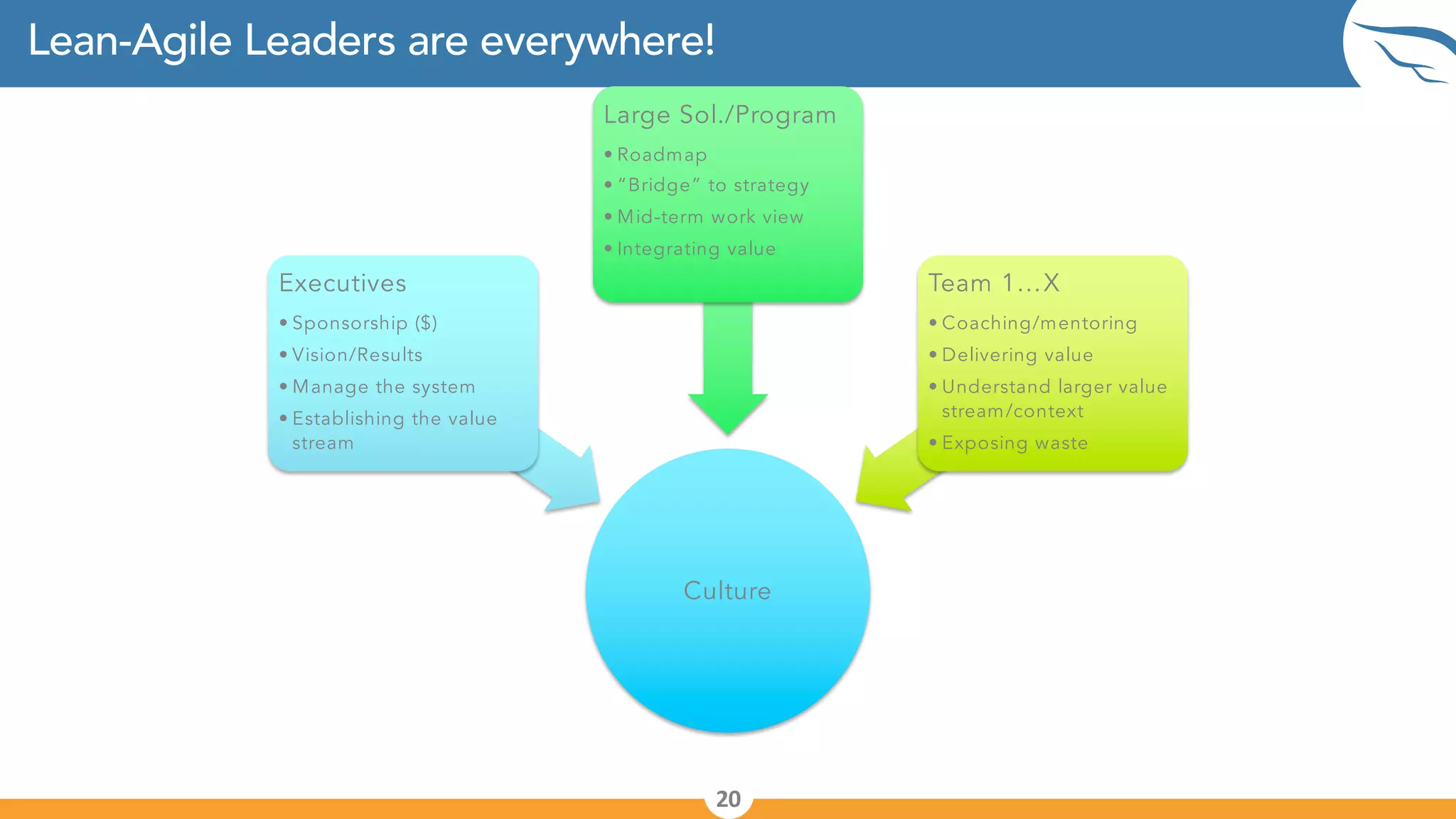
Lean-Agile Leaders are everywhere!
20
Culture
Executives
• Sponsorship ($)
• Vision/Results
• Manage the system
• Establishing the value
stream
Large Sol./Program
• Roadmap
• “Bridge” to strategy
• Mid-term work view
• Integrating value
Team 1…X
• Coaching/mentoring
• Delivering value
• Understand larger value
stream/context
• Exposing waste
What to look for in people opting in to Agile roles
22
• Highly adept at establishing trust
• Developers of people
• Highly collaborative
• Excellent communicators
• Courageous
• Growth mindset – “lifelong learners”
http://www.scaledagileframework.com/lean-agile-leaders
Leadership Culture
What should your
leadership culture be?
23
What type of corporate culture do we have and want?
24
Where would you place your corp. culture? Where do you want it?
25
Consensual
Hierarchical
Top-Down
Egalitarian
HBR, Erin Meyer
What level of trust exists between people in the organization?
26
High TrustLow Trust
Between Teams and Team Members?
High TrustLow Trust
Between those performing work and those asking for work to be done?
1 2 3 4 5 6 7 8 9 10
1 2 3 4 5 6 7 8 9 10
Exercise: Behavioral
Inventory
What are the standard behaviors
within the organization?
27
Discuss: 5 minutes Share: 5 minutes
Developing Your Style
What to do!
28
Exercise: Leadership Style
What characteristics do great leaders
need in your organization? Do you as
a leader exhibit these?
29
Discuss: 5 minutes Share: 5 minutes
Credits
30
Developing your Lean-Agile style
31
First and Foremost!
You need to understand who people are!
Aspirations
Cherished beliefs
Love
Value
Humor
Talents
Shy ßà Intense
Taste in food
Music
Clothes
Communication style
Developing your Lean-Agile style
32
How do you create an environment
where people feel comfortable
expressing themselves?
Intentionally break out of your traditional
corporate (norm-governed) role to
show/model acceptable expression
Developing your Lean-Agile style
33
Social Opening: Create the opportunity
for people to seize that moment and
build on it
Allow an environment where people are
free to cultivate, express, explore, and
appreciate individuality…in productive,
ethical ways
A quote about ethics….something to ponder
34
“Act in such a way that you treat humanity, whether in your own person or in the
person of any other, never merely as a means to an end, but always at the same time as
an end.”
— Immanuel Kant, Grounding for the Metaphysics of Morals
Do we as individuals violate this from time to time?
Are there practices anchored within our corporate culture that violate this?
Developing your Lean-Agile style
35
Do we need to change our behaviors to
exhibit new principles?
…in small ways…
1. Talk with someone you normally
wouldn’t
2. Cook a special meal and share
3. Help out a stranger
4. Send a gift
5. Spend a day learning something new
from someone
…in big ways…
1. “Pick one thing” leadership
challenge
2. Clear everyone’s meeting calendar
for 1 day out of the week
3. Give teams 1 day per quarter to do
whatever they would like to demo
4. Allow people to pick their own teams
Developing your Lean-Agile style
36
Be Awesome
Create opportunity
Inspire people
Opt-in to others efforts:
• In & excited
• Go along
Important things to stop
What NOT to do!
38
Developing your Lean-Agile style
39
Don’t block others opportunity for
expression/contribution
Opt-out of participation
Be fake
Opt-in and resist
Don’t be a jerk
Steal the thunder
Self-promote
Brag
Cheapskate
Preference Dictator
No effort
Stick in the mud
Credit: Riggle…On Being Awesome
Developing your Lean-Agile style
40
Stop
Viewing behavior as ‘good’ or ‘bad’
Talking too much
Responding to people lobbing criticism
Criticizing ideas you don’t like
Winning too much (over-competitive)
Adding too much value
Passing judgment
Making destructive comments
Starting with ‘no’ ‘but’ or ‘however’
Telling people how smart you are
Speaking while angry
Negativity
Withholding information
Failing to give credit
Credit: Goldsmith…what got you here…
Developing your Lean-Agile style
41
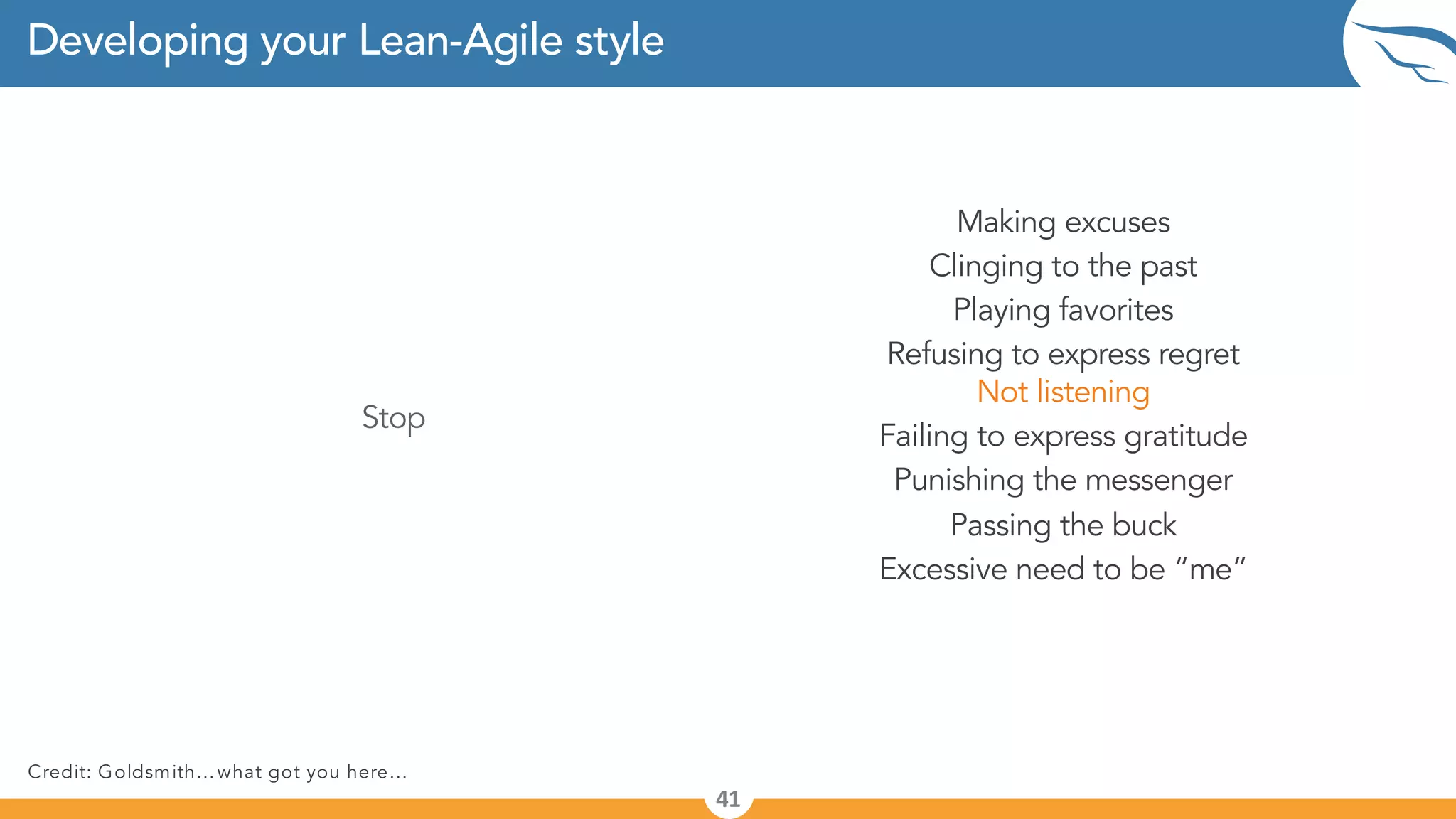
Stop
Making excuses
Clinging to the past
Playing favorites
Refusing to express regret
Not listening
Failing to express gratitude
Punishing the messenger
Passing the buck
Excessive need to be “me”
Credit: Goldsmith…what got you here…
Exercise: Bad Leader Role Play
1. Form teams
2. Select 1 team representative
3. Representative retrieves cards
4. Discuss the topic assigned (3 minutes)
5. Team member exhibits behavior
6. Volunteer guesses behavior
42
5 minutes
Thank you for your time - Time is the most valuable thing we can spend!
Exercise: Leadership Culture
What can you do in your organization
to cultivate a leadership culture?
44
Discuss: 5 minutes Share: 5 minutes
Awesome Culture
45
Launch “Project Awesome” in your organization as a creative community-building effort.
Sample:
• People contribute something inspiring idea connected to the culture of the company.
(Ex., improved work environment, related to corp./project mission/vision or perhaps
corp. sponsored charity)
• People/team vote on what they would like to see most.
• Company ante’s up some pool of funds, crowd-sources funding or provides other
resources to get that something done.
Desired Result: Spark an instant of joy and delight that inspires long term hope for a more
awesome future.

Lean agile leadership

  • 1.
  • 2.
    Agenda 2 • Defining theLean-Agile Leadership problem • Leading Change: A level deeper! • Cultivating a Leadership Culture • Developing your Lean-Agile leadership style
  • 3.
  • 4.
    Leadership Defined 4 lead·er·ship ˈlēdərˌSHip/ noun noun: leadership theaction of leading a group of people or an organization. "different styles of leadership” synonyms: guidance, direction, control, management, superintendence, supervision; More • the state or position of being a leader. "the leadership of the party” synonyms: directorship, governorship, governance, administration, captaincy, control, ascendancy, supremacy, rule, command, power, dominion, influence, “the leadership of the Coalition” • the leaders of an organization, country, etc. plural noun: leaderships "a change of leadership had become desirable"
  • 5.
    Exercise: Define Leadership Haveyou known a great leader? Find a partner and create your definition of “Leadership” 5 Discuss: 5 minutes Share: 5 minutes
  • 6.
    Leading Change 6 A “SAFe”level deeper on Kotter
  • 7.
    What to do 7 1.Start with Kotter’s Leading Change 2. ID the right launch opportunity 3. Cast the right characters 4. Enable people to lead within their context
  • 8.
    #1. Establish asense of urgency 8 1. Transformation 1. Compelling business reason 2. Executive-driven 2. Adoption – we can/need to improve
  • 9.
    #2. Create apowerful guiding coalition 9 o Participants • Key leaders in organization who will champion the agile adoption • Representatives from multiple aspects of the business (cross functional) • Sufficient influence in the organization to drive change – authority to change the system • Passion for Lean Agile and desire to drive change • Skillset: may vary but well organized, good soft skills, good knowledge of their domain • Ideally dedicated but part-time is feasible if consistent o Responsibilities • Own and act on Transformation Backlog • Vision and context for change • Stimulate conversation in organization • Allocate capacity/engage people • Set & communicate goals • Engage broad audience • Address people issues and impediments
  • 10.
    #2. Create apowerful guiding coalition 10 1. Types of guiding coalitions 1. Centralized: Executive committee performs function or leads from the front with an empowered execution group 2. Decentralized: Groups/business units figure out their own path 3. Combo: Centrally managed/funded best practices enablement group with internal “customers”
  • 11.
    #3. Develop theVision and Strategy 11 1. Scenario 1: Business Vision is the Change Vision 2. Scenario 2: Change Vision describing Lean-Agile contributions to the Business Vision • Leader/Sponsor can organize a set of working sessions to develop the vision. • Visioning is an art, not a science! • Needs to be aspirational but provide enough direction to be tangible • Link to people’s sense of purpose!
  • 12.
    #3. Develop theVision and Strategy 12 1. What specific results are we achieving and how are they defined/communicated? 1. OKR – Objectives and Key Results 2. Management By Objectives 2. Put a system in place to evaluate and pivot 1. SAFe cadence (I&A!) or other such review structure for the guiding coalition Objectives and Key Results Example Objective Improve the efficiency of the Biz value stream (concept to cash) by 25% (yearly) Key Results • Decrease wait time between ‘approving’ and ‘starting’ work from 120 days to less than 30 days • Decrease wait time between dev/component test and UAT from 75 days to 30 days • Maintain or improve current defect density profile on a project by project basis
  • 13.
    #4. Communicate theVision (and Strategy) 13 1. Leverage existing change infrastructure/process etc (ADKAR, customized) 2. Establish communication plans and communicate 100x more than you think you need to Group Communications Frequency Agile Lead Workshops, Newsletters, Planning Sessions, As scheduled Monthly As scheduled CIO Common cadence events Quarterly as scheduled Functional Leads Team Events 2-Weeks as sched. Business Execs Common cadence events Quarterly as scheduled Contract Stakeholders Contract Demos Cadence Events Monthly As scheduled
  • 14.
    #5. Empower employeesfor broad-based action 14 From a delivery/product perspective: 1. Value Stream map to establish value-based delivery structures 2. Set up cross-functional teams 3. Employ the SAFe Lean-Agile work management system 4. ‘Feed the system’ with Improvement items (i.e., set aside specific capacity for change!) From a guiding coalition perspective: 1. Use SAFe to roll-out SAFe (or other cadence-based pivot system)
  • 15.
    #6. Generate shortterm wins 15 • Pick the “right” train to launch • Evaluate based on Leader support, Compelling opportunity, Collaborating teams, Clear product/solution • Launch and win! • Organize your set of “customers” into a Roadmap for launches
  • 16.
    #7. Consolidate gainsand produce more wins 16 1. Agile Guiding Coalition captures measures against OKR/achieving Vision 2. Publish per communication/change management system (use PO/PM or Lean Portfolio Management Stakeholder exercise) 3. Inspect and Adapt the Vision/OKR/goals 4. Take advantage of Lean Agile Events to communicate
  • 17.
    #8. Anchor NewApproaches in Culture 17 • SAFe roles and delivery structure provide the baseline system • Figure out creative ways to reinforce changes in activity • Badging system to reinforce the correct actions • Don’t throw people off their path! • How does HR/Career Path get modified to support here? • Launch Communities of Practice
  • 18.
    Thank you, Mr.Kott-aire! 18 ….but what do I do in my role?
  • 19.
    Where do weneed leadership? 19 • Management = Leadership (right?!) CIO VP Ops Ops Manager VP Delivery Program Manager VP Shared Services Release Management Assistant Funded project to “get Agile”– awaiting results Told to “Go Agile” Entrenched in the old ways Managing Agile Project Only gal actually delivering Agile Just waiting for retirement Actually trying to help Optimize CIO Schedule + owns meeting rooms
  • 20.
    Lean-Agile Leaders areeverywhere! 20 Culture Executives • Sponsorship ($) • Vision/Results • Manage the system • Establishing the value stream Large Sol./Program • Roadmap • “Bridge” to strategy • Mid-term work view • Integrating value Team 1…X • Coaching/mentoring • Delivering value • Understand larger value stream/context • Exposing waste
  • 21.
    What to lookfor in people opting in to Agile roles 22 • Highly adept at establishing trust • Developers of people • Highly collaborative • Excellent communicators • Courageous • Growth mindset – “lifelong learners” http://www.scaledagileframework.com/lean-agile-leaders
  • 22.
    Leadership Culture What shouldyour leadership culture be? 23
  • 23.
    What type ofcorporate culture do we have and want? 24
  • 24.
    Where would youplace your corp. culture? Where do you want it? 25 Consensual Hierarchical Top-Down Egalitarian HBR, Erin Meyer
  • 25.
    What level oftrust exists between people in the organization? 26 High TrustLow Trust Between Teams and Team Members? High TrustLow Trust Between those performing work and those asking for work to be done? 1 2 3 4 5 6 7 8 9 10 1 2 3 4 5 6 7 8 9 10
  • 26.
    Exercise: Behavioral Inventory What arethe standard behaviors within the organization? 27 Discuss: 5 minutes Share: 5 minutes
  • 27.
  • 28.
    Exercise: Leadership Style Whatcharacteristics do great leaders need in your organization? Do you as a leader exhibit these? 29 Discuss: 5 minutes Share: 5 minutes
  • 29.
  • 30.
    Developing your Lean-Agilestyle 31 First and Foremost! You need to understand who people are! Aspirations Cherished beliefs Love Value Humor Talents Shy ßà Intense Taste in food Music Clothes Communication style
  • 31.
    Developing your Lean-Agilestyle 32 How do you create an environment where people feel comfortable expressing themselves? Intentionally break out of your traditional corporate (norm-governed) role to show/model acceptable expression
  • 32.
    Developing your Lean-Agilestyle 33 Social Opening: Create the opportunity for people to seize that moment and build on it Allow an environment where people are free to cultivate, express, explore, and appreciate individuality…in productive, ethical ways
  • 33.
    A quote aboutethics….something to ponder 34 “Act in such a way that you treat humanity, whether in your own person or in the person of any other, never merely as a means to an end, but always at the same time as an end.” — Immanuel Kant, Grounding for the Metaphysics of Morals Do we as individuals violate this from time to time? Are there practices anchored within our corporate culture that violate this?
  • 34.
    Developing your Lean-Agilestyle 35 Do we need to change our behaviors to exhibit new principles? …in small ways… 1. Talk with someone you normally wouldn’t 2. Cook a special meal and share 3. Help out a stranger 4. Send a gift 5. Spend a day learning something new from someone …in big ways… 1. “Pick one thing” leadership challenge 2. Clear everyone’s meeting calendar for 1 day out of the week 3. Give teams 1 day per quarter to do whatever they would like to demo 4. Allow people to pick their own teams
  • 35.
    Developing your Lean-Agilestyle 36 Be Awesome Create opportunity Inspire people Opt-in to others efforts: • In & excited • Go along
  • 36.
    Important things tostop What NOT to do! 38
  • 37.
    Developing your Lean-Agilestyle 39 Don’t block others opportunity for expression/contribution Opt-out of participation Be fake Opt-in and resist Don’t be a jerk Steal the thunder Self-promote Brag Cheapskate Preference Dictator No effort Stick in the mud Credit: Riggle…On Being Awesome
  • 38.
    Developing your Lean-Agilestyle 40 Stop Viewing behavior as ‘good’ or ‘bad’ Talking too much Responding to people lobbing criticism Criticizing ideas you don’t like Winning too much (over-competitive) Adding too much value Passing judgment Making destructive comments Starting with ‘no’ ‘but’ or ‘however’ Telling people how smart you are Speaking while angry Negativity Withholding information Failing to give credit Credit: Goldsmith…what got you here…
  • 39.
    Developing your Lean-Agilestyle 41 Stop Making excuses Clinging to the past Playing favorites Refusing to express regret Not listening Failing to express gratitude Punishing the messenger Passing the buck Excessive need to be “me” Credit: Goldsmith…what got you here…
  • 40.
    Exercise: Bad LeaderRole Play 1. Form teams 2. Select 1 team representative 3. Representative retrieves cards 4. Discuss the topic assigned (3 minutes) 5. Team member exhibits behavior 6. Volunteer guesses behavior 42 5 minutes
  • 41.
    Thank you foryour time - Time is the most valuable thing we can spend!
  • 42.
    Exercise: Leadership Culture Whatcan you do in your organization to cultivate a leadership culture? 44 Discuss: 5 minutes Share: 5 minutes
  • 43.
    Awesome Culture 45 Launch “ProjectAwesome” in your organization as a creative community-building effort. Sample: • People contribute something inspiring idea connected to the culture of the company. (Ex., improved work environment, related to corp./project mission/vision or perhaps corp. sponsored charity) • People/team vote on what they would like to see most. • Company ante’s up some pool of funds, crowd-sources funding or provides other resources to get that something done. Desired Result: Spark an instant of joy and delight that inspires long term hope for a more awesome future.