Real Time Strategic Change
Learning Series
Session II
March 23, 2009
Conference Call Dial In Number
• 1-800-511-7985  
• Access code and pin: 241230-1265
• Where are you today?
• How was your weekend?
Who is Here?
• First and last name
• Where are you today?
• How was your weekend?
Series Purpose
To learn how to make the
future happen faster in all of
your change work.
Series Outcomes
• Understand and be able to apply the six RTSC
principles to accelerate all of your change
work
• Know the best ways, best times, and best
people to include in your change work to
achieve the best results
• Understand how to identify key leverage
points to accelerate your change work
• Gain insights that you can act on right away
• Know ways that you can support or sabotage
your efforts
Session II Purpose
To be able to accelerate all of your
change work
Agenda
•  Welcome/Introductions
•  History and Evolution of RTSC Principles
•  Why Work From Principles
•  How to Work From Principles
•  Case Study: Applying the RTSC Principles
•  Insights and Questions
•  Pulse Check
Session II Outcomes
• Become familiar with each of the Principles,
what they help you achieve, and how to apply
them
• Gain a deeper understanding of the Principles
by appreciating their history and evolution
• See how the Principles apply in change work
and daily work
• Be able to apply the principles in your own
practice
How We’ll Work Together Today
•  Presentations with questions throughout
•  “Raise hand” in room for comments and questions
•  Use “Table Talk and Ideas box to collect questions /
insights as we go
•  Breakout sessions with facilitators, pre-determined
“max mix” groups, and separate dial in numbers
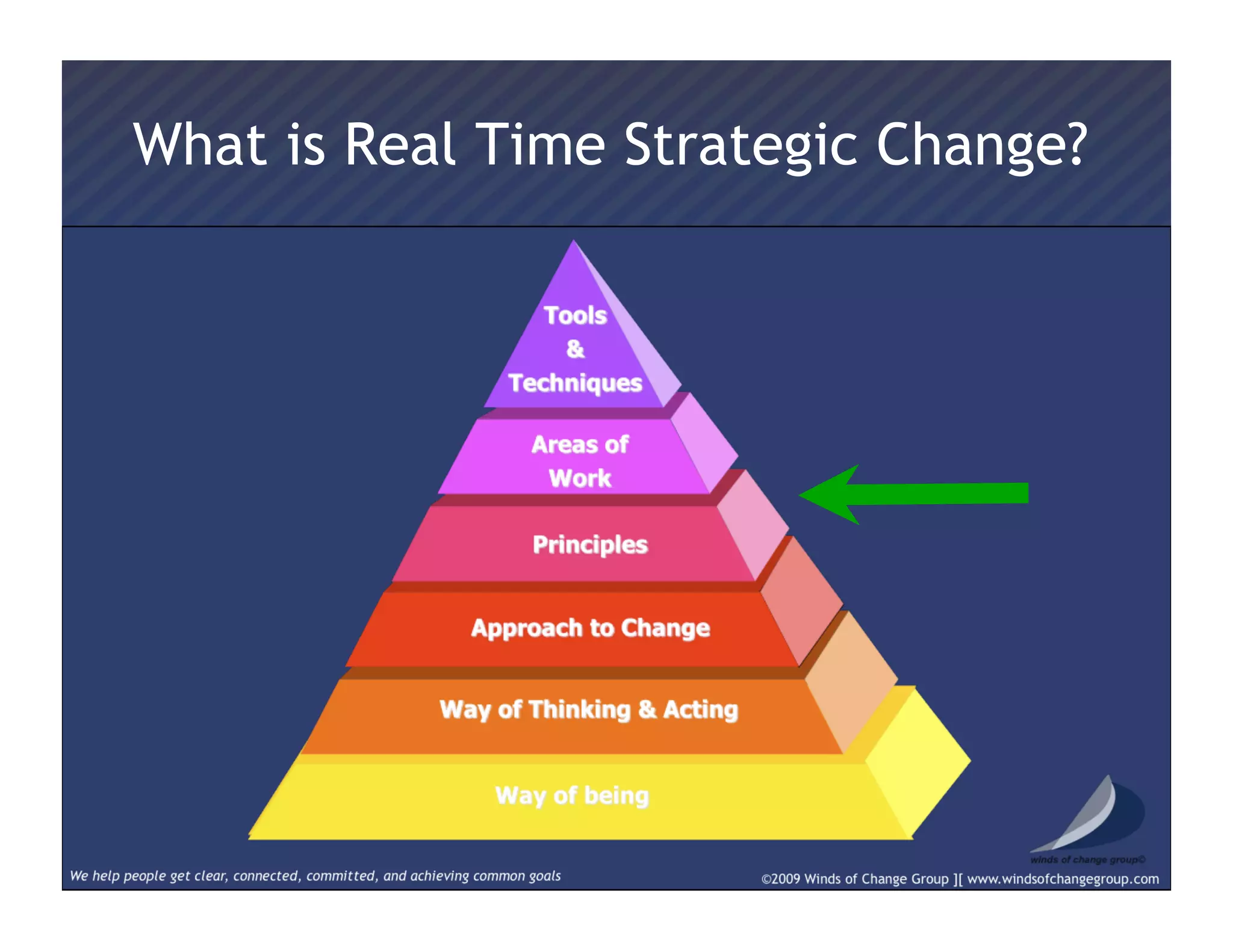
What is Real Time Strategic Change?
History and Evolution of the
RTSC Principles
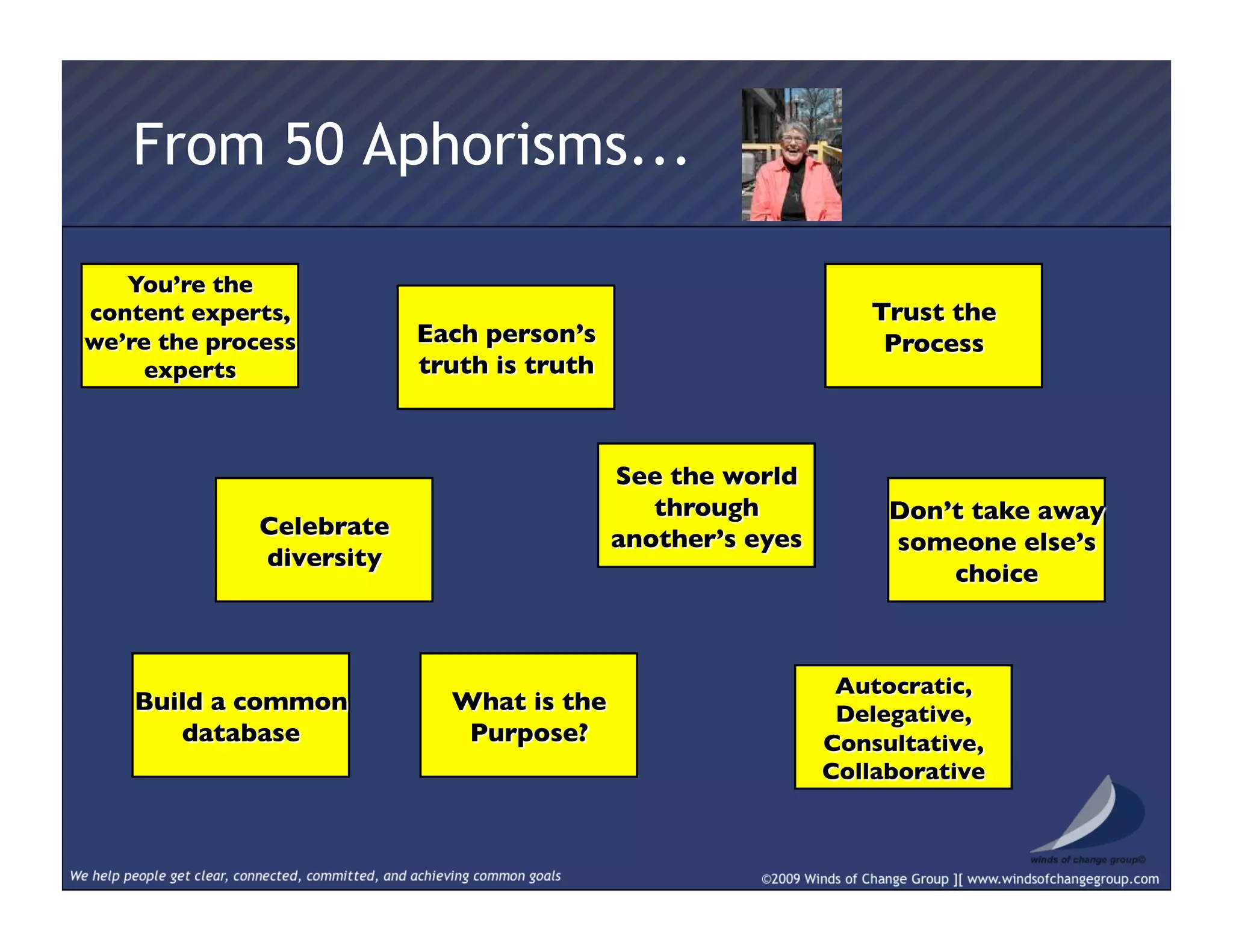
From 50 Aphorisms...
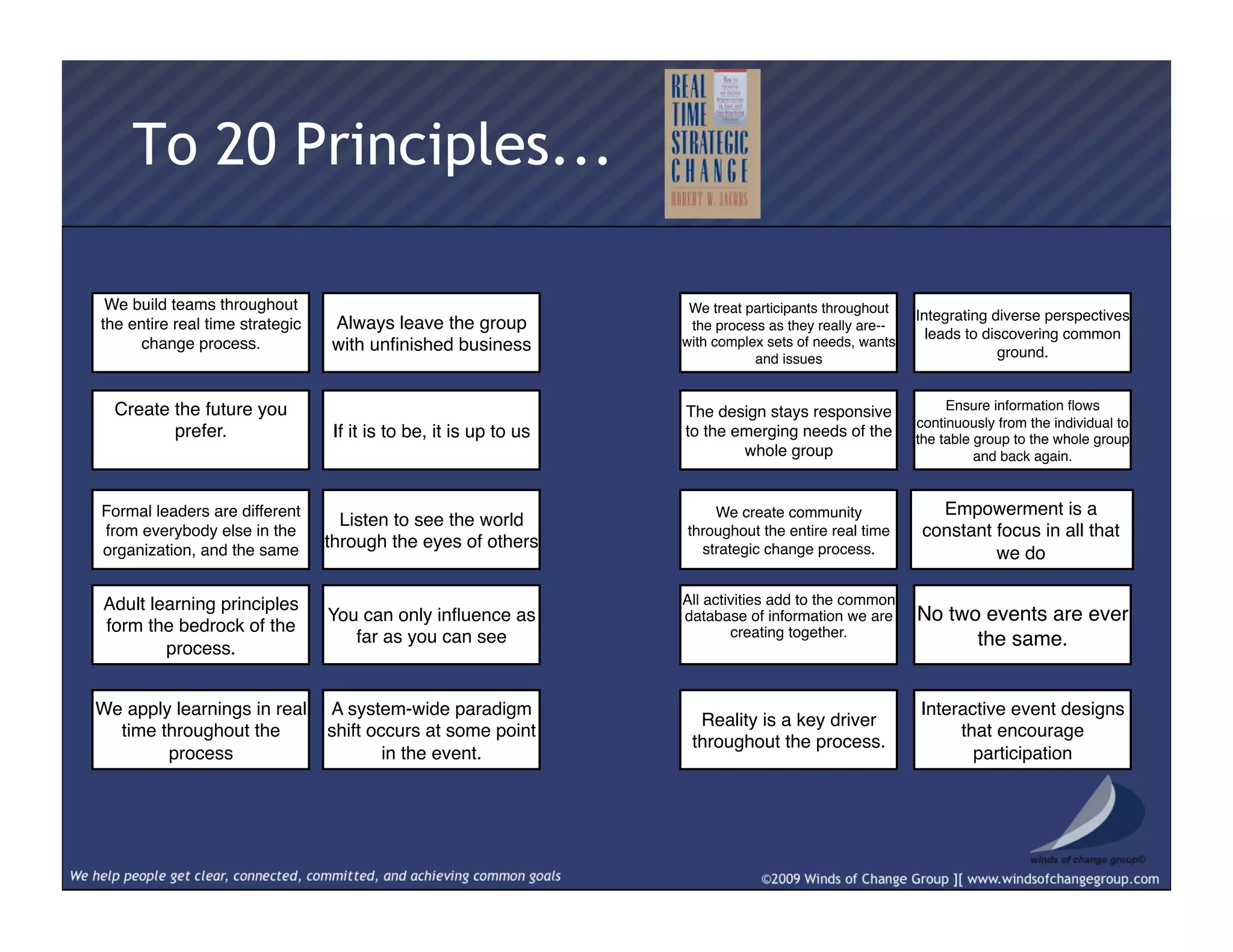
To 20 Principles...
Always leave the group
with unfinished business"
If it is to be, it is up to us"
We apply learnings in real
time throughout the
process"
Listen to see the world
through the eyes of others"
Formal leaders are different
from everybody else in the
organization, and the same"
You can only influence as
far as you can see"
We create community
throughout the entire real time
strategic change process."
A system-wide paradigm
shift occurs at some point
in the event."
We treat participants throughout
the process as they really are--
with complex sets of needs, wants
and issues"
The design stays responsive
to the emerging needs of the
whole group"
Reality is a key driver
throughout the process."
Adult learning principles
form the bedrock of the
process."
Integrating diverse perspectives
leads to discovering common
ground."
Interactive event designs
that encourage
participation"
Ensure information flows
continuously from the individual to
the table group to the whole group
and back again."
No two events are ever
the same."
Empowerment is a
constant focus in all that
we do"
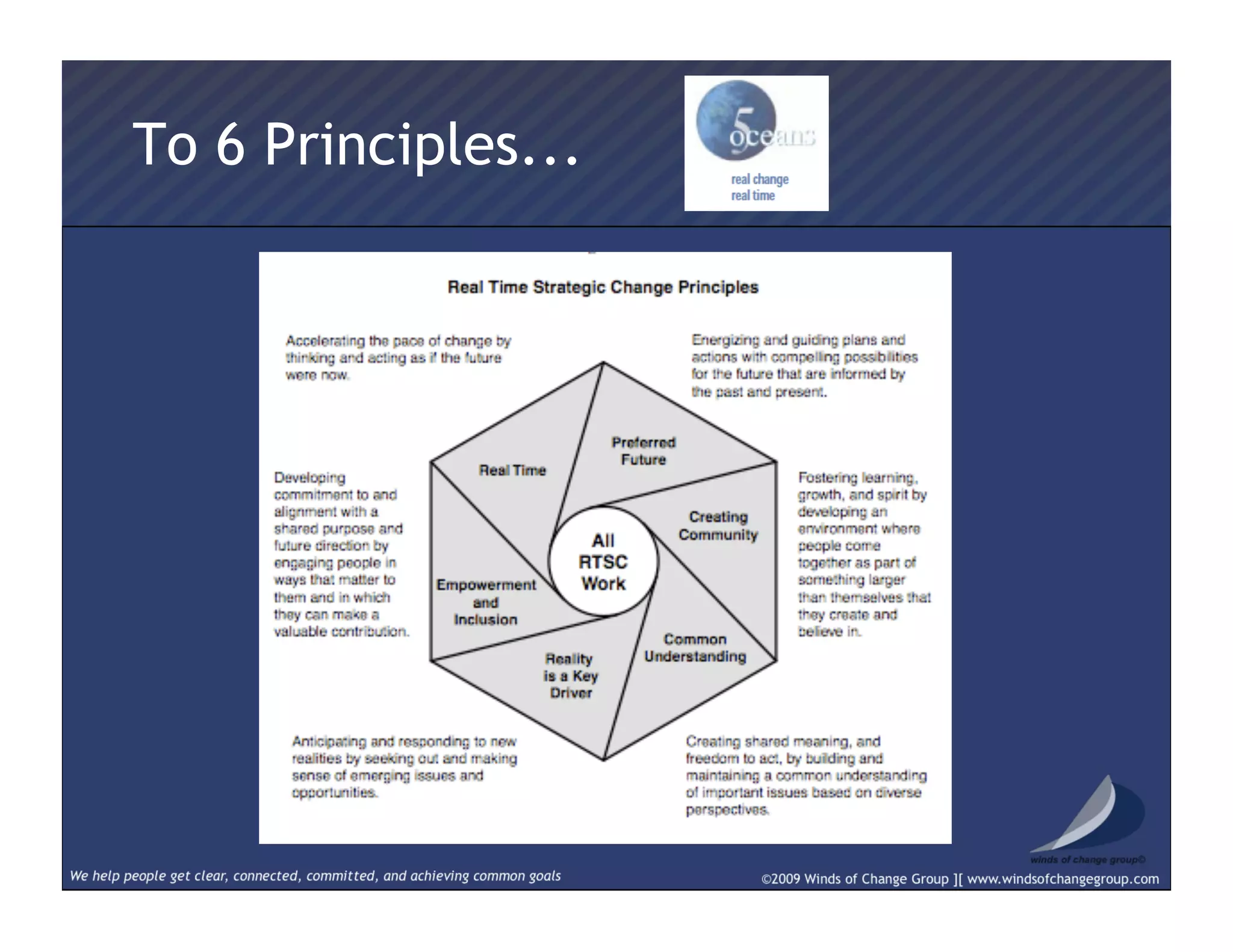
To 6 Principles...
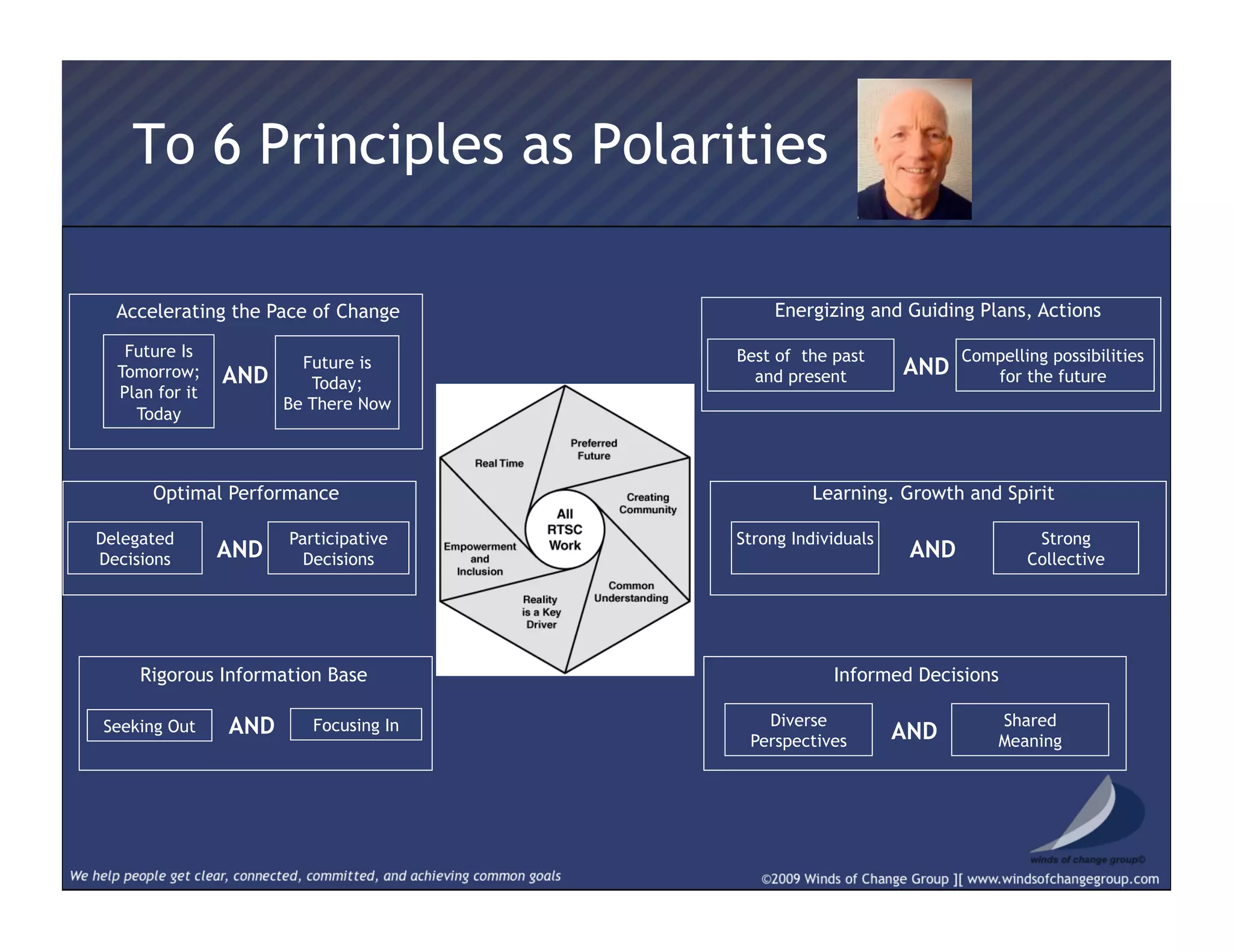
To 6 Principles as Polarities
Energizing and Guiding Plans, Actions
Best of the past
and present AND
Compelling possibilities
for the future
Learning. Growth and Spirit
Strong Individuals
AND
Strong
Collective
Informed Decisions
Diverse
Perspectives AND
Shared
Meaning
Rigorous Information Base
Seeking Out AND Focusing In
Optimal Performance
Delegated
Decisions AND
Participative
Decisions
Accelerating the Pace of Change
Future Is
Tomorrow;
Plan for it
Today
AND
Future is
Today;
Be There Now
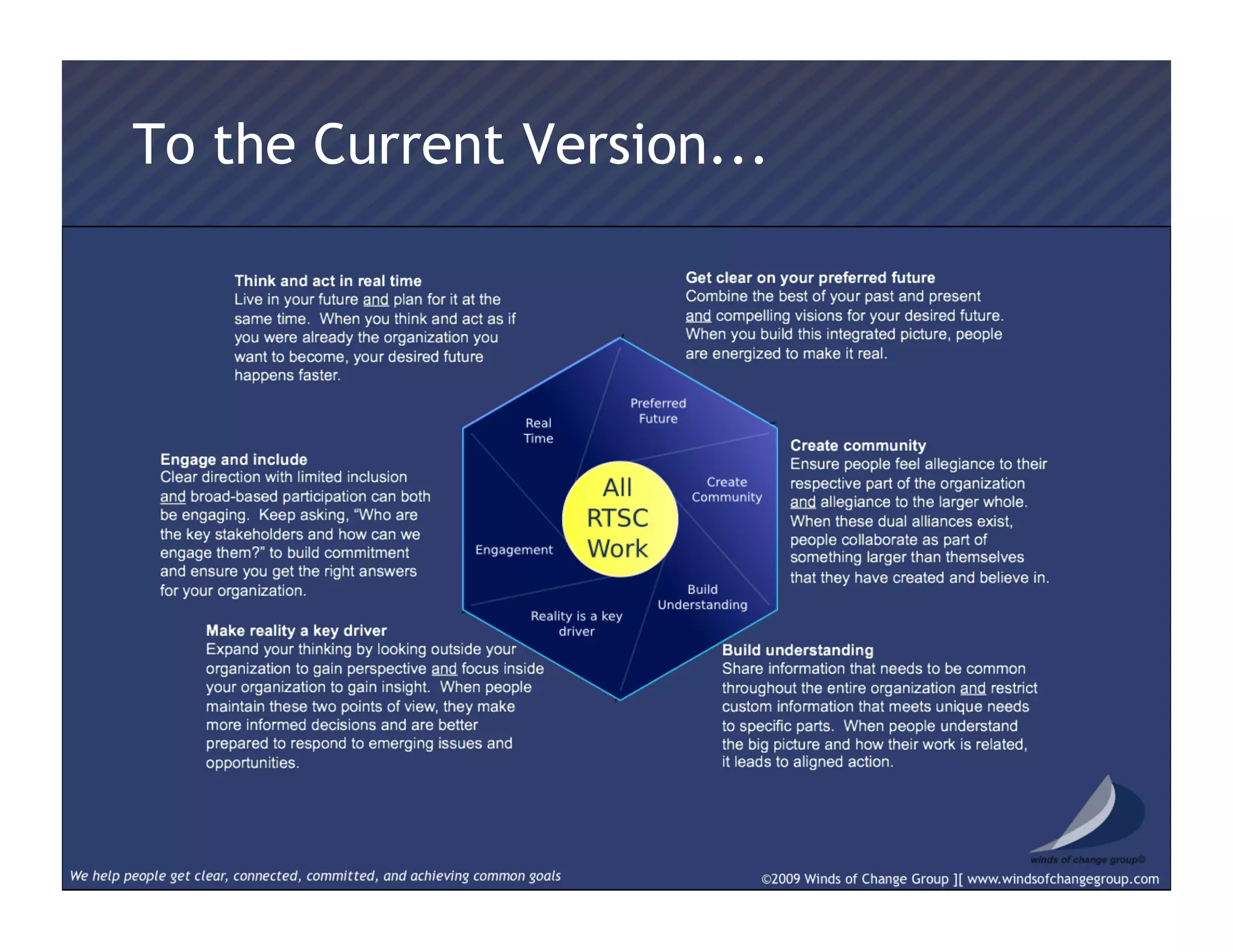
To the Current Version...
Why Work From Principles"
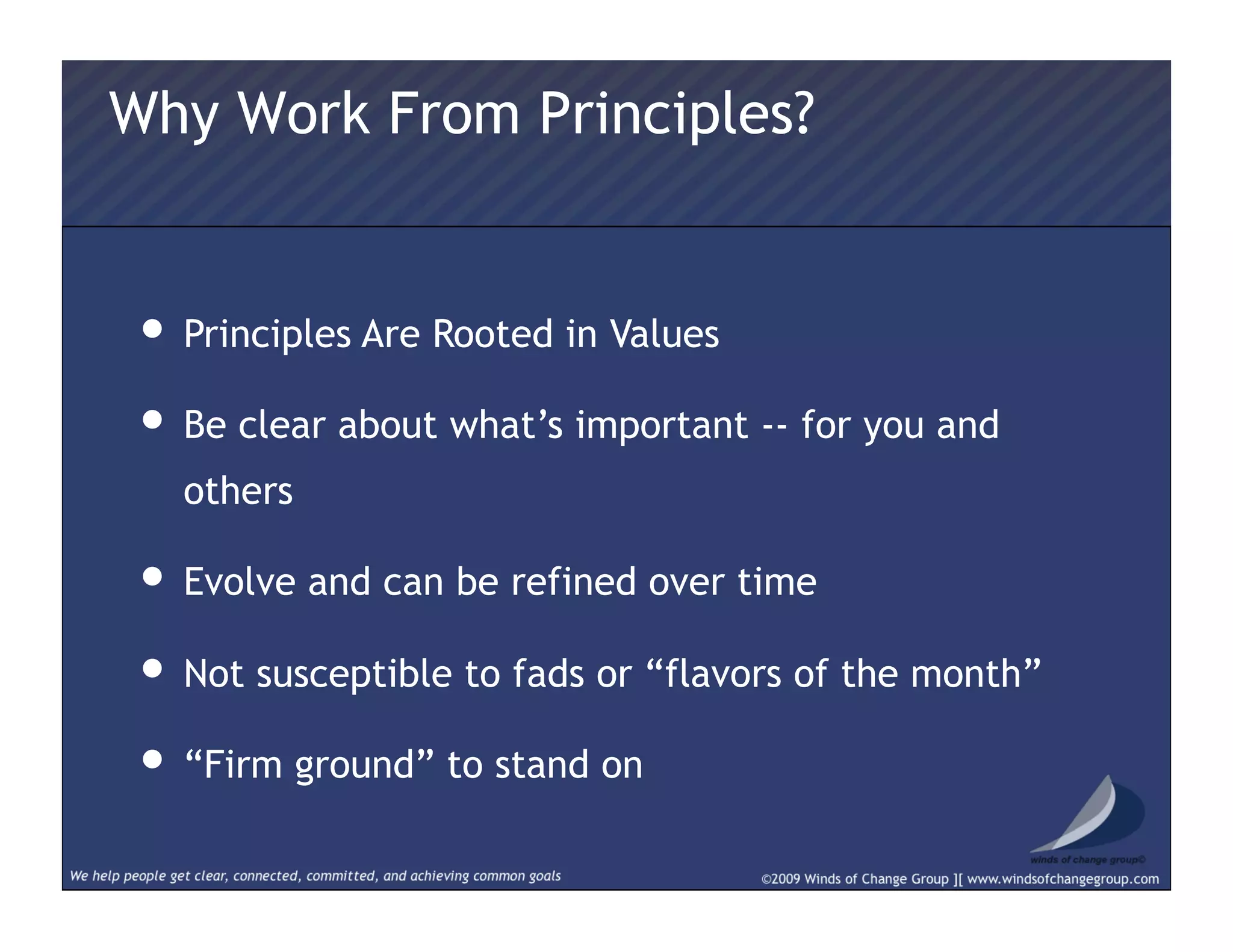
Why Work From Principles?
• Principles Are Rooted in Values
• Be clear about what’s important -- for you and
others
• Evolve and can be refined over time
• Not susceptible to fads or “flavors of the month”
• “Firm ground” to stand on
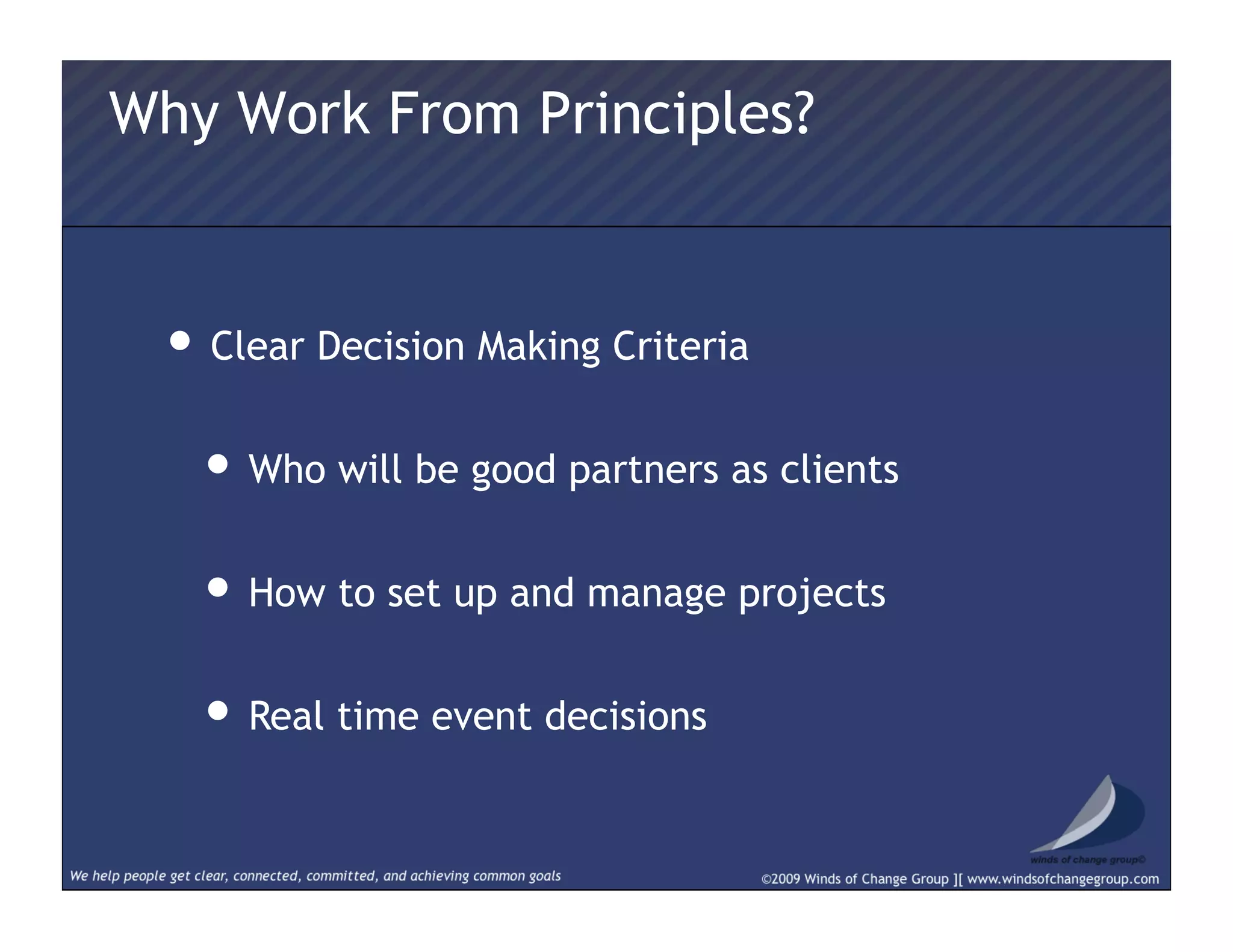
Why Work From Principles?
• Clear Decision Making Criteria
• Who will be good partners as clients
• How to set up and manage projects
• Real time event decisions
Why Work From Principles?
• Fixed Principles --------> Flexible application
• Opportunities for innovation
• “Open Platform”
Why Work From Principles?
• Applicable in any situation
• Individual
• Small Group
• Large Group
• Division
• Business Unit
• Enterprise
How To Work From Principles
How to Work From Principles
• Use as lens to see all work
• Contracting
• Scoping / Project Planning
• Data Gathering
• Planning / Designing
• Implementation
Design From One Principle Breakout
• Purposes
• To develop a deeper understanding and
appreciation of one of the six RTSC
Principles
• To become more comfortable and confident
in applying one of the six RTSC Principles
• Process
• Groups, Dial In Numbers Assigned in “Main Room”
• 10 minute Facilitator-led conversations in
“Breakouts”
• Notes taken by facilitators in their group’s chat box
onscreen
• Breakout Group Reports by Facilitators
Design From One Principle Breakout
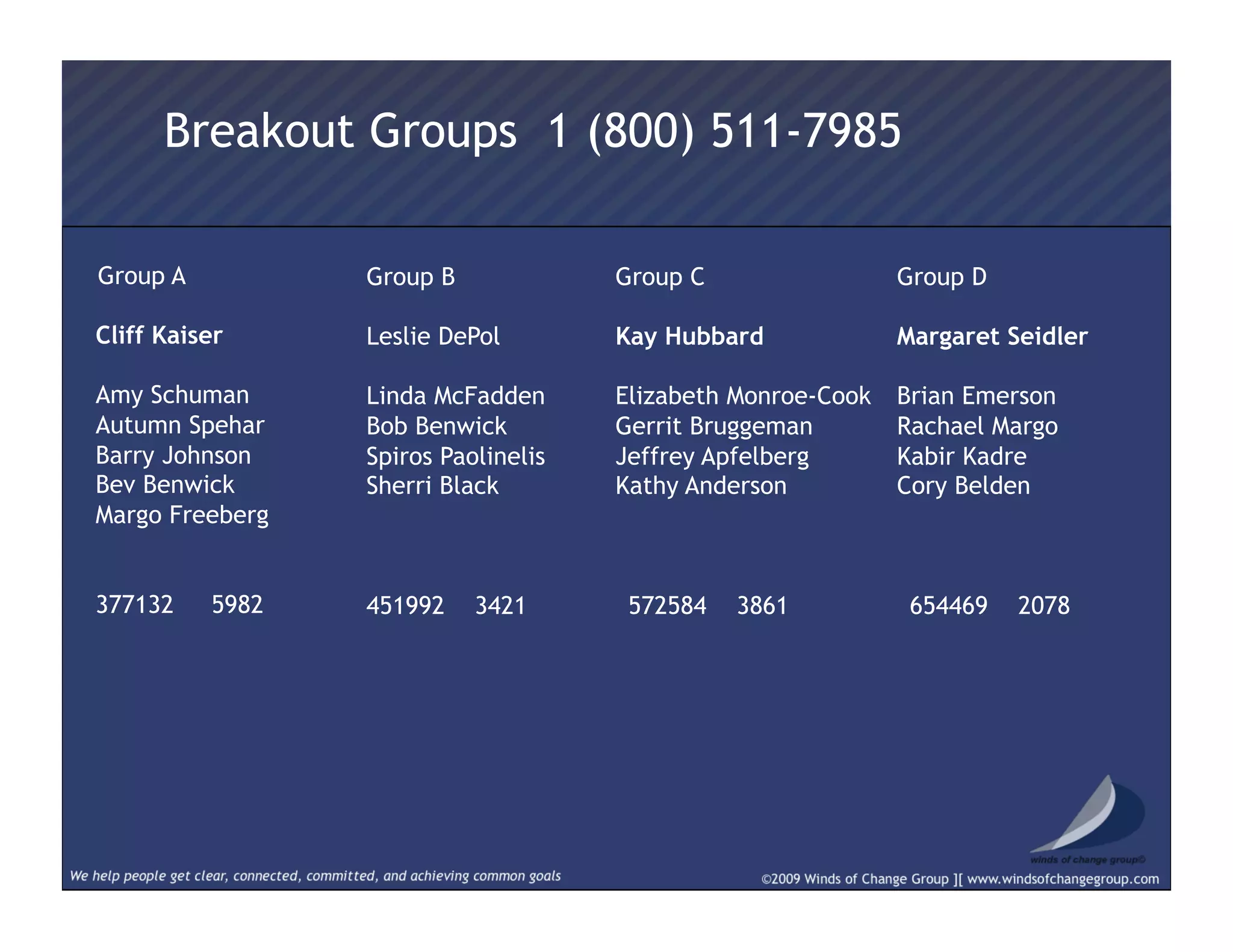
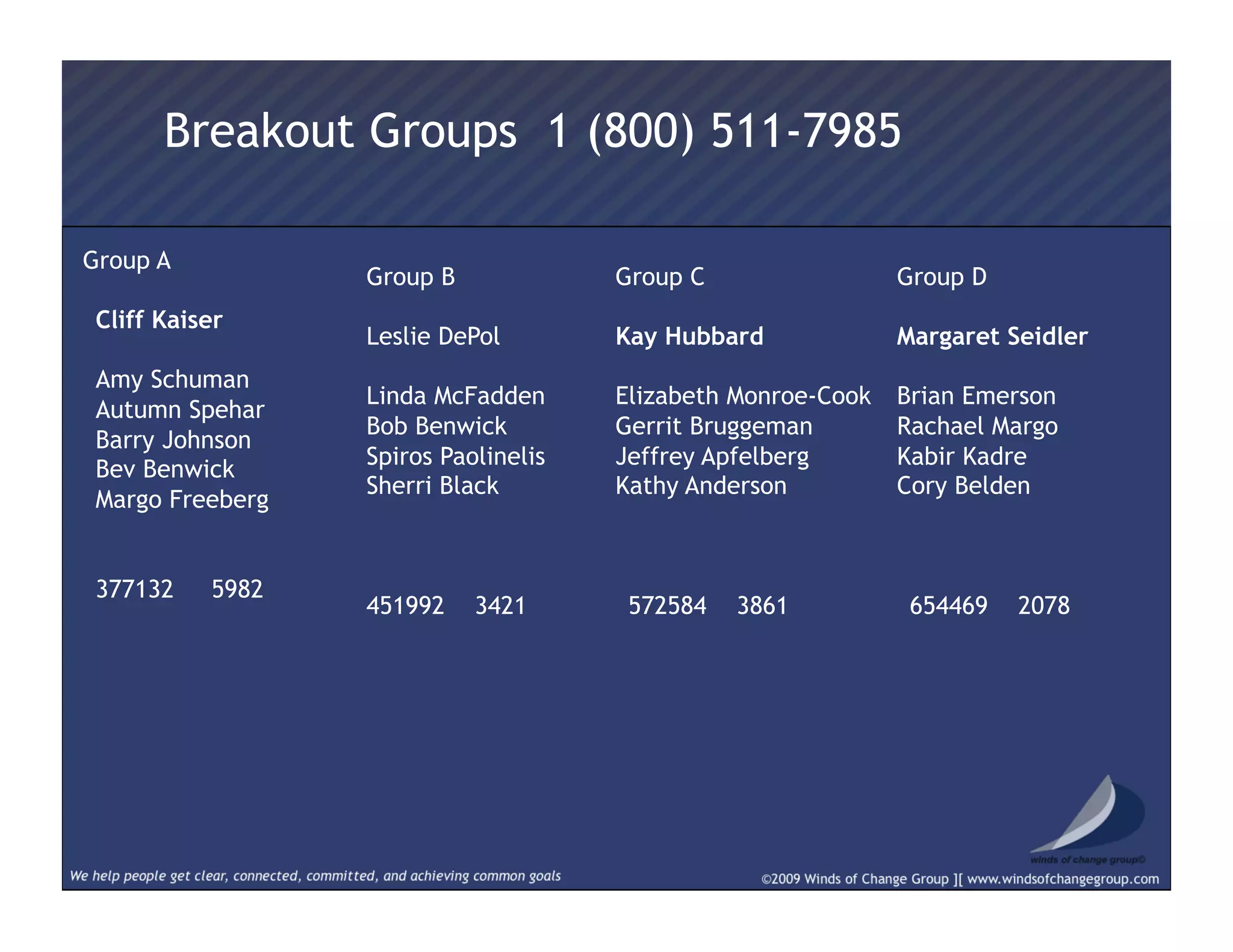
Group A
 Cliff Kaiser
 Amy Schuman
 Autumn Spehar
 Barry Johnson
 Bev Benwick
 Margo Freeberg
 377132 5982
Breakout Groups 1 (800) 511-7985
Group B
Leslie DePol
Linda McFadden
Bob Benwick
Spiros Paolinelis
Sherri Black
451992 3421
Group C
Kay Hubbard
Elizabeth Monroe-Cook
Gerrit Bruggeman
Jeffrey Apfelberg
Kathy Anderson
 572584 3861
Group D
Margaret Seidler
Brian Emerson
Rachael Margo
Kabir Kadre
Cory Belden
 654469 2078
• Situation
• 3 hour meeting
• 40 people
• Two-year-old conflict about governance of
organization
• Met once for two hours previously; agreement to
design a process to resolve the conflict
Design From One Principle Breakout
• Looking ONLY through the lens of your
principle...
• What questions do you have that would
help you plan for this three hour meeting?
• What actions would you take?
Design From One Principle Breakout
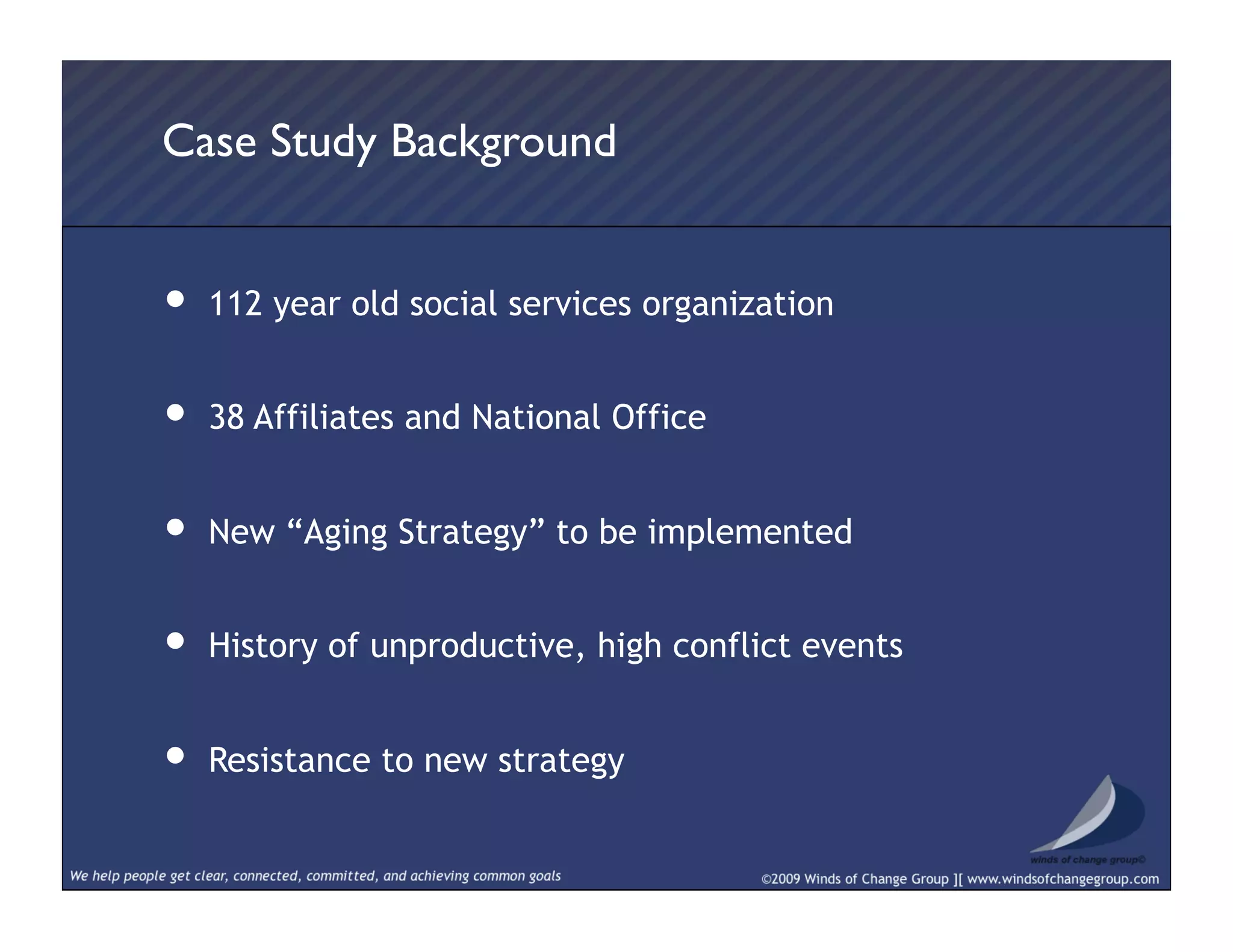
•  112 year old social services organization
•  38 Affiliates and National Office
•  New “Aging Strategy” to be implemented
•  History of unproductive, high conflict events
•  Resistance to new strategy
Case Study Background
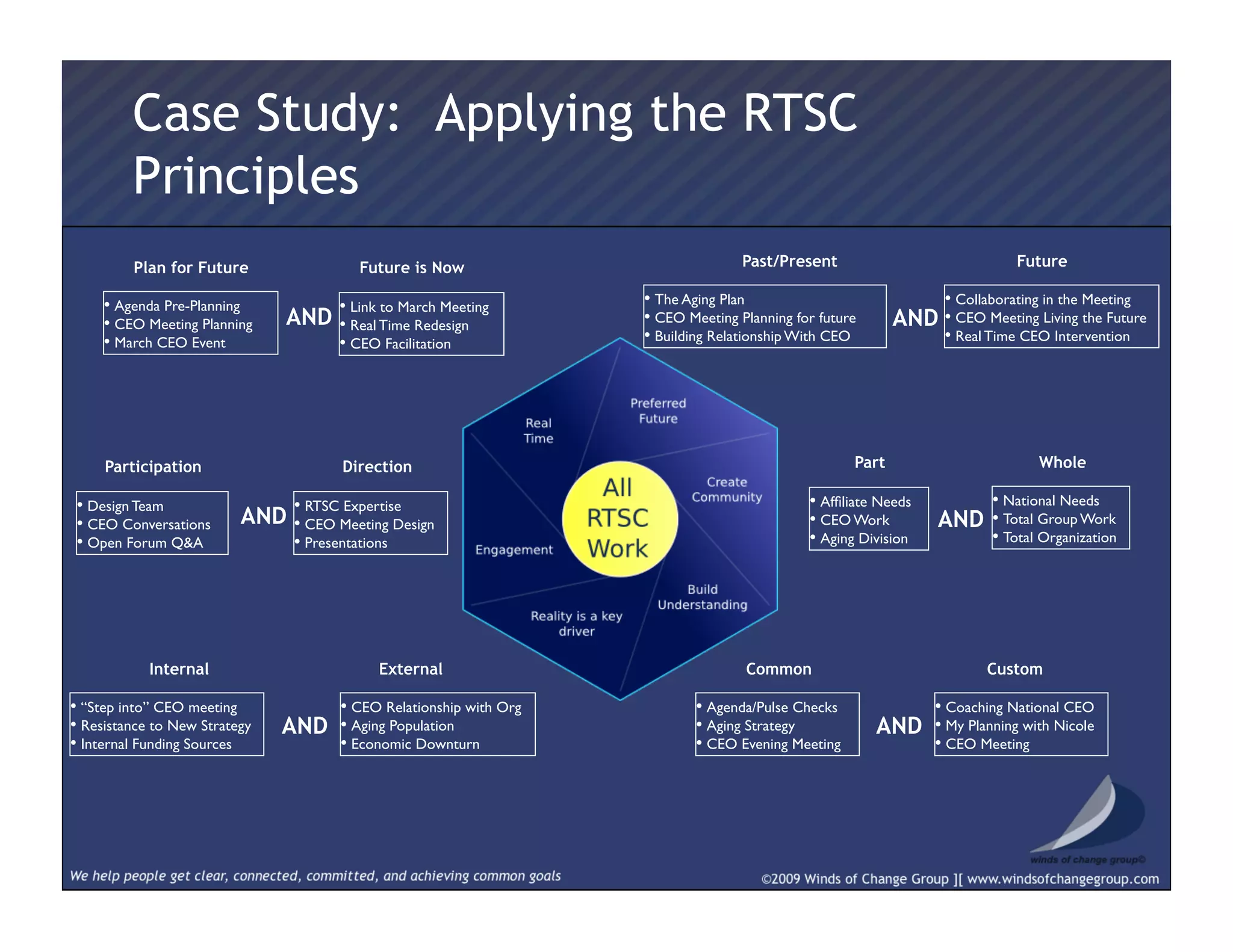
Case Study: Applying the RTSC
Principles
• Agenda Pre-Planning	

• CEO Meeting Planning	

• March CEO Event	

AND
• Link to March Meeting 	

• Real Time Redesign	

• CEO Facilitation	

Plan for Future Future is Now
• Design Team	

• CEO Conversations	

• Open Forum Q&A	

AND
• RTSC Expertise	

• CEO Meeting Design	

• Presentations	

Participation Direction
• “Step into” CEO meeting	

• Resistance to New Strategy	

• Internal Funding Sources	

AND
• CEO Relationship with Org	

• Aging Population	

• Economic Downturn	

Internal External
• Agenda/Pulse Checks	

• Aging Strategy	

• CEO Evening Meeting	

AND
• Coaching National CEO	

• My Planning with Nicole	

• CEO Meeting	

Common Custom
• The Aging Plan	

• CEO Meeting Planning for future	

• Building Relationship With CEO	

AND
• Collaborating in the Meeting	

• CEO Meeting Living the Future	

• Real Time CEO Intervention 	

Past/Present Future
• Affiliate Needs	

• CEO Work	

• Aging Division	

AND
• National Needs	

• Total Group Work	

• Total Organization	

Part Whole
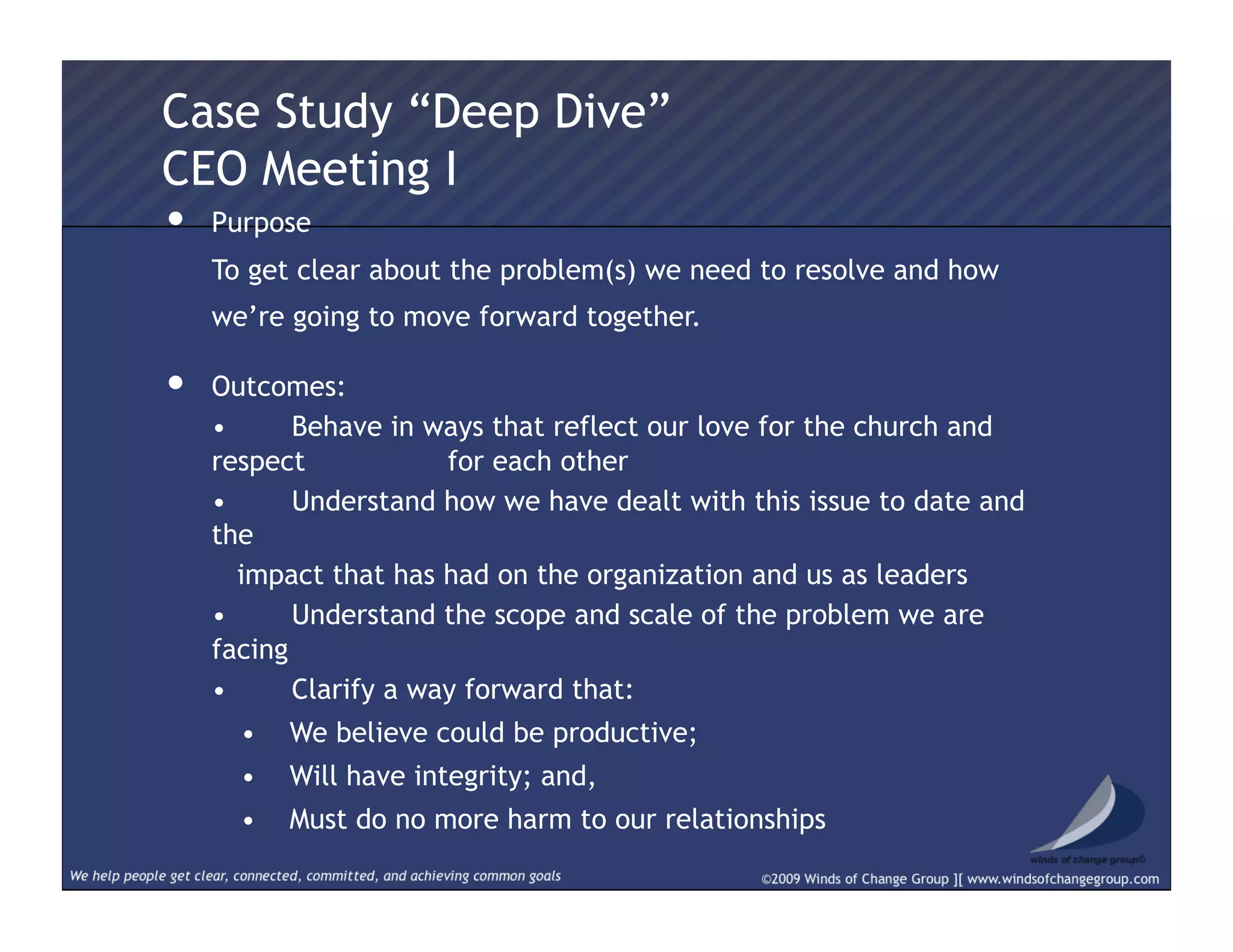
•  Purpose
  To get clear about the problem(s) we need to resolve and how
we’re going to move forward together.
•  Outcomes:
  • Behave in ways that reflect our love for the church and
respect for each other
  • Understand how we have dealt with this issue to date and
the
  impact that has had on the organization and us as leaders
  • Understand the scope and scale of the problem we are
facing
  • Clarify a way forward that:
•  We believe could be productive;
•  Will have integrity; and,
•  Must do no more harm to our relationships
Case Study “Deep Dive”
CEO Meeting I
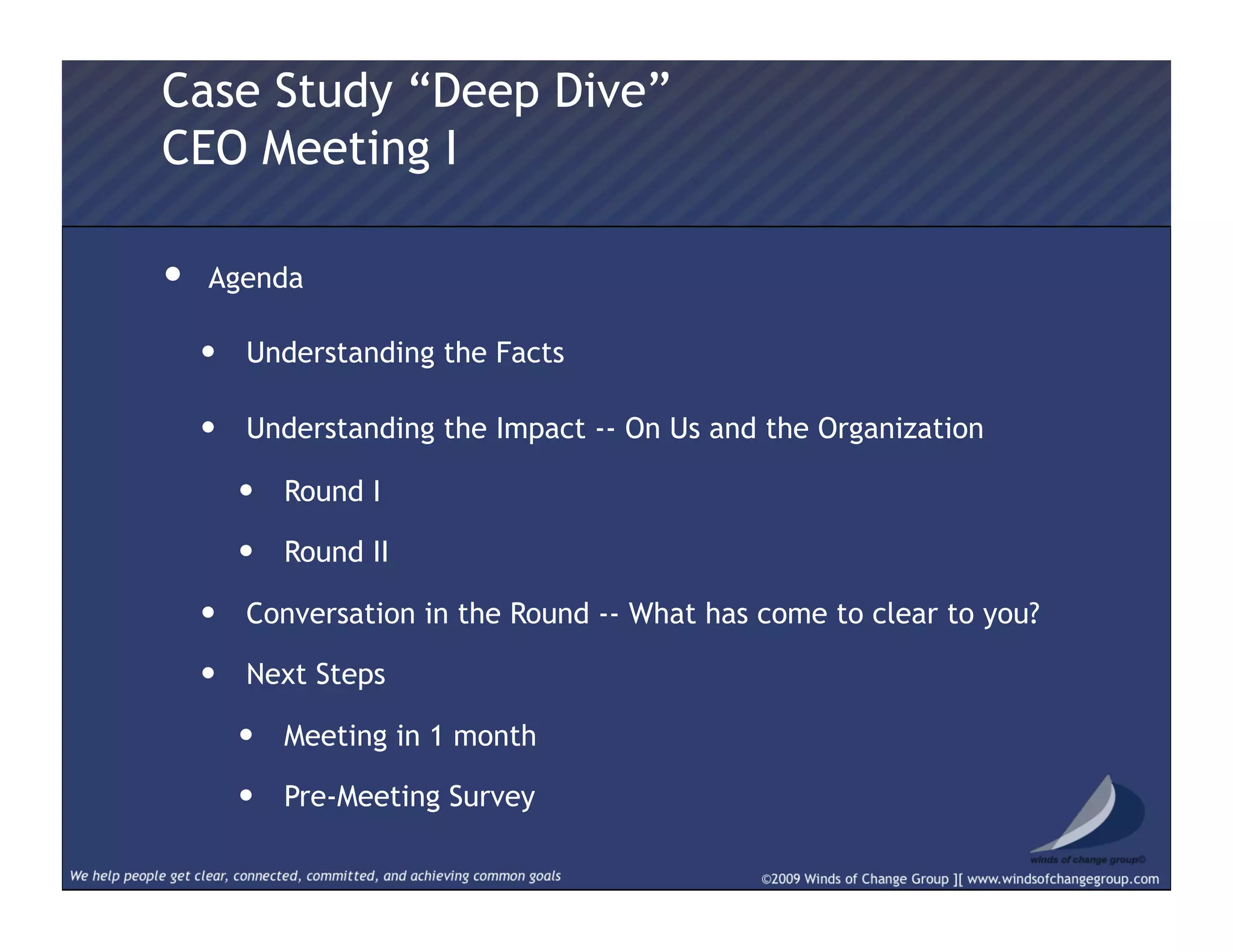
•  Agenda
•  Understanding the Facts
•  Understanding the Impact -- On Us and the Organization
•  Round I
•  Round II
•  Conversation in the Round -- What has come to clear to you?
•  Next Steps
•  Meeting in 1 month
•  Pre-Meeting Survey
Case Study “Deep Dive”
CEO Meeting I
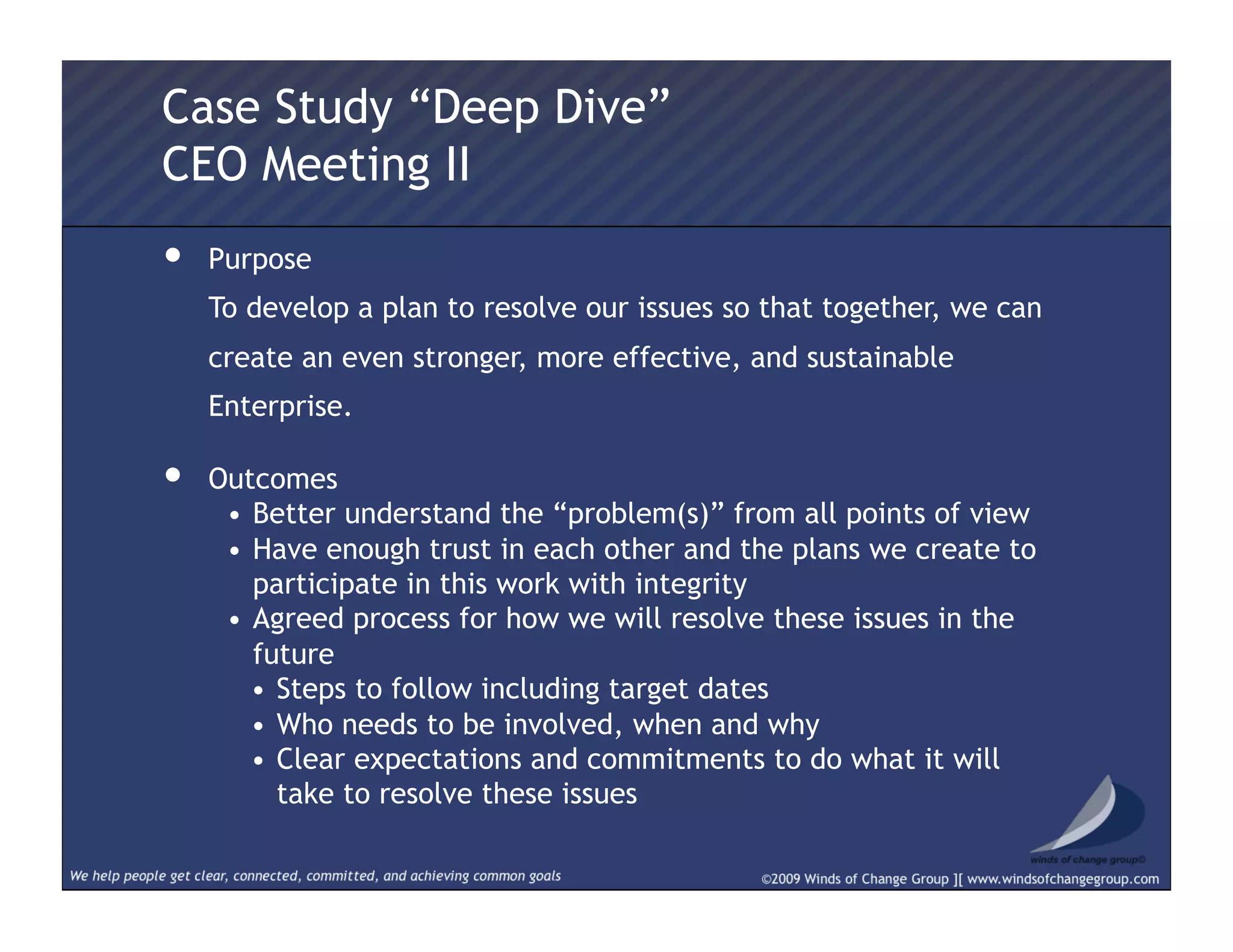
•  Purpose
  To develop a plan to resolve our issues so that together, we can
create an even stronger, more effective, and sustainable
Enterprise.
•  Outcomes
•  Better understand the “problem(s)” from all points of view
•  Have enough trust in each other and the plans we create to
participate in this work with integrity
•  Agreed process for how we will resolve these issues in the
future
•  Steps to follow including target dates
•  Who needs to be involved, when and why
•  Clear expectations and commitments to do what it will
take to resolve these issues
Case Study “Deep Dive”
CEO Meeting II
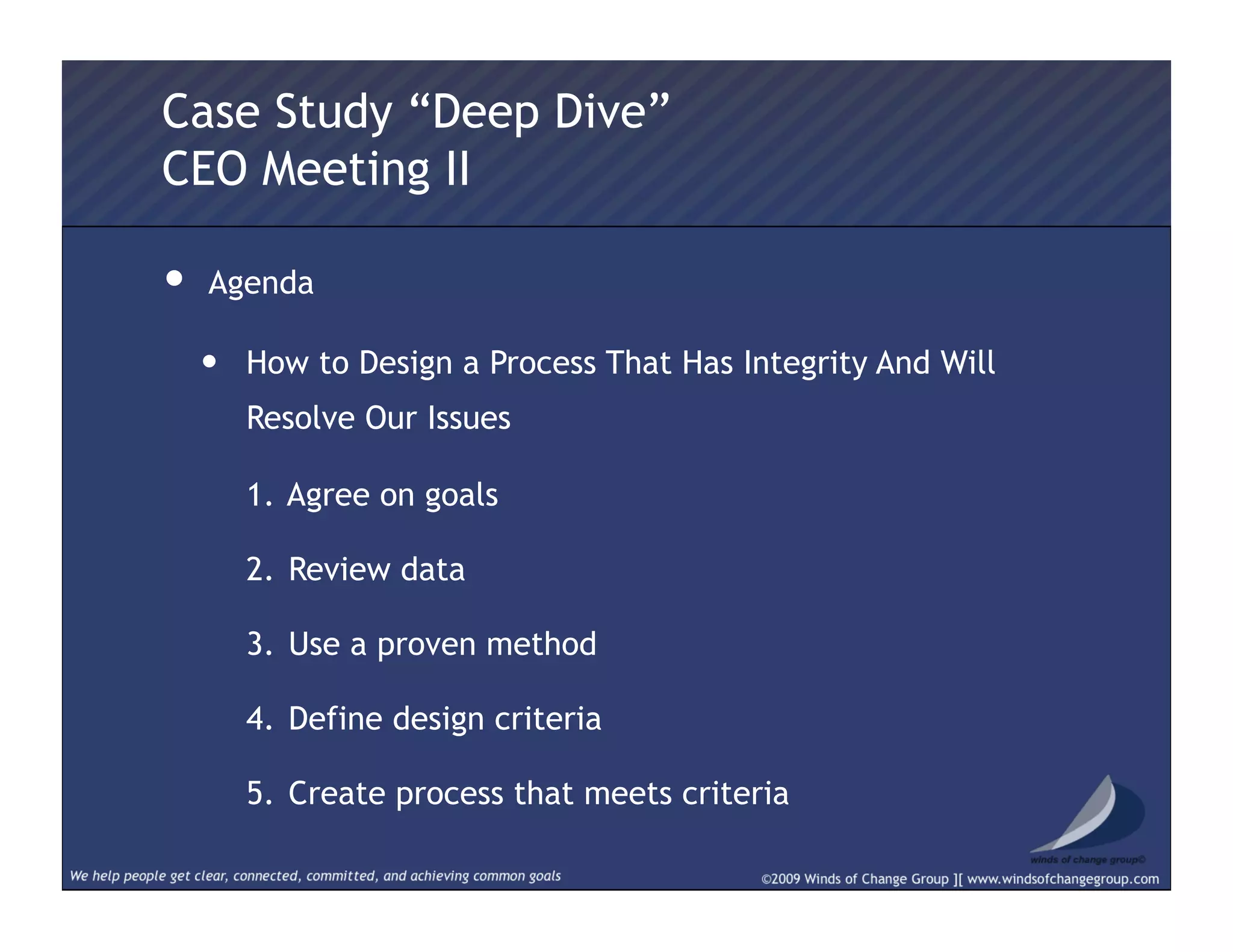
•  Agenda
•  How to Design a Process That Has Integrity And Will
Resolve Our Issues
  1. Agree on goals
  2. Review data
  3. Use a proven method
  4. Define design criteria
  5. Create process that meets criteria
Case Study “Deep Dive”
CEO Meeting II
• Agreement to design process
• Cross-Section Team Working with Consultant
• Process to be Reviewed within 3 Weeks
• Assessed Against Design Criteria
Case Study “Deep Dive” Status
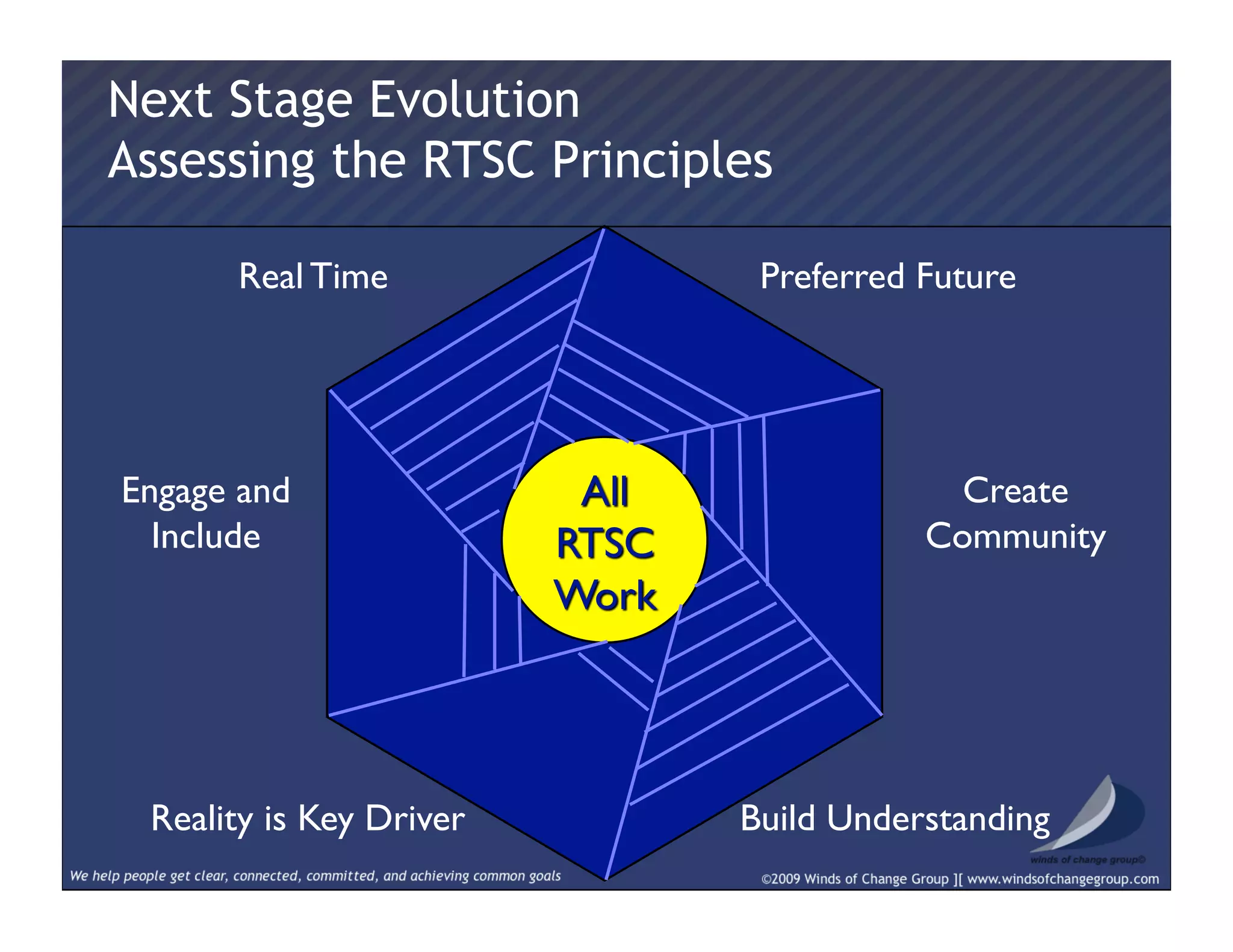
Next Stage Evolution
Assessing the RTSC Principles
Preferred Future	

Real Time	

Engage and
Include	

Reality is Key Driver	

 Build Understanding	

Create
Community
Insights and Questions Breakout
• Purpose
• To consolidate and expand learnings from
the session
• Process
• Groups, Dial In Numbers Assigned in “Main Room”
• 10 minute Facilitator-led conversations in
“Breakouts”
• Notes taken by facilitators in their group’s chat
box onscreen
• Breakout Group Reports by Facilitators
Insights and Questions Breakout
Group A
 Cliff Kaiser
 Amy Schuman
 Autumn Spehar
 Barry Johnson
 Bev Benwick
 Margo Freeberg
 377132 5982
Breakout Groups 1 (800) 511-7985
Group B
Leslie DePol
Linda McFadden
Bob Benwick
Spiros Paolinelis
Sherri Black
451992 3421
Group C
Kay Hubbard
Elizabeth Monroe-Cook
Gerrit Bruggeman
Jeffrey Apfelberg
Kathy Anderson
 572584 3861
Group D
Margaret Seidler
Brian Emerson
Rachael Margo
Kabir Kadre
Cory Belden
 654469 2078
• What insights do you have from our
session today?
• What questions still remain for you?
Insights and Questions Breakout
Pulse Check
On a scale from 1 – 10, to what
extent did this session meet your
expectations? (1 = Missed by a
mile!, 10 = Bullseye!)
(Bar chart to fill in on one side
of screen)
Why did you mark it where you
did?
(Chat box for typing)
Additional Resources
• Learning Series “After Hours” Chat Room
• Winds of Change Group Website
http://virtualthinktank.ning.com/group/
realtimestrategicchangelearningseries
http://windsofchangegroup.com
See You Online and at Session III
of the Real Time Strategic
Change Learning Series!
Session III: April 24
Session IV: May 18
All Sessions Begin at 1:00 PM EST
(Please reserve 90 minutes for each session)

Session II

  • 2.
    Real Time StrategicChange Learning Series Session II March 23, 2009
  • 3.
    Conference Call DialIn Number • 1-800-511-7985   • Access code and pin: 241230-1265 • Where are you today? • How was your weekend?
  • 4.
    Who is Here? • Firstand last name • Where are you today? • How was your weekend?
  • 5.
    Series Purpose To learnhow to make the future happen faster in all of your change work.
  • 6.
    Series Outcomes • Understand andbe able to apply the six RTSC principles to accelerate all of your change work • Know the best ways, best times, and best people to include in your change work to achieve the best results • Understand how to identify key leverage points to accelerate your change work • Gain insights that you can act on right away • Know ways that you can support or sabotage your efforts
  • 7.
    Session II Purpose Tobe able to accelerate all of your change work
  • 8.
    Agenda •  Welcome/Introductions •  Historyand Evolution of RTSC Principles •  Why Work From Principles •  How to Work From Principles •  Case Study: Applying the RTSC Principles •  Insights and Questions •  Pulse Check
  • 9.
    Session II Outcomes • Becomefamiliar with each of the Principles, what they help you achieve, and how to apply them • Gain a deeper understanding of the Principles by appreciating their history and evolution • See how the Principles apply in change work and daily work • Be able to apply the principles in your own practice
  • 10.
    How We’ll WorkTogether Today •  Presentations with questions throughout •  “Raise hand” in room for comments and questions •  Use “Table Talk and Ideas box to collect questions / insights as we go •  Breakout sessions with facilitators, pre-determined “max mix” groups, and separate dial in numbers
  • 11.
    What is RealTime Strategic Change?
  • 12.
    History and Evolutionof the RTSC Principles
  • 13.
  • 14.
    To 20 Principles... Alwaysleave the group with unfinished business" If it is to be, it is up to us" We apply learnings in real time throughout the process" Listen to see the world through the eyes of others" Formal leaders are different from everybody else in the organization, and the same" You can only influence as far as you can see" We create community throughout the entire real time strategic change process." A system-wide paradigm shift occurs at some point in the event." We treat participants throughout the process as they really are-- with complex sets of needs, wants and issues" The design stays responsive to the emerging needs of the whole group" Reality is a key driver throughout the process." Adult learning principles form the bedrock of the process." Integrating diverse perspectives leads to discovering common ground." Interactive event designs that encourage participation" Ensure information flows continuously from the individual to the table group to the whole group and back again." No two events are ever the same." Empowerment is a constant focus in all that we do"
  • 15.
  • 16.
    To 6 Principlesas Polarities Energizing and Guiding Plans, Actions Best of the past and present AND Compelling possibilities for the future Learning. Growth and Spirit Strong Individuals AND Strong Collective Informed Decisions Diverse Perspectives AND Shared Meaning Rigorous Information Base Seeking Out AND Focusing In Optimal Performance Delegated Decisions AND Participative Decisions Accelerating the Pace of Change Future Is Tomorrow; Plan for it Today AND Future is Today; Be There Now
  • 17.
    To the CurrentVersion...
  • 18.
    Why Work FromPrinciples"
  • 19.
    Why Work FromPrinciples? • Principles Are Rooted in Values • Be clear about what’s important -- for you and others • Evolve and can be refined over time • Not susceptible to fads or “flavors of the month” • “Firm ground” to stand on
  • 20.
    Why Work FromPrinciples? • Clear Decision Making Criteria • Who will be good partners as clients • How to set up and manage projects • Real time event decisions
  • 21.
    Why Work FromPrinciples? • Fixed Principles --------> Flexible application • Opportunities for innovation • “Open Platform”
  • 22.
    Why Work FromPrinciples? • Applicable in any situation • Individual • Small Group • Large Group • Division • Business Unit • Enterprise
  • 23.
    How To WorkFrom Principles
  • 24.
    How to WorkFrom Principles • Use as lens to see all work • Contracting • Scoping / Project Planning • Data Gathering • Planning / Designing • Implementation
  • 25.
    Design From OnePrinciple Breakout • Purposes • To develop a deeper understanding and appreciation of one of the six RTSC Principles • To become more comfortable and confident in applying one of the six RTSC Principles
  • 26.
    • Process • Groups, Dial InNumbers Assigned in “Main Room” • 10 minute Facilitator-led conversations in “Breakouts” • Notes taken by facilitators in their group’s chat box onscreen • Breakout Group Reports by Facilitators Design From One Principle Breakout
  • 27.
    Group A  Cliff Kaiser  AmySchuman  Autumn Spehar  Barry Johnson  Bev Benwick  Margo Freeberg  377132 5982 Breakout Groups 1 (800) 511-7985 Group B Leslie DePol Linda McFadden Bob Benwick Spiros Paolinelis Sherri Black 451992 3421 Group C Kay Hubbard Elizabeth Monroe-Cook Gerrit Bruggeman Jeffrey Apfelberg Kathy Anderson  572584 3861 Group D Margaret Seidler Brian Emerson Rachael Margo Kabir Kadre Cory Belden  654469 2078
  • 28.
    • Situation • 3 hour meeting • 40people • Two-year-old conflict about governance of organization • Met once for two hours previously; agreement to design a process to resolve the conflict Design From One Principle Breakout
  • 29.
    • Looking ONLY throughthe lens of your principle... • What questions do you have that would help you plan for this three hour meeting? • What actions would you take? Design From One Principle Breakout
  • 30.
    •  112 yearold social services organization •  38 Affiliates and National Office •  New “Aging Strategy” to be implemented •  History of unproductive, high conflict events •  Resistance to new strategy Case Study Background
  • 31.
    Case Study: Applyingthe RTSC Principles • Agenda Pre-Planning • CEO Meeting Planning • March CEO Event AND • Link to March Meeting • Real Time Redesign • CEO Facilitation Plan for Future Future is Now • Design Team • CEO Conversations • Open Forum Q&A AND • RTSC Expertise • CEO Meeting Design • Presentations Participation Direction • “Step into” CEO meeting • Resistance to New Strategy • Internal Funding Sources AND • CEO Relationship with Org • Aging Population • Economic Downturn Internal External • Agenda/Pulse Checks • Aging Strategy • CEO Evening Meeting AND • Coaching National CEO • My Planning with Nicole • CEO Meeting Common Custom • The Aging Plan • CEO Meeting Planning for future • Building Relationship With CEO AND • Collaborating in the Meeting • CEO Meeting Living the Future • Real Time CEO Intervention Past/Present Future • Affiliate Needs • CEO Work • Aging Division AND • National Needs • Total Group Work • Total Organization Part Whole
  • 32.
    •  Purpose   Toget clear about the problem(s) we need to resolve and how we’re going to move forward together. •  Outcomes:   • Behave in ways that reflect our love for the church and respect for each other   • Understand how we have dealt with this issue to date and the   impact that has had on the organization and us as leaders   • Understand the scope and scale of the problem we are facing   • Clarify a way forward that: •  We believe could be productive; •  Will have integrity; and, •  Must do no more harm to our relationships Case Study “Deep Dive” CEO Meeting I
  • 33.
    •  Agenda •  Understandingthe Facts •  Understanding the Impact -- On Us and the Organization •  Round I •  Round II •  Conversation in the Round -- What has come to clear to you? •  Next Steps •  Meeting in 1 month •  Pre-Meeting Survey Case Study “Deep Dive” CEO Meeting I
  • 34.
    •  Purpose   Todevelop a plan to resolve our issues so that together, we can create an even stronger, more effective, and sustainable Enterprise. •  Outcomes •  Better understand the “problem(s)” from all points of view •  Have enough trust in each other and the plans we create to participate in this work with integrity •  Agreed process for how we will resolve these issues in the future •  Steps to follow including target dates •  Who needs to be involved, when and why •  Clear expectations and commitments to do what it will take to resolve these issues Case Study “Deep Dive” CEO Meeting II
  • 35.
    •  Agenda •  Howto Design a Process That Has Integrity And Will Resolve Our Issues   1. Agree on goals   2. Review data   3. Use a proven method   4. Define design criteria   5. Create process that meets criteria Case Study “Deep Dive” CEO Meeting II
  • 36.
    • Agreement to designprocess • Cross-Section Team Working with Consultant • Process to be Reviewed within 3 Weeks • Assessed Against Design Criteria Case Study “Deep Dive” Status
  • 37.
    Next Stage Evolution Assessingthe RTSC Principles Preferred Future Real Time Engage and Include Reality is Key Driver Build Understanding Create Community
  • 38.
    Insights and QuestionsBreakout • Purpose • To consolidate and expand learnings from the session
  • 39.
    • Process • Groups, Dial InNumbers Assigned in “Main Room” • 10 minute Facilitator-led conversations in “Breakouts” • Notes taken by facilitators in their group’s chat box onscreen • Breakout Group Reports by Facilitators Insights and Questions Breakout
  • 40.
    Group A  Cliff Kaiser  AmySchuman  Autumn Spehar  Barry Johnson  Bev Benwick  Margo Freeberg  377132 5982 Breakout Groups 1 (800) 511-7985 Group B Leslie DePol Linda McFadden Bob Benwick Spiros Paolinelis Sherri Black 451992 3421 Group C Kay Hubbard Elizabeth Monroe-Cook Gerrit Bruggeman Jeffrey Apfelberg Kathy Anderson  572584 3861 Group D Margaret Seidler Brian Emerson Rachael Margo Kabir Kadre Cory Belden  654469 2078
  • 41.
    • What insights doyou have from our session today? • What questions still remain for you? Insights and Questions Breakout
  • 42.
    Pulse Check On ascale from 1 – 10, to what extent did this session meet your expectations? (1 = Missed by a mile!, 10 = Bullseye!) (Bar chart to fill in on one side of screen) Why did you mark it where you did? (Chat box for typing)
  • 43.
    Additional Resources • Learning Series“After Hours” Chat Room • Winds of Change Group Website http://virtualthinktank.ning.com/group/ realtimestrategicchangelearningseries http://windsofchangegroup.com
  • 44.
    See You Onlineand at Session III of the Real Time Strategic Change Learning Series! Session III: April 24 Session IV: May 18 All Sessions Begin at 1:00 PM EST (Please reserve 90 minutes for each session)