DOMAIN STATE MODEL
Raghukumar D.S
Introduction
• Some Domain objects pass through
connected distinct states and each state has
different constraints and Association or
multiplicities
• The state diagram describes the various
states that object can assume and their
properties and Constraints in all and the
events take in each state
• Most Domain classes do not require State
diagrams
• Described by list of operations
• Minority of classes that do exhibit distinct
states
• However , a state model can help
understanding their behaviour
Domain State Model Steps
First
-Identify the Domain class with states
Second
-Find the states
Third
-Find events
Fourth
-Build State diagrams
Fifth
-Evaluate state diagrams
Identify the Domain class with states
• Examine the list of domain classes for those that
have a distinct life cycle
• Look for the classes that can be characterized by the
progressive history or that exhibit cycle behavior
• Identify the significant state in the cycle of an object
• Not every state occur in every circle ,but the life
object is cycle
• ATM: state of an account
Finding States
• Each states characterize the objects in each
class on basis of attribute value that object
may have
• Associations may participates in and their
multiplicities ,attributes and associations are
meaningful in certain states only
• Try to describe the state
• Don’t focus on destination , particularly based
on small ,medium ,big . Because states based
on qualitative difference in behavior
• ATM: Accounts types
Finding Events
• Finding events that cause transition among the
states and think about stimuli that change the
state
• In many cases, you can regard an event as
completing a DO-activity
• We can find other events by thinking about
taking object in to a specific state
• There are additional events that occur within a
state and do not cause a transition but in D S M
we should focus on events that should cause
transition among the states
• ATM:: incorrect pin ,closing account
Building State Diagrams
• Note the states which each events applies
and add transitions to show the change in
state that caused by occurrence of event
• If an event terminates a state : it will usually
have a single transition from that state to
another
• If an event initiate a target state : then Add
transition from those states to target state
• Consider the possibility of using a transition
on enclosing state rather than adding a
transition from each substate to the target
state
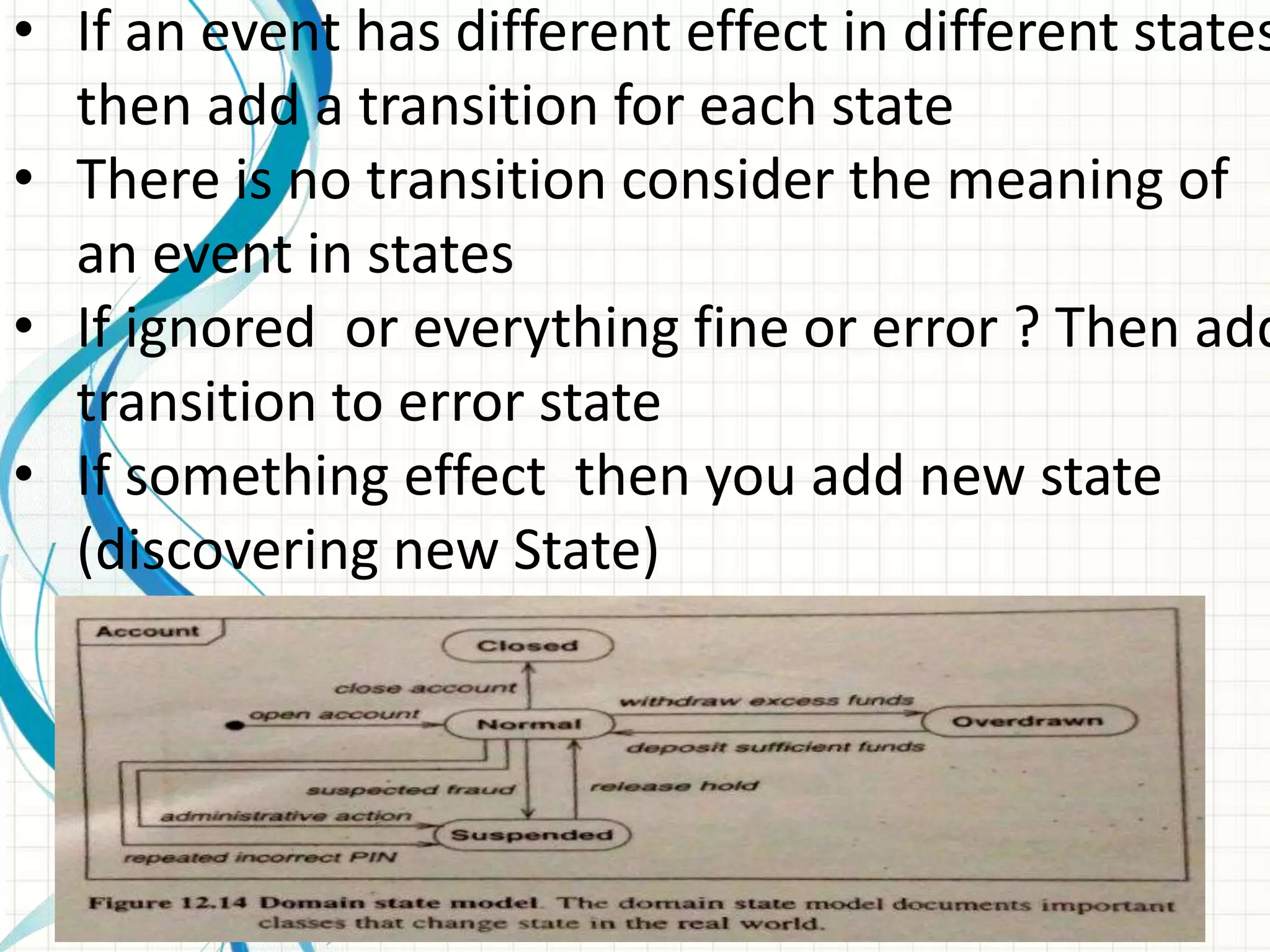
• If an event has different effect in different states
then add a transition for each state
• There is no transition consider the meaning of
an event in states
• If ignored or everything fine or error ? Then add
transition to error state
• If something effect then you add new state
(discovering new State)
Evaluating State Diagrams
• Examine each state model . Are all states
connected ?
• Pay attentions to paths and check it for
1. represents cyclic class ?
2. Presence of main loop
3. Is any dead state terminate cycle
ATM :model for Account
DOMAIN INTERACTION
MODEL
• The interaction model is seldom important
for domain analysis
• During domain analysis the emphasis is on
key concept and deep structural
relationships and not the users view of
them
• However ,is a important aspect of
application modelling
ITERATING THE ANALYSIS
Learning Objectives
• The problem statements often contain
circularities and most applications cannot be
approached In linear model
• To understand a problem with all its
implications , you must attack the analysis
iteratively
• Preparing a first approximation to the model
and then iterating the analysis as your
understand increase
REFINING ANALYSIS MODEL
• The overall analysis model may shows
inconsistence and imbalance within and
across models. Iterate the different portion
to produce a cleaner
• Try to refine classes to increase sharing and
improve structure
• Reexamine the fully when wont seem to fit in
right
• Common difficulty is a physically object that
has two logical aspects
• Remove the states first look fine but now
appear extraneous
• If doesn’t affect the rest of model in any way
then two classes can combined
• A good model feels right and does nt appear
to have extraneous detail
Restating the requirements
• The model serves as the basis for the
requirements and defines the scope of future
discourse
• Most of the real requirements will be part of
the model. you may have some performance
constraints and these should be stated be
stated clearly
• Should verify the final model with requestor
Analysis and Design
• The goal of analysis is to specify the
problem fully without introducing a bias
to any particular implementation
• If it is impossible in practice to avoid all
taints of implementations
• Don’t treat the rules we have given too
rigidly
• ATM: no further changes to ATM model at
this time
THANK YOU FOR YOUR TIME

Domain State model OOAD

  • 1.
  • 2.
    Introduction • Some Domainobjects pass through connected distinct states and each state has different constraints and Association or multiplicities • The state diagram describes the various states that object can assume and their properties and Constraints in all and the events take in each state
  • 3.
    • Most Domainclasses do not require State diagrams • Described by list of operations • Minority of classes that do exhibit distinct states • However , a state model can help understanding their behaviour
  • 4.
    Domain State ModelSteps First -Identify the Domain class with states Second -Find the states Third -Find events Fourth -Build State diagrams Fifth -Evaluate state diagrams
  • 5.
    Identify the Domainclass with states • Examine the list of domain classes for those that have a distinct life cycle • Look for the classes that can be characterized by the progressive history or that exhibit cycle behavior • Identify the significant state in the cycle of an object • Not every state occur in every circle ,but the life object is cycle • ATM: state of an account
  • 6.
    Finding States • Eachstates characterize the objects in each class on basis of attribute value that object may have • Associations may participates in and their multiplicities ,attributes and associations are meaningful in certain states only • Try to describe the state • Don’t focus on destination , particularly based on small ,medium ,big . Because states based on qualitative difference in behavior • ATM: Accounts types
  • 7.
    Finding Events • Findingevents that cause transition among the states and think about stimuli that change the state • In many cases, you can regard an event as completing a DO-activity • We can find other events by thinking about taking object in to a specific state • There are additional events that occur within a state and do not cause a transition but in D S M we should focus on events that should cause transition among the states • ATM:: incorrect pin ,closing account
  • 8.
    Building State Diagrams •Note the states which each events applies and add transitions to show the change in state that caused by occurrence of event • If an event terminates a state : it will usually have a single transition from that state to another • If an event initiate a target state : then Add transition from those states to target state • Consider the possibility of using a transition on enclosing state rather than adding a transition from each substate to the target state
  • 9.
    • If anevent has different effect in different states then add a transition for each state • There is no transition consider the meaning of an event in states • If ignored or everything fine or error ? Then add transition to error state • If something effect then you add new state (discovering new State)
  • 10.
    Evaluating State Diagrams •Examine each state model . Are all states connected ? • Pay attentions to paths and check it for 1. represents cyclic class ? 2. Presence of main loop 3. Is any dead state terminate cycle ATM :model for Account
  • 11.
  • 12.
    • The interactionmodel is seldom important for domain analysis • During domain analysis the emphasis is on key concept and deep structural relationships and not the users view of them • However ,is a important aspect of application modelling
  • 13.
  • 14.
    Learning Objectives • Theproblem statements often contain circularities and most applications cannot be approached In linear model • To understand a problem with all its implications , you must attack the analysis iteratively • Preparing a first approximation to the model and then iterating the analysis as your understand increase
  • 15.
    REFINING ANALYSIS MODEL •The overall analysis model may shows inconsistence and imbalance within and across models. Iterate the different portion to produce a cleaner • Try to refine classes to increase sharing and improve structure • Reexamine the fully when wont seem to fit in right • Common difficulty is a physically object that has two logical aspects
  • 16.
    • Remove thestates first look fine but now appear extraneous • If doesn’t affect the rest of model in any way then two classes can combined • A good model feels right and does nt appear to have extraneous detail
  • 17.
    Restating the requirements •The model serves as the basis for the requirements and defines the scope of future discourse • Most of the real requirements will be part of the model. you may have some performance constraints and these should be stated be stated clearly • Should verify the final model with requestor
  • 18.
    Analysis and Design •The goal of analysis is to specify the problem fully without introducing a bias to any particular implementation • If it is impossible in practice to avoid all taints of implementations • Don’t treat the rules we have given too rigidly • ATM: no further changes to ATM model at this time
  • 19.
    THANK YOU FORYOUR TIME