Domain Driven Design Quickly
Domain Driven Design
• collection of principles and patterns that help
developers craft elegant object systems
• creates software abstractions called domain models
• models encapsulate complex business logic, closing the
gap between business reality and code
DDD Main Concepts
➔ Ubiquitous Language
➔ Model-Driven Design
◆ Layered Architecture
◆ Entities
◆ Value Objects
◆ Services
◆ Modules
◆ Aggregates
◆ Repositories
➔ Bounded Context
Ubiquitous Language
Ubiquitous Language
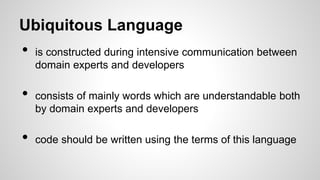
• is constructed during intensive communication between
domain experts and developers
• consists of mainly words which are understandable both
by domain experts and developers
• code should be written using the terms of this language
Ubiquitous Language
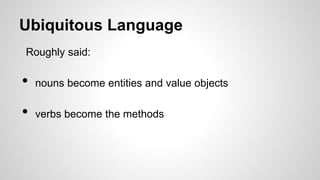
Roughly said:
• nouns become entities and value objects
• verbs become the methods
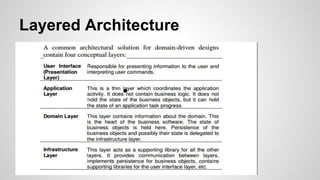
Layered Architecture
Model-Driven Design
Entities
Entities
An object, that can be identified uniquely, by
its identifier, which in code can be either ID,
or combination of some attributes.
Example:
• bank account number can be identified by its account number uniquely
• airport has an international identifier used in travel agencies all over the world
• ...
Value Objects
Value Objects
are descriptors or properties important in the
domain you are modeling
➔ do not have an identity
➔ they describe the things that do have identities
➔ should be immutable
➔ if you want a different value for the object, you simply
create another one
Value Objects
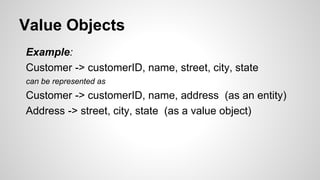
Example:
Customer -> customerID, name, street, city, state
can be represented as
Customer -> customerID, name, address (as an entity)
Address -> street, city, state (as a value object)
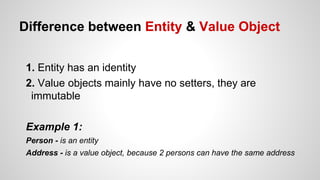
Difference between Entity & Value Object
1. Entity has an identity
2. Value objects mainly have no setters, they are
immutable
Example 1:
Person - is an entity
Address - is a value object, because 2 persons can have the same address
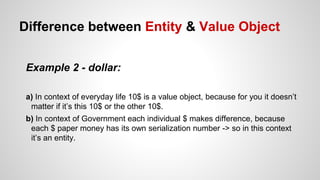
Difference between Entity & Value Object
Example 2 - dollar:
a) In context of everyday life 10$ is a value object, because for you it doesn’t
matter if it’s this 10$ or the other 10$.
b) In context of Government each individual $ makes difference, because
each $ paper money has its own serialization number -> so in this context
it’s an entity.
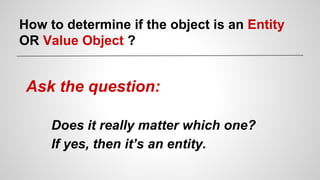
How to determine if the object is an Entity
OR Value Object ?
Ask the question:
Does it really matter which one?
If yes, then it’s an entity.
Services
Services
Some verbs of Ubiquitous Language do not
belong to any object, but they represent an
important behavior of the domain.
➔such behavior is declared as a service
➔its purpose is to provide functionality for the
domain
Modules
Modules
➔ Used as a method of organizing related concepts and tasks in order to reduce complexity. In
enterprise application big model can be separated into modules.
➔ Modules should be made up of elements which functionally or logically belong together assuring
cohesion.
➔ Modules should have well defined interfaces which are accessed by other modules. Instead of
calling three objects of a module, it is better to access one interface, because it reduces
coupling.
➔ Module names should be part of Ubiquitous Language.
➔ In Java they are simply packages.
Aggregates / Aggregate Root
Aggregates
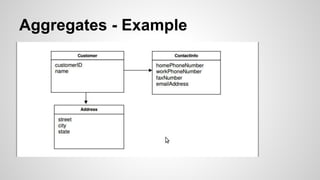
A group of associated objects which are considered as one unit with regard to
data changes. It’s an entity which can contain other entities or value objects.
➔ has one Aggregate Root
➔ from outside only this root should be referenced/accessed
➔ only the root should be obtainable from DB through queries
Aggregates - Example
dsfsdf
Repositories
Repositories
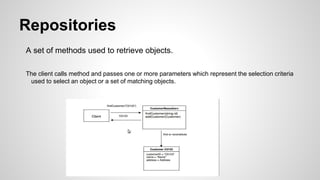
A set of methods used to retrieve objects.
The client calls method and passes one or more parameters which represent the selection criteria
used to select an object or a set of matching objects.
Bounded Context
Bounded Context
➔ an area of responsibility
➔ a logical frame inside of which the model evolves
➔ it owns its own Ubiquitous Language
• Use the context as the basis for team organization.
• The context of a model is the set of conditions which need to be applied to make sure that the terms used in the
model have a specific meaning.
• Define the scope of a model, draw up the boundaries of its context.
• Explicitly set boundaries in terms of team organization, usage within specific parts of the application, and
physical manifestations such as code bases and database schemas.
• Communicate via interfaces between different bounded context.
Context Map
Context Map
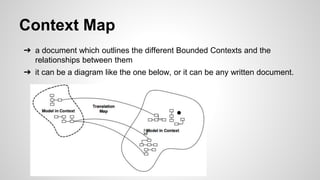
➔ a document which outlines the different Bounded Contexts and the
relationships between them
➔ it can be a diagram like the one below, or it can be any written document.
Context Map
There are series of patterns which can be used to create Context Maps
where contexts have clear roles and their relationships are pointed out
➔ Shared Kernel
➔ Customer-Supplier
➔ Separate Ways
➔ Open Host Services
➔ Anticorruption Layers
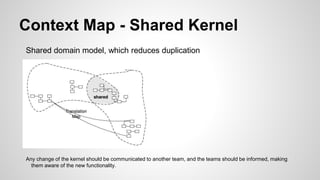
Context Map - Shared Kernel
Shared domain model, which reduces duplication
Any change of the kernel should be communicated to another team, and the teams should be informed, making
them aware of the new functionality.
Q & A

Domain Driven Design Quickly

  • 1.
  • 2.
    Domain Driven Design •collection of principles and patterns that help developers craft elegant object systems • creates software abstractions called domain models • models encapsulate complex business logic, closing the gap between business reality and code
  • 3.
    DDD Main Concepts ➔Ubiquitous Language ➔ Model-Driven Design ◆ Layered Architecture ◆ Entities ◆ Value Objects ◆ Services ◆ Modules ◆ Aggregates ◆ Repositories ➔ Bounded Context
  • 4.
  • 5.
    Ubiquitous Language • isconstructed during intensive communication between domain experts and developers • consists of mainly words which are understandable both by domain experts and developers • code should be written using the terms of this language
  • 6.
    Ubiquitous Language Roughly said: •nouns become entities and value objects • verbs become the methods
  • 7.
  • 8.
  • 9.
  • 10.
  • 11.
    Entities An object, thatcan be identified uniquely, by its identifier, which in code can be either ID, or combination of some attributes. Example: • bank account number can be identified by its account number uniquely • airport has an international identifier used in travel agencies all over the world • ...
  • 12.
  • 13.
    Value Objects are descriptorsor properties important in the domain you are modeling ➔ do not have an identity ➔ they describe the things that do have identities ➔ should be immutable ➔ if you want a different value for the object, you simply create another one
  • 14.
    Value Objects Example: Customer ->customerID, name, street, city, state can be represented as Customer -> customerID, name, address (as an entity) Address -> street, city, state (as a value object)
  • 15.
    Difference between Entity& Value Object 1. Entity has an identity 2. Value objects mainly have no setters, they are immutable Example 1: Person - is an entity Address - is a value object, because 2 persons can have the same address
  • 16.
    Difference between Entity& Value Object Example 2 - dollar: a) In context of everyday life 10$ is a value object, because for you it doesn’t matter if it’s this 10$ or the other 10$. b) In context of Government each individual $ makes difference, because each $ paper money has its own serialization number -> so in this context it’s an entity.
  • 17.
    How to determineif the object is an Entity OR Value Object ? Ask the question: Does it really matter which one? If yes, then it’s an entity.
  • 18.
  • 19.
    Services Some verbs ofUbiquitous Language do not belong to any object, but they represent an important behavior of the domain. ➔such behavior is declared as a service ➔its purpose is to provide functionality for the domain
  • 20.
  • 21.
    Modules ➔ Used asa method of organizing related concepts and tasks in order to reduce complexity. In enterprise application big model can be separated into modules. ➔ Modules should be made up of elements which functionally or logically belong together assuring cohesion. ➔ Modules should have well defined interfaces which are accessed by other modules. Instead of calling three objects of a module, it is better to access one interface, because it reduces coupling. ➔ Module names should be part of Ubiquitous Language. ➔ In Java they are simply packages.
  • 22.
  • 23.
    Aggregates A group ofassociated objects which are considered as one unit with regard to data changes. It’s an entity which can contain other entities or value objects. ➔ has one Aggregate Root ➔ from outside only this root should be referenced/accessed ➔ only the root should be obtainable from DB through queries
  • 24.
  • 25.
  • 26.
    Repositories A set ofmethods used to retrieve objects. The client calls method and passes one or more parameters which represent the selection criteria used to select an object or a set of matching objects.
  • 27.
  • 28.
    Bounded Context ➔ anarea of responsibility ➔ a logical frame inside of which the model evolves ➔ it owns its own Ubiquitous Language • Use the context as the basis for team organization. • The context of a model is the set of conditions which need to be applied to make sure that the terms used in the model have a specific meaning. • Define the scope of a model, draw up the boundaries of its context. • Explicitly set boundaries in terms of team organization, usage within specific parts of the application, and physical manifestations such as code bases and database schemas. • Communicate via interfaces between different bounded context.
  • 29.
  • 30.
    Context Map ➔ adocument which outlines the different Bounded Contexts and the relationships between them ➔ it can be a diagram like the one below, or it can be any written document.
  • 31.
    Context Map There areseries of patterns which can be used to create Context Maps where contexts have clear roles and their relationships are pointed out ➔ Shared Kernel ➔ Customer-Supplier ➔ Separate Ways ➔ Open Host Services ➔ Anticorruption Layers
  • 32.
    Context Map -Shared Kernel Shared domain model, which reduces duplication Any change of the kernel should be communicated to another team, and the teams should be informed, making them aware of the new functionality.
  • 33.