SEMINAR PRESENTATION ON IMPACT
FACTOR,LIVE LOAD AND
BOX CULVERTS
SRINIVAS REDDY.S
R19MCE13
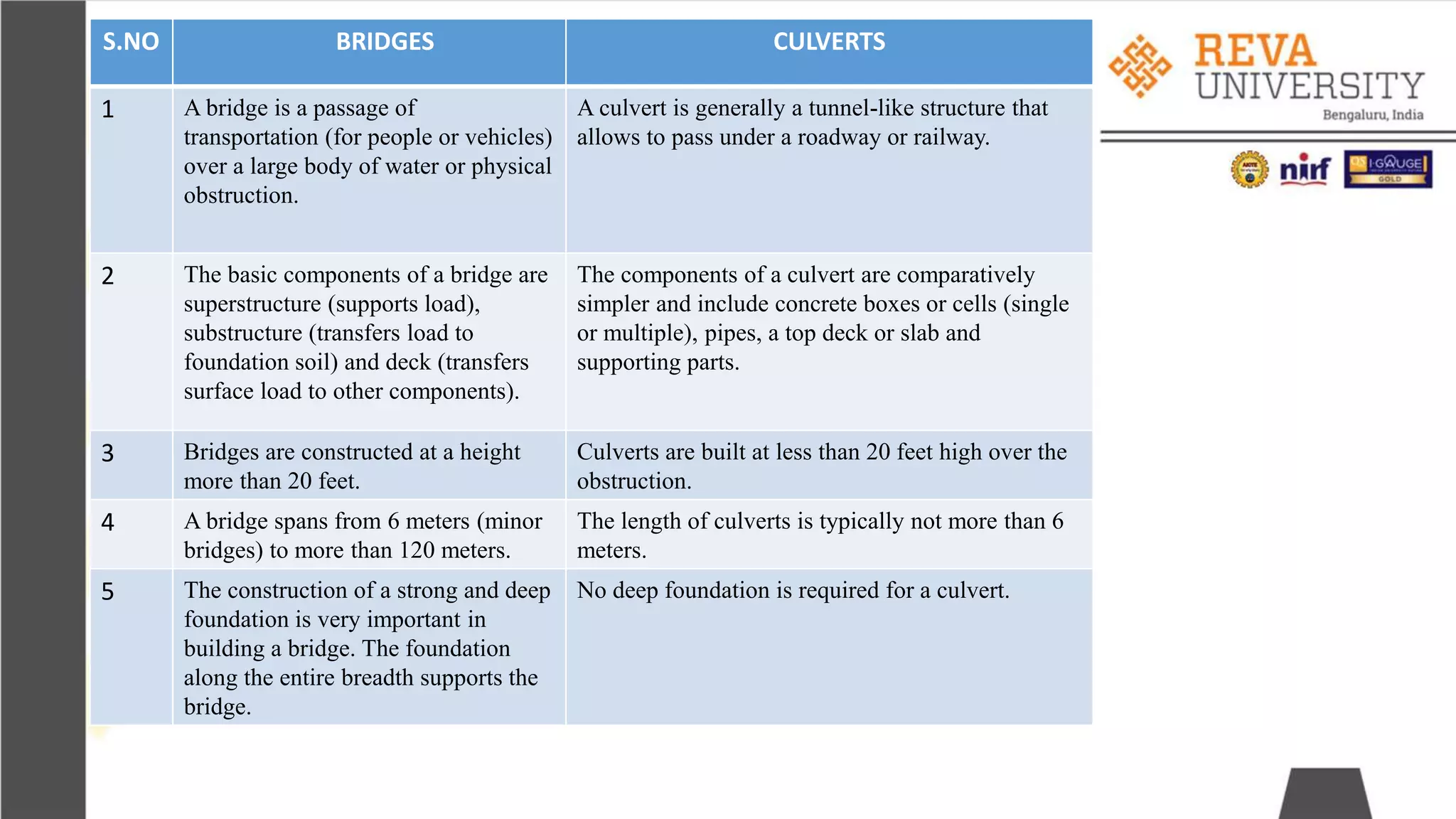
S.NO BRIDGES CULVERTS
1 A bridge is a passage of
transportation (for people or vehicles)
over a large body of water or physical
obstruction.
A culvert is generally a tunnel-like structure that
allows to pass under a roadway or railway.
2 The basic components of a bridge are
superstructure (supports load),
substructure (transfers load to
foundation soil) and deck (transfers
surface load to other components).
The components of a culvert are comparatively
simpler and include concrete boxes or cells (single
or multiple), pipes, a top deck or slab and
supporting parts.
3 Bridges are constructed at a height
more than 20 feet.
Culverts are built at less than 20 feet high over the
obstruction.
4 A bridge spans from 6 meters (minor
bridges) to more than 120 meters.
The length of culverts is typically not more than 6
meters.
5 The construction of a strong and deep
foundation is very important in
building a bridge. The foundation
along the entire breadth supports the
bridge.
No deep foundation is required for a culvert.
CULVERT
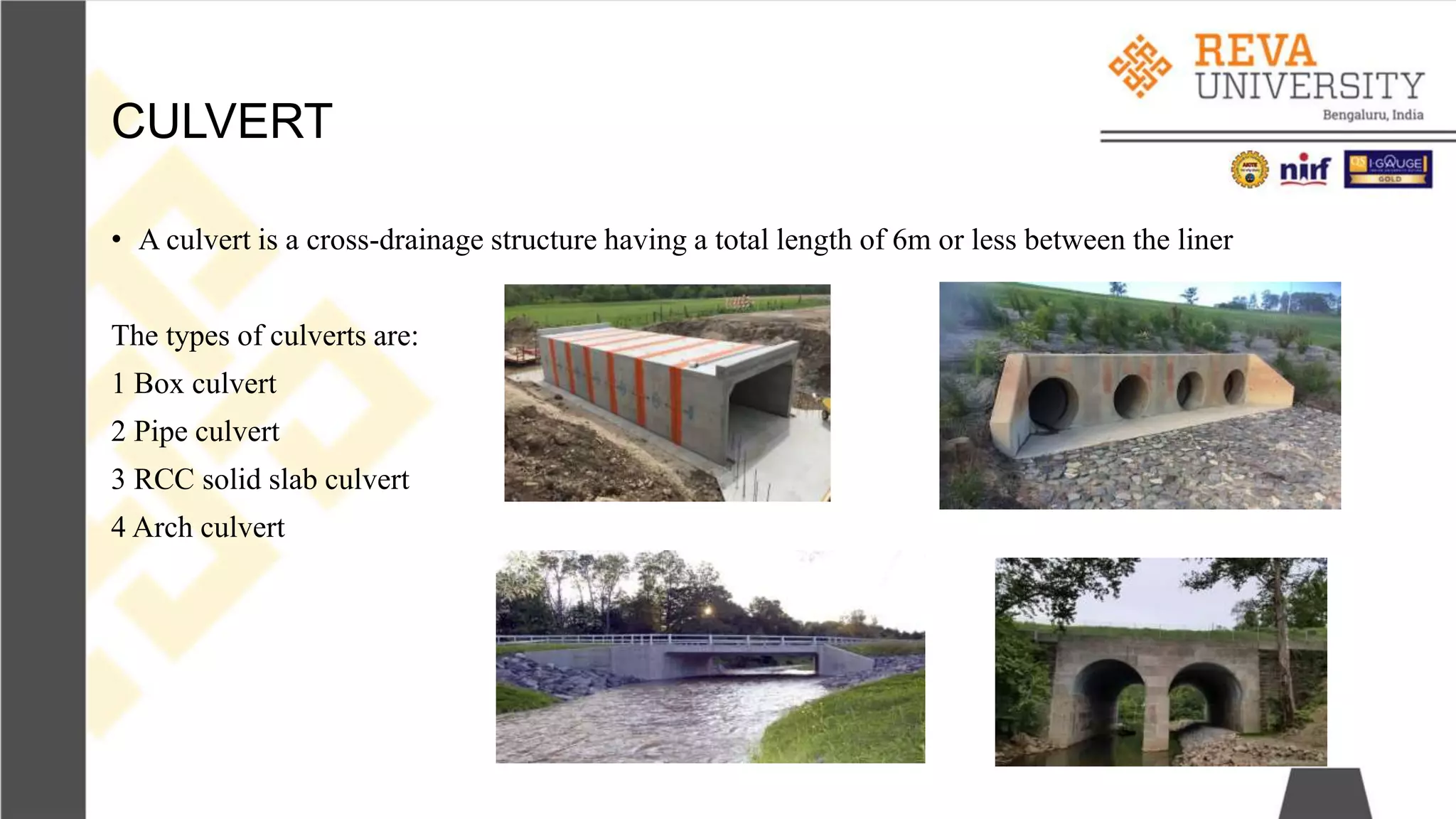
• A culvert is a cross-drainage structure having a total length of 6m or less between the liner
The types of culverts are:
1 Box culvert
2 Pipe culvert
3 RCC solid slab culvert
4 Arch culvert
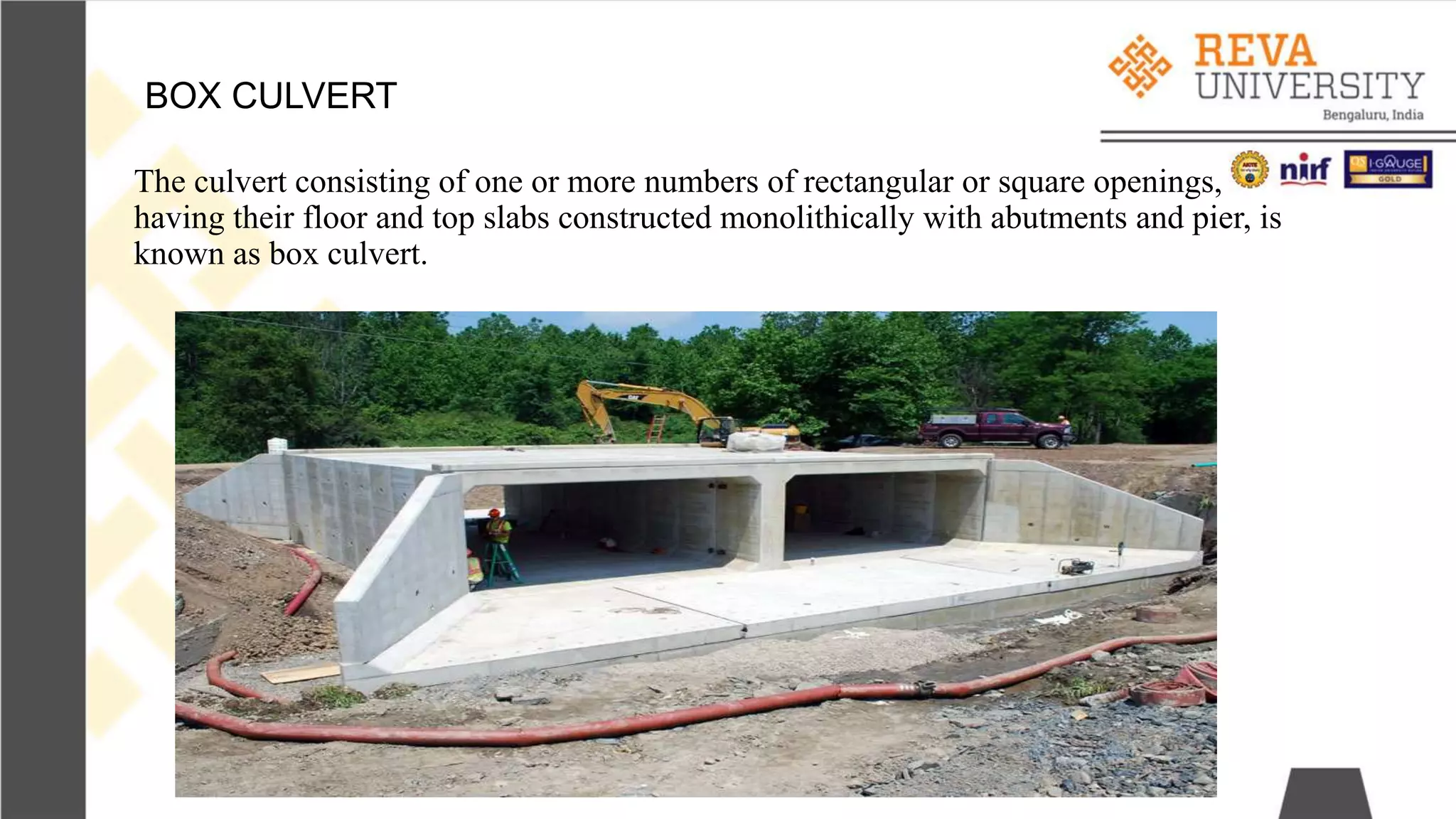
The culvert consisting of one or more numbers of rectangular or square openings,
having their floor and top slabs constructed monolithically with abutments and pier, is
known as box culvert.
BOX CULVERT
BOX CULVERT
• A four sided culverts are typically referred to as box culverts.
• Standard box sizes : 0.9*0.6m to 3.6*3.6 in 0.3 m span and raise increments.
• 3 sided structure is a u shaped structures that may or may not have a crown in the center
and its size range from 2.5m to 15m span lengths .
• Box culverts are mainly constructed where the sol is soft and the load has to be distributed
over a wider foundation area.
• Box culverts are made up of concrete and especially RCC(reinforced concrete cement).
• The most challenging part in constructing a box culvert is that dry surface is needed for
installing it
• However ,due to strength of the concrete floor ,water , direction can be changed when a
large amount of water is expected.
• This feature makes box culverts , one of the most commonly found types of the culvert.
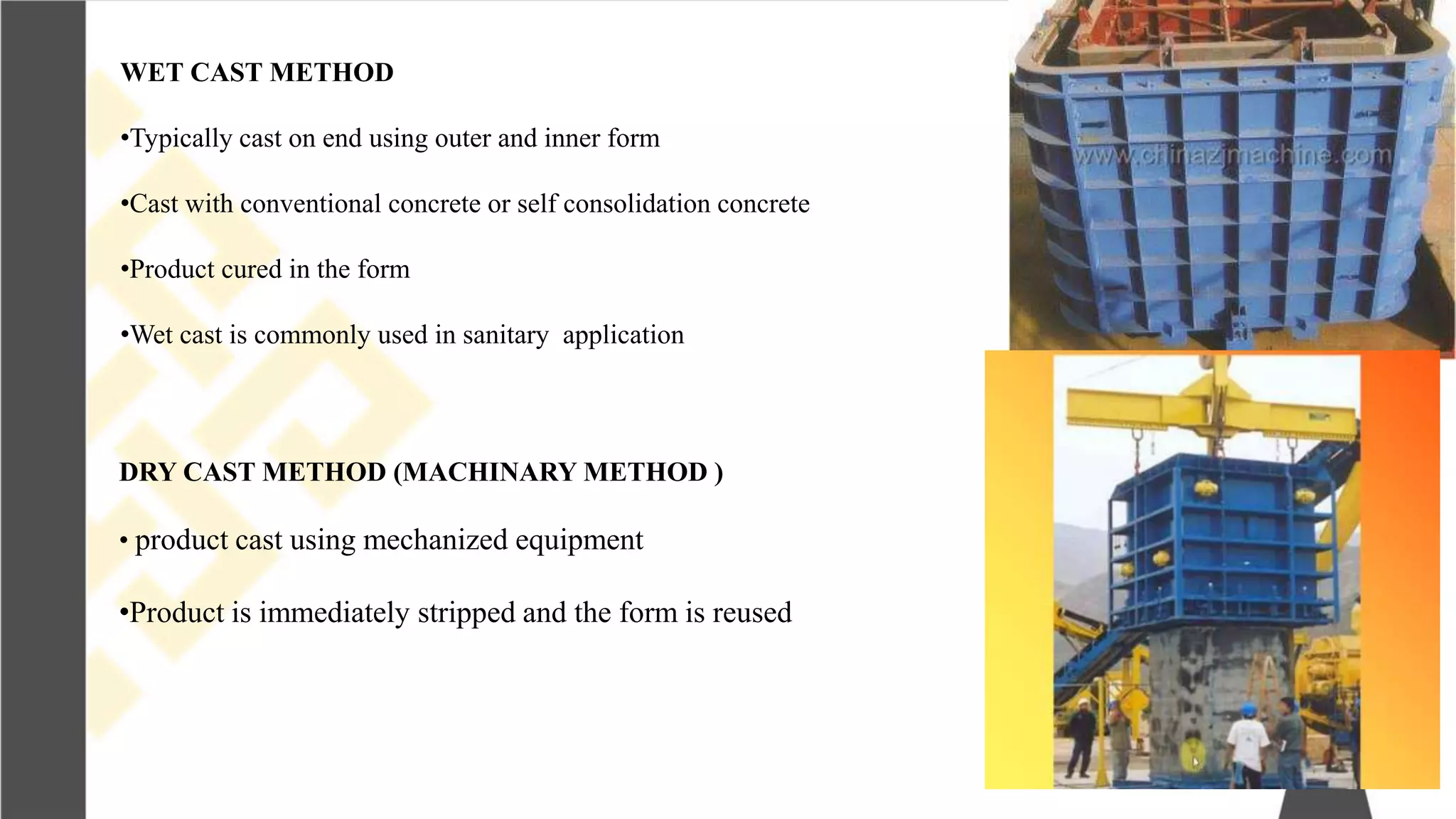
WET CAST METHOD
•Typically cast on end using outer and inner form
•Cast with conventional concrete or self consolidation concrete
•Product cured in the form
•Wet cast is commonly used in sanitary application
DRY CAST METHOD (MACHINARY METHOD )
• product cast using mechanized equipment
•Product is immediately stripped and the form is reused
Components of box culverts
• Bottom slab
• Vertical walls
• Deck slab
• Haunch
• Wing wall
• Return wall
• Drop wall
• Curtain wall
• Earth retainer
Box culverts are subject to:
• Lateral earth loads from soil and hydrostatic loads from ground water.
• Vertical loads from the cover soil and live loads above.
• Surcharge loads from nearby impact loads.
• Seismic loads where applicable.
APPLICATIONS
Box culverts
• Short-span bridges (over highways, waterways, railways, for golf courses, etc.)
• Conveyance of storm water, sewage or industrial wastes (storm drains)
• Tunnels (to house conveyers, utilities, etc; to provide access, escape routes, etc.)
• Detentions
3 sided culverts
• short -span bridges(flat and arched)
ADVANTAGES OF BOX CULVERT
• The box culvert is a rigid frame structure and very simple in construction
• It is suitable for non-perennial streams where scrub depth is not sufficient but the soil is weak
• The bottom slab of the box culvert reduces pressure on the soil
• Box culverts are economical due to their rigidity and monolithic action and separate foundations
are not required
• It is used in a special cases , weak foundation.
THANKYOU

SEMINAR PRESENTATION ON BOX CULVERTS

  • 1.
    SEMINAR PRESENTATION ONIMPACT FACTOR,LIVE LOAD AND BOX CULVERTS SRINIVAS REDDY.S R19MCE13
  • 2.
    S.NO BRIDGES CULVERTS 1A bridge is a passage of transportation (for people or vehicles) over a large body of water or physical obstruction. A culvert is generally a tunnel-like structure that allows to pass under a roadway or railway. 2 The basic components of a bridge are superstructure (supports load), substructure (transfers load to foundation soil) and deck (transfers surface load to other components). The components of a culvert are comparatively simpler and include concrete boxes or cells (single or multiple), pipes, a top deck or slab and supporting parts. 3 Bridges are constructed at a height more than 20 feet. Culverts are built at less than 20 feet high over the obstruction. 4 A bridge spans from 6 meters (minor bridges) to more than 120 meters. The length of culverts is typically not more than 6 meters. 5 The construction of a strong and deep foundation is very important in building a bridge. The foundation along the entire breadth supports the bridge. No deep foundation is required for a culvert.
  • 3.
    CULVERT • A culvertis a cross-drainage structure having a total length of 6m or less between the liner The types of culverts are: 1 Box culvert 2 Pipe culvert 3 RCC solid slab culvert 4 Arch culvert
  • 4.
    The culvert consistingof one or more numbers of rectangular or square openings, having their floor and top slabs constructed monolithically with abutments and pier, is known as box culvert. BOX CULVERT
  • 5.
    BOX CULVERT • Afour sided culverts are typically referred to as box culverts. • Standard box sizes : 0.9*0.6m to 3.6*3.6 in 0.3 m span and raise increments. • 3 sided structure is a u shaped structures that may or may not have a crown in the center and its size range from 2.5m to 15m span lengths . • Box culverts are mainly constructed where the sol is soft and the load has to be distributed over a wider foundation area. • Box culverts are made up of concrete and especially RCC(reinforced concrete cement). • The most challenging part in constructing a box culvert is that dry surface is needed for installing it • However ,due to strength of the concrete floor ,water , direction can be changed when a large amount of water is expected. • This feature makes box culverts , one of the most commonly found types of the culvert.
  • 6.
    WET CAST METHOD •Typicallycast on end using outer and inner form •Cast with conventional concrete or self consolidation concrete •Product cured in the form •Wet cast is commonly used in sanitary application DRY CAST METHOD (MACHINARY METHOD ) • product cast using mechanized equipment •Product is immediately stripped and the form is reused
  • 7.
    Components of boxculverts • Bottom slab • Vertical walls • Deck slab • Haunch • Wing wall • Return wall • Drop wall • Curtain wall • Earth retainer
  • 8.
    Box culverts aresubject to: • Lateral earth loads from soil and hydrostatic loads from ground water. • Vertical loads from the cover soil and live loads above. • Surcharge loads from nearby impact loads. • Seismic loads where applicable.
  • 9.
    APPLICATIONS Box culverts • Short-spanbridges (over highways, waterways, railways, for golf courses, etc.) • Conveyance of storm water, sewage or industrial wastes (storm drains) • Tunnels (to house conveyers, utilities, etc; to provide access, escape routes, etc.) • Detentions 3 sided culverts • short -span bridges(flat and arched)
  • 10.
    ADVANTAGES OF BOXCULVERT • The box culvert is a rigid frame structure and very simple in construction • It is suitable for non-perennial streams where scrub depth is not sufficient but the soil is weak • The bottom slab of the box culvert reduces pressure on the soil • Box culverts are economical due to their rigidity and monolithic action and separate foundations are not required • It is used in a special cases , weak foundation.
  • 11.