International Research Journal of Engineering and Technology (IRJET) e-ISSN: 2395-0056
Volume: 09 Issue: 03 | Mar 2022 www.irjet.net p-ISSN: 2395-0072
© 2022, IRJET | Impact Factor value: 7.529 | ISO 9001:2008 Certified Journal | Page 1182
A Review Paper on Analysis and Design of Precast Box Culvert Bridge
Payal Jain1, Prof. S. R. Suryawanshi2
1Post Graduate Student of Civil Engineering Department, JSPM’s Imperial College of Engineering and Research,
Wagholi, Pune, Maharashtra
2Assistant Professor Department of Civil Engineering, JSPM’s Imperial College of Engineering and Research,
Wagholi, Pune, Maharashtra
---------------------------------------------------------------------***----------------------------------------------------------------------
Abstract - Box culverts are monolithic structures used to
bridge roads, railway lines, andotherstructures. Culvertsmust
be installed beneath the earth embankment for thecrossing of
watercourses such as streams, Nallas, and other bodies of
water, as the road embankment cannot be allowed to block
the natural waterway. Culverts are also needed to balance
flood water on both sides of the earth embankment, lowering
the flood level on one side of the road and lowering the water
head, lowering the flood threat. Water, traffic, cushion, soil,
and other forms of loads are absorbed by the box. This work
examines the many types of IRC loadings as well as design
considerations such as the effect of ground pressure and the
depth of cushion at the base.
The structural elements have been developed to withstand
maximal bending moments and shear stresses. This article
gives a comprehensive examination of the requirementsin the
codes, as well as considerations and arguments for all of the
above design characteristics.
Key Words: Box Culvert, Design Coefficients, Loadings
Types, Moment, Shear, Pressure Cases, Cushioning, Loading
class, Moment calculations, Percent reinforcement,Pressure
cases, Side walls, Top slab, cushion, coefficient of earth
pressure, lateral earth pressure etc.
1. INTRODUCTION
Box culverts with four corners are joined monolithically. In
other circumstances, the box will be three-sided, meaning it
will have a bottom slab (Raft) as well as vertical walls. If we
don't make the top slab, which is also available in the
market, we won't be able to join it monolithically. Every box
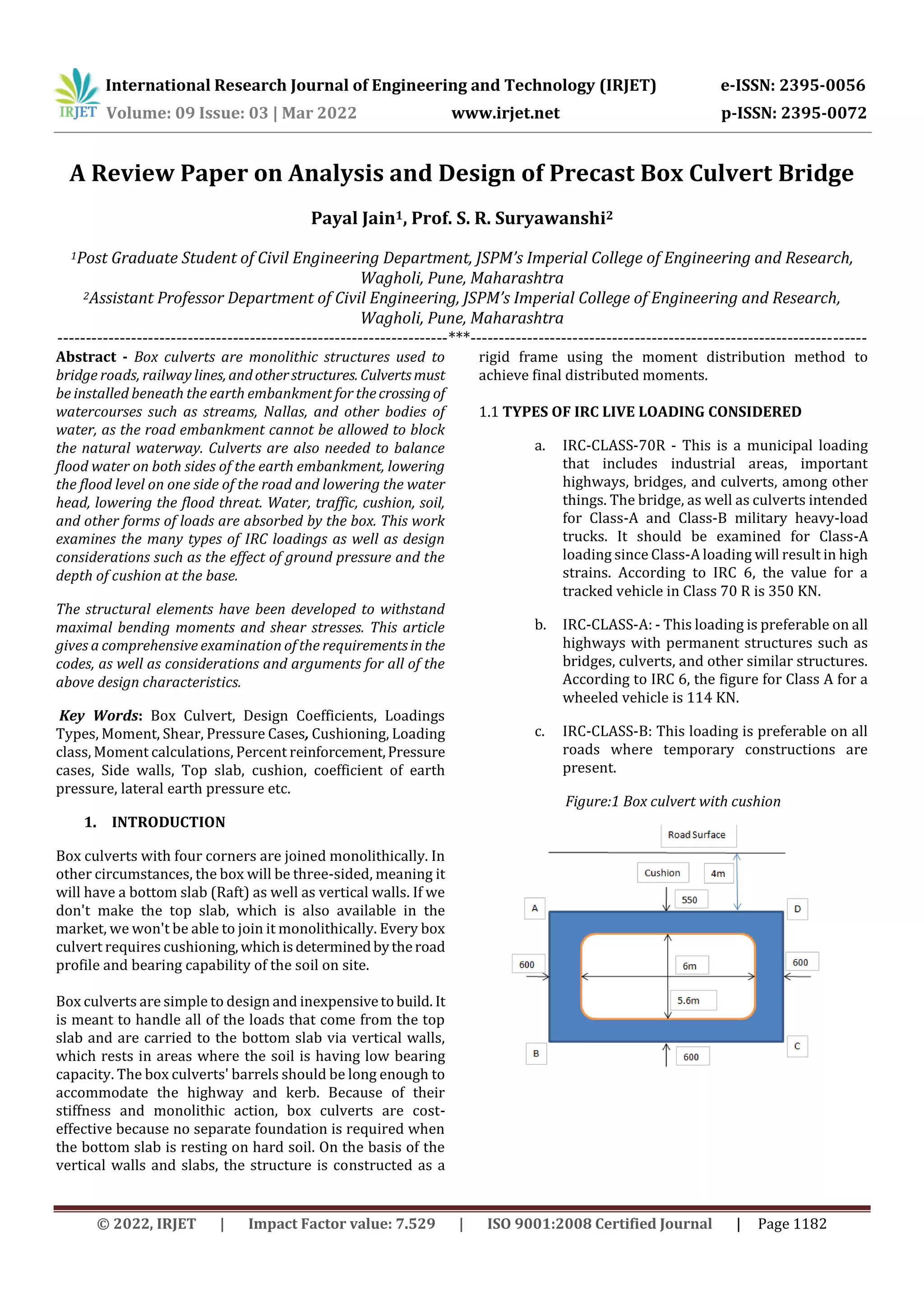
culvert requires cushioning, whichisdeterminedbytheroad
profile and bearing capability of the soil on site.
Box culverts are simple to design and inexpensivetobuild. It
is meant to handle all of the loads that come from the top
slab and are carried to the bottom slab via vertical walls,
which rests in areas where the soil is having low bearing
capacity. The box culverts' barrels should be long enough to
accommodate the highway and kerb. Because of their
stiffness and monolithic action, box culverts are cost-
effective because no separate foundation is required when
the bottom slab is resting on hard soil. On the basis of the
vertical walls and slabs, the structure is constructed as a
rigid frame using the moment distribution method to
achieve final distributed moments.
1.1 TYPES OF IRC LIVE LOADING CONSIDERED
a. IRC-CLASS-70R - This is a municipal loading
that includes industrial areas, important
highways, bridges, and culverts, among other
things. The bridge, as well as culverts intended
for Class-A and Class-B military heavy-load
trucks. It should be examined for Class-A
loading since Class-A loading will result in high
strains. According to IRC 6, the value for a
tracked vehicle in Class 70 R is 350 KN.
b. IRC-CLASS-A: - This loading is preferable on all
highways with permanent structures such as
bridges, culverts, and other similar structures.
According to IRC 6, the figure for Class A for a
wheeled vehicle is 114 KN.
c. IRC-CLASS-B: This loading is preferable on all
roads where temporary constructions are
present.
Figure:1 Box culvert with cushion
International Research Journal of Engineering and Technology (IRJET) e-ISSN: 2395-0056
Volume: 09 Issue: 03 | Mar 2022 www.irjet.net p-ISSN: 2395-0072
© 2022, IRJET | Impact Factor value: 7.529 | ISO 9001:2008 Certified Journal | Page 1183
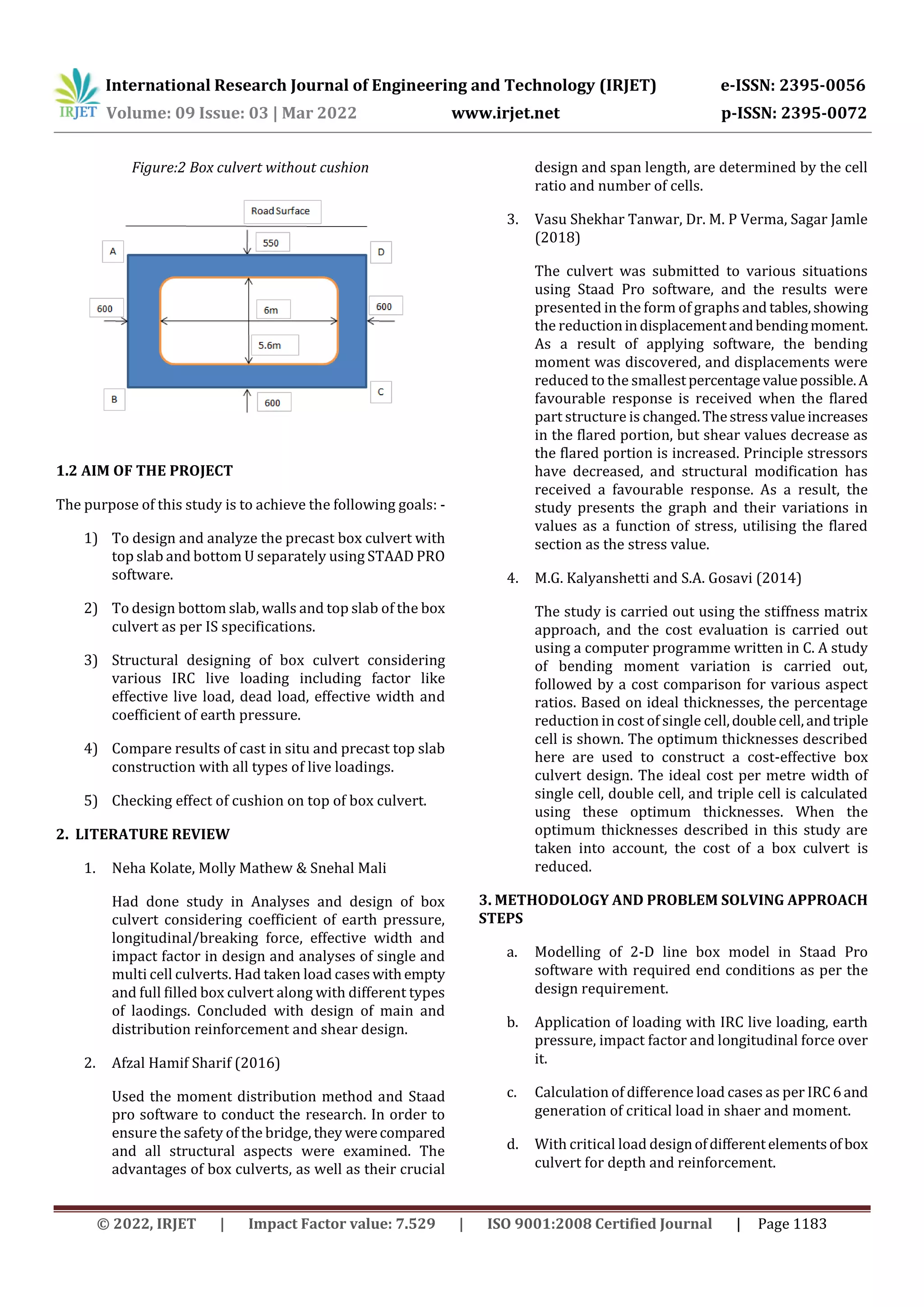
Figure:2 Box culvert without cushion
1.2 AIM OF THE PROJECT
The purpose of this study is to achieve the following goals: -
1) To design and analyze the precast box culvert with
top slab and bottom U separately using STAAD PRO
software.
2) To design bottom slab, walls and top slab of the box
culvert as per IS specifications.
3) Structural designing of box culvert considering
various IRC live loading including factor like
effective live load, dead load, effective width and
coefficient of earth pressure.
4) Compare results of cast in situ and precast top slab
construction with all types of live loadings.
5) Checking effect of cushion on top of box culvert.
2. LITERATURE REVIEW
1. Neha Kolate, Molly Mathew & Snehal Mali
Had done study in Analyses and design of box
culvert considering coefficient of earth pressure,
longitudinal/breaking force, effective width and
impact factor in design and analyses of single and
multi cell culverts. Had taken load cases withempty
and full filled box culvert along with different types
of laodings. Concluded with design of main and
distribution reinforcement and shear design.
2. Afzal Hamif Sharif (2016)
Used the moment distribution method and Staad
pro software to conduct the research. In order to
ensure the safety of the bridge, they werecompared
and all structural aspects were examined. The
advantages of box culverts, as well as their crucial
design and span length, are determined by the cell
ratio and number of cells.
3. Vasu Shekhar Tanwar, Dr. M. P Verma, Sagar Jamle
(2018)
The culvert was submitted to various situations
using Staad Pro software, and the results were
presented in the form of graphs and tables,showing
the reductionindisplacementandbendingmoment.
As a result of applying software, the bending
moment was discovered, and displacements were
reduced to the smallestpercentagevaluepossible.A
favourable response is received when the flared
part structure is changed.Thestressvalueincreases
in the flared portion, but shear values decrease as
the flared portion is increased. Principle stressors
have decreased, and structural modification has
received a favourable response. As a result, the
study presents the graph and their variations in
values as a function of stress, utilising the flared
section as the stress value.
4. M.G. Kalyanshetti and S.A. Gosavi (2014)
The study is carried out using the stiffness matrix
approach, and the cost evaluation is carried out
using a computer programme written in C. A study
of bending moment variation is carried out,
followed by a cost comparison for various aspect
ratios. Based on ideal thicknesses, the percentage
reduction in cost of single cell,doublecell,andtriple
cell is shown. The optimum thicknesses described
here are used to construct a cost-effective box
culvert design. The ideal cost per metre width of
single cell, double cell, and triple cell is calculated
using these optimum thicknesses. When the
optimum thicknesses described in this study are
taken into account, the cost of a box culvert is
reduced.
3. METHODOLOGY AND PROBLEM SOLVING APPROACH
STEPS
a. Modelling of 2-D line box model in Staad Pro
software with required end conditions as per the
design requirement.
b. Application of loading with IRC live loading, earth
pressure, impact factor and longitudinal force over
it.
c. Calculation of difference load cases as per IRC6and
generation of critical load in shaer and moment.
d. With critical load designofdifferentelementsof box
culvert for depth and reinforcement.
International Research Journal of Engineering and Technology (IRJET) e-ISSN: 2395-0056
Volume: 09 Issue: 03 | Mar 2022 www.irjet.net p-ISSN: 2395-0072
© 2022, IRJET | Impact Factor value: 7.529 | ISO 9001:2008 Certified Journal | Page 1184
e. Compare of the results for top slab monolithically
casted with wall and separately casted on
maximum moment, shear and deflection.
f. Compare the results with manual calculation for
design of elements with moment distribution
method.
4. DISCUSSION
Different types of loading circumstances have an impact on
the above literature study and box culvert design. Thedepth
of the cushion, the impact load, the braking forces, the
coefficient of earth pressure,andtheangleofloaddispersion
owing to the live load are all significant aspects to consider.
Different pressure scenarios and their variations are
investigated in box culverts. The highest bending momentis
seen in the dynamic load condition. The Indian Standard
Codes IS-456-2000, Indian Road Congress, IRC 6-2000, IRC
112-2020, and RC 122-2017 canbeusedtoanalyseandbuild
a box. Variations in shear force, bending moment, impact
load, braking force, and other factors will be examined.
5. CONCLUSION
The structure of a box bridge is exceptionally robust, rigid,
and safe. The base of a box bridge does not need to be
intricate, and it can be simply erectedovera softfoundation
by increasing the base slab projection to keep the base
pressure within the ground soil's safe bearingcapacity.Box
Bridges are simple to build and require little upkeep. It can
contain multiple cells to meet discharge within a lower
embankment height. The designer can choose the number
of cells with the desired span-to-depth ratio based on the
site's hydraulic characteristics.
REFERENCES
[1] Vasu Shekhar Tanwar, M.P Verma, Sagar Jamle (2018),"
Analytic study of box culvert to reduce bending
moments and displacements values" International
journal of current engineering technology, ISSN no.(o)
2277-4106,ISSN no.(p)2347-5161,Vol.08,Issue-03,p.p.
762-764.
[2] Reinforced concrete structure; volume:2; DR.B.C.
PUNIMA, ASHOK.K.JAIN, ARUN.K.JAIN.
[3] Vasu Shekhar Tanwar, M.P Verma, Sagar Jamle
(2018),"Analysis of box culvert to reduce stress value"
International journal ofadvanced engineering&science,
ISSN no.(o) 2456-1908, ISSN no.(p) 2349- 6495, Vol.05,
Issue-05, p. p 01-04.
[4] Afzal Hamif Sharif (2016), "Review paper on analysis
and design of railway box bridge" International journal
of scientific development & research, ISSN no.2455-
2631, Vol.01, Issue-07, p.p. 204-207.
[5] Neha Kolate,MollyMathew, Snehal Mali(2014)“Analyses
and design of RCC Box culvert” International Journal of
Scientific & Engineering Research, Volume 5, Issue 12,
December-2014 ISSN 2229-5518

A Review Paper on Analysis and Design of Precast Box Culvert Bridge

  • 1.
    International Research Journalof Engineering and Technology (IRJET) e-ISSN: 2395-0056 Volume: 09 Issue: 03 | Mar 2022 www.irjet.net p-ISSN: 2395-0072 © 2022, IRJET | Impact Factor value: 7.529 | ISO 9001:2008 Certified Journal | Page 1182 A Review Paper on Analysis and Design of Precast Box Culvert Bridge Payal Jain1, Prof. S. R. Suryawanshi2 1Post Graduate Student of Civil Engineering Department, JSPM’s Imperial College of Engineering and Research, Wagholi, Pune, Maharashtra 2Assistant Professor Department of Civil Engineering, JSPM’s Imperial College of Engineering and Research, Wagholi, Pune, Maharashtra ---------------------------------------------------------------------***---------------------------------------------------------------------- Abstract - Box culverts are monolithic structures used to bridge roads, railway lines, andotherstructures. Culvertsmust be installed beneath the earth embankment for thecrossing of watercourses such as streams, Nallas, and other bodies of water, as the road embankment cannot be allowed to block the natural waterway. Culverts are also needed to balance flood water on both sides of the earth embankment, lowering the flood level on one side of the road and lowering the water head, lowering the flood threat. Water, traffic, cushion, soil, and other forms of loads are absorbed by the box. This work examines the many types of IRC loadings as well as design considerations such as the effect of ground pressure and the depth of cushion at the base. The structural elements have been developed to withstand maximal bending moments and shear stresses. This article gives a comprehensive examination of the requirementsin the codes, as well as considerations and arguments for all of the above design characteristics. Key Words: Box Culvert, Design Coefficients, Loadings Types, Moment, Shear, Pressure Cases, Cushioning, Loading class, Moment calculations, Percent reinforcement,Pressure cases, Side walls, Top slab, cushion, coefficient of earth pressure, lateral earth pressure etc. 1. INTRODUCTION Box culverts with four corners are joined monolithically. In other circumstances, the box will be three-sided, meaning it will have a bottom slab (Raft) as well as vertical walls. If we don't make the top slab, which is also available in the market, we won't be able to join it monolithically. Every box culvert requires cushioning, whichisdeterminedbytheroad profile and bearing capability of the soil on site. Box culverts are simple to design and inexpensivetobuild. It is meant to handle all of the loads that come from the top slab and are carried to the bottom slab via vertical walls, which rests in areas where the soil is having low bearing capacity. The box culverts' barrels should be long enough to accommodate the highway and kerb. Because of their stiffness and monolithic action, box culverts are cost- effective because no separate foundation is required when the bottom slab is resting on hard soil. On the basis of the vertical walls and slabs, the structure is constructed as a rigid frame using the moment distribution method to achieve final distributed moments. 1.1 TYPES OF IRC LIVE LOADING CONSIDERED a. IRC-CLASS-70R - This is a municipal loading that includes industrial areas, important highways, bridges, and culverts, among other things. The bridge, as well as culverts intended for Class-A and Class-B military heavy-load trucks. It should be examined for Class-A loading since Class-A loading will result in high strains. According to IRC 6, the value for a tracked vehicle in Class 70 R is 350 KN. b. IRC-CLASS-A: - This loading is preferable on all highways with permanent structures such as bridges, culverts, and other similar structures. According to IRC 6, the figure for Class A for a wheeled vehicle is 114 KN. c. IRC-CLASS-B: This loading is preferable on all roads where temporary constructions are present. Figure:1 Box culvert with cushion
  • 2.
    International Research Journalof Engineering and Technology (IRJET) e-ISSN: 2395-0056 Volume: 09 Issue: 03 | Mar 2022 www.irjet.net p-ISSN: 2395-0072 © 2022, IRJET | Impact Factor value: 7.529 | ISO 9001:2008 Certified Journal | Page 1183 Figure:2 Box culvert without cushion 1.2 AIM OF THE PROJECT The purpose of this study is to achieve the following goals: - 1) To design and analyze the precast box culvert with top slab and bottom U separately using STAAD PRO software. 2) To design bottom slab, walls and top slab of the box culvert as per IS specifications. 3) Structural designing of box culvert considering various IRC live loading including factor like effective live load, dead load, effective width and coefficient of earth pressure. 4) Compare results of cast in situ and precast top slab construction with all types of live loadings. 5) Checking effect of cushion on top of box culvert. 2. LITERATURE REVIEW 1. Neha Kolate, Molly Mathew & Snehal Mali Had done study in Analyses and design of box culvert considering coefficient of earth pressure, longitudinal/breaking force, effective width and impact factor in design and analyses of single and multi cell culverts. Had taken load cases withempty and full filled box culvert along with different types of laodings. Concluded with design of main and distribution reinforcement and shear design. 2. Afzal Hamif Sharif (2016) Used the moment distribution method and Staad pro software to conduct the research. In order to ensure the safety of the bridge, they werecompared and all structural aspects were examined. The advantages of box culverts, as well as their crucial design and span length, are determined by the cell ratio and number of cells. 3. Vasu Shekhar Tanwar, Dr. M. P Verma, Sagar Jamle (2018) The culvert was submitted to various situations using Staad Pro software, and the results were presented in the form of graphs and tables,showing the reductionindisplacementandbendingmoment. As a result of applying software, the bending moment was discovered, and displacements were reduced to the smallestpercentagevaluepossible.A favourable response is received when the flared part structure is changed.Thestressvalueincreases in the flared portion, but shear values decrease as the flared portion is increased. Principle stressors have decreased, and structural modification has received a favourable response. As a result, the study presents the graph and their variations in values as a function of stress, utilising the flared section as the stress value. 4. M.G. Kalyanshetti and S.A. Gosavi (2014) The study is carried out using the stiffness matrix approach, and the cost evaluation is carried out using a computer programme written in C. A study of bending moment variation is carried out, followed by a cost comparison for various aspect ratios. Based on ideal thicknesses, the percentage reduction in cost of single cell,doublecell,andtriple cell is shown. The optimum thicknesses described here are used to construct a cost-effective box culvert design. The ideal cost per metre width of single cell, double cell, and triple cell is calculated using these optimum thicknesses. When the optimum thicknesses described in this study are taken into account, the cost of a box culvert is reduced. 3. METHODOLOGY AND PROBLEM SOLVING APPROACH STEPS a. Modelling of 2-D line box model in Staad Pro software with required end conditions as per the design requirement. b. Application of loading with IRC live loading, earth pressure, impact factor and longitudinal force over it. c. Calculation of difference load cases as per IRC6and generation of critical load in shaer and moment. d. With critical load designofdifferentelementsof box culvert for depth and reinforcement.
  • 3.
    International Research Journalof Engineering and Technology (IRJET) e-ISSN: 2395-0056 Volume: 09 Issue: 03 | Mar 2022 www.irjet.net p-ISSN: 2395-0072 © 2022, IRJET | Impact Factor value: 7.529 | ISO 9001:2008 Certified Journal | Page 1184 e. Compare of the results for top slab monolithically casted with wall and separately casted on maximum moment, shear and deflection. f. Compare the results with manual calculation for design of elements with moment distribution method. 4. DISCUSSION Different types of loading circumstances have an impact on the above literature study and box culvert design. Thedepth of the cushion, the impact load, the braking forces, the coefficient of earth pressure,andtheangleofloaddispersion owing to the live load are all significant aspects to consider. Different pressure scenarios and their variations are investigated in box culverts. The highest bending momentis seen in the dynamic load condition. The Indian Standard Codes IS-456-2000, Indian Road Congress, IRC 6-2000, IRC 112-2020, and RC 122-2017 canbeusedtoanalyseandbuild a box. Variations in shear force, bending moment, impact load, braking force, and other factors will be examined. 5. CONCLUSION The structure of a box bridge is exceptionally robust, rigid, and safe. The base of a box bridge does not need to be intricate, and it can be simply erectedovera softfoundation by increasing the base slab projection to keep the base pressure within the ground soil's safe bearingcapacity.Box Bridges are simple to build and require little upkeep. It can contain multiple cells to meet discharge within a lower embankment height. The designer can choose the number of cells with the desired span-to-depth ratio based on the site's hydraulic characteristics. REFERENCES [1] Vasu Shekhar Tanwar, M.P Verma, Sagar Jamle (2018)," Analytic study of box culvert to reduce bending moments and displacements values" International journal of current engineering technology, ISSN no.(o) 2277-4106,ISSN no.(p)2347-5161,Vol.08,Issue-03,p.p. 762-764. [2] Reinforced concrete structure; volume:2; DR.B.C. PUNIMA, ASHOK.K.JAIN, ARUN.K.JAIN. [3] Vasu Shekhar Tanwar, M.P Verma, Sagar Jamle (2018),"Analysis of box culvert to reduce stress value" International journal ofadvanced engineering&science, ISSN no.(o) 2456-1908, ISSN no.(p) 2349- 6495, Vol.05, Issue-05, p. p 01-04. [4] Afzal Hamif Sharif (2016), "Review paper on analysis and design of railway box bridge" International journal of scientific development & research, ISSN no.2455- 2631, Vol.01, Issue-07, p.p. 204-207. [5] Neha Kolate,MollyMathew, Snehal Mali(2014)“Analyses and design of RCC Box culvert” International Journal of Scientific & Engineering Research, Volume 5, Issue 12, December-2014 ISSN 2229-5518