DNSSEC Industry Coalition
           Webinar Series
         Brought to you by
.ORG, The Public Interest Registry and
               Afilias
   Lauren Price, DNSSEC Industry Coalition Chair
    ◦ Sr. Product Marketing Manager, .ORG The Public
      Interest Registry
    ◦ lprice@pir.org
   Jim Galvin, Afilias
    ◦ Director, Strategic Relationships & Technical
      Standards
    ◦ jgalvin@afilias.info
   Sadik Chandiwala, Afilias
    ◦ Technical Account Manager
    ◦ sadik@ca.afilias.info


                                                       2
   The Vulnerability of DNS
   Quick Intro to DNSSEC
   PIR and DNSSEC Timeline
   Friends and Family Program
   Some DNSSEC Terminology
   OT&E Functionality and Changes
     ◦ EPP
     ◦ Etc.
   Resources
   Questions
   When you visit a web site, send an email, or
    download software, can you be sure you are
    communicating with the server that you think
    you are?


   The answer is ‘no’, at least not with certainty.
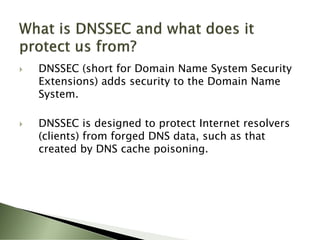
   DNSSEC (short for Domain Name System Security
    Extensions) adds security to the Domain Name
    System.

   DNSSEC is designed to protect Internet resolvers
    (clients) from forged DNS data, such as that
    created by DNS cache poisoning.
   Currently, a DNS resolver sends a query out to the
    Internet and then accepts the first response it
    receives, without question.
   If a malicious system were to send back an incorrect
    response, the resolver would use this address until
    its cache expired.

   This is bad enough if a single user's computer gets
    this bad data, but it is much worse if it's another
    name server that answers queries for an ISP –
    affecting thousands of users.
   It provides proof that DNS data has not been
    modified in transit to the end-user

   It does this by providing additional information,
    something like a “seal of origin”, that can be verified
    as being correct or not.

   It is a set of extensions to DNS, which provide:
       a) origin authentication of DNS data,
       b) data integrity, and
       c) authenticated denial of existence.
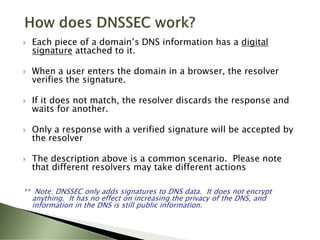
   Each piece of a domain’s DNS information has a digital
    signature attached to it.

   When a user enters the domain in a browser, the resolver
    verifies the signature.

   If it does not match, the resolver discards the response and
    waits for another.

   Only a response with a verified signature will be accepted by
    the resolver

   The description above is a common scenario. Please note
    that different resolvers may take different actions

** Note: DNSSEC only adds signatures to DNS data. It does not encrypt
  anything. It has no effect on increasing the privacy of the DNS, and
  information in the DNS is still public information.
End User Benefits
 Ensures you are communicating to the correct
  website
 End Users that are not DNSSEC aware will not see
  any adverse effect.

Registrant Benefits
 Mitigates the risk of possible fraud

 Greater protection of brand
 ◦ Significantly decreases the threat of domain hijacking
Registrar Benefits
 Ability to meet Registrant demands for increase
  security of their domain
 Ability to continue to sell domains that are not
  secured by DNSSEC for those registrants who are not
  interested.
 Complying with new industry standards


Registry Benefits
 Meeting new industry standards

 Ability to meet Registrar demands for increase
  security of their portfolio of domains
   Top five perceptions of the .ORG Brand*
    ◦   Informative
    ◦   Well-Intentioned
    ◦   Trustworthy
    ◦   Valuable Information
    ◦   Reliable


    We expect to keep it that way!

                       * Source: e5 Marketing Survey of over 10,000 respondents in an electronic form,
                       November 2008
                                                                                                  12
   .ORG zone signed June 2, 2009

   Registrars can participate in the testing phase
     Registrars are encouraged to test in OTE
     A certification test will be required
      2 registrars have passed their certification test to date


   We have selected small set of domains and have
    manually inserted the DS records at the Registry

   Successful scheduled Key Rollovers
   Additional mandatory .ORG DNSSEC OT&E Test
    required

   Registrars must pass the OT&E Test to become
    DNSSEC Aware

   PIR will enable DNSSEC functionality for the
    Registrar after successful completion of the OT&E
    test.
   We expect to be done with our internal testing by
    Q409

   Estimated full production timeframe first half of
    2010 meaning registrars can submit live
    delegations
   A DNS resolver is the program on a user’s
    computer that sends the query to the DNS.
   Once a response is received, the resolver returns
    the response back to the end user’s application.


                     domain.org?

                       192.0.5.4

        User’s PC
        Resolver
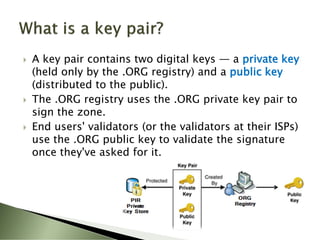
   A key pair contains two digital keys — a private key
    (held only by the .ORG registry) and a public key
    (distributed to the public).
   The .ORG registry uses the .ORG private key pair to
    sign the zone.
   End users' validators (or the validators at their ISPs)
    use the .ORG public key to validate the signature
    once they've asked for it.
If I trust a public key from someone, I can use that key to verify
    the signature … and authenticate the source

   Make sure the root zone key can be trusted
    ◦ Pointers in the root zone point to lower zones
      (org/com/info/de etc)
    ◦ Each pointer is validated with the previous validated
      zone key

   When DNSSEC is fully deployed, only the key for the
    root zone is needed to validate all the DNSSEC keys
    on the Internet
Root Servers


                                                  .org authoritative NS

                       Local
                       Cache


                               Recursive
                               DNS Server


 Local
 cache


                                                domain.org authoritative NS


User’s PC   Resolver                               Confidential – Copyright
                                                   2008 Afilias Limited
Root Servers


                                DNSSEC        DNSSEC     .ORG authoritative NS


                         Recursive
                         DNS Server          DNSSEC


Local cache

                                                       domain.ORG authoritative NS


User’s PC     Resolver                                    Confidential – Copyright
                                                          2008 Afilias Limited
   A key rollover will occur when the .ORG registry
    needs to change its side of a key pair.

   This means that the entire pair needs to be
    changed
    ◦ The .ORG zone will need to be re-signed with a
      new private key
              AND
    ◦ The public will need to update their validating
      resolvers with the new public portion of the .ORG
      zone key.
PIR will be required to do Key Rollovers on a regular
  basis:

  1. If one of the .ORG private keys were compromised
     (i.e., stolen) and had to be immediately revoked.

  2. For prevention of compromise (see next question
     for further information), where a key rollover
     would be scheduled at regular intervals.
   Digital signatures are not secure all of the time.
    They are subject to cryptanalysis.

   It is possible for an attacker to learn the private key
    in a key pair even though that key has never been
    disclosed, either through "brute force" or other
    types of attacks.

   Since every attack requires time to complete,
    periodically changing the key decreases the length
    of time an attacker has to attempt the compromise.
What would happen if end users do not update their
 validating resolvers with the new .ORG zone key?

   Once the old key is purged, domains in the .ORG
    zone that were signed would no longer resolve for
    those people who did not use the new .ORG key.

   It would not affect people that are not using
    DNSSEC – they would continue to see the domain
    name.
   A key rollover will be announced on the PIR Web
    site prior to the scheduled event

    Anyone using DNSSEC will have to watch for these
    announcements, specially ISPs, registrars, and
    people using DNSSEC in applications.
   Changes have been made to support the DNS
    protocol.
   Built New Registrar Tool Kit for DNSSEC
    ◦ Adds DNSSEC EPP transactions (RFC 4310)
   EPP server has been modified for DNSSEC
      Adds DNSSEC EPP transactions (as per RFC 4310)
   Changes to the Registry Database to now Store DS
    Information


                                           DNSSEC
   Covered in the ORG manual: Extensible Provisioning
    Protocol (EPP) v1.0 ORG DNSSEC Registrar Acceptance
    Criteria
   Registrars must test the basic operations that their
    client application can perform in the ORG DNSSEC
    registry environment including:
    ◦   Create Domain
    ◦   Create Domain with Optional Key Data
    ◦   Query Domain
    ◦   Query Domain with Optional Key Data
    ◦   Update Domain – Adding DS Data
    ◦   Update Domain – Changing DS Data
    ◦   Update Domain – Change to Include Optional Data
    ◦   Update Domain – Removing DS Data
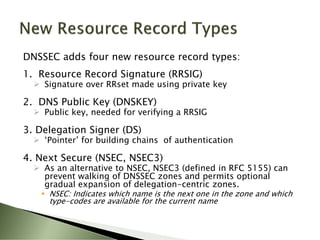
DNSSEC adds four new resource record types:
1. Resource Record Signature (RRSIG)
   Signature over RRset made using private key

2. DNS Public Key (DNSKEY)
   Public key, needed for verifying a RRSIG

3. Delegation Signer (DS)
   ‘Pointer’ for building chains of authentication

4. Next Secure (NSEC, NSEC3)
   As an alternative to NSEC, NSEC3 (defined in RFC 5155) can
    prevent walking of DNSSEC zones and permits optional
    gradual expansion of delegation-centric zones.
    NSEC: Indicates which name is the next one in the zone and which
     type-codes are available for the current name
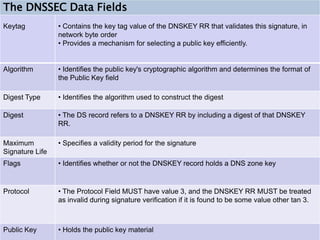
The DNSSEC Data Fields
Keytag           • Contains the key tag value of the DNSKEY RR that validates this signature, in
                 network byte order
                 • Provides a mechanism for selecting a public key efficiently.


Algorithm        • Identifies the public key's cryptographic algorithm and determines the format of
                 the Public Key field

Digest Type      • Identifies the algorithm used to construct the digest

Digest           • The DS record refers to a DNSKEY RR by including a digest of that DNSKEY
                 RR.

Maximum          • Specifies a validity period for the signature
Signature Life
Flags            • Identifies whether or not the DNSKEY record holds a DNS zone key


Protocol         • The Protocol Field MUST have value 3, and the DNSKEY RR MUST be treated
                 as invalid during signature verification if it is found to be some value other tan 3.


                                                                             Confidential – Copyright
Public Key       • Holds the public key material                             2005 Afilias Limited
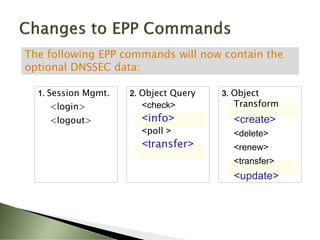
The following EPP commands will now contain the
optional DNSSEC data:

  1. Session Mgmt.   2. Object Query   3. Object
    <login>            <check>           Transform
    <logout>           <info>            <create>
                       <poll >           <delete>
                       <transfer>        <renew>
                                         <transfer>
                                         <update>
   Create Domain is changed because a DNSSEC
    secure domain must be created with a DS record
    attached to it

   Registrar needs to be accredited for creating
    domain names with DS records

   If they are not, the system will reject the domain
    create command and throw a validation error – You
    are not authorized to perform this action.
   If the maxSigLife is not entered for a <create>
    domain name with DS records, the system will set it
    to the default value (40 days)
   If the user provides empty tags for the following
    parameters, the domain will not be created and an
    error message will be returned:
    ◦ secDNS:keyTag
    ◦ secDNS:alg
    ◦ secDNS:digestType
   <update> domain command is now changed as DS
    information can be added or changed for each domain
   If the Registrar is not accredited for creating domain
    names with DS records and attempts to add DS data to
    an existing domain name, the system will reject the
    domain update command and return an error
   If the domain name already has 10 DS records and the
    sponsoring Registrar attempts to add another, the
    system will reject the domain update command and
    return an error per EPP RFC 3730.
   If the maxSigLife is not entered for a domain name with
    DS records, the system will set it to the default value
    (40 days)
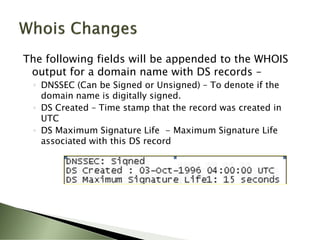
The following fields will be appended to the WHOIS
 output for a domain name with DS records –
 ◦ DNSSEC (Can be Signed or Unsigned) – To denote if the
   domain name is digitally signed.
 ◦ DS Created – Time stamp that the record was created in
   UTC
 ◦ DS Maximum Signature Life - Maximum Signature Life
   associated with this DS record
    If a domain name has more than one DS record
    associated with it, the DS record information for all
    the records will be displayed one after the other as
    displayed in the screenshot (above) If a domain
    name does not have any DS records associated with
    it, the DNSSEC value displayed will be Unsigned
   .ORG OT&E Test Criteria
   General FAQ
   ORG manual: Extensible Provisioning Protocol (EPP)
    v1.0 ORG DNSSEC Registrar Acceptance Criteria
   Registrar Tool Kit (RTK – Addon) including the
    DNSSEC extensions is available for download from:
    ◦ https://registrars.pir.org/registrar_relations/dns_
      security
    ◦ www.sourceforge.net
The Domain Name System Security Extensions
 (DNSSEC are described in these IETF documents:
 ◦ RFC 4033: DNS Security Introduction and Requirements
 ◦ RFC 4034: Resource Records for the DNS Security
   Extensions
 ◦ RFC 4035: Protocol Modifications for the DNS Security
   Extensions

.ORG website
  ◦ http://www.pir.org/dnssec


DNSSEC related information website
 www.dnssec-deployment.org
 www.dnssec.net
Questions?

DNSSEC: What a Registrar Needs to Know

  • 1.
    DNSSEC Industry Coalition Webinar Series Brought to you by .ORG, The Public Interest Registry and Afilias
  • 2.
    Lauren Price, DNSSEC Industry Coalition Chair ◦ Sr. Product Marketing Manager, .ORG The Public Interest Registry ◦ lprice@pir.org  Jim Galvin, Afilias ◦ Director, Strategic Relationships & Technical Standards ◦ jgalvin@afilias.info  Sadik Chandiwala, Afilias ◦ Technical Account Manager ◦ sadik@ca.afilias.info 2
  • 3.
    The Vulnerability of DNS  Quick Intro to DNSSEC  PIR and DNSSEC Timeline  Friends and Family Program  Some DNSSEC Terminology  OT&E Functionality and Changes ◦ EPP ◦ Etc.  Resources  Questions
  • 4.
    When you visit a web site, send an email, or download software, can you be sure you are communicating with the server that you think you are?  The answer is ‘no’, at least not with certainty.
  • 5.
    DNSSEC (short for Domain Name System Security Extensions) adds security to the Domain Name System.  DNSSEC is designed to protect Internet resolvers (clients) from forged DNS data, such as that created by DNS cache poisoning.
  • 6.
    Currently, a DNS resolver sends a query out to the Internet and then accepts the first response it receives, without question.  If a malicious system were to send back an incorrect response, the resolver would use this address until its cache expired.  This is bad enough if a single user's computer gets this bad data, but it is much worse if it's another name server that answers queries for an ISP – affecting thousands of users.
  • 7.
    It provides proof that DNS data has not been modified in transit to the end-user  It does this by providing additional information, something like a “seal of origin”, that can be verified as being correct or not.  It is a set of extensions to DNS, which provide: a) origin authentication of DNS data, b) data integrity, and c) authenticated denial of existence.
  • 8.
    Each piece of a domain’s DNS information has a digital signature attached to it.  When a user enters the domain in a browser, the resolver verifies the signature.  If it does not match, the resolver discards the response and waits for another.  Only a response with a verified signature will be accepted by the resolver  The description above is a common scenario. Please note that different resolvers may take different actions ** Note: DNSSEC only adds signatures to DNS data. It does not encrypt anything. It has no effect on increasing the privacy of the DNS, and information in the DNS is still public information.
  • 9.
    End User Benefits Ensures you are communicating to the correct website  End Users that are not DNSSEC aware will not see any adverse effect. Registrant Benefits  Mitigates the risk of possible fraud  Greater protection of brand ◦ Significantly decreases the threat of domain hijacking
  • 10.
    Registrar Benefits  Abilityto meet Registrant demands for increase security of their domain  Ability to continue to sell domains that are not secured by DNSSEC for those registrants who are not interested.  Complying with new industry standards Registry Benefits  Meeting new industry standards  Ability to meet Registrar demands for increase security of their portfolio of domains
  • 12.
    Top five perceptions of the .ORG Brand* ◦ Informative ◦ Well-Intentioned ◦ Trustworthy ◦ Valuable Information ◦ Reliable We expect to keep it that way! * Source: e5 Marketing Survey of over 10,000 respondents in an electronic form, November 2008 12
  • 13.
    .ORG zone signed June 2, 2009  Registrars can participate in the testing phase  Registrars are encouraged to test in OTE  A certification test will be required  2 registrars have passed their certification test to date  We have selected small set of domains and have manually inserted the DS records at the Registry  Successful scheduled Key Rollovers
  • 14.
    Additional mandatory .ORG DNSSEC OT&E Test required  Registrars must pass the OT&E Test to become DNSSEC Aware  PIR will enable DNSSEC functionality for the Registrar after successful completion of the OT&E test.
  • 15.
    We expect to be done with our internal testing by Q409  Estimated full production timeframe first half of 2010 meaning registrars can submit live delegations
  • 17.
    A DNS resolver is the program on a user’s computer that sends the query to the DNS.  Once a response is received, the resolver returns the response back to the end user’s application. domain.org? 192.0.5.4 User’s PC Resolver
  • 18.
    A key pair contains two digital keys — a private key (held only by the .ORG registry) and a public key (distributed to the public).  The .ORG registry uses the .ORG private key pair to sign the zone.  End users' validators (or the validators at their ISPs) use the .ORG public key to validate the signature once they've asked for it.
  • 19.
    If I trusta public key from someone, I can use that key to verify the signature … and authenticate the source  Make sure the root zone key can be trusted ◦ Pointers in the root zone point to lower zones (org/com/info/de etc) ◦ Each pointer is validated with the previous validated zone key  When DNSSEC is fully deployed, only the key for the root zone is needed to validate all the DNSSEC keys on the Internet
  • 20.
    Root Servers .org authoritative NS Local Cache Recursive DNS Server Local cache domain.org authoritative NS User’s PC Resolver Confidential – Copyright 2008 Afilias Limited
  • 21.
    Root Servers DNSSEC DNSSEC .ORG authoritative NS Recursive DNS Server DNSSEC Local cache domain.ORG authoritative NS User’s PC Resolver Confidential – Copyright 2008 Afilias Limited
  • 22.
    A key rollover will occur when the .ORG registry needs to change its side of a key pair.  This means that the entire pair needs to be changed ◦ The .ORG zone will need to be re-signed with a new private key AND ◦ The public will need to update their validating resolvers with the new public portion of the .ORG zone key.
  • 23.
    PIR will berequired to do Key Rollovers on a regular basis: 1. If one of the .ORG private keys were compromised (i.e., stolen) and had to be immediately revoked. 2. For prevention of compromise (see next question for further information), where a key rollover would be scheduled at regular intervals.
  • 24.
    Digital signatures are not secure all of the time. They are subject to cryptanalysis.  It is possible for an attacker to learn the private key in a key pair even though that key has never been disclosed, either through "brute force" or other types of attacks.  Since every attack requires time to complete, periodically changing the key decreases the length of time an attacker has to attempt the compromise.
  • 25.
    What would happenif end users do not update their validating resolvers with the new .ORG zone key?  Once the old key is purged, domains in the .ORG zone that were signed would no longer resolve for those people who did not use the new .ORG key.  It would not affect people that are not using DNSSEC – they would continue to see the domain name.
  • 26.
    A key rollover will be announced on the PIR Web site prior to the scheduled event  Anyone using DNSSEC will have to watch for these announcements, specially ISPs, registrars, and people using DNSSEC in applications.
  • 27.
    Changes have been made to support the DNS protocol.  Built New Registrar Tool Kit for DNSSEC ◦ Adds DNSSEC EPP transactions (RFC 4310)  EPP server has been modified for DNSSEC  Adds DNSSEC EPP transactions (as per RFC 4310)  Changes to the Registry Database to now Store DS Information DNSSEC
  • 28.
    Covered in the ORG manual: Extensible Provisioning Protocol (EPP) v1.0 ORG DNSSEC Registrar Acceptance Criteria  Registrars must test the basic operations that their client application can perform in the ORG DNSSEC registry environment including: ◦ Create Domain ◦ Create Domain with Optional Key Data ◦ Query Domain ◦ Query Domain with Optional Key Data ◦ Update Domain – Adding DS Data ◦ Update Domain – Changing DS Data ◦ Update Domain – Change to Include Optional Data ◦ Update Domain – Removing DS Data
  • 29.
    DNSSEC adds fournew resource record types: 1. Resource Record Signature (RRSIG)  Signature over RRset made using private key 2. DNS Public Key (DNSKEY)  Public key, needed for verifying a RRSIG 3. Delegation Signer (DS)  ‘Pointer’ for building chains of authentication 4. Next Secure (NSEC, NSEC3)  As an alternative to NSEC, NSEC3 (defined in RFC 5155) can prevent walking of DNSSEC zones and permits optional gradual expansion of delegation-centric zones.  NSEC: Indicates which name is the next one in the zone and which type-codes are available for the current name
  • 30.
    The DNSSEC DataFields Keytag • Contains the key tag value of the DNSKEY RR that validates this signature, in network byte order • Provides a mechanism for selecting a public key efficiently. Algorithm • Identifies the public key's cryptographic algorithm and determines the format of the Public Key field Digest Type • Identifies the algorithm used to construct the digest Digest • The DS record refers to a DNSKEY RR by including a digest of that DNSKEY RR. Maximum • Specifies a validity period for the signature Signature Life Flags • Identifies whether or not the DNSKEY record holds a DNS zone key Protocol • The Protocol Field MUST have value 3, and the DNSKEY RR MUST be treated as invalid during signature verification if it is found to be some value other tan 3. Confidential – Copyright Public Key • Holds the public key material 2005 Afilias Limited
  • 31.
    The following EPPcommands will now contain the optional DNSSEC data: 1. Session Mgmt. 2. Object Query 3. Object <login> <check> Transform <logout> <info> <create> <poll > <delete> <transfer> <renew> <transfer> <update>
  • 32.
    Create Domain is changed because a DNSSEC secure domain must be created with a DS record attached to it  Registrar needs to be accredited for creating domain names with DS records  If they are not, the system will reject the domain create command and throw a validation error – You are not authorized to perform this action.
  • 33.
    If the maxSigLife is not entered for a <create> domain name with DS records, the system will set it to the default value (40 days)  If the user provides empty tags for the following parameters, the domain will not be created and an error message will be returned: ◦ secDNS:keyTag ◦ secDNS:alg ◦ secDNS:digestType
  • 34.
    <update> domain command is now changed as DS information can be added or changed for each domain  If the Registrar is not accredited for creating domain names with DS records and attempts to add DS data to an existing domain name, the system will reject the domain update command and return an error  If the domain name already has 10 DS records and the sponsoring Registrar attempts to add another, the system will reject the domain update command and return an error per EPP RFC 3730.  If the maxSigLife is not entered for a domain name with DS records, the system will set it to the default value (40 days)
  • 35.
    The following fieldswill be appended to the WHOIS output for a domain name with DS records – ◦ DNSSEC (Can be Signed or Unsigned) – To denote if the domain name is digitally signed. ◦ DS Created – Time stamp that the record was created in UTC ◦ DS Maximum Signature Life - Maximum Signature Life associated with this DS record
  • 36.
    If a domain name has more than one DS record associated with it, the DS record information for all the records will be displayed one after the other as displayed in the screenshot (above) If a domain name does not have any DS records associated with it, the DNSSEC value displayed will be Unsigned
  • 37.
    .ORG OT&E Test Criteria  General FAQ  ORG manual: Extensible Provisioning Protocol (EPP) v1.0 ORG DNSSEC Registrar Acceptance Criteria  Registrar Tool Kit (RTK – Addon) including the DNSSEC extensions is available for download from: ◦ https://registrars.pir.org/registrar_relations/dns_ security ◦ www.sourceforge.net
  • 38.
    The Domain NameSystem Security Extensions (DNSSEC are described in these IETF documents: ◦ RFC 4033: DNS Security Introduction and Requirements ◦ RFC 4034: Resource Records for the DNS Security Extensions ◦ RFC 4035: Protocol Modifications for the DNS Security Extensions .ORG website ◦ http://www.pir.org/dnssec DNSSEC related information website www.dnssec-deployment.org www.dnssec.net
  • 39.