
Deep Learning on
Everyday Devices
Amir Alush, CTO & co founder, IMVC 2018
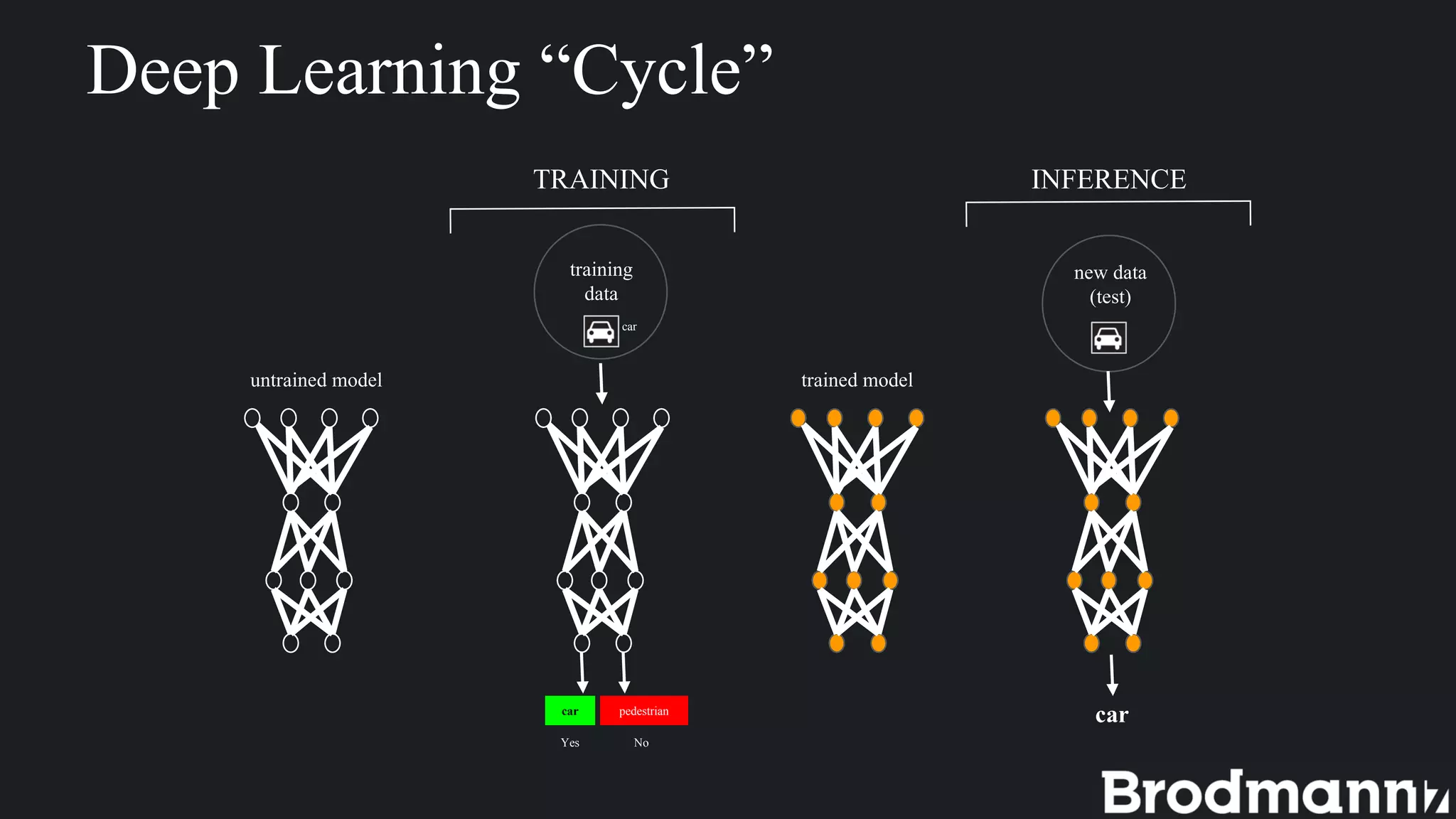
Deep Learning “Cycle”
untrained model
new data
(test)
training
data
trained model
car
car pedestrian
Yes No
car
TRAINING INFERENCE
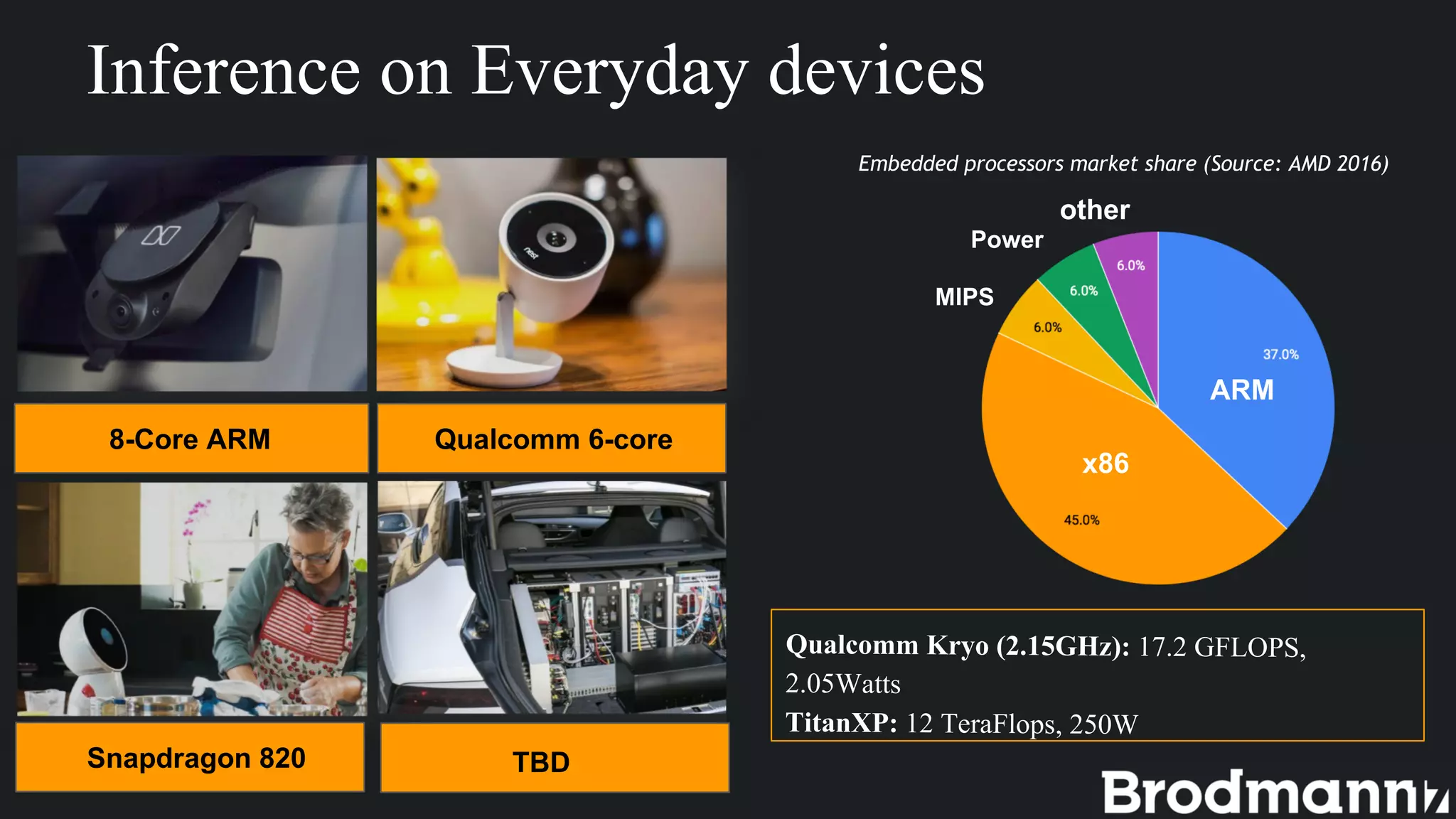
Inference on Everyday devices
8-Core ARM Qualcomm 6-core
Snapdragon 820 TBD
ARM
x86
MIPS
Power
other
Embedded processors market share (Source: AMD 2016)
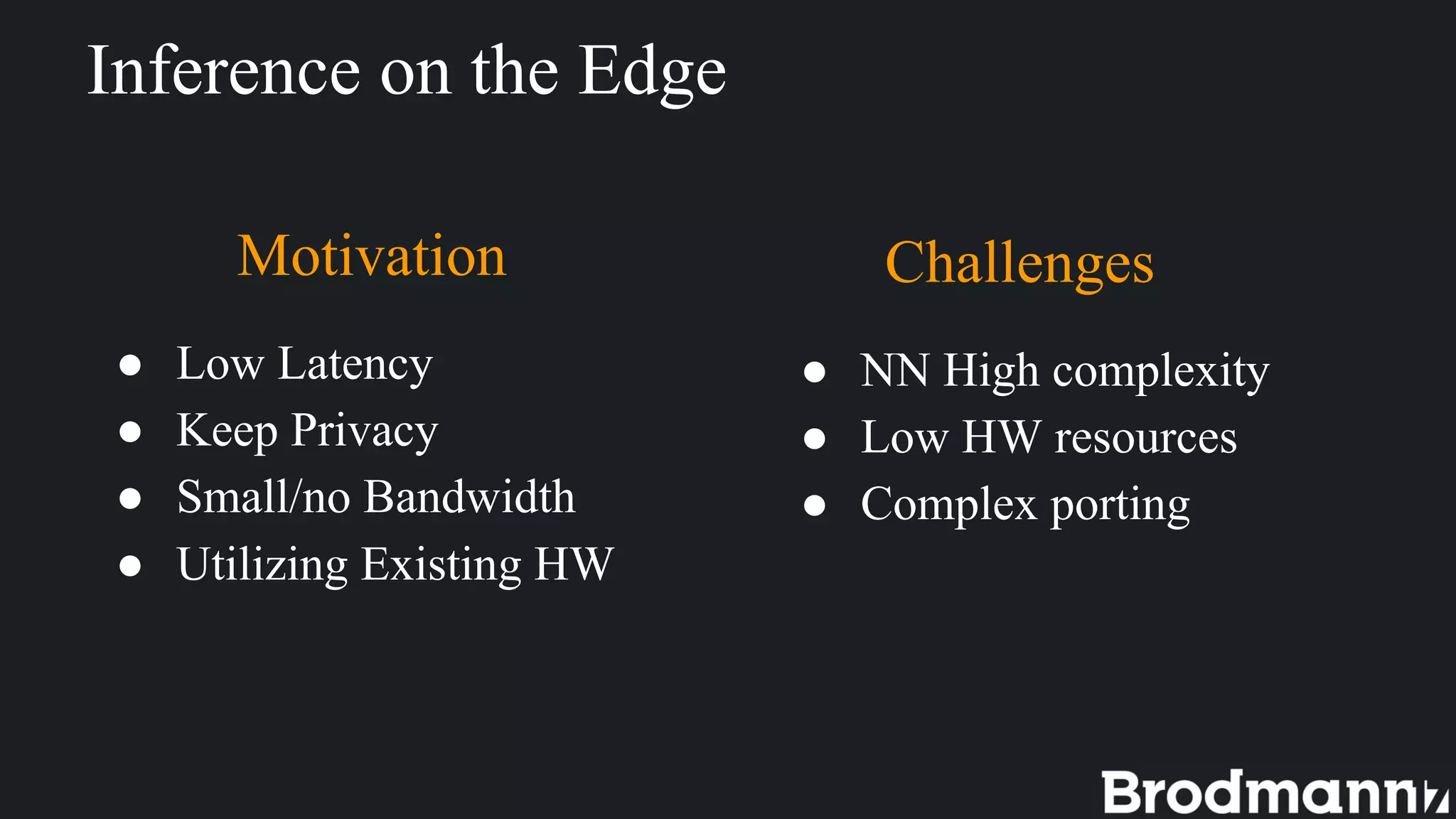
Inference on the Edge
Motivation
● Low Latency
● Keep Privacy
● Small/no Bandwidth
● Utilizing Existing HW
Challenges
● NN High complexity
● Low HW resources
● Complex porting
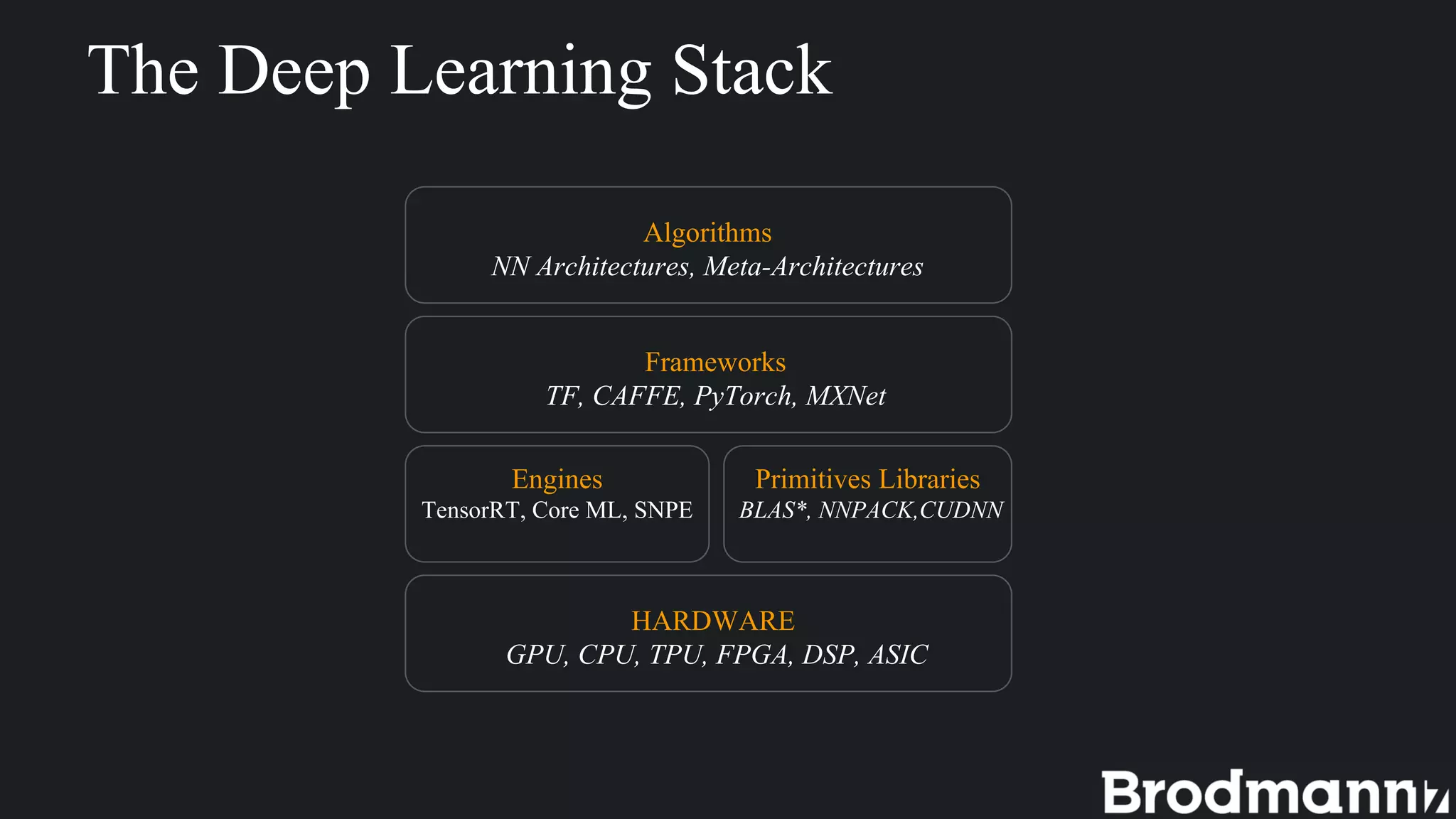
The Deep Learning Stack
HARDWARE
GPU, CPU, TPU, FPGA, DSP, ASIC
Primitives Libraries
BLAS*, NNPACK,CUDNN
Frameworks
TF, CAFFE, PyTorch, MXNet
Algorithms
NN Architectures, Meta-Architectures
Engines
TensorRT, Core ML, SNPE
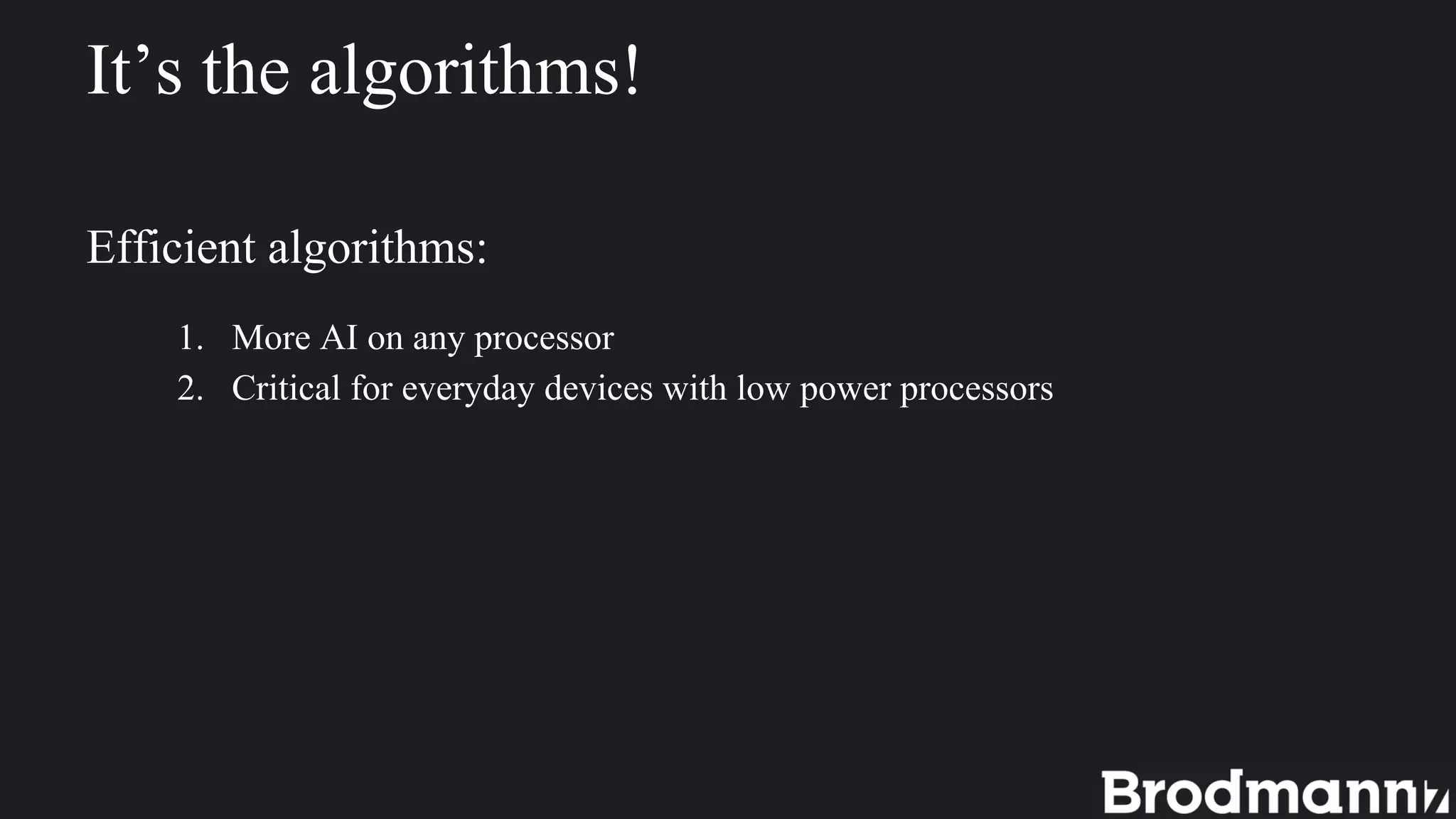
It’s the algorithms!
Efficient algorithms:
1. More AI on any processor
2. Critical for everyday devices with low power processors
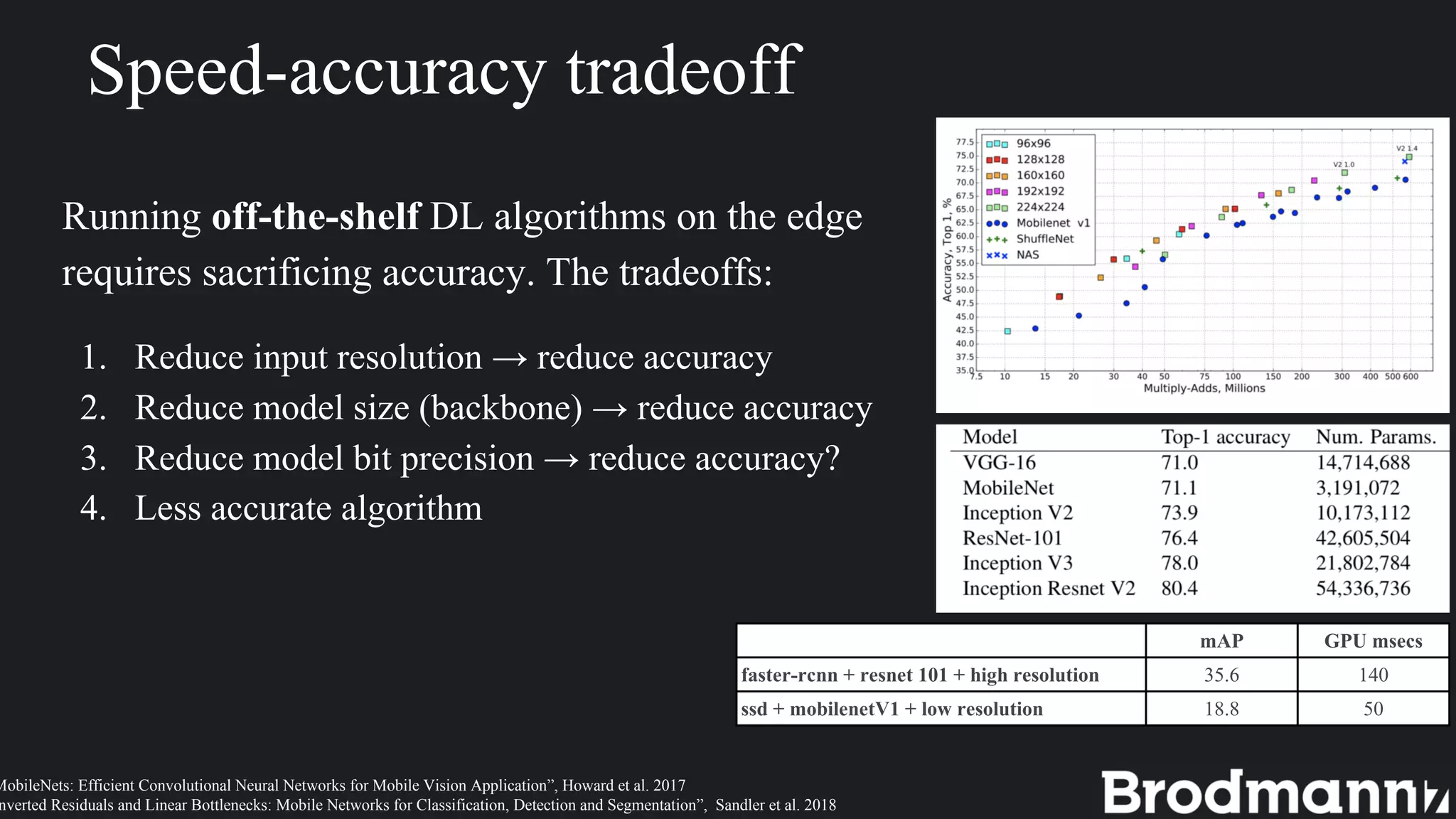
Speed-accuracy tradeoff
Running off-the-shelf DL algorithms on the edge
requires sacrificing accuracy. The tradeoffs:
1. Reduce input resolution → reduce accuracy
2. Reduce model size (backbone) → reduce accuracy
3. Reduce model bit precision → reduce accuracy?
4. Less accurate algorithm
MobileNets: Efficient Convolutional Neural Networks for Mobile Vision Application”, Howard et al. 2017
nverted Residuals and Linear Bottlenecks: Mobile Networks for Classification, Detection and Segmentation”, Sandler et al. 2018
mAP GPU msecs
faster-rcnn + resnet 101 + high resolution 35.6 140
ssd + mobilenetV1 + low resolution 18.8 50
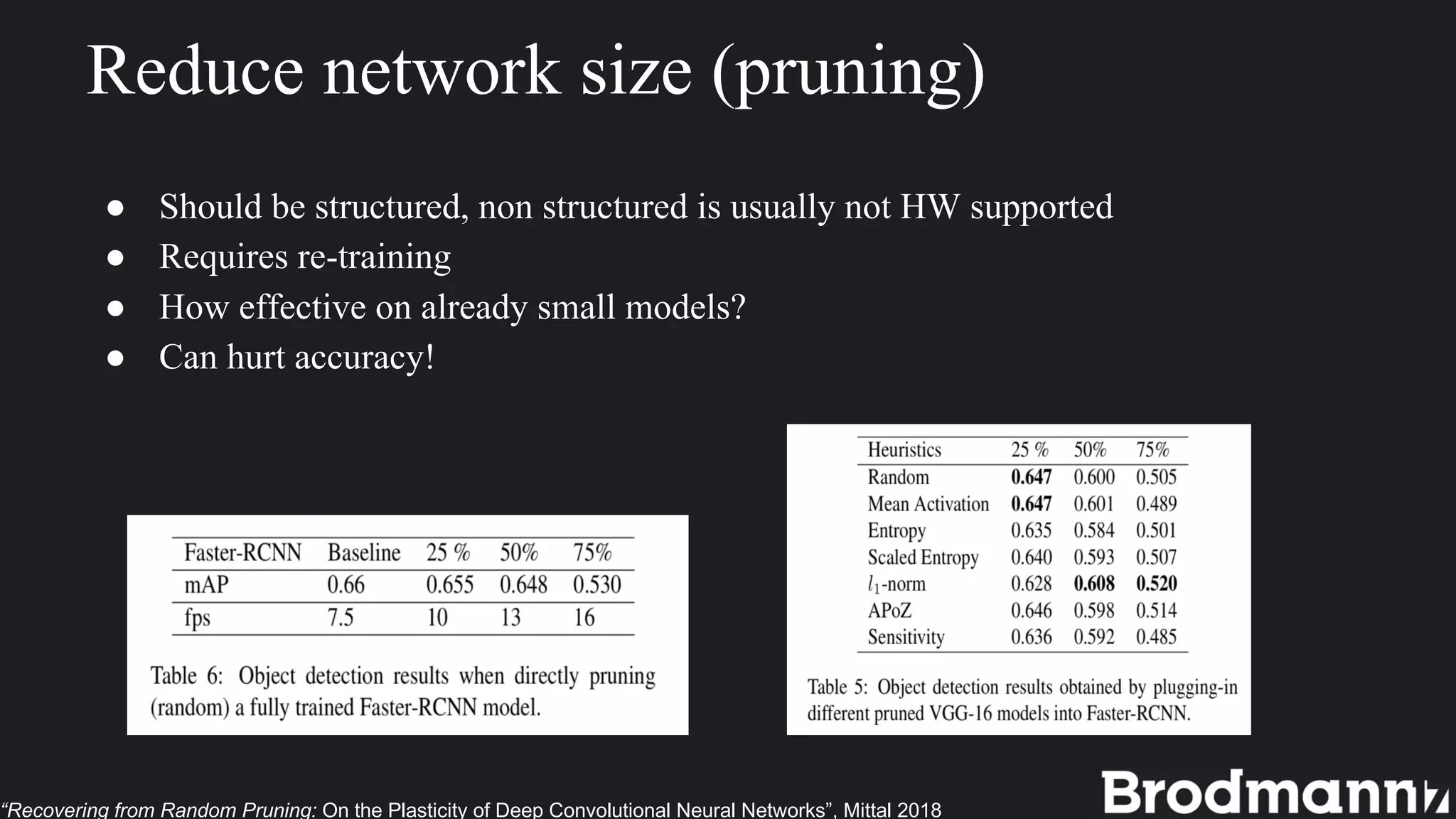
Reduce network size (pruning)
● Should be structured, non structured is usually not HW supported
● Requires re-training
● How effective on already small models?
● Can hurt accuracy!
“Recovering from Random Pruning: On the Plasticity of Deep Convolutional Neural Networks”, Mittal 2018
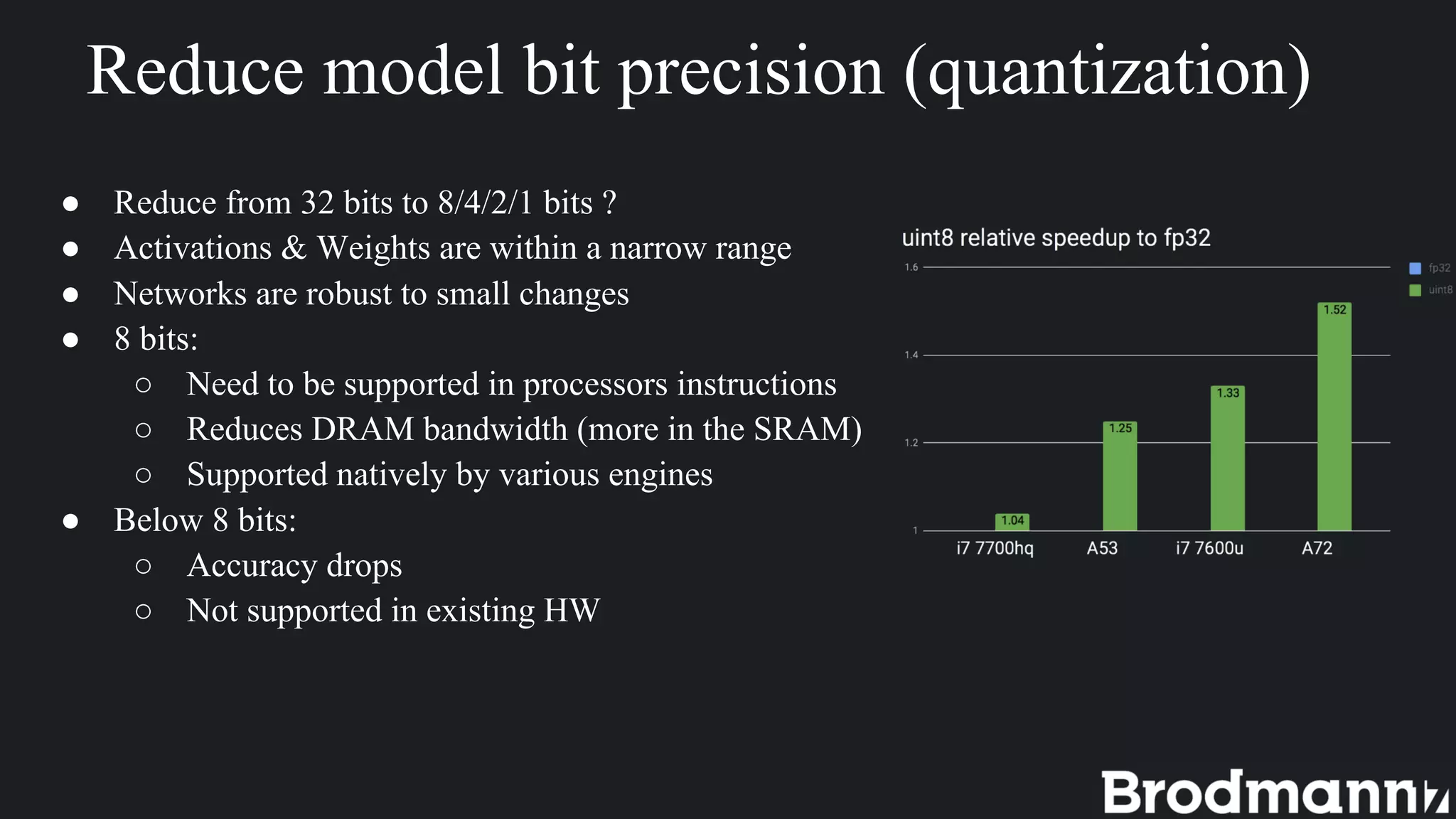
Reduce model bit precision (quantization)
● Reduce from 32 bits to 8/4/2/1 bits ?
● Activations & Weights are within a narrow range
● Networks are robust to small changes
● 8 bits:
○ Need to be supported in processors instructions
○ Reduces DRAM bandwidth (more in the SRAM)
○ Supported natively by various engines
● Below 8 bits:
○ Accuracy drops
○ Not supported in existing HW
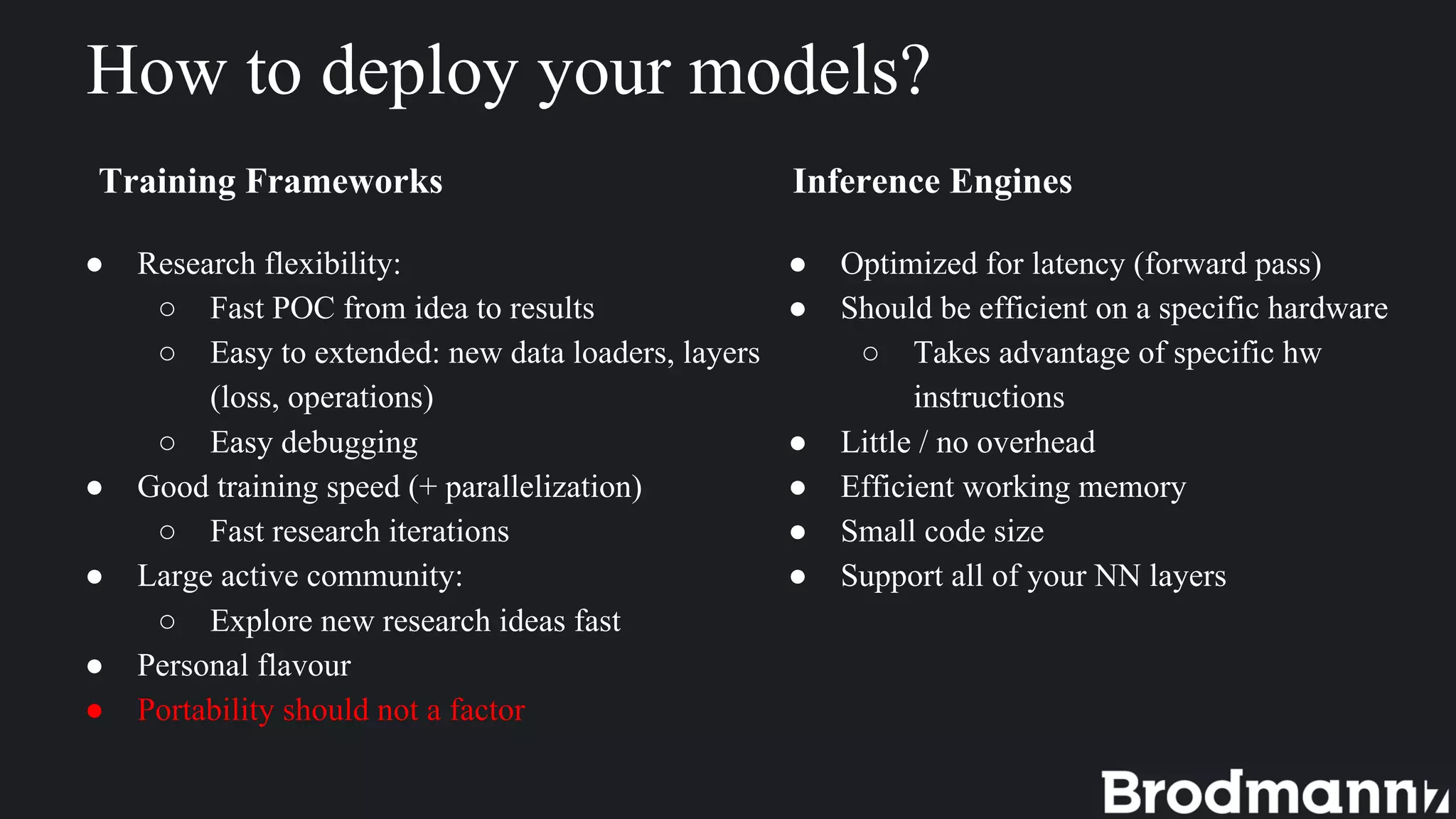
How to deploy your models?
Training Frameworks Inference Engines
● Research flexibility:
○ Fast POC from idea to results
○ Easy to extended: new data loaders, layers
(loss, operations)
○ Easy debugging
● Good training speed (+ parallelization)
○ Fast research iterations
● Large active community:
○ Explore new research ideas fast
● Personal flavour
● Portability should not a factor
● Optimized for latency (forward pass)
● Should be efficient on a specific hardware
○ Takes advantage of specific hw
instructions
● Little / no overhead
● Efficient working memory
● Small code size
● Support all of your NN layers
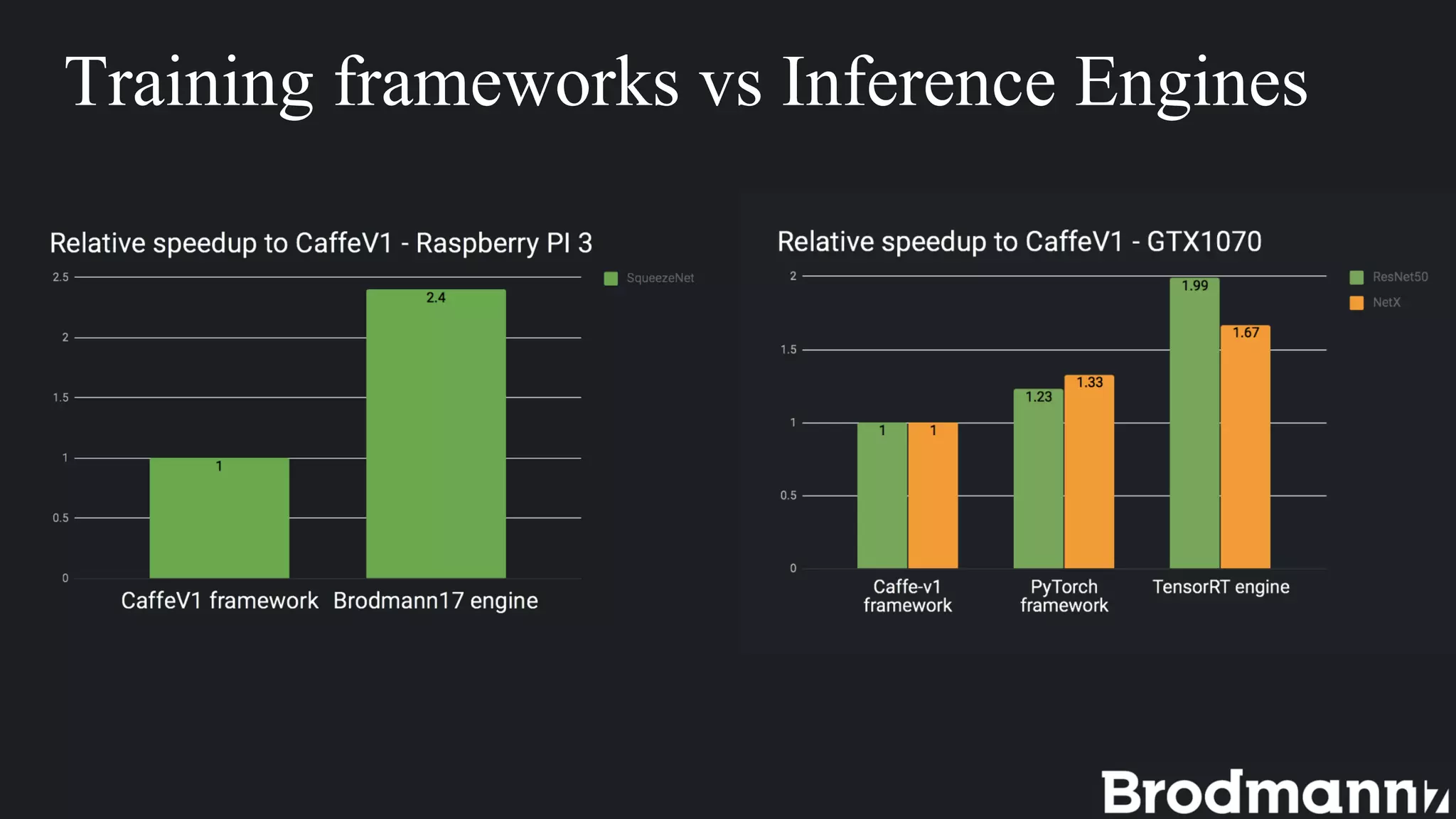
Training frameworks vs Inference Engines
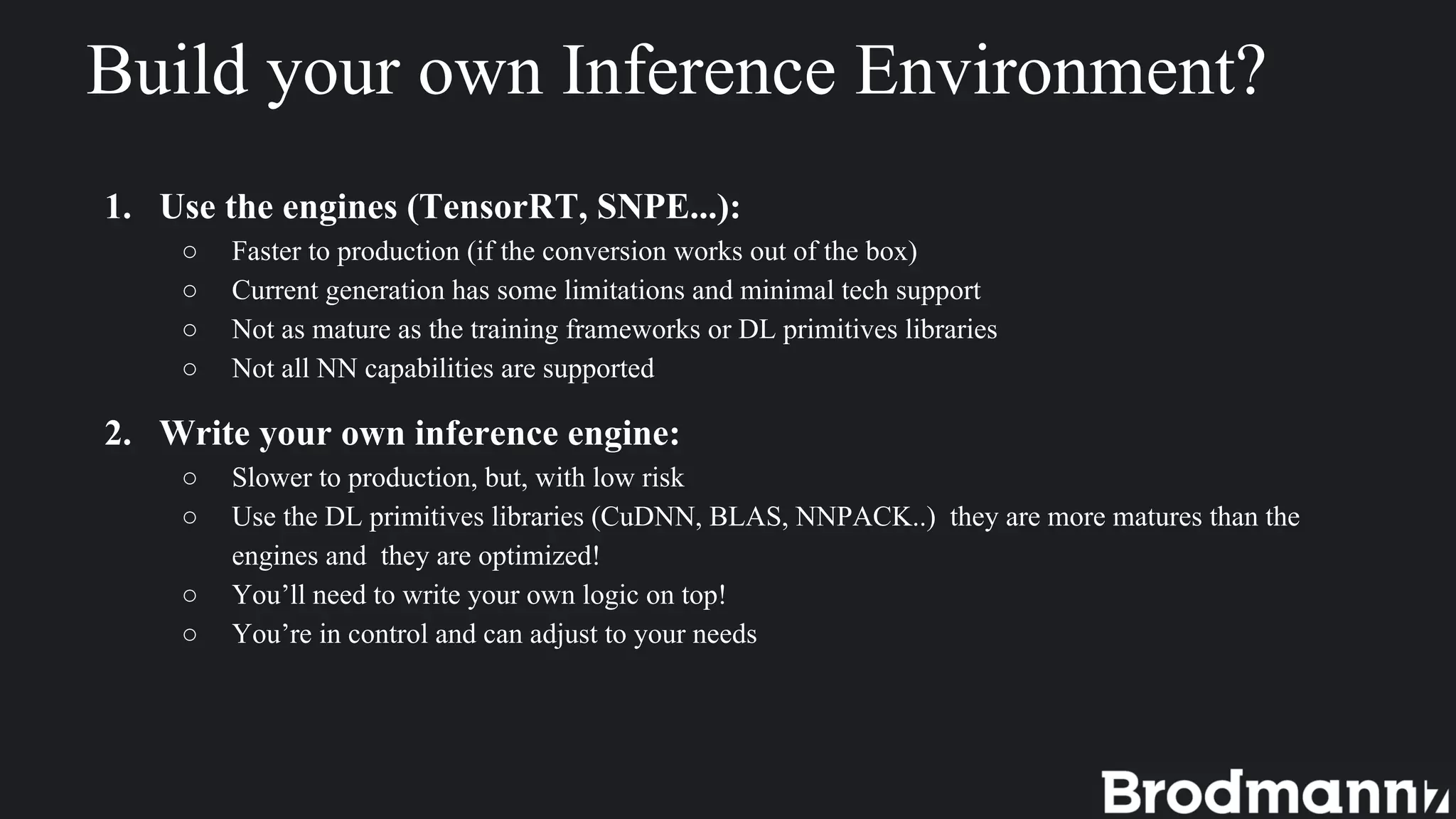
Build your own Inference Environment?
1. Use the engines (TensorRT, SNPE...):
○ Faster to production (if the conversion works out of the box)
○ Current generation has some limitations and minimal tech support
○ Not as mature as the training frameworks or DL primitives libraries
○ Not all NN capabilities are supported
2. Write your own inference engine:
○ Slower to production, but, with low risk
○ Use the DL primitives libraries (CuDNN, BLAS, NNPACK..) they are more matures than the
engines and they are optimized!
○ You’ll need to write your own logic on top!
○ You’re in control and can adjust to your needs
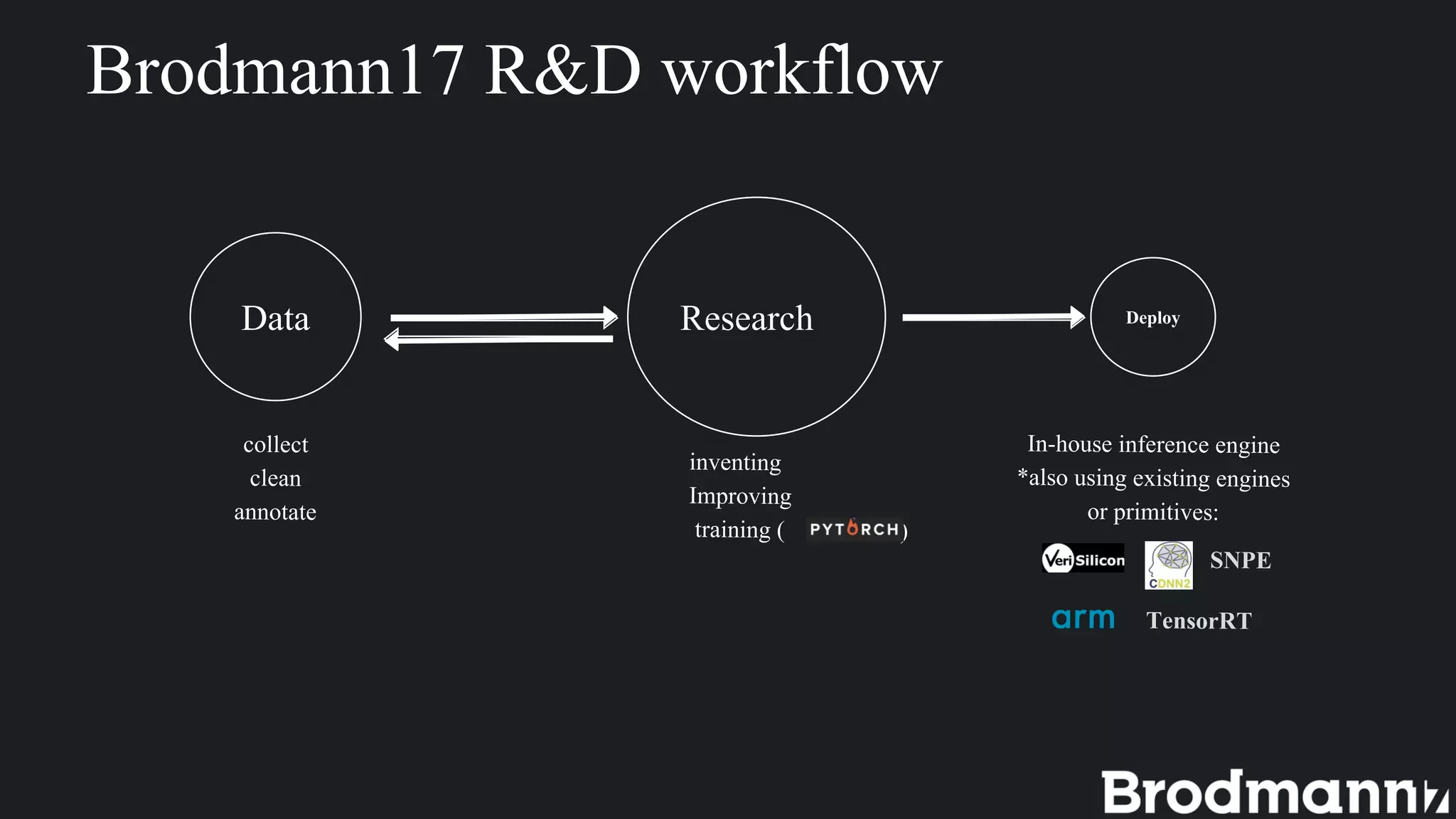
Brodmann17 R&D workflow
DeployData Research
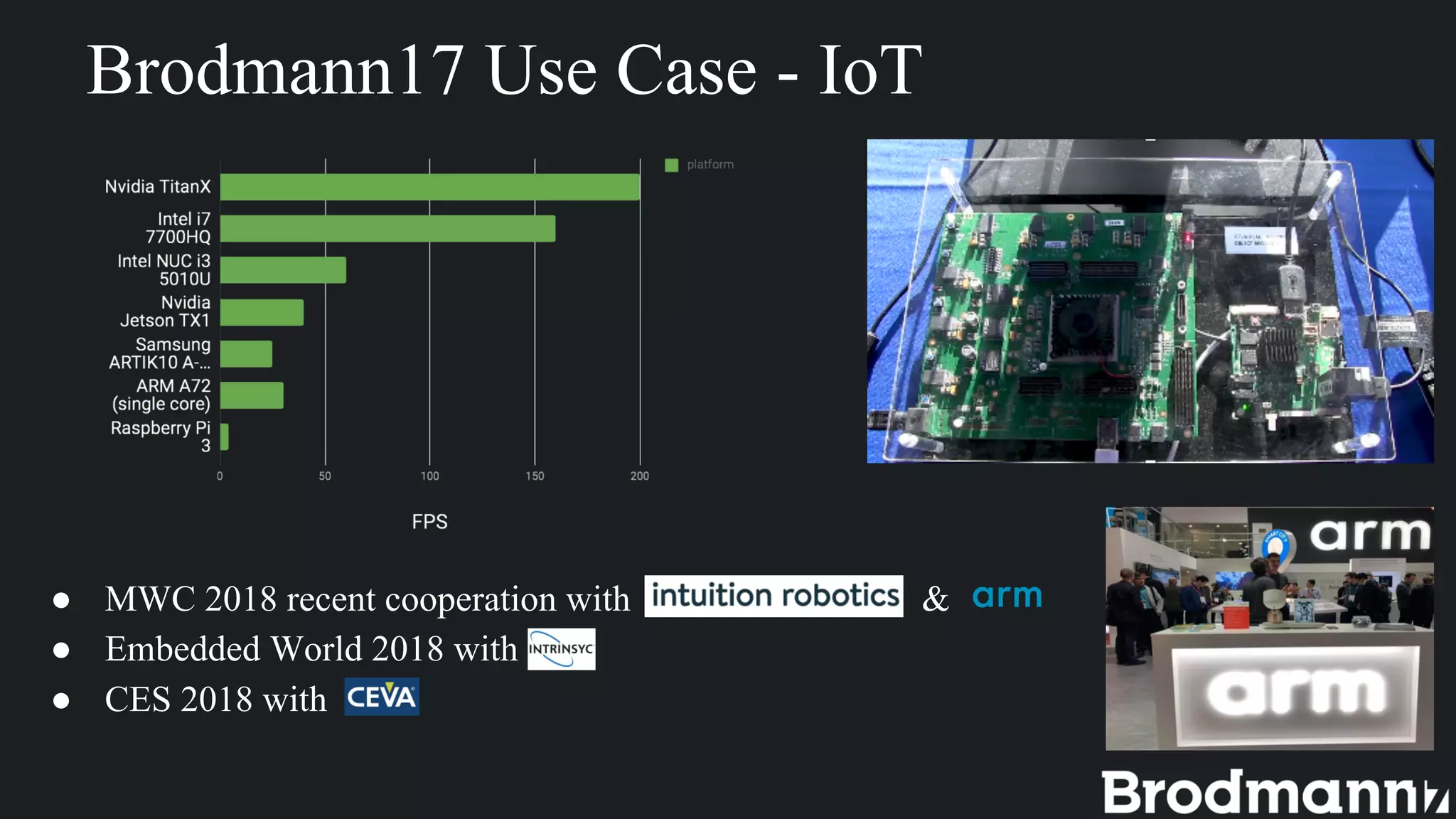
Brodmann17 Use Case - IoT
● MWC 2018 recent cooperation with &
● Embedded World 2018 with
● CES 2018 with
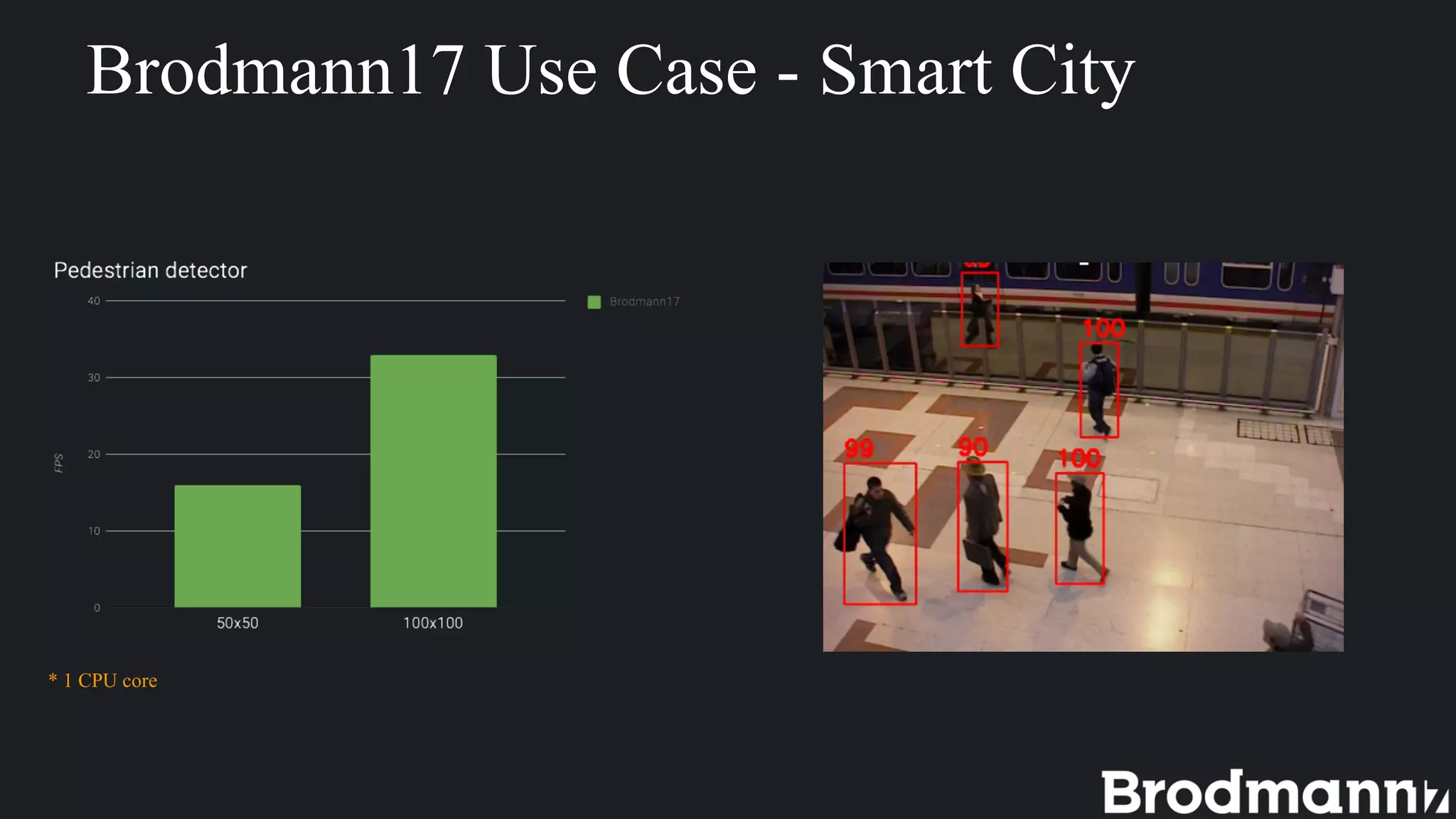
Brodmann17 Use Case - Smart City
* 1 CPU core
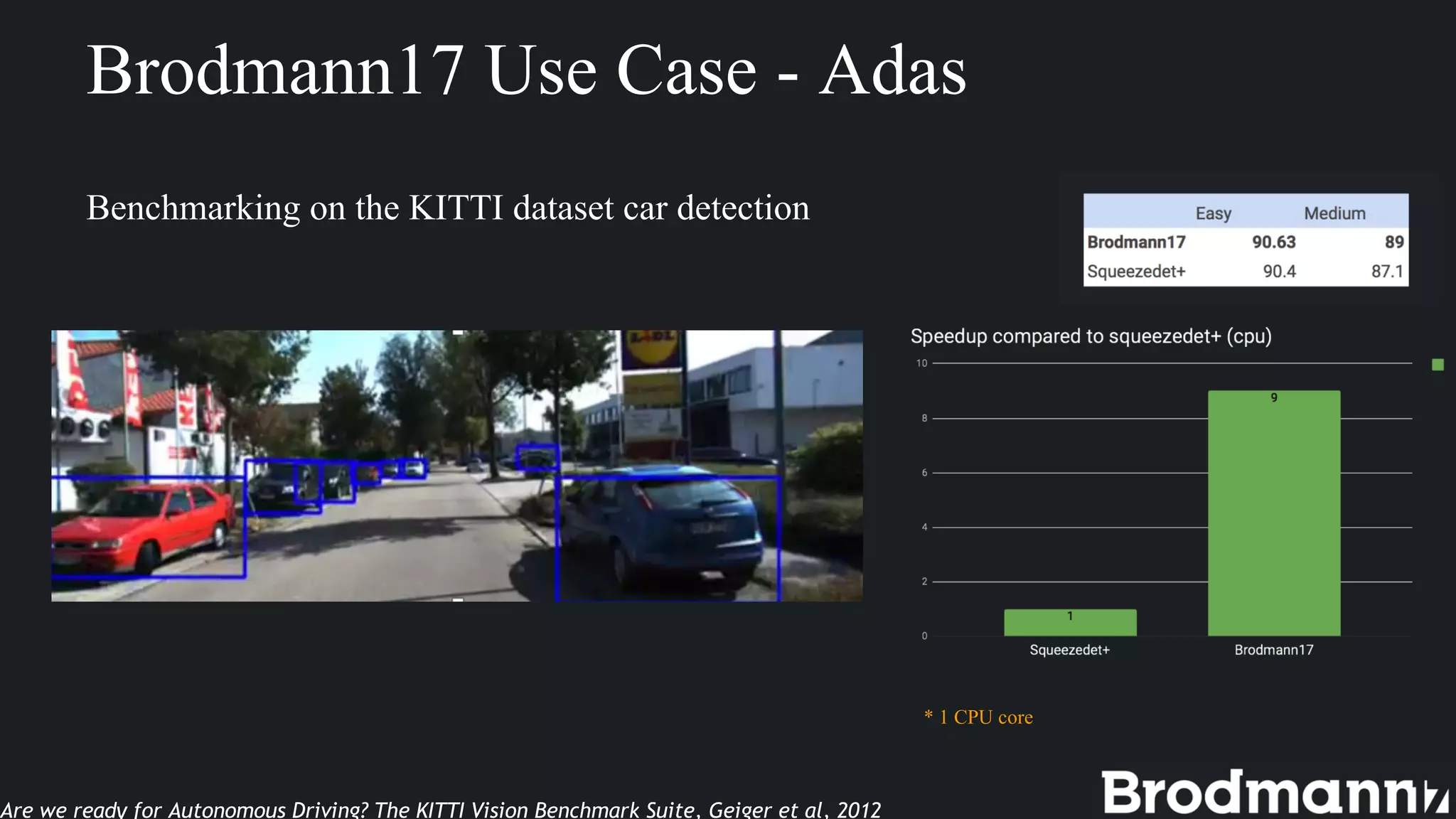
Brodmann17 Use Case - Adas
Benchmarking on the KITTI dataset car detection
* 1 CPU core
Are we ready for Autonomous Driving? The KITTI Vision Benchmark Suite, Geiger et al, 2012
1. motivation and challenges in NN edge processing
2. Speed accuracy tradeoffs made today
3. Brodmann17 key design principles for keeping efficiency and accuracy
on the edge
4. key considerations when choosing your inference environment
5. Brodmann17 example use cases
Summary

Deep Learning on Everyday Devices

  • 1.
    Deep Learning on EverydayDevices Amir Alush, CTO & co founder, IMVC 2018
  • 2.
    Deep Learning “Cycle” untrainedmodel new data (test) training data trained model car car pedestrian Yes No car TRAINING INFERENCE
  • 3.
    Inference on Everydaydevices 8-Core ARM Qualcomm 6-core Snapdragon 820 TBD ARM x86 MIPS Power other Embedded processors market share (Source: AMD 2016)
  • 4.
    Inference on theEdge Motivation ● Low Latency ● Keep Privacy ● Small/no Bandwidth ● Utilizing Existing HW Challenges ● NN High complexity ● Low HW resources ● Complex porting
  • 5.
    The Deep LearningStack HARDWARE GPU, CPU, TPU, FPGA, DSP, ASIC Primitives Libraries BLAS*, NNPACK,CUDNN Frameworks TF, CAFFE, PyTorch, MXNet Algorithms NN Architectures, Meta-Architectures Engines TensorRT, Core ML, SNPE
  • 6.
    It’s the algorithms! Efficientalgorithms: 1. More AI on any processor 2. Critical for everyday devices with low power processors
  • 7.
    Speed-accuracy tradeoff Running off-the-shelfDL algorithms on the edge requires sacrificing accuracy. The tradeoffs: 1. Reduce input resolution → reduce accuracy 2. Reduce model size (backbone) → reduce accuracy 3. Reduce model bit precision → reduce accuracy? 4. Less accurate algorithm MobileNets: Efficient Convolutional Neural Networks for Mobile Vision Application”, Howard et al. 2017 nverted Residuals and Linear Bottlenecks: Mobile Networks for Classification, Detection and Segmentation”, Sandler et al. 2018 mAP GPU msecs faster-rcnn + resnet 101 + high resolution 35.6 140 ssd + mobilenetV1 + low resolution 18.8 50
  • 8.
    Reduce network size(pruning) ● Should be structured, non structured is usually not HW supported ● Requires re-training ● How effective on already small models? ● Can hurt accuracy! “Recovering from Random Pruning: On the Plasticity of Deep Convolutional Neural Networks”, Mittal 2018
  • 9.
    Reduce model bitprecision (quantization) ● Reduce from 32 bits to 8/4/2/1 bits ? ● Activations & Weights are within a narrow range ● Networks are robust to small changes ● 8 bits: ○ Need to be supported in processors instructions ○ Reduces DRAM bandwidth (more in the SRAM) ○ Supported natively by various engines ● Below 8 bits: ○ Accuracy drops ○ Not supported in existing HW
  • 10.
    How to deployyour models? Training Frameworks Inference Engines ● Research flexibility: ○ Fast POC from idea to results ○ Easy to extended: new data loaders, layers (loss, operations) ○ Easy debugging ● Good training speed (+ parallelization) ○ Fast research iterations ● Large active community: ○ Explore new research ideas fast ● Personal flavour ● Portability should not a factor ● Optimized for latency (forward pass) ● Should be efficient on a specific hardware ○ Takes advantage of specific hw instructions ● Little / no overhead ● Efficient working memory ● Small code size ● Support all of your NN layers
  • 11.
    Training frameworks vsInference Engines
  • 12.
    Build your ownInference Environment? 1. Use the engines (TensorRT, SNPE...): ○ Faster to production (if the conversion works out of the box) ○ Current generation has some limitations and minimal tech support ○ Not as mature as the training frameworks or DL primitives libraries ○ Not all NN capabilities are supported 2. Write your own inference engine: ○ Slower to production, but, with low risk ○ Use the DL primitives libraries (CuDNN, BLAS, NNPACK..) they are more matures than the engines and they are optimized! ○ You’ll need to write your own logic on top! ○ You’re in control and can adjust to your needs
  • 13.
  • 14.
    Brodmann17 Use Case- IoT ● MWC 2018 recent cooperation with & ● Embedded World 2018 with ● CES 2018 with
  • 15.
    Brodmann17 Use Case- Smart City * 1 CPU core
  • 16.
    Brodmann17 Use Case- Adas Benchmarking on the KITTI dataset car detection * 1 CPU core Are we ready for Autonomous Driving? The KITTI Vision Benchmark Suite, Geiger et al, 2012
  • 17.
    1. motivation andchallenges in NN edge processing 2. Speed accuracy tradeoffs made today 3. Brodmann17 key design principles for keeping efficiency and accuracy on the edge 4. key considerations when choosing your inference environment 5. Brodmann17 example use cases Summary