Innovations in targeting African farming
systems for improved productivity and
investment impact
FARA AASW Sub-theme 2
Accra, 19 July 2013
John Dixon
Principal Regional Coordinator
South Asia & Africa, ACIAR
Contents
Challenges for ARD
Approaches to targeting
Farming systems
Conclusion
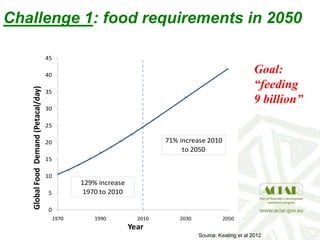
Challenge 1: food requirements in 2050
0
5
10
15
20
25
30
35
40
45
1970 1990 2010 2030 2050
GlobalFoodDemand(Petacal/day)
Year
71% increase 2010
to 2050
129% increase
1970 to 2010
Source: Keating et al 2012
Goal:
“feeding
9 billion”
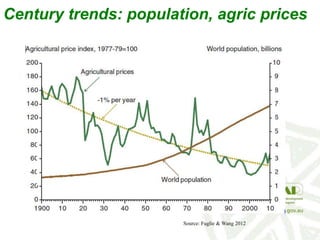
Century trends: population, agric prices
Source: Fuglie & Wang 2012
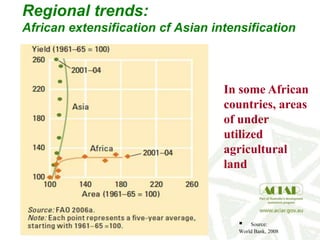
Regional trends:
African extensification cf Asian intensification
 Source:
World Bank, 2008
In some African
countries, areas
of under
utilized
agricultural
land
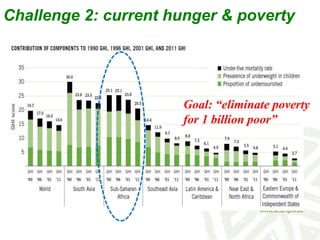
Challenge 2: current hunger & poverty
Goal: “eliminate poverty
for 1 billion poor”
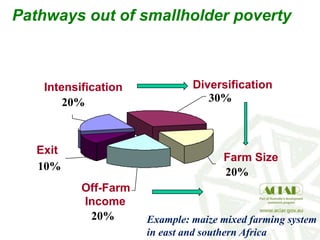
Pathways out of smallholder poverty
Intensification
20%
Diversification
30%
Exit
10%
Off-Farm
Income
20%
Farm Size
20%
Example: maize mixed farming system
in east and southern Africa
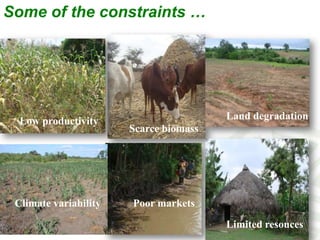
Some of the constraints …
Low productivity
Scarce biomass
Land degradation
Poor marketsClimate variability
Limited resouces
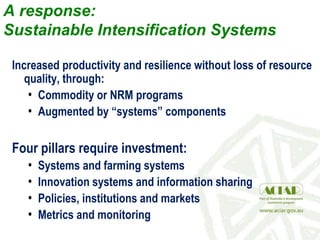
A response:
Sustainable Intensification Systems
Increased productivity and resilience without loss of resource
quality, through:
• Commodity or NRM programs
• Augmented by “systems” components
Four pillars require investment:
• Systems and farming systems
• Innovation systems and information sharing
• Policies, institutions and markets
• Metrics and monitoring
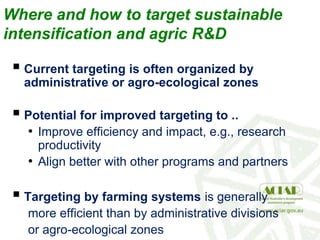
Where and how to target sustainable
intensification and agric R&D
 Current targeting is often organized by
administrative or agro-ecological zones
 Potential for improved targeting to ..
• Improve efficiency and impact, e.g., research
productivity
• Align better with other programs and partners
 Targeting by farming systems is generally
more efficient than by administrative divisions
or agro-ecological zones
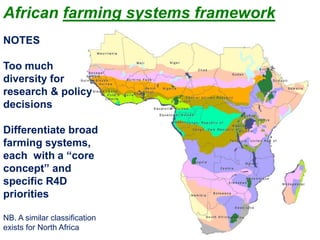
African farming systems framework
NOTES
Too much
diversity for
research & policy
decisions
Differentiate broad
farming systems,
each with a “core
concept” and
specific R4D
priorities
NB. A similar classification
exists for North Africa
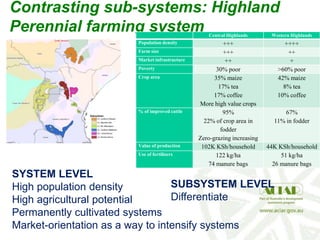
Contrasting sub-systems: Highland
Perennial farming system Central Highlands Western Highlands
Population density +++ ++++
Farm size +++ ++
Market infrastructure ++ +
Poverty 30% poor >60% poor
Crop area 35% maize
17% tea
17% coffee
More high value crops
42% maize
8% tea
10% coffee
% of improved cattle 95%
22% of crop area in
fodder
Zero-grazing increasing
67%
11% in fodder
Value of production 102K KSh/household 44K KSh/household
Use of fertilizers 122 kg/ha
74 manure bags
51 kg/ha
26 manure bags
SYSTEM LEVEL
High population density
High agricultural potential
Permanently cultivated systems
Market-orientation as a way to intensify systems
SUBSYSTEM LEVEL
Differentiate
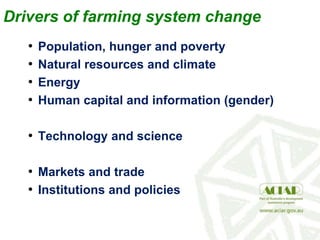
Drivers of farming system change
• Population, hunger and poverty
• Natural resources and climate
• Energy
• Human capital and information (gender)
• Technology and science
• Markets and trade
• Institutions and policies
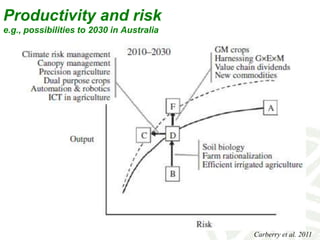
Productivity and risk
e.g., possibilities to 2030 in Australia
Carberry et al. 2011
Applying farming systems targeting
Value add at regional scale
 Differentiating regional strategic priorities
 Framing technology spillovers across countries
 Potential framework for monitoring progress (CAADP ..
Value add at national scale
 Enrich existing planning frameworks
 Support CAADP investment plans
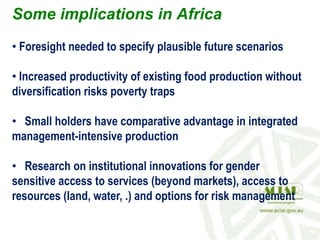
Some implications in Africa
• Foresight needed to specify plausible future scenarios
• Increased productivity of existing food production without
diversification risks poverty traps
• Small holders have comparative advantage in integrated
management-intensive production
• Research on institutional innovations for gender
sensitive access to services (beyond markets), access to
resources (land, water, .) and options for risk management
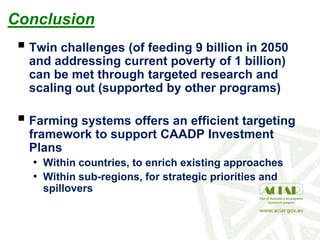
Conclusion
 Twin challenges (of feeding 9 billion in 2050
and addressing current poverty of 1 billion)
can be met through targeted research and
scaling out (supported by other programs)
 Farming systems offers an efficient targeting
framework to support CAADP Investment
Plans
• Within countries, to enrich existing approaches
• Within sub-regions, for strategic priorities and
spillovers
ACIAR
Thank you for your
attention

Key recommnadation from AASW6: Innovations in targeting African farming systems

  • 1.
    Innovations in targetingAfrican farming systems for improved productivity and investment impact FARA AASW Sub-theme 2 Accra, 19 July 2013 John Dixon Principal Regional Coordinator South Asia & Africa, ACIAR
  • 2.
    Contents Challenges for ARD Approachesto targeting Farming systems Conclusion
  • 3.
    Challenge 1: foodrequirements in 2050 0 5 10 15 20 25 30 35 40 45 1970 1990 2010 2030 2050 GlobalFoodDemand(Petacal/day) Year 71% increase 2010 to 2050 129% increase 1970 to 2010 Source: Keating et al 2012 Goal: “feeding 9 billion”
  • 4.
    Century trends: population,agric prices Source: Fuglie & Wang 2012
  • 5.
    Regional trends: African extensificationcf Asian intensification  Source: World Bank, 2008 In some African countries, areas of under utilized agricultural land
  • 6.
    Challenge 2: currenthunger & poverty Goal: “eliminate poverty for 1 billion poor”
  • 7.
    Pathways out ofsmallholder poverty Intensification 20% Diversification 30% Exit 10% Off-Farm Income 20% Farm Size 20% Example: maize mixed farming system in east and southern Africa
  • 8.
    Some of theconstraints … Low productivity Scarce biomass Land degradation Poor marketsClimate variability Limited resouces
  • 9.
    A response: Sustainable IntensificationSystems Increased productivity and resilience without loss of resource quality, through: • Commodity or NRM programs • Augmented by “systems” components Four pillars require investment: • Systems and farming systems • Innovation systems and information sharing • Policies, institutions and markets • Metrics and monitoring
  • 10.
    Where and howto target sustainable intensification and agric R&D  Current targeting is often organized by administrative or agro-ecological zones  Potential for improved targeting to .. • Improve efficiency and impact, e.g., research productivity • Align better with other programs and partners  Targeting by farming systems is generally more efficient than by administrative divisions or agro-ecological zones
  • 11.
    African farming systemsframework NOTES Too much diversity for research & policy decisions Differentiate broad farming systems, each with a “core concept” and specific R4D priorities NB. A similar classification exists for North Africa
  • 12.
    Contrasting sub-systems: Highland Perennialfarming system Central Highlands Western Highlands Population density +++ ++++ Farm size +++ ++ Market infrastructure ++ + Poverty 30% poor >60% poor Crop area 35% maize 17% tea 17% coffee More high value crops 42% maize 8% tea 10% coffee % of improved cattle 95% 22% of crop area in fodder Zero-grazing increasing 67% 11% in fodder Value of production 102K KSh/household 44K KSh/household Use of fertilizers 122 kg/ha 74 manure bags 51 kg/ha 26 manure bags SYSTEM LEVEL High population density High agricultural potential Permanently cultivated systems Market-orientation as a way to intensify systems SUBSYSTEM LEVEL Differentiate
  • 13.
    Drivers of farmingsystem change • Population, hunger and poverty • Natural resources and climate • Energy • Human capital and information (gender) • Technology and science • Markets and trade • Institutions and policies
  • 14.
    Productivity and risk e.g.,possibilities to 2030 in Australia Carberry et al. 2011
  • 15.
    Applying farming systemstargeting Value add at regional scale  Differentiating regional strategic priorities  Framing technology spillovers across countries  Potential framework for monitoring progress (CAADP .. Value add at national scale  Enrich existing planning frameworks  Support CAADP investment plans
  • 16.
    Some implications inAfrica • Foresight needed to specify plausible future scenarios • Increased productivity of existing food production without diversification risks poverty traps • Small holders have comparative advantage in integrated management-intensive production • Research on institutional innovations for gender sensitive access to services (beyond markets), access to resources (land, water, .) and options for risk management
  • 17.
    Conclusion  Twin challenges(of feeding 9 billion in 2050 and addressing current poverty of 1 billion) can be met through targeted research and scaling out (supported by other programs)  Farming systems offers an efficient targeting framework to support CAADP Investment Plans • Within countries, to enrich existing approaches • Within sub-regions, for strategic priorities and spillovers
  • 18.
    ACIAR Thank you foryour attention