Wesletter
June 2011   Vol. No. 2   Investment and Planning Insights from Wesban


The Importance of Rebalancing
                          Over time, your asset-allocation policy can veer off track
                          because of market ups and downs. This is illustrated
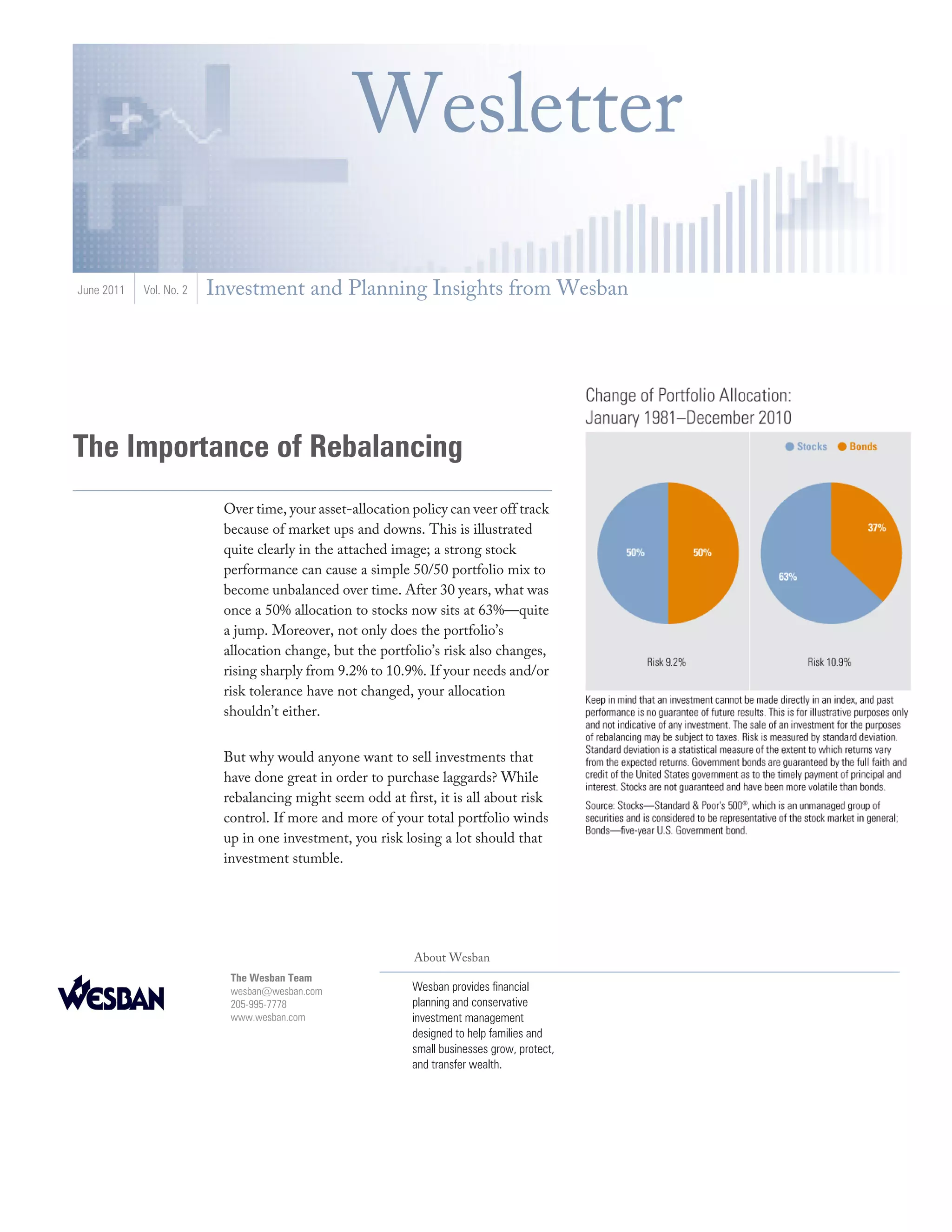
                          quite clearly in the attached image; a strong stock
                          performance can cause a simple 50/50 portfolio mix to
                          become unbalanced over time. After 30 years, what was
                          once a 50% allocation to stocks now sits at 63%—quite
                          a jump. Moreover, not only does the portfolio’s
                          allocation change, but the portfolio’s risk also changes,
                          rising sharply from 9.2% to 10.9%. If your needs and/or
                          risk tolerance have not changed, your allocation
                          shouldn’t either.


                          But why would anyone want to sell investments that
                          have done great in order to purchase laggards? While
                          rebalancing might seem odd at first, it is all about risk
                          control. If more and more of your total portfolio winds
                          up in one investment, you risk losing a lot should that
                          investment stumble.


                                                           About Wesban
                           The Wesban Team
                           wesban@wesban.com               Wesban provides financial
                           205-995-7778                    planning and conservative
                           www.wesban.com                  investment management
                                                           designed to help families and
                                                           small businesses grow, protect,
                                                           and transfer wealth.
Wesban Financial Consultants, P.C. Investment and Planning Insights from Wesban June 2011                           2


Dividends and Total Return
                                                                          both for income and total returns, dividend-
                                                                          paying stocks can be a reasonable place to invest.


                                                                          Although higher-yielding stocks have
             Income is important to consider when choosing
                                                                          demonstrated an ability to outperform large
             an investment. Especially important for investors
                                                                          stocks, all that glitters is not gold. Dividends are
             approaching retirement, income can add
                                                                          paid at a company’s discretion, and exceptionally
             meaningfully to one’s total return, which
                                                                          high yields can indicate a potential dividend cut.
             comprises income and price return (capital
                                                                          For example, had investors been lured to many
             appreciation). Investors can pursue income
                                                                          high-yielding bank stocks in late 2008, they would
             returns in many ways including bonds, real estate
                                                                          have been sorely disappointed when many banks
             investment trusts, and stocks.
                                                                          subsequently cut their dividends as profitability
                                                                          declined during the credit crisis. When looking at
             Stock income is typically paid in the form of a              dividend-paying stocks, investors should focus on
             monthly, quarterly, annual, or special cash                  reasonable dividend yields with companies that
             dividend, which can be used to finance current               have the earnings power to increase their dividend
             consumption or to reinvest. Dividends are                    distributions over time. Many large companies
             typically expressed in terms of yield. Like an               with recognizable brand names have
             interest rate, yield is represented as a percentage          demonstrated an ability to offer this slow and
             rate and is calculated by taking the annual cash             steady income distribution to shareholders.
             dividend divided by a stock’s current price. For
             example, a stock trading at $20 with a future
             annual cash dividend of $1 would have a dividend
             yield of 5%.


             Keep in mind, though, that there is no guarantee
             a dividend will be paid, even if a certain company
             has a consistent dividend-paying track record. A
             company can increase, decrease, and even
             eliminate dividends altogether, depending on its
             financial situation. Furthermore, if a dividend is
             declared, the company has to pay dividends for
             preferred shares first, before any common share
             dividends can be paid.


             Although stocks can be a source of income return,
             not all stocks are created equal in this regard.
             Some companies distribute significantly more of
             their profits in the form of dividends than others,
             and some don’t distribute dividends at all. The
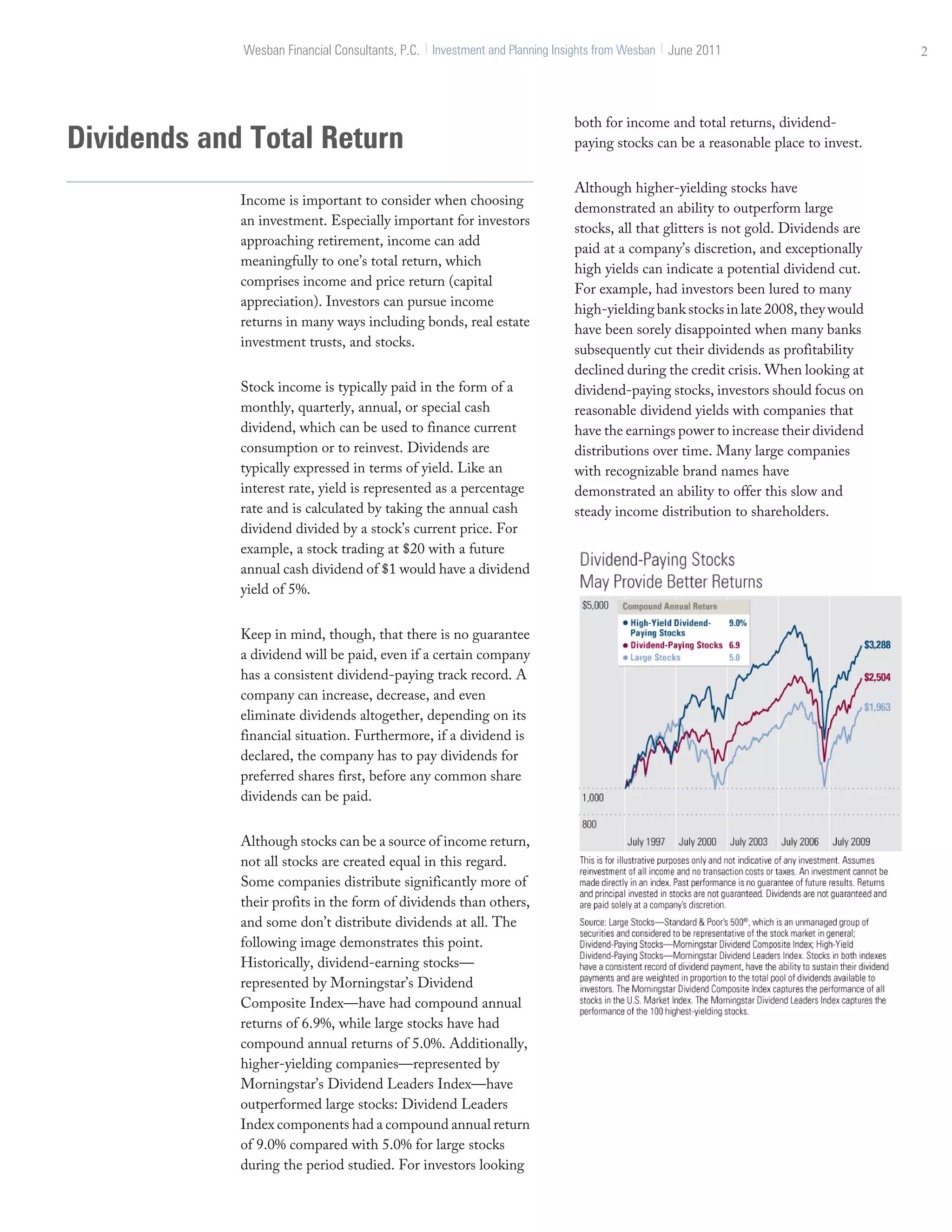
             following image demonstrates this point.
             Historically, dividend-earning stocks—
             represented by Morningstar’s Dividend
             Composite Index—have had compound annual
             returns of 6.9%, while large stocks have had
             compound annual returns of 5.0%. Additionally,
             higher-yielding companies—represented by
             Morningstar’s Dividend Leaders Index—have
             outperformed large stocks: Dividend Leaders
             Index components had a compound annual return
             of 9.0% compared with 5.0% for large stocks
             during the period studied. For investors looking
Wesban Financial Consultants, P.C. Investment and Planning Insights from Wesban June 2011                            3


Social Insecurity
                                                                           United States government decides to implement.
                                                                           If you are nearing retirement, it is unlikely that
                                                                           your Social Security benefits will change
                                                                           dramatically. Younger workers, however, are
              All of us who work feel the bite that Social                 more likely to see sweeping changes in the way
              Security taxes take out of our paycheck. Most of             Social Security works in the form of higher taxes,
              us take comfort in the hope that when we retire,             lower benefits, or a combination of the two.
              Social Security will be there, giving back all the
              money that we paid into the system over the
                                                                           Bear in mind that Social Security was never
              course of our careers. Isn’t that how it works?
                                                                           intended to provide Americans with all of the
                                                                           income they would need in retirement. Social
              Well, the short answer is no, it doesn’t work that           Security is only one leg of a three-legged stool that
              way. The Social Security taxes deducted from your            also includes pension plans and personal savings.
              paycheck are not sitting in a special account                With concerns mounting over the stability of one
              someplace, earmarked to be returned to you upon              leg of the stool, you need to take control of your
              your retirement. Instead, the taxes you pay today            retirement by investing in personal savings plans
              are used to pay benefits to today’s beneficiaries,           such as IRAs and 401(k)s.
              just as when you retire, the benefits you receive
              will come from the taxes paid by people who are
              still working. This arrangement works as long as
              there are enough people sending in taxes; it
              doesn’t work so well if the number of current
              workers per retiree is decreasing.


              The baby boomer generation (those born between
              1946 and 1964) have started to retire in 2010.
              This large group’s retiring, coupled with
              increasing life expectancies and decreasing birth
              rates, means that the number of retirees will grow
              faster than the number of workers. As the graph
              illustrates, according to the Social Security
              Administration, the number of workers sending
              in Social Security taxes to pay each retiree’s
              benefits has plummeted from 42 workers per
              beneficiary in 1945 to 2.9 in 2010. What is more
              is that this number is projected to go down even
              further to 2.1 workers per beneficiary by 2035.
              Since the ratio of workers to retirees is expected
              to continue declining, a shortfall in future Social
              Security funding is likely.


              The trustees of the Social Security program
              estimate that benefits paid will exceed payroll
              taxes collected in 2010 and 2011, be less than
              payroll taxes collected in 2012 through 2014, then
              once again exceed tax income in 2015 and remain
              higher thereafter. Moreover, they are forecasting
              that the Social Security trust fund will be
              exhausted in 2037 unless changes are made.


              What does all this mean for you? Well, that
              depends on how old you are and what changes the
Wesban Financial Consultants, P.C. Investment and Planning Insights from Wesban June 2011                                                                               4


Head to Head Competition: Large
Growth versus Large Value
               The battle between large-cap growth and value
               investing has been going on for years, with each
               style trying to seize the spotlight. Although there
               is an annual frontrunner, history shows that
               leadership shifts with market conditions. In the
               bull market of the late 90s, growth stocks offered
               superior returns. But, since that bubble burst in
               2000, value went on quite an impressive run.
               Growth seems to have captured the spotlight
               recently and many wonder if the tables have turned
               yet again.


               Determining your allocation between growth and
               value can be difficult. Which style is more stable,
               or which will provide higher returns?
               Unfortunately, there is no definite answer. Focus
               on finding the option that offers the most upside
               for your situation: perhaps it’s growth, maybe
               value, or possibly a blend of both.


           ©2011 Morningstar, Inc. All Rights Reserved. The information contained herein (1) is intended solely for informational purposes; (2) is proprietary to Morningstar and/or
           the content providers; (3) is not warranted to be accurate, complete, or timely; and (4) does not constitute investment advice of any kind. Neither Morningstar nor the
           content providers are responsible for any damages or losses arising from any use of this information. Past performance is no guarantee of future results. "Morningstar"
           and the Morningstar logo are registered trademarks of Morningstar, Inc.


                                          The Wesban Team                       Wesban Financial Consultants, P.C. wesban@wesban.com                          Tel:205-995-7778
                                                                                1800 Providence Park               www.wesban.com                             Fax:205-995-7771
                                                                                Suite 200
                                                                                Birmingham, Alabama 35242

June 2011 wesletter

  • 1.
    Wesletter June 2011 Vol. No. 2 Investment and Planning Insights from Wesban The Importance of Rebalancing Over time, your asset-allocation policy can veer off track because of market ups and downs. This is illustrated quite clearly in the attached image; a strong stock performance can cause a simple 50/50 portfolio mix to become unbalanced over time. After 30 years, what was once a 50% allocation to stocks now sits at 63%—quite a jump. Moreover, not only does the portfolio’s allocation change, but the portfolio’s risk also changes, rising sharply from 9.2% to 10.9%. If your needs and/or risk tolerance have not changed, your allocation shouldn’t either. But why would anyone want to sell investments that have done great in order to purchase laggards? While rebalancing might seem odd at first, it is all about risk control. If more and more of your total portfolio winds up in one investment, you risk losing a lot should that investment stumble. About Wesban The Wesban Team wesban@wesban.com Wesban provides financial 205-995-7778 planning and conservative www.wesban.com investment management designed to help families and small businesses grow, protect, and transfer wealth.
  • 2.
    Wesban Financial Consultants,P.C. Investment and Planning Insights from Wesban June 2011 2 Dividends and Total Return both for income and total returns, dividend- paying stocks can be a reasonable place to invest. Although higher-yielding stocks have Income is important to consider when choosing demonstrated an ability to outperform large an investment. Especially important for investors stocks, all that glitters is not gold. Dividends are approaching retirement, income can add paid at a company’s discretion, and exceptionally meaningfully to one’s total return, which high yields can indicate a potential dividend cut. comprises income and price return (capital For example, had investors been lured to many appreciation). Investors can pursue income high-yielding bank stocks in late 2008, they would returns in many ways including bonds, real estate have been sorely disappointed when many banks investment trusts, and stocks. subsequently cut their dividends as profitability declined during the credit crisis. When looking at Stock income is typically paid in the form of a dividend-paying stocks, investors should focus on monthly, quarterly, annual, or special cash reasonable dividend yields with companies that dividend, which can be used to finance current have the earnings power to increase their dividend consumption or to reinvest. Dividends are distributions over time. Many large companies typically expressed in terms of yield. Like an with recognizable brand names have interest rate, yield is represented as a percentage demonstrated an ability to offer this slow and rate and is calculated by taking the annual cash steady income distribution to shareholders. dividend divided by a stock’s current price. For example, a stock trading at $20 with a future annual cash dividend of $1 would have a dividend yield of 5%. Keep in mind, though, that there is no guarantee a dividend will be paid, even if a certain company has a consistent dividend-paying track record. A company can increase, decrease, and even eliminate dividends altogether, depending on its financial situation. Furthermore, if a dividend is declared, the company has to pay dividends for preferred shares first, before any common share dividends can be paid. Although stocks can be a source of income return, not all stocks are created equal in this regard. Some companies distribute significantly more of their profits in the form of dividends than others, and some don’t distribute dividends at all. The following image demonstrates this point. Historically, dividend-earning stocks— represented by Morningstar’s Dividend Composite Index—have had compound annual returns of 6.9%, while large stocks have had compound annual returns of 5.0%. Additionally, higher-yielding companies—represented by Morningstar’s Dividend Leaders Index—have outperformed large stocks: Dividend Leaders Index components had a compound annual return of 9.0% compared with 5.0% for large stocks during the period studied. For investors looking
  • 3.
    Wesban Financial Consultants,P.C. Investment and Planning Insights from Wesban June 2011 3 Social Insecurity United States government decides to implement. If you are nearing retirement, it is unlikely that your Social Security benefits will change dramatically. Younger workers, however, are All of us who work feel the bite that Social more likely to see sweeping changes in the way Security taxes take out of our paycheck. Most of Social Security works in the form of higher taxes, us take comfort in the hope that when we retire, lower benefits, or a combination of the two. Social Security will be there, giving back all the money that we paid into the system over the Bear in mind that Social Security was never course of our careers. Isn’t that how it works? intended to provide Americans with all of the income they would need in retirement. Social Well, the short answer is no, it doesn’t work that Security is only one leg of a three-legged stool that way. The Social Security taxes deducted from your also includes pension plans and personal savings. paycheck are not sitting in a special account With concerns mounting over the stability of one someplace, earmarked to be returned to you upon leg of the stool, you need to take control of your your retirement. Instead, the taxes you pay today retirement by investing in personal savings plans are used to pay benefits to today’s beneficiaries, such as IRAs and 401(k)s. just as when you retire, the benefits you receive will come from the taxes paid by people who are still working. This arrangement works as long as there are enough people sending in taxes; it doesn’t work so well if the number of current workers per retiree is decreasing. The baby boomer generation (those born between 1946 and 1964) have started to retire in 2010. This large group’s retiring, coupled with increasing life expectancies and decreasing birth rates, means that the number of retirees will grow faster than the number of workers. As the graph illustrates, according to the Social Security Administration, the number of workers sending in Social Security taxes to pay each retiree’s benefits has plummeted from 42 workers per beneficiary in 1945 to 2.9 in 2010. What is more is that this number is projected to go down even further to 2.1 workers per beneficiary by 2035. Since the ratio of workers to retirees is expected to continue declining, a shortfall in future Social Security funding is likely. The trustees of the Social Security program estimate that benefits paid will exceed payroll taxes collected in 2010 and 2011, be less than payroll taxes collected in 2012 through 2014, then once again exceed tax income in 2015 and remain higher thereafter. Moreover, they are forecasting that the Social Security trust fund will be exhausted in 2037 unless changes are made. What does all this mean for you? Well, that depends on how old you are and what changes the
  • 4.
    Wesban Financial Consultants,P.C. Investment and Planning Insights from Wesban June 2011 4 Head to Head Competition: Large Growth versus Large Value The battle between large-cap growth and value investing has been going on for years, with each style trying to seize the spotlight. Although there is an annual frontrunner, history shows that leadership shifts with market conditions. In the bull market of the late 90s, growth stocks offered superior returns. But, since that bubble burst in 2000, value went on quite an impressive run. Growth seems to have captured the spotlight recently and many wonder if the tables have turned yet again. Determining your allocation between growth and value can be difficult. Which style is more stable, or which will provide higher returns? Unfortunately, there is no definite answer. Focus on finding the option that offers the most upside for your situation: perhaps it’s growth, maybe value, or possibly a blend of both. ©2011 Morningstar, Inc. All Rights Reserved. The information contained herein (1) is intended solely for informational purposes; (2) is proprietary to Morningstar and/or the content providers; (3) is not warranted to be accurate, complete, or timely; and (4) does not constitute investment advice of any kind. Neither Morningstar nor the content providers are responsible for any damages or losses arising from any use of this information. Past performance is no guarantee of future results. "Morningstar" and the Morningstar logo are registered trademarks of Morningstar, Inc. The Wesban Team Wesban Financial Consultants, P.C. wesban@wesban.com Tel:205-995-7778 1800 Providence Park www.wesban.com Fax:205-995-7771 Suite 200 Birmingham, Alabama 35242