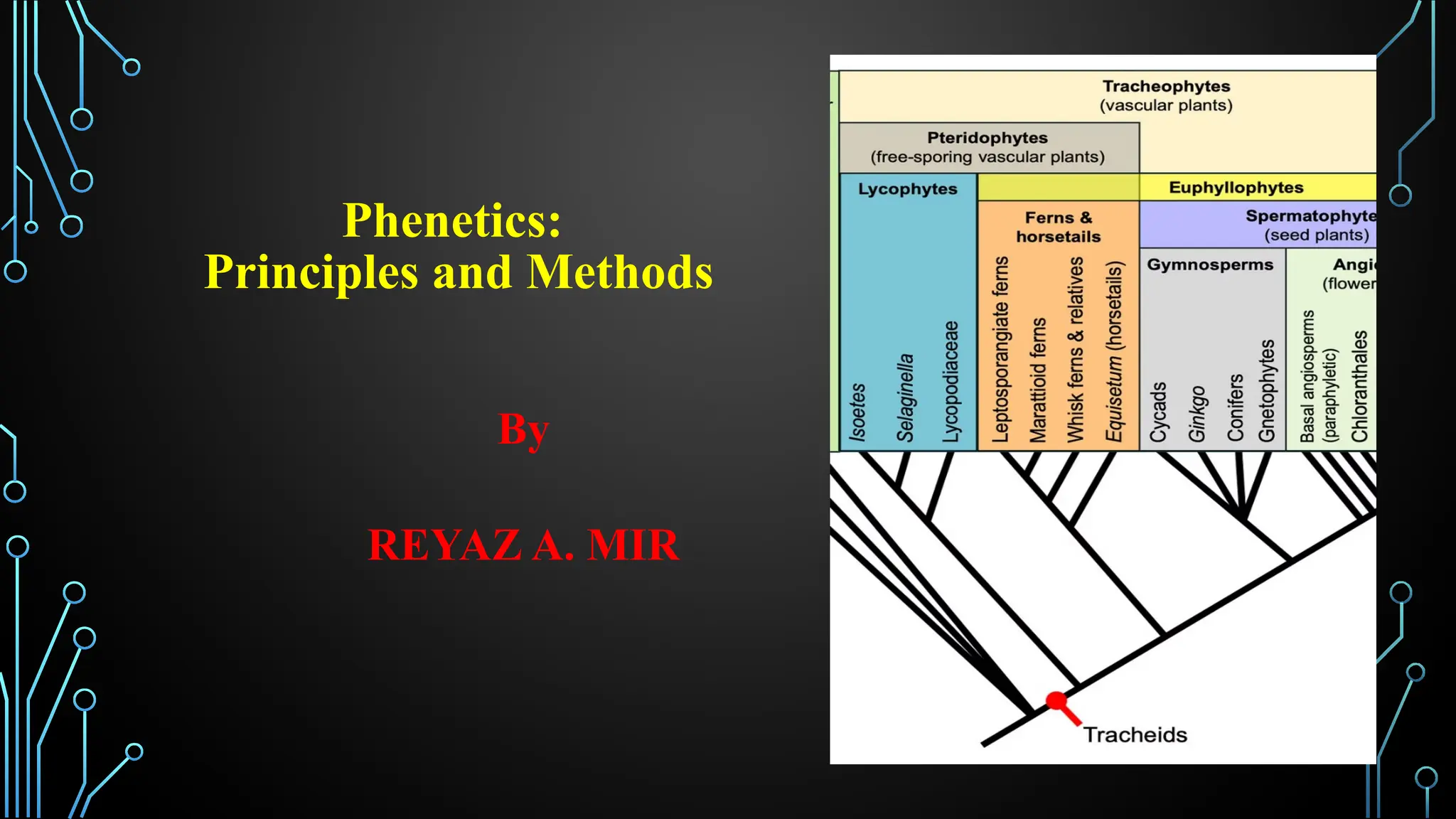
Phenetics:
Principles and Methods
By
REYAZ A. MIR
Phenetics (Numerical Taxonomy)
 Phenetics is a taxonomic approach that classifies organisms based on their observable
physical characteristics, rather than evolutionary relationships.
 In simple words Organisms are arranged on the basis of overall similarity of existing
organisms and their characters.
 This classification was given by Michel Adanson in 1763.
 Later it was popularized in 1973, Sneath and Sokal published a book named “Principles of
Numerical Taxonomy”
 The unit of numerical taxonomic is OTU (Operational Taxonomy Unit)
Principles
 The more characters the better a given classification will be.
 In Numerical taxonomy Weightage technique is used.
 Classification is based on phenetic similarity.
Steps
 CHOICE OF UNITS TO BE STUDIED.
 CHARACTER SELECTION.
 MEASUREMENT OF SIMILARITY.
 CLUSTER ANALYSIS.
 DISCRIMINATION
Operational Taxonomic Units (OTUs)
 Operational Taxonomic Units (OTUs) are a fundamental concept in phenetics, which is the
study of the overall similarity between organisms.
 By using OTUs, researchers can gain insights into the evolutionary history and relatedness of
organisms.
 They can analyze the distribution of OTUs across different species, populations, or
environments to understand patterns of biodiversity and evolutionary relationships
.
Methods
Clustering Algorithms
 Clustering algorithms are computational techniques used in phenetics to group organisms
based on their similarities or dissimilarities.
 These algorithms take into account various characteristics or traits of organisms, such as
genetic data, morphological features, or ecological attributes.
 They provide a valuable tool for researchers to analyze and interpret large datasets, helping
to uncover hidden patterns and structures within biological data.
Continue…..
.
UPGMA
Unweighted Pair Group Method with Arithmetic Mean is a common agglomerative
clustering technique.
Ward's Method
Minimizes the within-cluster variance to produce compact, spherical clusters.
Principal Coordinates
Ordination method that represents OTUs in a low-dimensional space based on their
similarities
.
Similarity Coefficients
Similarity coefficients are mathematical measures used in phenetics to quantify the degree of
similarity between organisms. These coefficients provide a way to compare and assess the overall
resemblance or dissimilarity between different taxa.
By using similarity coefficients, researchers can objectively analyze and compare the phenetic
distances between organisms. This information can be used to infer evolutionary relationships,
classify organisms into different groups, or study patterns of biodiversity and species distribution.
Simple Matching
Measures the proportion of
characters that are shared
between two OTUs.
Jaccard
Considers only the shared
presence of characters,
ignoring shared absences.
Euclidean Distance
Calculates the geometric
distance between two OTUs
in multidimensional
character space.
Phenograms
A phenogram is a type of dendrogram that represents the relationships between different
organisms based on their overall similarity. It is a visual representation of the phenetic
relationships among taxa, which are groups of organisms that share common characteristics.
Phenograms are constructed using similarity coefficients, such as the Jaccard coefficient or the
Dice coefficient, which quantify the degree of similarity between pairs of organisms. These
coefficients are used to calculate the distances between the taxa, and these distances are then
used to construct the phenogram.
Phenograms can be useful in various fields of biology, such as taxonomy, ecology, and
evolutionary biology. They provide insights into the overall similarity and relatedness of different
organisms, allowing researchers to identify patterns and make inferences about their evolutionary
relationships.
Applications of Phenetics
Taxonomy
Phenetics provides a practical
system for classifying and
naming organisms.
Identification
Keys and field guides often
use phenetic characters to
aid in species identification.
Paleontology
Phenetics is useful for
classifying and studying fossil
organisms with incomplete
evolutionary histories.
Limitations and Criticisms
Ignores Evolution
Phenetic methods do not account for evolutionary divergence and
convergence.
Oversimplified
Phenetic classification may overlook important biological nuances and
fail to represent natural relationships.
Subjective
The choice of characters and similarity coefficients can significantly
impact the resulting phenograms.

Phenetics-Principles-and-Methods in detial.pptx

  • 1.
  • 2.
    Phenetics (Numerical Taxonomy) Phenetics is a taxonomic approach that classifies organisms based on their observable physical characteristics, rather than evolutionary relationships.  In simple words Organisms are arranged on the basis of overall similarity of existing organisms and their characters.  This classification was given by Michel Adanson in 1763.  Later it was popularized in 1973, Sneath and Sokal published a book named “Principles of Numerical Taxonomy”  The unit of numerical taxonomic is OTU (Operational Taxonomy Unit)
  • 3.
    Principles  The morecharacters the better a given classification will be.  In Numerical taxonomy Weightage technique is used.  Classification is based on phenetic similarity. Steps  CHOICE OF UNITS TO BE STUDIED.  CHARACTER SELECTION.  MEASUREMENT OF SIMILARITY.  CLUSTER ANALYSIS.  DISCRIMINATION
  • 4.
    Operational Taxonomic Units(OTUs)  Operational Taxonomic Units (OTUs) are a fundamental concept in phenetics, which is the study of the overall similarity between organisms.  By using OTUs, researchers can gain insights into the evolutionary history and relatedness of organisms.  They can analyze the distribution of OTUs across different species, populations, or environments to understand patterns of biodiversity and evolutionary relationships . Methods Clustering Algorithms  Clustering algorithms are computational techniques used in phenetics to group organisms based on their similarities or dissimilarities.  These algorithms take into account various characteristics or traits of organisms, such as genetic data, morphological features, or ecological attributes.  They provide a valuable tool for researchers to analyze and interpret large datasets, helping to uncover hidden patterns and structures within biological data.
  • 5.
    Continue….. . UPGMA Unweighted Pair GroupMethod with Arithmetic Mean is a common agglomerative clustering technique. Ward's Method Minimizes the within-cluster variance to produce compact, spherical clusters. Principal Coordinates Ordination method that represents OTUs in a low-dimensional space based on their similarities .
  • 6.
    Similarity Coefficients Similarity coefficientsare mathematical measures used in phenetics to quantify the degree of similarity between organisms. These coefficients provide a way to compare and assess the overall resemblance or dissimilarity between different taxa. By using similarity coefficients, researchers can objectively analyze and compare the phenetic distances between organisms. This information can be used to infer evolutionary relationships, classify organisms into different groups, or study patterns of biodiversity and species distribution. Simple Matching Measures the proportion of characters that are shared between two OTUs. Jaccard Considers only the shared presence of characters, ignoring shared absences. Euclidean Distance Calculates the geometric distance between two OTUs in multidimensional character space.
  • 7.
    Phenograms A phenogram isa type of dendrogram that represents the relationships between different organisms based on their overall similarity. It is a visual representation of the phenetic relationships among taxa, which are groups of organisms that share common characteristics. Phenograms are constructed using similarity coefficients, such as the Jaccard coefficient or the Dice coefficient, which quantify the degree of similarity between pairs of organisms. These coefficients are used to calculate the distances between the taxa, and these distances are then used to construct the phenogram. Phenograms can be useful in various fields of biology, such as taxonomy, ecology, and evolutionary biology. They provide insights into the overall similarity and relatedness of different organisms, allowing researchers to identify patterns and make inferences about their evolutionary relationships.
  • 8.
    Applications of Phenetics Taxonomy Pheneticsprovides a practical system for classifying and naming organisms. Identification Keys and field guides often use phenetic characters to aid in species identification. Paleontology Phenetics is useful for classifying and studying fossil organisms with incomplete evolutionary histories.
  • 9.
    Limitations and Criticisms IgnoresEvolution Phenetic methods do not account for evolutionary divergence and convergence. Oversimplified Phenetic classification may overlook important biological nuances and fail to represent natural relationships. Subjective The choice of characters and similarity coefficients can significantly impact the resulting phenograms.