FLOWERS
RIZA KHAN
V- A
UNIVERSAL ACADEMY, DEHRADUN
FLOWERS
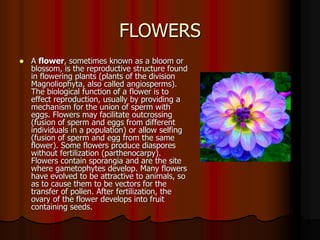
 A flower, sometimes known as a bloom or
blossom, is the reproductive structure found
in flowering plants (plants of the division
Magnoliophyta, also called angiosperms).
The biological function of a flower is to
effect reproduction, usually by providing a
mechanism for the union of sperm with
eggs. Flowers may facilitate outcrossing
(fusion of sperm and eggs from different
individuals in a population) or allow selfing
(fusion of sperm and egg from the same
flower). Some flowers produce diaspores
without fertilization (parthenocarpy).
Flowers contain sporangia and are the site
where gametophytes develop. Many flowers
have evolved to be attractive to animals, so
as to cause them to be vectors for the
transfer of pollen. After fertilization, the
ovary of the flower develops into fruit
containing seeds.
Common Usage
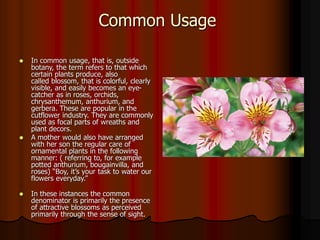
 In common usage, that is, outside
botany, the term refers to that which
certain plants produce, also
called blossom, that is colorful, clearly
visible, and easily becomes an eye-
catcher as in roses, orchids,
chrysanthemum, anthurium, and
gerbera. These are popular in the
cutflower industry. They are commonly
used as focal parts of wreaths and
plant decors.
 A mother would also have arranged
with her son the regular care of
ornamental plants in the following
manner: ( referring to, for example
potted anthurium, bougainvilla, and
roses) “Boy, it’s your task to water our
flowers everyday.”
 In these instances the common
denominator is primarily the presence
of attractive blossoms as perceived
primarily through the sense of sight.
Floral parts
 The essential parts of a flower can be
considered in two parts: the vegetative part,
consisting of petals and associated structures in
the perianth, and the reproductive or sexual
parts. A stereotypical flower consists of four
kinds of structures attached to the tip of a short
stalk. Each of these kinds of parts is arranged in
a whorl on the receptacle. The four main whorls
(starting from the base of the flower or lowest
node and working upwards) are as follows:
 Perianth
 Reproductive

FLOWERS..............................................

  • 1.
  • 2.
    FLOWERS  A flower,sometimes known as a bloom or blossom, is the reproductive structure found in flowering plants (plants of the division Magnoliophyta, also called angiosperms). The biological function of a flower is to effect reproduction, usually by providing a mechanism for the union of sperm with eggs. Flowers may facilitate outcrossing (fusion of sperm and eggs from different individuals in a population) or allow selfing (fusion of sperm and egg from the same flower). Some flowers produce diaspores without fertilization (parthenocarpy). Flowers contain sporangia and are the site where gametophytes develop. Many flowers have evolved to be attractive to animals, so as to cause them to be vectors for the transfer of pollen. After fertilization, the ovary of the flower develops into fruit containing seeds.
  • 3.
    Common Usage  Incommon usage, that is, outside botany, the term refers to that which certain plants produce, also called blossom, that is colorful, clearly visible, and easily becomes an eye- catcher as in roses, orchids, chrysanthemum, anthurium, and gerbera. These are popular in the cutflower industry. They are commonly used as focal parts of wreaths and plant decors.  A mother would also have arranged with her son the regular care of ornamental plants in the following manner: ( referring to, for example potted anthurium, bougainvilla, and roses) “Boy, it’s your task to water our flowers everyday.”  In these instances the common denominator is primarily the presence of attractive blossoms as perceived primarily through the sense of sight.
  • 4.
    Floral parts  Theessential parts of a flower can be considered in two parts: the vegetative part, consisting of petals and associated structures in the perianth, and the reproductive or sexual parts. A stereotypical flower consists of four kinds of structures attached to the tip of a short stalk. Each of these kinds of parts is arranged in a whorl on the receptacle. The four main whorls (starting from the base of the flower or lowest node and working upwards) are as follows:  Perianth  Reproductive