1.EDUCATION LEADERSHIP ROLE- The Role of
the teachers leader and Skills
• Collaborate with teachers
• Provide direction and guidance on the curriculum
• Supporting teachers to implement the cycle of planning effectively in
order to enhance programs and practices
• Lead the development and implementation of effective educational
programs
• Ensure that children’s learning and development are guided by the
learning outcome of the approved learning frameworks
EDUCATION LEADERSHIP ROLE-The Role of the
teachers leader and Skills …CONTINUE
• Guiding and developing the understanding of teachers and families on
educational matters
• Building the knowledge, skills and professionalism of teachers
• Ensure that the school is managed properly and abiding to the legislations,
regulations in place
• Promote the education of learners in a proper way and in line with the
policies
• Evaluating teaching program, carry out teaching, supervision,
administration and in-service development and guidance of teachers at
the school
• Engage in class teaching
EDUCATION LEADERSHIP ROLE: The Role of the
teachers leader and skills…..continue
• Accountability
• Promoting a positive school climate
• Creating an effective learning environment
• Leading and managing the staff
• Effective deployment of staff and resources
• Interaction with stakeholders
• Administrative
2. Traits/ qualities of a leader (distinguishing
quality or characteristics
• Integrity and honesty- to do the right things even when none is
watching. Being truthful as a leader.
• Delegation and empowerment- Allocating duties to followers to
empower them with necessary knowledge and skills
• Self-awareness- Knowing and understand oneself as a leader
• Gratitude-Ability to give thanks, awarding and praising followers
• Learning agility- Ability to know what to do even in unfamiliar
circumstances
• Influence- Ability to inspire and convince followers to attain a
common goal.
Traits/ qualities of a leader (distinguishing
quality or characteristics……..continue
• Empathy-Ability to understand the followers’ problems and feeling
their pain.
• Courage and confidence- Ability to voice new ideas, to provide
feedback, put concerns forward and to step up and move things in
the right direction rather than avoiding problems or allowing conflicts
to arise
• Respect- Treating all people with respect and dignity. This will ease
tensions, conflicts, create trust and improve effectiveness.
• Decision- making capabilities- Ability to take the right decision at the
right time, and consulting key stakeholders before taking decisions
Traits/ qualities of a leader (distinguishing
quality or characteristics……..continue
• Accountability- Ability to make sure that every follower is
accountable for what he/she is doing. If followers did well, then a
leader should thank them, and when struggling they must be made to
realize their mistakes and work together to improve. This creates a
sense of responsibility.
• Creativity and innovation- Ability to apply creative thinking and
constant innovation. Think out of the box, come up with unique
ideas, turn ideas and goals into reality.
• Humility- being selfless and always think about followers
• Transparency- Openly share information, giving visibility, keep the
followers engaged
Traits/ qualities of a leader (distinguishing
quality or characteristics……..continue
• Vision and purpose- have vision and purpose and share it with the
followers
• Emotional intelligence- Ability to connect with people emotionally.
A leader has to control emotions so that negative emotions cannot
influence the decision –making skills, manage emotions effectively,
better social awareness and conflict resolution.
• Commitment and passion- Being committed and have passion for the
work. It helps to gain respect and motivate followers to achieve goals.
• Resilience- displaying and applying positive attitudes no matter how
difficult the circumstances might be.
Traits/ qualities of a leader (distinguishing
quality or characteristics……..continue
• Other qualities:
Discipline
Assertiveness
Sensitivity
Fairness
Consistency
Flexibility
adaptability
3.1 Three major leadership styles
• 3.1.1 Autocratic leadership
• 3.1.2 Democratic leadership
• 3.1.3 Laissez-faire
3.1.1 Autocratic leadership (command)
• Is the leader-centred and dictatorship to a certain extent.
• Leaders impose their own will on followers
• Leaders take all decisions and stick to a fixed and rigid schedule
• Initiation are taken from the top and communication flows from the
principal down to the followers
• All authority for planning, organization and control are vested with a
leader
• The leader does not allow for participative decision making and good
human relations are considered less important.
Advantages of autocratic leadership
• Needed when immediate action is called for, as in the case of
emergency
• Management takes the initiative in coordinating work
• Tasks, situations and relationship are clearly defined
• Decision making is fast with management at the centre of activities
• Staff receive direct and immediate assistance towards achieving their
goals
Disadvantages of autocratic leadership
• Lack of cooperation
• Staff and learners are motivated by fears
• A tense atmosphere in the school with little job satisfaction
• Suppression of initiative and creative thought
• Poor human relations and inadequate communication
• Little or no staff development takes place
• Dissatisfaction with the management of the school prevails
3.1.2 Democratic leadership (participative)
• Is group-centred (teamwork), with decentralized authority and decision making.
• It involves decentralization of planning, organization and control
• It allows for more participation and consulting with the followers without dictating to them
• The leader is flexible and able to apply leadership skills
• Tasks, responsibilities and authority are delegated
• Staff members, learners and parents are involved in the decision-making and planning process
• An open-door policy is followed
• The opinion of staff members is considered as valuable in the decision-making process
• Two –way communication takes place
• A healthy school climate and team spirit is fostered
• Good human relations are maintained
Advantages of democratic/participative style
• Two-way communication takes place
• Staff, parents and learners are motivated to achieve the vision of the school
• Initiative and creativity are promoted amongst the staff members
• A relaxed atmosphere prevails and staff members feel free to contribute to
management
• Authority can be more easily exercised
• Staff morale is improved by involving staff members in decision making,
planning and control
• Job satisfaction is increased through staff development, delegation of
responsibilities and making work more interesting
Disadvantages of democratic/participative
style
• It may lead to over-participation if not properly handled
• Decision making might be time consuming
• Disagreements may occur and staff members my not want to get
involved in a tug of war
• Lack of positive and clear direction may prevent objectives being
attained
• There might be staff who are not capable of working without close
supervision
3.1.3 Laissez-faire leadership
• The organization moves along without specific direction of the leader
• The leader has little or no interest in planning, organizing or the exercise of control
• The organization’s vision or mission is not projected
• A clearly formulated vision rarely exist
• Goals are rarely set and problems are solved by whoever is available.
• Staff members are expected to motivate themselves with little or no feedback on their
performance
• The leader hesitate to make decisions and does not attempt to influence the group
• Leadership is practiced through suggestions and delegation without the leader being willing to
accept accountability for delegated tasks.
• Communication in the school is within departments and between staff members because of a
lack of downward communication
• Little attention is given to policy making and policy implementation with a result that the
discipline in the school is weak
Disadvantages of laissez- faire leadership
• Confidence in and respect for the principal may be forfeited
• Task performance in the school may be poor
• Clear goals and objectives are not set for the school
• It leads to battles among competing subordinates who try to exercise
power
• As a result of a lack of coordination, communication, motivation and
control, there is frustration, aimlessness and indecision in the school
• The school as an organization is vulnerable to power plays
• Staff work members are unmotivated and experience little job satisfaction
• Staff may experience boredom in the execution of their daily tasks
References
• Bush, t., Bell, L. & Middle, D. (2011). The Principles of Educational
Leadership and Management (2nd ed.). Thousand Oaks, CA:SAGE
• Davidoff, S. & Lazarus, S. (1997). The learning school. An organization
development approach. Kenwyn: Juta.
3.2 Other leadership styles
3.2.1 Collaborative leadership
• Under collaborative leadership style, leaders influence or motivate people to
create the greatest possible impact and to do better.
• Leaders keep some control over the process.
• Leaders also allow people to work independently because creativity is seen as a
strength with this leadership style.
• This leadership style features mentorship as a top priority.
• By working directly with their team, leaders using the collaborative process can
transfer their knowledge, skills, and wisdom.
• Collaborative leadership includes constructive feedback provision, open sharing
of data, strong network building skills, and contextual intelligence.
Advantages of collaborative leadership
1.Collaboration opens up the workplace to new workers.
• it opens the workplace up to new ideas.
• creates more diversity, which adds new ideas into the mix.
• Everyone has the ability to contribute to the work being done.
2. It strengthens the relationships of the team.
• It leads to new opportunities to get to know people on a personal level.
• it creates higher levels of loyalty within the team.
• It allows people to pursue what they are passionate about.
• It leads to better services being rendered, better products, and innovative
processes.
Advantages of collaborative
leadership…continues
3. Collaboration creates shorter lead times.
• it allows each team member to focus on what they are best at doing.
• each person is permitted to bring their strengths and expertise on
the matter and that allows the quality of work to improve.
• with improved quality, the time for review and revision is reduced.
Advantages of collaborative
leadership…continues
4. There is a balance brought to every decision with this leadership style.
• it allows multiple voices to be heard, while retaining the authority to make a
singular decision.
• cooperation is encouraged because each team member to maintain an open
mind.
5. It improves the morale of the team.
• the ability to learn from each other, work together, and solve problems together
creates an inviting workplace.
• it naturally builds trust because each person is working toward the mutual
success.
• the morale of the team continues to improve, which then cultivate more
collaboration to take place.
Advantages of collaborative
leadership…continues
6. Collaborative leadership demands creativity.
• All staff members are encouraged to tap into their creative resources
for the betterment of a project, the team, and the organization as a
whole.
• They invite the challenge instead. New ideas drive people forward.
7. It reduces the workload responsibilities of each individual.
• The process of working together naturally divides the workload
equally.
• The chance to work together is better than the expectation of solving
own problems should something come up.
Disadvantages of collaborative leadership style
• Collaboration doesn’t remove all forms of conflict.
Disagreements are common in the workplace.
• It requires people to stay connected with each other
It creates ambiguous roles.
• it may cause some workers to feel like they must take a leadership
role.
• causes some people to force their ideas onto others, even if it isn’t
the best path forward.
• this issue can become such a problem that it leads to sabotage
Disadvantages of collaborative leadership
style…..continue
• Collaboration can encourage groups to think alike.
• Collaboration can lead to group thinking and “yes” people.
• the team decides to agree with the most persuasive individual.
• Instead of new ideas, the team ends up pursuing the personal outcomes that one
person wants.
• There may be issues with individual working styles.
• Some team members will see themselves as leaders too.
• Though collaborative leadership style encourages mentorship, Some mentors
might feel like their experience is even better than that of their leaders.
• Note: working together is a good thing when properly managed. Sharing
experiences creates better working environments, however, it can also create
internal conflicts.
3.2.2 Transitional leadership
• A transitional leader is an individual brought in the organization to
tackle a corporate challenge with a defined purpose and direction.
• He/she is typically hired to lead a major transformation, e.g
restructuring, sale or turnaround, integration of an acquisition or the
start-up of a new division.
• the transitional leader faces the complex, testing and often getting
the difficult job done
3.2.3 Visionary leadership
• A visionary leader has clear ideas of how the future should look.
• Visionary Leadership is built on inspiring and motivating people to pursue a
long term vision of an organization.
Advantages of visionary leadership
• There is a clear idea of the overall goal for everyone to achieve
• Temporary setbacks don’t deter the achievement of the overall vision
• A visionary leader can focus the team’s energy on what ultimately
matters to make the overall goal a reality
• Visionary leaders are proactive and can often foresee challenges
• Visionary leaders value innovation and creativity
• Visionary leaders aren’t afraid to take risks that will push the
organization closer to the overall goal
• Visionary leaders place high value on acknowledging worker’s
achievements and making them feel valuable since their work
impacts the organization’s vision
• Inspire unity and getting everyone on the same page
Disadvantages of visionary leadership
• Followers rely too much on the leader
• sometimes, it is hard to win over all followers
• Lack of clarity- hard to see the potential dangers of an institution
3.2.4 Situational leadership
• Under Situational leadership a leader adapts a style of leading to suit
the current work environment and/or needs of a team.
• This style of leadership is based on a leader's ability to adjust to the
requirements of a team or organization in order to be a better and
more effective leader.
• This leadership style may also be referred to as "Situational
Leadership Theory" or the "Situational Leadership Model"
Situational leadership style…continue
Some common traits that a situational leader illustrates or is capable of illustrating in the workplace:
• Direction: effective in giving direction and providing constant supervision.
• Flexibility: must be flexible and able to adapt on a regular basis.
• Encourage participation: must encourage team members to become more self-reliant by promoting
participation in decisions.
• Delegation: must be able to delegate tasks to those team members who are capable of working
independently.
• Regular coaching: be able to coach the team to encourage growth and independence.
• Honesty: must be honest about a situation and adapt the leadership style to suit any situation at hand.
Note: A true situational leader is able to successfully assess a team and implement different leadership styles
to meet the needs of the team in each situation. A true Situational leader must offer support where needed
and encourage growth and independence in order to promote increased productivity and success.
Advantages of Situational leadership style
• Leaders are able to use whichever leadership style they believe is best in a
given situation.
• A situational leadership style can be more comfortable for good leaders
who know how to use it.
• This type of leadership style is fairly simple, as all that is needed is the
ability to assess a situation and adjust to it.
• Situational leadership can create a more comfortable environment for staff
members as the leadership style implemented will typically match their
needs.
• This type of leadership accounts for the various levels of development in
staff members and helps to address each staff member's skill level and
needs.
Disadvantages of Situational leadership style
• Can cause confusion within an organization, as a situational leader
may constantly change the approach to address each team or
individual's needs.
• Tends to only focus on short-term goals which leads to overlooking of
long-term goals.
• Does not work well when repetitive tasks need to be completed, as it
is flexible.
• Situational leadership depends on the leader's ability to judge a staff
member’s maturity level. Some leaders are unable to do this
effectively and may, therefore, provide a style of leadership that does
not suit a particular staff member.
3.2.5 Strategic leadership
• The ability to anticipate, envision, maintain, being flexible and empowers
others to bring about strategic changes as necessary in an organization.
Characteristics a strategic leader should focus on developing in order
to succeed:
1.Inquisitive
• A strategic leader need to be able to look at complex situations and
come up with the best solutions for moving forward. Therefore, the
strategic leader is curious about the options and question things.
Strategic leadership style…continue
2. Resourceful
3. Influential
4.Communicative
5.Compassionate
Advantages of strategic leadership
• Provides more clarity in the decision-making process
• Adds more clarity to operations. Having a clearly defined vision will make
it easier for followers to understand why things are done that way. The
objectives are clear, making it easier to implement procedures that move
the organization towards them.
• action plan creates a set of objectives and tasks, which are clearly
defined. This gives rise to goals and processes that can be measured. By
measuring performance and achievement, the organization can create a
stronger understanding of what it is doing right and the areas that need to
be developed and improved further.
• It examines the different components and trying to predict the future.
Disadvantages of strategic leadership style
• The future doesn’t unfold as anticipated
• It can be expensive
• Long term benefit versus immediate results
• Impedes flexibility
References
Belyh, A. (2020). Strategic Leadership. Downloaded from
cleverism.com/strategic-leadership-guide. Accessed: 09/08/2020.
Bush, t., Bell, L. & Middle, D. (2011). The Principles of Educational
Leadership and Management (2nd ed.). Thousand Oaks, CA:SAGE.
Davidoff, S. & Lazarus, S. (1997). The learning school. An organization
development approach. Kenwyn: Juta.
Kinsey, A. (2018). What is visionary leadership? Downloaded from
bizfluenet.com/info-8721665-visionary-leadership.html. Accessed:
01/09/2020.
4. Leadership life cycle
Leadership posses a life cycle.
• The leadership life cycle comprises of the following five stages/phases:
Birth/ creation, Growth, Maturity, Legacy/ turnaround, and Death/ Decline
1.Birth/creation- Is when a leader has just started with the leadership role and is excited
to take on new challenges
2. Growth
• A leader starts the path of growth with the support and assistance of mature leaders,
mentors or coaches.
• Some growths come from observing and learning from mistakes and successes of others,
some come from learning from own mistakes and success.
• Productive stage that focus on achievement.
Leadership life cycle…continues
3. Maturity
• Think less about achievement and focus more on legacy
• Seek new leaders to pour into and mentor
• Focus on continued growth and passing on what is learned
4. Legacy/turnaround
• The vision outlives the leader, meaning even when that leader retires or
passed on the vision carries on
• All high ideals, vision and values of the leader continue among younger
leaders even during his/her physical absence at the school/institution
Leadership life cycle…continues
5. Death/ Decline- Is the non-physical death of a leader through actions and behaviours.
Indicators of this stage/phase:
• Lack of accountability
• Incompetency/ lack of desire
• Apathy
• Not developing a new generation leaders
• Unethical behavior
• Dishonesty
• Duplicity
• Interested only in promoting themselves at the expense of others
• Lack of respect by their team for the leader’s authority
References
Hersey, P., Blanchard, K., & Johnson, D.E.(2001). Management of Organizational
Behaviors: Leading human resources (8th.ed.). Englewood Cliffs, NJ: Prentice
Hall.
The Leadership Life Cycle- Lead Change.(2014). Downloaded from
leadchangegroup.com. Accessed: 31/08/2020
Ward, A. (2003). The leadership Life cycle.pp1-17. Downloaded from
link.springer.com>content>pdf. Accessed: 01/09/2020.
5. Leadership and communication
5.1 Basics of effective communication
• Completeness of the Message i.e Communication must be complete
so as not to baffle the recipient. Better communication helps in better
decision-making.
• Clearness and Integrity of the Message. The message sent must
have clarity and integrity for better understanding. Clarity of thoughts
and ideas enhances the meaning of the message.
5.1 Basics of effective
communication…continues
• The pith and substance of the message should be based on honesty
and accuracy.
• The intended message must be free from verbosity and should be so
written that it is intelligible at the first sight. Short and intelligible
message sent to the receiver is ever appealing and comprehensible as
it saves time and cost.
5.1 Basics of effective
communication…continue
• Consideration of Physical Setting and the Recipient’s overall physical setting,
i.e., the media of communication and the work environment, must be
considered.
• The content of the message must take into account the attitude, knowledge, and
position of the recipient.
• The message should have clarity of thoughts and ideas in order to be understood
clearly. The use of exact, appropriate and concrete words and symbols.
• Courtesy to be Maintained .The sender's message should be so drafted or
prepared that it should be polite, reflective, and enthusiastic. It must show the
sender's respect for the receiver and be positive and focused at the receiver.
• Correctness of the Message. The final message must be free from any
grammatical errors and repetitions of sentences. The message should be exact,
correct and well-timed.
5.2 Level of communications according to
(Miller, P.2012)
Three level of communications skills needed by leaders are:
1. Core communication skills
2. Team communication skills
3.Strategic and external communication skills
5.2 Level of communications according to
(Miller, P.2012)…continues
1. Core communications skills includes the following:
• Interpersonal skills or people skills needed to develop relationship
with people
• Key skills needed by leaders within the interpersonal skills framework
are:
• Oral and written communication
• Non-verbal communication e.g. facial expressions, body language, the
way a person dresses, the way a person moves hands when talking,
the distance in between when talking
5.2 Level of communications according to
(Miller, P.2012)…continues
• Active listening-Leaders need to active listeners
• Giving and receiving feedback-praise and criticism that vary from
work performance to interpersonal behaviours. Such feedback must
be clear and fully understood.
• Emotional intelligence- capacity of a leader to deal with own
emotions and those of others (Goleman,2004).
• Conflict resolution and negotiating skills- leaders must be initiators of
conflict resolutions. They should also handle any conflict situation
when it arises. Five conflict management styles (Lussier and
Achua,2004): avoidance, accommodation, force, negotiation, and
collaboration
5.2 Level of communications according to
(Miller, P.2012)…continues
2. Team communication skills
• Managing by walking around (MBWA) to be able to do the following:
Use of informal conversations to teach and reinforce values of an institution
to individuals in the team
Listen and pay attention
Discover and acknowledge innovation
Coach and mentor in staff members in own environments
• Facilitating meetings
Communication skills needed to manage productive meetings(Daglish and
Miller,2010): purpose, participants, planning and process
5.2 Level of communications according to
(Miller, P.2012)…continues
3. Strategic and external communication skills
• Statement of vision, mission and values
• Communication systems e.g. manual and paper based reporting systems,
information technology systems(emails) and statement of policies and
procedures. These must work to align with and reinforce the organization’s
mission, vision and values
• Leaders as communication role models- by setting the standard for
communication. Leaders set the climate for communications with staff
members and other leaders. i.e. when a leader communicate either
individually, in groups, by email and internal correspondences, that set up
examples to be emulated. Similarly, transparency in decision making, the
frequency of visibility around the institution, and own often she/ he
address the staff in person also set examples to others.
5.2 Level of communications according to
(Miller, P.2012)…continues
• Knowledge management
The ability to design and monitor the management of knowledge and
the management information systems.
• External relations
Leaders need skills in media and public relations
5.3 Leadership types of communication
Verbal Communication
• refers to the form of communication in which message is transmitted verbally; where
communication is carried out either by word of mouth or by writing.
Components of Verbal Communication:
• Understandable Language
• Word choice
• Inflection (pattern of stress in oral speech)
• Tone
• Body language
• Eye behavior (oculesics)
• Visuals (pictures, maps, charts, graphs, colors, signs, etc.)
• Auditory elements (sounds, tunes, whistles, etc.)
5.3 Leadership types of communication
…continues
Non-verbal communication
• refers to communications made through various wordless or
unspoken mediums.
5.4 The art of listening: Active listening
There are eight specific behaviours that leaders should endeavour to
practice to build active listening skills (Robbins, Bergman, Stagg &
Coulter 2003):
• Make eye contact with the speaker.
• Make affirmative nods and other appropriate facial expressions to
show interest in what is being said.
• Appropriate movements and non-verbal listening responses let the
speaker know that one is listening.
5.4 The art of listening: Active
listening…continues
• Avoid distracting gestures that can be an indication of being bored or
tired of what is being said. Give full and undivided attention.
• Ask questions to seek clarification and to ensure own understanding
but leave it until the end so as not to be interruptive.
• the use of paraphrasing technique by restating and rephrasing the
communication in own words by commencing with, ‘Do you mean …’or
‘As I understand it, what you are saying is …’. This technique checks for
accuracy and verifies that one has listened correctly.
5.4 The art of listening: Active
listening…continues
• Avoid interrupting the speaker until the end of the communication.
• Avoid talking over the top of the speaker. One cannot listen and
speak at the same time!
• Make smooth transitions between the roles of speaker and listener—
try not to think what one might say as listening to the other person.
5.5 Conducting effective meetings and giving
feedback
• Clear objectives
• Consider who is invited
• Sticking to the schedule
• Take no hostage by not allowing one person to monopolize the
conversations
• Start on time
• Ban technology to enable full concentration and participation
• Follow up by sending out a memo highlighting the discussions to all
who attended the meeting
5.6 Barriers to communications
• The use of jargon
• Emotional barriers
• Lack of attention, interest, distractions, or irrelevance to the receiver.
• Differences in perception and viewpoint.
• Physical disabilities such as hearing problems or speech difficulties
• Language
• Nothing or little in common
• Lack of eye contact
• Information overload and lack of focus
• Not being prepared, lack of credibility
• Talking too much
5.6 Barriers to communications…continues
• Dissatisfaction or disinterest With one’s job
• Inability to Listen to Others
• Lack of Transparency & Trust
• Communication Styles (when they differ)
• Conflicts in the Workplace
• Cultural Differences
References
Dalglish, C. and Miller, P. (2010). Leadership: Understanding its Global
Impact, Tilde University Press (Palgrave Macmillan), Melbourne.
Goleman, D.( 2004). ‘What makes a leader?’, Harvard Business Review, The
best of HBR edition, January, Article first published 1995.
Lussier, R. & Achua, C. (2004). Leadership: Theory, application, skills
development,( 2nd ed.), Thomson, USA.
Miller, P. (2012). Leadership Communication-the three levels, Today’s
Manager. Singapore Institute of Management, Issue February-March
2012,pp.19-21
Robbins, S., Bergman, R., Stagg, I. & Coulter, M. (2003). Management, 3rd
ed.)Prentice Hall, Frenchs Forest.
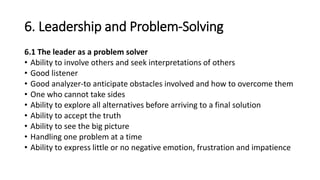
6. Leadership and Problem-Solving
6.1 The leader as a problem solver
• Ability to involve others and seek interpretations of others
• Good listener
• Good analyzer-to anticipate obstacles involved and how to overcome them
• One who cannot take sides
• Ability to explore all alternatives before arriving to a final solution
• Ability to accept the truth
• Ability to see the big picture
• Handling one problem at a time
• Ability to express little or no negative emotion, frustration and impatience
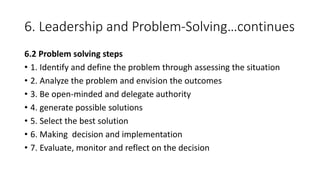
6. Leadership and Problem-Solving…continues
6.2 Problem solving steps
• 1. Identify and define the problem through assessing the situation
• 2. Analyze the problem and envision the outcomes
• 3. Be open-minded and delegate authority
• 4. generate possible solutions
• 5. Select the best solution
• 6. Making decision and implementation
• 7. Evaluate, monitor and reflect on the decision
References
Bush, T. (2011). Theories of Educational Leadership and Management
(4thEd.). Thousand Oaks, CA: SAGE.
7. Education Leadership and Management
(definitions)
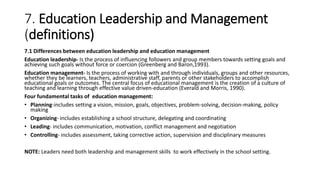
7.1 Differences between education leadership and education management
Education leadership- Is the process of influencing followers and group members towards setting goals and
achieving such goals without force or coercion (Greenberg and Baron,1993).
Education management- Is the process of working with and through individuals, groups and other resources,
whether they be learners, teachers, administrative staff, parents or other stakeholders to accomplish
educational goals or outcomes. The central focus of educational management is the creation of a culture of
teaching and learning through effective value driven-education (Everald and Morris, 1990).
Four fundamental tasks of education management:
• Planning-includes setting a vision, mission, goals, objectives, problem-solving, decision-making, policy
making
• Organizing- includes establishing a school structure, delegating and coordinating
• Leading- includes communication, motivation, conflict management and negotiation
• Controlling- includes assessment, taking corrective action, supervision and disciplinary measures
NOTE: Leaders need both leadership and management skills to work effectively in the school setting.
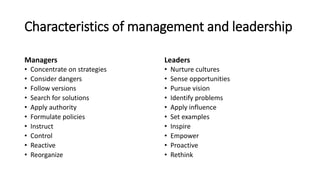
Characteristics of management and leadership
Managers
• Concentrate on strategies
• Consider dangers
• Follow versions
• Search for solutions
• Apply authority
• Formulate policies
• Instruct
• Control
• Reactive
• Reorganize
Leaders
• Nurture cultures
• Sense opportunities
• Pursue vision
• Identify problems
• Apply influence
• Set examples
• Inspire
• Empower
• Proactive
• Rethink
7. Education Leadership and Management
(definitions)…continue
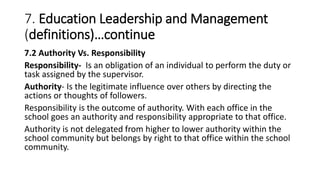
7.2 Authority Vs. Responsibility
Responsibility- Is an obligation of an individual to perform the duty or
task assigned by the supervisor.
Authority- Is the legitimate influence over others by directing the
actions or thoughts of followers.
Responsibility is the outcome of authority. With each office in the
school goes an authority and responsibility appropriate to that office.
Authority is not delegated from higher to lower authority within the
school community but belongs by right to that office within the school
community.
7. Education Leadership and Management
(definitions)…continue
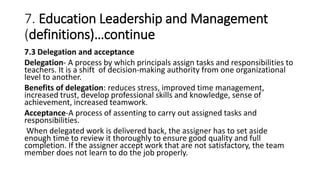
7.3 Delegation and acceptance
Delegation- A process by which principals assign tasks and responsibilities to
teachers. It is a shift of decision-making authority from one organizational
level to another.
Benefits of delegation: reduces stress, improved time management,
increased trust, develop professional skills and knowledge, sense of
achievement, increased teamwork.
Acceptance-A process of assenting to carry out assigned tasks and
responsibilities.
When delegated work is delivered back, the assigner has to set aside
enough time to review it thoroughly to ensure good quality and full
completion. If the assigner accept work that are not satisfactory, the team
member does not learn to do the job properly.
7. Education Leadership and Management
(definitions)…continue
7.4 Interpersonal relationships as a leader
• Demonstrate sound positive relationships towards others
• Being open and honest
• Exhibits patience in dealing with others
• Being gentle and kind in dealing with others
• Controls temper, tongue and habits
• Expresses a high feeling of pleasure or delight that is caught by fellow workers
• Demonstrate willingness to learn, listen and grow within the organization
• Demonstrate ability to exercise care in safe guarding confidential information
• Demonstrate soundness of conclusions, decisions and actions should be based on sound values
• Demonstrate a willingness to serve rather than be served, and enjoy seeing others succeeding.
7. Education Leadership and Management
(definitions)…continue
7.5 The manager as a leader
The manager as a leader integrates both qualities of a manager with that of a leader for successful
management and leadership. This can be attained when a manager get involved in the following leadership
tasks:
• Providing direction
• Innovate
• Motivate and inspire
• Delegate
• Values interpersonal skills and builds trust
• Values staff
• Being proactive
• Creates an environment for change
• Trains and teaches
• Provides guidance and counselling
References
Everald, B & Morris, G. (1990). Effective school management. London:
Paul Chapman.
Greenberg, J & Baron, A. (1993). Behaviour in organisations.
Understanding and managing the human side of work.(4th.ed.).
EnglewoodCliffs, NJ: Prentice Hall.
Higginson, R. (1996). Transforming leadership. London:SPCK.
8. The Basics of Successful Leadership
8.1 Set direction goals
• Ability to set organizational direction.
• It allows for all individuals to share the common understandings that
guide goal setting initiatives, dictate development activities and
facilitate the realization of organizational vision
• People are motivated by challenging, compelling and achievable goals
• Goals help people to make sense of their work
• Goals help people to find a sense of work identity
8. The Basics of Successful
Leadership…continue
Leadership practices that help to set direction get involved in the
following:
• Identify and articulate a clear vision
• Foster the acceptance of group goals
• Create high performance expectations
• Monitor organizational performance
• Promoting effective communication
• Development of shared organizational purpose
8. The Basics of Successful
Leadership…continue
8.2 Developing people
• Capacities and motivations are influenced by direct shared
experiences between leaders and followers and the immediate
organizational context
• People can be developed by offering intellectual stimulation
• People can be developed by providing individualized support
• People can be developed by providing appropriate models of best
practice and beliefs
• People can be developed by instilling acceptable behaviours
8. The Basics of Successful
Leadership…continue
8.3 Redesigning the organization
• Successful school leaders find ways to support the performance of learners,
teachers and administrators and implement strategies that ensure
sustainability.
Redesigning an organization also include the following:
• Strengthening school cultures.
• Modifying organizational structures.
• Building collaborative processes.
• Ensure that the purpose of organizational design initiatives are aligned with
the ever evolving organizational improvement plan.
References
• Petrillo, B. (2020). The Basics of Successful Leadership. Downloaded
from: leadinginthenew.com/2020/07/29the-basics-of-successful-
leadership/. Accessed 28/09/2020.
9. Leadership and Coaching
9. 1 The coaching cycle
1. Assess: determine the teacher preparation
2. Set goals: identify school goals.
Determine classroom goals
identify activity project
determine required skills
3. Prepare: set models for learning activities
Plan activity
share lessons/ resources
create/adapt materials
9. Leadership and Coaching…continues
4. Implement: Team teach
apply/ adjust
assess learning
5. Reflect/ debrief: determine the effectiveness
Plan future activities
9.Leadership and Coaching…continues
9.2 The importance of coaching and mentoring
• It indicates to people within the school that management is willing to
invest in its staff members
• Shows the outside world that the school values its staff members
• Fosters more loyal staff members
• Creates a more positive environment
• Foster leadership skills in the mentors
• Encourages staff members growth to future leaders
• Promotes a sense of cooperation and harmony within an organization
9. Leadership and Coaching…continues
9.3 Coaching for performance
• Develop a supportive working relationship
• Give praise and recognition
• Avoid blame and embarrassment
• Focus on the behavior, not the person
• Have staff members assess their own performance
• Give specific and descriptive feedback
• Give coaching feedback
• Provide modelling and training
• Make feedback timely
• Do not criticize
9. Leadership and Coaching
9.4 Leader’s role in coaching the team
• Building trust and inspiring teamwork
• Coaching team members and group members towards higher levels
of performance
• Facilitating and supporting team’s decisions
• Creating a team identity
9. Leadership and Coaching
9.5 Managing people’s issues affecting the school
1. Listen
2. Investigate
3. Inform where necessary
4. Seek to resolve the issue
5. Provide feedback
References
• Jurgen, A. (2010). Management 3.0: Leading Agile Developers.
Developing Agile Leaders. Addison-Wesley Professional.
10. Leadership and Team Building
10.1 Importance of team building
• It increase the organization’s ability to meet new challenges
• It makes the organization successful
• It enables the organization to fulfill its mission
• It builds trust
• It facilitates planning
• It enhances communication
• It ensure effective problem solving and decision making
• It creates adaptability
10. Leadership and Team Building
10.2 Team building process
1. Identify the need for team building
2. Define objectives and required skills
3. Consider the roles of the team
4. Determine team building strategy
5. Develop a team of individuals
6. Establish and communicate the rules
7. Identify individual strengths
8. Be part of the team
9. Monitor performance
10. Schedule meetings
11. Dissolve the team
10. Leadership and Team Building
10.3 Dealing with internal and external politics
• Actively recognizing and acting upon internal and external politics that impact the
work of the organization
• Be an active and ethical player
• Put the organization first
• Understand your own political style as a leader ( initiates, predicts, responds)
• Believe strongly in change initiative
• Take the lead
• Avoid moral and rational blocks
• Ethically build a critical mass of support for an idea you care about
• Being fully aware of the culture and relationships within an organization.
10. Leadership and Team Building
10.4 The Team Leader as a facilitator, mediator and negotiator
As a facilitator:
• Lead by example
• Motivate
• Inspire
• Mentor
• Coach
• Promote teamwork
• Have a vision
• Aims to win
10. Leadership and Team Building…continues
As a mediator
• Active listener
• Suggest alternative methods and procedures
• Remain neutral
• Monitor the process
10. Leadership and Team Building…continues
As a negotiator
• Negotiation skills
• Ability to keep dialogue flowing
• Seek for equal benefits
• Ensure collaboration
• Communicate effectively
• Accept and respect differences
References
• Bush, T., Bell, L & Middle, D. (2011). The Principles of Educational
Leadership and Management (2nd ed.) Thousand Oaks, CA SAGE.
11. Leadership and Motivation
11.1 Principles of motivation
• To motivate people, recognition such as rewards for performances (
praise, acknowledgement, book prizes and certificates) and the
creation of positive experiences will be positive influences bringing
more self-confidence and job- satisfaction.
• Participation and delegation, by allowing some new responsibilities,
can be very encouraging. Principals should allow teachers to express
themselves as individuals.
• Communication, good relationships and support will show that
principals appreciate the work that teachers do. All people need
acceptance and friendship.
11. 2 Motivation theories and their
applications
Following are specific theories of motivation:
• The intrinsic motivational theory of Maslow
• The extrinsic motivational theories of McGregor and Hertzberg
• The achievement motivational theory of McClelland
11.2.1 Maslow’s theory of hierarchy of needs
Maslow distinguishes a number of needs from lower to higher order:
• Physiological needs e.g. food, oxygen, constant blood temperature,
water and shelter. When management concentrates on physiological
needs as a way of motivating staff, they have made the assumption
that people work foremost for salaries and other financial rewards.
Emphasis is placed on wage increases, better working conditions and
improved fringe benefits as the means of motivating staff.
• Security and safety needs e.g. physical and psychological, security
and protection. This level is about stability and freedom from physical
threats and danger. Many teachers have entered education system
because the service provides a secure and stable job.
11.2.1 Maslow’s theory of hierarchy of needs…
continues
• Individuals who are frustrated because their security needs are
threatened may withdraw or show less morale. A teacher who fears
the loss of teaching a favourite subject may drop out activities, fill
every conversation with complains or show fear in other ways.
• Security –minded teachers want everything in black and white.
The need to belong and love needs e.g. affiliation, affection
• Social needs include affective relationships and the need to belong to
a group or family. If not fulfilled, the teacher may respond by
excessive use of sick leave and inadequate productivity. The
educational manager should made effort to promote social
interaction. The Principal should act in a very supportive manner.
11.2.1 Maslow’s theory of hierarchy of needs…
continues
• Needs for esteem or appreciation e.g. competence, mastery,
recognition, reputation, independence, freedom, confidence,
achievement and approval from others. Satisfaction of such needs
leads to self-confidence and a sense of gratification. If such needs not
satisfied, teachers can become discouraged. Teachers want to be
recognized for their accomplishments.
11.2.1 Maslow’s theory of hierarchy of needs…
continues
The need for self-actualization e.g. need for self-fulfillment
• Principals should make the work meaningful.
• Participation should be maximized so that teachers can use their
unique skills.
• Teachers should be involved in decision-making and goal defining
• Positive experiences should be created so that teachers can feel
wanted and responsible
• Rewards should be given
• Creativity should be encouraged
11.2.2 McGregor’s Theory X and Y
• McGregor describes two opinions about work. One approach
believes that people strive for self-realization by means of work, while
the other assumes that people strives only to satisfy their lower order
needs. McGregor calls these assumptions about the nature of work,
Theory X and Y (Van der Westhuizen, 1991,p.197).
• Theory X is about mistaken assumptions: the average person dislikes
work, shows resistance and against work and will do anything to avoid
it. Most employees must be threatened with disciplinary measures
and punishment before they will start working. They have little
ambition and rather be told what to do.
11.2.2 McGregor’s Theory X and Y…continues
• Educational mangers with this attitude have a descriptive approach
and feels that teachers avoid responsibilities and will take advantage
of the work situation. Teachers must be controlled everyday because
they posses limited capabilities. Principals have to keep a close watch
on their abilities and potential when devising their classroom work.
• The results will be that teachers will get more frustrated and
negative, with poorer interpersonal relationships.
11.2.2 McGregor’s Theory X and Y…continues
• Theory Y is more invitational approach. With theory Y, most employees are loyal,
hardworking, involved and have awareness of duty. Circumstances and
experience influence a person’s performance. Imagination and creativity is
promoted. People want more responsibilities. They do not want to be threatened
and do not need control as the only techniques to be used to achieve goals.
• The application of McGregor’s theory to the practice of education is that:
Educational leaders should not only make use of a limited part of the average
individuals' intellectual capabilities and potentials.
• Principals must view their staff as having a definite capacity for growth and
development. Teachers are not hostile, stupid or irresponsible.
• The few staff members who do not want to work are the exception and not the
rule.
• The real potential of every teacher should be tapped.
11.2.3 Theory Z ( Peter Drucker)
This is a combination of Theories X and Y with the following
principles:
• Individuals are potentially open to good and bad
• Social interaction will influence their performance
• People have a free will and use it positively and this can provide
motivational potential
• Principals should make use of individuals’ intellectual capabilities and
potential and show a positive attitude towards their staff.
11.2.4 Herzberg’s two-factor theory
• Herzberg distinguished between two sets of work factors, one of which relates to
the actual execution of the work. These factors are called motivators, satisfiers or
care factors and include achievement, recognition, responsibility and
advancement possibilities.
• The other set of factors relates to the work environment and extrinsic or
environmental factors. These are known as hygiene factors. Dissatisfiers,
demotivators or extrinsic factors and include supervision, interpersonal
relationships, physical working conditions, salary, fringe benefits and job security.
• Intrinsic factors urge teachers towards better achievement. Principals should
make motivators part of their daily management and leadership tasks. Care
factors are vital for the achievement of real job satisfaction and motivation.
• Teachers are not really going to work harder if they get paid more. So more
attention should be given to intrinsic factors.
11.2.5 McClelland’s theory of self-realisation
• The need of achievement (N-Ach) is better than monetary rewards, self-
realization is better than money.
• People with a high N-Ach set themselves high goals
• Apart from N-Ach people, McClelland distinguishes between N-Pow and N-
Aff people.
• N-Pow people are those with needs of power, authority and more
challenging work.
• N-Aff people need affiliation and good interpersonal relationships.
• This proves how different people are.
• Educational leaders should take note of individual differences in order to
motivate people.
11.3 Guidelines for setting SMART goals
• SMART-Specific, Measurable, Achievable/Attainable, Relevant, Time-bound
Specific but simple- Describe what needs to be achieved. Exactly what is it
you want to achieve in the school?
Measurable- The goal should answer the question. How much? How many?
How often?
Achievable/ Attainable- Say what you are going to do in a broader sense.
Describe the result. Challenging but not impossible.
Relevant –Does the goal support the school’s vision
Time-bound- Goal should have a time limit. By when do you want to achieve
the result . Stick to it.
References
Du Preez, P.J.(1999). Educational Management. A guide to educators
and managers in education. Amabhuku Publications. Pretoria.
Ministry of Education. (2014). Handbook for Instructional leaders in
Namibian schools. Windhoek.
Van der Westhuizen, P.C. (1991). Effective educational management.
Pretoria: Kagiso.
12. Leadership and Management of change
12.1 Leadership life cycle ( already discussed -Topic 4)
12.2 The need for change
• The external environment impacts on schools in many ways
• Education has to be responsive to factors emanating from the
external environment
• The following factors may bring about educational policy changes:
• Changes in politic e.g. democratization
• Changes in economy e.g. demands of the employment sector
• Social changes e.g. the shift to multi-cultural schools
• Technological changes e.g. IT
12.3 Communicating for change
• It requires transformational leadership
• Leaders and followers need to be united in pursuit of higher-level
goals
• The leader initiate change
• Involve staff members in the change process
• Steer change
• Develop plans for the implementation of change
• Ensure the resources and necessary skills are available to drive the
change process
12.4 Resistance to change and types of
resistance
• Resistance to change is caused by the fact that people move from a situation
which is known to one which is unknown
• That situation might or might not be better than the current situation(Davidoff
and Lazarus, 1997.38)
A number of different groups with respect to most proposal for change:
• Innovators ( enthusiasts for change in general)
• Early adopters ( people who are willing to give change a chance)
• Late adopters (cautious people who need more convincing or hard evidence of
the proposed change working elsewhere)
• Laggards ( people with a strong antipathy to change)
• Resisters ( people who try to sabotage the process of change)
12.4 Resistance to change and types of
resistance…continue
Types of resistance
1.Active resistance- refusal to implement it, taking the matter up with the unions,
taking the matter to court
2. Non- compliance- refusal to be forced into change
3. Passive resistance- doing as little as possible to implement the change , no
enthusiasm
4. Grudging compliance- adoption of the attitude of being forced to change against
one’s will
5. Formal compliance- doing the basic minimum
6. Genuine compliance- doing what is required, nothing more
7. Enrolment- doing what is required in good spirit
8. Commitment- complete involvement to make the change work
12.5 Factors that give rise to resistance to
change
• Fear of the unknown
• Lack of clarity of purpose
• Uncertainty and ambiguity
• Feelings of vulnerability
• Lack of clarity on the benefits of the change
• Reluctance to let go of the present
• Threats to expertise and established skills
• Fear of failure and threats to self-esteem
• Concerns about ability to cope
• Fear of loss of control
• Stress
• Increased workload
• Peer pressure
12.6 Methods of managing resistance to
change
• Communication
• Involvement and ownership
• Prevention of problems
• Clarity at all times and in all things
• Clear focus
• Encouraging success
• Looking at causes of problems and difficulties
• Providing evidence of benefits
• Being sensitive to people
• Identifying the kind of threat/ problem posed
• Building trust
• Looking at cultural factors in the organization
• Providing support
• Addressing the issue of timing
• Undertaking a task analysis
References
Bush, T. & West-Burnham, J.(1994). The principles of educational
management. London: Financial Times.
Davidoff, S & Lazarus, S. (1997). The learning school. An organization
development approach. Kenwyn: Juta.
Morrison, K. (1998). Management theories for educational change.
London: Paul Chapman.
13. School as an organization
The basic aim is that schools are the betterment of societies
To provide an efficient life to the learners and prepare them for the
art of learning together.
To bring schools and communities close together
To help learners to unfold their personalities (mental development)
To enable learners to have the right type of psychology of life
To conserve group practical values, heredity and culture of societies
and communities.
13.1 School climate and culture and its
importance
• Definition of School Culture: School cultures refers to the values and
norms, belief systems and ways of thinking that are typical of the people in
a given organization. Simply put, organizational culture is the identity of
the organization.
Definition of Climate: Organizational climate is generally viewed as the
characteristics of the total environment in say a school, which includes the
study of the perceptions of the individuals in that social set up. It has to do
with the ambience, aura, spirit, feeling and state of the atmosphere in an
organization.
• Organizational climate comprises 4 dimensions: ecology (physical and
material factors), milieu (social dimension), social system (organizational
and administrative structure) and culture. It is the perception of the work
environment as depicted by the level of employee motivation.
School climate and culture and its importance
….continues
• Strong school cultures breed dedicated teachers
• In a healthy environment, the professional relationships between a school’s
staff can become more congenial and productive.
• With collaborative input from all parties on major school decisions, a wider
range of views becomes represented.
• Opportunities are more evenly distributed among the student population,
increasing the likelihood that disadvantaged students have a chance to
succeed.
• Most importantly, though, the positive attitudes and behaviours exhibited
by school leaders and administrators become infectious, filtering down to
staff and students alike and improving the wellbeing of all.
• Teacher retention and development as well as student achievement.
13.2 School social structure
• The term social structure refers to a relatively enduring pattern of social
arrangements or interrelations within a particular society, organization, or
group.
13.2.1 Relationship between social structure and education
• When it comes to the external social context for school organizations,
attention is given to professionalism and bureaucracy, institutional forms of
organization, decentralized control, and community influences.
• Whereas, the internal structure of a school organization considers
teachers' working conditions, status differences among students, and
curriculum tracking.
• The emphasis is on ways in which social structure influences what is taught
in schools, how it is taught, and what is learned.
13.2.2 Parents and community
• Successful parental and community involvement can be defined as
the active, ongoing participation of a parent or primary caregiver and
the community in the education of children.
• Parents can demonstrate involvement at home-by reading with their
children, helping with homework, and discussing school events-or at
school, by attending functions or volunteering in classrooms.
• Schools with involved parents engage those parents, communicate
with them regularly, and incorporate them into the learning process.
13.2.3 The state
he degree to which the state control education depends upon constitution, statutes, and
regulations. Among the duties performed by state authorities are:
• Providing funding for public education at all levels;
• Licensing or chartering private schools and public and private institutions of higher education;
• Providing oversight and guidance to local school boards;
• Setting broad policies for school-level curricula, texts, standards, and assessments (but not higher
education);
• Licensing school teachers and other educational personnel;
• Overseeing the provision of educational services for persons living with disabilities, adults
needing basic education services, and other special needs populations;
• Setting the standards for examining and licensing persons seeking to work in any regulated
professional occupation; and
• Electing or appointing some or all of the members of the governing boards of public higher
education institutions and state boards of education.
13.2.4 Political party
• Influences the system of education
• Influences policies and regulations in education
• Influences the development of educational funding
• Influences educational reform
• Influences the review of educational aspects e.g. curriculum
13.2.5 Business and industries
• Support schools with resources and infrastructures
• influence the agenda of educational reform by indicating skills
needed in the market that education should impart
• Support educators in different ways e.g retaining ultimate decision
making responsibility
• Stimulate educational decision processes towards greater efficiency
and clarity
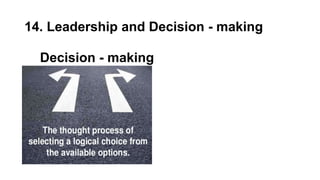
14. Leadership and Decision - making
Decision - making
14.1 Common pitfalls in Decision - making
• Lack of clear guidance - Leaders should set early parameters.
• Unclear purpose - Leaders should set clear purposes
• Lack of autonomy
• Wrong people, wrong place - integral to decision-making is having the
power (defined as credibility and knowledge) to grab the gavel and say.
14.1 Common pitfalls in Decision – making Continues..
• Defaulting to Consensus
As you and your team work through the steps in the decision-making
process, there can be a tendency to default to consensus, wherein everyone
agrees on what the problem is, there’s a free exchange of ideas, and the
recommendations for moving forward are acceptable to everyone involved.
• Not offering alternatives
Another drawback that can result from defaulting to consensus is a lack of
alternative solutions presented during the decision-making process.
14.1. Common pitfalls in Decision – making
continues..
• Mistaking opinions for facts
One of the key steps in the decision-making process is to set ground rules
and ensure everyone is aware of their role and how they can contribute.
• Losing sight of purpose
Over the course of the decision-making process, managers and their teams
can, at times, get wrapped up in the intricacies of problem-solving and lose
sight of the bigger picture.
14.2. Thinking and Decision- making process
• Take note and define the need /the idea/ the problem
• Gather all the relevant facts and information, including the prescribed
policies.
• Generate possible actions/solutions.
• Consider the consequences of the possible actions/solutions.
• Choose the best action/solution, make a decision.
14.2. Thinking and Decision- making process Continues..
• Take the necessary action by setting up a plan (what, who, when, cost)
• Take full responsibility for your decisions - it shows character and creates
respect.
14.3. Decision- making matrix – focus and impact
• An impact effort matrix is a decision-making tool that is used to
compare possible solutions
• An organization, team, or individual assesses activities based on the
level of effort required and the potential impact or benefits they will
have.
14.3. Decision- making matrix – focus
and impact
• It helps to select the best course of action
• It aids in prioritizing tasks
• It helps in problem solving
• It helps in crafting arguments to defend a decision tat is already made
References
Administration. 38(2), 130-141.Bligh, M. C., Pearce, C. L., & Kohles, J. C. (2006). The
importance of self-and shared leadership in team based knowledge work: A meso-level
model of leadership dynamics. Journal of Managerial Psychology, 21(4), 296-318.
Blasé, J. & Blasé, J. (2000). Effective instructional leadership: Teachers‟ perspectives on
how principals promote teaching and learning in schools. Journal of Educational.
Republic of Namibia. (2014). Handbook for instructional leaders in Namibian schools.
Millennium Challenge Account Namibia.
15. Leadership and Ethics in Education
Work ethics provide a healthy atmosphere and conducive teaching and
learning environment for teachers. If a teacher fails to recognise the
importance of these values, productivity in the school be halted.
15.1 Character and integrity
• Personal courage - the challenges that schools are facing increase day by
day, in order to create a positive educational environment, administrators
should be willing to stand up against policies, rules and regulations.
15.1 Character and integrity continues…
• Public interest ahead of self - what is best for students and staff must be placed
ahead of the needs of the individual leader.
• Self Control, Self Discipline and Integrity - all types of leadership essentially
should include these three traits in order to be considered ethical .
• Task and Employee centeredness - school leaders must create a foundation of
success that draws from the strengths of the teachers and staff who interact with
students.
• Recognizing talent - ethical leaders recognize the talent of their followers
15.1 Character and integrity continues…
• Requiring high ethics from everyone - Leaders need not only concern
themselves with their own ethical standards but also with the ethical
standards of others in their organization.
• Sensitivity and Understanding - this applies to the political, social and
economic environment of the stakeholders in the school settings.
• Inclusiveness - a sense of belonging is key to gaining trust within an
organization, and trust is a driving factor in success within the educational
context.
15. 2. Ethics and Values and Culture in Educational
Leadership
• Work ethics provide a healthy atmosphere and conducive teaching and
learning environment. All staff members should make effort to recognise
the importance of ethics, values and culture
The followings concepts are of outmost importance:
• Attendance
• Punctuality
15. 2. Ethics and Values and Culture in Educational
Leadership continues…
• Integrity
• Character
• Positive attitude
• Teamwork
• Appearance
• Productivity
• Communication
• Cooperation
15.3. Building excellence
• Be an example leader – teachers will always follow good
examples, positive, dedication and hard work
• Motivation - motivation is a set of forces that energies, directs,
and sustain behavior for both teachers and learners. Motivation
lies with the job itself, teachers can control and principal can
influence.
15.3. Building excellence continues…
• Focus on job enrichment - Leaders should ensure that job of the
teacher will provide challenges, the teacher will be loyal and dedicated
to do his/her best.
• Learn to like your teachers – leaders should focus on individual
teachers, shows a genuine interest in them, get to know them better.
Recognize their contributions
15.3. Building excellence continues…
• Ensure enthusiastic participation in school affairs by the teachers
• Make work itself a motivator – teachers want to be well utilized
• Lead the way by example
• Reward accomplishment – teachers expect to be rewarded in some way. School
managements needs to think creativity about alternatives to reward teachers who
work hard and achieve good results
• Provide opportunities to grow – school leaders should opportunities for teachers
to develop (PDP).
15.4. Emotional intelligence
• It is the ability to understand and manage own emotions and those of
others.
• People with as high degree of emotional intelligence usually know
their feelings, what it means and how their emotions can affect other
people (cleverness in dealing with emotions).
The five main elements of emotional intelligence
1. Self – awareness
• Know how you feel
• Know how your emotions and actions can affect people around you
• Have a clear picture of your strengths and weakness
• Have humility
2. Self – regulations
• Leaders who regulate themselves rarely verbally attack others
• Make rushed or emotional decisions
• Stereotype people or compromise their values.
• Self-regulation is all about staying in control
Emotional intelligence Continue..
3. Motivation
• Self – motivated leaders consistently work toward their goals and they have
extremely high standards for the quality of their work.
4. Empathy
• Have the ability to put themselves in someone else’s situation.
• They help develop the people in the team
• Challenge others who are acting unfairly
• Give constructive feedback and listen actively
Emotional intelligence continue..
5. Social Skills
• Leaders who have well-developed social skills are great communicators and
have excellent listening skills.
• They are experts at getting their team to support them and be excited about a
new vision, goal or projects.
• They set the example of commitment and hard work with their own
behaviour.
References
Administration. 38(2), 130-141.Bligh, M. C., Pearce, C. L., & Kohles, J. C. (2006).
The importance of self-and shared leadership in team based knowledge work: A
meso-level model of leadership dynamics. Journal of Managerial Psychology, 21(4),
296-318.
Blasé, J. & Blasé, J. (2000). Effective instructional leadership: Teachers‟
perspectives on how principals promote teaching and learning in schools. Journal of
Educational.
Republic of Namibia. (2014). Handbook for instructional leaders in Namibian
schools. Millennium Challenge Account Namibia.

Management_in__Education_notes[1].pptx

  • 1.
    1.EDUCATION LEADERSHIP ROLE-The Role of the teachers leader and Skills • Collaborate with teachers • Provide direction and guidance on the curriculum • Supporting teachers to implement the cycle of planning effectively in order to enhance programs and practices • Lead the development and implementation of effective educational programs • Ensure that children’s learning and development are guided by the learning outcome of the approved learning frameworks
  • 2.
    EDUCATION LEADERSHIP ROLE-TheRole of the teachers leader and Skills …CONTINUE • Guiding and developing the understanding of teachers and families on educational matters • Building the knowledge, skills and professionalism of teachers • Ensure that the school is managed properly and abiding to the legislations, regulations in place • Promote the education of learners in a proper way and in line with the policies • Evaluating teaching program, carry out teaching, supervision, administration and in-service development and guidance of teachers at the school • Engage in class teaching
  • 3.
    EDUCATION LEADERSHIP ROLE:The Role of the teachers leader and skills…..continue • Accountability • Promoting a positive school climate • Creating an effective learning environment • Leading and managing the staff • Effective deployment of staff and resources • Interaction with stakeholders • Administrative
  • 4.
    2. Traits/ qualitiesof a leader (distinguishing quality or characteristics • Integrity and honesty- to do the right things even when none is watching. Being truthful as a leader. • Delegation and empowerment- Allocating duties to followers to empower them with necessary knowledge and skills • Self-awareness- Knowing and understand oneself as a leader • Gratitude-Ability to give thanks, awarding and praising followers • Learning agility- Ability to know what to do even in unfamiliar circumstances • Influence- Ability to inspire and convince followers to attain a common goal.
  • 5.
    Traits/ qualities ofa leader (distinguishing quality or characteristics……..continue • Empathy-Ability to understand the followers’ problems and feeling their pain. • Courage and confidence- Ability to voice new ideas, to provide feedback, put concerns forward and to step up and move things in the right direction rather than avoiding problems or allowing conflicts to arise • Respect- Treating all people with respect and dignity. This will ease tensions, conflicts, create trust and improve effectiveness. • Decision- making capabilities- Ability to take the right decision at the right time, and consulting key stakeholders before taking decisions
  • 6.
    Traits/ qualities ofa leader (distinguishing quality or characteristics……..continue • Accountability- Ability to make sure that every follower is accountable for what he/she is doing. If followers did well, then a leader should thank them, and when struggling they must be made to realize their mistakes and work together to improve. This creates a sense of responsibility. • Creativity and innovation- Ability to apply creative thinking and constant innovation. Think out of the box, come up with unique ideas, turn ideas and goals into reality. • Humility- being selfless and always think about followers • Transparency- Openly share information, giving visibility, keep the followers engaged
  • 7.
    Traits/ qualities ofa leader (distinguishing quality or characteristics……..continue • Vision and purpose- have vision and purpose and share it with the followers • Emotional intelligence- Ability to connect with people emotionally. A leader has to control emotions so that negative emotions cannot influence the decision –making skills, manage emotions effectively, better social awareness and conflict resolution. • Commitment and passion- Being committed and have passion for the work. It helps to gain respect and motivate followers to achieve goals. • Resilience- displaying and applying positive attitudes no matter how difficult the circumstances might be.
  • 8.
    Traits/ qualities ofa leader (distinguishing quality or characteristics……..continue • Other qualities: Discipline Assertiveness Sensitivity Fairness Consistency Flexibility adaptability
  • 9.
    3.1 Three majorleadership styles • 3.1.1 Autocratic leadership • 3.1.2 Democratic leadership • 3.1.3 Laissez-faire
  • 10.
    3.1.1 Autocratic leadership(command) • Is the leader-centred and dictatorship to a certain extent. • Leaders impose their own will on followers • Leaders take all decisions and stick to a fixed and rigid schedule • Initiation are taken from the top and communication flows from the principal down to the followers • All authority for planning, organization and control are vested with a leader • The leader does not allow for participative decision making and good human relations are considered less important.
  • 11.
    Advantages of autocraticleadership • Needed when immediate action is called for, as in the case of emergency • Management takes the initiative in coordinating work • Tasks, situations and relationship are clearly defined • Decision making is fast with management at the centre of activities • Staff receive direct and immediate assistance towards achieving their goals
  • 12.
    Disadvantages of autocraticleadership • Lack of cooperation • Staff and learners are motivated by fears • A tense atmosphere in the school with little job satisfaction • Suppression of initiative and creative thought • Poor human relations and inadequate communication • Little or no staff development takes place • Dissatisfaction with the management of the school prevails
  • 13.
    3.1.2 Democratic leadership(participative) • Is group-centred (teamwork), with decentralized authority and decision making. • It involves decentralization of planning, organization and control • It allows for more participation and consulting with the followers without dictating to them • The leader is flexible and able to apply leadership skills • Tasks, responsibilities and authority are delegated • Staff members, learners and parents are involved in the decision-making and planning process • An open-door policy is followed • The opinion of staff members is considered as valuable in the decision-making process • Two –way communication takes place • A healthy school climate and team spirit is fostered • Good human relations are maintained
  • 14.
    Advantages of democratic/participativestyle • Two-way communication takes place • Staff, parents and learners are motivated to achieve the vision of the school • Initiative and creativity are promoted amongst the staff members • A relaxed atmosphere prevails and staff members feel free to contribute to management • Authority can be more easily exercised • Staff morale is improved by involving staff members in decision making, planning and control • Job satisfaction is increased through staff development, delegation of responsibilities and making work more interesting
  • 15.
    Disadvantages of democratic/participative style •It may lead to over-participation if not properly handled • Decision making might be time consuming • Disagreements may occur and staff members my not want to get involved in a tug of war • Lack of positive and clear direction may prevent objectives being attained • There might be staff who are not capable of working without close supervision
  • 16.
    3.1.3 Laissez-faire leadership •The organization moves along without specific direction of the leader • The leader has little or no interest in planning, organizing or the exercise of control • The organization’s vision or mission is not projected • A clearly formulated vision rarely exist • Goals are rarely set and problems are solved by whoever is available. • Staff members are expected to motivate themselves with little or no feedback on their performance • The leader hesitate to make decisions and does not attempt to influence the group • Leadership is practiced through suggestions and delegation without the leader being willing to accept accountability for delegated tasks. • Communication in the school is within departments and between staff members because of a lack of downward communication • Little attention is given to policy making and policy implementation with a result that the discipline in the school is weak
  • 17.
    Disadvantages of laissez-faire leadership • Confidence in and respect for the principal may be forfeited • Task performance in the school may be poor • Clear goals and objectives are not set for the school • It leads to battles among competing subordinates who try to exercise power • As a result of a lack of coordination, communication, motivation and control, there is frustration, aimlessness and indecision in the school • The school as an organization is vulnerable to power plays • Staff work members are unmotivated and experience little job satisfaction • Staff may experience boredom in the execution of their daily tasks
  • 18.
    References • Bush, t.,Bell, L. & Middle, D. (2011). The Principles of Educational Leadership and Management (2nd ed.). Thousand Oaks, CA:SAGE • Davidoff, S. & Lazarus, S. (1997). The learning school. An organization development approach. Kenwyn: Juta.
  • 19.
    3.2 Other leadershipstyles 3.2.1 Collaborative leadership • Under collaborative leadership style, leaders influence or motivate people to create the greatest possible impact and to do better. • Leaders keep some control over the process. • Leaders also allow people to work independently because creativity is seen as a strength with this leadership style. • This leadership style features mentorship as a top priority. • By working directly with their team, leaders using the collaborative process can transfer their knowledge, skills, and wisdom. • Collaborative leadership includes constructive feedback provision, open sharing of data, strong network building skills, and contextual intelligence.
  • 20.
    Advantages of collaborativeleadership 1.Collaboration opens up the workplace to new workers. • it opens the workplace up to new ideas. • creates more diversity, which adds new ideas into the mix. • Everyone has the ability to contribute to the work being done. 2. It strengthens the relationships of the team. • It leads to new opportunities to get to know people on a personal level. • it creates higher levels of loyalty within the team. • It allows people to pursue what they are passionate about. • It leads to better services being rendered, better products, and innovative processes.
  • 21.
    Advantages of collaborative leadership…continues 3.Collaboration creates shorter lead times. • it allows each team member to focus on what they are best at doing. • each person is permitted to bring their strengths and expertise on the matter and that allows the quality of work to improve. • with improved quality, the time for review and revision is reduced.
  • 22.
    Advantages of collaborative leadership…continues 4.There is a balance brought to every decision with this leadership style. • it allows multiple voices to be heard, while retaining the authority to make a singular decision. • cooperation is encouraged because each team member to maintain an open mind. 5. It improves the morale of the team. • the ability to learn from each other, work together, and solve problems together creates an inviting workplace. • it naturally builds trust because each person is working toward the mutual success. • the morale of the team continues to improve, which then cultivate more collaboration to take place.
  • 23.
    Advantages of collaborative leadership…continues 6.Collaborative leadership demands creativity. • All staff members are encouraged to tap into their creative resources for the betterment of a project, the team, and the organization as a whole. • They invite the challenge instead. New ideas drive people forward. 7. It reduces the workload responsibilities of each individual. • The process of working together naturally divides the workload equally. • The chance to work together is better than the expectation of solving own problems should something come up.
  • 24.
    Disadvantages of collaborativeleadership style • Collaboration doesn’t remove all forms of conflict. Disagreements are common in the workplace. • It requires people to stay connected with each other It creates ambiguous roles. • it may cause some workers to feel like they must take a leadership role. • causes some people to force their ideas onto others, even if it isn’t the best path forward. • this issue can become such a problem that it leads to sabotage
  • 25.
    Disadvantages of collaborativeleadership style…..continue • Collaboration can encourage groups to think alike. • Collaboration can lead to group thinking and “yes” people. • the team decides to agree with the most persuasive individual. • Instead of new ideas, the team ends up pursuing the personal outcomes that one person wants. • There may be issues with individual working styles. • Some team members will see themselves as leaders too. • Though collaborative leadership style encourages mentorship, Some mentors might feel like their experience is even better than that of their leaders. • Note: working together is a good thing when properly managed. Sharing experiences creates better working environments, however, it can also create internal conflicts.
  • 26.
    3.2.2 Transitional leadership •A transitional leader is an individual brought in the organization to tackle a corporate challenge with a defined purpose and direction. • He/she is typically hired to lead a major transformation, e.g restructuring, sale or turnaround, integration of an acquisition or the start-up of a new division. • the transitional leader faces the complex, testing and often getting the difficult job done
  • 27.
    3.2.3 Visionary leadership •A visionary leader has clear ideas of how the future should look. • Visionary Leadership is built on inspiring and motivating people to pursue a long term vision of an organization.
  • 28.
    Advantages of visionaryleadership • There is a clear idea of the overall goal for everyone to achieve • Temporary setbacks don’t deter the achievement of the overall vision • A visionary leader can focus the team’s energy on what ultimately matters to make the overall goal a reality • Visionary leaders are proactive and can often foresee challenges • Visionary leaders value innovation and creativity • Visionary leaders aren’t afraid to take risks that will push the organization closer to the overall goal • Visionary leaders place high value on acknowledging worker’s achievements and making them feel valuable since their work impacts the organization’s vision • Inspire unity and getting everyone on the same page
  • 29.
    Disadvantages of visionaryleadership • Followers rely too much on the leader • sometimes, it is hard to win over all followers • Lack of clarity- hard to see the potential dangers of an institution
  • 30.
    3.2.4 Situational leadership •Under Situational leadership a leader adapts a style of leading to suit the current work environment and/or needs of a team. • This style of leadership is based on a leader's ability to adjust to the requirements of a team or organization in order to be a better and more effective leader. • This leadership style may also be referred to as "Situational Leadership Theory" or the "Situational Leadership Model"
  • 31.
    Situational leadership style…continue Somecommon traits that a situational leader illustrates or is capable of illustrating in the workplace: • Direction: effective in giving direction and providing constant supervision. • Flexibility: must be flexible and able to adapt on a regular basis. • Encourage participation: must encourage team members to become more self-reliant by promoting participation in decisions. • Delegation: must be able to delegate tasks to those team members who are capable of working independently. • Regular coaching: be able to coach the team to encourage growth and independence. • Honesty: must be honest about a situation and adapt the leadership style to suit any situation at hand. Note: A true situational leader is able to successfully assess a team and implement different leadership styles to meet the needs of the team in each situation. A true Situational leader must offer support where needed and encourage growth and independence in order to promote increased productivity and success.
  • 32.
    Advantages of Situationalleadership style • Leaders are able to use whichever leadership style they believe is best in a given situation. • A situational leadership style can be more comfortable for good leaders who know how to use it. • This type of leadership style is fairly simple, as all that is needed is the ability to assess a situation and adjust to it. • Situational leadership can create a more comfortable environment for staff members as the leadership style implemented will typically match their needs. • This type of leadership accounts for the various levels of development in staff members and helps to address each staff member's skill level and needs.
  • 33.
    Disadvantages of Situationalleadership style • Can cause confusion within an organization, as a situational leader may constantly change the approach to address each team or individual's needs. • Tends to only focus on short-term goals which leads to overlooking of long-term goals. • Does not work well when repetitive tasks need to be completed, as it is flexible. • Situational leadership depends on the leader's ability to judge a staff member’s maturity level. Some leaders are unable to do this effectively and may, therefore, provide a style of leadership that does not suit a particular staff member.
  • 34.
    3.2.5 Strategic leadership •The ability to anticipate, envision, maintain, being flexible and empowers others to bring about strategic changes as necessary in an organization. Characteristics a strategic leader should focus on developing in order to succeed: 1.Inquisitive • A strategic leader need to be able to look at complex situations and come up with the best solutions for moving forward. Therefore, the strategic leader is curious about the options and question things.
  • 35.
    Strategic leadership style…continue 2.Resourceful 3. Influential 4.Communicative 5.Compassionate
  • 36.
    Advantages of strategicleadership • Provides more clarity in the decision-making process • Adds more clarity to operations. Having a clearly defined vision will make it easier for followers to understand why things are done that way. The objectives are clear, making it easier to implement procedures that move the organization towards them. • action plan creates a set of objectives and tasks, which are clearly defined. This gives rise to goals and processes that can be measured. By measuring performance and achievement, the organization can create a stronger understanding of what it is doing right and the areas that need to be developed and improved further. • It examines the different components and trying to predict the future.
  • 37.
    Disadvantages of strategicleadership style • The future doesn’t unfold as anticipated • It can be expensive • Long term benefit versus immediate results • Impedes flexibility
  • 38.
    References Belyh, A. (2020).Strategic Leadership. Downloaded from cleverism.com/strategic-leadership-guide. Accessed: 09/08/2020. Bush, t., Bell, L. & Middle, D. (2011). The Principles of Educational Leadership and Management (2nd ed.). Thousand Oaks, CA:SAGE. Davidoff, S. & Lazarus, S. (1997). The learning school. An organization development approach. Kenwyn: Juta. Kinsey, A. (2018). What is visionary leadership? Downloaded from bizfluenet.com/info-8721665-visionary-leadership.html. Accessed: 01/09/2020.
  • 39.
    4. Leadership lifecycle Leadership posses a life cycle. • The leadership life cycle comprises of the following five stages/phases: Birth/ creation, Growth, Maturity, Legacy/ turnaround, and Death/ Decline 1.Birth/creation- Is when a leader has just started with the leadership role and is excited to take on new challenges 2. Growth • A leader starts the path of growth with the support and assistance of mature leaders, mentors or coaches. • Some growths come from observing and learning from mistakes and successes of others, some come from learning from own mistakes and success. • Productive stage that focus on achievement.
  • 40.
    Leadership life cycle…continues 3.Maturity • Think less about achievement and focus more on legacy • Seek new leaders to pour into and mentor • Focus on continued growth and passing on what is learned 4. Legacy/turnaround • The vision outlives the leader, meaning even when that leader retires or passed on the vision carries on • All high ideals, vision and values of the leader continue among younger leaders even during his/her physical absence at the school/institution
  • 41.
    Leadership life cycle…continues 5.Death/ Decline- Is the non-physical death of a leader through actions and behaviours. Indicators of this stage/phase: • Lack of accountability • Incompetency/ lack of desire • Apathy • Not developing a new generation leaders • Unethical behavior • Dishonesty • Duplicity • Interested only in promoting themselves at the expense of others • Lack of respect by their team for the leader’s authority
  • 42.
    References Hersey, P., Blanchard,K., & Johnson, D.E.(2001). Management of Organizational Behaviors: Leading human resources (8th.ed.). Englewood Cliffs, NJ: Prentice Hall. The Leadership Life Cycle- Lead Change.(2014). Downloaded from leadchangegroup.com. Accessed: 31/08/2020 Ward, A. (2003). The leadership Life cycle.pp1-17. Downloaded from link.springer.com>content>pdf. Accessed: 01/09/2020.
  • 43.
    5. Leadership andcommunication 5.1 Basics of effective communication • Completeness of the Message i.e Communication must be complete so as not to baffle the recipient. Better communication helps in better decision-making. • Clearness and Integrity of the Message. The message sent must have clarity and integrity for better understanding. Clarity of thoughts and ideas enhances the meaning of the message.
  • 44.
    5.1 Basics ofeffective communication…continues • The pith and substance of the message should be based on honesty and accuracy. • The intended message must be free from verbosity and should be so written that it is intelligible at the first sight. Short and intelligible message sent to the receiver is ever appealing and comprehensible as it saves time and cost.
  • 45.
    5.1 Basics ofeffective communication…continue • Consideration of Physical Setting and the Recipient’s overall physical setting, i.e., the media of communication and the work environment, must be considered. • The content of the message must take into account the attitude, knowledge, and position of the recipient. • The message should have clarity of thoughts and ideas in order to be understood clearly. The use of exact, appropriate and concrete words and symbols. • Courtesy to be Maintained .The sender's message should be so drafted or prepared that it should be polite, reflective, and enthusiastic. It must show the sender's respect for the receiver and be positive and focused at the receiver. • Correctness of the Message. The final message must be free from any grammatical errors and repetitions of sentences. The message should be exact, correct and well-timed.
  • 46.
    5.2 Level ofcommunications according to (Miller, P.2012) Three level of communications skills needed by leaders are: 1. Core communication skills 2. Team communication skills 3.Strategic and external communication skills
  • 47.
    5.2 Level ofcommunications according to (Miller, P.2012)…continues 1. Core communications skills includes the following: • Interpersonal skills or people skills needed to develop relationship with people • Key skills needed by leaders within the interpersonal skills framework are: • Oral and written communication • Non-verbal communication e.g. facial expressions, body language, the way a person dresses, the way a person moves hands when talking, the distance in between when talking
  • 48.
    5.2 Level ofcommunications according to (Miller, P.2012)…continues • Active listening-Leaders need to active listeners • Giving and receiving feedback-praise and criticism that vary from work performance to interpersonal behaviours. Such feedback must be clear and fully understood. • Emotional intelligence- capacity of a leader to deal with own emotions and those of others (Goleman,2004). • Conflict resolution and negotiating skills- leaders must be initiators of conflict resolutions. They should also handle any conflict situation when it arises. Five conflict management styles (Lussier and Achua,2004): avoidance, accommodation, force, negotiation, and collaboration
  • 49.
    5.2 Level ofcommunications according to (Miller, P.2012)…continues 2. Team communication skills • Managing by walking around (MBWA) to be able to do the following: Use of informal conversations to teach and reinforce values of an institution to individuals in the team Listen and pay attention Discover and acknowledge innovation Coach and mentor in staff members in own environments • Facilitating meetings Communication skills needed to manage productive meetings(Daglish and Miller,2010): purpose, participants, planning and process
  • 50.
    5.2 Level ofcommunications according to (Miller, P.2012)…continues 3. Strategic and external communication skills • Statement of vision, mission and values • Communication systems e.g. manual and paper based reporting systems, information technology systems(emails) and statement of policies and procedures. These must work to align with and reinforce the organization’s mission, vision and values • Leaders as communication role models- by setting the standard for communication. Leaders set the climate for communications with staff members and other leaders. i.e. when a leader communicate either individually, in groups, by email and internal correspondences, that set up examples to be emulated. Similarly, transparency in decision making, the frequency of visibility around the institution, and own often she/ he address the staff in person also set examples to others.
  • 51.
    5.2 Level ofcommunications according to (Miller, P.2012)…continues • Knowledge management The ability to design and monitor the management of knowledge and the management information systems. • External relations Leaders need skills in media and public relations
  • 52.
    5.3 Leadership typesof communication Verbal Communication • refers to the form of communication in which message is transmitted verbally; where communication is carried out either by word of mouth or by writing. Components of Verbal Communication: • Understandable Language • Word choice • Inflection (pattern of stress in oral speech) • Tone • Body language • Eye behavior (oculesics) • Visuals (pictures, maps, charts, graphs, colors, signs, etc.) • Auditory elements (sounds, tunes, whistles, etc.)
  • 53.
    5.3 Leadership typesof communication …continues Non-verbal communication • refers to communications made through various wordless or unspoken mediums.
  • 54.
    5.4 The artof listening: Active listening There are eight specific behaviours that leaders should endeavour to practice to build active listening skills (Robbins, Bergman, Stagg & Coulter 2003): • Make eye contact with the speaker. • Make affirmative nods and other appropriate facial expressions to show interest in what is being said. • Appropriate movements and non-verbal listening responses let the speaker know that one is listening.
  • 55.
    5.4 The artof listening: Active listening…continues • Avoid distracting gestures that can be an indication of being bored or tired of what is being said. Give full and undivided attention. • Ask questions to seek clarification and to ensure own understanding but leave it until the end so as not to be interruptive. • the use of paraphrasing technique by restating and rephrasing the communication in own words by commencing with, ‘Do you mean …’or ‘As I understand it, what you are saying is …’. This technique checks for accuracy and verifies that one has listened correctly.
  • 56.
    5.4 The artof listening: Active listening…continues • Avoid interrupting the speaker until the end of the communication. • Avoid talking over the top of the speaker. One cannot listen and speak at the same time! • Make smooth transitions between the roles of speaker and listener— try not to think what one might say as listening to the other person.
  • 57.
    5.5 Conducting effectivemeetings and giving feedback • Clear objectives • Consider who is invited • Sticking to the schedule • Take no hostage by not allowing one person to monopolize the conversations • Start on time • Ban technology to enable full concentration and participation • Follow up by sending out a memo highlighting the discussions to all who attended the meeting
  • 58.
    5.6 Barriers tocommunications • The use of jargon • Emotional barriers • Lack of attention, interest, distractions, or irrelevance to the receiver. • Differences in perception and viewpoint. • Physical disabilities such as hearing problems or speech difficulties • Language • Nothing or little in common • Lack of eye contact • Information overload and lack of focus • Not being prepared, lack of credibility • Talking too much
  • 59.
    5.6 Barriers tocommunications…continues • Dissatisfaction or disinterest With one’s job • Inability to Listen to Others • Lack of Transparency & Trust • Communication Styles (when they differ) • Conflicts in the Workplace • Cultural Differences
  • 60.
    References Dalglish, C. andMiller, P. (2010). Leadership: Understanding its Global Impact, Tilde University Press (Palgrave Macmillan), Melbourne. Goleman, D.( 2004). ‘What makes a leader?’, Harvard Business Review, The best of HBR edition, January, Article first published 1995. Lussier, R. & Achua, C. (2004). Leadership: Theory, application, skills development,( 2nd ed.), Thomson, USA. Miller, P. (2012). Leadership Communication-the three levels, Today’s Manager. Singapore Institute of Management, Issue February-March 2012,pp.19-21 Robbins, S., Bergman, R., Stagg, I. & Coulter, M. (2003). Management, 3rd ed.)Prentice Hall, Frenchs Forest.
  • 61.
    6. Leadership andProblem-Solving 6.1 The leader as a problem solver • Ability to involve others and seek interpretations of others • Good listener • Good analyzer-to anticipate obstacles involved and how to overcome them • One who cannot take sides • Ability to explore all alternatives before arriving to a final solution • Ability to accept the truth • Ability to see the big picture • Handling one problem at a time • Ability to express little or no negative emotion, frustration and impatience
  • 62.
    6. Leadership andProblem-Solving…continues 6.2 Problem solving steps • 1. Identify and define the problem through assessing the situation • 2. Analyze the problem and envision the outcomes • 3. Be open-minded and delegate authority • 4. generate possible solutions • 5. Select the best solution • 6. Making decision and implementation • 7. Evaluate, monitor and reflect on the decision
  • 63.
    References Bush, T. (2011).Theories of Educational Leadership and Management (4thEd.). Thousand Oaks, CA: SAGE.
  • 64.
    7. Education Leadershipand Management (definitions) 7.1 Differences between education leadership and education management Education leadership- Is the process of influencing followers and group members towards setting goals and achieving such goals without force or coercion (Greenberg and Baron,1993). Education management- Is the process of working with and through individuals, groups and other resources, whether they be learners, teachers, administrative staff, parents or other stakeholders to accomplish educational goals or outcomes. The central focus of educational management is the creation of a culture of teaching and learning through effective value driven-education (Everald and Morris, 1990). Four fundamental tasks of education management: • Planning-includes setting a vision, mission, goals, objectives, problem-solving, decision-making, policy making • Organizing- includes establishing a school structure, delegating and coordinating • Leading- includes communication, motivation, conflict management and negotiation • Controlling- includes assessment, taking corrective action, supervision and disciplinary measures NOTE: Leaders need both leadership and management skills to work effectively in the school setting.
  • 65.
    Characteristics of managementand leadership Managers • Concentrate on strategies • Consider dangers • Follow versions • Search for solutions • Apply authority • Formulate policies • Instruct • Control • Reactive • Reorganize Leaders • Nurture cultures • Sense opportunities • Pursue vision • Identify problems • Apply influence • Set examples • Inspire • Empower • Proactive • Rethink
  • 66.
    7. Education Leadershipand Management (definitions)…continue 7.2 Authority Vs. Responsibility Responsibility- Is an obligation of an individual to perform the duty or task assigned by the supervisor. Authority- Is the legitimate influence over others by directing the actions or thoughts of followers. Responsibility is the outcome of authority. With each office in the school goes an authority and responsibility appropriate to that office. Authority is not delegated from higher to lower authority within the school community but belongs by right to that office within the school community.
  • 67.
    7. Education Leadershipand Management (definitions)…continue 7.3 Delegation and acceptance Delegation- A process by which principals assign tasks and responsibilities to teachers. It is a shift of decision-making authority from one organizational level to another. Benefits of delegation: reduces stress, improved time management, increased trust, develop professional skills and knowledge, sense of achievement, increased teamwork. Acceptance-A process of assenting to carry out assigned tasks and responsibilities. When delegated work is delivered back, the assigner has to set aside enough time to review it thoroughly to ensure good quality and full completion. If the assigner accept work that are not satisfactory, the team member does not learn to do the job properly.
  • 68.
    7. Education Leadershipand Management (definitions)…continue 7.4 Interpersonal relationships as a leader • Demonstrate sound positive relationships towards others • Being open and honest • Exhibits patience in dealing with others • Being gentle and kind in dealing with others • Controls temper, tongue and habits • Expresses a high feeling of pleasure or delight that is caught by fellow workers • Demonstrate willingness to learn, listen and grow within the organization • Demonstrate ability to exercise care in safe guarding confidential information • Demonstrate soundness of conclusions, decisions and actions should be based on sound values • Demonstrate a willingness to serve rather than be served, and enjoy seeing others succeeding.
  • 69.
    7. Education Leadershipand Management (definitions)…continue 7.5 The manager as a leader The manager as a leader integrates both qualities of a manager with that of a leader for successful management and leadership. This can be attained when a manager get involved in the following leadership tasks: • Providing direction • Innovate • Motivate and inspire • Delegate • Values interpersonal skills and builds trust • Values staff • Being proactive • Creates an environment for change • Trains and teaches • Provides guidance and counselling
  • 70.
    References Everald, B &Morris, G. (1990). Effective school management. London: Paul Chapman. Greenberg, J & Baron, A. (1993). Behaviour in organisations. Understanding and managing the human side of work.(4th.ed.). EnglewoodCliffs, NJ: Prentice Hall. Higginson, R. (1996). Transforming leadership. London:SPCK.
  • 71.
    8. The Basicsof Successful Leadership 8.1 Set direction goals • Ability to set organizational direction. • It allows for all individuals to share the common understandings that guide goal setting initiatives, dictate development activities and facilitate the realization of organizational vision • People are motivated by challenging, compelling and achievable goals • Goals help people to make sense of their work • Goals help people to find a sense of work identity
  • 72.
    8. The Basicsof Successful Leadership…continue Leadership practices that help to set direction get involved in the following: • Identify and articulate a clear vision • Foster the acceptance of group goals • Create high performance expectations • Monitor organizational performance • Promoting effective communication • Development of shared organizational purpose
  • 73.
    8. The Basicsof Successful Leadership…continue 8.2 Developing people • Capacities and motivations are influenced by direct shared experiences between leaders and followers and the immediate organizational context • People can be developed by offering intellectual stimulation • People can be developed by providing individualized support • People can be developed by providing appropriate models of best practice and beliefs • People can be developed by instilling acceptable behaviours
  • 74.
    8. The Basicsof Successful Leadership…continue 8.3 Redesigning the organization • Successful school leaders find ways to support the performance of learners, teachers and administrators and implement strategies that ensure sustainability. Redesigning an organization also include the following: • Strengthening school cultures. • Modifying organizational structures. • Building collaborative processes. • Ensure that the purpose of organizational design initiatives are aligned with the ever evolving organizational improvement plan.
  • 75.
    References • Petrillo, B.(2020). The Basics of Successful Leadership. Downloaded from: leadinginthenew.com/2020/07/29the-basics-of-successful- leadership/. Accessed 28/09/2020.
  • 76.
    9. Leadership andCoaching 9. 1 The coaching cycle 1. Assess: determine the teacher preparation 2. Set goals: identify school goals. Determine classroom goals identify activity project determine required skills 3. Prepare: set models for learning activities Plan activity share lessons/ resources create/adapt materials
  • 77.
    9. Leadership andCoaching…continues 4. Implement: Team teach apply/ adjust assess learning 5. Reflect/ debrief: determine the effectiveness Plan future activities
  • 78.
    9.Leadership and Coaching…continues 9.2The importance of coaching and mentoring • It indicates to people within the school that management is willing to invest in its staff members • Shows the outside world that the school values its staff members • Fosters more loyal staff members • Creates a more positive environment • Foster leadership skills in the mentors • Encourages staff members growth to future leaders • Promotes a sense of cooperation and harmony within an organization
  • 79.
    9. Leadership andCoaching…continues 9.3 Coaching for performance • Develop a supportive working relationship • Give praise and recognition • Avoid blame and embarrassment • Focus on the behavior, not the person • Have staff members assess their own performance • Give specific and descriptive feedback • Give coaching feedback • Provide modelling and training • Make feedback timely • Do not criticize
  • 80.
    9. Leadership andCoaching 9.4 Leader’s role in coaching the team • Building trust and inspiring teamwork • Coaching team members and group members towards higher levels of performance • Facilitating and supporting team’s decisions • Creating a team identity
  • 81.
    9. Leadership andCoaching 9.5 Managing people’s issues affecting the school 1. Listen 2. Investigate 3. Inform where necessary 4. Seek to resolve the issue 5. Provide feedback
  • 82.
    References • Jurgen, A.(2010). Management 3.0: Leading Agile Developers. Developing Agile Leaders. Addison-Wesley Professional.
  • 83.
    10. Leadership andTeam Building 10.1 Importance of team building • It increase the organization’s ability to meet new challenges • It makes the organization successful • It enables the organization to fulfill its mission • It builds trust • It facilitates planning • It enhances communication • It ensure effective problem solving and decision making • It creates adaptability
  • 84.
    10. Leadership andTeam Building 10.2 Team building process 1. Identify the need for team building 2. Define objectives and required skills 3. Consider the roles of the team 4. Determine team building strategy 5. Develop a team of individuals 6. Establish and communicate the rules 7. Identify individual strengths 8. Be part of the team 9. Monitor performance 10. Schedule meetings 11. Dissolve the team
  • 85.
    10. Leadership andTeam Building 10.3 Dealing with internal and external politics • Actively recognizing and acting upon internal and external politics that impact the work of the organization • Be an active and ethical player • Put the organization first • Understand your own political style as a leader ( initiates, predicts, responds) • Believe strongly in change initiative • Take the lead • Avoid moral and rational blocks • Ethically build a critical mass of support for an idea you care about • Being fully aware of the culture and relationships within an organization.
  • 86.
    10. Leadership andTeam Building 10.4 The Team Leader as a facilitator, mediator and negotiator As a facilitator: • Lead by example • Motivate • Inspire • Mentor • Coach • Promote teamwork • Have a vision • Aims to win
  • 87.
    10. Leadership andTeam Building…continues As a mediator • Active listener • Suggest alternative methods and procedures • Remain neutral • Monitor the process
  • 88.
    10. Leadership andTeam Building…continues As a negotiator • Negotiation skills • Ability to keep dialogue flowing • Seek for equal benefits • Ensure collaboration • Communicate effectively • Accept and respect differences
  • 89.
    References • Bush, T.,Bell, L & Middle, D. (2011). The Principles of Educational Leadership and Management (2nd ed.) Thousand Oaks, CA SAGE.
  • 90.
    11. Leadership andMotivation 11.1 Principles of motivation • To motivate people, recognition such as rewards for performances ( praise, acknowledgement, book prizes and certificates) and the creation of positive experiences will be positive influences bringing more self-confidence and job- satisfaction. • Participation and delegation, by allowing some new responsibilities, can be very encouraging. Principals should allow teachers to express themselves as individuals. • Communication, good relationships and support will show that principals appreciate the work that teachers do. All people need acceptance and friendship.
  • 91.
    11. 2 Motivationtheories and their applications Following are specific theories of motivation: • The intrinsic motivational theory of Maslow • The extrinsic motivational theories of McGregor and Hertzberg • The achievement motivational theory of McClelland
  • 92.
    11.2.1 Maslow’s theoryof hierarchy of needs Maslow distinguishes a number of needs from lower to higher order: • Physiological needs e.g. food, oxygen, constant blood temperature, water and shelter. When management concentrates on physiological needs as a way of motivating staff, they have made the assumption that people work foremost for salaries and other financial rewards. Emphasis is placed on wage increases, better working conditions and improved fringe benefits as the means of motivating staff. • Security and safety needs e.g. physical and psychological, security and protection. This level is about stability and freedom from physical threats and danger. Many teachers have entered education system because the service provides a secure and stable job.
  • 93.
    11.2.1 Maslow’s theoryof hierarchy of needs… continues • Individuals who are frustrated because their security needs are threatened may withdraw or show less morale. A teacher who fears the loss of teaching a favourite subject may drop out activities, fill every conversation with complains or show fear in other ways. • Security –minded teachers want everything in black and white. The need to belong and love needs e.g. affiliation, affection • Social needs include affective relationships and the need to belong to a group or family. If not fulfilled, the teacher may respond by excessive use of sick leave and inadequate productivity. The educational manager should made effort to promote social interaction. The Principal should act in a very supportive manner.
  • 94.
    11.2.1 Maslow’s theoryof hierarchy of needs… continues • Needs for esteem or appreciation e.g. competence, mastery, recognition, reputation, independence, freedom, confidence, achievement and approval from others. Satisfaction of such needs leads to self-confidence and a sense of gratification. If such needs not satisfied, teachers can become discouraged. Teachers want to be recognized for their accomplishments.
  • 95.
    11.2.1 Maslow’s theoryof hierarchy of needs… continues The need for self-actualization e.g. need for self-fulfillment • Principals should make the work meaningful. • Participation should be maximized so that teachers can use their unique skills. • Teachers should be involved in decision-making and goal defining • Positive experiences should be created so that teachers can feel wanted and responsible • Rewards should be given • Creativity should be encouraged
  • 96.
    11.2.2 McGregor’s TheoryX and Y • McGregor describes two opinions about work. One approach believes that people strive for self-realization by means of work, while the other assumes that people strives only to satisfy their lower order needs. McGregor calls these assumptions about the nature of work, Theory X and Y (Van der Westhuizen, 1991,p.197). • Theory X is about mistaken assumptions: the average person dislikes work, shows resistance and against work and will do anything to avoid it. Most employees must be threatened with disciplinary measures and punishment before they will start working. They have little ambition and rather be told what to do.
  • 97.
    11.2.2 McGregor’s TheoryX and Y…continues • Educational mangers with this attitude have a descriptive approach and feels that teachers avoid responsibilities and will take advantage of the work situation. Teachers must be controlled everyday because they posses limited capabilities. Principals have to keep a close watch on their abilities and potential when devising their classroom work. • The results will be that teachers will get more frustrated and negative, with poorer interpersonal relationships.
  • 98.
    11.2.2 McGregor’s TheoryX and Y…continues • Theory Y is more invitational approach. With theory Y, most employees are loyal, hardworking, involved and have awareness of duty. Circumstances and experience influence a person’s performance. Imagination and creativity is promoted. People want more responsibilities. They do not want to be threatened and do not need control as the only techniques to be used to achieve goals. • The application of McGregor’s theory to the practice of education is that: Educational leaders should not only make use of a limited part of the average individuals' intellectual capabilities and potentials. • Principals must view their staff as having a definite capacity for growth and development. Teachers are not hostile, stupid or irresponsible. • The few staff members who do not want to work are the exception and not the rule. • The real potential of every teacher should be tapped.
  • 99.
    11.2.3 Theory Z( Peter Drucker) This is a combination of Theories X and Y with the following principles: • Individuals are potentially open to good and bad • Social interaction will influence their performance • People have a free will and use it positively and this can provide motivational potential • Principals should make use of individuals’ intellectual capabilities and potential and show a positive attitude towards their staff.
  • 100.
    11.2.4 Herzberg’s two-factortheory • Herzberg distinguished between two sets of work factors, one of which relates to the actual execution of the work. These factors are called motivators, satisfiers or care factors and include achievement, recognition, responsibility and advancement possibilities. • The other set of factors relates to the work environment and extrinsic or environmental factors. These are known as hygiene factors. Dissatisfiers, demotivators or extrinsic factors and include supervision, interpersonal relationships, physical working conditions, salary, fringe benefits and job security. • Intrinsic factors urge teachers towards better achievement. Principals should make motivators part of their daily management and leadership tasks. Care factors are vital for the achievement of real job satisfaction and motivation. • Teachers are not really going to work harder if they get paid more. So more attention should be given to intrinsic factors.
  • 101.
    11.2.5 McClelland’s theoryof self-realisation • The need of achievement (N-Ach) is better than monetary rewards, self- realization is better than money. • People with a high N-Ach set themselves high goals • Apart from N-Ach people, McClelland distinguishes between N-Pow and N- Aff people. • N-Pow people are those with needs of power, authority and more challenging work. • N-Aff people need affiliation and good interpersonal relationships. • This proves how different people are. • Educational leaders should take note of individual differences in order to motivate people.
  • 102.
    11.3 Guidelines forsetting SMART goals • SMART-Specific, Measurable, Achievable/Attainable, Relevant, Time-bound Specific but simple- Describe what needs to be achieved. Exactly what is it you want to achieve in the school? Measurable- The goal should answer the question. How much? How many? How often? Achievable/ Attainable- Say what you are going to do in a broader sense. Describe the result. Challenging but not impossible. Relevant –Does the goal support the school’s vision Time-bound- Goal should have a time limit. By when do you want to achieve the result . Stick to it.
  • 103.
    References Du Preez, P.J.(1999).Educational Management. A guide to educators and managers in education. Amabhuku Publications. Pretoria. Ministry of Education. (2014). Handbook for Instructional leaders in Namibian schools. Windhoek. Van der Westhuizen, P.C. (1991). Effective educational management. Pretoria: Kagiso.
  • 104.
    12. Leadership andManagement of change 12.1 Leadership life cycle ( already discussed -Topic 4)
  • 105.
    12.2 The needfor change • The external environment impacts on schools in many ways • Education has to be responsive to factors emanating from the external environment • The following factors may bring about educational policy changes: • Changes in politic e.g. democratization • Changes in economy e.g. demands of the employment sector • Social changes e.g. the shift to multi-cultural schools • Technological changes e.g. IT
  • 106.
    12.3 Communicating forchange • It requires transformational leadership • Leaders and followers need to be united in pursuit of higher-level goals • The leader initiate change • Involve staff members in the change process • Steer change • Develop plans for the implementation of change • Ensure the resources and necessary skills are available to drive the change process
  • 107.
    12.4 Resistance tochange and types of resistance • Resistance to change is caused by the fact that people move from a situation which is known to one which is unknown • That situation might or might not be better than the current situation(Davidoff and Lazarus, 1997.38) A number of different groups with respect to most proposal for change: • Innovators ( enthusiasts for change in general) • Early adopters ( people who are willing to give change a chance) • Late adopters (cautious people who need more convincing or hard evidence of the proposed change working elsewhere) • Laggards ( people with a strong antipathy to change) • Resisters ( people who try to sabotage the process of change)
  • 108.
    12.4 Resistance tochange and types of resistance…continue Types of resistance 1.Active resistance- refusal to implement it, taking the matter up with the unions, taking the matter to court 2. Non- compliance- refusal to be forced into change 3. Passive resistance- doing as little as possible to implement the change , no enthusiasm 4. Grudging compliance- adoption of the attitude of being forced to change against one’s will 5. Formal compliance- doing the basic minimum 6. Genuine compliance- doing what is required, nothing more 7. Enrolment- doing what is required in good spirit 8. Commitment- complete involvement to make the change work
  • 109.
    12.5 Factors thatgive rise to resistance to change • Fear of the unknown • Lack of clarity of purpose • Uncertainty and ambiguity • Feelings of vulnerability • Lack of clarity on the benefits of the change • Reluctance to let go of the present • Threats to expertise and established skills • Fear of failure and threats to self-esteem • Concerns about ability to cope • Fear of loss of control • Stress • Increased workload • Peer pressure
  • 110.
    12.6 Methods ofmanaging resistance to change • Communication • Involvement and ownership • Prevention of problems • Clarity at all times and in all things • Clear focus • Encouraging success • Looking at causes of problems and difficulties • Providing evidence of benefits • Being sensitive to people • Identifying the kind of threat/ problem posed • Building trust • Looking at cultural factors in the organization • Providing support • Addressing the issue of timing • Undertaking a task analysis
  • 111.
    References Bush, T. &West-Burnham, J.(1994). The principles of educational management. London: Financial Times. Davidoff, S & Lazarus, S. (1997). The learning school. An organization development approach. Kenwyn: Juta. Morrison, K. (1998). Management theories for educational change. London: Paul Chapman.
  • 112.
    13. School asan organization The basic aim is that schools are the betterment of societies To provide an efficient life to the learners and prepare them for the art of learning together. To bring schools and communities close together To help learners to unfold their personalities (mental development) To enable learners to have the right type of psychology of life To conserve group practical values, heredity and culture of societies and communities.
  • 113.
    13.1 School climateand culture and its importance • Definition of School Culture: School cultures refers to the values and norms, belief systems and ways of thinking that are typical of the people in a given organization. Simply put, organizational culture is the identity of the organization. Definition of Climate: Organizational climate is generally viewed as the characteristics of the total environment in say a school, which includes the study of the perceptions of the individuals in that social set up. It has to do with the ambience, aura, spirit, feeling and state of the atmosphere in an organization. • Organizational climate comprises 4 dimensions: ecology (physical and material factors), milieu (social dimension), social system (organizational and administrative structure) and culture. It is the perception of the work environment as depicted by the level of employee motivation.
  • 114.
    School climate andculture and its importance ….continues • Strong school cultures breed dedicated teachers • In a healthy environment, the professional relationships between a school’s staff can become more congenial and productive. • With collaborative input from all parties on major school decisions, a wider range of views becomes represented. • Opportunities are more evenly distributed among the student population, increasing the likelihood that disadvantaged students have a chance to succeed. • Most importantly, though, the positive attitudes and behaviours exhibited by school leaders and administrators become infectious, filtering down to staff and students alike and improving the wellbeing of all. • Teacher retention and development as well as student achievement.
  • 115.
    13.2 School socialstructure • The term social structure refers to a relatively enduring pattern of social arrangements or interrelations within a particular society, organization, or group. 13.2.1 Relationship between social structure and education • When it comes to the external social context for school organizations, attention is given to professionalism and bureaucracy, institutional forms of organization, decentralized control, and community influences. • Whereas, the internal structure of a school organization considers teachers' working conditions, status differences among students, and curriculum tracking. • The emphasis is on ways in which social structure influences what is taught in schools, how it is taught, and what is learned.
  • 116.
    13.2.2 Parents andcommunity • Successful parental and community involvement can be defined as the active, ongoing participation of a parent or primary caregiver and the community in the education of children. • Parents can demonstrate involvement at home-by reading with their children, helping with homework, and discussing school events-or at school, by attending functions or volunteering in classrooms. • Schools with involved parents engage those parents, communicate with them regularly, and incorporate them into the learning process.
  • 117.
    13.2.3 The state hedegree to which the state control education depends upon constitution, statutes, and regulations. Among the duties performed by state authorities are: • Providing funding for public education at all levels; • Licensing or chartering private schools and public and private institutions of higher education; • Providing oversight and guidance to local school boards; • Setting broad policies for school-level curricula, texts, standards, and assessments (but not higher education); • Licensing school teachers and other educational personnel; • Overseeing the provision of educational services for persons living with disabilities, adults needing basic education services, and other special needs populations; • Setting the standards for examining and licensing persons seeking to work in any regulated professional occupation; and • Electing or appointing some or all of the members of the governing boards of public higher education institutions and state boards of education.
  • 118.
    13.2.4 Political party •Influences the system of education • Influences policies and regulations in education • Influences the development of educational funding • Influences educational reform • Influences the review of educational aspects e.g. curriculum
  • 119.
    13.2.5 Business andindustries • Support schools with resources and infrastructures • influence the agenda of educational reform by indicating skills needed in the market that education should impart • Support educators in different ways e.g retaining ultimate decision making responsibility • Stimulate educational decision processes towards greater efficiency and clarity
  • 120.
    14. Leadership andDecision - making Decision - making
  • 121.
    14.1 Common pitfallsin Decision - making • Lack of clear guidance - Leaders should set early parameters. • Unclear purpose - Leaders should set clear purposes • Lack of autonomy • Wrong people, wrong place - integral to decision-making is having the power (defined as credibility and knowledge) to grab the gavel and say.
  • 122.
    14.1 Common pitfallsin Decision – making Continues.. • Defaulting to Consensus As you and your team work through the steps in the decision-making process, there can be a tendency to default to consensus, wherein everyone agrees on what the problem is, there’s a free exchange of ideas, and the recommendations for moving forward are acceptable to everyone involved. • Not offering alternatives Another drawback that can result from defaulting to consensus is a lack of alternative solutions presented during the decision-making process.
  • 123.
    14.1. Common pitfallsin Decision – making continues.. • Mistaking opinions for facts One of the key steps in the decision-making process is to set ground rules and ensure everyone is aware of their role and how they can contribute. • Losing sight of purpose Over the course of the decision-making process, managers and their teams can, at times, get wrapped up in the intricacies of problem-solving and lose sight of the bigger picture.
  • 124.
    14.2. Thinking andDecision- making process • Take note and define the need /the idea/ the problem • Gather all the relevant facts and information, including the prescribed policies. • Generate possible actions/solutions. • Consider the consequences of the possible actions/solutions. • Choose the best action/solution, make a decision.
  • 125.
    14.2. Thinking andDecision- making process Continues.. • Take the necessary action by setting up a plan (what, who, when, cost) • Take full responsibility for your decisions - it shows character and creates respect.
  • 126.
    14.3. Decision- makingmatrix – focus and impact • An impact effort matrix is a decision-making tool that is used to compare possible solutions • An organization, team, or individual assesses activities based on the level of effort required and the potential impact or benefits they will have.
  • 127.
    14.3. Decision- makingmatrix – focus and impact • It helps to select the best course of action • It aids in prioritizing tasks • It helps in problem solving • It helps in crafting arguments to defend a decision tat is already made
  • 128.
    References Administration. 38(2), 130-141.Bligh,M. C., Pearce, C. L., & Kohles, J. C. (2006). The importance of self-and shared leadership in team based knowledge work: A meso-level model of leadership dynamics. Journal of Managerial Psychology, 21(4), 296-318. Blasé, J. & Blasé, J. (2000). Effective instructional leadership: Teachers‟ perspectives on how principals promote teaching and learning in schools. Journal of Educational. Republic of Namibia. (2014). Handbook for instructional leaders in Namibian schools. Millennium Challenge Account Namibia.
  • 129.
    15. Leadership andEthics in Education Work ethics provide a healthy atmosphere and conducive teaching and learning environment for teachers. If a teacher fails to recognise the importance of these values, productivity in the school be halted. 15.1 Character and integrity • Personal courage - the challenges that schools are facing increase day by day, in order to create a positive educational environment, administrators should be willing to stand up against policies, rules and regulations.
  • 130.
    15.1 Character andintegrity continues… • Public interest ahead of self - what is best for students and staff must be placed ahead of the needs of the individual leader. • Self Control, Self Discipline and Integrity - all types of leadership essentially should include these three traits in order to be considered ethical . • Task and Employee centeredness - school leaders must create a foundation of success that draws from the strengths of the teachers and staff who interact with students. • Recognizing talent - ethical leaders recognize the talent of their followers
  • 131.
    15.1 Character andintegrity continues… • Requiring high ethics from everyone - Leaders need not only concern themselves with their own ethical standards but also with the ethical standards of others in their organization. • Sensitivity and Understanding - this applies to the political, social and economic environment of the stakeholders in the school settings. • Inclusiveness - a sense of belonging is key to gaining trust within an organization, and trust is a driving factor in success within the educational context.
  • 132.
    15. 2. Ethicsand Values and Culture in Educational Leadership • Work ethics provide a healthy atmosphere and conducive teaching and learning environment. All staff members should make effort to recognise the importance of ethics, values and culture The followings concepts are of outmost importance: • Attendance • Punctuality
  • 133.
    15. 2. Ethicsand Values and Culture in Educational Leadership continues… • Integrity • Character • Positive attitude • Teamwork • Appearance • Productivity • Communication • Cooperation
  • 134.
    15.3. Building excellence •Be an example leader – teachers will always follow good examples, positive, dedication and hard work • Motivation - motivation is a set of forces that energies, directs, and sustain behavior for both teachers and learners. Motivation lies with the job itself, teachers can control and principal can influence.
  • 135.
    15.3. Building excellencecontinues… • Focus on job enrichment - Leaders should ensure that job of the teacher will provide challenges, the teacher will be loyal and dedicated to do his/her best. • Learn to like your teachers – leaders should focus on individual teachers, shows a genuine interest in them, get to know them better. Recognize their contributions
  • 136.
    15.3. Building excellencecontinues… • Ensure enthusiastic participation in school affairs by the teachers • Make work itself a motivator – teachers want to be well utilized • Lead the way by example • Reward accomplishment – teachers expect to be rewarded in some way. School managements needs to think creativity about alternatives to reward teachers who work hard and achieve good results • Provide opportunities to grow – school leaders should opportunities for teachers to develop (PDP).
  • 137.
    15.4. Emotional intelligence •It is the ability to understand and manage own emotions and those of others. • People with as high degree of emotional intelligence usually know their feelings, what it means and how their emotions can affect other people (cleverness in dealing with emotions).
  • 138.
    The five mainelements of emotional intelligence 1. Self – awareness • Know how you feel • Know how your emotions and actions can affect people around you • Have a clear picture of your strengths and weakness • Have humility 2. Self – regulations • Leaders who regulate themselves rarely verbally attack others • Make rushed or emotional decisions • Stereotype people or compromise their values. • Self-regulation is all about staying in control
  • 139.
    Emotional intelligence Continue.. 3.Motivation • Self – motivated leaders consistently work toward their goals and they have extremely high standards for the quality of their work. 4. Empathy • Have the ability to put themselves in someone else’s situation. • They help develop the people in the team • Challenge others who are acting unfairly • Give constructive feedback and listen actively
  • 140.
    Emotional intelligence continue.. 5.Social Skills • Leaders who have well-developed social skills are great communicators and have excellent listening skills. • They are experts at getting their team to support them and be excited about a new vision, goal or projects. • They set the example of commitment and hard work with their own behaviour.
  • 141.
    References Administration. 38(2), 130-141.Bligh,M. C., Pearce, C. L., & Kohles, J. C. (2006). The importance of self-and shared leadership in team based knowledge work: A meso-level model of leadership dynamics. Journal of Managerial Psychology, 21(4), 296-318. Blasé, J. & Blasé, J. (2000). Effective instructional leadership: Teachers‟ perspectives on how principals promote teaching and learning in schools. Journal of Educational. Republic of Namibia. (2014). Handbook for instructional leaders in Namibian schools. Millennium Challenge Account Namibia.