
Distributed GLM
Tom Kraljevic
January 27, 2015
Atlanta, GA @ Polygon
• About H2O.ai (the company) (5 minutes)
• About H2O (the software) (10 minutes)
• H2O’s Distributed GLM (30 minutes)
• Demo of GLM (15 minutes)
• Q & A (up to 30 minutes)
Content for today’s talk can be found at:
https://github.com/h2oai/h2o-meetups/tree/master/2015_01_27_GLM
Outline for today’s talk
H2O.ai
Machine Intelligence
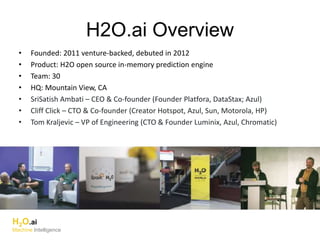
• Founded: 2011 venture-backed, debuted in 2012
• Product: H2O open source in-memory prediction engine
• Team: 30
• HQ: Mountain View, CA
• SriSatish Ambati – CEO & Co-founder (Founder Platfora, DataStax; Azul)
• Cliff Click – CTO & Co-founder (Creator Hotspot, Azul, Sun, Motorola, HP)
• Tom Kraljevic – VP of Engineering (CTO & Founder Luminix, Azul, Chromatic)
H2O.ai Overview
H2O.ai
Machine Intelligence
TBD.
Customer
Support
TBD
Head of Sales
Distributed
Systems
Engineers
Making
ML Scale!
H2O.ai
Machine Intelligence
H2O.ai
Machine Intelligence
cientific Advisory Council
Stephen Boyd
Professor of EE Engineering
Stanford University
Rob Tibshirani
Professor of Health Research
and Policy, and Statistics
Stanford University
Trevor Hastie
Professor of Statistics
Stanford University
H2O.ai
Machine Intelligence
What is H2O?
Open source in-memory prediction engineMath Platform
• Parallelized and distributed algorithms making the most use out of
multithreaded systems
• GLM, Random Forest, GBM, PCA, etc.
Easy to use and adoptAPI
• Written in Java – perfect for Java Programmers
• REST API (JSON) – drives H2O from R, Python, Excel, Tableau
More data? Or better models? BOTHBig Data
• Use all of your data – model without down sampling
• Run a simple GLM or a more complex GBM to find the best fit for the data
• More Data + Better Models = Better Predictions
Ensembles
Deep Neural Networks
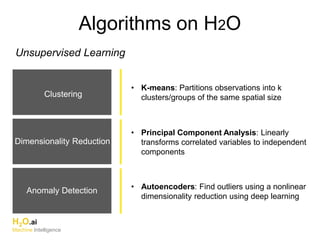
Algorithms on H2O
• Generalized Linear Models: Binomial,
Gaussian, Gamma, Poisson and Tweedie
• Cox Proportional Hazards Models
• Naïve Bayes
• Distributed Random Forest: Classification or
regression models
• Gradient Boosting Machine: Produces an
ensemble of decision trees with increasing
refined approximations
• Deep learning: Create multi-layer feed
forward neural networks starting with an input
layer followed by multiple layers of nonlinear
transformations
Supervised Learning
Statistical
Analysis
H2O.ai
Machine Intelligence
Dimensionality Reduction
Anomaly Detection
Algorithms on H2O
• K-means: Partitions observations into k
clusters/groups of the same spatial size
• Principal Component Analysis: Linearly
transforms correlated variables to independent
components
• Autoencoders: Find outliers using a nonlinear
dimensionality reduction using deep learning
Unsupervised Learning
Clustering
H2O.ai
Machine Intelligence
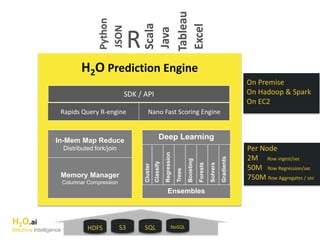
Per Node
2M Row ingest/sec
50M Row Regression/sec
750M Row Aggregates / sec
On Premise
On Hadoop & Spark
On EC2
Tableau
R
JSON
Scala
Java
H2O Prediction Engine
Nano Fast Scoring Engine
Memory Manager
Columnar Compression
Rapids Query R-engine
In-Mem Map Reduce
Distributed fork/join
Python
HDFS S3 SQL NoSQL
SDK / API
Excel
H2O.ai
Machine Intelligence
Deep Learning
Ensembles
Distributed GLM
H2O.ai
Machine Intelligence
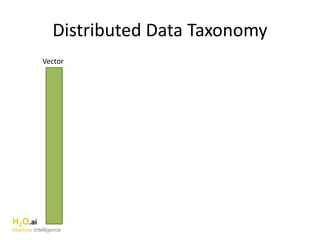
Distributed Data Taxonomy
Vector
H2O.ai
Machine Intelligence
Distributed Data Taxonomy
Vector
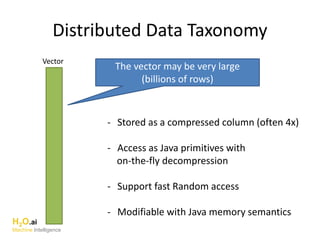
The vector may be very large
(billions of rows)
- Stored as a compressed column (often 4x)
- Access as Java primitives with
on-the-fly decompression
- Support fast Random access
- Modifiable with Java memory semantics
H2O.ai
Machine Intelligence
Distributed Data Taxonomy
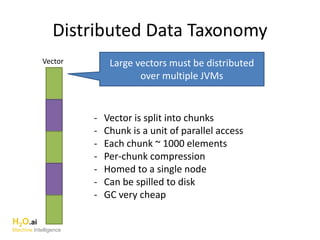
Vector Large vectors must be distributed
over multiple JVMs
- Vector is split into chunks
- Chunk is a unit of parallel access
- Each chunk ~ 1000 elements
- Per-chunk compression
- Homed to a single node
- Can be spilled to disk
- GC very cheap
H2O.ai
Machine Intelligence
Distributed Data Taxonomy
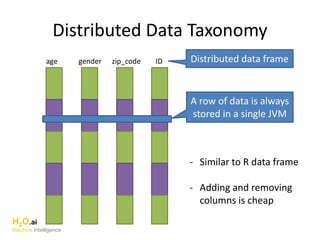
age gender zip_code ID
A row of data is always
stored in a single JVM
Distributed data frame
- Similar to R data frame
- Adding and removing
columns is cheap
H2O.ai
Machine Intelligence
Distributed Fork/Join
JVM
task
JVM
task
JVM
task
JVM
task
JVM
task
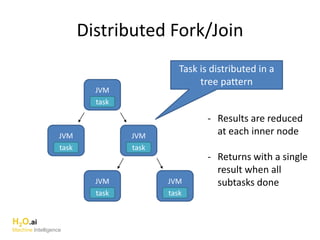
Task is distributed in a
tree pattern
- Results are reduced
at each inner node
- Returns with a single
result when all
subtasks done
H2O.ai
Machine Intelligence
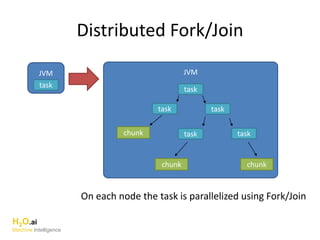
Distributed Fork/Join
JVM
task
JVM
task
task task
tasktaskchunk
chunk chunk
On each node the task is parallelized using Fork/Join
H2O.ai
Machine Intelligence
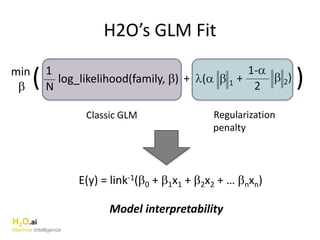
H2O’s GLM Fit
min
b
1
N
log_likelihood(family, b)( + )l(a b 1 + b 2)
1-a
2
Classic GLM Regularization
penalty
H2O.ai
Machine Intelligence
E(y) = link-1(b0 + b1x1 + b2x2 + … bnxn)
Model interpretability
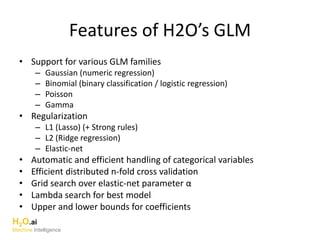
Features of H2O’s GLM
• Support for various GLM families
– Gaussian (numeric regression)
– Binomial (binary classification / logistic regression)
– Poisson
– Gamma
• Regularization
– L1 (Lasso) (+ Strong rules)
– L2 (Ridge regression)
– Elastic-net
• Automatic and efficient handling of categorical variables
• Efficient distributed n-fold cross validation
• Grid search over elastic-net parameter α
• Lambda search for best model
• Upper and lower bounds for coefficients
H2O.ai
Machine Intelligence
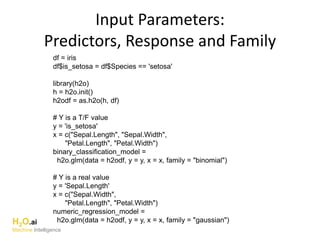
Input Parameters:
Predictors, Response and Family
df = iris
df$is_setosa = df$Species == 'setosa'
library(h2o)
h = h2o.init()
h2odf = as.h2o(h, df)
# Y is a T/F value
y = 'is_setosa'
x = c("Sepal.Length", "Sepal.Width",
"Petal.Length", "Petal.Width")
binary_classification_model =
h2o.glm(data = h2odf, y = y, x = x, family = "binomial")
# Y is a real value
y = 'Sepal.Length'
x = c("Sepal.Width",
"Petal.Length", "Petal.Width")
numeric_regression_model =
h2o.glm(data = h2odf, y = y, x = x, family = "gaussian")H2O.ai
Machine Intelligence
Input Parameters:
Number of iterations
H2O.ai
Machine Intelligence
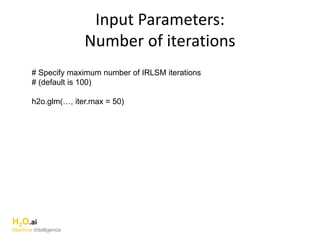
# Specify maximum number of IRLSM iterations
# (default is 100)
h2o.glm(…, iter.max = 50)
Input Parameters:
Regularization
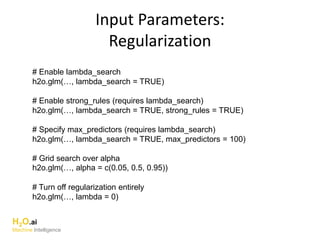
# Enable lambda_search
h2o.glm(…, lambda_search = TRUE)
# Enable strong_rules (requires lambda_search)
h2o.glm(…, lambda_search = TRUE, strong_rules = TRUE)
# Specify max_predictors (requires lambda_search)
h2o.glm(…, lambda_search = TRUE, max_predictors = 100)
# Grid search over alpha
h2o.glm(…, alpha = c(0.05, 0.5, 0.95))
# Turn off regularization entirely
h2o.glm(…, lambda = 0)
H2O.ai
Machine Intelligence
Input Parameters:
Cross validation
# Specify 5-fold cross validation
model_with_5folds = h2o.glm(data = h2odf, y = y, x = x, family = "binomial",
nfolds = 5)
print(model_with_5folds@model$auc)
print(model_with_5folds@xval[[1]]@model$auc)
print(model_with_5folds@xval[[2]]@model$auc)
print(model_with_5folds@xval[[3]]@model$auc)
print(model_with_5folds@xval[[4]]@model$auc)
print(model_with_5folds@xval[[5]]@model$auc)
H2O.ai
Machine Intelligence
Outputs
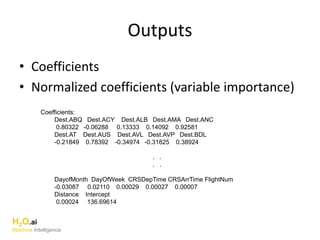
• Coefficients
• Normalized coefficients (variable importance)
H2O.ai
Machine Intelligence
Coefficients:
Dest.ABQ Dest.ACY Dest.ALB Dest.AMA Dest.ANC
0.80322 -0.06288 0.13333 0.14092 0.92581
Dest.AT Dest.AUS Dest.AVL Dest.AVP Dest.BDL
-0.21849 0.78392 -0.34974 -0.31825 0.38924
. .
. .
DayofMonth DayOfWeek CRSDepTime CRSArrTime FlightNum
-0.03087 0.02110 0.00029 0.00027 0.00007
Distance Intercept
0.00024 136.69614
Outputs
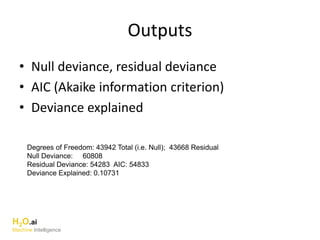
• Null deviance, residual deviance
• AIC (Akaike information criterion)
• Deviance explained
H2O.ai
Machine Intelligence
Degrees of Freedom: 43942 Total (i.e. Null); 43668 Residual
Null Deviance: 60808
Residual Deviance: 54283 AIC: 54833
Deviance Explained: 0.10731
Outputs
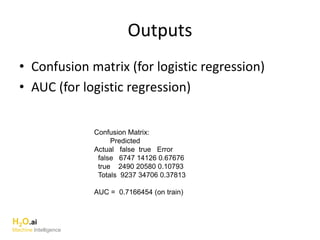
• Confusion matrix (for logistic regression)
• AUC (for logistic regression)
H2O.ai
Machine Intelligence
Confusion Matrix:
Predicted
Actual false true Error
false 6747 14126 0.67676
true 2490 20580 0.10793
Totals 9237 34706 0.37813
AUC = 0.7166454 (on train)
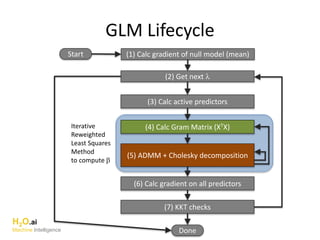
GLM Lifecycle
H2O.ai
Machine Intelligence
(1) Calc gradient of null model (mean)
Done
(2) Get next l
(3) Calc active predictors
(4) Calc Gram Matrix (XTX)
(5) ADMM + Cholesky decomposition
(6) Calc gradient on all predictors
(7) KKT checks
Start
Iterative
Reweighted
Least Squares
Method
to compute b
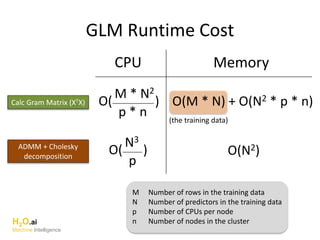
GLM Runtime Cost
H2O.ai
Machine Intelligence
Calc Gram Matrix (XTX)
ADMM + Cholesky
decomposition
CPU Memory
O(
M * N2
p * n
) O(M * N) + O(N2 * p * n)
O(
N3
p
)
M Number of rows in the training data
N Number of predictors in the training data
p Number of CPUs per node
n Number of nodes in the cluster
O(N2)
(the training data)
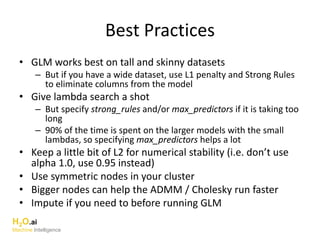
Best Practices
• GLM works best on tall and skinny datasets
– But if you have a wide dataset, use L1 penalty and Strong Rules
to eliminate columns from the model
• Give lambda search a shot
– But specify strong_rules and/or max_predictors if it is taking too
long
– 90% of the time is spent on the larger models with the small
lambdas, so specifying max_predictors helps a lot
• Keep a little bit of L2 for numerical stability (i.e. don’t use
alpha 1.0, use 0.95 instead)
• Use symmetric nodes in your cluster
• Bigger nodes can help the ADMM / Cholesky run faster
• Impute if you need to before running GLM
H2O.ai
Machine Intelligence
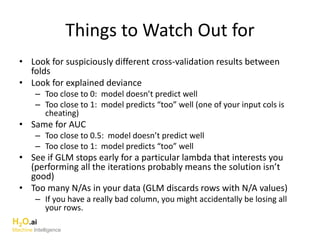
Things to Watch Out for
• Look for suspiciously different cross-validation results between
folds
• Look for explained deviance
– Too close to 0: model doesn’t predict well
– Too close to 1: model predicts “too” well (one of your input cols is
cheating)
• Same for AUC
– Too close to 0.5: model doesn’t predict well
– Too close to 1: model predicts “too” well
• See if GLM stops early for a particular lambda that interests you
(performing all the iterations probably means the solution isn’t
good)
• Too many N/As in your data (GLM discards rows with N/A values)
– If you have a really bad column, you might accidentally be losing all
your rows.
H2O.ai
Machine Intelligence
H2O.ai
Machine Intelligence
Demonstration
H2O.ai
Machine Intelligence
Q & A
H2O.ai
Machine Intelligence
Thanks for attending!
Content for today’s talk can be found at:
https://github.com/h2oai/h2o-meetups/tree/master/2015_01_27_GLM

Distributed GLM with H2O - Atlanta Meetup

  • 1.
    Distributed GLM Tom Kraljevic January27, 2015 Atlanta, GA @ Polygon
  • 2.
    • About H2O.ai(the company) (5 minutes) • About H2O (the software) (10 minutes) • H2O’s Distributed GLM (30 minutes) • Demo of GLM (15 minutes) • Q & A (up to 30 minutes) Content for today’s talk can be found at: https://github.com/h2oai/h2o-meetups/tree/master/2015_01_27_GLM Outline for today’s talk H2O.ai Machine Intelligence
  • 3.
    • Founded: 2011venture-backed, debuted in 2012 • Product: H2O open source in-memory prediction engine • Team: 30 • HQ: Mountain View, CA • SriSatish Ambati – CEO & Co-founder (Founder Platfora, DataStax; Azul) • Cliff Click – CTO & Co-founder (Creator Hotspot, Azul, Sun, Motorola, HP) • Tom Kraljevic – VP of Engineering (CTO & Founder Luminix, Azul, Chromatic) H2O.ai Overview H2O.ai Machine Intelligence
  • 4.
  • 5.
    H2O.ai Machine Intelligence cientific AdvisoryCouncil Stephen Boyd Professor of EE Engineering Stanford University Rob Tibshirani Professor of Health Research and Policy, and Statistics Stanford University Trevor Hastie Professor of Statistics Stanford University
  • 6.
    H2O.ai Machine Intelligence What isH2O? Open source in-memory prediction engineMath Platform • Parallelized and distributed algorithms making the most use out of multithreaded systems • GLM, Random Forest, GBM, PCA, etc. Easy to use and adoptAPI • Written in Java – perfect for Java Programmers • REST API (JSON) – drives H2O from R, Python, Excel, Tableau More data? Or better models? BOTHBig Data • Use all of your data – model without down sampling • Run a simple GLM or a more complex GBM to find the best fit for the data • More Data + Better Models = Better Predictions
  • 7.
    Ensembles Deep Neural Networks Algorithmson H2O • Generalized Linear Models: Binomial, Gaussian, Gamma, Poisson and Tweedie • Cox Proportional Hazards Models • Naïve Bayes • Distributed Random Forest: Classification or regression models • Gradient Boosting Machine: Produces an ensemble of decision trees with increasing refined approximations • Deep learning: Create multi-layer feed forward neural networks starting with an input layer followed by multiple layers of nonlinear transformations Supervised Learning Statistical Analysis H2O.ai Machine Intelligence
  • 8.
    Dimensionality Reduction Anomaly Detection Algorithmson H2O • K-means: Partitions observations into k clusters/groups of the same spatial size • Principal Component Analysis: Linearly transforms correlated variables to independent components • Autoencoders: Find outliers using a nonlinear dimensionality reduction using deep learning Unsupervised Learning Clustering H2O.ai Machine Intelligence
  • 9.
    Per Node 2M Rowingest/sec 50M Row Regression/sec 750M Row Aggregates / sec On Premise On Hadoop & Spark On EC2 Tableau R JSON Scala Java H2O Prediction Engine Nano Fast Scoring Engine Memory Manager Columnar Compression Rapids Query R-engine In-Mem Map Reduce Distributed fork/join Python HDFS S3 SQL NoSQL SDK / API Excel H2O.ai Machine Intelligence Deep Learning Ensembles
  • 10.
  • 11.
  • 12.
    Distributed Data Taxonomy Vector Thevector may be very large (billions of rows) - Stored as a compressed column (often 4x) - Access as Java primitives with on-the-fly decompression - Support fast Random access - Modifiable with Java memory semantics H2O.ai Machine Intelligence
  • 13.
    Distributed Data Taxonomy VectorLarge vectors must be distributed over multiple JVMs - Vector is split into chunks - Chunk is a unit of parallel access - Each chunk ~ 1000 elements - Per-chunk compression - Homed to a single node - Can be spilled to disk - GC very cheap H2O.ai Machine Intelligence
  • 14.
    Distributed Data Taxonomy agegender zip_code ID A row of data is always stored in a single JVM Distributed data frame - Similar to R data frame - Adding and removing columns is cheap H2O.ai Machine Intelligence
  • 15.
    Distributed Fork/Join JVM task JVM task JVM task JVM task JVM task Task isdistributed in a tree pattern - Results are reduced at each inner node - Returns with a single result when all subtasks done H2O.ai Machine Intelligence
  • 16.
    Distributed Fork/Join JVM task JVM task task task tasktaskchunk chunkchunk On each node the task is parallelized using Fork/Join H2O.ai Machine Intelligence
  • 17.
    H2O’s GLM Fit min b 1 N log_likelihood(family,b)( + )l(a b 1 + b 2) 1-a 2 Classic GLM Regularization penalty H2O.ai Machine Intelligence E(y) = link-1(b0 + b1x1 + b2x2 + … bnxn) Model interpretability
  • 18.
    Features of H2O’sGLM • Support for various GLM families – Gaussian (numeric regression) – Binomial (binary classification / logistic regression) – Poisson – Gamma • Regularization – L1 (Lasso) (+ Strong rules) – L2 (Ridge regression) – Elastic-net • Automatic and efficient handling of categorical variables • Efficient distributed n-fold cross validation • Grid search over elastic-net parameter α • Lambda search for best model • Upper and lower bounds for coefficients H2O.ai Machine Intelligence
  • 19.
    Input Parameters: Predictors, Responseand Family df = iris df$is_setosa = df$Species == 'setosa' library(h2o) h = h2o.init() h2odf = as.h2o(h, df) # Y is a T/F value y = 'is_setosa' x = c("Sepal.Length", "Sepal.Width", "Petal.Length", "Petal.Width") binary_classification_model = h2o.glm(data = h2odf, y = y, x = x, family = "binomial") # Y is a real value y = 'Sepal.Length' x = c("Sepal.Width", "Petal.Length", "Petal.Width") numeric_regression_model = h2o.glm(data = h2odf, y = y, x = x, family = "gaussian")H2O.ai Machine Intelligence
  • 20.
    Input Parameters: Number ofiterations H2O.ai Machine Intelligence # Specify maximum number of IRLSM iterations # (default is 100) h2o.glm(…, iter.max = 50)
  • 21.
    Input Parameters: Regularization # Enablelambda_search h2o.glm(…, lambda_search = TRUE) # Enable strong_rules (requires lambda_search) h2o.glm(…, lambda_search = TRUE, strong_rules = TRUE) # Specify max_predictors (requires lambda_search) h2o.glm(…, lambda_search = TRUE, max_predictors = 100) # Grid search over alpha h2o.glm(…, alpha = c(0.05, 0.5, 0.95)) # Turn off regularization entirely h2o.glm(…, lambda = 0) H2O.ai Machine Intelligence
  • 22.
    Input Parameters: Cross validation #Specify 5-fold cross validation model_with_5folds = h2o.glm(data = h2odf, y = y, x = x, family = "binomial", nfolds = 5) print(model_with_5folds@model$auc) print(model_with_5folds@xval[[1]]@model$auc) print(model_with_5folds@xval[[2]]@model$auc) print(model_with_5folds@xval[[3]]@model$auc) print(model_with_5folds@xval[[4]]@model$auc) print(model_with_5folds@xval[[5]]@model$auc) H2O.ai Machine Intelligence
  • 23.
    Outputs • Coefficients • Normalizedcoefficients (variable importance) H2O.ai Machine Intelligence Coefficients: Dest.ABQ Dest.ACY Dest.ALB Dest.AMA Dest.ANC 0.80322 -0.06288 0.13333 0.14092 0.92581 Dest.AT Dest.AUS Dest.AVL Dest.AVP Dest.BDL -0.21849 0.78392 -0.34974 -0.31825 0.38924 . . . . DayofMonth DayOfWeek CRSDepTime CRSArrTime FlightNum -0.03087 0.02110 0.00029 0.00027 0.00007 Distance Intercept 0.00024 136.69614
  • 24.
    Outputs • Null deviance,residual deviance • AIC (Akaike information criterion) • Deviance explained H2O.ai Machine Intelligence Degrees of Freedom: 43942 Total (i.e. Null); 43668 Residual Null Deviance: 60808 Residual Deviance: 54283 AIC: 54833 Deviance Explained: 0.10731
  • 25.
    Outputs • Confusion matrix(for logistic regression) • AUC (for logistic regression) H2O.ai Machine Intelligence Confusion Matrix: Predicted Actual false true Error false 6747 14126 0.67676 true 2490 20580 0.10793 Totals 9237 34706 0.37813 AUC = 0.7166454 (on train)
  • 26.
    GLM Lifecycle H2O.ai Machine Intelligence (1)Calc gradient of null model (mean) Done (2) Get next l (3) Calc active predictors (4) Calc Gram Matrix (XTX) (5) ADMM + Cholesky decomposition (6) Calc gradient on all predictors (7) KKT checks Start Iterative Reweighted Least Squares Method to compute b
  • 27.
    GLM Runtime Cost H2O.ai MachineIntelligence Calc Gram Matrix (XTX) ADMM + Cholesky decomposition CPU Memory O( M * N2 p * n ) O(M * N) + O(N2 * p * n) O( N3 p ) M Number of rows in the training data N Number of predictors in the training data p Number of CPUs per node n Number of nodes in the cluster O(N2) (the training data)
  • 28.
    Best Practices • GLMworks best on tall and skinny datasets – But if you have a wide dataset, use L1 penalty and Strong Rules to eliminate columns from the model • Give lambda search a shot – But specify strong_rules and/or max_predictors if it is taking too long – 90% of the time is spent on the larger models with the small lambdas, so specifying max_predictors helps a lot • Keep a little bit of L2 for numerical stability (i.e. don’t use alpha 1.0, use 0.95 instead) • Use symmetric nodes in your cluster • Bigger nodes can help the ADMM / Cholesky run faster • Impute if you need to before running GLM H2O.ai Machine Intelligence
  • 29.
    Things to WatchOut for • Look for suspiciously different cross-validation results between folds • Look for explained deviance – Too close to 0: model doesn’t predict well – Too close to 1: model predicts “too” well (one of your input cols is cheating) • Same for AUC – Too close to 0.5: model doesn’t predict well – Too close to 1: model predicts “too” well • See if GLM stops early for a particular lambda that interests you (performing all the iterations probably means the solution isn’t good) • Too many N/As in your data (GLM discards rows with N/A values) – If you have a really bad column, you might accidentally be losing all your rows. H2O.ai Machine Intelligence
  • 30.
  • 31.
  • 32.
    Q & A H2O.ai MachineIntelligence Thanks for attending! Content for today’s talk can be found at: https://github.com/h2oai/h2o-meetups/tree/master/2015_01_27_GLM

Editor's Notes

  • #19 L1 penalization (lasso) is a technique for eliminating predictors from the model. L1 leads to a sparse solution, which is good for model interpretability L2 penalization (ridge) is a technique that tends to improve numerical stability and push the coefficients of correlated columns toward each other Elastic-net combines L1 and L2 with an alpha parameter
  • #25 The null deviance shows how well the response is predicted by the model with nothing but an intercept. The residual deviance shows how well the response is predicted by the model when the predictors are included. The Akaike information criterion (AIC) is a measure of the relative quality of a statistical model for a given set of data. That is, given a collection of models for the data, AIC estimates the quality of each model, relative to the other models. Hence, AIC provides a means for model selection. AIC is founded on information theory: it offers a relative estimate of the information lost when a given model is used to represent the process that generates the data. In doing so, it deals with the trade-off between the goodness of fit of the model and the complexity of the model. AIC does not provide a test of a model in the sense of testing a null hypothesis; i.e. AIC can tell nothing about the quality of the model in an absolute sense. If all the candidate models fit poorly, AIC will not give any warning of that. Null and Residual deviance can be combined to give the proportion deviance explained, a generalization of r^2.
  • #27 This diagram shows the full GLM lifecycle (1) GLM starts by creating a null model, which is just the mean (2) When using Lambda search, GLM tries many different values starting at LambdaMax and decreasing from there (3) Strong rules calculate the active predictors based on a warm start from the previous iteration (4, 5) We convert the log likelihood problem into an Iterative Reweighted Least Squares problem so we can distribute it across many nodes. (4) The Gram matrix calculation (Green box) is distributed. This is big data. (5) The ADMM and Cholesky calculations are done on a single node (although the Cholesky is done in parallel). ADMM solves for the non-differentiable Lasso penalty. This is (usually) small data. ADMM solves on the smaller Gram, not the entire training dataset of X. (6, 7) Calculate gradient again based on new Beta values. Check for KKT stopping criteria.