Scalable Automatic Machine Learning 

in H2O
Erin LeDell Ph.D.

H2O.ai
AI & DL Meetup
Nov 2017
What is H2O?
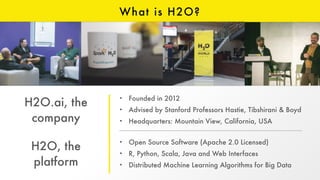
H2O.ai, the
company
H2O, the
platform
• Founded in 2012
• Advised by Stanford Professors Hastie, Tibshirani & Boyd
• Headquarters: Mountain View, California, USA
• Open Source Software (Apache 2.0 Licensed)
• R, Python, Scala, Java and Web Interfaces
• Distributed Machine Learning Algorithms for Big Data
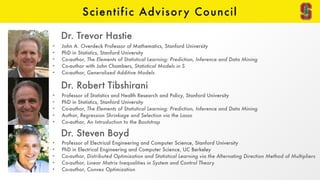
Scientific Advisory Council
• John A. Overdeck Professor of Mathematics, Stanford University
• PhD in Statistics, Stanford University
• Co-author, The Elements of Statistical Learning: Prediction, Inference and Data Mining
• Co-author with John Chambers, Statistical Models in S
• Co-author, Generalized Additive Models
Dr. Trevor Hastie
• Professor of Statistics and Health Research and Policy, Stanford University
• PhD in Statistics, Stanford University
• Co-author, The Elements of Statistical Learning: Prediction, Inference and Data Mining
• Author, Regression Shrinkage and Selection via the Lasso
• Co-author, An Introduction to the Bootstrap
Dr. Robert Tibshirani
• Professor of Electrical Engineering and Computer Science, Stanford University
• PhD in Electrical Engineering and Computer Science, UC Berkeley
• Co-author, Distributed Optimization and Statistical Learning via the Alternating Direction Method of Multipliers
• Co-author, Linear Matrix Inequalities in System and Control Theory
• Co-author, Convex Optimization
Dr. Steven Boyd
Agenda
• Intro to Automatic Machine Learning (AutoML)
• Bayesian Hyperparameter Optimization
• Random Grid Search & Stacked Ensembles
• H2O Machine Learning Platform Overview
• H2O’s AutoML (R, Python, GUI)
AutoML Overview
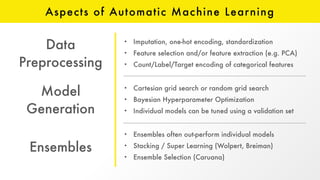
Aspects of Automatic Machine Learning
• Cartesian grid search or random grid search
• Bayesian Hyperparameter Optimization
• Individual models can be tuned using a validation set
Data
Preprocessing
Model

Generation
Ensembles
• Imputation, one-hot encoding, standardization
• Feature selection and/or feature extraction (e.g. PCA)
• Count/Label/Target encoding of categorical features
• Ensembles often out-perform individual models
• Stacking / Super Learning (Wolpert, Breiman)
• Ensemble Selection (Caruana)
Bayesian Optimization
of Hyperparameters
Bayesian Optimization
• Bayesian Hyperparameter Optimization consists of
developing a statistical model of the function mapping
hyperparameter values to the objective (e.g. AUC,
MSE), evaluated on a validation set.
• Different approaches based on: Gaussian Processes,
Tree Structured Parzen Estimator, Random Forest


AKA “Sequential Model-based Optimization (SMBO)”
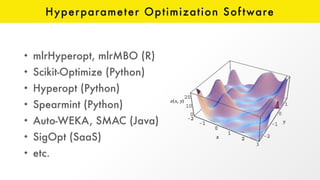
Hyperparameter Optimization Software
• mlrHyperopt, mlrMBO (R)
• Scikit-Optimize (Python)
• Hyperopt (Python)
• Spearmint (Python)
• Auto-WEKA, SMAC (Java)
• SigOpt (SaaS)
• etc.
Random Grids +
Stacked Ensembles
Random Grid Search & Stacking
• Random Grid Search combined with Stacked
Ensembles is a powerful combination.

• Ensembles perform particularly well if the models
they are based on (1) are individually strong, 

and (2) make uncorrelated errors.

• Stacking uses a second-level metalearning algorithm
to find the optimal combination of base learners.
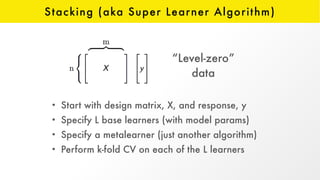
Stacking (aka Super Learner Algorithm)
• Start with design matrix, X, and response, y
• Specify L base learners (with model params)
• Specify a metalearner (just another algorithm)
• Perform k-fold CV on each of the L learners
“Level-zero” 

data
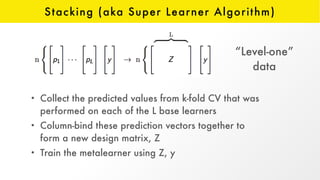
Stacking (aka Super Learner Algorithm)
• Collect the predicted values from k-fold CV that was
performed on each of the L base learners
• Column-bind these prediction vectors together to
form a new design matrix, Z
• Train the metalearner using Z, y
“Level-one” 

data
Stacking vs Ensemble Selection
• Stacking uses all the given models (good and bad)
and uses a second-level metalearning algorithm to
find the optimal combination of base learners. 

• With Ensemble Selection, rather than combine good
and bad models in an ensemble, forward stepwise
selection is used to find a subset of models that, when
averaged together, yield the best performance.
H2O Platform
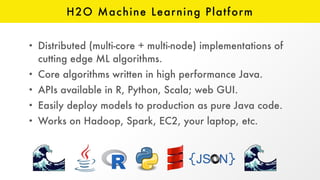
H2O Machine Learning Platform
• Distributed (multi-core + multi-node) implementations of
cutting edge ML algorithms.
• Core algorithms written in high performance Java.
• APIs available in R, Python, Scala; web GUI.
• Easily deploy models to production as pure Java code.
• Works on Hadoop, Spark, EC2, your laptop, etc.
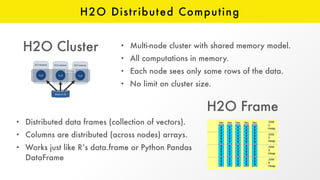
H2O Distributed Computing
H2O Cluster
H2O Frame
• Multi-node cluster with shared memory model.
• All computations in memory.
• Each node sees only some rows of the data.
• No limit on cluster size.
• Distributed data frames (collection of vectors).
• Columns are distributed (across nodes) arrays.
• Works just like R’s data.frame or Python Pandas
DataFrame
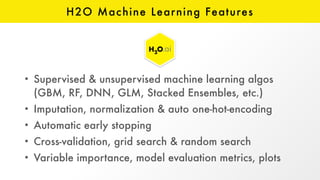
H2O Machine Learning Features
• Supervised & unsupervised machine learning algos
(GBM, RF, DNN, GLM, Stacked Ensembles, etc.)
• Imputation, normalization & auto one-hot-encoding
• Automatic early stopping
• Cross-validation, grid search & random search
• Variable importance, model evaluation metrics, plots
H2O AutoML
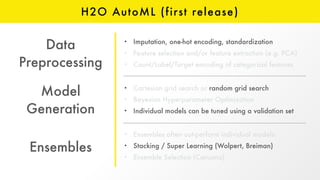
H2O AutoML (first release)
• Cartesian grid search or random grid search
• Bayesian Hyperparameter Optimization
• Individual models can be tuned using a validation set
Data
Preprocessing
Model

Generation
Ensembles
• Imputation, one-hot encoding, standardization
• Feature selection and/or feature extraction (e.g. PCA)
• Count/Label/Target encoding of categorical features
• Ensembles often out-perform individual models:
• Stacking / Super Learning (Wolpert, Breiman)
• Ensemble Selection (Caruana)
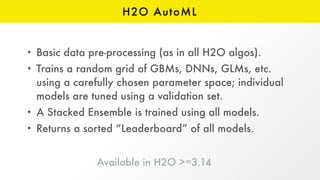
H2O AutoML
• Basic data pre-processing (as in all H2O algos).
• Trains a random grid of GBMs, DNNs, GLMs, etc.
using a carefully chosen parameter space; individual
models are tuned using a validation set.
• A Stacked Ensemble is trained using all models.
• Returns a sorted “Leaderboard” of all models.
Available in H2O >=3.14

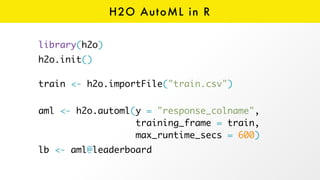
H2O AutoML in R
library(h2o)
h2o.init()


train <- h2o.importFile("train.csv")


aml <- h2o.automl(y = "response_colname", 

training_frame = train,

max_runtime_secs = 600)
lb <- aml@leaderboard

H2O AutoML in Python
import h2o
from h2o.automl import H2OAutoML
h2o.init()


train = h2o.import_file("train.csv")
aml = H2OAutoML(max_runtime_secs = 600)

aml.train(y = "response_colname", 

training_frame = train)
lb = aml.leaderboard

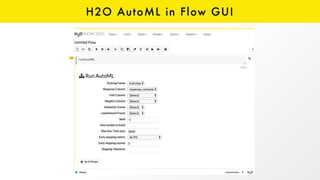
H2O AutoML in Flow GUI
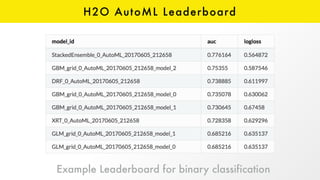
H2O AutoML Leaderboard
Example Leaderboard for binary classification
H2O Resources
• Documentation: http://docs.h2o.ai
• Tutorials: https://github.com/h2oai/h2o-tutorials
• Slidedecks: https://github.com/h2oai/h2o-meetups
• Video Presentations: https://www.youtube.com/user/0xdata
• Events & Meetups: http://h2o.ai/events
Thank you!
@ledell on Github, Twitter
erin@h2o.ai
http://www.stat.berkeley.edu/~ledell

Scalable Automatic Machine Learning in H2O

  • 1.
    Scalable Automatic MachineLearning 
 in H2O Erin LeDell Ph.D.
 H2O.ai AI & DL Meetup Nov 2017
  • 2.
    What is H2O? H2O.ai,the company H2O, the platform • Founded in 2012 • Advised by Stanford Professors Hastie, Tibshirani & Boyd • Headquarters: Mountain View, California, USA • Open Source Software (Apache 2.0 Licensed) • R, Python, Scala, Java and Web Interfaces • Distributed Machine Learning Algorithms for Big Data
  • 3.
    Scientific Advisory Council •John A. Overdeck Professor of Mathematics, Stanford University • PhD in Statistics, Stanford University • Co-author, The Elements of Statistical Learning: Prediction, Inference and Data Mining • Co-author with John Chambers, Statistical Models in S • Co-author, Generalized Additive Models Dr. Trevor Hastie • Professor of Statistics and Health Research and Policy, Stanford University • PhD in Statistics, Stanford University • Co-author, The Elements of Statistical Learning: Prediction, Inference and Data Mining • Author, Regression Shrinkage and Selection via the Lasso • Co-author, An Introduction to the Bootstrap Dr. Robert Tibshirani • Professor of Electrical Engineering and Computer Science, Stanford University • PhD in Electrical Engineering and Computer Science, UC Berkeley • Co-author, Distributed Optimization and Statistical Learning via the Alternating Direction Method of Multipliers • Co-author, Linear Matrix Inequalities in System and Control Theory • Co-author, Convex Optimization Dr. Steven Boyd
  • 4.
    Agenda • Intro toAutomatic Machine Learning (AutoML) • Bayesian Hyperparameter Optimization • Random Grid Search & Stacked Ensembles • H2O Machine Learning Platform Overview • H2O’s AutoML (R, Python, GUI)
  • 5.
  • 6.
    Aspects of AutomaticMachine Learning • Cartesian grid search or random grid search • Bayesian Hyperparameter Optimization • Individual models can be tuned using a validation set Data Preprocessing Model
 Generation Ensembles • Imputation, one-hot encoding, standardization • Feature selection and/or feature extraction (e.g. PCA) • Count/Label/Target encoding of categorical features • Ensembles often out-perform individual models • Stacking / Super Learning (Wolpert, Breiman) • Ensemble Selection (Caruana)
  • 7.
  • 8.
    Bayesian Optimization • BayesianHyperparameter Optimization consists of developing a statistical model of the function mapping hyperparameter values to the objective (e.g. AUC, MSE), evaluated on a validation set. • Different approaches based on: Gaussian Processes, Tree Structured Parzen Estimator, Random Forest
 
 
 AKA “Sequential Model-based Optimization (SMBO)”
  • 9.
    Hyperparameter Optimization Software •mlrHyperopt, mlrMBO (R) • Scikit-Optimize (Python) • Hyperopt (Python) • Spearmint (Python) • Auto-WEKA, SMAC (Java) • SigOpt (SaaS) • etc.
  • 10.
  • 11.
    Random Grid Search& Stacking • Random Grid Search combined with Stacked Ensembles is a powerful combination.
 • Ensembles perform particularly well if the models they are based on (1) are individually strong, 
 and (2) make uncorrelated errors.
 • Stacking uses a second-level metalearning algorithm to find the optimal combination of base learners.
  • 12.
    Stacking (aka SuperLearner Algorithm) • Start with design matrix, X, and response, y • Specify L base learners (with model params) • Specify a metalearner (just another algorithm) • Perform k-fold CV on each of the L learners “Level-zero” 
 data
  • 13.
    Stacking (aka SuperLearner Algorithm) • Collect the predicted values from k-fold CV that was performed on each of the L base learners • Column-bind these prediction vectors together to form a new design matrix, Z • Train the metalearner using Z, y “Level-one” 
 data
  • 14.
    Stacking vs EnsembleSelection • Stacking uses all the given models (good and bad) and uses a second-level metalearning algorithm to find the optimal combination of base learners. 
 • With Ensemble Selection, rather than combine good and bad models in an ensemble, forward stepwise selection is used to find a subset of models that, when averaged together, yield the best performance.
  • 15.
  • 16.
    H2O Machine LearningPlatform • Distributed (multi-core + multi-node) implementations of cutting edge ML algorithms. • Core algorithms written in high performance Java. • APIs available in R, Python, Scala; web GUI. • Easily deploy models to production as pure Java code. • Works on Hadoop, Spark, EC2, your laptop, etc.
  • 17.
    H2O Distributed Computing H2OCluster H2O Frame • Multi-node cluster with shared memory model. • All computations in memory. • Each node sees only some rows of the data. • No limit on cluster size. • Distributed data frames (collection of vectors). • Columns are distributed (across nodes) arrays. • Works just like R’s data.frame or Python Pandas DataFrame
  • 18.
    H2O Machine LearningFeatures • Supervised & unsupervised machine learning algos (GBM, RF, DNN, GLM, Stacked Ensembles, etc.) • Imputation, normalization & auto one-hot-encoding • Automatic early stopping • Cross-validation, grid search & random search • Variable importance, model evaluation metrics, plots
  • 19.
  • 20.
    H2O AutoML (firstrelease) • Cartesian grid search or random grid search • Bayesian Hyperparameter Optimization • Individual models can be tuned using a validation set Data Preprocessing Model
 Generation Ensembles • Imputation, one-hot encoding, standardization • Feature selection and/or feature extraction (e.g. PCA) • Count/Label/Target encoding of categorical features • Ensembles often out-perform individual models: • Stacking / Super Learning (Wolpert, Breiman) • Ensemble Selection (Caruana)
  • 21.
    H2O AutoML • Basicdata pre-processing (as in all H2O algos). • Trains a random grid of GBMs, DNNs, GLMs, etc. using a carefully chosen parameter space; individual models are tuned using a validation set. • A Stacked Ensemble is trained using all models. • Returns a sorted “Leaderboard” of all models. Available in H2O >=3.14

  • 22.
    H2O AutoML inR library(h2o) h2o.init()
 
 train <- h2o.importFile("train.csv") 
 aml <- h2o.automl(y = "response_colname", 
 training_frame = train,
 max_runtime_secs = 600) lb <- aml@leaderboard

  • 23.
    H2O AutoML inPython import h2o from h2o.automl import H2OAutoML h2o.init()
 
 train = h2o.import_file("train.csv") aml = H2OAutoML(max_runtime_secs = 600)
 aml.train(y = "response_colname", 
 training_frame = train) lb = aml.leaderboard

  • 24.
    H2O AutoML inFlow GUI
  • 25.
    H2O AutoML Leaderboard ExampleLeaderboard for binary classification
  • 26.
    H2O Resources • Documentation:http://docs.h2o.ai • Tutorials: https://github.com/h2oai/h2o-tutorials • Slidedecks: https://github.com/h2oai/h2o-meetups • Video Presentations: https://www.youtube.com/user/0xdata • Events & Meetups: http://h2o.ai/events
  • 27.
    Thank you! @ledell onGithub, Twitter erin@h2o.ai http://www.stat.berkeley.edu/~ledell