Discipline & Ideas in
the Social Sciences
Introduction to Social
Sciences with Natural
Sciences and
Humanities
Lesson 1 – Defining
Social Sciences as the
Study of Society
Objectives:
define Social Sciences as the study of
society;
distinguish Social Sciences and Natural
Sciences and Humanities; and
differentiate Social Sciences from Natural
Sciences and Humanities.
1. TALRUNA CESNICES
It is a branch of science which
deals with the physical world.
NATURAL SCIENCES
2. TIMSEIMAHUN
It is an academic discipline that
studies aspects of human society and
culture.
HUMANITIES
3. ALISOC ENSICCES
It is a branch of science devoted to the
study of human societies and the
relationships among individuals with
those societies.
SOCIAL SCIENCES
Historical Background of Social
Sciences Quexbook 2018
 The history of the social sciences begun in the
roots of ancient philosophy. In ancient history,
there was no difference between Mathematics and
the study of history, poetry or politics, only with the
development of mathematical proof did there
gradually arise a perceived difference between
“scientific” disciplines and others such as the
“humanities” or “liberal arts.”
Social Sciences
 A branch of science devoted to the study of
societies and the relationships among individuals
within those societies. “Social sciences as those
mental or cultural sciences which deal with the
activities of the individual as member of the
group. The term social sciences thus embrace all
those subjects which deal with the relationship of
man to the society.
Natural Sciences
A major branch of science that deals with
the description, prediction and
understanding of natural phenomena,
basically based on observational and
empirical evidence.
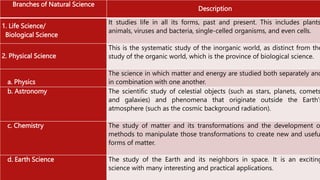
Branches of Natural Science
Description
1. Life Science/
Biological Science
It studies life in all its forms, past and present. This includes plants
animals, viruses and bacteria, single-celled organisms, and even cells.
2. Physical Science
This is the systematic study of the inorganic world, as distinct from the
study of the organic world, which is the province of biological science.
a. Physics
The science in which matter and energy are studied both separately and
in combination with one another.
b. Astronomy The scientific study of celestial objects (such as stars, planets, comets
and galaxies) and phenomena that originate outside the Earth's
atmosphere (such as the cosmic background radiation).
c. Chemistry The study of matter and its transformations and the development o
methods to manipulate those transformations to create new and usefu
forms of matter.
d. Earth Science The study of the Earth and its neighbors in space. It is an exciting
science with many interesting and practical applications.
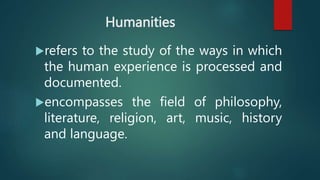
Humanities
refers to the study of the ways in which
the human experience is processed and
documented.
encompasses the field of philosophy,
literature, religion, art, music, history
and language.
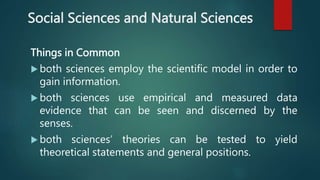
Social Sciences and Natural Sciences
Things in Common
 both sciences employ the scientific model in order to
gain information.
 both sciences use empirical and measured data
evidence that can be seen and discerned by the
senses.
 both sciences’ theories can be tested to yield
theoretical statements and general positions.
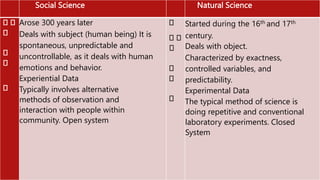
Social Science Natural Science
Arose 300 years later
Deals with subject (human being) It is
spontaneous, unpredictable and
uncontrollable, as it deals with human
emotions and behavior.
Experiential Data
Typically involves alternative
methods of observation and
interaction with people within
community. Open system
Started during the 16th and 17th
century.
Deals with object.
Characterized by exactness,
controlled variables, and
predictability.
Experimental Data
The typical method of science is
doing repetitive and conventional
laboratory experiments. Closed
System
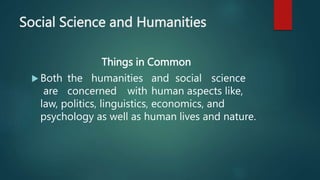
Social Science and Humanities
Things in Common
 Both the humanities and social science
are concerned with human aspects like,
law, politics, linguistics, economics, and
psychology as well as human lives and nature.
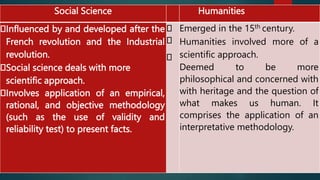
Social Science Humanities
Influenced by and developed after the
French revolution and the Industrial
revolution.
Social science deals with more
scientific approach.
Involves application of an empirical,
rational, and objective methodology
(such as the use of validity and
reliability test) to present facts.
Emerged in the 15th century.
Humanities involved more of a
scientific approach.
Deemed to be more
philosophical and concerned with
with heritage and the question of
what makes us human. It
comprises the application of an
interpretative methodology.
Directions: Write down 3 problems that you
think needed attention in your society. In
the opposite column, write the things that
you can do to help solve these problems.
Do this on a separate sheet of bond paper.
Examples are provided below.
Problems I See Help I Can Give
1. lack of education
Be an active participant
to society using
strategic ways in
accessing educational
tools, modules and
equipment.

Buddhism

  • 1.
    Discipline & Ideasin the Social Sciences
  • 2.
    Introduction to Social Scienceswith Natural Sciences and Humanities
  • 3.
    Lesson 1 –Defining Social Sciences as the Study of Society
  • 4.
    Objectives: define Social Sciencesas the study of society; distinguish Social Sciences and Natural Sciences and Humanities; and differentiate Social Sciences from Natural Sciences and Humanities.
  • 5.
    1. TALRUNA CESNICES Itis a branch of science which deals with the physical world. NATURAL SCIENCES
  • 6.
    2. TIMSEIMAHUN It isan academic discipline that studies aspects of human society and culture. HUMANITIES
  • 7.
    3. ALISOC ENSICCES Itis a branch of science devoted to the study of human societies and the relationships among individuals with those societies. SOCIAL SCIENCES
  • 8.
    Historical Background ofSocial Sciences Quexbook 2018  The history of the social sciences begun in the roots of ancient philosophy. In ancient history, there was no difference between Mathematics and the study of history, poetry or politics, only with the development of mathematical proof did there gradually arise a perceived difference between “scientific” disciplines and others such as the “humanities” or “liberal arts.”
  • 9.
    Social Sciences  Abranch of science devoted to the study of societies and the relationships among individuals within those societies. “Social sciences as those mental or cultural sciences which deal with the activities of the individual as member of the group. The term social sciences thus embrace all those subjects which deal with the relationship of man to the society.
  • 10.
    Natural Sciences A majorbranch of science that deals with the description, prediction and understanding of natural phenomena, basically based on observational and empirical evidence.
  • 11.
    Branches of NaturalScience Description 1. Life Science/ Biological Science It studies life in all its forms, past and present. This includes plants animals, viruses and bacteria, single-celled organisms, and even cells. 2. Physical Science This is the systematic study of the inorganic world, as distinct from the study of the organic world, which is the province of biological science. a. Physics The science in which matter and energy are studied both separately and in combination with one another. b. Astronomy The scientific study of celestial objects (such as stars, planets, comets and galaxies) and phenomena that originate outside the Earth's atmosphere (such as the cosmic background radiation). c. Chemistry The study of matter and its transformations and the development o methods to manipulate those transformations to create new and usefu forms of matter. d. Earth Science The study of the Earth and its neighbors in space. It is an exciting science with many interesting and practical applications.
  • 12.
    Humanities refers to thestudy of the ways in which the human experience is processed and documented. encompasses the field of philosophy, literature, religion, art, music, history and language.
  • 13.
    Social Sciences andNatural Sciences Things in Common  both sciences employ the scientific model in order to gain information.  both sciences use empirical and measured data evidence that can be seen and discerned by the senses.  both sciences’ theories can be tested to yield theoretical statements and general positions.
  • 14.
    Social Science NaturalScience Arose 300 years later Deals with subject (human being) It is spontaneous, unpredictable and uncontrollable, as it deals with human emotions and behavior. Experiential Data Typically involves alternative methods of observation and interaction with people within community. Open system Started during the 16th and 17th century. Deals with object. Characterized by exactness, controlled variables, and predictability. Experimental Data The typical method of science is doing repetitive and conventional laboratory experiments. Closed System
  • 15.
    Social Science andHumanities Things in Common  Both the humanities and social science are concerned with human aspects like, law, politics, linguistics, economics, and psychology as well as human lives and nature.
  • 16.
    Social Science Humanities Influencedby and developed after the French revolution and the Industrial revolution. Social science deals with more scientific approach. Involves application of an empirical, rational, and objective methodology (such as the use of validity and reliability test) to present facts. Emerged in the 15th century. Humanities involved more of a scientific approach. Deemed to be more philosophical and concerned with with heritage and the question of what makes us human. It comprises the application of an interpretative methodology.
  • 17.
    Directions: Write down3 problems that you think needed attention in your society. In the opposite column, write the things that you can do to help solve these problems. Do this on a separate sheet of bond paper. Examples are provided below.
  • 18.
    Problems I SeeHelp I Can Give 1. lack of education Be an active participant to society using strategic ways in accessing educational tools, modules and equipment.