DISCIPLINES AND IDEAS
IN SOCIAL SCIENCES
Unit 1: How Social Is Science, and
How Scientific is Social?
Chapter 1. How did the Social Sciences Emerge?
How Does It Link to the Natural Sciences?
Learning Objectives:
1. Define “social science’ as the study of society in the mold of
scientific tradition;
2. Chart the development of social science in the context of
Western intellectual history;
3. Explain what consist social science and appreciate their
differences and collective objectives;
4. Introduce social science as key to the study of this discipline;
and
5. Learn about how social science started in the Philippines in the
context of the Filipino struggle for independence.
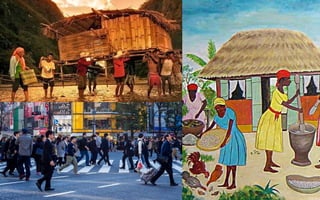
Early Depictions of Philippine Social Life
Who I am
How I behave
with others.
Nature vs. Society
Nature conjures an image of random
and unstructured forces that shape a
given area.
●
These forces follow a general
pattern, law, or process ever since
the world existed
●
Society is contrast to the preceding imagery of
nature.
●
Society is organized and deliberately
structured and formalized and bound by rules
drafted and implemented by the people who
themselves constitute society.
Nature vs. Society
Society
✘ Society refers to ‘a system of interrelationships which
connects individuals together’ (Giddens1990)
✘ A ‘common habitat’ or environment within which members
of a society depend on one another for survival and well-
being (Marvin Harris 1983)
✘ Society refers to a group of people who share a culture and a
territory.
✘ Socialization affects the overall cultural practices of a society
and shape one’s self-image.
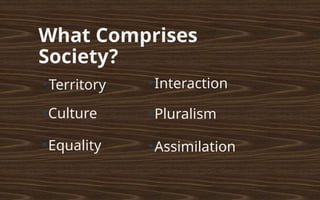
What Comprises
Society?
●
Territory
●
Culture
●
Equality
●
Interaction
●
Pluralism
●
Assimilation
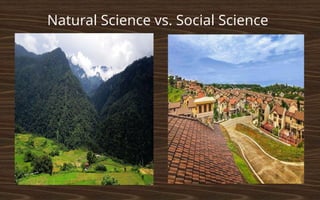
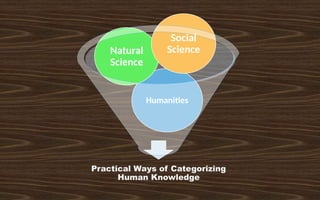
Natural Science vs. Social Science
Practical Ways of Categorizing
Human Knowledge
Humanities
Natural
Science
Social
Science
What is
NATURAL SCIENCE?
✘ A major branch of science that deals with the description,
prediction and understanding of natural phenomena,
basically based on observational and empirical evidence.
Natural Science
●
Natural science is the empirical sciences that explains or predicts
natural phenomena. It is a science, such as biology, chemistry,
geology, astronomy, or physics that deals with the objects,
phenomena, or laws of nature and the physical world.
●
Natural science can be further broken down into two categories: life
sciences and physical sciences.
●
Life science refers to things like biology or human anatomy, in other
words, sciences that revolve around all living things on Earth.
●
Physical science covers the rest of the natural sciences, like chemistry
and physics, astronomy, earth science, for example, so the areas that
aren’t directly related to life.
What is
SOCIAL SCIENCE?
Social Science
●
It is a body of knowledge characterized by an objective to
understand what society is and what it does to the people living
inside it.
●
It is a systematic study of society and developed various modes of
engaging the notion of society and how to truly grasp its enigma
●
It is comprised of two distinct words society (social) and empirical
analysis (science)
Social Science
●
It is a body of knowledge characterized by an objective to
understand what society is and what it does to the people
living inside it.
●
It is a systematic study of society and developed various
modes of engaging the notion of society and how to truly
grasp its enigma
●
It is comprised of two distinct words society (social) and
empirical analysis (science)
✘ Any discipline or branch of science that deals with human
behavior in its social and cultural aspects.
✘ Social science is an academic discipline concerned with
society and the relationships among individuals within a
society, which often rely primarily on empirical approaches.
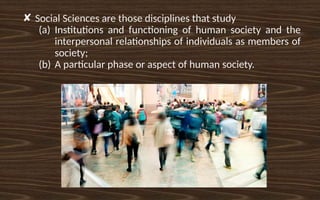
✘ Social Sciences are those disciplines that study
(a) Institutions and functioning of human society and the
interpersonal relationships of individuals as members of
society;
(b) A particular phase or aspect of human society.
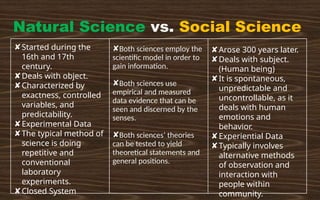
Natural Science vs. Social Science
✘Both sciences employ the
scientific model in order to
gain information.
✘Both sciences use
empirical and measured
data evidence that can be
seen and discerned by the
senses.
✘Both sciences’ theories
can be tested to yield
theoretical statements and
general positions.
✘Arose 300 years later.
✘Deals with subject.
(Human being)
✘It is spontaneous,
unpredictable and
uncontrollable, as it
deals with human
emotions and
behavior.
✘Experiential Data
✘Typically involves
alternative methods
of observation and
interaction with
people within
community.
✘Started during the
16th and 17th
century.
✘Deals with object.
✘Characterized by
exactness, controlled
variables, and
predictability.
✘Experimental Data
✘The typical method of
science is doing
repetitive and
conventional
laboratory
experiments.
✘Closed System
✘ The social sciences have a
critical contribution to make,
in helping us understand,
imagine, and craft a more
sustainable future for all.”
- UNESCO
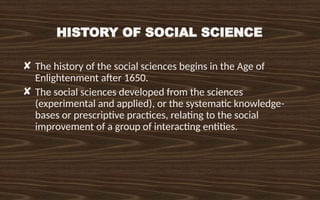
HISTORY OF SOCIAL SCIENCE
✘ The history of the social sciences begins in the Age of
Enlightenment after 1650.
✘ The social sciences developed from the sciences
(experimental and applied), or the systematic knowledge-
bases or prescriptive practices, relating to the social
improvement of a group of interacting entities.
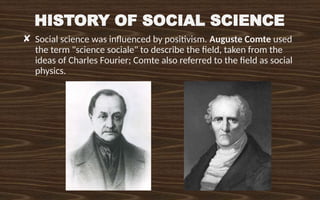
HISTORY OF SOCIAL SCIENCE
✘ Social science was influenced by positivism. Auguste Comte used
the term "science sociale" to describe the field, taken from the
ideas of Charles Fourier; Comte also referred to the field as social
physics.
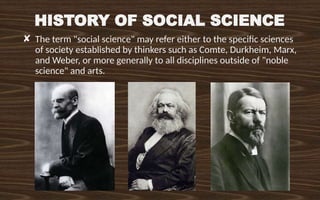
HISTORY OF SOCIAL SCIENCE
✘ The term "social science" may refer either to the specific sciences
of society established by thinkers such as Comte, Durkheim, Marx,
and Weber, or more generally to all disciplines outside of "noble
science" and arts.
How is social science
related to society?
✘ Social sciences focus on the study of society and the
relationship among individuals within society.
What is social sciences and how can it be used to
study and understand society?
What are the roles of social science in the society?
✘ Conceptualization of the social problem - means what is the
problem affecting the society, positive or negative?
✘ Understanding the existing concepts related to the problem.
✘ Conducting the research on the problem, using scientific
methods such as inclusive sampling, classification, tabulation
and analysis then conclusion.
✘ Based on analysis and conclusion suggesting
recommendations to the problem.
✘ It is used to understand society, identify potential social
problems create an hypothesis and try and formulate
answers to those problems.
For example, our aging population.
How natural
science can be used in our
daily lives?
What is HUMANITIES?
✘ Refers to the study of the ways in which the human
experience is processed and documented.
✘ Encompasses the field of philosophy, literature, religion, art,
music, history, and language.
Humanities vs. Social Science
✘ Both the
humanities and
social science are
concerned with
human aspects
like, law, politics,
linguistics,
economics, and
psychology.
✘ Both the
humanities and
social sciences are
concerned with
human lives and
nature.
✘ Influence by and
developed after the
French revolution
and the industrial
revolution.
✘ Social science deal
with more scientific
approach.

✘ Involves application
of an empirical,
rational, and
objective
methodology (such
as the use of validity
and reliability test) to
present facts.
✘ Emerged in the 15th
century.
✘ Humanities involved
a more of a scientific
approach.
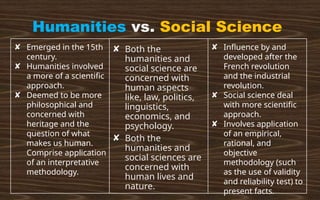
✘ Deemed to be more
philosophical and
concerned with
heritage and the
question of what
makes us human.
Comprise application
of an interpretative
methodology.
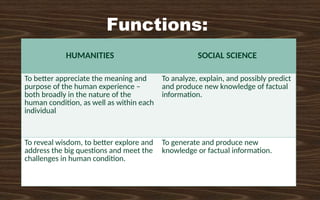
Functions:
HUMANITIES SOCIAL SCIENCE
To better appreciate the meaning and
purpose of the human experience –
both broadly in the nature of the
human condition, as well as within each
individual
To analyze, explain, and possibly predict
and produce new knowledge of factual
information.
To reveal wisdom, to better explore and
address the big questions and meet the
challenges in human condition.
To generate and produce new
knowledge or factual information.
How can humanities be applied to
our daily living?
What is Modernity? What Was Its Role in the
Development of Social Science
●
Modernity is a concept that deals not only with the shift in the
physical and material conditions of society but also with the mental
and behavioral shifts among people.
●
Modernity is referred to in popular language- is characterized by the
presence of urbanism and capitalism.
●
Modernity becomes the blueprint of society that promotes
individualism, and, in the words of Emile Durkheim, organic solidarity
or interdependence.
●
Durkheim is a French social thinker and considered the “Father of
Sociology and Anthropology”.
Functionalism
●
It is a concept that was borne out of this conception of
society, suggest that cultural and social institution are
created to perform certain functions that, in the end,
contribute to the overall health of society, thus
preserving the prosperity.
●
Mechanic solidarity means the basis of people’s
cooperation and society’s integration is due to similar
experiences in the work, lifeways, values, and
worldviews.
Bringing Positivism to the Fore of
Social Science
●
Positivism a philosophy in developed in Europe about a century
before the Industrial revolution, shaped scientific tradition
through the nineteenth century and beyond.
●
It traces its roots in the ideas put forward by philosophers during
the Enlightenment- an important intellectual movement during the
late seventeenth to late eighteenth century.
●
It calls for a commitment to objectivity and focuses on applying
the laws of nature to a model of society.
●
Augusto Comte was the proponent of
positivism
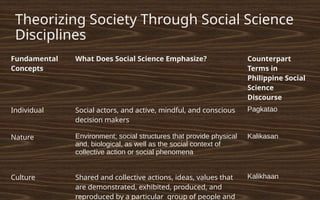
Theorizing Society Through Social Science
Disciplines
Fundamental
Concepts
What Does Social Science Emphasize? Counterpart
Terms in
Philippine Social
Science
Discourse
Individual Social actors, and active, mindful, and conscious
decision makers
Pagkatao
Nature Environment; social structures that provide physical
and, biological, as well as the social context of
collective action or social phenomena
Kalikasan
Culture Shared and collective actions, ideas, values that
are demonstrated, exhibited, produced, and
reproduced by a particular group of people and
Kalikhaan
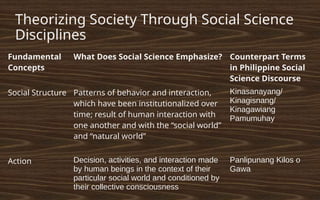
Theorizing Society Through Social Science
Disciplines
Fundamental
Concepts
What Does Social Science Emphasize? Counterpart Terms
in Philippine Social
Science Discourse
Social Structure Patterns of behavior and interaction,
which have been institutionalized over
time; result of human interaction with
one another and with the “social world”
and “natural world”
Kinasanayang/
Kinagisnang/
Kinagawiang
Pamumuhay
Action Decision, activities, and interaction made
by human beings in the context of their
particular social world and conditioned by
their collective consciousness
Panlipunang Kilos o
Gawa
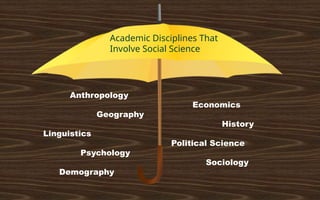
Anthropology
Economics
Geography
History
Linguistics
Political Science
Psychology
Sociology
Demography
Academic Disciplines That
Involve Social Science
Academic Disciplines That Involve
Social Science
●
Anthropology – deals with the nature of human
beings, both from biological and cultural point of view.
For anthropology, culture is a key factor that shapes
human nature and that this culture is conditioned by
both natural and social environments.
●
Sociology – deals with how people behave and
interact with one another as a member of a particular
social group
Academic Disciplines That Involve Social
Science
•
Demography – deals with population as a unit of
analysis. Demographic process , such as birth
migration and aging are investigated because they
impact on how society changes across a period of
time.
•
Economics – it gives emphasis on quantitative
analysis and mathematical equation as
representation of social behavior, focuses on markets,
wealth, and resources that people construct and
make use in order to live.
Academic Disciplines That Involve Social
Science
●
Geography – the proximity to certain geographic locations determines the kind
of society that will be formed or created over a period of time
●
Other disciplines:
●Psychology – what is going on within the individual mind or the psyche – does
shape the way he or she views society, and thus impact his or her
relationship with people and the environment.
●History – the past is part or parcel of the present as events that happened in
the past shape the way people make decision in the present.
●Language – a product of human race’s biological and cultural heritage, is an
invention by people yet they themselves are shaped by it.
Political science
●
Puts all the aspects together for a coherent social
organization
●
Political science believe that it is politics or the
political realm that captures human life
Ethnography
●
It is a special methodology in the social sciences
that aims to describe what constitutes a particular
social phenomenon: event, actors, interactions,
relationship, ideas, symbols, and objects
●
Ethnographic techniques use nonnumerical data
and narratives or experiences and perceptions of
people.
Doing Ethnographic Study
●
Participant observation – actual and physical participation of the
researcher in group activities;
●
In-depth interviews – formal and detailed interview of KI’s;
●
Focus group discussion – facilitating a discussion with a number
of KI’s guided by the researcher’s agenda
●
Life history method – in-depth examination of the social
phenomenon from the lens of the personal life story of KI; and
●
Ocular inspection – familiarization with the location and physical
context of the subject area.
Fieldwork
●
Is a social research technique of going to the “field’ to
conduct a face to face study of a subject matter.
●
Combines positivist framework and opens up to a more
phenomenological (experience-based), interactionist
(constant interaction and deliberate participation), and
interpretevist.
●
It is not tied up with numbers or recorded data, but it deals
with dynamic forms information elicited from people in the
context of their everyday lives.
Triangulation Technique
•
Three sources of the same data are analyzed in order to
verify and validate what has been previously gathered from
a certain source. This maybe in the form of the following:
●Three different sources telling the same story
●Three different ways of gathering data
●Three different types of data
Intersubjectivity
●
When two out of three persons affirm what other
person is saying or claiming about a certain
phenomenon issue
●
Also means that people tend to validate each other’s
thought , feelings, and interpretation because they
agree on basic things and assumptions due to shared
experiences of a particular phenomenon.
Facts That Matter
●
Bronislaw Malinowski, pioneered the technique
of “participant observation” which his detailed
recording and analysis of the inhabitants
Tobriand Islands
●
Isabelo de los Reyes, conducted folkloric studies
about the Philippines, which was considered,
then, a not-so-familiar terrain in intellectual
pursuits.
1. What are the different cultures and traditions
in the Philippines?
2. Are cultures and traditions related to
people? If yes, how?
---
Discipline and
Ideas in Social
Sciences
Quiz 2
1-6.
What Comprises
Society?
7. This refers to things
like biology or human
anatomy. In other
words, sciences that
revolve around all
living things on Earth.
8.It is comprised of
two distinct words
society and
empirical analysis.
9. He is a French
social thinker and
considered the
“Father of Sociology
and Anthropology”
10. This is a concept that
deals not only with the shift
in the physical and material
conditions of society but
also with the mental and
behavioral shifts among
people.
11. It is a special
methodology in the
social sciences that
aims to describe what
constitutes a particular
social phenomenon
12. It is a techniques in
which three sources of the
same data are analyzed in
order to verify and validate
what has been previously
gathered from a certain
source
13. It takes place when
two out of three persons
affirm what other person
is saying or claiming
about a certain
phenomenon issue.
14. It is a body of
knowledge characterized
by an objective to
understand what society is
and what it does to the
people living inside it.
15. This refers to the
study of the ways in
which the human
experience is processed
and documented.
16. He is the
writer of Pugad
Baboy.
17. It is the
empirical sciences
that explains or
predicts natural
phenomena.
18-20. Give three
academic
disciplines of
social science.

Chapter 1: Understanding Social Science.pptx

  • 1.
    DISCIPLINES AND IDEAS INSOCIAL SCIENCES Unit 1: How Social Is Science, and How Scientific is Social?
  • 2.
    Chapter 1. Howdid the Social Sciences Emerge? How Does It Link to the Natural Sciences? Learning Objectives: 1. Define “social science’ as the study of society in the mold of scientific tradition; 2. Chart the development of social science in the context of Western intellectual history; 3. Explain what consist social science and appreciate their differences and collective objectives; 4. Introduce social science as key to the study of this discipline; and 5. Learn about how social science started in the Philippines in the context of the Filipino struggle for independence.
  • 4.
    Early Depictions ofPhilippine Social Life
  • 5.
    Early Depictions ofPhilippine Social Life
  • 6.
    Who I am HowI behave with others.
  • 7.
    Nature vs. Society Natureconjures an image of random and unstructured forces that shape a given area. ● These forces follow a general pattern, law, or process ever since the world existed
  • 8.
    ● Society is contrastto the preceding imagery of nature. ● Society is organized and deliberately structured and formalized and bound by rules drafted and implemented by the people who themselves constitute society. Nature vs. Society
  • 9.
    Society ✘ Society refersto ‘a system of interrelationships which connects individuals together’ (Giddens1990) ✘ A ‘common habitat’ or environment within which members of a society depend on one another for survival and well- being (Marvin Harris 1983) ✘ Society refers to a group of people who share a culture and a territory. ✘ Socialization affects the overall cultural practices of a society and shape one’s self-image.
  • 10.
  • 11.
    Natural Science vs.Social Science
  • 15.
    Practical Ways ofCategorizing Human Knowledge Humanities Natural Science Social Science
  • 16.
  • 17.
    ✘ A majorbranch of science that deals with the description, prediction and understanding of natural phenomena, basically based on observational and empirical evidence.
  • 18.
    Natural Science ● Natural scienceis the empirical sciences that explains or predicts natural phenomena. It is a science, such as biology, chemistry, geology, astronomy, or physics that deals with the objects, phenomena, or laws of nature and the physical world. ● Natural science can be further broken down into two categories: life sciences and physical sciences. ● Life science refers to things like biology or human anatomy, in other words, sciences that revolve around all living things on Earth. ● Physical science covers the rest of the natural sciences, like chemistry and physics, astronomy, earth science, for example, so the areas that aren’t directly related to life.
  • 19.
  • 20.
    Social Science ● It isa body of knowledge characterized by an objective to understand what society is and what it does to the people living inside it. ● It is a systematic study of society and developed various modes of engaging the notion of society and how to truly grasp its enigma ● It is comprised of two distinct words society (social) and empirical analysis (science)
  • 21.
    Social Science ● It isa body of knowledge characterized by an objective to understand what society is and what it does to the people living inside it. ● It is a systematic study of society and developed various modes of engaging the notion of society and how to truly grasp its enigma ● It is comprised of two distinct words society (social) and empirical analysis (science)
  • 22.
    ✘ Any disciplineor branch of science that deals with human behavior in its social and cultural aspects. ✘ Social science is an academic discipline concerned with society and the relationships among individuals within a society, which often rely primarily on empirical approaches.
  • 23.
    ✘ Social Sciencesare those disciplines that study (a) Institutions and functioning of human society and the interpersonal relationships of individuals as members of society; (b) A particular phase or aspect of human society.
  • 24.
    Natural Science vs.Social Science ✘Both sciences employ the scientific model in order to gain information. ✘Both sciences use empirical and measured data evidence that can be seen and discerned by the senses. ✘Both sciences’ theories can be tested to yield theoretical statements and general positions. ✘Arose 300 years later. ✘Deals with subject. (Human being) ✘It is spontaneous, unpredictable and uncontrollable, as it deals with human emotions and behavior. ✘Experiential Data ✘Typically involves alternative methods of observation and interaction with people within community. ✘Started during the 16th and 17th century. ✘Deals with object. ✘Characterized by exactness, controlled variables, and predictability. ✘Experimental Data ✘The typical method of science is doing repetitive and conventional laboratory experiments. ✘Closed System
  • 25.
    ✘ The socialsciences have a critical contribution to make, in helping us understand, imagine, and craft a more sustainable future for all.” - UNESCO
  • 26.
    HISTORY OF SOCIALSCIENCE ✘ The history of the social sciences begins in the Age of Enlightenment after 1650. ✘ The social sciences developed from the sciences (experimental and applied), or the systematic knowledge- bases or prescriptive practices, relating to the social improvement of a group of interacting entities.
  • 27.
    HISTORY OF SOCIALSCIENCE ✘ Social science was influenced by positivism. Auguste Comte used the term "science sociale" to describe the field, taken from the ideas of Charles Fourier; Comte also referred to the field as social physics.
  • 28.
    HISTORY OF SOCIALSCIENCE ✘ The term "social science" may refer either to the specific sciences of society established by thinkers such as Comte, Durkheim, Marx, and Weber, or more generally to all disciplines outside of "noble science" and arts.
  • 30.
    How is socialscience related to society?
  • 31.
    ✘ Social sciencesfocus on the study of society and the relationship among individuals within society.
  • 32.
    What is socialsciences and how can it be used to study and understand society? What are the roles of social science in the society?
  • 33.
    ✘ Conceptualization ofthe social problem - means what is the problem affecting the society, positive or negative? ✘ Understanding the existing concepts related to the problem. ✘ Conducting the research on the problem, using scientific methods such as inclusive sampling, classification, tabulation and analysis then conclusion. ✘ Based on analysis and conclusion suggesting recommendations to the problem. ✘ It is used to understand society, identify potential social problems create an hypothesis and try and formulate answers to those problems. For example, our aging population.
  • 34.
    How natural science canbe used in our daily lives?
  • 35.
  • 36.
    ✘ Refers tothe study of the ways in which the human experience is processed and documented. ✘ Encompasses the field of philosophy, literature, religion, art, music, history, and language.
  • 37.
    Humanities vs. SocialScience ✘ Both the humanities and social science are concerned with human aspects like, law, politics, linguistics, economics, and psychology. ✘ Both the humanities and social sciences are concerned with human lives and nature. ✘ Influence by and developed after the French revolution and the industrial revolution. ✘ Social science deal with more scientific approach. ✘ Involves application of an empirical, rational, and objective methodology (such as the use of validity and reliability test) to present facts. ✘ Emerged in the 15th century. ✘ Humanities involved a more of a scientific approach. ✘ Deemed to be more philosophical and concerned with heritage and the question of what makes us human. Comprise application of an interpretative methodology.
  • 38.
    Functions: HUMANITIES SOCIAL SCIENCE Tobetter appreciate the meaning and purpose of the human experience – both broadly in the nature of the human condition, as well as within each individual To analyze, explain, and possibly predict and produce new knowledge of factual information. To reveal wisdom, to better explore and address the big questions and meet the challenges in human condition. To generate and produce new knowledge or factual information.
  • 39.
    How can humanitiesbe applied to our daily living?
  • 40.
    What is Modernity?What Was Its Role in the Development of Social Science ● Modernity is a concept that deals not only with the shift in the physical and material conditions of society but also with the mental and behavioral shifts among people. ● Modernity is referred to in popular language- is characterized by the presence of urbanism and capitalism. ● Modernity becomes the blueprint of society that promotes individualism, and, in the words of Emile Durkheim, organic solidarity or interdependence. ● Durkheim is a French social thinker and considered the “Father of Sociology and Anthropology”.
  • 41.
    Functionalism ● It is aconcept that was borne out of this conception of society, suggest that cultural and social institution are created to perform certain functions that, in the end, contribute to the overall health of society, thus preserving the prosperity. ● Mechanic solidarity means the basis of people’s cooperation and society’s integration is due to similar experiences in the work, lifeways, values, and worldviews.
  • 42.
    Bringing Positivism tothe Fore of Social Science ● Positivism a philosophy in developed in Europe about a century before the Industrial revolution, shaped scientific tradition through the nineteenth century and beyond. ● It traces its roots in the ideas put forward by philosophers during the Enlightenment- an important intellectual movement during the late seventeenth to late eighteenth century. ● It calls for a commitment to objectivity and focuses on applying the laws of nature to a model of society. ● Augusto Comte was the proponent of positivism
  • 43.
    Theorizing Society ThroughSocial Science Disciplines Fundamental Concepts What Does Social Science Emphasize? Counterpart Terms in Philippine Social Science Discourse Individual Social actors, and active, mindful, and conscious decision makers Pagkatao Nature Environment; social structures that provide physical and, biological, as well as the social context of collective action or social phenomena Kalikasan Culture Shared and collective actions, ideas, values that are demonstrated, exhibited, produced, and reproduced by a particular group of people and Kalikhaan
  • 44.
    Theorizing Society ThroughSocial Science Disciplines Fundamental Concepts What Does Social Science Emphasize? Counterpart Terms in Philippine Social Science Discourse Social Structure Patterns of behavior and interaction, which have been institutionalized over time; result of human interaction with one another and with the “social world” and “natural world” Kinasanayang/ Kinagisnang/ Kinagawiang Pamumuhay Action Decision, activities, and interaction made by human beings in the context of their particular social world and conditioned by their collective consciousness Panlipunang Kilos o Gawa
  • 45.
  • 46.
    Academic Disciplines ThatInvolve Social Science ● Anthropology – deals with the nature of human beings, both from biological and cultural point of view. For anthropology, culture is a key factor that shapes human nature and that this culture is conditioned by both natural and social environments. ● Sociology – deals with how people behave and interact with one another as a member of a particular social group
  • 47.
    Academic Disciplines ThatInvolve Social Science • Demography – deals with population as a unit of analysis. Demographic process , such as birth migration and aging are investigated because they impact on how society changes across a period of time. • Economics – it gives emphasis on quantitative analysis and mathematical equation as representation of social behavior, focuses on markets, wealth, and resources that people construct and make use in order to live.
  • 48.
    Academic Disciplines ThatInvolve Social Science ● Geography – the proximity to certain geographic locations determines the kind of society that will be formed or created over a period of time ● Other disciplines: ●Psychology – what is going on within the individual mind or the psyche – does shape the way he or she views society, and thus impact his or her relationship with people and the environment. ●History – the past is part or parcel of the present as events that happened in the past shape the way people make decision in the present. ●Language – a product of human race’s biological and cultural heritage, is an invention by people yet they themselves are shaped by it.
  • 49.
    Political science ● Puts allthe aspects together for a coherent social organization ● Political science believe that it is politics or the political realm that captures human life
  • 50.
    Ethnography ● It is aspecial methodology in the social sciences that aims to describe what constitutes a particular social phenomenon: event, actors, interactions, relationship, ideas, symbols, and objects ● Ethnographic techniques use nonnumerical data and narratives or experiences and perceptions of people.
  • 51.
    Doing Ethnographic Study ● Participantobservation – actual and physical participation of the researcher in group activities; ● In-depth interviews – formal and detailed interview of KI’s; ● Focus group discussion – facilitating a discussion with a number of KI’s guided by the researcher’s agenda ● Life history method – in-depth examination of the social phenomenon from the lens of the personal life story of KI; and ● Ocular inspection – familiarization with the location and physical context of the subject area.
  • 52.
    Fieldwork ● Is a socialresearch technique of going to the “field’ to conduct a face to face study of a subject matter. ● Combines positivist framework and opens up to a more phenomenological (experience-based), interactionist (constant interaction and deliberate participation), and interpretevist. ● It is not tied up with numbers or recorded data, but it deals with dynamic forms information elicited from people in the context of their everyday lives.
  • 53.
  • 54.
    Triangulation Technique • Three sourcesof the same data are analyzed in order to verify and validate what has been previously gathered from a certain source. This maybe in the form of the following: ●Three different sources telling the same story ●Three different ways of gathering data ●Three different types of data
  • 55.
    Intersubjectivity ● When two outof three persons affirm what other person is saying or claiming about a certain phenomenon issue ● Also means that people tend to validate each other’s thought , feelings, and interpretation because they agree on basic things and assumptions due to shared experiences of a particular phenomenon.
  • 56.
    Facts That Matter ● BronislawMalinowski, pioneered the technique of “participant observation” which his detailed recording and analysis of the inhabitants Tobriand Islands ● Isabelo de los Reyes, conducted folkloric studies about the Philippines, which was considered, then, a not-so-familiar terrain in intellectual pursuits.
  • 57.
    1. What arethe different cultures and traditions in the Philippines? 2. Are cultures and traditions related to people? If yes, how?
  • 58.
  • 59.
    Discipline and Ideas inSocial Sciences Quiz 2
  • 60.
  • 61.
    7. This refersto things like biology or human anatomy. In other words, sciences that revolve around all living things on Earth.
  • 62.
    8.It is comprisedof two distinct words society and empirical analysis.
  • 63.
    9. He isa French social thinker and considered the “Father of Sociology and Anthropology”
  • 64.
    10. This isa concept that deals not only with the shift in the physical and material conditions of society but also with the mental and behavioral shifts among people.
  • 65.
    11. It isa special methodology in the social sciences that aims to describe what constitutes a particular social phenomenon
  • 66.
    12. It isa techniques in which three sources of the same data are analyzed in order to verify and validate what has been previously gathered from a certain source
  • 67.
    13. It takesplace when two out of three persons affirm what other person is saying or claiming about a certain phenomenon issue.
  • 68.
    14. It isa body of knowledge characterized by an objective to understand what society is and what it does to the people living inside it.
  • 69.
    15. This refersto the study of the ways in which the human experience is processed and documented.
  • 70.
    16. He isthe writer of Pugad Baboy.
  • 71.
    17. It isthe empirical sciences that explains or predicts natural phenomena.
  • 72.