What is DOS (Disk Operating System) and its function?
Today in this article I am going to give you information about DOS (Disk
operating system). In the realm of computing, where intricacies abound and
simplicity often conceals profound complexity, there exists an omnipresent yet
enigmatic entity known as the Disk Operating System, or DOS. It is this elusive
enabler that has played an instrumental role in the evolution of modern computing,
offering a myriad of functions that, when unraveled, reveal a tapestry of perplexity
and a symphony of burstiness.
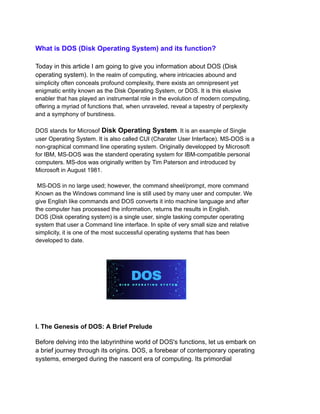
DOS stands for Microsof Disk Operating System. It is an example of Single
user Operating System. It is also called CUI (Charater User Interface). MS-DOS is a
non-graphical command line operating system. Originally developped by Microsoft
for IBM, MS-DOS was the standerd operating system for IBM-compatible personal
computers. MS-dos was originally written by Tim Paterson and introduced by
Microsoft in August 1981.
MS-DOS in no large used; however, the command sheel/prompt, more command
Known as the Windows command line is still used by many user and computer. We
give English like commands and DOS converts it into machine language and after
the computer has processed the information, returns the results in English.
DOS (Disk operating system) is a single user, single tasking computer operating
system that user a Command line interface. In spite of very small size and relative
simplicity, it is one of the most successful operating systems that has been
developed to date.
I. The Genesis of DOS: A Brief Prelude
Before delving into the labyrinthine world of DOS's functions, let us embark on
a brief journey through its origins. DOS, a forebear of contemporary operating
systems, emerged during the nascent era of computing. Its primordial
incarnation, MS-DOS, saw the light of day in the early 1980s, marking a
seminal moment in the annals of technological history.
II. The Paradox of Simplicity and Complexity
One of the defining paradoxes of DOS is its inherent simplicity. At its core,
DOS is a command-line interface, a stark contrast to the graphical user
interfaces (GUIs) that grace our screens today. Yet, within this simplicity lies a
profound complexity that has been the hallmark of its enduring relevance.
III. The Multifaceted Functions of DOS
1. File Management Unveiled
DOS's role as a file management maestro cannot be overstated. Its
command-line interface allows users to navigate, manipulate, and organize
files and directories with unparalleled precision. Whether it's copying, moving,
renaming, or deleting files, DOS wields a versatile array of commands that
empower the user to orchestrate their digital realm.
2. Memory Management Mastery
The memory constraints of yesteryears' computing environments demanded
ingenious memory management. DOS excelled in this domain, utilizing
memory allocation schemes like conventional, extended, and expanded
memory to optimize system resources. This intricate memory juggling act is a
testament to the burstiness of DOS, as it dynamically allocated memory for
applications.
3. Bootstrapping Brilliance
DOS's ability to boot a computer from scratch is a testament to its essential
functions. Through a convoluted dance of bootstrap loaders, sector-based
disk reads, and BIOS interactions, DOS initiates the computing journey,
breathing life into the machine.
4. Scripting Sorcery
For those who dared to explore the depths of DOS, the scripting capabilities it
offered were a revelation. Batch files, comprising a series of commands,
unleashed the potential for automation, allowing users to execute complex
sequences of operations with a single keystroke.
5. Networking Nuances
Even in its simplest form, DOS showcased its burstiness when it came to
networking. It introduced rudimentary networking commands that paved the
way for nascent networked computing, demonstrating its adaptability in the
face of evolving technology.
IV.The Enduring Legacy
In the annals of computing history, DOS stands as a testament to the duality of
simplicity and complexity. Its multifaceted functions, ranging from file
management to memory optimization, have left an indelible mark on the digital
landscape. While the graphical marvels of today's operating systems may
have eclipsed its prominence, the burstiness and perplexity of DOS continue
to resonate as a foundational pillar of computing's evolution.
Features of DOS :
There are some characteristics that make advise operating system stand out:
1. DOS does not support GUIs and does not recognize mouse inputs.
2. Advise operating system controls files and directories and enables the loading and
running of programs. It can of manage resource allocation and manage hardware
like disc and memory.
3. It is an operating system designed for a single user that performs several
functions to ensure systems are running properly.
4. The file allocation is a tabular structure used to hold these IDS.
5. DOS needs a concept of user responsibilities,support a multi-user operating
system, and is less secure. Due to its simple interface and few functionalities, it is
incredibly light.
Working of DOS:
The procedure a computer goes thought to start up is called the boot process. For a
machine running one of the six — disk operating systems listed below, for example.
1. The Masters Boot Record is read by the read — only memory (ROM) bootstrap
loader before it transfers Control to it.
2. The boot record starts the computer by loading the operating system into memory
and giving it control.
3. Data from a magnetic dise is transferred to the computer's primary memory, the
random access memory.
4. The computer offers serval application programming interface (APIc) for
applications, such as character input/output, termination, and managing user input
thought a keyboard.
5. The OS further offers file, management, which groups, reads, and writes data
stored on storage. A hierarchical system comprising folders, Subdirectories, and files
is used to arrange the files.
Q. How to open DOS in Windows?
= Start > All Program > Accessories > Command Prompt.
Start > Run-CMD or Command
Q. How to make MS-DOS Window Maximize (full Screem)?
= ALT+ ENTER (applicable for Windows xp not for 7,8 & 10)
Q. How to exit from DOS?
=Exit Command is use to exit Command Prompt.
Q. How to change Drive in MS-DOS?
= Syntax:- Drive Name: (press enter key)
Example- D:
BOOTING:
Process that starts up a computer is called booting. It check for proper functioning of
all the Hardware (peripheral) devices attached with the system. It searchs for the
operating system and, when located, loads it into the main memory (RAM).
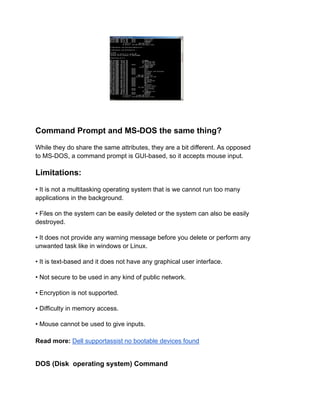
Command Prompt and MS-DOS the same thing?
While they do share the same attributes, they are a bit different. As opposed
to MS-DOS, a command prompt is GUI-based, so it accepts mouse input.
Limitations:
• It is not a multitasking operating system that is we cannot run too many
applications in the background.
• Files on the system can be easily deleted or the system can also be easily
destroyed.
• It does not provide any warning message before you delete or perform any
unwanted task like in windows or Linux.
• It is text-based and it does not have any graphical user interface.
• Not secure to be used in any kind of public network.
• Encryption is not supported.
• Difficulty in memory access.
• Mouse cannot be used to give inputs.
Read more: Dell supportassist no bootable devices found
DOS (Disk operating system) Command
DOS has a relatively small number of commands, and an even smaller number of
commonly used ones Moreover, these Commands are generally inflexible because ,
in contrast to linux and other Ubix — like operating systems, they are designed to
accommodate few operating or argument ( I.e.,value that can be passed to the
Commands).
Commands are predefine instruction which is used to perform internal and external
operation.
A command can be given in capitals or Small letters also. After Typing DOS
command we muct press enter key.
MS-DOS file and filetypes:
A computer file created by an application running under the DOS operating
system. is called an MS-DOS file. There are three main files of DOS. During
the Booting process, the computer loads the operating system into its memory.
DOS booting involves reading the following files into memory namely
• IO. SYS: A hidden executable binary file that processes instructions that tell
the operating system (OS) how the computer is set up when it is booted or
started. It contains the default MS-DOS device drivers (hardware interfacing
routines) and the DOS initialization program.
• MSDOS. SYS: The MSDOS.SYS file is a hidden, system, read-only file
created on the root of the boot drive. There are several configurations that can
be changed using this file. Most values in the MSDOS.SYS are either 0 or 1,
which is off or on.
• COMMAND.COM: COMMAND.COM is the default command-line interpreter
for MS-DOS. It is the default user interface as well.COMMAND.COM is the
command shell on MS-DOS and PC-DOS, as well as versions of Windows
that depend on DOS. Gives users a command line interface to DOS as well as
a way to run scripts called “batch files” with the .BAT file extension.
DOS Today : The Riseand Fall of Disk operating system:
DOS has been a significant part of the evolution of the OS. However , its peak has
long been over. Here are the reasons why :
1. Outdated Technology :
DOS lacks the features and functionalities of today's OSes like Windows, macOS,
and linux.
2. User—Friendly Interfaces :
DOS uses text to understand what the user wants to do. Standalone Dos computers
cannot run graphics — based applications as efficiently as modern operating
systems.
3. Lock of Hardware support :
DOS struggles with modern Hardware and drives, making everyday use of modern
devices and peripherals impractical.
4. Limited software Compatibility :
Most software applications are for Windows, macOS, or Linux, making running
modern applications on DOS Challenging due to compatibility issues.
5. Security Concerns :
DOS lacks essential security features, making it vulnerable to viruses, malware and
cyberattacks. However, companies continue to develop custom system on it.
Different Versions of MS-DOS
• MS-DOS 1. x
• MS-DOS 2. x
• MS-DOS 3. x
• MS-DOS 4.x/4.0
• MS-DOS 5. x
• MS-DOS 6. x
• MS-DOS 7/8
DOS Command line:
DOS is mainly used the Command line DOS provides a lot of of different commands
to manage the current operating system and tasks. You can look following Command
line operations.
Multitasking
DOS (Disk operating system) provides multitasking features.
Multitasking makes the multiple process can run at the smae time. This is a great
feature. Which means while downloading a files, listening to music or we can play
games.
Multi-user
Multi-user features make the same computer can be used with different user names
and session. All user's data are stored in their private folders and their operating
system and desktop related setting are stored too.
Read more: Run CMD Command in PowerShell
Are DOS commands still used?
While DOS is severely outdated, it's still used in some capacity. In every
Windows-based computer, there's a PowerShell or command prompt today. It
allows them to use the same commands as DOS to work around troubles or
solve issues with hardware.
DOS command divided into 2 parts :
1. Internal Commands or Memory-Resident Commands.
2. External Command or Disk-Residence Commands.
1.Internal Command
These commands are automatically loaded into the computer's memory during the
bootimg process. They actually included in the Commands are executable
immediatly after getting the DOS prompt.
A few internal commands are:
VER CD..
VOL RD
DATE COPY CON
TIME TYPE
CLS COPY
DIR DEL
MD REN
CD PROMPT
VER
All O/S has its own edition number or relase or version number. The version number
indicates which edition of O/S we are working on.
Syntax: VER
Example: VER
Microsoft Windows XP [version 5.1.2600]
VOL
It is used to display volume lable (name) and serial number of the current drive.
Syntax: VOL[drive:]
Example: C:/> VOL D:
DATE
Used to display the current system date and prompt for entering new date.
Syntax: DATE
Example: Date
TIME:
Display the current system Time and prompt for entering new time.
Syntax: TIME
Example: Time
CLS:
Clear the screen.
Syntax: CLS
Example: CLS
MD or MKDIR:
Used to creat a new Directory or nested Directories.
Syntax: MD DIRECTORY NAME
MKDIR DIRECTORY NAME
Example: MD HARI <ENTER>
CD:
This command allows us to change present directory to another directory.
Syntex: CD [directory name]
Example: CD Hari <Enter>
RD
To delete the empty directry.
Syntax: RD [directroy name] <Enter>
Example: RD Hari press <Enter>
NOTE:-
The dirctroy muct be empty when we use RD
* Remove with subdirectories and files.
Syntax: RD/S [directroy name]
Example: RD/s COLOUR press <Enter>
COPY CON:
We use this command to create a new file.
Syntax: COPY CON <FILENAME>
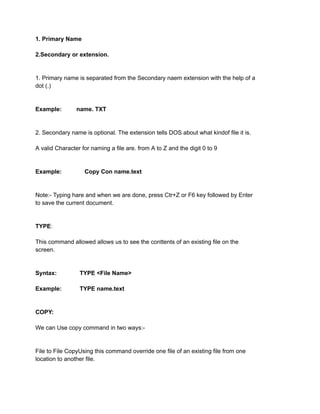
There are two name in DOS and is divided into 2 parts.
1. Primary Name
2.Secondary or extension.
1. Primary name is separated from the Secondary naem extension with the help of a
dot (.)
Example: name. TXT
2. Secondary name is optional. The extension tells DOS about what kindof file it is.
A valid Character for naming a file are. from A to Z and the digit 0 to 9
Example: Copy Con name.text
Note:- Typing hare and when we are done, press Ctr+Z or F6 key followed by Enter
to save the current document.
TYPE:
This command allowed allows us to see the conttents of an existing file on the
screen.
Syntax: TYPE <File Name>
Example: TYPE name.text
COPY:
We can Use copy command in two ways:-
File to File CopyUsing this command override one file of an existing file from one
location to another file.
Syntax: COPY [SOURCE FILE NAME] [TARGAR FILE
NAME]
Example: COPY name.txt name.text
File to File Directory
This is use to duplicate files of an existing file one directory to another with different
name or exiting name.
Syntex: COPY [SOURCE FILE NAME] [TARGET
Directory Name]
DEL/ERASE
This command removes one or more files from the disk or current working directorys.
Syntax: DEL [File Name] or ERASE [File Name]
Example: DEL Hari.txt or ERASE Krishna.Txt
REN
Used to change the name of the file or directory.
Rename Directory
Syntax: Ren [old directory name]
[new directory name]
Rename File
Syntax: REN <old file name. Extension> <New file name.
Extension>
Example: REN name.text name1.doc
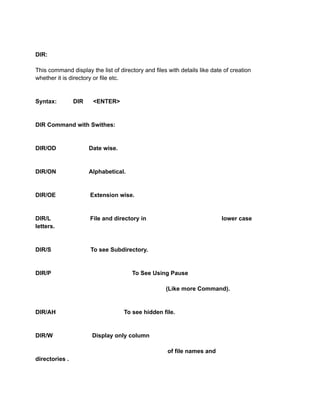
DIR:
This command display the list of directory and files with details like date of creation
whether it is directory or file etc.
Syntax: DIR <ENTER>
DIR Command with Swithes:
DIR/OD Date wise.
DIR/ON Alphabetical.
DIR/OE Extension wise.
DIR/L File and directory in lower case
letters.
DIR/S To see Subdirectory.
DIR/P To See Using Pause
(Like more Command).
DIR/AH To see hidden file.
DIR/W Display only column
of file names and
directories .
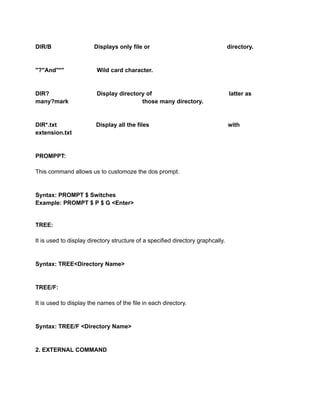
DIR/B Displays only file or directory.
"?"And"*" Wild card character.
DIR? Display directory of latter as
many?mark those many directory.
DIR*.txt Display all the files with
extension.txt
PROMPPT:
This command allows us to customoze the dos prompt.
Syntax: PROMPT $ Switches
Example: PROMPT $ P $ G <Enter>
TREE:
It is used to display directory structure of a specified directory graphcally.
Syntax: TREE<Directory Name>
TREE/F:
It is used to display the names of the file in each directory.
Syntax: TREE/F <Directory Name>
2. EXTERNAL COMMAND
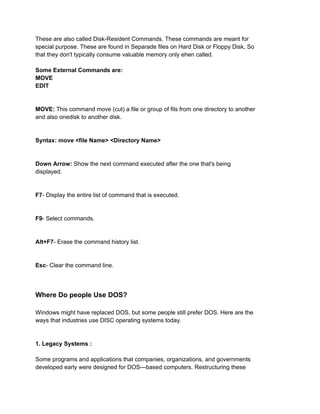
These are also called Disk-Resident Commands. These commands are meant for
special purpose. These are found in Separade files on Hard Disk or Floppy Disk, So
that they don't typically consume valuable memory only ehen called.
Some External Commands are:
MOVE
EDIT
MOVE: This command move (cut) a file or group of fils from one directory to another
and also onedisk to another disk.
Syntax: move <file Name> <Directory Name>
Down Arrow: Show the next command executed after the one that's being
displayed.
F7- Display the entire list of command that is executed.
F9- Select commands.
Alt+F7- Erase the command history list.
Esc- Clear the command line.
Where Do people Use DOS?
Windows might have replaced DOS, but some people still prefer DOS. Here are the
ways that industries use DISC operating systems today.
1. Legacy Systems :
Some programs and applications that companies, organizations, and governments
developed early were designed for DOS—based computers. Restructuring these
systems requires time and money. This structure led to organizations operating for
DOS and hiring specialized engineers for support and maintenance.
2. Embedded Systems :
Due to their simple tasks, DOS is still uses in some embedded systems (e.g., ATMs,
medical equipment, public space Kiosks, and stores point — of — sall terminals).
3. Vintage computing and retro Gaming :
Collectors and hobbyists have preserved their DOS Computers from decades ago.
To run classic software on update computer, DOS emulators and virtual machines
are dedicated to the community of nostalgic and retro gamers.
4. Nostalgia and learning :
Understanding how pre—GUI computers work is the first step to learning about
programming. DOS does this by exposing tech enthusiasts and students to the early
days of computing. Students can easily experiment with DOS with low—level
programming before trying today's more complex operating systems.
Read more: Task Manager Chromebook: A Deep Dive
DOS Hardware Support:
DOS Operating system is mainly developed for personal computers or PCs. The first
PC is designed to use Intel 8086 16bit processor. DOS is developed for IBM by
Microsoft and a every identical operating system named MS—DOS at the time pc
developed diffrent Hardware is supported by the DOS operating system like
Commodore 64, Atari 800, Apple 11, etc.
Advantages
• The commands in DOS are easy to remember and use.
• DOS is free of cost and can be installed easily.
• It gives us direct access to the BIOS calls.
• It can run on smaller machines and therefore the booting process is much
faster than other operating systems.
• DOS is very lightweight and it allows access to hardware.
• It does not have the overhead of a multitasking operating system.
Disadvantages
• DOS doesn’t support multitasking.
• It only has 2 GB of space which cannot be extended.
• It can only have a single user at a time.
• It is not compatible with other browsers.
• It doesn’t support networking.
• Automatic IRQ ordering is not supported by the OS.
• Not nearly as fancy in the graphics department.
There a basic flow of DOS Command work :
1. Boot process:
DOS undergoes a boot process when the computer turns on. BIOS (Dos component)
initially checks if the device work properly.
2. DOS kernel :
After the BIOS performs a self — check, the DOS kernel tasks control.
This is when the actual operation of the computer begins. The kernel also manages
memory, operating files etc.
3. Command Prompt :
When the kernel tasks over, it's time for the user to enter Commands. Command
Prompt are Introduction you the computer to perform.
4. Command Execution :
Command execution happens when the kernel reads and interprets the command
into actions.
5. File system :
Thought DOS, the computer can store the data you perform thought directories.
6. Running Applications :
Apps have their own set of commands built into them. When the user prompts the
computer to run a app, the app temporarily takes over.
7. Exiting DOS :
After performing the task, the user will shut the computer down,
automatically bringing DOS into BIOS mode.
In conclusion, DOS, with its intricate functions and nuanced simplicity,
represents a captivating enigma within the world of technology. It reminds us
that within the seemingly straightforward lies the potential for boundless
complexity, and within the uniformity of code resides the spark of creativity and
innovation.
Thanks for reading.
Read more:
Entrepreneurial operating system

Disk operating system (DOS).PDF

  • 1.
    What is DOS(Disk Operating System) and its function? Today in this article I am going to give you information about DOS (Disk operating system). In the realm of computing, where intricacies abound and simplicity often conceals profound complexity, there exists an omnipresent yet enigmatic entity known as the Disk Operating System, or DOS. It is this elusive enabler that has played an instrumental role in the evolution of modern computing, offering a myriad of functions that, when unraveled, reveal a tapestry of perplexity and a symphony of burstiness. DOS stands for Microsof Disk Operating System. It is an example of Single user Operating System. It is also called CUI (Charater User Interface). MS-DOS is a non-graphical command line operating system. Originally developped by Microsoft for IBM, MS-DOS was the standerd operating system for IBM-compatible personal computers. MS-dos was originally written by Tim Paterson and introduced by Microsoft in August 1981. MS-DOS in no large used; however, the command sheel/prompt, more command Known as the Windows command line is still used by many user and computer. We give English like commands and DOS converts it into machine language and after the computer has processed the information, returns the results in English. DOS (Disk operating system) is a single user, single tasking computer operating system that user a Command line interface. In spite of very small size and relative simplicity, it is one of the most successful operating systems that has been developed to date. I. The Genesis of DOS: A Brief Prelude Before delving into the labyrinthine world of DOS's functions, let us embark on a brief journey through its origins. DOS, a forebear of contemporary operating systems, emerged during the nascent era of computing. Its primordial
  • 2.
    incarnation, MS-DOS, sawthe light of day in the early 1980s, marking a seminal moment in the annals of technological history. II. The Paradox of Simplicity and Complexity One of the defining paradoxes of DOS is its inherent simplicity. At its core, DOS is a command-line interface, a stark contrast to the graphical user interfaces (GUIs) that grace our screens today. Yet, within this simplicity lies a profound complexity that has been the hallmark of its enduring relevance. III. The Multifaceted Functions of DOS 1. File Management Unveiled DOS's role as a file management maestro cannot be overstated. Its command-line interface allows users to navigate, manipulate, and organize files and directories with unparalleled precision. Whether it's copying, moving, renaming, or deleting files, DOS wields a versatile array of commands that empower the user to orchestrate their digital realm. 2. Memory Management Mastery The memory constraints of yesteryears' computing environments demanded ingenious memory management. DOS excelled in this domain, utilizing memory allocation schemes like conventional, extended, and expanded memory to optimize system resources. This intricate memory juggling act is a
  • 3.
    testament to theburstiness of DOS, as it dynamically allocated memory for applications. 3. Bootstrapping Brilliance DOS's ability to boot a computer from scratch is a testament to its essential functions. Through a convoluted dance of bootstrap loaders, sector-based disk reads, and BIOS interactions, DOS initiates the computing journey, breathing life into the machine. 4. Scripting Sorcery For those who dared to explore the depths of DOS, the scripting capabilities it offered were a revelation. Batch files, comprising a series of commands, unleashed the potential for automation, allowing users to execute complex sequences of operations with a single keystroke. 5. Networking Nuances Even in its simplest form, DOS showcased its burstiness when it came to networking. It introduced rudimentary networking commands that paved the way for nascent networked computing, demonstrating its adaptability in the face of evolving technology. IV.The Enduring Legacy
  • 4.
    In the annalsof computing history, DOS stands as a testament to the duality of simplicity and complexity. Its multifaceted functions, ranging from file management to memory optimization, have left an indelible mark on the digital landscape. While the graphical marvels of today's operating systems may have eclipsed its prominence, the burstiness and perplexity of DOS continue to resonate as a foundational pillar of computing's evolution. Features of DOS : There are some characteristics that make advise operating system stand out: 1. DOS does not support GUIs and does not recognize mouse inputs. 2. Advise operating system controls files and directories and enables the loading and running of programs. It can of manage resource allocation and manage hardware like disc and memory. 3. It is an operating system designed for a single user that performs several functions to ensure systems are running properly. 4. The file allocation is a tabular structure used to hold these IDS. 5. DOS needs a concept of user responsibilities,support a multi-user operating system, and is less secure. Due to its simple interface and few functionalities, it is incredibly light. Working of DOS: The procedure a computer goes thought to start up is called the boot process. For a machine running one of the six — disk operating systems listed below, for example. 1. The Masters Boot Record is read by the read — only memory (ROM) bootstrap loader before it transfers Control to it. 2. The boot record starts the computer by loading the operating system into memory and giving it control.
  • 5.
    3. Data froma magnetic dise is transferred to the computer's primary memory, the random access memory. 4. The computer offers serval application programming interface (APIc) for applications, such as character input/output, termination, and managing user input thought a keyboard. 5. The OS further offers file, management, which groups, reads, and writes data stored on storage. A hierarchical system comprising folders, Subdirectories, and files is used to arrange the files. Q. How to open DOS in Windows? = Start > All Program > Accessories > Command Prompt. Start > Run-CMD or Command Q. How to make MS-DOS Window Maximize (full Screem)? = ALT+ ENTER (applicable for Windows xp not for 7,8 & 10) Q. How to exit from DOS? =Exit Command is use to exit Command Prompt. Q. How to change Drive in MS-DOS? = Syntax:- Drive Name: (press enter key) Example- D: BOOTING: Process that starts up a computer is called booting. It check for proper functioning of all the Hardware (peripheral) devices attached with the system. It searchs for the operating system and, when located, loads it into the main memory (RAM).
  • 6.
    Command Prompt andMS-DOS the same thing? While they do share the same attributes, they are a bit different. As opposed to MS-DOS, a command prompt is GUI-based, so it accepts mouse input. Limitations: • It is not a multitasking operating system that is we cannot run too many applications in the background. • Files on the system can be easily deleted or the system can also be easily destroyed. • It does not provide any warning message before you delete or perform any unwanted task like in windows or Linux. • It is text-based and it does not have any graphical user interface. • Not secure to be used in any kind of public network. • Encryption is not supported. • Difficulty in memory access. • Mouse cannot be used to give inputs. Read more: Dell supportassist no bootable devices found DOS (Disk operating system) Command
  • 7.
    DOS has arelatively small number of commands, and an even smaller number of commonly used ones Moreover, these Commands are generally inflexible because , in contrast to linux and other Ubix — like operating systems, they are designed to accommodate few operating or argument ( I.e.,value that can be passed to the Commands). Commands are predefine instruction which is used to perform internal and external operation. A command can be given in capitals or Small letters also. After Typing DOS command we muct press enter key. MS-DOS file and filetypes: A computer file created by an application running under the DOS operating system. is called an MS-DOS file. There are three main files of DOS. During the Booting process, the computer loads the operating system into its memory. DOS booting involves reading the following files into memory namely • IO. SYS: A hidden executable binary file that processes instructions that tell the operating system (OS) how the computer is set up when it is booted or started. It contains the default MS-DOS device drivers (hardware interfacing routines) and the DOS initialization program. • MSDOS. SYS: The MSDOS.SYS file is a hidden, system, read-only file created on the root of the boot drive. There are several configurations that can be changed using this file. Most values in the MSDOS.SYS are either 0 or 1, which is off or on. • COMMAND.COM: COMMAND.COM is the default command-line interpreter for MS-DOS. It is the default user interface as well.COMMAND.COM is the command shell on MS-DOS and PC-DOS, as well as versions of Windows that depend on DOS. Gives users a command line interface to DOS as well as a way to run scripts called “batch files” with the .BAT file extension. DOS Today : The Riseand Fall of Disk operating system: DOS has been a significant part of the evolution of the OS. However , its peak has long been over. Here are the reasons why : 1. Outdated Technology :
  • 8.
    DOS lacks thefeatures and functionalities of today's OSes like Windows, macOS, and linux. 2. User—Friendly Interfaces : DOS uses text to understand what the user wants to do. Standalone Dos computers cannot run graphics — based applications as efficiently as modern operating systems. 3. Lock of Hardware support : DOS struggles with modern Hardware and drives, making everyday use of modern devices and peripherals impractical. 4. Limited software Compatibility : Most software applications are for Windows, macOS, or Linux, making running modern applications on DOS Challenging due to compatibility issues. 5. Security Concerns : DOS lacks essential security features, making it vulnerable to viruses, malware and cyberattacks. However, companies continue to develop custom system on it. Different Versions of MS-DOS • MS-DOS 1. x • MS-DOS 2. x • MS-DOS 3. x • MS-DOS 4.x/4.0 • MS-DOS 5. x • MS-DOS 6. x • MS-DOS 7/8
  • 9.
    DOS Command line: DOSis mainly used the Command line DOS provides a lot of of different commands to manage the current operating system and tasks. You can look following Command line operations. Multitasking DOS (Disk operating system) provides multitasking features. Multitasking makes the multiple process can run at the smae time. This is a great feature. Which means while downloading a files, listening to music or we can play games. Multi-user Multi-user features make the same computer can be used with different user names and session. All user's data are stored in their private folders and their operating system and desktop related setting are stored too. Read more: Run CMD Command in PowerShell Are DOS commands still used? While DOS is severely outdated, it's still used in some capacity. In every Windows-based computer, there's a PowerShell or command prompt today. It allows them to use the same commands as DOS to work around troubles or solve issues with hardware. DOS command divided into 2 parts : 1. Internal Commands or Memory-Resident Commands. 2. External Command or Disk-Residence Commands. 1.Internal Command
  • 10.
    These commands areautomatically loaded into the computer's memory during the bootimg process. They actually included in the Commands are executable immediatly after getting the DOS prompt. A few internal commands are: VER CD.. VOL RD DATE COPY CON TIME TYPE CLS COPY DIR DEL MD REN CD PROMPT VER All O/S has its own edition number or relase or version number. The version number indicates which edition of O/S we are working on. Syntax: VER Example: VER Microsoft Windows XP [version 5.1.2600] VOL It is used to display volume lable (name) and serial number of the current drive. Syntax: VOL[drive:]
  • 11.
    Example: C:/> VOLD: DATE Used to display the current system date and prompt for entering new date. Syntax: DATE Example: Date TIME: Display the current system Time and prompt for entering new time. Syntax: TIME Example: Time CLS: Clear the screen. Syntax: CLS Example: CLS MD or MKDIR: Used to creat a new Directory or nested Directories. Syntax: MD DIRECTORY NAME MKDIR DIRECTORY NAME Example: MD HARI <ENTER>
  • 12.
    CD: This command allowsus to change present directory to another directory. Syntex: CD [directory name] Example: CD Hari <Enter> RD To delete the empty directry. Syntax: RD [directroy name] <Enter> Example: RD Hari press <Enter> NOTE:- The dirctroy muct be empty when we use RD * Remove with subdirectories and files. Syntax: RD/S [directroy name] Example: RD/s COLOUR press <Enter> COPY CON: We use this command to create a new file. Syntax: COPY CON <FILENAME> There are two name in DOS and is divided into 2 parts.
  • 13.
    1. Primary Name 2.Secondaryor extension. 1. Primary name is separated from the Secondary naem extension with the help of a dot (.) Example: name. TXT 2. Secondary name is optional. The extension tells DOS about what kindof file it is. A valid Character for naming a file are. from A to Z and the digit 0 to 9 Example: Copy Con name.text Note:- Typing hare and when we are done, press Ctr+Z or F6 key followed by Enter to save the current document. TYPE: This command allowed allows us to see the conttents of an existing file on the screen. Syntax: TYPE <File Name> Example: TYPE name.text COPY: We can Use copy command in two ways:- File to File CopyUsing this command override one file of an existing file from one location to another file.
  • 14.
    Syntax: COPY [SOURCEFILE NAME] [TARGAR FILE NAME] Example: COPY name.txt name.text File to File Directory This is use to duplicate files of an existing file one directory to another with different name or exiting name. Syntex: COPY [SOURCE FILE NAME] [TARGET Directory Name] DEL/ERASE This command removes one or more files from the disk or current working directorys. Syntax: DEL [File Name] or ERASE [File Name] Example: DEL Hari.txt or ERASE Krishna.Txt REN Used to change the name of the file or directory. Rename Directory Syntax: Ren [old directory name] [new directory name] Rename File Syntax: REN <old file name. Extension> <New file name. Extension> Example: REN name.text name1.doc
  • 15.
    DIR: This command displaythe list of directory and files with details like date of creation whether it is directory or file etc. Syntax: DIR <ENTER> DIR Command with Swithes: DIR/OD Date wise. DIR/ON Alphabetical. DIR/OE Extension wise. DIR/L File and directory in lower case letters. DIR/S To see Subdirectory. DIR/P To See Using Pause (Like more Command). DIR/AH To see hidden file. DIR/W Display only column of file names and directories .
  • 16.
    DIR/B Displays onlyfile or directory. "?"And"*" Wild card character. DIR? Display directory of latter as many?mark those many directory. DIR*.txt Display all the files with extension.txt PROMPPT: This command allows us to customoze the dos prompt. Syntax: PROMPT $ Switches Example: PROMPT $ P $ G <Enter> TREE: It is used to display directory structure of a specified directory graphcally. Syntax: TREE<Directory Name> TREE/F: It is used to display the names of the file in each directory. Syntax: TREE/F <Directory Name> 2. EXTERNAL COMMAND
  • 17.
    These are alsocalled Disk-Resident Commands. These commands are meant for special purpose. These are found in Separade files on Hard Disk or Floppy Disk, So that they don't typically consume valuable memory only ehen called. Some External Commands are: MOVE EDIT MOVE: This command move (cut) a file or group of fils from one directory to another and also onedisk to another disk. Syntax: move <file Name> <Directory Name> Down Arrow: Show the next command executed after the one that's being displayed. F7- Display the entire list of command that is executed. F9- Select commands. Alt+F7- Erase the command history list. Esc- Clear the command line. Where Do people Use DOS? Windows might have replaced DOS, but some people still prefer DOS. Here are the ways that industries use DISC operating systems today. 1. Legacy Systems : Some programs and applications that companies, organizations, and governments developed early were designed for DOS—based computers. Restructuring these
  • 18.
    systems requires timeand money. This structure led to organizations operating for DOS and hiring specialized engineers for support and maintenance. 2. Embedded Systems : Due to their simple tasks, DOS is still uses in some embedded systems (e.g., ATMs, medical equipment, public space Kiosks, and stores point — of — sall terminals). 3. Vintage computing and retro Gaming : Collectors and hobbyists have preserved their DOS Computers from decades ago. To run classic software on update computer, DOS emulators and virtual machines are dedicated to the community of nostalgic and retro gamers. 4. Nostalgia and learning : Understanding how pre—GUI computers work is the first step to learning about programming. DOS does this by exposing tech enthusiasts and students to the early days of computing. Students can easily experiment with DOS with low—level programming before trying today's more complex operating systems. Read more: Task Manager Chromebook: A Deep Dive DOS Hardware Support: DOS Operating system is mainly developed for personal computers or PCs. The first PC is designed to use Intel 8086 16bit processor. DOS is developed for IBM by Microsoft and a every identical operating system named MS—DOS at the time pc developed diffrent Hardware is supported by the DOS operating system like Commodore 64, Atari 800, Apple 11, etc. Advantages • The commands in DOS are easy to remember and use. • DOS is free of cost and can be installed easily.
  • 19.
    • It givesus direct access to the BIOS calls. • It can run on smaller machines and therefore the booting process is much faster than other operating systems. • DOS is very lightweight and it allows access to hardware. • It does not have the overhead of a multitasking operating system. Disadvantages • DOS doesn’t support multitasking. • It only has 2 GB of space which cannot be extended. • It can only have a single user at a time. • It is not compatible with other browsers. • It doesn’t support networking. • Automatic IRQ ordering is not supported by the OS. • Not nearly as fancy in the graphics department. There a basic flow of DOS Command work : 1. Boot process: DOS undergoes a boot process when the computer turns on. BIOS (Dos component) initially checks if the device work properly. 2. DOS kernel : After the BIOS performs a self — check, the DOS kernel tasks control. This is when the actual operation of the computer begins. The kernel also manages memory, operating files etc. 3. Command Prompt :
  • 20.
    When the kerneltasks over, it's time for the user to enter Commands. Command Prompt are Introduction you the computer to perform. 4. Command Execution : Command execution happens when the kernel reads and interprets the command into actions. 5. File system : Thought DOS, the computer can store the data you perform thought directories. 6. Running Applications : Apps have their own set of commands built into them. When the user prompts the computer to run a app, the app temporarily takes over. 7. Exiting DOS : After performing the task, the user will shut the computer down, automatically bringing DOS into BIOS mode. In conclusion, DOS, with its intricate functions and nuanced simplicity, represents a captivating enigma within the world of technology. It reminds us that within the seemingly straightforward lies the potential for boundless complexity, and within the uniformity of code resides the spark of creativity and innovation. Thanks for reading. Read more: Entrepreneurial operating system