DISINFECTION&CHLORINATION
By
Mr. MOOD NARESH
DISINFECTION
• The treatment of water with chemicals to kill
bacteria is called as disinfection.
• Sterilization, is boiling of water before using for
domestic purposes.
• Boiling kills disease germs of cholera and typhoid
within few minutes.
• Chlorination, ozonization, ultra-violet ray method
and application of silver, Iodine of Bromine
method are the principal methods used for
disinfection of water.
DISINFECTING MATERIALS/
DISINFECTANTS
• The disinfecting material should be harmless and
unobjectionable to the consumer.
• It should be able to retain residual disinfecting
effect for a long period.
• The common materials for disinfection are:
 Chlorine
 Ozone
 Lime
 Silver, Iodine and Bromine
 Ultraviolet rays
CHLORINATION
• Chlorination is the application of small quantities of
chlorine or chlorine compounds to water.
• The dose applied is generally less than 1 mg/lit.
• The amount of chlorine required to be added depends
upon the chlorine demand of water.
• Chlorine demand is difference between the amount of
chlorine added and the amount of chlorine remaining
at the end of a contact period of a 10 – 20 minutes.
• Chlorination possesses great disinfecting powers.
• It is universally accepted method for public water
supplies
THEORY OF CHLORINATION
• Chlorine hydrolyses in water to form hypochlorous acid
(HOCl) and further produce hypochlorite ion (OCl). The
HOCl and Ocl together are known as free available
chlorine.
• If Ammonia is also present in water, chlorine reacts to
form chloramines (monochloromine, dichloramine and
trichloramine). The chlorine existing in the form of
chloramines is called as combined available chlorine.
• These resulting chlorine compounds in water interfere
with certain enzymes in the bacterial wall forming a
toxic chloro-compounds thus destroying bacteria
completely.
THEORY OF CHLORINATION
• The effect of chlorine as disinfectant depends on the
contact period and the concentration of chlorine in
water.
• The killing power of disinfectant is proportional to the
product of contact period and chlorine concentration.
• The factors affecting chlorination are:
1. pH value of water
2. Water temperature
3. Residual chlorine in the form of free available or
combined available chlorine
CHARACTERISTICS OF CHLORINE
In the application of chlorine to water, certain
important characteristics of chlorine should be
understood.
• Greenish-yellow gas
• 2.5 times heavier than air
• When compressed chlorine gas liquifies
• When liquid chlorine drawn from cylinder, it
changes into gas and the temperature
inside the cylinder falls.
APPLICATION OF CHLORINE
• Chlorine can be applied by any of the
following methods:
1. As dry chlorine gas
2. As chlorine liquid/ solution
3. In powder form (bleaching powder/
sodium hypochlorites)
METHOD-1 (AS DRY CHLORINE GAS)
• As dry chlorine gas from the liquid chlorine
cylinder, it is applied directly to water.
• By supplying through submerged diffusers.
• This method is unsatisfactory
improper and
• It caused corrosion to pipes.
because of
METHOD-2 (AS LIQUID CHLORINE
SOLUTION)
• Liquid chlorine solution is prepared in a
solution feed chlorinator, by mixing chlorine
gas with a small quantity water.
• The chlorine solution is applied to the water
supply by using a water injector through a
discharge pipe.
• This method is commonly used in water works
practice.
METHOD-3 (IN POWDER FORM)
• In powder form chlorine available as two
forms as hypochlorites:
1. Bleaching powder – Ca(Ocl)2
2. Sodium hypochlorite – NaOCl
• Hypochlorites are applied to water by using
hypochlorite feeding apparatus.
• Bleaching powder is not as stable as high
strength hypochlorites. It loses strength on
long storage or exposure.
CHLORINE DOSAGE OF WATER
• Too little chlorine is ineffective and too much chlorine
cause taste and odours.
• So the amount of chlorine required to be added should
be determined.
• It can be determined in the laboratory: by adding
various doses of chlorine to equal proportions of water
sample and finding the amount of residual after a
period of contact of 10-20 minutes.
• Chlorine demand is difference between the amount of
chlorine added and the amount of chlorine remaining
at the end of a contact period of a 10 – 20 minutes.
CHLORINE DOSAGE OF WATER
• The minimum dose giving a residual of 0.05 –
0.20 mg/l is generally selected.
• Chlorine dosage can also be calculated with
help of following formula:
Dosage in kg. of chlorine =
(volume of water in lit. X dosage in mg/l)/1,000,000
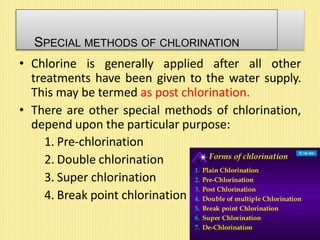
SPECIAL METHODS OF CHLORINATION
• Chlorine is generally applied after all other
treatments have been given to the water supply.
This may be termed as post chlorination.
• There are other special methods of chlorination,
depend upon the particular purpose:
1. Pre-chlorination
2. Double chlorination
3. Super chlorination
4. Break point chlorination
PRE-CHLORINATION
• Pre-chlorination is the application of chlorine
preceding filtration.
• Either added in to pipe lines or to water as it
enters in the mixing basin.
• Pre-chlorination reduces bacterial load on
filters and oxidising excessive organic matter
thus removing taste and odour.
DOUBLE CHLORINATION
• Double chlorination is the application of chlorine
at two points in the treatment process.
• It includes pre-chlorination before filtration and
post chlorination after filtration also.
• Advantage of double chlorination:
1. Decrease the load on filters
2. Greater efficiency in removal of bacteria
3. Control of algae and slimy growths in
clarifiers and filters
BREAK POINT CHLORINATION
• Also called as free-residual chlorination
• It involves the addition of sufficient chlorine to
oxidize all the organic matter.
• It reduces substances and free ammonia in
raw water.
• It leaves free residual chlorine which
possesses strong disinfecting action against
pathogens.
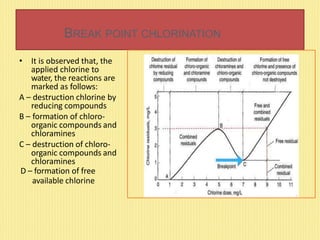
BREAK POINT CHLORINATION
• It is observed that, the
applied chlorine to
water, the reactions are
marked as follows:
A – destruction chlorine by
reducing compounds
B – formation of chloro-
organic compounds and
chloramines
C – destruction of chloro-
organic compounds and
chloramines
D – formation of free
available chlorine
BREAK POINT CHLORINATION
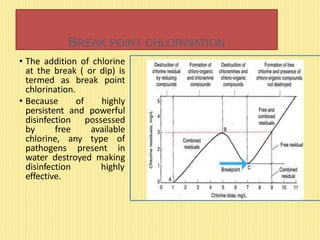
• The addition of chlorine
at the break ( or dip) is
termed as break point
chlorination.
• Because of highly
persistent and powerful
disinfection possessed
by free available
chlorine, any type of
pathogens present in
water destroyed making
disinfection highly
effective.

Disinfection&Chlorination

  • 1.
  • 2.
    DISINFECTION • The treatmentof water with chemicals to kill bacteria is called as disinfection. • Sterilization, is boiling of water before using for domestic purposes. • Boiling kills disease germs of cholera and typhoid within few minutes. • Chlorination, ozonization, ultra-violet ray method and application of silver, Iodine of Bromine method are the principal methods used for disinfection of water.
  • 3.
    DISINFECTING MATERIALS/ DISINFECTANTS • Thedisinfecting material should be harmless and unobjectionable to the consumer. • It should be able to retain residual disinfecting effect for a long period. • The common materials for disinfection are:  Chlorine  Ozone  Lime  Silver, Iodine and Bromine  Ultraviolet rays
  • 5.
    CHLORINATION • Chlorination isthe application of small quantities of chlorine or chlorine compounds to water. • The dose applied is generally less than 1 mg/lit. • The amount of chlorine required to be added depends upon the chlorine demand of water. • Chlorine demand is difference between the amount of chlorine added and the amount of chlorine remaining at the end of a contact period of a 10 – 20 minutes. • Chlorination possesses great disinfecting powers. • It is universally accepted method for public water supplies
  • 6.
    THEORY OF CHLORINATION •Chlorine hydrolyses in water to form hypochlorous acid (HOCl) and further produce hypochlorite ion (OCl). The HOCl and Ocl together are known as free available chlorine. • If Ammonia is also present in water, chlorine reacts to form chloramines (monochloromine, dichloramine and trichloramine). The chlorine existing in the form of chloramines is called as combined available chlorine. • These resulting chlorine compounds in water interfere with certain enzymes in the bacterial wall forming a toxic chloro-compounds thus destroying bacteria completely.
  • 7.
    THEORY OF CHLORINATION •The effect of chlorine as disinfectant depends on the contact period and the concentration of chlorine in water. • The killing power of disinfectant is proportional to the product of contact period and chlorine concentration. • The factors affecting chlorination are: 1. pH value of water 2. Water temperature 3. Residual chlorine in the form of free available or combined available chlorine
  • 8.
    CHARACTERISTICS OF CHLORINE Inthe application of chlorine to water, certain important characteristics of chlorine should be understood. • Greenish-yellow gas • 2.5 times heavier than air • When compressed chlorine gas liquifies • When liquid chlorine drawn from cylinder, it changes into gas and the temperature inside the cylinder falls.
  • 9.
    APPLICATION OF CHLORINE •Chlorine can be applied by any of the following methods: 1. As dry chlorine gas 2. As chlorine liquid/ solution 3. In powder form (bleaching powder/ sodium hypochlorites)
  • 10.
    METHOD-1 (AS DRYCHLORINE GAS) • As dry chlorine gas from the liquid chlorine cylinder, it is applied directly to water. • By supplying through submerged diffusers. • This method is unsatisfactory improper and • It caused corrosion to pipes. because of
  • 11.
    METHOD-2 (AS LIQUIDCHLORINE SOLUTION) • Liquid chlorine solution is prepared in a solution feed chlorinator, by mixing chlorine gas with a small quantity water. • The chlorine solution is applied to the water supply by using a water injector through a discharge pipe. • This method is commonly used in water works practice.
  • 12.
    METHOD-3 (IN POWDERFORM) • In powder form chlorine available as two forms as hypochlorites: 1. Bleaching powder – Ca(Ocl)2 2. Sodium hypochlorite – NaOCl • Hypochlorites are applied to water by using hypochlorite feeding apparatus. • Bleaching powder is not as stable as high strength hypochlorites. It loses strength on long storage or exposure.
  • 13.
    CHLORINE DOSAGE OFWATER • Too little chlorine is ineffective and too much chlorine cause taste and odours. • So the amount of chlorine required to be added should be determined. • It can be determined in the laboratory: by adding various doses of chlorine to equal proportions of water sample and finding the amount of residual after a period of contact of 10-20 minutes. • Chlorine demand is difference between the amount of chlorine added and the amount of chlorine remaining at the end of a contact period of a 10 – 20 minutes.
  • 14.
    CHLORINE DOSAGE OFWATER • The minimum dose giving a residual of 0.05 – 0.20 mg/l is generally selected. • Chlorine dosage can also be calculated with help of following formula: Dosage in kg. of chlorine = (volume of water in lit. X dosage in mg/l)/1,000,000
  • 15.
    SPECIAL METHODS OFCHLORINATION • Chlorine is generally applied after all other treatments have been given to the water supply. This may be termed as post chlorination. • There are other special methods of chlorination, depend upon the particular purpose: 1. Pre-chlorination 2. Double chlorination 3. Super chlorination 4. Break point chlorination
  • 16.
    PRE-CHLORINATION • Pre-chlorination isthe application of chlorine preceding filtration. • Either added in to pipe lines or to water as it enters in the mixing basin. • Pre-chlorination reduces bacterial load on filters and oxidising excessive organic matter thus removing taste and odour.
  • 17.
    DOUBLE CHLORINATION • Doublechlorination is the application of chlorine at two points in the treatment process. • It includes pre-chlorination before filtration and post chlorination after filtration also. • Advantage of double chlorination: 1. Decrease the load on filters 2. Greater efficiency in removal of bacteria 3. Control of algae and slimy growths in clarifiers and filters
  • 18.
    BREAK POINT CHLORINATION •Also called as free-residual chlorination • It involves the addition of sufficient chlorine to oxidize all the organic matter. • It reduces substances and free ammonia in raw water. • It leaves free residual chlorine which possesses strong disinfecting action against pathogens.
  • 19.
    BREAK POINT CHLORINATION •It is observed that, the applied chlorine to water, the reactions are marked as follows: A – destruction chlorine by reducing compounds B – formation of chloro- organic compounds and chloramines C – destruction of chloro- organic compounds and chloramines D – formation of free available chlorine
  • 20.
    BREAK POINT CHLORINATION •The addition of chlorine at the break ( or dip) is termed as break point chlorination. • Because of highly persistent and powerful disinfection possessed by free available chlorine, any type of pathogens present in water destroyed making disinfection highly effective.