Presented by:
MOOD NARESH
ASST.PROF
PETW
• Sewage consists of various residential, public
and industrial mixtures of wastewater, which
contain organic and inorganic materials in
dissolved or suspended or colloidal form as
well as various microorganisms useful and
harmful to human life.
• We need the characteristics and examination of
sewage before designing any sewage treatment
system to work efficiently.
• Sewage: It is the Liquid Waste or Wastewater
produced as a result of water use.
• Sewer: It is a pipe or conduit for carrying
sewage. It is generally closed and flow takes
place under gravity .
• Sewerage: Sewerage is the system of collection of
wastewater and conveying it to the point of disposal
with or without treatment.
waste water collection
1.Dometic: It is wastewater from houses offices,
other buildings, hotels and institutions
2.Industrial: It is the liquid waste from industrial
process
3.Storm-water: It includes surface run-off
generated by rainfall and the street wash
1. Collection System  Network of Sewer pipes
2. Disposal  Sewage Pumping Stations and
Outfalls
3.Treatment Works  Wastewater treatment
Plants
Fig: Components of Wastewater Engineering
1. Sanitary Sewer- It carries sanitary sewage like waste
from municipalities including domestic and industrial
waste-water
2. Storm Sewer-It carries storm sewage including surface
run-off and street wash
3. Combined Sewer- It carries domestic, industrial and
storm Sewage
4. House Sewer-It is the sewer conveying sewage from
plumbing system of a building to common municipal
system
5. Lateral Sewer- This sewer carries discharge from
houses sewer
6.Sub-main-This sewer receives discharge from two or
more laterals
7.Main/Trunk Sewer- Receives discharge from two or
more sub-mains
8.Outfall Sewer- It receives discharge from all
collecting system and conveys it to the point of final
disposal
Lateral
Main/Trunk
Sewer
Sub-main
sewer
Outfall sewer
House
Sewer
Fig: Types of Sewers
• 1. Separate System
If storm water is carried separately from domestic
and industrial wastewater the system is called as
separate system.
Separate systems are favored when
(i) There is an immediate need for collection of the
sanitary sewage but not for storm water.
(ii) When sanitary sewage needs treatment but the
storm water does not.
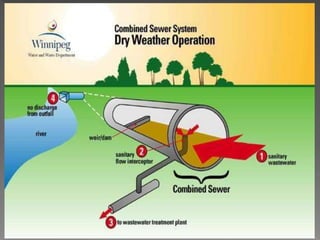
2. Combined System
It is the system in which the sewers carry both
sanitary and storm water, combined system is
favored when;
(i) Combined sewage can be disposed off without
treatment
(ii) Both sanitary and storm water need treatment
(iii) Streets are narrow and two separate sewer
cannot be laid
3. Partially Combined System
If some portion of storm or surface run-off is
allowed to be carried along with sanitary
sewage the system is known as partially
combined system.
(In Urban area of developing countries, mostly
partially combined system is employed as it is
economical)
In Pakistan we use this system
• The Characteristics of sewage arc classified as
follows:
1. Physical characteristics
2. Chemical characteristics and
3. Biological characteristics
A. Color :
Color is due to the suspended and other
matters found in wastewater.
If sewage is fresh it has a soap solution
color i.e grey-brown and decomposed sewage
has dark grey color.
B. Odour:
Fresh sewage is of soapy or oily
odour but stale sewage has offensive odour
due to H2S, CH4
• C. Temperature:
Generally sewage has slightly
higher temperature than the water which
increases the biological activities. 40 degree C.
D . Turbidity :
It is very turbid than water due
to the presence of high suspended and other
• Though sewerage typically contains lower than
zero to 0.5 % solids, the remainder being
water, still the nuisance caused by the solids
cannot be unnoted, as these solids are
extremely degradable and so want correct
disposal.
• The sewerage solids could also be classified
into dissolved solids, suspended solids and
volatile suspended solids.
• Data of the volatile or organic fraction of solid,
that decomposes, becomes necessary, as this
constitutes the load on biological treatment units
or resources of a stream once sewerage is
disposed off by dilution.
• The estimation of suspended solids, each organic
and inorganic, provides a general image of the
load on deposit and grit removal system
throughout sewerage treatment. Dissolved
inorganic fraction is to be thought-about once
sewerage is employed for land irrigation or the
other utilize is planned.
• Sewage contains complex compounds
derived from urine, faces, inorganic
chemicals etc.
• a. pH
• b. DO (Dissolved Oxygen)
• c. BOD (Biochemical Oxygen Demand)
• d. COD (Chemical Oxygen Demand)
• a. pH
• The hydrogen ion concentration expressed as
pH scale, could be a valuable parameter within
the operation of biological units.
• The pH scale of the contemporary sewerage is
slightly quite the water provided to the
community. However, decomposition of
organic matter might lower the pH scale,
whereas the presence of business waste
material might manufacture extreme
fluctuations typically the pH scale of raw
sewerage is within the vary 5 to 8.0.
• DO (Dissolved Oxygen):
It is the amount of oxygen dissolved in waste water.
Presence it indicates the sewage is fresh or oxidation
has been occurred after treatment. It is necessary to
ensure at least 4 ppm of DO in stream in which treated
wastewater is disposed otherwise fish are likely to be
killed.
• BOD (Biochemical Oxygen Demand)
BOD is defined as the amount of oxygen required for
the bacteria to oxidize the organic matter present in the
sewage.
BOD – 80 mg/L
• COD (Chemical Oxygen Demand)
• It is defined as the amount of oxygen required
for chemical oxidation of organic matters
readily oxidizable carbonaceous and other
matter.
• COD – 150 mg/L
• Domestic sewage consists of various types of
plant or animal microorganism and the biological
characteristic of sewage is related to the presence
of these microorganisms.
• This microorganism whose presence is 22 — 25
millions numbers in a liter of sewage may be
pathogenic, indicator organisms etc. The main
source of pathogenic microorganism is excreta
from sick people and these organisms require
living tissues to grow and reproduce and harmful
to man.
• (a)Aquatic plants
• (b)Aquatic animals
• (c)Aquatic mold (fungi), bacteria and virus.
• Aquatic Plants consists of waterweeds algae
etc.
• Aquatic animals consist of fish, snails,
amphibians insects, earth Worms, hydra etc.
• Aquatic mold (fungi), bacteria and virus are
also aquatic plant but categorized separately.
These are responsible for disease.
• The bacterium which needs free oxygen to
survive is called aerobic bacteria and which
survives
anaerobic
without
bacteria
free oxygen is called
and which survives in
presence or absence of free oxygen is called
facultative bacteria.
• The decomposition of sewage is possible due
to these bacteria.
THANKS!

characteristicsofsewagewastewatercollection-pptx

  • 1.
  • 9.
    • Sewage consistsof various residential, public and industrial mixtures of wastewater, which contain organic and inorganic materials in dissolved or suspended or colloidal form as well as various microorganisms useful and harmful to human life. • We need the characteristics and examination of sewage before designing any sewage treatment system to work efficiently.
  • 10.
    • Sewage: Itis the Liquid Waste or Wastewater produced as a result of water use. • Sewer: It is a pipe or conduit for carrying sewage. It is generally closed and flow takes place under gravity .
  • 11.
    • Sewerage: Sewerageis the system of collection of wastewater and conveying it to the point of disposal with or without treatment. waste water collection 1.Dometic: It is wastewater from houses offices, other buildings, hotels and institutions 2.Industrial: It is the liquid waste from industrial process 3.Storm-water: It includes surface run-off generated by rainfall and the street wash
  • 12.
    1. Collection System Network of Sewer pipes 2. Disposal  Sewage Pumping Stations and Outfalls 3.Treatment Works  Wastewater treatment Plants
  • 13.
    Fig: Components ofWastewater Engineering
  • 14.
    1. Sanitary Sewer-It carries sanitary sewage like waste from municipalities including domestic and industrial waste-water 2. Storm Sewer-It carries storm sewage including surface run-off and street wash 3. Combined Sewer- It carries domestic, industrial and storm Sewage 4. House Sewer-It is the sewer conveying sewage from plumbing system of a building to common municipal system 5. Lateral Sewer- This sewer carries discharge from houses sewer
  • 15.
    6.Sub-main-This sewer receivesdischarge from two or more laterals 7.Main/Trunk Sewer- Receives discharge from two or more sub-mains 8.Outfall Sewer- It receives discharge from all collecting system and conveys it to the point of final disposal
  • 16.
  • 17.
    • 1. SeparateSystem If storm water is carried separately from domestic and industrial wastewater the system is called as separate system. Separate systems are favored when (i) There is an immediate need for collection of the sanitary sewage but not for storm water. (ii) When sanitary sewage needs treatment but the storm water does not.
  • 20.
    2. Combined System Itis the system in which the sewers carry both sanitary and storm water, combined system is favored when; (i) Combined sewage can be disposed off without treatment (ii) Both sanitary and storm water need treatment (iii) Streets are narrow and two separate sewer cannot be laid
  • 22.
    3. Partially CombinedSystem If some portion of storm or surface run-off is allowed to be carried along with sanitary sewage the system is known as partially combined system. (In Urban area of developing countries, mostly partially combined system is employed as it is economical) In Pakistan we use this system
  • 24.
    • The Characteristicsof sewage arc classified as follows: 1. Physical characteristics 2. Chemical characteristics and 3. Biological characteristics
  • 26.
    A. Color : Coloris due to the suspended and other matters found in wastewater. If sewage is fresh it has a soap solution color i.e grey-brown and decomposed sewage has dark grey color. B. Odour: Fresh sewage is of soapy or oily odour but stale sewage has offensive odour due to H2S, CH4
  • 27.
    • C. Temperature: Generallysewage has slightly higher temperature than the water which increases the biological activities. 40 degree C. D . Turbidity : It is very turbid than water due to the presence of high suspended and other
  • 28.
    • Though seweragetypically contains lower than zero to 0.5 % solids, the remainder being water, still the nuisance caused by the solids cannot be unnoted, as these solids are extremely degradable and so want correct disposal. • The sewerage solids could also be classified into dissolved solids, suspended solids and volatile suspended solids.
  • 29.
    • Data ofthe volatile or organic fraction of solid, that decomposes, becomes necessary, as this constitutes the load on biological treatment units or resources of a stream once sewerage is disposed off by dilution. • The estimation of suspended solids, each organic and inorganic, provides a general image of the load on deposit and grit removal system throughout sewerage treatment. Dissolved inorganic fraction is to be thought-about once sewerage is employed for land irrigation or the other utilize is planned.
  • 30.
    • Sewage containscomplex compounds derived from urine, faces, inorganic chemicals etc. • a. pH • b. DO (Dissolved Oxygen) • c. BOD (Biochemical Oxygen Demand) • d. COD (Chemical Oxygen Demand)
  • 31.
    • a. pH •The hydrogen ion concentration expressed as pH scale, could be a valuable parameter within the operation of biological units. • The pH scale of the contemporary sewerage is slightly quite the water provided to the community. However, decomposition of organic matter might lower the pH scale, whereas the presence of business waste material might manufacture extreme fluctuations typically the pH scale of raw sewerage is within the vary 5 to 8.0.
  • 32.
    • DO (DissolvedOxygen): It is the amount of oxygen dissolved in waste water. Presence it indicates the sewage is fresh or oxidation has been occurred after treatment. It is necessary to ensure at least 4 ppm of DO in stream in which treated wastewater is disposed otherwise fish are likely to be killed. • BOD (Biochemical Oxygen Demand) BOD is defined as the amount of oxygen required for the bacteria to oxidize the organic matter present in the sewage. BOD – 80 mg/L
  • 33.
    • COD (ChemicalOxygen Demand) • It is defined as the amount of oxygen required for chemical oxidation of organic matters readily oxidizable carbonaceous and other matter. • COD – 150 mg/L
  • 35.
    • Domestic sewageconsists of various types of plant or animal microorganism and the biological characteristic of sewage is related to the presence of these microorganisms. • This microorganism whose presence is 22 — 25 millions numbers in a liter of sewage may be pathogenic, indicator organisms etc. The main source of pathogenic microorganism is excreta from sick people and these organisms require living tissues to grow and reproduce and harmful to man.
  • 36.
    • (a)Aquatic plants •(b)Aquatic animals • (c)Aquatic mold (fungi), bacteria and virus.
  • 37.
    • Aquatic Plantsconsists of waterweeds algae etc. • Aquatic animals consist of fish, snails, amphibians insects, earth Worms, hydra etc. • Aquatic mold (fungi), bacteria and virus are also aquatic plant but categorized separately. These are responsible for disease.
  • 38.
    • The bacteriumwhich needs free oxygen to survive is called aerobic bacteria and which survives anaerobic without bacteria free oxygen is called and which survives in presence or absence of free oxygen is called facultative bacteria. • The decomposition of sewage is possible due to these bacteria.
  • 39.