Why Disinfection???
 In the water treatment processes like sedimentation,
coagulation, filtration, etc considered so far, all the bacteria from
the water can not be removed.
 This bacteria may lead to spread many diseases and their
epidemics , thus causing disasters to public life.
 The presence of turbidities, color, or minerals etc may not be
dangerous , but presence of even a single harmful organism will
definitely prove dangerous.
 Hence disinfection is an essential minimum treatment
requirement for any drinking water.
 Sterilization: In sterilization process , all organisms
are usually killed by a physical phenomenon such as boiling
for long period .
 Disinfection: In disinfection disease or illness causing
micro-organisms are reduced to such a level that no
infection or disease results when water is used for domestic
purposes including drinking water.
 Chemicals used for killing these bacteria
are known as disinfectants.
Sterilization vs. Disinfection
 The requirement of good
disinfectants may be:
•. They should be able to kill all pathogenic germs within
required time at normal temperature.
•They should be economical and easily available.
• After their treatment , the water should not become
objectionable and toxic to the consumer.
•The disinfectant dose should be such that, it may leave
some concentration for protection against future contamination
Of water.
Methods of Disinfection:
1. Boiling:
• Bacteria can be destroyed by boiling it for long period.
• It is an effective method but practically not possible to boil huge
amount of public water supply.
• It can only kill the existing germs but cannot take care of future
contamination.
2. Treatment with excess lime:
• It increases the pH of water making it extremely alkaline. This
extreme alkalinity has been detrimental to the survival of
bacteria, thus killing them partially or completely.
• Treatment like recarbonation for removal of excess lime after
disinfection.
• It does not ensure safety against future contamination.
3. Treatment with ozone:
• Unstable allotropic of oxygen , and readily breaks into normal
oxygen and release nascent oxygen.
• This nascent oxygen is powerful oxidizing agent and remove the
bacteria and organic matter from water and also remove color,
taste, odour from the water.
•This is very costly, required electricity for the formation of ozone
and does not ensure safety against future contamination.
4. Treatment with ultra-violet rays:
• Invisible rays having wavelength of 1000-4000 mu.
• These rays highly effective in killing all types of bacteria , thus
producing a truly sterilized water.
• This method is very costly and needs technical know-how.
5. Treatment with potassium permanganate:
• A popular disinfectant for disinfecting well water supplies in villages.
• The addition of potassium permanganate to water, produces pink
color.
• However , if pink color disappears, it shows that that is organic
matter is present in water.
• More quantity of potassium permanganate should be added, until
the pink color stands.
• Does not remover 100% bacteria from water.
6. Chlorination:
• Most commonly used disinfectant because:
a. It is cheap, reliable, easy to handle, easily measurable.
b. It is capable of proving residual disinfecting effect for long periods,
thus proving complete protection against future contamination.
Chlorine Chemistry
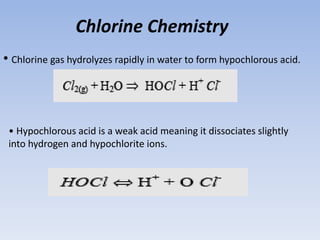
• Chlorine gas hydrolyzes rapidly in water to form hypochlorous acid.
• Hypochlorous acid is a weak acid meaning it dissociates slightly
into hydrogen and hypochlorite ions.
• Between a pH of 6.5 and 8.5 this dissociation is
incomplete and both HOCl and OCl- species are
present to some extent. Below a pH of 6.5, no
dissociation of HOCl occurs, while above a pH of 8.5,
complete dissociation to OCl- occurs.
• As the germicidal effects of HOCl is much higher than
that of OCl-, chlorination at a lower pH is preferred.
Various forms in which chlorine can be
applied:
1. Use of chlorine as liquid or chlorine gas:
• The molecular chlorine (cl2) can be carried and applied to the
water to be treated either in a liquid form or in gaseous form.
• The gaseous form of chlorine gets converted into liquid form,
when subjected to a pressure of about 700kN/m2.
• The liquid chlorine is kept in steel cylinder under a pressure of
700-1000 KN/m2. When required for use , the pressure is released
and liquid chlorine get converted into gas, which escapes out of
cylinder and dissolved into water to make a solution in the
chlorinator.
• Supply cylinder is generally kept at about 38-42 degree to
prevent the freezing of liquid chlorine in cylinder.
2. Use of Hypochlorite and bleaching powder:
• Calcium and sodium hypochlorite may be used for disinfecting small
public supplies.
• This process is know as hypochlorination.
3. Use of chlorine-dioxide gas:
• Chlorine dioxide is very effective and powerful disinfectant, about 2.5
times stronger than chlorine but this chlorine dioxide gas is costly and
unstable and has to be immediately after its production. For these
reasons it is generally not used for treating ordinary public supplies.
DISINFECTANT DEMAND REACTIONS
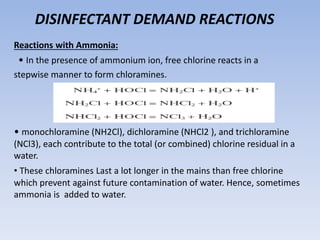
Reactions with Ammonia:
• In the presence of ammonium ion, free chlorine reacts in a
stepwise manner to form chloramines.
• monochloramine (NH2Cl), dichloramine (NHCl2 ), and trichloramine
(NCl3), each contribute to the total (or combined) chlorine residual in a
water.
• These chloramines Last a lot longer in the mains than free chlorine
which prevent against future contamination of water. Hence, sometimes
ammonia is added to water.
pH Effect on Chlorine
• Chlorine is a more effective disinfectant at pH levels between
6.0 and 7.0, because hypochlorous acid is maximized at these pH levels
• Any attempt to disinfect water with a pH greater than 9 to 10 or more
will not be very effective
• Controlling the pH of the water in the aquifer is not practical. However
buffering or pH-altering agents may be used to control pH in the chlorine
solution.
 Temperature Effect on Chlorine
• As temperatures increase, the metabolism rate of
microorganisms increases.
• With the higher metabolic rate, the chlorine is taken into
the microbial cell faster, and its bactericidal effect is
significantly increased.
• The higher the temperature the more likely the disinfection will produce
the desired results. being placed in the well.
Contact time:
• Time is required in order that any pathogens present in the
water are inactivated.
• The time taken for different types of microbes to be killed varies
widely.
• it is important to ensure that adequate contact time is available
before water enters a distribution system or is collected for use.
Germicidal Efficiency of Chlorine:
• The major factors affecting the germicidal efficiency of the free
chlorine residual process are: chlorine residual concentration
,contact time , pH , water temperature.
• Increasing the chlorine residual, the contact time, or the water
temperature increases the germicidal efficiency. Increasing
the pH above 7.5 drastically decreases the germicidal efficiency of
free chlorine.
Chlorine residual:
•Chlorine persists in water as ‘residual’ chlorine after dosing and
this helps to minimize the effects of re-contamination by
inactivating microbes which may enter the water supply after
chlorination. It is important to take this into account when
estimating requirements for chlorination to ensure residual
Chlorine.
•The level of chlorine residual required varies with type of
water supply and local conditions.
• Varies from 0.2-0.5 mg/l.
Combined Chlorine:
•Free chlorine that has combined with ammonia (NH3) or
other nitrogen-containing organic substances.
•Typically, chloramines are formed .
Can we have too much Chlorine?
1. Chlorine is a health concern at certain levels of exposure.
2. Drinking water containing chlorine well in excess of
drinking water standards could cause irritating effects to eyes
and nose.
3. Some people who drink water containing chlorine well in
excess of standards could experience stomach discomfort.
4. Drinking water standards for chlorine protect against the risk
of these adverse effects.
5. Little or no risk with drinking water that meets the drinking
water standard level and should be considered safe with
respect to chlorine
Special Methods of Chlorination
1.Post-chlorination:
• When chlorine is added in the water after all treatments, it is
known as post chlorination, it is generally done after filtration. The
chlorine is commonly added in the clear water reservoir. The
minimum contact period should be 30 min, before use of water.
2. Plain chlorination
• When only chlorine treatment is given to raw water, the process is
called plain chlorination. The amount of chlorine required is 0.5 mg/l.
3.Prechlorination:
• It is the application of chlorine before filtration. It may be added in
the suction pipes or in the mixing basins.
• It reduces bacterial load on filters, this results increased filter runs
and oxidizes excessive organic matter. This helps in removing taste
and odor and makes the water fit for use.
4.Super-chlorination:
• It is application of excessive amount of chlorine to water. The
amount of chlorine may vary from 5 to 15 mg/l of water. This is
not ordinarily employed but is practiced only during the
epidemics of waterborne diseases.
5.Double-chlorination:
• It is application of chlorine at two points in the treatment
process. It is also prechlorination with an added treatment to the
final effluent from the filters.
6.Break-point chlorination:
• This term gives an idea of the extent of chlorine added to water.
• It represents a dose of chlorination beyond which any further
addition of chlorine will appear as free residual chlorine.
7.Dechlorination:
• The process of removing excess chlorine from water.
• It is done in such a way that some residual chlorine remains in
water. Dechlorinating agents or chemicals used are:
– Potassium permanganate
– Sodium bisulphate
– Sodium thiosulphate
– Sodium sulphite
– Sulphur dioxide etc.
CHLORINATION BY-PRODUCTS
• By-products created from the reactions between inorganic
compounds and chlorine are harmless and can be easily removed
by filtration.
• Other by-products such as chloramines are beneficial to
disinfection process.
• Other by-products are:
1. TRIHALOMETHANES:
•Formed by reaction between chlorine and organic material such
as humic acid and fulvic acid to create halogenated organics.
• Trihalomethanes are carcinogenic.
• The trihalomethane of most concern is chloroform.
• Chronic exposure may cause damage to liver and kidneys.
2. TRICHLOROACETIC ACID:
• Produced commercially for use as a herbicide and is also
produced in drinking water.
3. DICHLOROACETIC ACID:
• It is an irritant ,corrosive and destructive against mucous
membrane.
4. HALOACETONITRILES
• Used as pesticide in the past ,but no longer manufactured.
• They are produced as a result of reaction
between chlorine ,natural organic matter and
bromide.
5. CHLOROPHENOLS
•Cause taste and odor problems.
• They are toxic when present in higher concentrations.
• Affect the respiration and energy storage process in the body.

Ee ppt

  • 2.
    Why Disinfection???  Inthe water treatment processes like sedimentation, coagulation, filtration, etc considered so far, all the bacteria from the water can not be removed.  This bacteria may lead to spread many diseases and their epidemics , thus causing disasters to public life.  The presence of turbidities, color, or minerals etc may not be dangerous , but presence of even a single harmful organism will definitely prove dangerous.  Hence disinfection is an essential minimum treatment requirement for any drinking water.
  • 3.
     Sterilization: Insterilization process , all organisms are usually killed by a physical phenomenon such as boiling for long period .  Disinfection: In disinfection disease or illness causing micro-organisms are reduced to such a level that no infection or disease results when water is used for domestic purposes including drinking water.  Chemicals used for killing these bacteria are known as disinfectants. Sterilization vs. Disinfection
  • 4.
     The requirementof good disinfectants may be: •. They should be able to kill all pathogenic germs within required time at normal temperature. •They should be economical and easily available. • After their treatment , the water should not become objectionable and toxic to the consumer. •The disinfectant dose should be such that, it may leave some concentration for protection against future contamination Of water.
  • 5.
    Methods of Disinfection: 1.Boiling: • Bacteria can be destroyed by boiling it for long period. • It is an effective method but practically not possible to boil huge amount of public water supply. • It can only kill the existing germs but cannot take care of future contamination. 2. Treatment with excess lime: • It increases the pH of water making it extremely alkaline. This extreme alkalinity has been detrimental to the survival of bacteria, thus killing them partially or completely. • Treatment like recarbonation for removal of excess lime after disinfection. • It does not ensure safety against future contamination.
  • 6.
    3. Treatment withozone: • Unstable allotropic of oxygen , and readily breaks into normal oxygen and release nascent oxygen. • This nascent oxygen is powerful oxidizing agent and remove the bacteria and organic matter from water and also remove color, taste, odour from the water. •This is very costly, required electricity for the formation of ozone and does not ensure safety against future contamination. 4. Treatment with ultra-violet rays: • Invisible rays having wavelength of 1000-4000 mu. • These rays highly effective in killing all types of bacteria , thus producing a truly sterilized water. • This method is very costly and needs technical know-how.
  • 7.
    5. Treatment withpotassium permanganate: • A popular disinfectant for disinfecting well water supplies in villages. • The addition of potassium permanganate to water, produces pink color. • However , if pink color disappears, it shows that that is organic matter is present in water. • More quantity of potassium permanganate should be added, until the pink color stands. • Does not remover 100% bacteria from water. 6. Chlorination: • Most commonly used disinfectant because: a. It is cheap, reliable, easy to handle, easily measurable. b. It is capable of proving residual disinfecting effect for long periods, thus proving complete protection against future contamination.
  • 8.
    Chlorine Chemistry • Chlorinegas hydrolyzes rapidly in water to form hypochlorous acid. • Hypochlorous acid is a weak acid meaning it dissociates slightly into hydrogen and hypochlorite ions.
  • 9.
    • Between apH of 6.5 and 8.5 this dissociation is incomplete and both HOCl and OCl- species are present to some extent. Below a pH of 6.5, no dissociation of HOCl occurs, while above a pH of 8.5, complete dissociation to OCl- occurs. • As the germicidal effects of HOCl is much higher than that of OCl-, chlorination at a lower pH is preferred.
  • 10.
    Various forms inwhich chlorine can be applied: 1. Use of chlorine as liquid or chlorine gas: • The molecular chlorine (cl2) can be carried and applied to the water to be treated either in a liquid form or in gaseous form. • The gaseous form of chlorine gets converted into liquid form, when subjected to a pressure of about 700kN/m2. • The liquid chlorine is kept in steel cylinder under a pressure of 700-1000 KN/m2. When required for use , the pressure is released and liquid chlorine get converted into gas, which escapes out of cylinder and dissolved into water to make a solution in the chlorinator. • Supply cylinder is generally kept at about 38-42 degree to prevent the freezing of liquid chlorine in cylinder.
  • 11.
    2. Use ofHypochlorite and bleaching powder: • Calcium and sodium hypochlorite may be used for disinfecting small public supplies. • This process is know as hypochlorination. 3. Use of chlorine-dioxide gas: • Chlorine dioxide is very effective and powerful disinfectant, about 2.5 times stronger than chlorine but this chlorine dioxide gas is costly and unstable and has to be immediately after its production. For these reasons it is generally not used for treating ordinary public supplies.
  • 12.
    DISINFECTANT DEMAND REACTIONS Reactionswith Ammonia: • In the presence of ammonium ion, free chlorine reacts in a stepwise manner to form chloramines. • monochloramine (NH2Cl), dichloramine (NHCl2 ), and trichloramine (NCl3), each contribute to the total (or combined) chlorine residual in a water. • These chloramines Last a lot longer in the mains than free chlorine which prevent against future contamination of water. Hence, sometimes ammonia is added to water.
  • 13.
    pH Effect onChlorine • Chlorine is a more effective disinfectant at pH levels between 6.0 and 7.0, because hypochlorous acid is maximized at these pH levels • Any attempt to disinfect water with a pH greater than 9 to 10 or more will not be very effective • Controlling the pH of the water in the aquifer is not practical. However buffering or pH-altering agents may be used to control pH in the chlorine solution.  Temperature Effect on Chlorine • As temperatures increase, the metabolism rate of microorganisms increases. • With the higher metabolic rate, the chlorine is taken into the microbial cell faster, and its bactericidal effect is significantly increased. • The higher the temperature the more likely the disinfection will produce the desired results. being placed in the well.
  • 14.
    Contact time: • Timeis required in order that any pathogens present in the water are inactivated. • The time taken for different types of microbes to be killed varies widely. • it is important to ensure that adequate contact time is available before water enters a distribution system or is collected for use. Germicidal Efficiency of Chlorine: • The major factors affecting the germicidal efficiency of the free chlorine residual process are: chlorine residual concentration ,contact time , pH , water temperature. • Increasing the chlorine residual, the contact time, or the water temperature increases the germicidal efficiency. Increasing the pH above 7.5 drastically decreases the germicidal efficiency of free chlorine.
  • 15.
    Chlorine residual: •Chlorine persistsin water as ‘residual’ chlorine after dosing and this helps to minimize the effects of re-contamination by inactivating microbes which may enter the water supply after chlorination. It is important to take this into account when estimating requirements for chlorination to ensure residual Chlorine. •The level of chlorine residual required varies with type of water supply and local conditions. • Varies from 0.2-0.5 mg/l. Combined Chlorine: •Free chlorine that has combined with ammonia (NH3) or other nitrogen-containing organic substances. •Typically, chloramines are formed .
  • 16.
    Can we havetoo much Chlorine? 1. Chlorine is a health concern at certain levels of exposure. 2. Drinking water containing chlorine well in excess of drinking water standards could cause irritating effects to eyes and nose. 3. Some people who drink water containing chlorine well in excess of standards could experience stomach discomfort. 4. Drinking water standards for chlorine protect against the risk of these adverse effects. 5. Little or no risk with drinking water that meets the drinking water standard level and should be considered safe with respect to chlorine
  • 17.
    Special Methods ofChlorination 1.Post-chlorination: • When chlorine is added in the water after all treatments, it is known as post chlorination, it is generally done after filtration. The chlorine is commonly added in the clear water reservoir. The minimum contact period should be 30 min, before use of water. 2. Plain chlorination • When only chlorine treatment is given to raw water, the process is called plain chlorination. The amount of chlorine required is 0.5 mg/l. 3.Prechlorination: • It is the application of chlorine before filtration. It may be added in the suction pipes or in the mixing basins. • It reduces bacterial load on filters, this results increased filter runs and oxidizes excessive organic matter. This helps in removing taste and odor and makes the water fit for use.
  • 18.
    4.Super-chlorination: • It isapplication of excessive amount of chlorine to water. The amount of chlorine may vary from 5 to 15 mg/l of water. This is not ordinarily employed but is practiced only during the epidemics of waterborne diseases. 5.Double-chlorination: • It is application of chlorine at two points in the treatment process. It is also prechlorination with an added treatment to the final effluent from the filters. 6.Break-point chlorination: • This term gives an idea of the extent of chlorine added to water. • It represents a dose of chlorination beyond which any further addition of chlorine will appear as free residual chlorine.
  • 19.
    7.Dechlorination: • The processof removing excess chlorine from water. • It is done in such a way that some residual chlorine remains in water. Dechlorinating agents or chemicals used are: – Potassium permanganate – Sodium bisulphate – Sodium thiosulphate – Sodium sulphite – Sulphur dioxide etc.
  • 20.
    CHLORINATION BY-PRODUCTS • By-productscreated from the reactions between inorganic compounds and chlorine are harmless and can be easily removed by filtration. • Other by-products such as chloramines are beneficial to disinfection process. • Other by-products are: 1. TRIHALOMETHANES: •Formed by reaction between chlorine and organic material such as humic acid and fulvic acid to create halogenated organics. • Trihalomethanes are carcinogenic. • The trihalomethane of most concern is chloroform. • Chronic exposure may cause damage to liver and kidneys.
  • 21.
    2. TRICHLOROACETIC ACID: •Produced commercially for use as a herbicide and is also produced in drinking water. 3. DICHLOROACETIC ACID: • It is an irritant ,corrosive and destructive against mucous membrane. 4. HALOACETONITRILES • Used as pesticide in the past ,but no longer manufactured. • They are produced as a result of reaction between chlorine ,natural organic matter and bromide. 5. CHLOROPHENOLS •Cause taste and odor problems. • They are toxic when present in higher concentrations. • Affect the respiration and energy storage process in the body.