CHEMICAL TREATMENT- DISINFESTATION
College of Horticulture ,
VCSG Uttarakhand University of Horticulture and Forestry ,Bharsar ,Pauri Garhwal
Course Title:- Post Harvest Technology Horticultural Crops.
Course No.:- HPT 102
Submitted to:- Submitted by:-
Ms Neha Rawat Vikas Tiwari (16031)
CHEMICAL TREATMENT-DISINFESTATION
Succulent nature of fruits and vegetables make them easily invaded by these organisms. The
common pathogens causing rots in fruits and vegetables are fungi such as Alternaria,
Botrytis, Diplodia, Phomopsis, Rhizopus, Pencillium and Fusarium and among bacteria,
Erwinia and Pseudomonas cause extensive damage.
Losses from post-harvest disease in fresh produce can be both quantitative and qualitative.
Loss in quantity occurs where deep penetration of decay makes the infected produce
unusable. Loss in quality occurs when the disease affects only the surface of produce causing
skin blemishes that can lower the commercial value of a crop.
DISINFESTATION
Post harvest diseases of fruits, vegetables and flowers are caused by fungi and bacteria but
viruses are rare. These exist either as parasite (on living matter) or saprophytes (dead
produce). Most fungi require acidic pH (2.5 – 6) condition in which they grow and develop,
while bacteria thrive best at neutral and few can grow at levels below pH 4.5. Bacteria
therefore don’t usually infect fruits, normally but only vegetables and flowers.
Chlorine and sulfur dioxide are most widely used chemicals. Chlorine is probably the most
widely used sanitizer. It is used in concentrations from 50 to 200 ppm in water to reduce the
number of microorganisms present on the surface of the fruit. However, it does not stop the
growth of a pathogen already established.
Mode of infection of micro organism
Fungal and bacterial infection can occur through mechanical injuries and cut surfaces of the
crop, growth cracks and pest damage. They also infect through natural opening on the surface
of the crop such as stomata, lenticels, cuticles and hydrathodes. Most fungi are able to
penetrate the intact healthy skin of the fruits and vegetables. Many pathogens remain dormant
on the surface of the produce for many weeks before visible symptoms of the infection occur.
Damage by micro organism
It mainly causes physical loss of the edible matter, which may be partial or total. Also affects
marketability, particularly where mold growth is obvious on the produce surface. In some
cases the superficial infection also make the produce either entirely unmarketable or at least
reduce its economic value.
Example: Fungi Aspergillus flavus and A. parasitica which produce aflatoxin like mycotoxin
on ground nut kernels, coconut, dry beans and some leafy foods. The apples juice is also
affected by mycotoxin "patulin" produced by Penicillium patulum and P. expansum,
P.urticae, Aspergillus clavatus when stored for too long before being processed. This
mycotoxin is carcinogenic and has maximum permitted levels of 50 ppb in fruit juices.
Disinfestationmethods
Field management
Growing fruits and vegetable adopting scientific standard and
recommended practices can reduce the field inoculum of disease causing pathogens.
Adopting standard cultural practices in terms of sanitation, proper nutrition, irrigation and
appropriate harvesting time and methods, etc. are known to reduce post harvest diseases. Use
of wind breaks can reduce spread of field infection where wind is the carrier of pathogen.
Other practices like cultivation of crops in regions free from diseases, cultivation of disease
resistant cultivars, care in harvesting and handling to avoid wounding fruit, fruit bagging for
reducing surface wetness and deposition of inoculum will all help in reducing post harvest
diseases.
Pre-harvest spraying: Field sprays with fungicides are known to prevent spore
germination and the formation of deep seated infections in the lenticels or in the floral
remains of the fruits.
Post harvest chemical treatments: Post harvest treatments with fungicides like
Thiobendazole and Benomyl have rendered good control of stem end rot in many citrus
fruits, anthracnose of banana and mangoes despite the fact that infection occurred long before
the treatment was applied.
Safer and less toxic chemicals grouped under the category of GRAS (generally regarded as
safe) can be used for the control of post harvest diseases of fruit and vegetables. These
compounds mostly include week organic acids, inorganic salts and neutralized compounds. It
has been reported that extracts of Eucalyptus globula, Punica granatum, Lawsonia inumis,
Datura stramonium and Ocimum sp. extracts are effective against various fruits rots. Some
vegetable and other oils are also effective against fruit rots. Mustard, castor and paraffin oils
have been found effective against Rhizopus rot of mango.
Disinfection of all handling equipment in pack-houses with 1-3% formaldehyde solution,
hypochlorite or SOPP (Sodium ortho phenylphenate) will help in prevention of secondary
infection. Washing with water alone reduces many disease of fruits and vegetables.
Methods of Chemical Application
1. Dipping – for effective control of diseases chemical may be used with hot water at 550C
for about 10 min. The crop may be passed below shower of the diluted chemicals. This is
called ‘cascade’ application. Use of chemical like citric acid to lower the pH of the solution
along with fungicides seems more effective.
In pineapple, infection occur commonly through the cut fruit stalk, therefore dipping cut end
was found sufficient to control the disease, save pesticides solution and lower residues on the
fruits.
Eg. Citrus, apples, pineapple, root vegetables.
2. Spraying - Spraying is more effective than dipping, because fungicide effectiveness is
reduced if the crop has been washed and is still wet and many pesticide chemicals are
formulated so that they are not in a solution , but rather in a fine suspension. This results in a
concentration gradient in the tank between top(less concentration) and bottom (more) of the
tank unless suspension frequently agitated.
Eg. Citrus, apple
3. Electrostatic Sprays / Thin film of Coating – breaking up the pesticides solution into fine
droplet and then giving them an electric charge to obtain uniformity of application. Principle
is that the particle all have the same electrical charges hence, thus repel each other. These
charges are attracted toward the crop and form uniform coating on the produce.
Eg.: Potato and crown rot of banana
4. Dusting – with wood ash and lime in case of yam. Fungicides along with talc on potato.
5. Fumigation / Vapour treatment – Fumigation is to eliminate insects, either adults, eggs,
larvae or pupae and pathogen inoculum. Fumigant such as sulphur dioxide (SO2) is used for
controlling post harvest disease in grapes. This is achieved by placing the boxes of fruit in a
gastight room and introducing the gas from the cylinder to the appropriate concentration. This
treatment results in a residue of 5-18 ppm SO2 in the grapes is sufficient to control decay. Its
toxicity to Botrytis cinerea was found to be proportional to temperature over the range of 0-
300C, where the toxicity of SO2 increased about 1 ½ times for every 100C rise in temperature.
In general treatment with 0.5- 1% SO2 for 20 min is found to be effective fallowed by
ventilation. During storage, periodic (every 7-10 days) fumigations are performed in
concentrations of 0.25%.
Disadvantages:-
SO2 can be corrosive, especially to metals, because it combines with atmospheric
moisture to form sulphurous acids. Hence, special sodium met bisulphate
impregnated pads are available which can be packed into individual boxes of fruits to
gives a slow releases of SO2. Eg.: Grape guard used in grapes fruit packing.
b. At higher concentration it has bleaching effects on black grapes.
c. Some people are allergic to SO2, particularly those who have chronic respiratory
problems.
Litchi fruits - SO2 fumigation at 1.2% for 10 min. is used to prevent discolouration of the
skins of fresh litchi fruits caused by fungal infection, followed by 2 min. dip in 1 N HCL
stabilizes the red colour and reduces the skin browning.
Snap beans - Exposing the beans to SO2 at 0.7% for 30 seconds reduced the broken end
discoloration
due to mechanical injury.
Other chemicals -
Acetaldehydes fumigation in Sultana grapes @500 ppm for 24hr. control postharvest
diseases.
Paper pad impregnated with diphenyl fungicides are commonly applied to citrus fruit.
Tecnzane, 2-aminobutane(potato) and 2-AB (orange) are the chemicals used.
Fumigation with gaseous sterilants is the most effective techniques for disinfesting produce.
However, these are becoming increasingly unpopular or banned because of high mammalian
toxicity (hydrogen disulphide), flammability (carbon disulphide) and damage to the
atmospheric ozone layer (methyl bromide).
Fumigation with methyl bromide has been replaced by temperature (high and low)
treatments, controlled atmosphere, other fumigants or irradiation.
5. Absorbent paper – chemical may be absorbed into a pad made of suitable material like
paper. This absorbent pad soaked in fungicides like thiabendazole and dried, is placed over
cut surfaces, such as cut crown end to control the crown end rot of banana. Here pad absorbs
latex from the cut surfaces, which also helps to keep the pad in the position and prevents
staining the banana. Potassium aluminum sulphate may be added to the pads, which helps to
coagulate the latex. This method is used when banana is dehanded in the field and packed
directly into export cartoon, where no washing, spraying or dipping take place. Insecticides
like dichlorovos has limited vapour phase activity, therefore dichlorovos based pest strip
have been included in cartoon packed with flowers to effects ongoing disinfestations during
export.
6. Cold storage – many insect pests do not tolerate prolonged exposure to low temperature.
Storing the produce at <1.60C for 16 days has been shown to be effective for disinfesting
fruits against Mediterranean and Queensland fruit fly. But chilling susceptible fruits are not
suitable for the this method
7. High temperature – Heat treatments like hot water dips or exposure to hot air or vapor is
employed for insect control (and for fungi, in some cases). Using high temperature of about
40-550C for about 15 minutes can be easily disinfected. Generally, high temperatures can
cause softening of tissues and promote bacterial diseases.
Dipping temperature depends on commodity, insect to be controlled and its degree of
development.
Dipping in hot water also contributes to reduced microbial load in plums, peaches,
papaya, cantaloupes, sweet potato and tomato but does not always guarantee good insect
control.
Heat treatments is reconsidered as quarantine treatments in fruits such as mango, papaya,
citrus, bananas, carambola and vegetables like pepper, eggplant, tomato, cucumber and
zucchinis.
Temperature, exposure and application methods are commodity specific and must be
carried out precisely in order to avoid heat injuries, particularly in highly perishable
crops. On completion of treatment, it is important to reduce temperature to recommended
levels for storage and/or transport.
Many tropical crops are exposed to hot and humid air (40-50 °C up to 8 hours) or water
vapor to reach a pulp temperature which is lethal to insects. Hot air is well tolerated by
mango, grapefruit, Navel oranges, carambola, persimmon and papaya. Similarly, vapor
treatments have been used for grapefruits, oranges, mango, pepper, eggplant, papaya,
pineapple, tomatoes and zucchinis.
A common mango fruits disease, anthracnose can be successfully controlled by dipping at
550C for about 5 min.
8. Biological control –
The yeast Candida guilliermondii is used against Penicillium spp. incorporated into
citrus waxes
Bacillus subtilis is used against mango anthracnose and stem end rot.
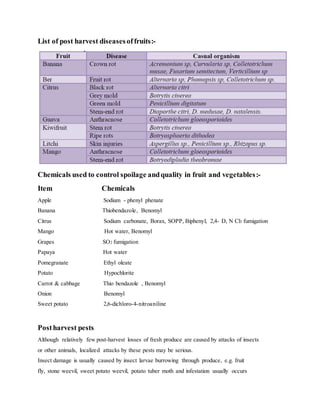
List of post harvest diseasesoffruits:-
Chemicals used to control spoilage andquality in fruit and vegetables:-
Item Chemicals
Apple Sodium - phenyl phenate
Banana Thiobendazole, Benomyl
Citrus Sodium carbonate, Borax, SOPP, Biphenyl, 2,4- D, N Cl3 fumigation
Mango Hot water, Benomyl
Grapes SO2 fumigation
Papaya Hot water
Pomegranate Ethyl oleate
Potato Hypochlorite
Carrot & cabbage Thio bendazole , Benomyl
Onion Benomyl
Sweet potato 2,6-dichloro-4-nitroaniline
Postharvest pests
Although relatively few post-harvest losses of fresh produce are caused by attacks of insects
or other animals, localized attacks by these pests may be serious.
Insect damage is usually caused by insect larvae burrowing through produce, e.g. fruit
fly, stone weevil, sweet potato weevil, potato tuber moth and infestation usually occurs
before harvest.
Rats, mice and other animal pests again are sometimes a problem when produce is stored
on the farm.
Almost all post harvest pests originate from field infestations. Wounds and punctures caused
by insect pests not only adversely affect visual quality but also serve as entry points for
pathogens, leading to secondary infection and spoilage.
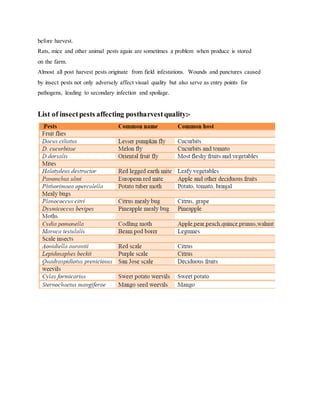
List of insectpests affecting postharvestquality:-
Reference:-
e-course of PostHarvest Technology of Horticultural Crops.