Student Information Skills How Can the Library Help? Dana Longley, Manager of Library Services
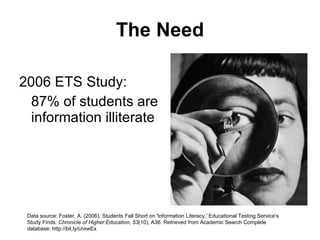
The Need 87% of students are “information illiterate”  1 89% use search engines to start research  (2% use library web site)  2 Foster, A. (2006). Students Fall Short on 'Information Literacy,' Educational Testing Service's Study Finds.  Chronicle of Higher Education ,  53 (10), A36. Retrieved from Academic Search Complete database: http://bit.ly/cnxwEx  College Students’ Perceptions of the Libraries and Information Resources: A Report to the OCLC Membership. Dublin, OH: OCLC, 2006: http://www.oclc.org/reports/perceptionscollege.htm
Student Research Behavior Primary student sources: textbooks and Google 1   Tend not to use “library services that require interacting with librarians.”  2 “ miss opportunities that college education provides for  exploration, discovery, and deep learning .”  2   A. Head and M. Eisenberg, "Lessons Learned: How College Students Seek Information in the Digital Age," Project Information Literacy Progress Report, Information School, Univ. of Washington, Dec 1, 2009. Sharon A. Weiner, “Information Literacy: A Neglected Core Competency,” EDUCAUSE Quarterly, 33(1), 2010.
A Greater Cause? “ the key to a democratic society is the ability of the population to access and handle information effectively and efficiently.” - William Badke From: Badke, W. (2010). Foundations of Information Literacy: Learning From Paul Zurkowski. Online, 34(1), 48-50. Retrieved from Academic Search Complete database.
What information skills should a successful student (and citizen) possess? Are students given enough opportunities (and motivation) to acquire these skills? Thoughts?
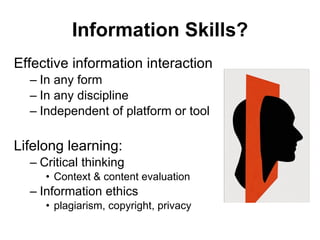
Information Interaction In any form Independent of platform / tool Requires: Context & content evaluation Information ethics  Critical thinking & problem solving
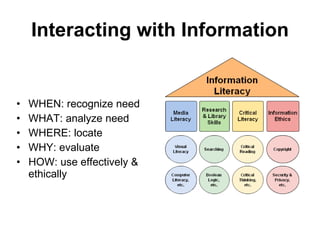
WHEN: recognize need WHAT: analyze need WHERE: locate WHY: evaluate / filter HOW: use effectively & ethically 5 Basic Information Skills
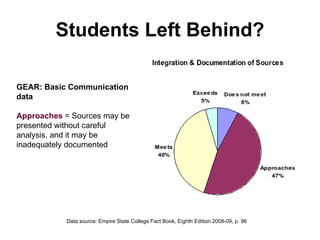
@ Empire State College GEAR: Basic Communication “ Approaches”   = Sources may be presented  without careful analysis , and it may be  inadequately documented Data source: Empire State College Fact Book, Eighth Edition 2008-09, p. 96
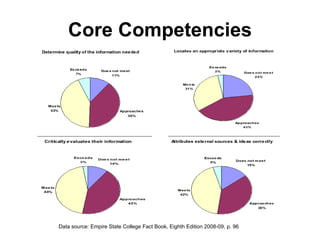
Core Competencies Data source: Empire State College Fact Book, Eighth Edition 2008-09, p. 96 GEAR: Information Management:
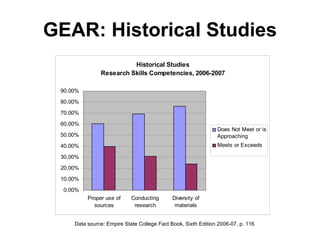
GEAR: Historical Studies Data source: Empire State College Fact Book, Sixth Edition 2006-07, p. 116
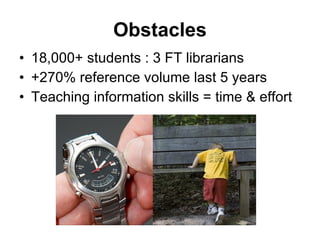
Obstacles 18,000+ students : 3 FT librarians +270% reference volume last 5 years Teaching information skills = time & effort
Faculty Role? "Professional literature indicates that, when faculty members place value and emphasis on the library, so will their students...from the teaching methods faculty use, to their choice of class activities and assignments, as well as their own personal use of the library” Cahoy, Ellysa Stern, and Lesley Mutinta Moyo. "Faculty Perspectives on E-Learners' Library Research Needs." Journal of Library & Information Services in Distance Learning 2.4 (2007): 1-17.
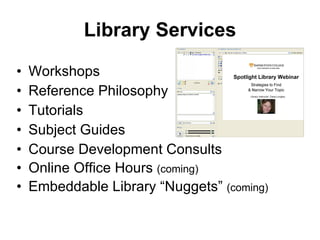
Library Services Workshops Reference Philosophy Tutorials  Subject Guides Course Development Consults Online Office Hours  (coming) Embeddable Library “Nuggets”  (coming)
Collaborate? Scalable, reusable Assignment-integrated Real world-based  Assignment design Embedded librarians Other ideas?
Contact Me to Talk More Dana Longley Manager of Library Services [email_address] Ext. 2479 Resources:  tinyurl.com/allcollege2010

Discussion on Information Literacy for Faculty at Empire State College

  • 1.
    Student Information SkillsHow Can the Library Help? Dana Longley, Manager of Library Services
  • 2.
    The Need 87%of students are “information illiterate” 1 89% use search engines to start research (2% use library web site) 2 Foster, A. (2006). Students Fall Short on 'Information Literacy,' Educational Testing Service's Study Finds. Chronicle of Higher Education , 53 (10), A36. Retrieved from Academic Search Complete database: http://bit.ly/cnxwEx College Students’ Perceptions of the Libraries and Information Resources: A Report to the OCLC Membership. Dublin, OH: OCLC, 2006: http://www.oclc.org/reports/perceptionscollege.htm
  • 3.
    Student Research BehaviorPrimary student sources: textbooks and Google 1 Tend not to use “library services that require interacting with librarians.” 2 “ miss opportunities that college education provides for exploration, discovery, and deep learning .” 2 A. Head and M. Eisenberg, "Lessons Learned: How College Students Seek Information in the Digital Age," Project Information Literacy Progress Report, Information School, Univ. of Washington, Dec 1, 2009. Sharon A. Weiner, “Information Literacy: A Neglected Core Competency,” EDUCAUSE Quarterly, 33(1), 2010.
  • 4.
    A Greater Cause?“ the key to a democratic society is the ability of the population to access and handle information effectively and efficiently.” - William Badke From: Badke, W. (2010). Foundations of Information Literacy: Learning From Paul Zurkowski. Online, 34(1), 48-50. Retrieved from Academic Search Complete database.
  • 5.
    What information skillsshould a successful student (and citizen) possess? Are students given enough opportunities (and motivation) to acquire these skills? Thoughts?
  • 6.
    Information Interaction Inany form Independent of platform / tool Requires: Context & content evaluation Information ethics Critical thinking & problem solving
  • 7.
    WHEN: recognize needWHAT: analyze need WHERE: locate WHY: evaluate / filter HOW: use effectively & ethically 5 Basic Information Skills
  • 8.
    @ Empire StateCollege GEAR: Basic Communication “ Approaches” = Sources may be presented without careful analysis , and it may be inadequately documented Data source: Empire State College Fact Book, Eighth Edition 2008-09, p. 96
  • 9.
    Core Competencies Datasource: Empire State College Fact Book, Eighth Edition 2008-09, p. 96 GEAR: Information Management:
  • 10.
    GEAR: Historical StudiesData source: Empire State College Fact Book, Sixth Edition 2006-07, p. 116
  • 11.
    Obstacles 18,000+ students: 3 FT librarians +270% reference volume last 5 years Teaching information skills = time & effort
  • 12.
    Faculty Role? "Professionalliterature indicates that, when faculty members place value and emphasis on the library, so will their students...from the teaching methods faculty use, to their choice of class activities and assignments, as well as their own personal use of the library” Cahoy, Ellysa Stern, and Lesley Mutinta Moyo. "Faculty Perspectives on E-Learners' Library Research Needs." Journal of Library & Information Services in Distance Learning 2.4 (2007): 1-17.
  • 13.
    Library Services WorkshopsReference Philosophy Tutorials Subject Guides Course Development Consults Online Office Hours (coming) Embeddable Library “Nuggets” (coming)
  • 14.
    Collaborate? Scalable, reusableAssignment-integrated Real world-based Assignment design Embedded librarians Other ideas?
  • 15.
    Contact Me toTalk More Dana Longley Manager of Library Services [email_address] Ext. 2479 Resources: tinyurl.com/allcollege2010

Editor's Notes

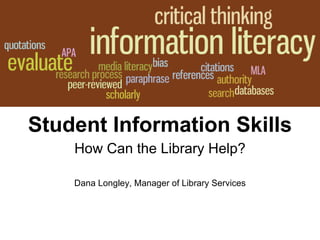
  • #2 Top image generated via Wordle.com
  • #3 Image: from Blaugh.com
  • #4 Study: 2,318 college students on six campuses across the U.S. in the spring of 2009.
  • #6 Photo via Flickr creative commons: Right: by L S G: http://www.flickr.com/photos/l_s_g/4407672870/
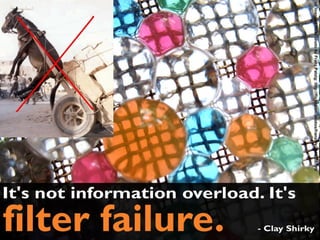
  • #7 IL can be seen as a prerequisite for lifelong learning! Info skills are more than library skills! Information age: data, information & authority are liquid , easily manipulated – ability to filter & evaluate is essential Creative Commons image by Network Osaka: http://www.flickr.com/photos/networkosaka/3199354666/
  • #8 Photo credit: Woman Inspecting Transistor, 1948 © Bettmann/CORBIS
  • #11 2006-2007 assessment of Historical Studies student work samples found that students met or exceeded standards in regards to research skills less than 50% of the time on all fronts: proper use of sources: 40% conducting research: 30% diversity of materials: 23%
  • #14 By the way, if you are using a research assignment where students will be coming to the library, let us know (what the assignment is and the due dates, if possible) – we can provide much more relevant help to the students if we have this information in hand.
  • #15 Other possibilities (that would probably require more librarians): Parallel to select capstone/research courses: required information literacy credit courses or add-on modules that tie directly into course term assignments? Information Skills “Bootcamps” – online or residency-style intensive studies (2 days/ 2 weeks, etc.) covering all aspect of research processes Photo via CC license by Leo Reynolds, www.flickr.com/photos/lwr/167559345/
  • #16 Photo credit: We Can Do It! Poster by J. Howard Miller © CORBIS