@vacekrae @UMichLibrary
Challenges and Opportunities in
Customizing Library Repository
User Interfaces
Rachel Vacek, Head of Design & Discovery,
University of Michigan
Library As Publisher, Part Two:
UX and UI for the Library's Digital Collections
March 14, 2018
@vacekrae @UMichLibrary
Hi! I’m Rachel.
I’m passionate
about improving
the user experience
across our
web presence.
@vacekrae @UMichLibrary
Outline
Comparing Repositories
Challenges Impacting Repository UI
Opportunities for Improving Repository UI
Recap
@vacekrae @UMichLibrary
Comparing Repositories
@vacekrae @UMichLibrary
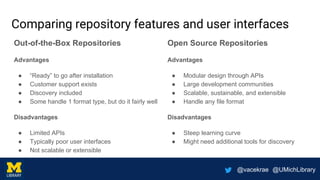
Comparing repository features and user interfaces
Out-of-the-Box Repositories
Advantages
● “Ready” to go after installation
● Customer support exists
● Discovery included
● Some handle 1 format type, but do it fairly well
Disadvantages
● Limited APIs
● Typically poor user interfaces
● Not scalable or extensible
Open Source Repositories
Advantages
● Modular design through APIs
● Large development communities
● Scalable, sustainable, and extensible
● Handle any file format
Disadvantages
● Steep learning curve
● Might need additional tools for discovery
@vacekrae @UMichLibrary
So many content types / formats
● Images
● Maps
● Text
● Articles
● Ebooks
● Dictionaries
● Papyrus
● Video
● Audio
● Theses and Dissertations
● Newspapers
● Finding Aids
● Bibliographic Materials
● Scrolls
● Data
● So many more...
@vacekrae @UMichLibrary
Challenges Impacting
Repository UI
@vacekrae @UMichLibrary
Driving forces in digital scholarship
● Growing demand of digitized primary sources
● Researcher collaboration changes rapidly
● Lots of uncertainty and ambiguity around:
○ What future services might look like, and what tools are needed to support those services
○ Federal and state funding for grants, budgets, projects
● Longstanding norms in the library profession around privacy are being
challenged
@vacekrae @UMichLibrary
Driving forces in digital scholarship, cont.
● An increase in researchers’ potential audience
● Standards for scholars to be considered successful are evolving
○ Altmetrics, publication practices, public engagement, non-monograph projects, etc.
● Researchers want easy connections to other related resources
@vacekrae @UMichLibrary
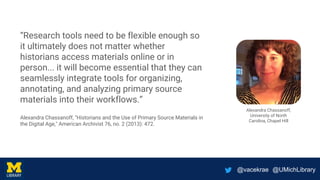
“Research tools need to be flexible enough so
it ultimately does not matter whether
historians access materials online or in
person... it will become essential that they can
seamlessly integrate tools for organizing,
annotating, and analyzing primary source
materials into their workflows.”
Alexandra Chassanoff, "Historians and the Use of Primary Source Materials in
the Digital Age," American Archivist 76, no. 2 (2013): 472.
Alexandra Chassanoff,
University of North
Carolina, Chapel Hill
@vacekrae @UMichLibrary
“Historians … would like to have full text
search of digitized books, archival finding aids,
and non-textual sources ... as comprehensively
as possible through their main discovery
services. They would also like to have services
that help them not only find some items in
[response] to their query, but to ensure that
they have been comprehensive in their
research on a given topic.”
Jennifer Rumer and Roger C. Schonfeld, (2012) “Supporting the
Changing Research Practices of Historians: Final Report from
ITHAKA S+R”: 43.
@vacekrae @UMichLibrary
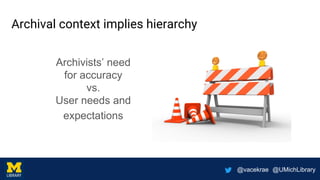
Archival context implies hierarchy
Archivists’ need
for accuracy
vs.
User needs and
expectations
@vacekrae @UMichLibrary
Changes in platforms and tools
● DSpace
● CONTENTdm
● Greenstone
● Omeka
● Fedora
● Hydra Samvera
● Islandora
● Rosetta
● bePress
● Digital Commons
● Spotlight
● CollectionSpace
● Fulcrum
● Avalon
● Blacklight
● IIIF
● So many more...
@vacekrae @UMichLibrary
“Old” digital collections
● The older the repository (repositories), the more complicated it is to keep the
interfaces current, usable, and consistent
● Michigan’s digital library platform (DLXS) was creately over 20 years
○ Focus was on being a production service to create digital collections
● Today, people have higher expectations of systems
○ Shouldn’t need training on how to use or navigate the interface - it should be intuitive and
familiar
● Sometimes collections had more items added, but most became stagnant - the
interfaces were never updated
● Challenges in migrating old content and features to a new system
@vacekrae @UMichLibrary
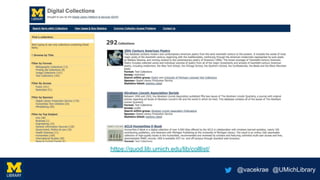
https://quod.lib.umich.edu/lib/colllist/
@vacekrae @UMichLibrary
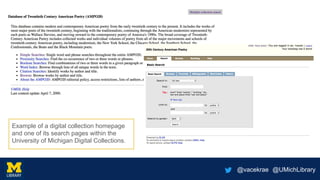
Example of a digital collection homepage
and one of its search pages within the
University of Michigan Digital Collections.
@vacekrae @UMichLibrary
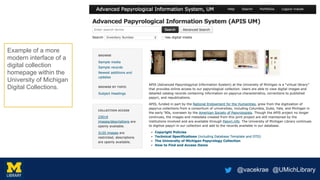
Example of a more
modern interface of a
digital collection
homepage within the
University of Michigan
Digital Collections.
@vacekrae @UMichLibrary
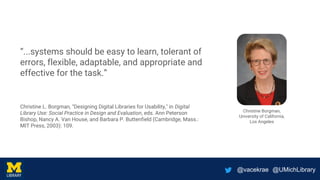
“...systems should be easy to learn, tolerant of
errors, flexible, adaptable, and appropriate and
effective for the task.”
Christine L. Borgman, "Designing Digital Libraries for Usability," in Digital
Library Use: Social Practice in Design and Evaluation, eds. Ann Peterson
Bishop, Nancy A. Van House, and Barbara P. Buttenfield (Cambridge, Mass.:
MIT Press, 2003): 109.
Christine Borgman,
University of California,
Los Angeles
@vacekrae @UMichLibrary
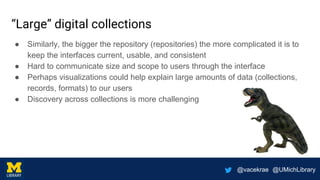
“Large” digital collections
● Similarly, the bigger the repository (repositories) the more complicated it is to
keep the interfaces current, usable, and consistent
● Hard to communicate size and scope to users through the interface
● Perhaps visualizations could help explain large amounts of data (collections,
records, formats) to our users
● Discovery across collections is more challenging
@vacekrae @UMichLibrary
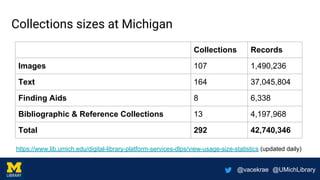
Collections sizes at Michigan
Collections Records
Images 107 1,490,236
Text 164 37,045,804
Finding Aids 8 6,338
Bibliographic & Reference Collections 13 4,197,968
Total 292 42,740,346
https://www.lib.umich.edu/digital-library-platform-services-dlps/view-usage-size-statistics (updated daily)
@vacekrae @UMichLibrary
Back to talking about format again...
● Images
● Maps
● Text
● Articles
● Ebooks
● Dictionaries
● Papyrus
● Video
● Audio
● Theses and Dissertations
● Newspapers
● Finding Aids
● Bibliographic Materials
● Scrolls
● Data
● So many more...
@vacekrae @UMichLibrary
Opportunities for Improving
Repository UI
@vacekrae @UMichLibrary
Increase in UX support and user research
● Libraries are paying more attention to users’ motivations
○ Data-driven research and learning analytics
○ Assessment and demonstrating impact
● More UX librarians and UX departments are showing up in libraries
○ Support user research and usability on website and digital library projects → expanding to all
applications integrated across a library’s web presence
○ Bring consistency and universal design principles to interfaces
○ Improve accessibility
@vacekrae @UMichLibrary
“[Researchers] were frustrated by the lack of
general uniformity of interface presentation
related to search, both across types of
materials and across databases. One
researcher was bothered by a lack of
standardization in presentation due to content
being aggregated for multiple sources, noting
that the variation can be disorienting.”
Jody L. DeRidder and Kathryn G. Matheny, (2014) “What Do Researchers
Need? Feedback On Use of Online Primary Source Materials”, D-Lib Magazine,
Vol 20 Number: 7/8, http://www.dlib.org/dlib/july14/deridder/07deridder.html
Jody DeRidder,
University of Alabama
@vacekrae @UMichLibrary
Search and discovery is improving
● Library discovery systems are providing more open tools and APIs, enabling
libraries to customize or personalize their search experience for users
● Algorithms in search engines are becoming smarter, more intuitive, and
feature rich
● Tools like Blacklight, a discovery platform framework, let libraries customize
discovery interfaces
● More opportunities to improve discoverability across related items and
collections
@vacekrae @UMichLibrary
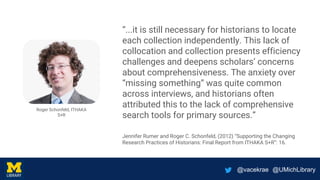
“...it is still necessary for historians to locate
each collection independently. This lack of
collocation and collection presents efficiency
challenges and deepens scholars’ concerns
about comprehensiveness. The anxiety over
“missing something” was quite common
across interviews, and historians often
attributed this to the lack of comprehensive
search tools for primary sources.”
Jennifer Rumer and Roger C. Schonfeld, (2012) “Supporting the Changing
Research Practices of Historians: Final Report from ITHAKA S+R”: 16.
Roger Schonfeld, ITHAKA
S+R
@vacekrae @UMichLibrary
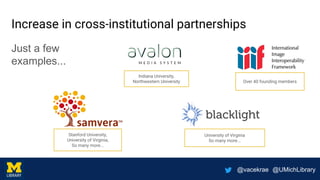
Increase in cross-institutional partnerships
Indiana University,
Northwestern University
Stanford University,
University of Virginia,
So many more...
Over 40 founding members
University of Virginia
So many more...
Just a few
examples...
@vacekrae @UMichLibrary
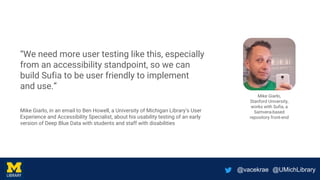
“We need more user testing like this, especially
from an accessibility standpoint, so we can
build Sufia to be user friendly to implement
and use.”
Mike Giarlo, in an email to Ben Howell, a University of Michigan Library’s User
Experience and Accessibility Specialist, about his usability testing of an early
version of Deep Blue Data with students and staff with disabilities
Mike Giarlo,
Stanford University,
works with Sufia, a
Samvera-based
repository front-end
@vacekrae @UMichLibrary
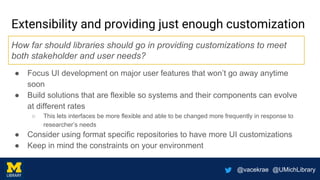
Extensibility and providing just enough customization
● Focus UI development on major user features that won’t go away anytime
soon
● Build solutions that are flexible so systems and their components can evolve
at different rates
○ This lets interfaces be more flexible and able to be changed more frequently in response to
researcher’s needs
● Consider using format specific repositories to have more UI customizations
● Keep in mind the constraints on your environment
How far should libraries should go in providing customizations to meet
both stakeholder and user needs?
@vacekrae @UMichLibrary
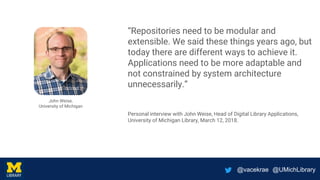
“Repositories need to be modular and
extensible. We said these things years ago, but
today there are different ways to achieve it.
Applications need to be more adaptable and
not constrained by system architecture
unnecessarily.”
Personal interview with John Weise, Head of Digital Library Applications,
University of Michigan Library, March 12, 2018.
John Weise,
University of Michigan
@vacekrae @UMichLibrary
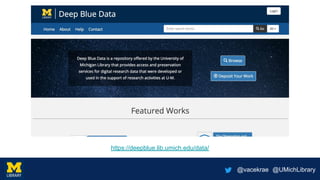
https://deepblue.lib.umich.edu/data/
@vacekrae @UMichLibrary
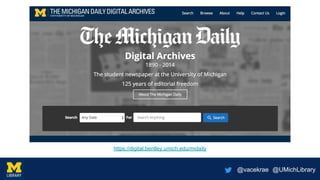
Fishrappr
● Browser for newspaper archives
● Available at https://github.com/mlibrary/fishrappr
● Developed for a particular project, but built so
it can potentially be used for additional
newspaper repositories
Fishrappr Logo
@vacekrae @UMichLibrary
https://digital.bentley.umich.edu/midaily
@vacekrae @UMichLibrary
Recap
@vacekrae @UMichLibrary
Recap
● Challenges in customizing user interfaces still exist and will continue to exist,
but more solutions are being created and explored everyday
○ Better tools and platforms
○ Enhanced discovery
○ Growing interest in UX
○ Community sourced development projects
● It’s important to find balance between meeting user needs and meeting the
needs of your environment
● Building tools that are extensive is critical to keeping your UI adaptable with
rapid changes
@vacekrae @UMichLibrary
Resources
Ali Shiri, (2003) "Digital library research: current developments and trends", Library Review, Vol. 52 Issue: 5, pp.198-202,
https://doi-org.proxy.lib.umich.edu/10.1108/00242530310476689
Harriett E. Green, Patricia Lampron, (2017) “User Engagement with Digital Archives for Research and Teaching: A Case Study of Emblematica
Online”, Libraries and the Academy, Vol. 17 Number 4, pp. 759-775, https://doi.org/10.1353/pla.2017.0045
Paul Alonso Gaona-García, David Martin-Moncunill, Carlos Enrique Montenegro-Marin, (2017) "Trends and challenges of visual search interfaces in
digital libraries and repositories", The Electronic Library, Vol. 35 Issue: 1, pp. 69-98, https://doi.org/10.1108/EL-03-2015-0046
Jody L. DeRidder and Kathryn G. Matheny, (2014) “What Do Researchers Need? Feedback On Use of Online Primary Source Materials”, D-Lib
Magazine, Vol 20 Number: 7/8, http://www.dlib.org/dlib/july14/deridder/07deridder.html
Jennifer Rumer and Roger C. Schonfeld, (2012) “Supporting the Changing Research Practices of Historians: Final Report from ITHAKA S+R”,
http://www.sr.ithaka.org/sites/default/files/reports/supporting-the-changing-research-practices-of-historians.pdf
NISO Framework Working Group with support from the Institute of Museum and Library Services, A Framework of Guidance for Building Good Digital
Collections (Baltimore, MD: National Information Standards Organization (NISO), 2007).
@vacekrae @UMichLibrary
Resources, cont.
Christine L Borgman. "Designing digital libraries for usability", Cambridge, MA, Digital Library Use: Social Practice in Design and Evaluation (2003).
Georgios Gkoumas, Fotis Lazarinis, (2015) "Evaluation and usage scenarios of open source digital library and collection management tools",
Program, Vol. 49 Issue: 3, pp. 226-241, https://doi.org/10.1108/PROG-09-2014-0070
Dion Hoe‐Lian Goh, Alton Chua, Davina Anqi Khoo, Emily Boon‐Hui Khoo, Eric Bok‐Tong Mak, Maple Wen‐Min Ng, (2006) "A checklist for
evaluating open source digital library software", Online Information Review, Vol. 30 Issue: 4, pp. 360-379,
https://doi.org/10.1108/14684520610686283
Jennifer L. Marill and Edward C. Luczak, (May 2009) “Evaluation of Digital Repository Software at the National Library of Medicine,” D-Lib Magazine,
Vol. 15 Number: 5/6, http://www.dlib.org/dlib/may09/marill/05marill.html
Annie Wu, Santi Thompson, Rachel Vacek, Sean Watkins, and Andrew Weidner, (2016) “Hitting the Road Towards a Greater Digital Destination:
Evaluating and Testing DAMS at University of Houston Libraries”, Information Technology and Libraries, Vol. 35 Number: 2,
https://doi.org/10.6017/ital.v35i2.9152
@vacekrae @UMichLibrary
Thank you!
Questions? Contact me!
rvacek@umich.edu

Challenges & Opportunities in Customizing Library IR User Interfaces

  • 1.
    @vacekrae @UMichLibrary Challenges andOpportunities in Customizing Library Repository User Interfaces Rachel Vacek, Head of Design & Discovery, University of Michigan Library As Publisher, Part Two: UX and UI for the Library's Digital Collections March 14, 2018
  • 2.
    @vacekrae @UMichLibrary Hi! I’mRachel. I’m passionate about improving the user experience across our web presence.
  • 3.
    @vacekrae @UMichLibrary Outline Comparing Repositories ChallengesImpacting Repository UI Opportunities for Improving Repository UI Recap
  • 4.
  • 5.
    @vacekrae @UMichLibrary Comparing repositoryfeatures and user interfaces Out-of-the-Box Repositories Advantages ● “Ready” to go after installation ● Customer support exists ● Discovery included ● Some handle 1 format type, but do it fairly well Disadvantages ● Limited APIs ● Typically poor user interfaces ● Not scalable or extensible Open Source Repositories Advantages ● Modular design through APIs ● Large development communities ● Scalable, sustainable, and extensible ● Handle any file format Disadvantages ● Steep learning curve ● Might need additional tools for discovery
  • 6.
    @vacekrae @UMichLibrary So manycontent types / formats ● Images ● Maps ● Text ● Articles ● Ebooks ● Dictionaries ● Papyrus ● Video ● Audio ● Theses and Dissertations ● Newspapers ● Finding Aids ● Bibliographic Materials ● Scrolls ● Data ● So many more...
  • 7.
  • 8.
    @vacekrae @UMichLibrary Driving forcesin digital scholarship ● Growing demand of digitized primary sources ● Researcher collaboration changes rapidly ● Lots of uncertainty and ambiguity around: ○ What future services might look like, and what tools are needed to support those services ○ Federal and state funding for grants, budgets, projects ● Longstanding norms in the library profession around privacy are being challenged
  • 9.
    @vacekrae @UMichLibrary Driving forcesin digital scholarship, cont. ● An increase in researchers’ potential audience ● Standards for scholars to be considered successful are evolving ○ Altmetrics, publication practices, public engagement, non-monograph projects, etc. ● Researchers want easy connections to other related resources
  • 10.
    @vacekrae @UMichLibrary “Research toolsneed to be flexible enough so it ultimately does not matter whether historians access materials online or in person... it will become essential that they can seamlessly integrate tools for organizing, annotating, and analyzing primary source materials into their workflows.” Alexandra Chassanoff, "Historians and the Use of Primary Source Materials in the Digital Age," American Archivist 76, no. 2 (2013): 472. Alexandra Chassanoff, University of North Carolina, Chapel Hill
  • 11.
    @vacekrae @UMichLibrary “Historians …would like to have full text search of digitized books, archival finding aids, and non-textual sources ... as comprehensively as possible through their main discovery services. They would also like to have services that help them not only find some items in [response] to their query, but to ensure that they have been comprehensive in their research on a given topic.” Jennifer Rumer and Roger C. Schonfeld, (2012) “Supporting the Changing Research Practices of Historians: Final Report from ITHAKA S+R”: 43.
  • 12.
    @vacekrae @UMichLibrary Archival contextimplies hierarchy Archivists’ need for accuracy vs. User needs and expectations
  • 13.
    @vacekrae @UMichLibrary Changes inplatforms and tools ● DSpace ● CONTENTdm ● Greenstone ● Omeka ● Fedora ● Hydra Samvera ● Islandora ● Rosetta ● bePress ● Digital Commons ● Spotlight ● CollectionSpace ● Fulcrum ● Avalon ● Blacklight ● IIIF ● So many more...
  • 14.
    @vacekrae @UMichLibrary “Old” digitalcollections ● The older the repository (repositories), the more complicated it is to keep the interfaces current, usable, and consistent ● Michigan’s digital library platform (DLXS) was creately over 20 years ○ Focus was on being a production service to create digital collections ● Today, people have higher expectations of systems ○ Shouldn’t need training on how to use or navigate the interface - it should be intuitive and familiar ● Sometimes collections had more items added, but most became stagnant - the interfaces were never updated ● Challenges in migrating old content and features to a new system
  • 15.
  • 16.
    @vacekrae @UMichLibrary Example ofa digital collection homepage and one of its search pages within the University of Michigan Digital Collections.
  • 17.
    @vacekrae @UMichLibrary Example ofa more modern interface of a digital collection homepage within the University of Michigan Digital Collections.
  • 18.
    @vacekrae @UMichLibrary “...systems shouldbe easy to learn, tolerant of errors, flexible, adaptable, and appropriate and effective for the task.” Christine L. Borgman, "Designing Digital Libraries for Usability," in Digital Library Use: Social Practice in Design and Evaluation, eds. Ann Peterson Bishop, Nancy A. Van House, and Barbara P. Buttenfield (Cambridge, Mass.: MIT Press, 2003): 109. Christine Borgman, University of California, Los Angeles
  • 19.
    @vacekrae @UMichLibrary “Large” digitalcollections ● Similarly, the bigger the repository (repositories) the more complicated it is to keep the interfaces current, usable, and consistent ● Hard to communicate size and scope to users through the interface ● Perhaps visualizations could help explain large amounts of data (collections, records, formats) to our users ● Discovery across collections is more challenging
  • 20.
    @vacekrae @UMichLibrary Collections sizesat Michigan Collections Records Images 107 1,490,236 Text 164 37,045,804 Finding Aids 8 6,338 Bibliographic & Reference Collections 13 4,197,968 Total 292 42,740,346 https://www.lib.umich.edu/digital-library-platform-services-dlps/view-usage-size-statistics (updated daily)
  • 21.
    @vacekrae @UMichLibrary Back totalking about format again... ● Images ● Maps ● Text ● Articles ● Ebooks ● Dictionaries ● Papyrus ● Video ● Audio ● Theses and Dissertations ● Newspapers ● Finding Aids ● Bibliographic Materials ● Scrolls ● Data ● So many more...
  • 22.
  • 23.
    @vacekrae @UMichLibrary Increase inUX support and user research ● Libraries are paying more attention to users’ motivations ○ Data-driven research and learning analytics ○ Assessment and demonstrating impact ● More UX librarians and UX departments are showing up in libraries ○ Support user research and usability on website and digital library projects → expanding to all applications integrated across a library’s web presence ○ Bring consistency and universal design principles to interfaces ○ Improve accessibility
  • 24.
    @vacekrae @UMichLibrary “[Researchers] werefrustrated by the lack of general uniformity of interface presentation related to search, both across types of materials and across databases. One researcher was bothered by a lack of standardization in presentation due to content being aggregated for multiple sources, noting that the variation can be disorienting.” Jody L. DeRidder and Kathryn G. Matheny, (2014) “What Do Researchers Need? Feedback On Use of Online Primary Source Materials”, D-Lib Magazine, Vol 20 Number: 7/8, http://www.dlib.org/dlib/july14/deridder/07deridder.html Jody DeRidder, University of Alabama
  • 25.
    @vacekrae @UMichLibrary Search anddiscovery is improving ● Library discovery systems are providing more open tools and APIs, enabling libraries to customize or personalize their search experience for users ● Algorithms in search engines are becoming smarter, more intuitive, and feature rich ● Tools like Blacklight, a discovery platform framework, let libraries customize discovery interfaces ● More opportunities to improve discoverability across related items and collections
  • 26.
    @vacekrae @UMichLibrary “...it isstill necessary for historians to locate each collection independently. This lack of collocation and collection presents efficiency challenges and deepens scholars’ concerns about comprehensiveness. The anxiety over “missing something” was quite common across interviews, and historians often attributed this to the lack of comprehensive search tools for primary sources.” Jennifer Rumer and Roger C. Schonfeld, (2012) “Supporting the Changing Research Practices of Historians: Final Report from ITHAKA S+R”: 16. Roger Schonfeld, ITHAKA S+R
  • 27.
    @vacekrae @UMichLibrary Increase incross-institutional partnerships Indiana University, Northwestern University Stanford University, University of Virginia, So many more... Over 40 founding members University of Virginia So many more... Just a few examples...
  • 28.
  • 29.
    @vacekrae @UMichLibrary “We needmore user testing like this, especially from an accessibility standpoint, so we can build Sufia to be user friendly to implement and use.” Mike Giarlo, in an email to Ben Howell, a University of Michigan Library’s User Experience and Accessibility Specialist, about his usability testing of an early version of Deep Blue Data with students and staff with disabilities Mike Giarlo, Stanford University, works with Sufia, a Samvera-based repository front-end
  • 30.
    @vacekrae @UMichLibrary Extensibility andproviding just enough customization ● Focus UI development on major user features that won’t go away anytime soon ● Build solutions that are flexible so systems and their components can evolve at different rates ○ This lets interfaces be more flexible and able to be changed more frequently in response to researcher’s needs ● Consider using format specific repositories to have more UI customizations ● Keep in mind the constraints on your environment How far should libraries should go in providing customizations to meet both stakeholder and user needs?
  • 31.
    @vacekrae @UMichLibrary “Repositories needto be modular and extensible. We said these things years ago, but today there are different ways to achieve it. Applications need to be more adaptable and not constrained by system architecture unnecessarily.” Personal interview with John Weise, Head of Digital Library Applications, University of Michigan Library, March 12, 2018. John Weise, University of Michigan
  • 32.
  • 33.
    @vacekrae @UMichLibrary Fishrappr ● Browserfor newspaper archives ● Available at https://github.com/mlibrary/fishrappr ● Developed for a particular project, but built so it can potentially be used for additional newspaper repositories Fishrappr Logo
  • 34.
  • 35.
  • 36.
    @vacekrae @UMichLibrary Recap ● Challengesin customizing user interfaces still exist and will continue to exist, but more solutions are being created and explored everyday ○ Better tools and platforms ○ Enhanced discovery ○ Growing interest in UX ○ Community sourced development projects ● It’s important to find balance between meeting user needs and meeting the needs of your environment ● Building tools that are extensive is critical to keeping your UI adaptable with rapid changes
  • 37.
    @vacekrae @UMichLibrary Resources Ali Shiri,(2003) "Digital library research: current developments and trends", Library Review, Vol. 52 Issue: 5, pp.198-202, https://doi-org.proxy.lib.umich.edu/10.1108/00242530310476689 Harriett E. Green, Patricia Lampron, (2017) “User Engagement with Digital Archives for Research and Teaching: A Case Study of Emblematica Online”, Libraries and the Academy, Vol. 17 Number 4, pp. 759-775, https://doi.org/10.1353/pla.2017.0045 Paul Alonso Gaona-García, David Martin-Moncunill, Carlos Enrique Montenegro-Marin, (2017) "Trends and challenges of visual search interfaces in digital libraries and repositories", The Electronic Library, Vol. 35 Issue: 1, pp. 69-98, https://doi.org/10.1108/EL-03-2015-0046 Jody L. DeRidder and Kathryn G. Matheny, (2014) “What Do Researchers Need? Feedback On Use of Online Primary Source Materials”, D-Lib Magazine, Vol 20 Number: 7/8, http://www.dlib.org/dlib/july14/deridder/07deridder.html Jennifer Rumer and Roger C. Schonfeld, (2012) “Supporting the Changing Research Practices of Historians: Final Report from ITHAKA S+R”, http://www.sr.ithaka.org/sites/default/files/reports/supporting-the-changing-research-practices-of-historians.pdf NISO Framework Working Group with support from the Institute of Museum and Library Services, A Framework of Guidance for Building Good Digital Collections (Baltimore, MD: National Information Standards Organization (NISO), 2007).
  • 38.
    @vacekrae @UMichLibrary Resources, cont. ChristineL Borgman. "Designing digital libraries for usability", Cambridge, MA, Digital Library Use: Social Practice in Design and Evaluation (2003). Georgios Gkoumas, Fotis Lazarinis, (2015) "Evaluation and usage scenarios of open source digital library and collection management tools", Program, Vol. 49 Issue: 3, pp. 226-241, https://doi.org/10.1108/PROG-09-2014-0070 Dion Hoe‐Lian Goh, Alton Chua, Davina Anqi Khoo, Emily Boon‐Hui Khoo, Eric Bok‐Tong Mak, Maple Wen‐Min Ng, (2006) "A checklist for evaluating open source digital library software", Online Information Review, Vol. 30 Issue: 4, pp. 360-379, https://doi.org/10.1108/14684520610686283 Jennifer L. Marill and Edward C. Luczak, (May 2009) “Evaluation of Digital Repository Software at the National Library of Medicine,” D-Lib Magazine, Vol. 15 Number: 5/6, http://www.dlib.org/dlib/may09/marill/05marill.html Annie Wu, Santi Thompson, Rachel Vacek, Sean Watkins, and Andrew Weidner, (2016) “Hitting the Road Towards a Greater Digital Destination: Evaluating and Testing DAMS at University of Houston Libraries”, Information Technology and Libraries, Vol. 35 Number: 2, https://doi.org/10.6017/ital.v35i2.9152
  • 39.