Discourse
analysis is
sometimes
defined as the
analysis of
language 'beyond
the sentence'
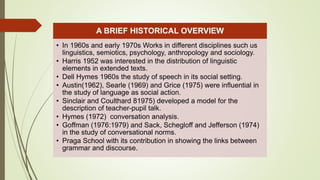
A BRIEF HISTORICAL OVERVIEW
• In 1960s and early 1970s Works in different disciplines such us
linguistics, semiotics, psychology, anthropology and sociology.
• Harris 1952 was interested in the distribution of linguistic
elements in extended texts.
• Dell Hymes 1960s the study of speech in its social setting.
• Austin(1962), Searle (1969) and Grice (1975) were influential in
the study of language as social action.
• Sinclair and Coulthard 81975) developed a model for the
description of teacher-pupil talk.
• Hymes (1972) conversation analysis.
• Goffman (1976:1979) and Sack, Schegloff and Jefferson (1974)
in the study of conversational norms.
• Praga School with its contribution in showing the links between
grammar and discourse.
A grammatical form depends on a number of factors: some
linguistic, some purely situational.
Linguistic feature that may affect our interpretation is the
intonation.
In different kind of spoken interaction as phone calls, buying things
in shops, interview for a job, in classroom, they have their own
formula for example opening and closing the encounter, different
role relationships, different purposes and different settings.
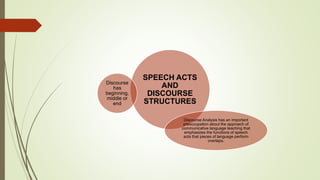
SPEECH ACTS
AND
DISCOURSE
STRUCTURES
Discourse Analysis has an important
preoccupation about the approach of
communicative language teaching that
emphasizes the functions of speech
acts that pieces of language perform
overlaps.
Discourse
has
beginning,
middle or
end
THE SCOPE
OF
DISCOURSE
ANALYSIS
It is important the
coherent in which the
words and or
sentences are linked to
one another.
The principal
objective is the
have a much better
understanding.
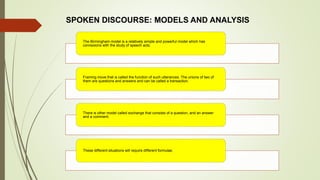
The Birmingham model is a relatively simple and powerful model which has
connexions with the study of speech acts.
Framing move that is called the function of such utterances. The unions of two of
them are questions and answers and can be called a transaction.
There is other model called exchange that consists of a question, and an answer
and a comment.
These different situations will require different formulae.
SPOKEN DISCOURSE: MODELS AND ANALYSIS
It is at first sight to be “free”.
It could become politeness as
conversation is increasing.
The conversation also could has
intonation, gesture, etc in order
to help in the analysis.
The hierarchy can be expresses
as: Transaction, Exchange,
Move and Act
CONVERSATION OUTSIDE THE CLASSROOM
It is more structured than the
classroom talk.
It is also important knowing
how turn taking is managed,
ho conversational opening
and closing affected, how
speakers engage in strategic
acts of politeness, face-
preservation, and so on.
TALK AS
A SOCIAL
ACTIVITY
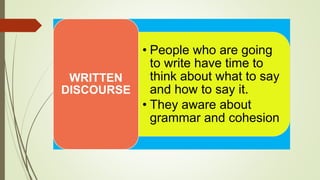
• People who are going
to write have time to
think about what to say
and how to say it.
• They aware about
grammar and cohesion
WRITTEN
DISCOURSE
TEXT AND
INTERPRETATION
Markers of various kind, and cohesive markers
are very much concerned with the surface of the
text.
Interpretation can be seen as a set of procedures.
Other way to make an interpretation is through
recognizing textual patterns.
Reading a text is like having a dialogue with the
writer.
LARGER PATTERNS IN
TEXT
It concerns with larger patterns
which regularly occur in texts.
Readers and writers need to be
aware about signalling devices.
Signalling can be even more
important part in signposting the text,

Discourse analysis

  • 1.
    Discourse analysis is sometimes defined asthe analysis of language 'beyond the sentence'
  • 2.
    A BRIEF HISTORICALOVERVIEW • In 1960s and early 1970s Works in different disciplines such us linguistics, semiotics, psychology, anthropology and sociology. • Harris 1952 was interested in the distribution of linguistic elements in extended texts. • Dell Hymes 1960s the study of speech in its social setting. • Austin(1962), Searle (1969) and Grice (1975) were influential in the study of language as social action. • Sinclair and Coulthard 81975) developed a model for the description of teacher-pupil talk. • Hymes (1972) conversation analysis. • Goffman (1976:1979) and Sack, Schegloff and Jefferson (1974) in the study of conversational norms. • Praga School with its contribution in showing the links between grammar and discourse.
  • 3.
    A grammatical formdepends on a number of factors: some linguistic, some purely situational. Linguistic feature that may affect our interpretation is the intonation. In different kind of spoken interaction as phone calls, buying things in shops, interview for a job, in classroom, they have their own formula for example opening and closing the encounter, different role relationships, different purposes and different settings.
  • 4.
    SPEECH ACTS AND DISCOURSE STRUCTURES Discourse Analysishas an important preoccupation about the approach of communicative language teaching that emphasizes the functions of speech acts that pieces of language perform overlaps. Discourse has beginning, middle or end
  • 5.
    THE SCOPE OF DISCOURSE ANALYSIS It isimportant the coherent in which the words and or sentences are linked to one another. The principal objective is the have a much better understanding.
  • 6.
    The Birmingham modelis a relatively simple and powerful model which has connexions with the study of speech acts. Framing move that is called the function of such utterances. The unions of two of them are questions and answers and can be called a transaction. There is other model called exchange that consists of a question, and an answer and a comment. These different situations will require different formulae. SPOKEN DISCOURSE: MODELS AND ANALYSIS
  • 7.
    It is atfirst sight to be “free”. It could become politeness as conversation is increasing. The conversation also could has intonation, gesture, etc in order to help in the analysis. The hierarchy can be expresses as: Transaction, Exchange, Move and Act CONVERSATION OUTSIDE THE CLASSROOM
  • 8.
    It is morestructured than the classroom talk. It is also important knowing how turn taking is managed, ho conversational opening and closing affected, how speakers engage in strategic acts of politeness, face- preservation, and so on. TALK AS A SOCIAL ACTIVITY
  • 9.
    • People whoare going to write have time to think about what to say and how to say it. • They aware about grammar and cohesion WRITTEN DISCOURSE
  • 10.
    TEXT AND INTERPRETATION Markers ofvarious kind, and cohesive markers are very much concerned with the surface of the text. Interpretation can be seen as a set of procedures. Other way to make an interpretation is through recognizing textual patterns. Reading a text is like having a dialogue with the writer.
  • 11.
    LARGER PATTERNS IN TEXT Itconcerns with larger patterns which regularly occur in texts. Readers and writers need to be aware about signalling devices. Signalling can be even more important part in signposting the text,