J O R G E F L O R E S
LEARNING ACTIVITY 2.1
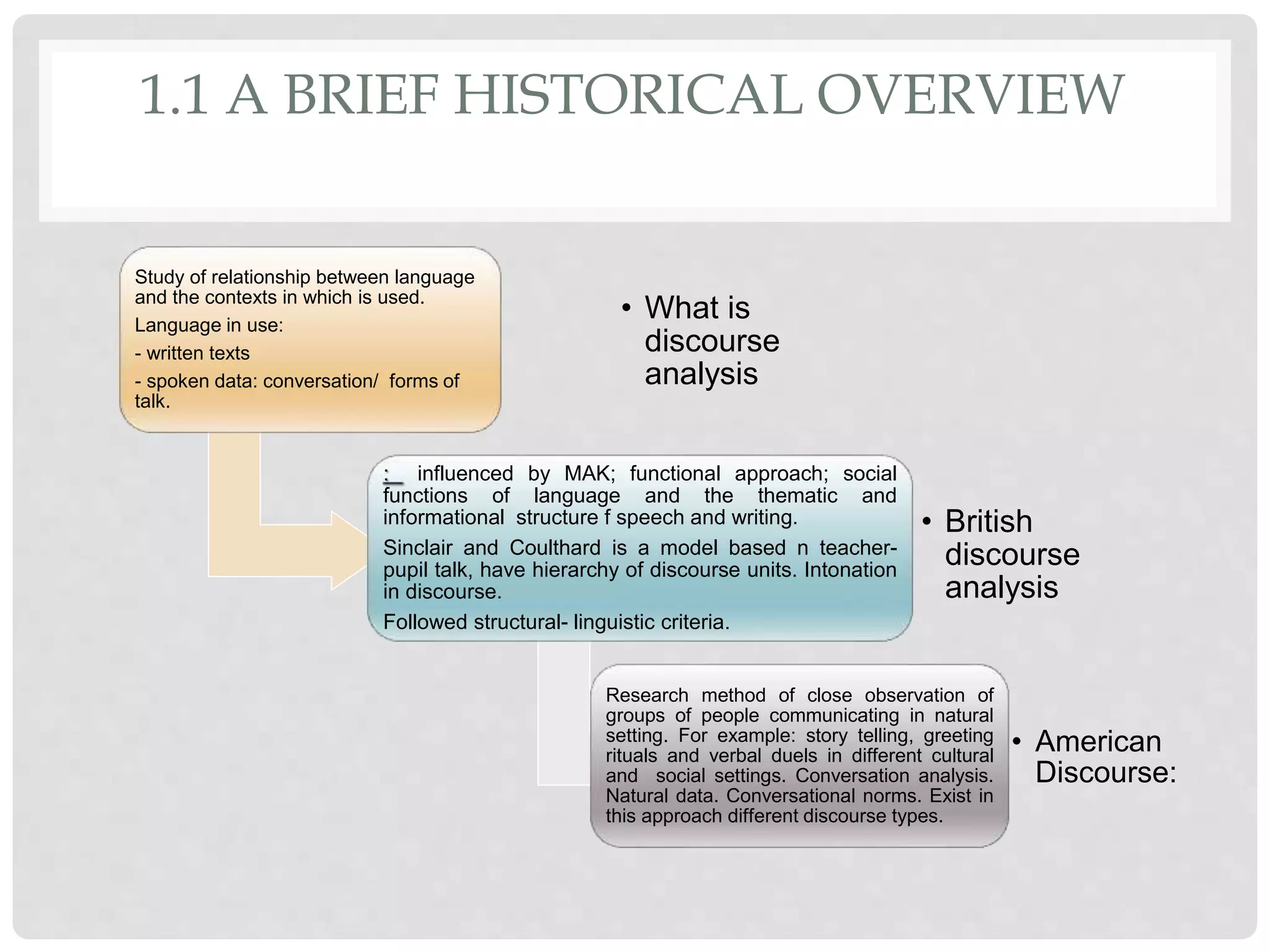
1.1 A BRIEF HISTORICAL OVERVIEW
Study of relationship between language
and the contexts in which is used.
Language in use:
- written texts
- spoken data: conversation/ forms of
talk.
• What is
discourse
analysis
: influenced by MAK; functional approach; social
functions of language and the thematic and
informational structure f speech and writing.
Sinclair and Coulthard is a model based n teacher-
pupil talk, have hierarchy of discourse units. Intonation
in discourse.
Followed structural- linguistic criteria.
• British
discourse
analysis
Research method of close observation of
groups of people communicating in natural
setting. For example: story telling, greeting
rituals and verbal duels in different cultural
and social settings. Conversation analysis.
Natural data. Conversational norms. Exist in
this approach different discourse types.
• American
Discourse:
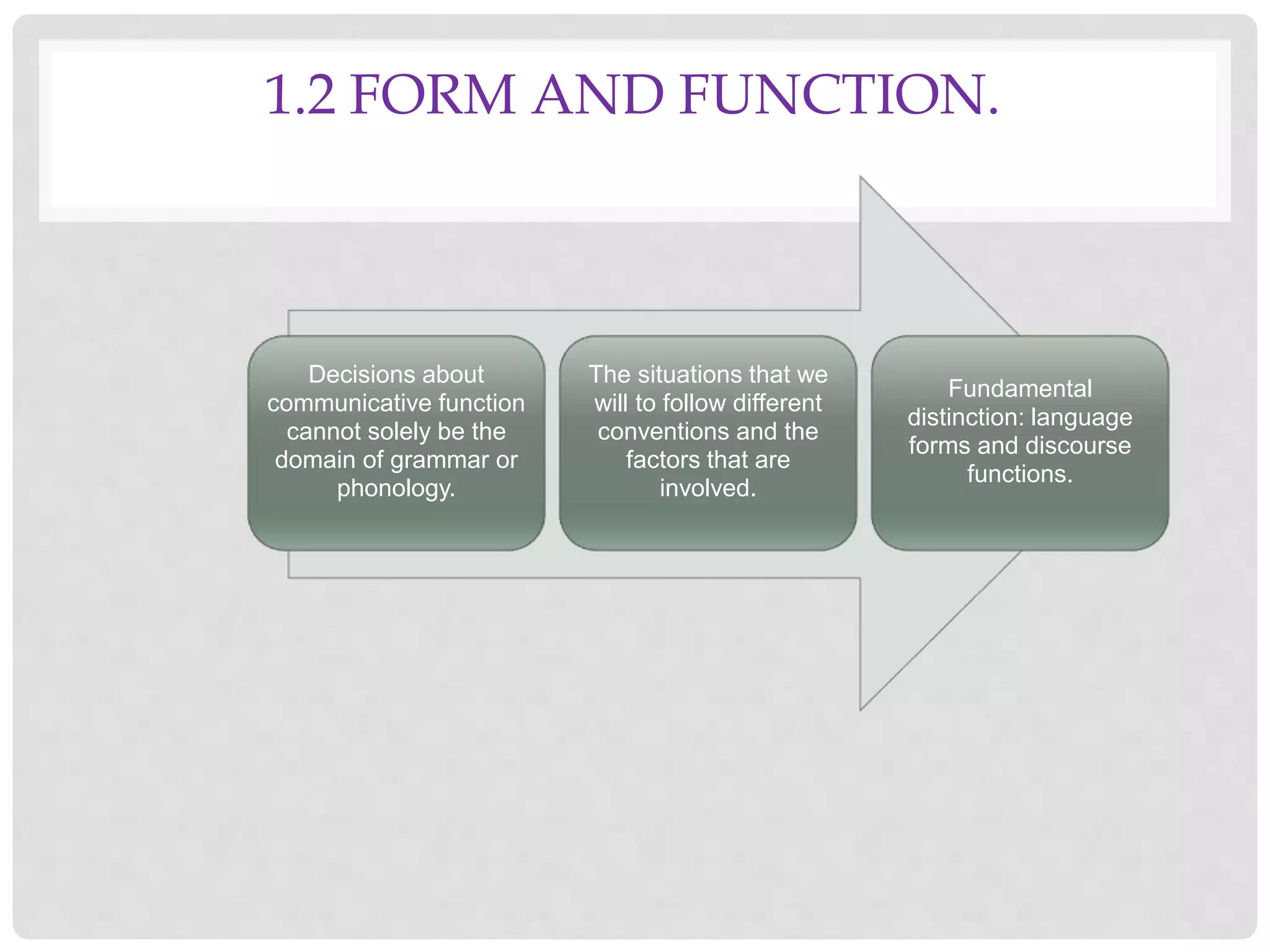
1.2 FORM AND FUNCTION.
Decisions about
communicative function
cannot solely be the
domain of grammar or
phonology.
The situations that we
will to follow different
conventions and the
factors that are
involved.
Fundamental
distinction: language
forms and discourse
functions.
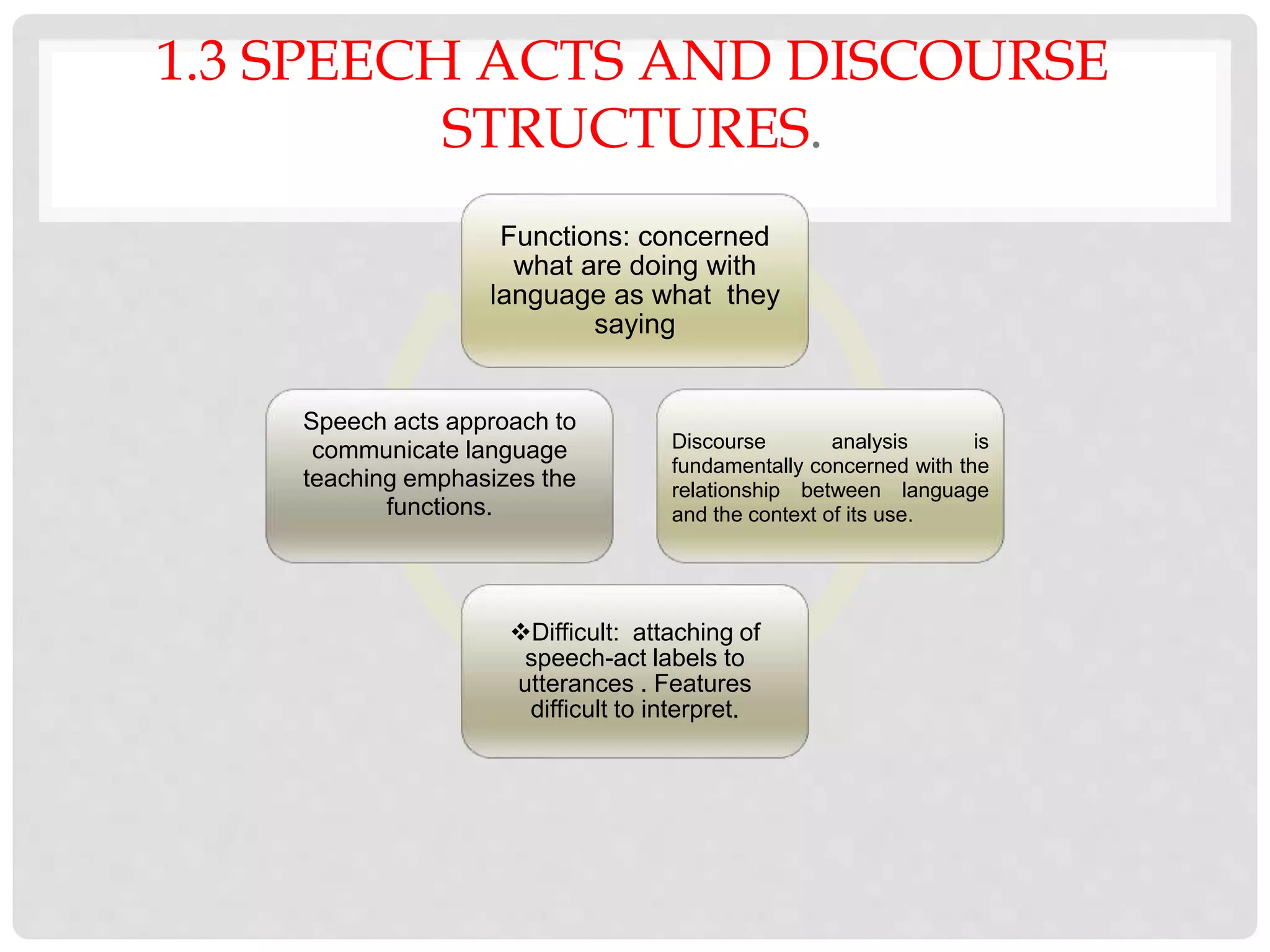
1.3 SPEECH ACTS AND DISCOURSE
STRUCTURES.
Functions: concerned
what are doing with
language as what they
saying
Discourse analysis is
fundamentally concerned with the
relationship between language
and the context of its use.
Difficult: attaching of
speech-act labels to
utterances . Features
difficult to interpret.
Speech acts approach to
communicate language
teaching emphasizes the
functions.
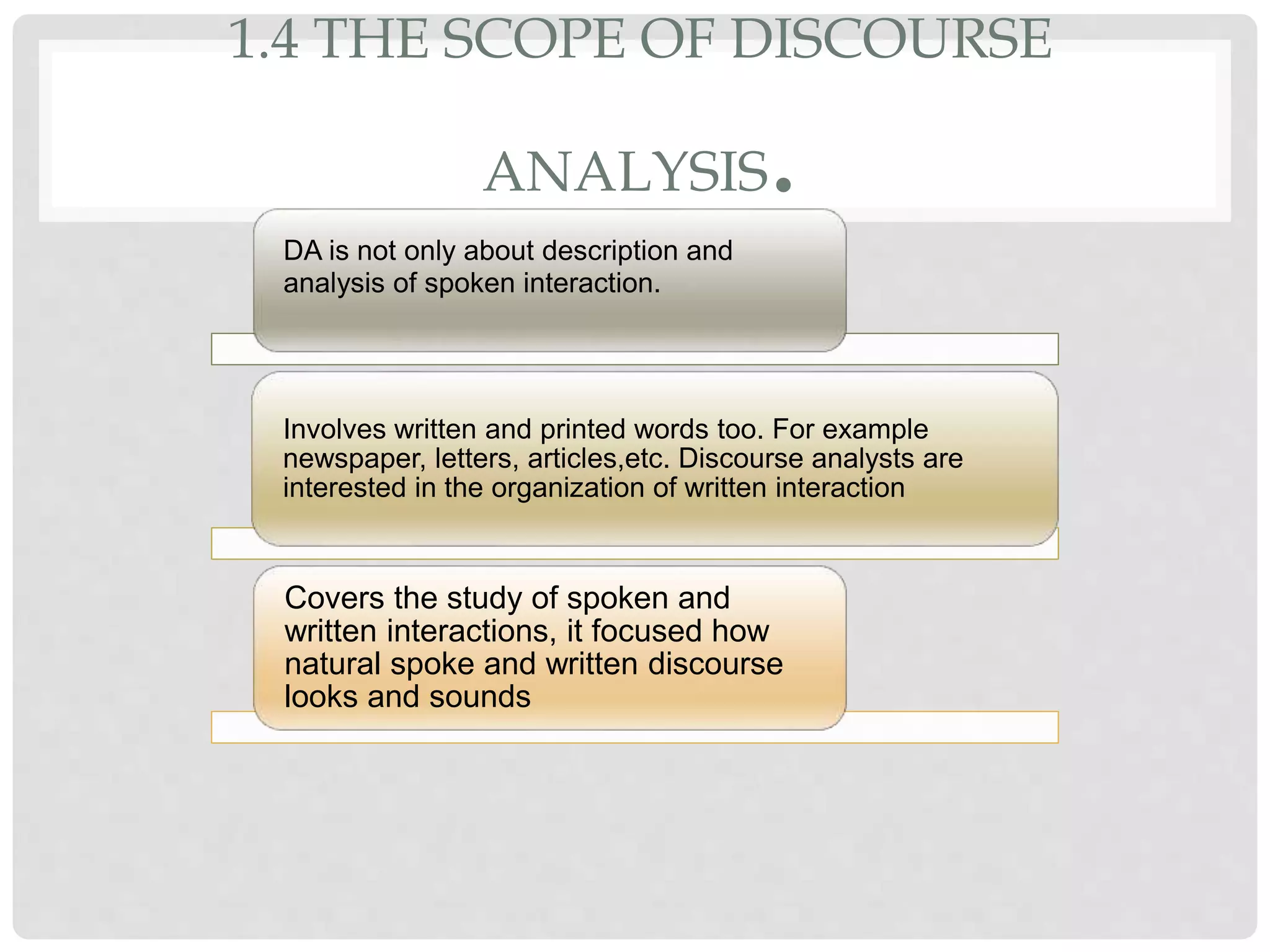
1.4 THE SCOPE OF DISCOURSE
ANALYSIS.
DA is not only about description and
analysis of spoken interaction.
Involves written and printed words too. For example
newspaper, letters, articles,etc. Discourse analysts are
interested in the organization of written interaction
Covers the study of spoken and
written interactions, it focused how
natural spoke and written discourse
looks and sounds
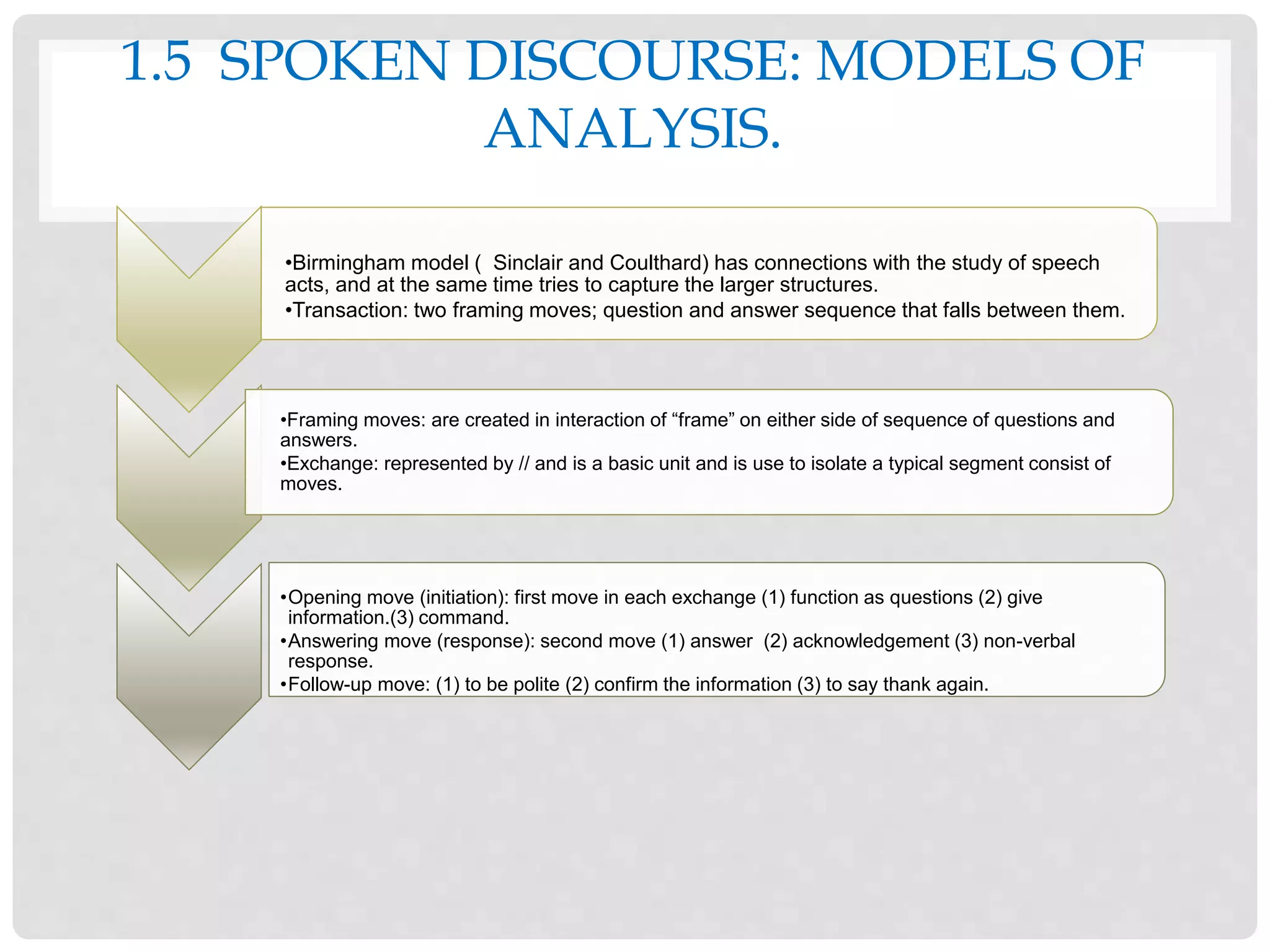
1.5 SPOKEN DISCOURSE: MODELS OF
ANALYSIS.
•Birmingham model ( Sinclair and Coulthard) has connections with the study of speech
acts, and at the same time tries to capture the larger structures.
•Transaction: two framing moves; question and answer sequence that falls between them.
•Framing moves: are created in interaction of “frame” on either side of sequence of questions and
answers.
•Exchange: represented by // and is a basic unit and is use to isolate a typical segment consist of
moves.
•Opening move (initiation): first move in each exchange (1) function as questions (2) give
information.(3) command.
•Answering move (response): second move (1) answer (2) acknowledgement (3) non-verbal
response.
•Follow-up move: (1) to be polite (2) confirm the information (3) to say thank again.
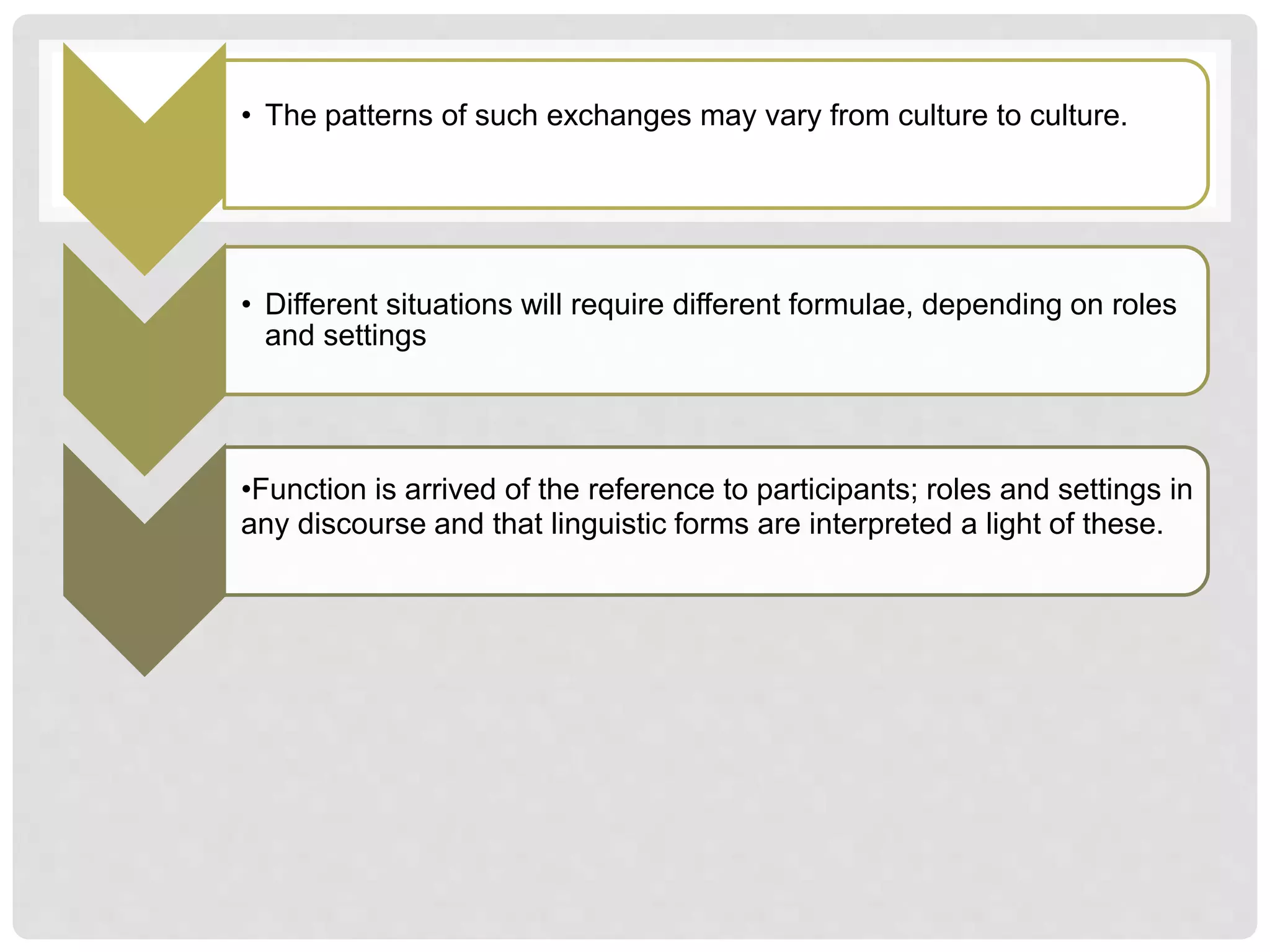
• The patterns of such exchanges may vary from culture to culture.
• Different situations will require different formulae, depending on roles
and settings
•Function is arrived of the reference to participants; roles and settings in
any discourse and that linguistic forms are interpreted a light of these.
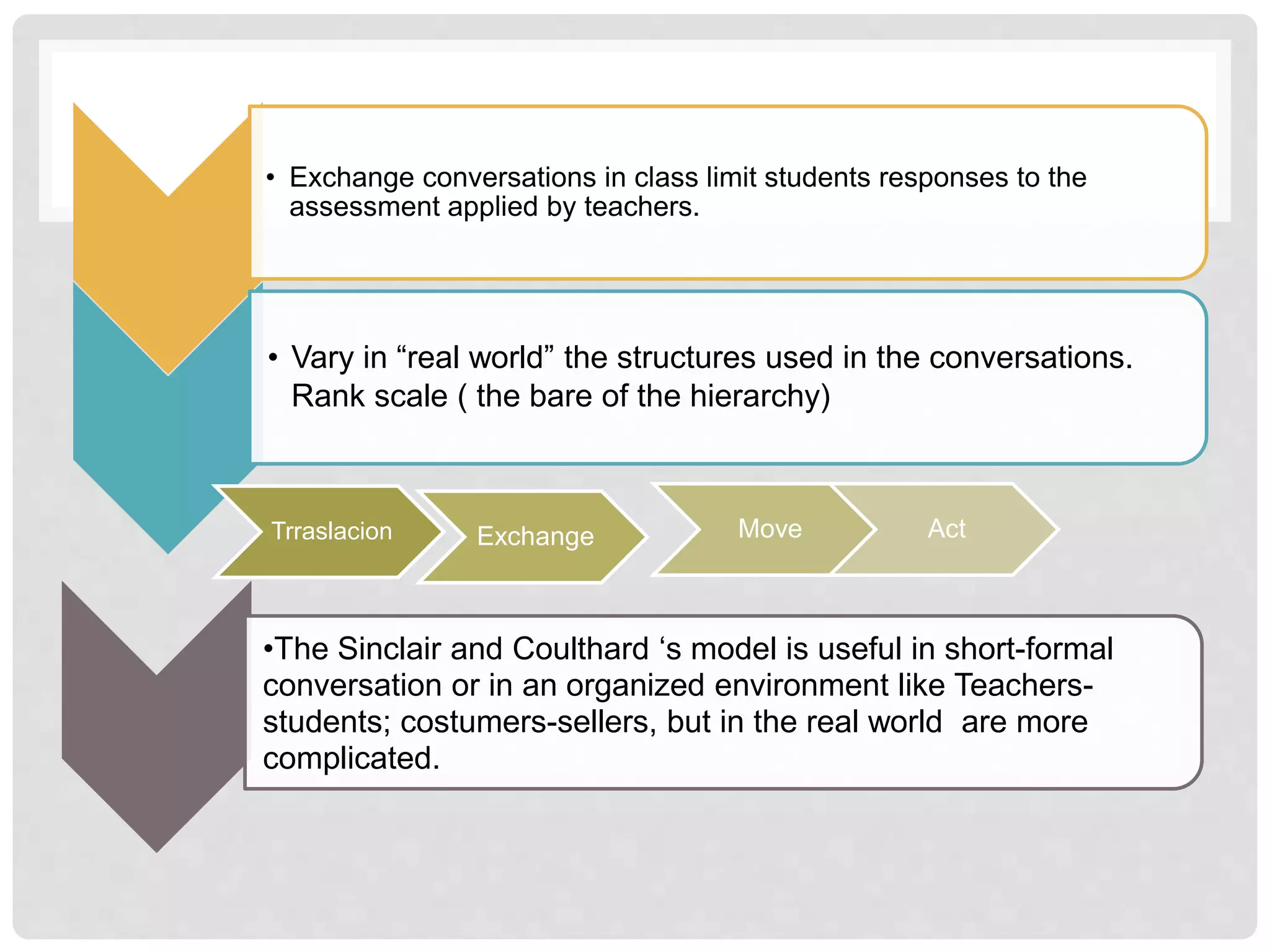
• Exchange conversations in class limit students responses to the
assessment applied by teachers.
• Vary in “real world” the structures used in the conversations.
Rank scale ( the bare of the hierarchy)
•The Sinclair and Coulthard ‘s model is useful in short-formal
conversation or in an organized environment like Teachers-
students; costumers-sellers, but in the real world are more
complicated.
Trraslacion Exchange Move Act
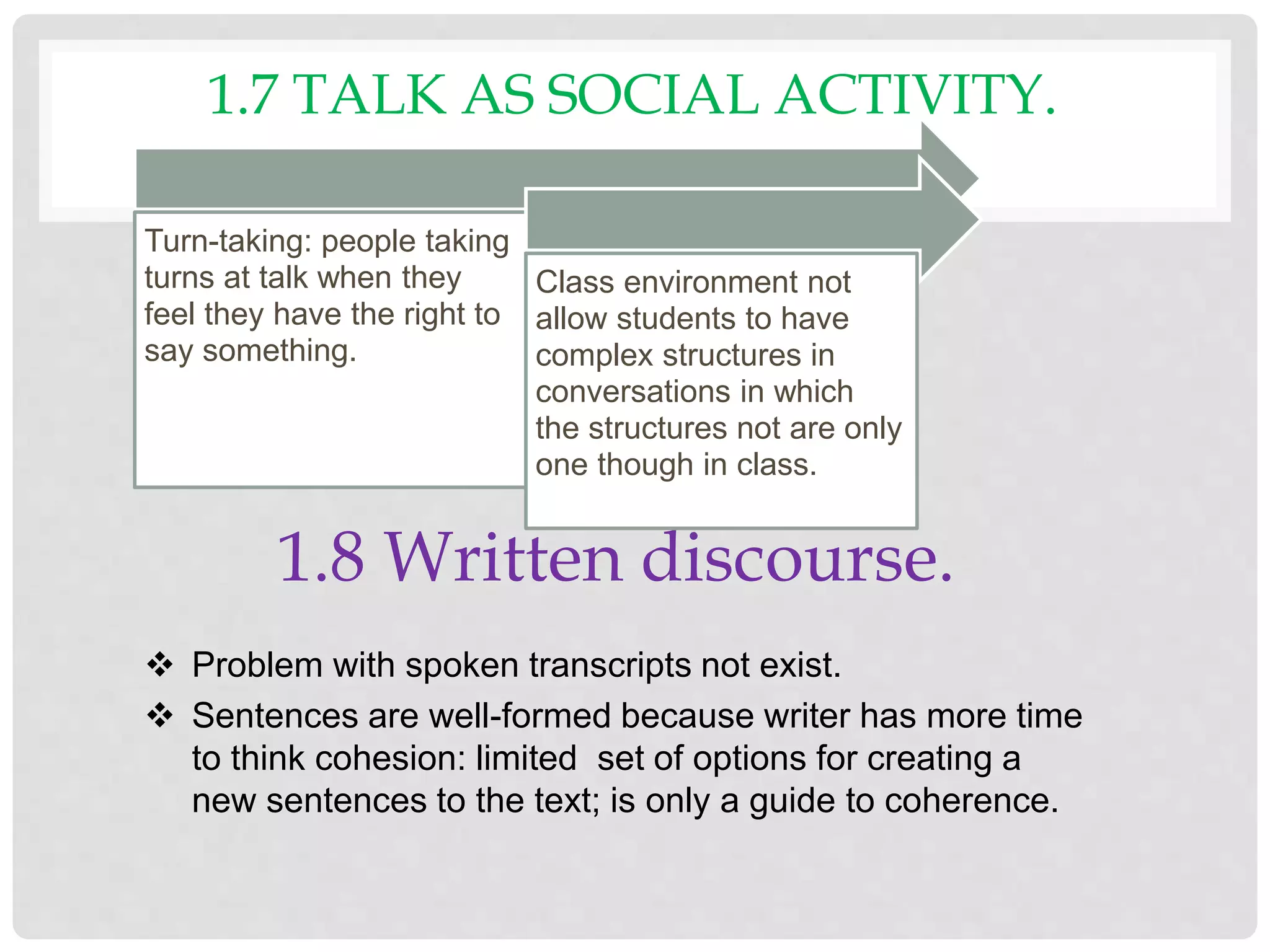
1.7 TALK AS SOCIAL ACTIVITY.
 Problem with spoken transcripts not exist.
 Sentences are well-formed because writer has more time
to think cohesion: limited set of options for creating a
new sentences to the text; is only a guide to coherence.
1.8 Written discourse.
Turn-taking: people taking
turns at talk when they
feel they have the right to
say something.
Class environment not
allow students to have
complex structures in
conversations in which
the structures not are only
one though in class.
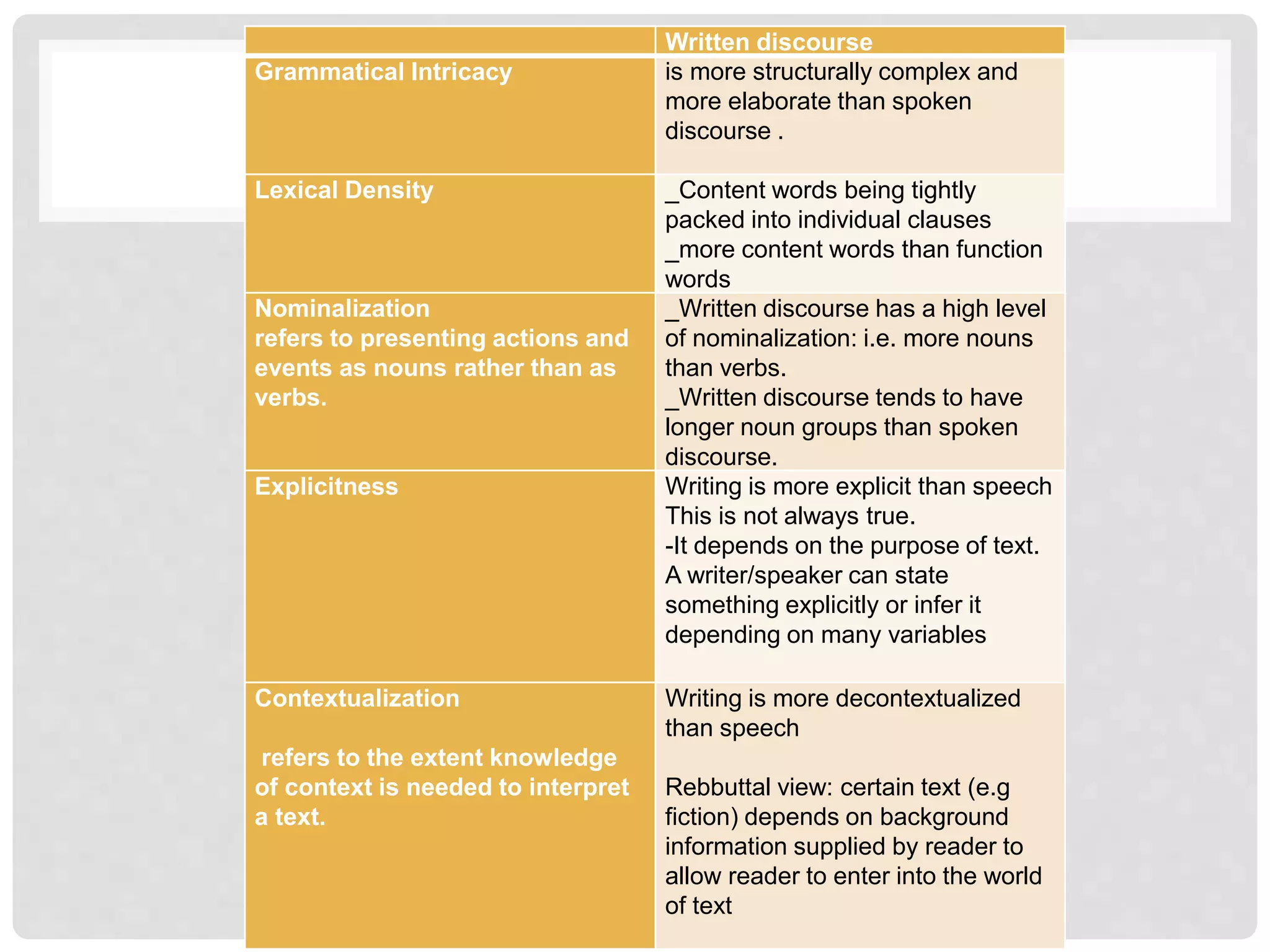
Written discourse
Grammatical Intricacy is more structurally complex and
more elaborate than spoken
discourse .
Lexical Density _Content words being tightly
packed into individual clauses
_more content words than function
words
Nominalization
refers to presenting actions and
events as nouns rather than as
verbs.
_Written discourse has a high level
of nominalization: i.e. more nouns
than verbs.
_Written discourse tends to have
longer noun groups than spoken
discourse.
Explicitness Writing is more explicit than speech
This is not always true.
-It depends on the purpose of text.
A writer/speaker can state
something explicitly or infer it
depending on many variables
Contextualization
refers to the extent knowledge
of context is needed to interpret
a text.
Writing is more decontextualized
than speech
Rebbuttal view: certain text (e.g
fiction) depends on background
information supplied by reader to
allow reader to enter into the world
of text
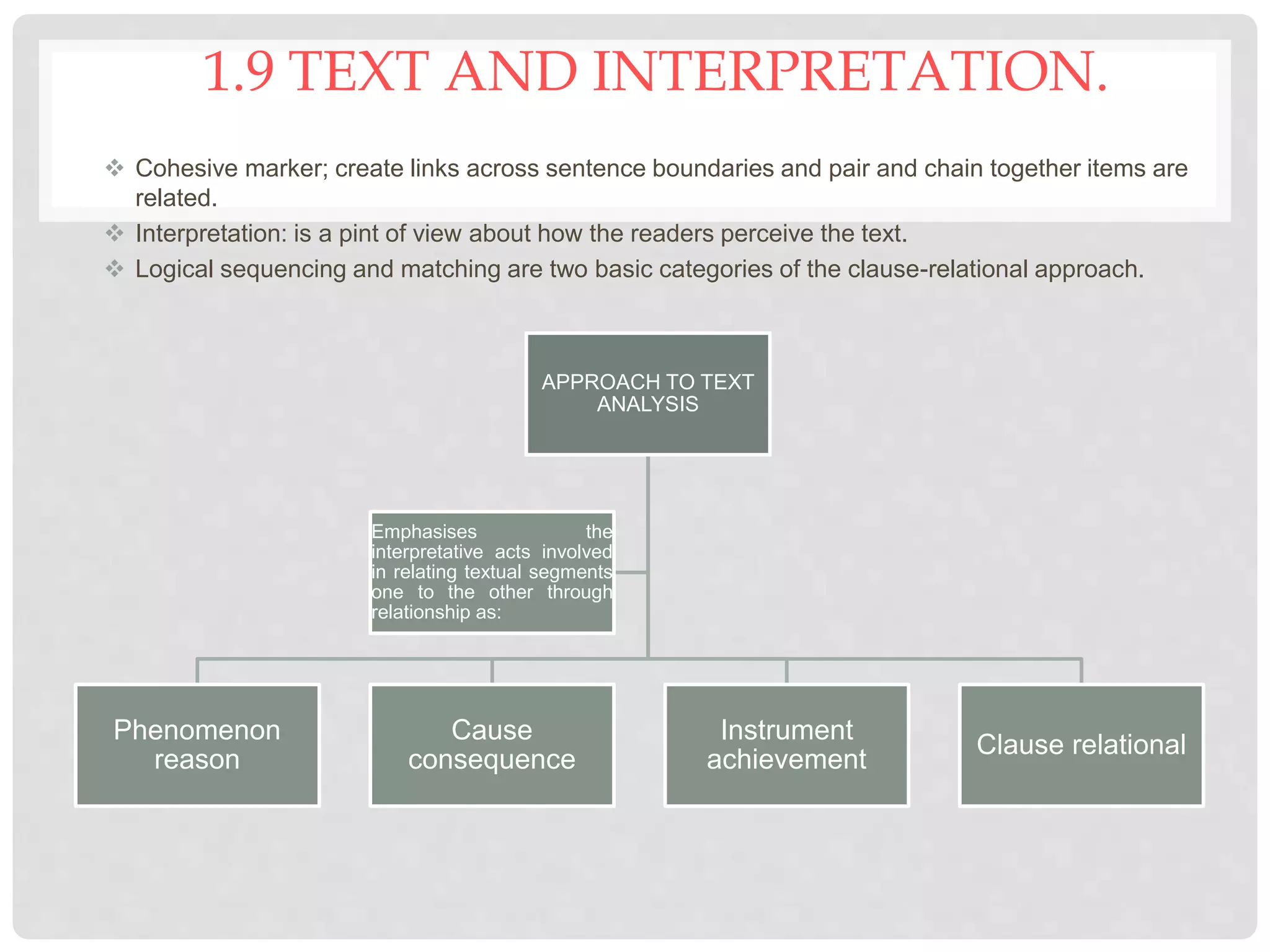
1.9 TEXT AND INTERPRETATION.
 Cohesive marker; create links across sentence boundaries and pair and chain together items are
related.
 Interpretation: is a pint of view about how the readers perceive the text.
 Logical sequencing and matching are two basic categories of the clause-relational approach.
APPROACH TO TEXT
ANALYSIS
Phenomenon
reason
Cause
consequence
Instrument
achievement
Clause relational
Emphasises the
interpretative acts involved
in relating textual segments
one to the other through
relationship as:
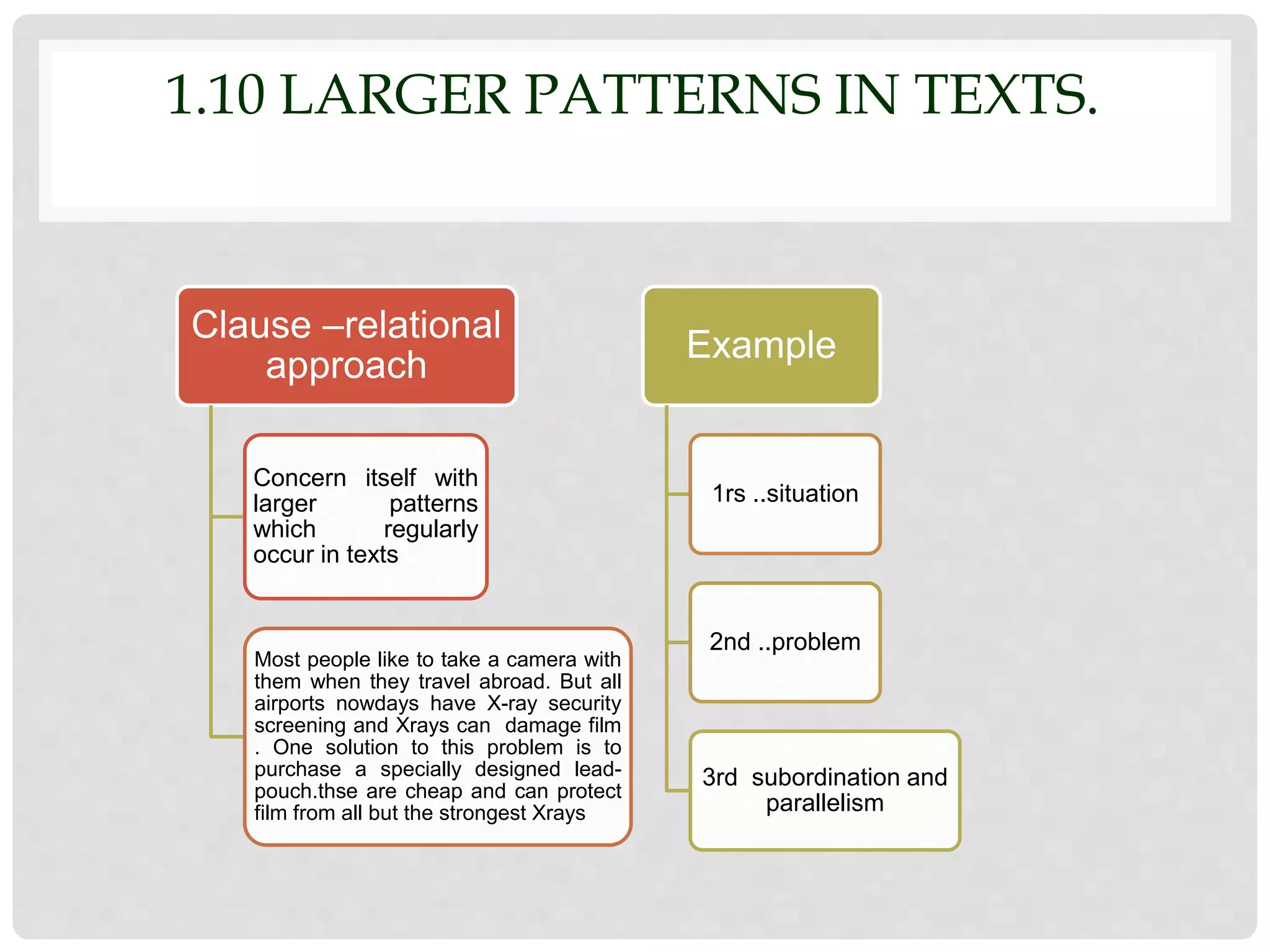
1.10 LARGER PATTERNS IN TEXTS.
Clause –relational
approach
Concern itself with
larger patterns
which regularly
occur in texts
Most people like to take a camera with
them when they travel abroad. But all
airports nowdays have X-ray security
screening and Xrays can damage film
. One solution to this problem is to
purchase a specially designed lead-
pouch.thse are cheap and can protect
film from all but the strongest Xrays
Example
1rs ..situation
2nd ..problem
3rd subordination and
parallelism
CONCLUSION
• It is an area of linguistics it identifies how people
construct a vision of the world using language and other
forms of communication, so often look at the way that we
as humans interpret ideas based on language used to
express them. Example the word a ‘terrorist’ or a
‘freedom fighter’. To expand, 'terrorist' is a term that
brings negative connotations of evil and violence,
whereas 'freedom fighter' has positive connotations of
fighting towards political upheaval of dictatorships.
Discourse analysis is really interested in how people
use these differences in language in order to so
construct a slightly different views on the world.

Learning activity 2

  • 1.
    J O RG E F L O R E S LEARNING ACTIVITY 2.1
  • 2.
    1.1 A BRIEFHISTORICAL OVERVIEW Study of relationship between language and the contexts in which is used. Language in use: - written texts - spoken data: conversation/ forms of talk. • What is discourse analysis : influenced by MAK; functional approach; social functions of language and the thematic and informational structure f speech and writing. Sinclair and Coulthard is a model based n teacher- pupil talk, have hierarchy of discourse units. Intonation in discourse. Followed structural- linguistic criteria. • British discourse analysis Research method of close observation of groups of people communicating in natural setting. For example: story telling, greeting rituals and verbal duels in different cultural and social settings. Conversation analysis. Natural data. Conversational norms. Exist in this approach different discourse types. • American Discourse:
  • 3.
    1.2 FORM ANDFUNCTION. Decisions about communicative function cannot solely be the domain of grammar or phonology. The situations that we will to follow different conventions and the factors that are involved. Fundamental distinction: language forms and discourse functions.
  • 4.
    1.3 SPEECH ACTSAND DISCOURSE STRUCTURES. Functions: concerned what are doing with language as what they saying Discourse analysis is fundamentally concerned with the relationship between language and the context of its use. Difficult: attaching of speech-act labels to utterances . Features difficult to interpret. Speech acts approach to communicate language teaching emphasizes the functions.
  • 5.
    1.4 THE SCOPEOF DISCOURSE ANALYSIS. DA is not only about description and analysis of spoken interaction. Involves written and printed words too. For example newspaper, letters, articles,etc. Discourse analysts are interested in the organization of written interaction Covers the study of spoken and written interactions, it focused how natural spoke and written discourse looks and sounds
  • 6.
    1.5 SPOKEN DISCOURSE:MODELS OF ANALYSIS. •Birmingham model ( Sinclair and Coulthard) has connections with the study of speech acts, and at the same time tries to capture the larger structures. •Transaction: two framing moves; question and answer sequence that falls between them. •Framing moves: are created in interaction of “frame” on either side of sequence of questions and answers. •Exchange: represented by // and is a basic unit and is use to isolate a typical segment consist of moves. •Opening move (initiation): first move in each exchange (1) function as questions (2) give information.(3) command. •Answering move (response): second move (1) answer (2) acknowledgement (3) non-verbal response. •Follow-up move: (1) to be polite (2) confirm the information (3) to say thank again.
  • 7.
    • The patternsof such exchanges may vary from culture to culture. • Different situations will require different formulae, depending on roles and settings •Function is arrived of the reference to participants; roles and settings in any discourse and that linguistic forms are interpreted a light of these.
  • 9.
    • Exchange conversationsin class limit students responses to the assessment applied by teachers. • Vary in “real world” the structures used in the conversations. Rank scale ( the bare of the hierarchy) •The Sinclair and Coulthard ‘s model is useful in short-formal conversation or in an organized environment like Teachers- students; costumers-sellers, but in the real world are more complicated. Trraslacion Exchange Move Act
  • 10.
    1.7 TALK ASSOCIAL ACTIVITY.  Problem with spoken transcripts not exist.  Sentences are well-formed because writer has more time to think cohesion: limited set of options for creating a new sentences to the text; is only a guide to coherence. 1.8 Written discourse. Turn-taking: people taking turns at talk when they feel they have the right to say something. Class environment not allow students to have complex structures in conversations in which the structures not are only one though in class.
  • 11.
    Written discourse Grammatical Intricacyis more structurally complex and more elaborate than spoken discourse . Lexical Density _Content words being tightly packed into individual clauses _more content words than function words Nominalization refers to presenting actions and events as nouns rather than as verbs. _Written discourse has a high level of nominalization: i.e. more nouns than verbs. _Written discourse tends to have longer noun groups than spoken discourse. Explicitness Writing is more explicit than speech This is not always true. -It depends on the purpose of text. A writer/speaker can state something explicitly or infer it depending on many variables Contextualization refers to the extent knowledge of context is needed to interpret a text. Writing is more decontextualized than speech Rebbuttal view: certain text (e.g fiction) depends on background information supplied by reader to allow reader to enter into the world of text
  • 12.
    1.9 TEXT ANDINTERPRETATION.  Cohesive marker; create links across sentence boundaries and pair and chain together items are related.  Interpretation: is a pint of view about how the readers perceive the text.  Logical sequencing and matching are two basic categories of the clause-relational approach. APPROACH TO TEXT ANALYSIS Phenomenon reason Cause consequence Instrument achievement Clause relational Emphasises the interpretative acts involved in relating textual segments one to the other through relationship as:
  • 13.
    1.10 LARGER PATTERNSIN TEXTS. Clause –relational approach Concern itself with larger patterns which regularly occur in texts Most people like to take a camera with them when they travel abroad. But all airports nowdays have X-ray security screening and Xrays can damage film . One solution to this problem is to purchase a specially designed lead- pouch.thse are cheap and can protect film from all but the strongest Xrays Example 1rs ..situation 2nd ..problem 3rd subordination and parallelism
  • 14.
    CONCLUSION • It isan area of linguistics it identifies how people construct a vision of the world using language and other forms of communication, so often look at the way that we as humans interpret ideas based on language used to express them. Example the word a ‘terrorist’ or a ‘freedom fighter’. To expand, 'terrorist' is a term that brings negative connotations of evil and violence, whereas 'freedom fighter' has positive connotations of fighting towards political upheaval of dictatorships. Discourse analysis is really interested in how people use these differences in language in order to so construct a slightly different views on the world.