IOSR Journal of Mechanical and Civil Engineering (IOSR-JMCE)
e-ISSN: 2278-1684,p-ISSN: 2320-334X, Volume 12, Issue 6 Ver. II (Nov. - Dec. 2015), PP 105-114
www.iosrjournals.org
DOI: 10.9790/1684-1262105114 www.iosrjournals.org 105 | Page
Accident Analysis At The Black Spot: A Case Study
Mr.Yashas.S.R
1
, Mr.Harish.S.N
2
, Prof.H.R.Muralidhar
3
1
Student, 4
th
Year, Civil Engineering, Malnad College of Engineering, Hassan, Karnataka, India.
2
Student, 4
th
Year, Civil Engineering, Malnad College of Engineering, Hassan , Karnataka, India.
3
Professor, Department of Civil Engineering, Malnad college of Engineering, Hassan, Karnataka, India.
Abstract: Humans prefer comfort in every form. The same reason has prompted him to lay the roads and invent
motor vehicles. This is the era we are seeing very huge number of vehicles on the roads. But to his dismay, with this
comfortless, there came the problem of accidents due to increase in traffic volume. The increased human misery and
serious economic loss caused by road accidents demand the attention of the society and call for the solution of this
problem. The causes for accidents are many. It may be either due to the fault of the driver or vehicular defect, tough
weather condition or due to improper road design and many more. Precisely, if accidents occur frequently at a
particular road stretch then, the location is coined as Black Spot. In the present work, an attempt has been made to
evaluate the effects of highway geometrics and speed parameters in increased accident rates at the black spot. The
black spot of our interest is Busthenahalli bypass (spot-A) on National Highway-48 between Bangalore and
Mangalore, Karnataka, India. The mixed traffic condition prevailing on the road and the inadequate geometric
conditions on field create the problem of increased accident rates. The regression equation for the condition
prevailing has been found for the location under consideration which represents the variation of accident rate with
age of the driver, rise and fall, pavement width, Stopping Sight Distance for operating speed and regulating speed and
Annual Daily Traffic(ADT).
Keywords - Accident rate, Black spot, Curve fitting, Geometric parameter, Regression analysis.
I. Introduction
The spectacular increase in number of motor vehicles on road has created a major social problem-the
loss of lives through road accidents. The appalling human misery and serious economic loss caused by road
accidents demand the attention of the society and call for the solution of the problem. A multi-disciplinary
approach is needed in understanding the problem and providing solution. Many features of highway affect the
safety of vehicle and other road user, which leads to accidents and the improvements that may be desired. Based
on the statistics, the traffic and highway engineer must devise ways to reduce accidents through better planning,
design, construction and maintenance of traffic operation with appropriate regulatory measures. The accident
situation is too more serious in India because of rapid growth of motor vehicles in the past few years and the
inadequacy of many of our roads and streets to cope up with this traffic. It is estimated that the number of
persons killed per 10,000 vehicles is 24.A recent Annual Accident Survey report of Hassan town highlights that
Busthenahalli bypass(spot-A) of Hassan District, Karnataka, India i.e., between Bangalore-Mangalore,
Karnataka as an accident-prone zone. The fatality rate of accidents are very much high over the years. The
mixed traffic conditions prevailing on road, inadequate geometric conditions and attention of maintaining
appropriate road geometric standards at the time of resurfacing maybe creating the problem in increasing
accident rates. Here, an attempt has been made to analyze the impact of highway geometries and vehicular
movement on the accident rate. The presently available geometric parameters are being compared with the
present traffic conditions. The geometric elements evaluated are compared with the past geometric details and
also with the geometric elements suggested by IRC. It gives an insight to the lapses in design for the existing
condition on the field. Introduction of the paper should explain the nature of the problem, previous work,
purpose, and the contribution of the paper. The contents of each section may be provided to understand easily
about the paper.
II. Methodology
The test stretch under consideration, the independent variables like geometric parameters, age of driver,
rise and fall, Annual Daily Traffic (ADT), SSD for operating speed, and SSD for regulating speed are evaluated.
The accident data are collected from the records of Hassan City Police Station, Karnataka, India. After having
the information individual relationship between accidents rates versus independent variables is established using
“IBM SPSS Statistics 19” software. The relationship obtained between accident rate and each independent
variable is nonlinear and they are initially linearized. Finally using all the variables multiple regression equation
Accident Analysis At The Black Spot: A Case Study
DOI: 10.9790/1684-1262105114 www.iosrjournals.org 106 | Page
is developed and is presented. The validation of the model is carried out and tested for hypothesis to decide at
what confidence of interval this equation can be used in the field. The analysis of accident statistics provides
clues to the many factors that lead to the accidents and to improvements that may be desired. Accident data also
supply valuable information to control, to regulate and manage the traffic more efficiently. Hence, based on
these studies, the traffic engineer must devise ways to reduce accidents through better planning, design,
construction, maintenance, traffic operation with timely regulation and management of traffic to ensure safety
for the road users.
III. Statistical Alalysis And Results
3.1 Relationship between age of driver and accident severity.
The analysis is performed using the effective tool called Chi Square Test to compare the observed and
expected value of the parameter under consideration and also to suggest that relationship established will be use
full for prediction in future. The test helps in deciding the authenticity of observed and expected value. The
observed value here is the information collected through the police records where through the objected data
logic is derived and through logic, excepted values are evaluated.
TABLE I: Showing the Results Accident Rate Influencing the Age Group of Driver at Spot-A at 99.5%
Confidence Interval
Year (Ψ) 2
observed (ψ)2
tabled
2011 1.828 0.676
2012 1.740 0.676
2013 1.467 0.676
2014 0.527 0.676
The above results of table II helps in bringing the concurrency of expected and observed value. The
above procedure includes testing of proportions with contingency tables and evaluating of goodness of fit. If
chi-square observed is greater than Chi-Square expected, observed and expected values are in agreement. The
closer the agreement suggests the hypothesis agrees to that level of confidence interval.
Here (ψ)
2
Observed is greater than (ψ)
2
tabled at 99.5% confidence interval in most of the cases at the spot-A
and hence the hypothesis is true that accident severity is influencing the age of driver by applying a logic ratio
and proportion technique.
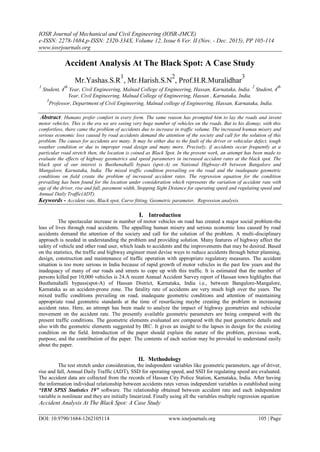
3.2 Spot Speed Analysis at spot-A.
TABLE II: Showing the showing data for spot speed analysis results
Accident Analysis At The Black Spot: A Case Study
DOI: 10.9790/1684-1262105114 www.iosrjournals.org 107 | Page
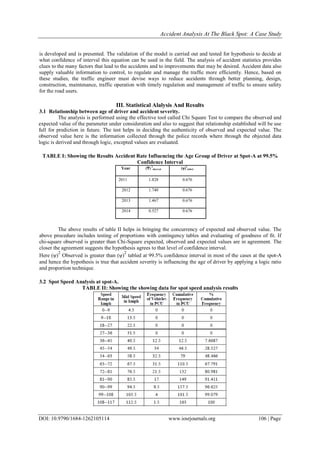
Fig. 1 Showing Variation of percentage of Cumulative Frequency with Mid Speed.
Following speed was obtained from the curve:
 Design speed(98th percentile) 99.54 kmph 
 Upper speed limit(85th percentile) 83.83 kmph 
 Medium speed(50th percentile) 59.21 kmph 
 Lower speed limit (15th percentile) 43.65 kmph. 

3.3 Regression model between accident rate and rise and fall.
TABLE III: Table showing regression models for accident rate versus rise at spot-a
Model
Equation Summary
R2
F
Linear
0.954 185.255
b0+b1x
Logarithmic
0.863 56.462
bolog(b1x)
Inverse
0.710 22.062
bo*e(xlnb
1
)
Quadratic
0.966 113.304
bo+b1*x+b2*x2
Cubic
0.989 204.949bo+b1*x+b2*x2
+b3*x3
Compound
0.784 32.732
b0(b1
x
)
Power
0.617 14.490
bo(xb1
)
Growth
0.784 32.732
b0ex
Exponential
0.784 32.732
b0eb1x
Logistic
1/(1+e-x
) 0.784 32.732
x=b0+b1x
Accident Analysis At The Black Spot: A Case Study
DOI: 10.9790/1684-1262105114 www.iosrjournals.org 108 | Page
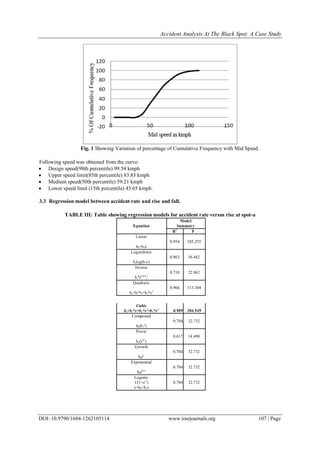
From the model it is evident that the relationship between accident rate and rise is cubic in nature at
Spot-A. It may appear that accident rate is having a direct impact on rise. As the rise increases the resistance to
motion may increase and the tendency of the driver is to accelerate the vehicle. If the visibility problem is
accumulated in the above section accident rate may increase. As R
2
value calculated is closer to unity, rise may
have an impact in causing the accident in the location under consideration.
Fig. 2 Showing Variation of Accident rate versus Rise.
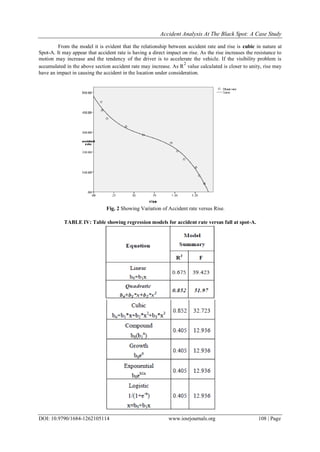
TABLE IV: Table showing regression models for accident rate versus fall at spot-A.
IOSR Journal of Mechanical and Civil Engineering (IOSR-JMCE)
e-ISSN: 2278-1684,p-ISSN: 2320-334X, Volume 12, Issue 6 Ver. II (Nov. - Dec. 2015), PP 105-114
www.iosrjournals.org
DOI: 10.9790/1684-1262105114 www.iosrjournals.org 109 | Page
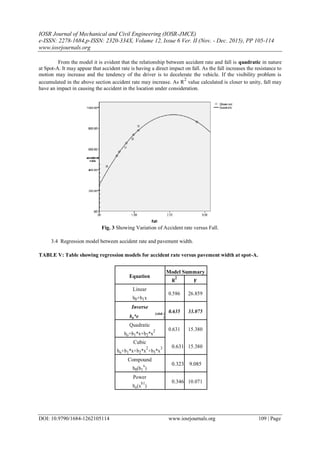
From the model it is evident that the relationship between accident rate and fall is quadratic in nature
at Spot-A. It may appear that accident rate is having a direct impact on fall. As the fall increases the resistance to
motion may increase and the tendency of the driver is to decelerate the vehicle. If the visibility problem is
accumulated in the above section accident rate may increase. As R
2
value calculated is closer to unity, fall may
have an impact in causing the accident in the location under consideration.
Fig. 3 Showing Variation of Accident rate versus Fall.
3.4 Regression model between accident rate and pavement width.
TABLE V: Table showing regression models for accident rate versus pavement width at spot-A.
Equation
Model Summary
R
2
F
Linear
0.586 26.859
b0+b1x
Inverse
0.635 33.075
bo*e
(xlnb )
1
Quadratic
0.631 15.380
bo+b1*x+b2*x
2
Cubic
0.631 15.380
bo+b1*x+b2*x
2
+b3*x
3
Compound
0.323 9.085
b0(b1
x
)
Power
0.346 10.071
bo(x
b1
)
Accident Analysis At The Black Spot: A Case Study
DOI: 10.9790/1684-1262105114 www.iosrjournals.org 110 | Page
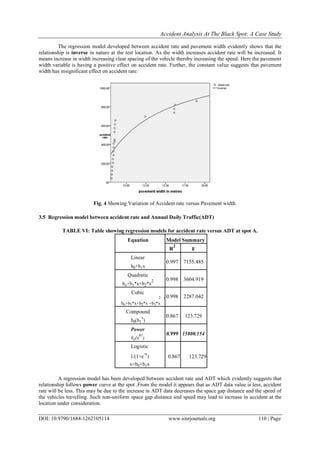
The regression model developed between accident rate and pavement width evidently shows that the
relationship is inverse in nature at the test location. As the width increases accident rate will be increased. It
means increase in width increasing clear spacing of the vehicle thereby increasing the speed. Here the pavement
width variable is having a positive effect on accident rate. Further, the constant value suggests that pavement
width has insignificant effect on accident rate.
Fig. 4 Showing Variation of Accident rate versus Pavement width.
3.5 Regression model between accident rate and Annual Daily Traffic(ADT)
TABLE VI: Table showing regression models for accident rate versus ADT at spot A.
Equation Model Summary
R
2
F
Linear
0.997 7155.485
b0+b1x
Quadratic
0.998 3604.919
bo+b1*x+b2*x
2
Cubic
0.998 2287.0422 3
bo+b1*x+b2*x +b3*x
Compound
0.867 123.729
b0(b1
x
)
Power
0.999 15800.154
bo(x
b1
)
Logistic
1/(1+e
-x
) 0.867 123.729
x=b0+b1x
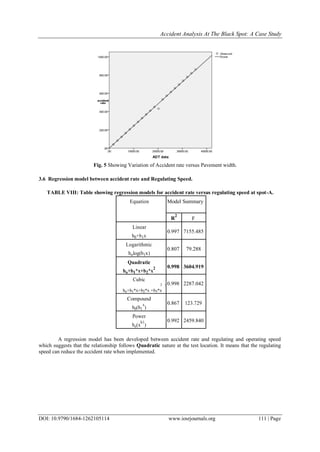
A regression model has been developed between accident rate and ADT which evidently suggests that
relationship follows power curve at the spot .From the model it appears that as ADT data value is less, accident
rate will be less. This may be due to the increase in ADT data decreases the space gap distance and the speed of
the vehicles travelling. Such non-uniform space gap distance and speed may lead to increase in accident at the
location under consideration.
Accident Analysis At The Black Spot: A Case Study
DOI: 10.9790/1684-1262105114 www.iosrjournals.org 111 | Page
Fig. 5 Showing Variation of Accident rate versus Pavement width.
3.6 Regression model between accident rate and Regulating Speed.
TABLE VIII: Table showing regression models for accident rate versus regulating speed at spot-A.
Equation Model Summary
R
2
F
Linear
0.997 7155.485
b0+b1x
Logarithmic
0.807 79.288
bolog(b1x)
Quadratic
0.998 3604.919
bo+b1*x+b2*x
2
Cubic
0.998 2287.0422 3
bo+b1*x+b2*x +b3*x
Compound
0.867 123.729
b0(b1
x
)
Power
0.992 2459.840
bo(x
b1
)
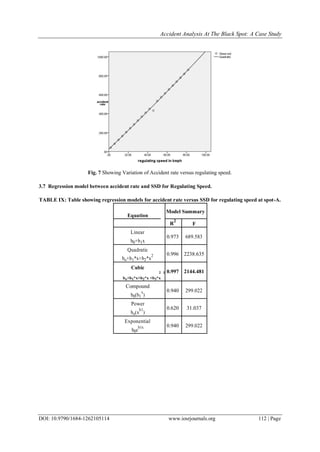
A regression model has been developed between accident rate and regulating and operating speed
which suggests that the relationship follows Quadratic nature at the test location. It means that the regulating
speed can reduce the accident rate when implemented.
Accident Analysis At The Black Spot: A Case Study
DOI: 10.9790/1684-1262105114 www.iosrjournals.org 112 | Page
Fig. 7 Showing Variation of Accident rate versus regulating speed.
3.7 Regression model between accident rate and SSD for Regulating Speed.
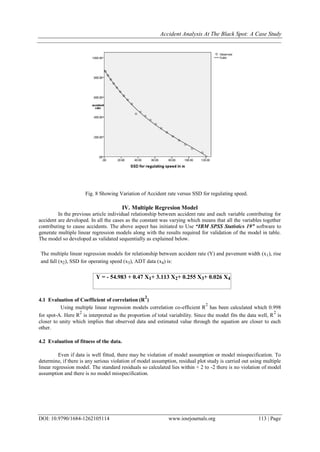
TABLE IX: Table showing regression models for accident rate versus SSD for regulating speed at spot-A.
Equation
Model Summary
R
2
F
Linear
0.973 689.583
b0+b1x
Quadratic
0.996 2238.635
bo+b1*x+b2*x
2
Cubic
0.997 2144.4812 3
bo+b1*x+b2*x +b3*x
Compound
0.940 299.022
b0(b1
x
)
Power
0.620 31.037
bo(x
b1
)
Exponential
0.940 299.022
b0e
b1x
Accident Analysis At The Black Spot: A Case Study
DOI: 10.9790/1684-1262105114 www.iosrjournals.org 113 | Page
Fig. 8 Showing Variation of Accident rate versus SSD for regulating speed.
IV. Multiple Regresion Model
In the previous article individual relationship between accident rate and each variable contributing for
accident are developed. In all the cases as the constant was varying which means that all the variables together
contributing to cause accidents. The above aspect has initiated to Use “IBM SPSS Statistics 19” software to
generate multiple linear regression models along with the results required for validation of the model in table.
The model so developed as validated sequentially as explained below.
The multiple linear regression models for relationship between accident rate (Y) and pavement width (x1), rise
and fall (x2), SSD for operating speed (x3), ADT data (x4) is:
Y = - 54.983 + 0.47 X1+ 3.113 X2+ 0.255 X3+ 0.026 X4
4.1 Evaluation of Coefficient of correlation (R
2
)
Using multiple linear regression models correlation co-efficient R
2
has been calculated which 0.998
for spot-A. Here R
2
is interpreted as the proportion of total variability. Since the model fits the data well, R
2
is
closer to unity which implies that observed data and estimated value through the equation are closer to each
other.
4.2 Evaluation of fitness of the data.
Even if data is well fitted, there may be violation of model assumption or model misspecification. To
determine, if there is any serious violation of model assumption, residual plot study is carried out using multiple
linear regression model. The standard residuals so calculated lies within + 2 to -2 there is no violation of model
assumption and there is no model misspecification.
Accident Analysis At The Black Spot: A Case Study
DOI: 10.9790/1684-1262105114 www.iosrjournals.org 114 | Page
4.3 Evaluation of goodness of fit using standard static F-Test.
To check the authenticity of goodness of fit standard static F-test has been performed using multiple
linear regression models by IBM SPSS Statistics 19. Ftabled is calculated which is 4.7.Here Fcalculated is
1602.007. As Fcalculated is greater than Ftabled at 99.9% level of confidence the goodness of fit condition is
satisfied.
V. Conclusions
From the above project study carried out for spot-A, the following conclusions are arrived:
1. The age group of the driver is influencing in increasing the accident rate.
2. The increase in accident rate in the test may be due to rise and fall of the location.
3. Decrease in pavement width may be one of the reasons to increase the accident rate at the location under
consideration.
4. Increase in operating speed may be causative for the increase in accident rate at the test location.
4. Especially at junctions because of the interference of the flow accident rate may be increased.
5. Increase in ADT especially in peak hour flow may be one of the reasons to increase accident rate.
6. The accident rate may be brought down if operating speed is limited to regulating speed.
8. Increase in road width at critical location under consideration may be the reason to increase accident rate.
References
[1] Cohen. J. and B. Preston, Causes and Prevention of road accidents, Faber and Faber, London, 1968.
[2] Road User Cost Study, Final Report, Central Road Research Institute, New Delhi, 1982.
[3] Road Accident Forms A-1 and 4, the IRC. New Delhi, 1982.
[4] Report of the study group on road safety, ministry of transport, New Delhi, 1972.
[5] Road Safety-A Committee Report, Ministry of Shipping and Transport, New Delhi, 1983.
[6] Safety of motor-cycle and scooter riders, Editorial, Transport Communications Monthly Review, No. 254, New Delhi, 1973.
[7] Special Issue on Motor Vehicle Accident Statistics in India, 1986, Transport Research Division, Ministry of Surface Transport,
New Delhi, 1986.
[8] Motor Transport Statistics, 1991-93 Transport Research Division, Ministry of Shipping and Transport, Govt. of India, New Delhi.
[9] Special Issue on Motor Vehicle Accident Statistics in India, 1986, Transport Research Division, Ministry of Surface Transport,
New Delhi, 1986.
[10] IBM SPSS Statistics 19 Brief Guide © Copyright IBM Corporation 1989, 2011

Accident Analysis At The Black Spot: A Case Study

  • 1.
    IOSR Journal ofMechanical and Civil Engineering (IOSR-JMCE) e-ISSN: 2278-1684,p-ISSN: 2320-334X, Volume 12, Issue 6 Ver. II (Nov. - Dec. 2015), PP 105-114 www.iosrjournals.org DOI: 10.9790/1684-1262105114 www.iosrjournals.org 105 | Page Accident Analysis At The Black Spot: A Case Study Mr.Yashas.S.R 1 , Mr.Harish.S.N 2 , Prof.H.R.Muralidhar 3 1 Student, 4 th Year, Civil Engineering, Malnad College of Engineering, Hassan, Karnataka, India. 2 Student, 4 th Year, Civil Engineering, Malnad College of Engineering, Hassan , Karnataka, India. 3 Professor, Department of Civil Engineering, Malnad college of Engineering, Hassan, Karnataka, India. Abstract: Humans prefer comfort in every form. The same reason has prompted him to lay the roads and invent motor vehicles. This is the era we are seeing very huge number of vehicles on the roads. But to his dismay, with this comfortless, there came the problem of accidents due to increase in traffic volume. The increased human misery and serious economic loss caused by road accidents demand the attention of the society and call for the solution of this problem. The causes for accidents are many. It may be either due to the fault of the driver or vehicular defect, tough weather condition or due to improper road design and many more. Precisely, if accidents occur frequently at a particular road stretch then, the location is coined as Black Spot. In the present work, an attempt has been made to evaluate the effects of highway geometrics and speed parameters in increased accident rates at the black spot. The black spot of our interest is Busthenahalli bypass (spot-A) on National Highway-48 between Bangalore and Mangalore, Karnataka, India. The mixed traffic condition prevailing on the road and the inadequate geometric conditions on field create the problem of increased accident rates. The regression equation for the condition prevailing has been found for the location under consideration which represents the variation of accident rate with age of the driver, rise and fall, pavement width, Stopping Sight Distance for operating speed and regulating speed and Annual Daily Traffic(ADT). Keywords - Accident rate, Black spot, Curve fitting, Geometric parameter, Regression analysis. I. Introduction The spectacular increase in number of motor vehicles on road has created a major social problem-the loss of lives through road accidents. The appalling human misery and serious economic loss caused by road accidents demand the attention of the society and call for the solution of the problem. A multi-disciplinary approach is needed in understanding the problem and providing solution. Many features of highway affect the safety of vehicle and other road user, which leads to accidents and the improvements that may be desired. Based on the statistics, the traffic and highway engineer must devise ways to reduce accidents through better planning, design, construction and maintenance of traffic operation with appropriate regulatory measures. The accident situation is too more serious in India because of rapid growth of motor vehicles in the past few years and the inadequacy of many of our roads and streets to cope up with this traffic. It is estimated that the number of persons killed per 10,000 vehicles is 24.A recent Annual Accident Survey report of Hassan town highlights that Busthenahalli bypass(spot-A) of Hassan District, Karnataka, India i.e., between Bangalore-Mangalore, Karnataka as an accident-prone zone. The fatality rate of accidents are very much high over the years. The mixed traffic conditions prevailing on road, inadequate geometric conditions and attention of maintaining appropriate road geometric standards at the time of resurfacing maybe creating the problem in increasing accident rates. Here, an attempt has been made to analyze the impact of highway geometries and vehicular movement on the accident rate. The presently available geometric parameters are being compared with the present traffic conditions. The geometric elements evaluated are compared with the past geometric details and also with the geometric elements suggested by IRC. It gives an insight to the lapses in design for the existing condition on the field. Introduction of the paper should explain the nature of the problem, previous work, purpose, and the contribution of the paper. The contents of each section may be provided to understand easily about the paper. II. Methodology The test stretch under consideration, the independent variables like geometric parameters, age of driver, rise and fall, Annual Daily Traffic (ADT), SSD for operating speed, and SSD for regulating speed are evaluated. The accident data are collected from the records of Hassan City Police Station, Karnataka, India. After having the information individual relationship between accidents rates versus independent variables is established using “IBM SPSS Statistics 19” software. The relationship obtained between accident rate and each independent variable is nonlinear and they are initially linearized. Finally using all the variables multiple regression equation Accident Analysis At The Black Spot: A Case Study
  • 2.
    Accident Analysis AtThe Black Spot: A Case Study DOI: 10.9790/1684-1262105114 www.iosrjournals.org 106 | Page is developed and is presented. The validation of the model is carried out and tested for hypothesis to decide at what confidence of interval this equation can be used in the field. The analysis of accident statistics provides clues to the many factors that lead to the accidents and to improvements that may be desired. Accident data also supply valuable information to control, to regulate and manage the traffic more efficiently. Hence, based on these studies, the traffic engineer must devise ways to reduce accidents through better planning, design, construction, maintenance, traffic operation with timely regulation and management of traffic to ensure safety for the road users. III. Statistical Alalysis And Results 3.1 Relationship between age of driver and accident severity. The analysis is performed using the effective tool called Chi Square Test to compare the observed and expected value of the parameter under consideration and also to suggest that relationship established will be use full for prediction in future. The test helps in deciding the authenticity of observed and expected value. The observed value here is the information collected through the police records where through the objected data logic is derived and through logic, excepted values are evaluated. TABLE I: Showing the Results Accident Rate Influencing the Age Group of Driver at Spot-A at 99.5% Confidence Interval Year (Ψ) 2 observed (ψ)2 tabled 2011 1.828 0.676 2012 1.740 0.676 2013 1.467 0.676 2014 0.527 0.676 The above results of table II helps in bringing the concurrency of expected and observed value. The above procedure includes testing of proportions with contingency tables and evaluating of goodness of fit. If chi-square observed is greater than Chi-Square expected, observed and expected values are in agreement. The closer the agreement suggests the hypothesis agrees to that level of confidence interval. Here (ψ) 2 Observed is greater than (ψ) 2 tabled at 99.5% confidence interval in most of the cases at the spot-A and hence the hypothesis is true that accident severity is influencing the age of driver by applying a logic ratio and proportion technique. 3.2 Spot Speed Analysis at spot-A. TABLE II: Showing the showing data for spot speed analysis results
  • 3.
    Accident Analysis AtThe Black Spot: A Case Study DOI: 10.9790/1684-1262105114 www.iosrjournals.org 107 | Page Fig. 1 Showing Variation of percentage of Cumulative Frequency with Mid Speed. Following speed was obtained from the curve:  Design speed(98th percentile) 99.54 kmph   Upper speed limit(85th percentile) 83.83 kmph   Medium speed(50th percentile) 59.21 kmph   Lower speed limit (15th percentile) 43.65 kmph.   3.3 Regression model between accident rate and rise and fall. TABLE III: Table showing regression models for accident rate versus rise at spot-a Model Equation Summary R2 F Linear 0.954 185.255 b0+b1x Logarithmic 0.863 56.462 bolog(b1x) Inverse 0.710 22.062 bo*e(xlnb 1 ) Quadratic 0.966 113.304 bo+b1*x+b2*x2 Cubic 0.989 204.949bo+b1*x+b2*x2 +b3*x3 Compound 0.784 32.732 b0(b1 x ) Power 0.617 14.490 bo(xb1 ) Growth 0.784 32.732 b0ex Exponential 0.784 32.732 b0eb1x Logistic 1/(1+e-x ) 0.784 32.732 x=b0+b1x
  • 4.
    Accident Analysis AtThe Black Spot: A Case Study DOI: 10.9790/1684-1262105114 www.iosrjournals.org 108 | Page From the model it is evident that the relationship between accident rate and rise is cubic in nature at Spot-A. It may appear that accident rate is having a direct impact on rise. As the rise increases the resistance to motion may increase and the tendency of the driver is to accelerate the vehicle. If the visibility problem is accumulated in the above section accident rate may increase. As R 2 value calculated is closer to unity, rise may have an impact in causing the accident in the location under consideration. Fig. 2 Showing Variation of Accident rate versus Rise. TABLE IV: Table showing regression models for accident rate versus fall at spot-A.
  • 5.
    IOSR Journal ofMechanical and Civil Engineering (IOSR-JMCE) e-ISSN: 2278-1684,p-ISSN: 2320-334X, Volume 12, Issue 6 Ver. II (Nov. - Dec. 2015), PP 105-114 www.iosrjournals.org DOI: 10.9790/1684-1262105114 www.iosrjournals.org 109 | Page From the model it is evident that the relationship between accident rate and fall is quadratic in nature at Spot-A. It may appear that accident rate is having a direct impact on fall. As the fall increases the resistance to motion may increase and the tendency of the driver is to decelerate the vehicle. If the visibility problem is accumulated in the above section accident rate may increase. As R 2 value calculated is closer to unity, fall may have an impact in causing the accident in the location under consideration. Fig. 3 Showing Variation of Accident rate versus Fall. 3.4 Regression model between accident rate and pavement width. TABLE V: Table showing regression models for accident rate versus pavement width at spot-A. Equation Model Summary R 2 F Linear 0.586 26.859 b0+b1x Inverse 0.635 33.075 bo*e (xlnb ) 1 Quadratic 0.631 15.380 bo+b1*x+b2*x 2 Cubic 0.631 15.380 bo+b1*x+b2*x 2 +b3*x 3 Compound 0.323 9.085 b0(b1 x ) Power 0.346 10.071 bo(x b1 )
  • 6.
    Accident Analysis AtThe Black Spot: A Case Study DOI: 10.9790/1684-1262105114 www.iosrjournals.org 110 | Page The regression model developed between accident rate and pavement width evidently shows that the relationship is inverse in nature at the test location. As the width increases accident rate will be increased. It means increase in width increasing clear spacing of the vehicle thereby increasing the speed. Here the pavement width variable is having a positive effect on accident rate. Further, the constant value suggests that pavement width has insignificant effect on accident rate. Fig. 4 Showing Variation of Accident rate versus Pavement width. 3.5 Regression model between accident rate and Annual Daily Traffic(ADT) TABLE VI: Table showing regression models for accident rate versus ADT at spot A. Equation Model Summary R 2 F Linear 0.997 7155.485 b0+b1x Quadratic 0.998 3604.919 bo+b1*x+b2*x 2 Cubic 0.998 2287.0422 3 bo+b1*x+b2*x +b3*x Compound 0.867 123.729 b0(b1 x ) Power 0.999 15800.154 bo(x b1 ) Logistic 1/(1+e -x ) 0.867 123.729 x=b0+b1x A regression model has been developed between accident rate and ADT which evidently suggests that relationship follows power curve at the spot .From the model it appears that as ADT data value is less, accident rate will be less. This may be due to the increase in ADT data decreases the space gap distance and the speed of the vehicles travelling. Such non-uniform space gap distance and speed may lead to increase in accident at the location under consideration.
  • 7.
    Accident Analysis AtThe Black Spot: A Case Study DOI: 10.9790/1684-1262105114 www.iosrjournals.org 111 | Page Fig. 5 Showing Variation of Accident rate versus Pavement width. 3.6 Regression model between accident rate and Regulating Speed. TABLE VIII: Table showing regression models for accident rate versus regulating speed at spot-A. Equation Model Summary R 2 F Linear 0.997 7155.485 b0+b1x Logarithmic 0.807 79.288 bolog(b1x) Quadratic 0.998 3604.919 bo+b1*x+b2*x 2 Cubic 0.998 2287.0422 3 bo+b1*x+b2*x +b3*x Compound 0.867 123.729 b0(b1 x ) Power 0.992 2459.840 bo(x b1 ) A regression model has been developed between accident rate and regulating and operating speed which suggests that the relationship follows Quadratic nature at the test location. It means that the regulating speed can reduce the accident rate when implemented.
  • 8.
    Accident Analysis AtThe Black Spot: A Case Study DOI: 10.9790/1684-1262105114 www.iosrjournals.org 112 | Page Fig. 7 Showing Variation of Accident rate versus regulating speed. 3.7 Regression model between accident rate and SSD for Regulating Speed. TABLE IX: Table showing regression models for accident rate versus SSD for regulating speed at spot-A. Equation Model Summary R 2 F Linear 0.973 689.583 b0+b1x Quadratic 0.996 2238.635 bo+b1*x+b2*x 2 Cubic 0.997 2144.4812 3 bo+b1*x+b2*x +b3*x Compound 0.940 299.022 b0(b1 x ) Power 0.620 31.037 bo(x b1 ) Exponential 0.940 299.022 b0e b1x
  • 9.
    Accident Analysis AtThe Black Spot: A Case Study DOI: 10.9790/1684-1262105114 www.iosrjournals.org 113 | Page Fig. 8 Showing Variation of Accident rate versus SSD for regulating speed. IV. Multiple Regresion Model In the previous article individual relationship between accident rate and each variable contributing for accident are developed. In all the cases as the constant was varying which means that all the variables together contributing to cause accidents. The above aspect has initiated to Use “IBM SPSS Statistics 19” software to generate multiple linear regression models along with the results required for validation of the model in table. The model so developed as validated sequentially as explained below. The multiple linear regression models for relationship between accident rate (Y) and pavement width (x1), rise and fall (x2), SSD for operating speed (x3), ADT data (x4) is: Y = - 54.983 + 0.47 X1+ 3.113 X2+ 0.255 X3+ 0.026 X4 4.1 Evaluation of Coefficient of correlation (R 2 ) Using multiple linear regression models correlation co-efficient R 2 has been calculated which 0.998 for spot-A. Here R 2 is interpreted as the proportion of total variability. Since the model fits the data well, R 2 is closer to unity which implies that observed data and estimated value through the equation are closer to each other. 4.2 Evaluation of fitness of the data. Even if data is well fitted, there may be violation of model assumption or model misspecification. To determine, if there is any serious violation of model assumption, residual plot study is carried out using multiple linear regression model. The standard residuals so calculated lies within + 2 to -2 there is no violation of model assumption and there is no model misspecification.
  • 10.
    Accident Analysis AtThe Black Spot: A Case Study DOI: 10.9790/1684-1262105114 www.iosrjournals.org 114 | Page 4.3 Evaluation of goodness of fit using standard static F-Test. To check the authenticity of goodness of fit standard static F-test has been performed using multiple linear regression models by IBM SPSS Statistics 19. Ftabled is calculated which is 4.7.Here Fcalculated is 1602.007. As Fcalculated is greater than Ftabled at 99.9% level of confidence the goodness of fit condition is satisfied. V. Conclusions From the above project study carried out for spot-A, the following conclusions are arrived: 1. The age group of the driver is influencing in increasing the accident rate. 2. The increase in accident rate in the test may be due to rise and fall of the location. 3. Decrease in pavement width may be one of the reasons to increase the accident rate at the location under consideration. 4. Increase in operating speed may be causative for the increase in accident rate at the test location. 4. Especially at junctions because of the interference of the flow accident rate may be increased. 5. Increase in ADT especially in peak hour flow may be one of the reasons to increase accident rate. 6. The accident rate may be brought down if operating speed is limited to regulating speed. 8. Increase in road width at critical location under consideration may be the reason to increase accident rate. References [1] Cohen. J. and B. Preston, Causes and Prevention of road accidents, Faber and Faber, London, 1968. [2] Road User Cost Study, Final Report, Central Road Research Institute, New Delhi, 1982. [3] Road Accident Forms A-1 and 4, the IRC. New Delhi, 1982. [4] Report of the study group on road safety, ministry of transport, New Delhi, 1972. [5] Road Safety-A Committee Report, Ministry of Shipping and Transport, New Delhi, 1983. [6] Safety of motor-cycle and scooter riders, Editorial, Transport Communications Monthly Review, No. 254, New Delhi, 1973. [7] Special Issue on Motor Vehicle Accident Statistics in India, 1986, Transport Research Division, Ministry of Surface Transport, New Delhi, 1986. [8] Motor Transport Statistics, 1991-93 Transport Research Division, Ministry of Shipping and Transport, Govt. of India, New Delhi. [9] Special Issue on Motor Vehicle Accident Statistics in India, 1986, Transport Research Division, Ministry of Surface Transport, New Delhi, 1986. [10] IBM SPSS Statistics 19 Brief Guide © Copyright IBM Corporation 1989, 2011