Disaster Management Plan
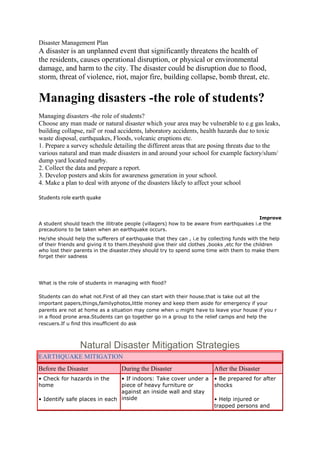
A disaster is an unplanned event that significantly threatens the health of
the residents, causes operational disruption, or physical or environmental
damage, and harm to the city. The disaster could be disruption due to flood,
storm, threat of violence, riot, major fire, building collapse, bomb threat, etc.


Managing disasters -the role of students?
Choose any man made or natural disaster which your area may be vulnerable to e.g gas leaks,
building collapse, rail' or road accidents, laboratory accidents, health hazards due to toxic
waste disposal, earthquakes, Floods, volcanic eruptions etc.
1. Prepare a survey schedule detailing the different areas that are posing threats due to the
various natural and man made disasters in and around your school for example factory/slum/
dump yard located nearby.
2. Collect the data and prepare a report.
3. Develop posters and skits for awareness generation in your school.
4. Make a plan to deal with anyone of the disasters likely to affect your school

Students role earth quake


                                                                                           Improve
A student should teach the illitrate people (villagers) how to be aware from earthquakes i.e the
precautions to be taken when an earthquake occurs.
He/she should help the sufferers of earthquake that they can , i.e by collecting funds with the help
of their friends and giving it to them.theyshold give their old clothes ,books ,etc for the children
who lost their parents in the disaster.they should try to spend some time with them to make them
forget their sadness


What is the role of students in managing with flood?

Students can do what not.First of all they can start with their house.that is take out all the
important papers,things,familyphotos,little money and keep them aside for emergency if your
parents are not at home as a situation may come when u might have to leave your house if you r
in a flood prone area.Students can go together go in a group to the relief camps and help the
rescuers.If u find this insufficient do ask


                 Natural Disaster Mitigation Strategies
EARTHQUAKE MITIGATION
Before the Disaster               During the Disaster                   After the Disaster
• Check for hazards in the     • If indoors: Take cover under a         • Be prepared for after
home                           piece of heavy furniture or              shocks
                               against an inside wall and stay
• Identify safe places in each inside                                   • Help injured or
                                                                        trapped persons and
room                                                              give first aid where
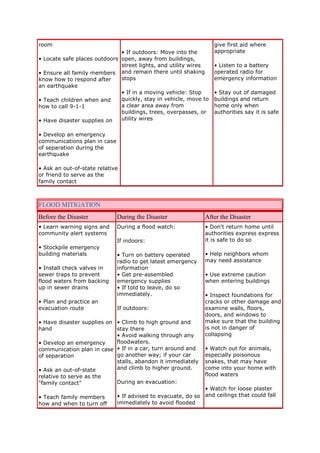
                              • If outdoors: Move into the        appropriate
• Locate safe places outdoors open, away from buildings,
                              street lights, and utility wires    • Listen to a battery
• Ensure all family members and remain there until shaking        operated radio for
know how to respond after     stops                               emergency information
an earthquake
                              • If in a moving vehicle: Stop      • Stay out of damaged
• Teach children when and     quickly, stay in vehicle, move to   buildings and return
how to call 9-1-1             a clear area away from              home only when
                              buildings, trees, overpasses, or    authorities say it is safe
• Have disaster supplies on   utility wires

• Develop an emergency
communications plan in case
of separation during the
earthquake

• Ask an out-of-state relative
or friend to serve as the
family contact


FLOOD MITIGATION
Before the Disaster           During the Disaster              After the Disaster
• Learn warning signs and     During a flood watch:            • Don't return home until
community alert systems                                        authorities express express
                              If indoors:                      it is safe to do so
• Stockpile emergency
building materials            • Turn on battery operated       • Help neighbors whom
                              radio to get latest emergency    may need assistance
• Install check valves in     information
sewer traps to prevent        • Get pre-assembled              • Use extreme caution
flood waters from backing     emergency supplies               when entering buildings
up in sewer drains            • If told to leave, do so
                              immediately.                     • Inspect foundations for
• Plan and practice an                                         cracks or other damage and
evacuation route              If outdoors:                     examine walls, floors,
                                                               doors, and windows to
• Have disaster supplies on • Climb to high ground and         make sure that the building
hand                        stay there                         is not in danger of
                            • Avoid walking through any        collapsing
• Develop an emergency      floodwaters.
communication plan in case • If in a car, turn around and      • Watch out for animals,
of separation               go another way; if your car        especially poisonous
                            stalls, abandon it immediately     snakes, that may have
• Ask an out-of-state       and climb to higher ground.        come into your home with
relative to serve as the                                       flood waters
"family contact"              During an evacuation:
                                                              • Watch for loose plaster
• Teach family members        • If advised to evacuate, do so and ceilings that could fall
how and when to turn off      immediately to avoid flooded
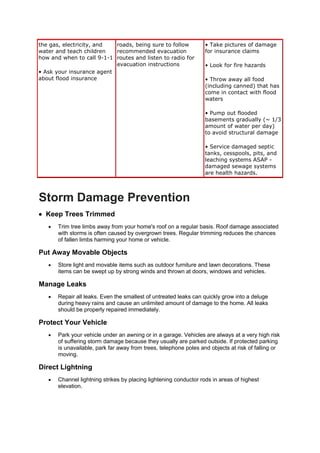
the gas, electricity, and  roads, being sure to follow             • Take pictures of damage
water and teach children   recommended evacuation                  for insurance claims
how and when to call 9-1-1 routes and listen to radio for
                           evacuation instructions                 • Look for fire hazards
• Ask your insurance agent
about flood insurance                                              • Throw away all food
                                                                   (including canned) that has
                                                                   come in contact with flood
                                                                   waters

                                                                   • Pump out flooded
                                                                   basements gradually (~ 1/3
                                                                   amount of water per day)
                                                                   to avoid structural damage

                                                                   • Service damaged septic
                                                                   tanks, cesspools, pits, and
                                                                   leaching systems ASAP -
                                                                   damaged sewage systems
                                                                   are health hazards.


Storm Damage Prevention
 Keep Trees Trimmed
      Trim tree limbs away from your home's roof on a regular basis. Roof damage associated
       with storms is often caused by overgrown trees. Regular trimming reduces the chances
       of fallen limbs harming your home or vehicle.

Put Away Movable Objects
      Store light and movable items such as outdoor furniture and lawn decorations. These
       items can be swept up by strong winds and thrown at doors, windows and vehicles.

Manage Leaks
      Repair all leaks. Even the smallest of untreated leaks can quickly grow into a deluge
       during heavy rains and cause an unlimited amount of damage to the home. All leaks
       should be properly repaired immediately.

Protect Your Vehicle
      Park your vehicle under an awning or in a garage. Vehicles are always at a very high risk
       of suffering storm damage because they usually are parked outside. If protected parking
       is unavailable, park far away from trees, telephone poles and objects at risk of falling or
       moving.

Direct Lightning
      Channel lightning strikes by placing lightening conductor rods in areas of highest
       elevation.
Disaster management plan

Disaster management plan

  • 1.
    Disaster Management Plan Adisaster is an unplanned event that significantly threatens the health of the residents, causes operational disruption, or physical or environmental damage, and harm to the city. The disaster could be disruption due to flood, storm, threat of violence, riot, major fire, building collapse, bomb threat, etc. Managing disasters -the role of students? Managing disasters -the role of students? Choose any man made or natural disaster which your area may be vulnerable to e.g gas leaks, building collapse, rail' or road accidents, laboratory accidents, health hazards due to toxic waste disposal, earthquakes, Floods, volcanic eruptions etc. 1. Prepare a survey schedule detailing the different areas that are posing threats due to the various natural and man made disasters in and around your school for example factory/slum/ dump yard located nearby. 2. Collect the data and prepare a report. 3. Develop posters and skits for awareness generation in your school. 4. Make a plan to deal with anyone of the disasters likely to affect your school Students role earth quake Improve A student should teach the illitrate people (villagers) how to be aware from earthquakes i.e the precautions to be taken when an earthquake occurs. He/she should help the sufferers of earthquake that they can , i.e by collecting funds with the help of their friends and giving it to them.theyshold give their old clothes ,books ,etc for the children who lost their parents in the disaster.they should try to spend some time with them to make them forget their sadness What is the role of students in managing with flood? Students can do what not.First of all they can start with their house.that is take out all the important papers,things,familyphotos,little money and keep them aside for emergency if your parents are not at home as a situation may come when u might have to leave your house if you r in a flood prone area.Students can go together go in a group to the relief camps and help the rescuers.If u find this insufficient do ask Natural Disaster Mitigation Strategies EARTHQUAKE MITIGATION Before the Disaster During the Disaster After the Disaster • Check for hazards in the • If indoors: Take cover under a • Be prepared for after home piece of heavy furniture or shocks against an inside wall and stay • Identify safe places in each inside • Help injured or trapped persons and
  • 2.
    room give first aid where • If outdoors: Move into the appropriate • Locate safe places outdoors open, away from buildings, street lights, and utility wires • Listen to a battery • Ensure all family members and remain there until shaking operated radio for know how to respond after stops emergency information an earthquake • If in a moving vehicle: Stop • Stay out of damaged • Teach children when and quickly, stay in vehicle, move to buildings and return how to call 9-1-1 a clear area away from home only when buildings, trees, overpasses, or authorities say it is safe • Have disaster supplies on utility wires • Develop an emergency communications plan in case of separation during the earthquake • Ask an out-of-state relative or friend to serve as the family contact FLOOD MITIGATION Before the Disaster During the Disaster After the Disaster • Learn warning signs and During a flood watch: • Don't return home until community alert systems authorities express express If indoors: it is safe to do so • Stockpile emergency building materials • Turn on battery operated • Help neighbors whom radio to get latest emergency may need assistance • Install check valves in information sewer traps to prevent • Get pre-assembled • Use extreme caution flood waters from backing emergency supplies when entering buildings up in sewer drains • If told to leave, do so immediately. • Inspect foundations for • Plan and practice an cracks or other damage and evacuation route If outdoors: examine walls, floors, doors, and windows to • Have disaster supplies on • Climb to high ground and make sure that the building hand stay there is not in danger of • Avoid walking through any collapsing • Develop an emergency floodwaters. communication plan in case • If in a car, turn around and • Watch out for animals, of separation go another way; if your car especially poisonous stalls, abandon it immediately snakes, that may have • Ask an out-of-state and climb to higher ground. come into your home with relative to serve as the flood waters "family contact" During an evacuation: • Watch for loose plaster • Teach family members • If advised to evacuate, do so and ceilings that could fall how and when to turn off immediately to avoid flooded
  • 3.
    the gas, electricity,and roads, being sure to follow • Take pictures of damage water and teach children recommended evacuation for insurance claims how and when to call 9-1-1 routes and listen to radio for evacuation instructions • Look for fire hazards • Ask your insurance agent about flood insurance • Throw away all food (including canned) that has come in contact with flood waters • Pump out flooded basements gradually (~ 1/3 amount of water per day) to avoid structural damage • Service damaged septic tanks, cesspools, pits, and leaching systems ASAP - damaged sewage systems are health hazards. Storm Damage Prevention  Keep Trees Trimmed  Trim tree limbs away from your home's roof on a regular basis. Roof damage associated with storms is often caused by overgrown trees. Regular trimming reduces the chances of fallen limbs harming your home or vehicle. Put Away Movable Objects  Store light and movable items such as outdoor furniture and lawn decorations. These items can be swept up by strong winds and thrown at doors, windows and vehicles. Manage Leaks  Repair all leaks. Even the smallest of untreated leaks can quickly grow into a deluge during heavy rains and cause an unlimited amount of damage to the home. All leaks should be properly repaired immediately. Protect Your Vehicle  Park your vehicle under an awning or in a garage. Vehicles are always at a very high risk of suffering storm damage because they usually are parked outside. If protected parking is unavailable, park far away from trees, telephone poles and objects at risk of falling or moving. Direct Lightning  Channel lightning strikes by placing lightening conductor rods in areas of highest elevation.