GOOD
MORNING
Disaster Readiness and
Risk Reduction
Hydrometeorological Hazards
Signs of Impending
Hydrometeorological
Hazards
Hydrometeorology is a branch
of meteorology that deals
with water in the atmosphere
especially as precipitation.
(Merriam-Webster)
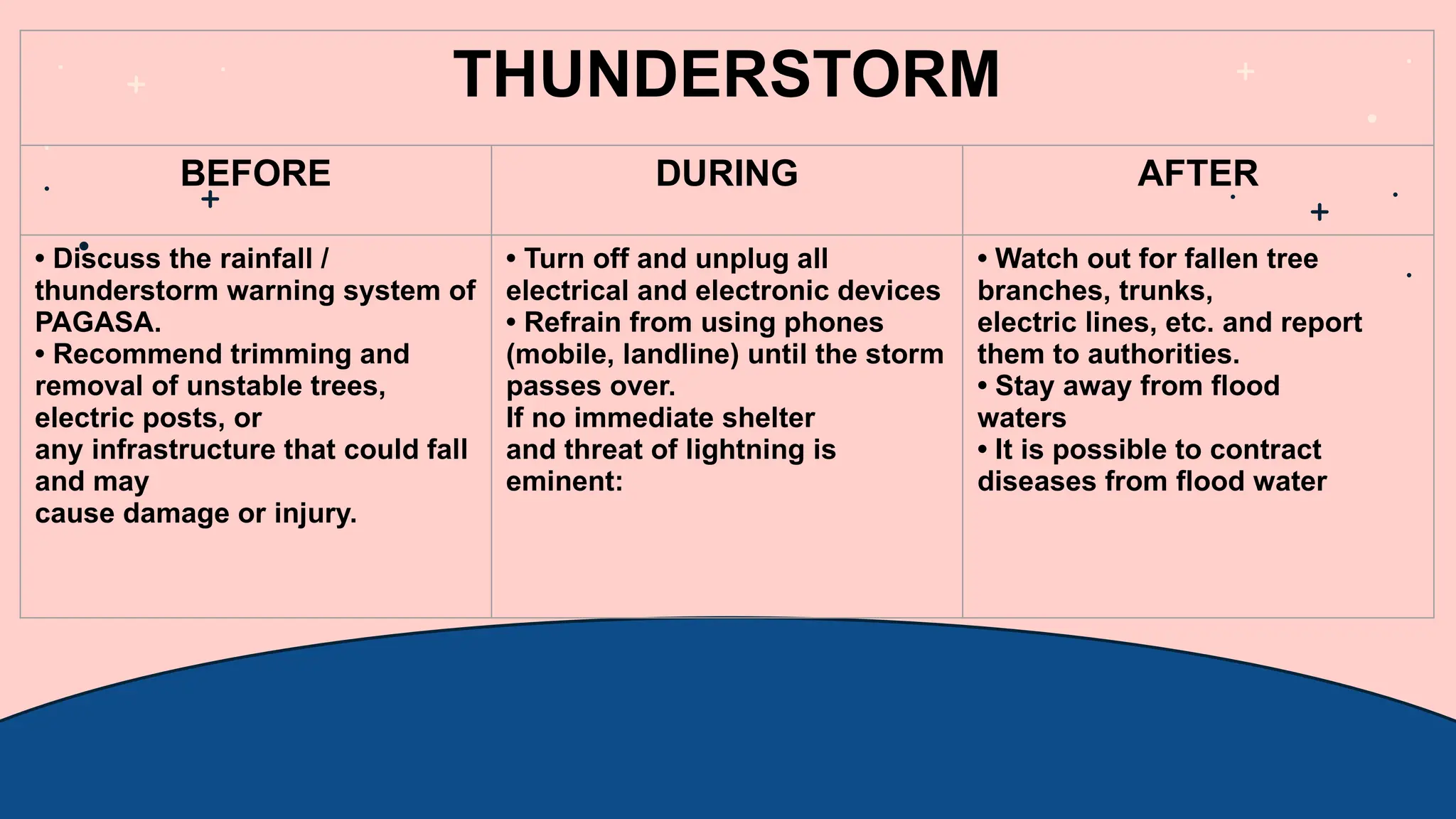
THUNDERSTORM
BEFORE DURING AFTER
• Discuss the rainfall /
thunderstorm warning system of
PAGASA.
• Recommend trimming and
removal of unstable trees,
electric posts, or
any infrastructure that could fall
and may
cause damage or injury.
• Turn off and unplug all
electrical and electronic devices
• Refrain from using phones
(mobile, landline) until the storm
passes over.
If no immediate shelter
and threat of lightning is
eminent:
• Watch out for fallen tree
branches, trunks,
electric lines, etc. and report
them to authorities.
• Stay away from flood
waters
• It is possible to contract
diseases from flood water
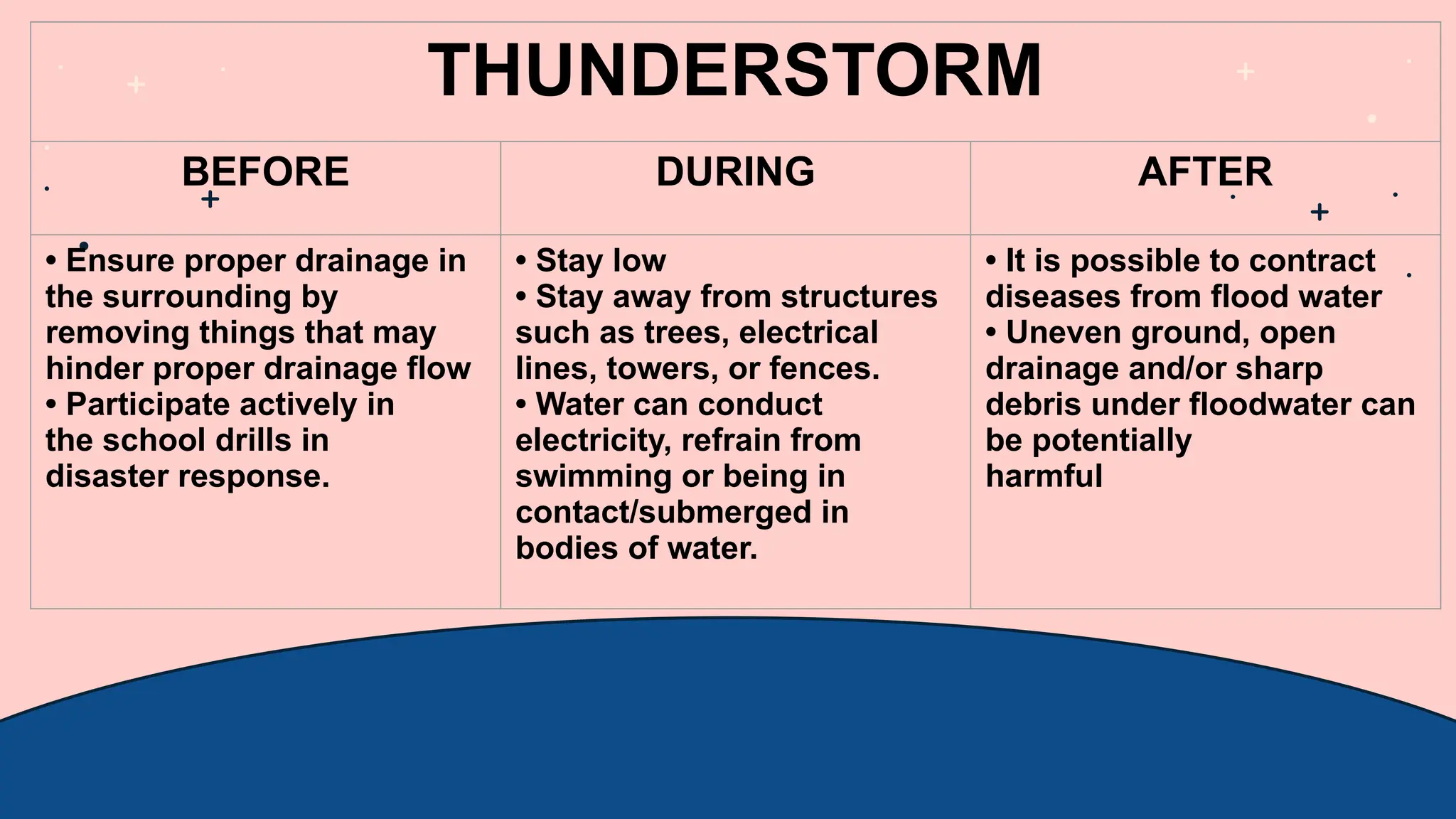
THUNDERSTORM
BEFORE DURING AFTER
• Ensure proper drainage in
the surrounding by
removing things that may
hinder proper drainage flow
• Participate actively in
the school drills in
disaster response.
• Stay low
• Stay away from structures
such as trees, electrical
lines, towers, or fences.
• Water can conduct
electricity, refrain from
swimming or being in
contact/submerged in
bodies of water.
• It is possible to contract
diseases from flood water
• Uneven ground, open
drainage and/or sharp
debris under floodwater can
be potentially
harmful
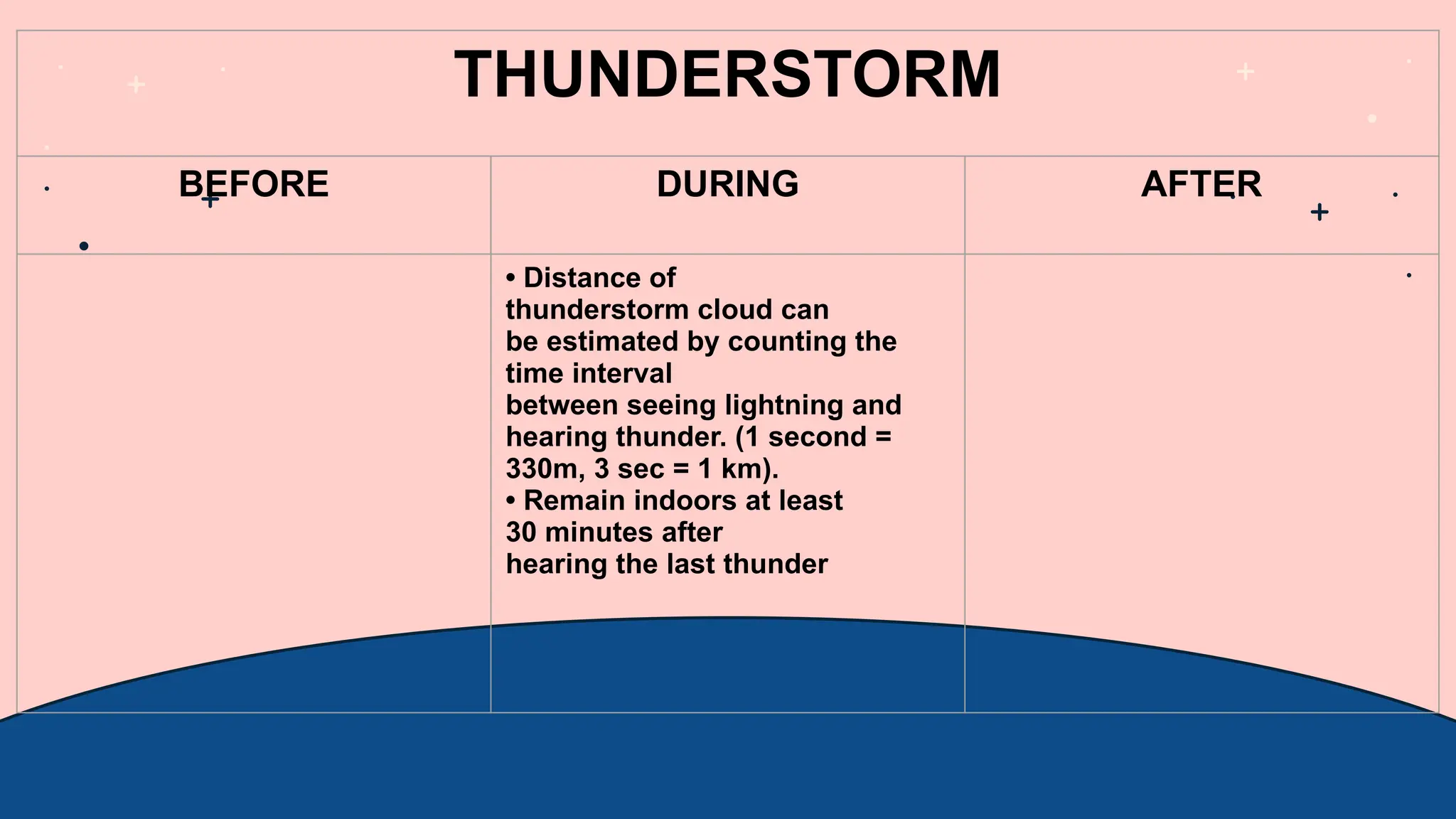
THUNDERSTORM
BEFORE DURING AFTER
• Distance of
thunderstorm cloud can
be estimated by counting the
time interval
between seeing lightning and
hearing thunder. (1 second =
330m, 3 sec = 1 km).
• Remain indoors at least
30 minutes after
hearing the last thunder
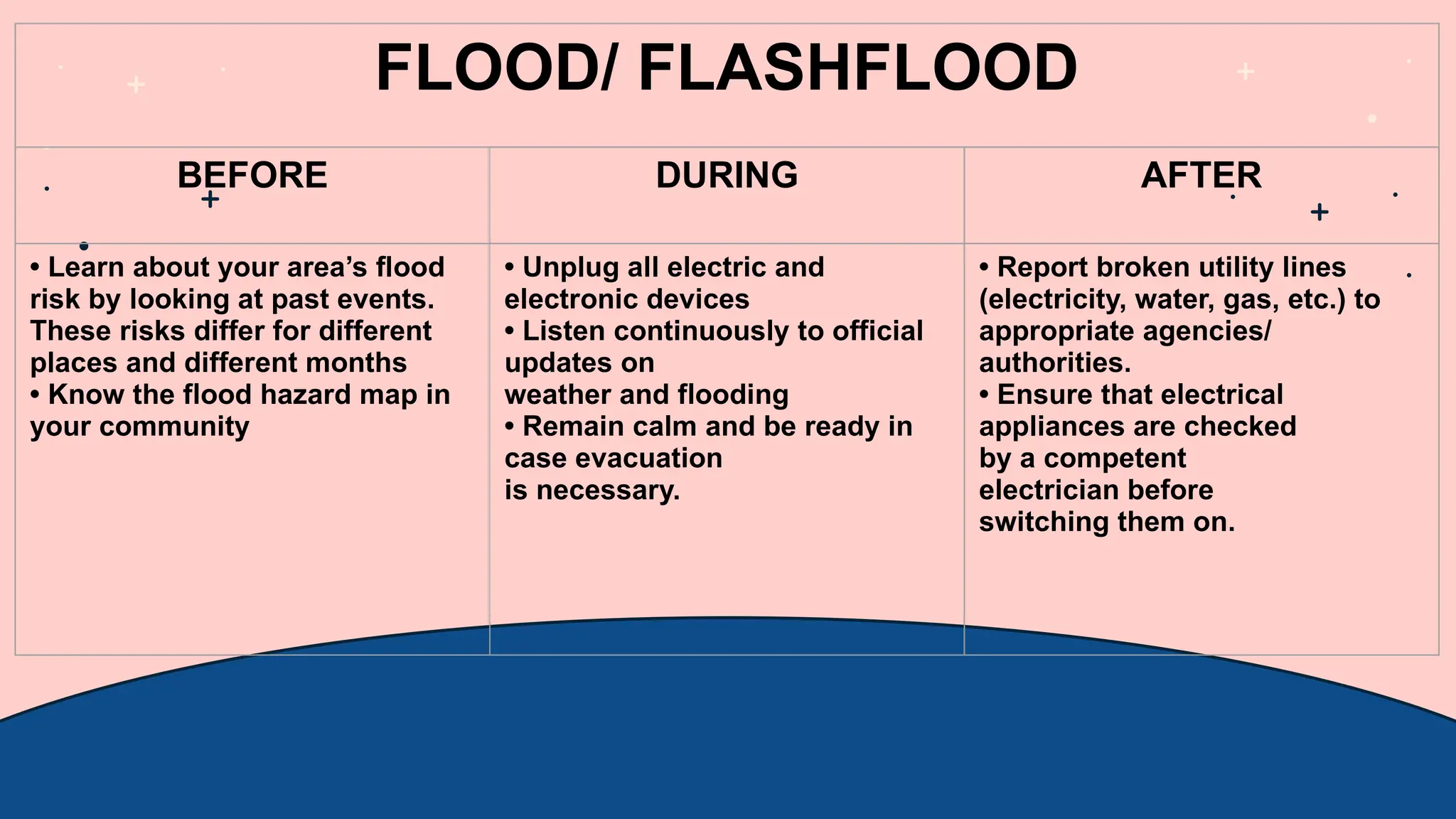
FLOOD/ FLASHFLOOD
BEFORE DURING AFTER
• Learn about your area’s flood
risk by looking at past events.
These risks differ for different
places and different months
• Know the flood hazard map in
your community
• Unplug all electric and
electronic devices
• Listen continuously to official
updates on
weather and flooding
• Remain calm and be ready in
case evacuation
is necessary.
• Report broken utility lines
(electricity, water, gas, etc.) to
appropriate agencies/
authorities.
• Ensure that electrical
appliances are checked
by a competent
electrician before
switching them on.
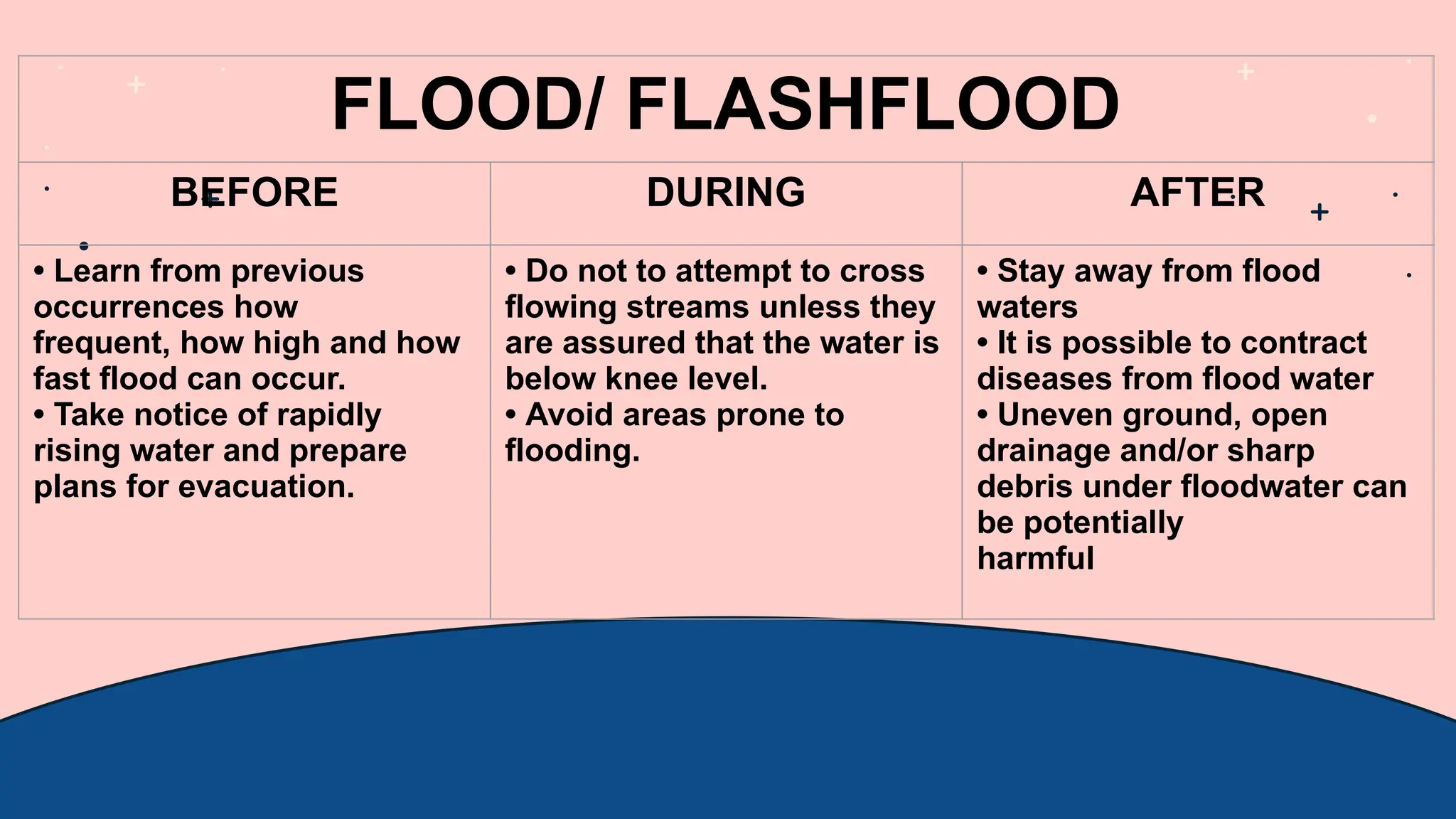
FLOOD/ FLASHFLOOD
BEFORE DURING AFTER
• Learn from previous
occurrences how
frequent, how high and how
fast flood can occur.
• Take notice of rapidly
rising water and prepare
plans for evacuation.
• Do not to attempt to cross
flowing streams unless they
are assured that the water is
below knee level.
• Avoid areas prone to
flooding.
• Stay away from flood
waters
• It is possible to contract
diseases from flood water
• Uneven ground, open
drainage and/or sharp
debris under floodwater can
be potentially
harmful
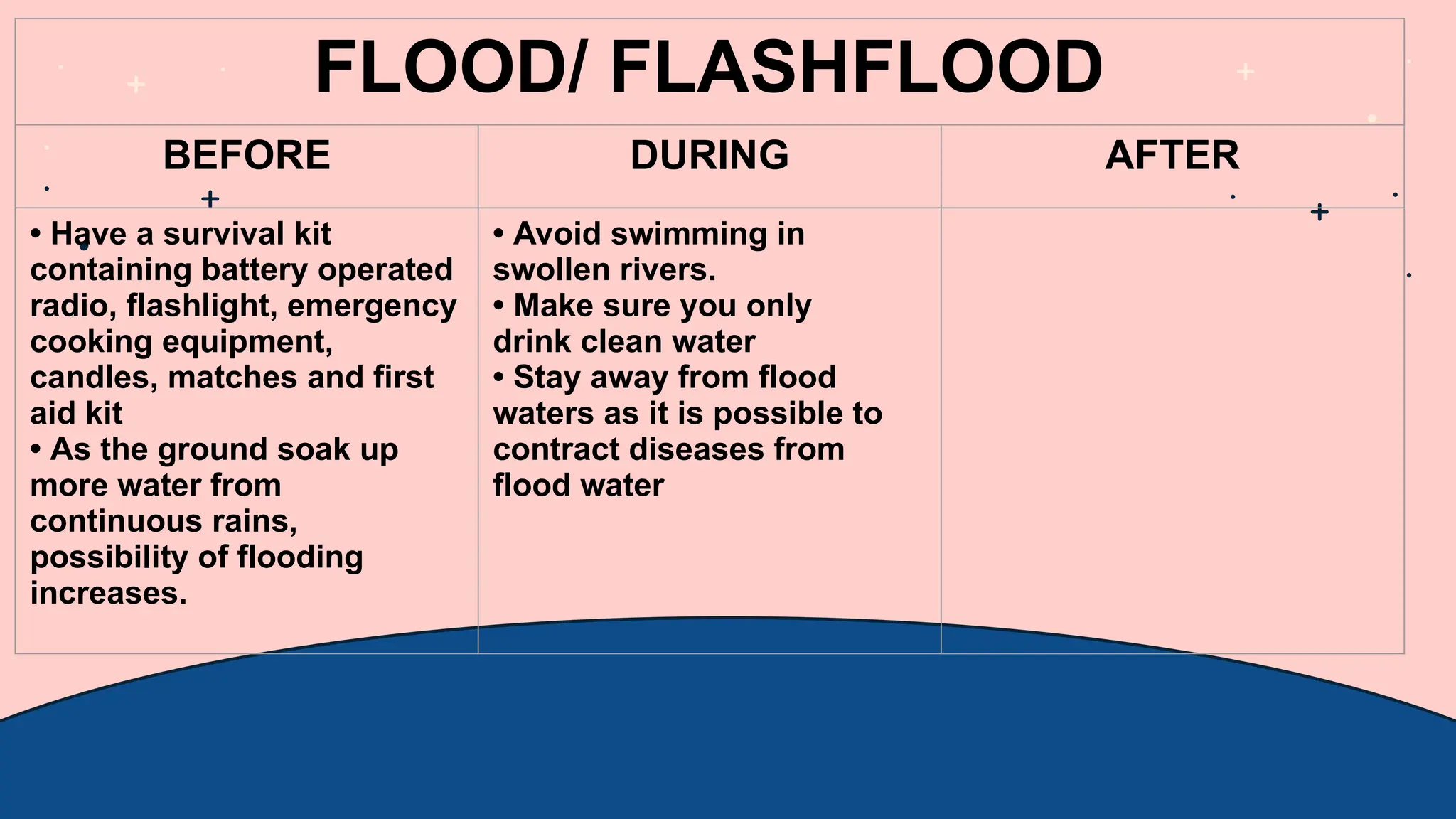
FLOOD/ FLASHFLOOD
BEFORE DURING AFTER
• Have a survival kit
containing battery operated
radio, flashlight, emergency
cooking equipment,
candles, matches and first
aid kit
• As the ground soak up
more water from
continuous rains,
possibility of flooding
increases.
• Avoid swimming in
swollen rivers.
• Make sure you only
drink clean water
• Stay away from flood
waters as it is possible to
contract diseases from
flood water
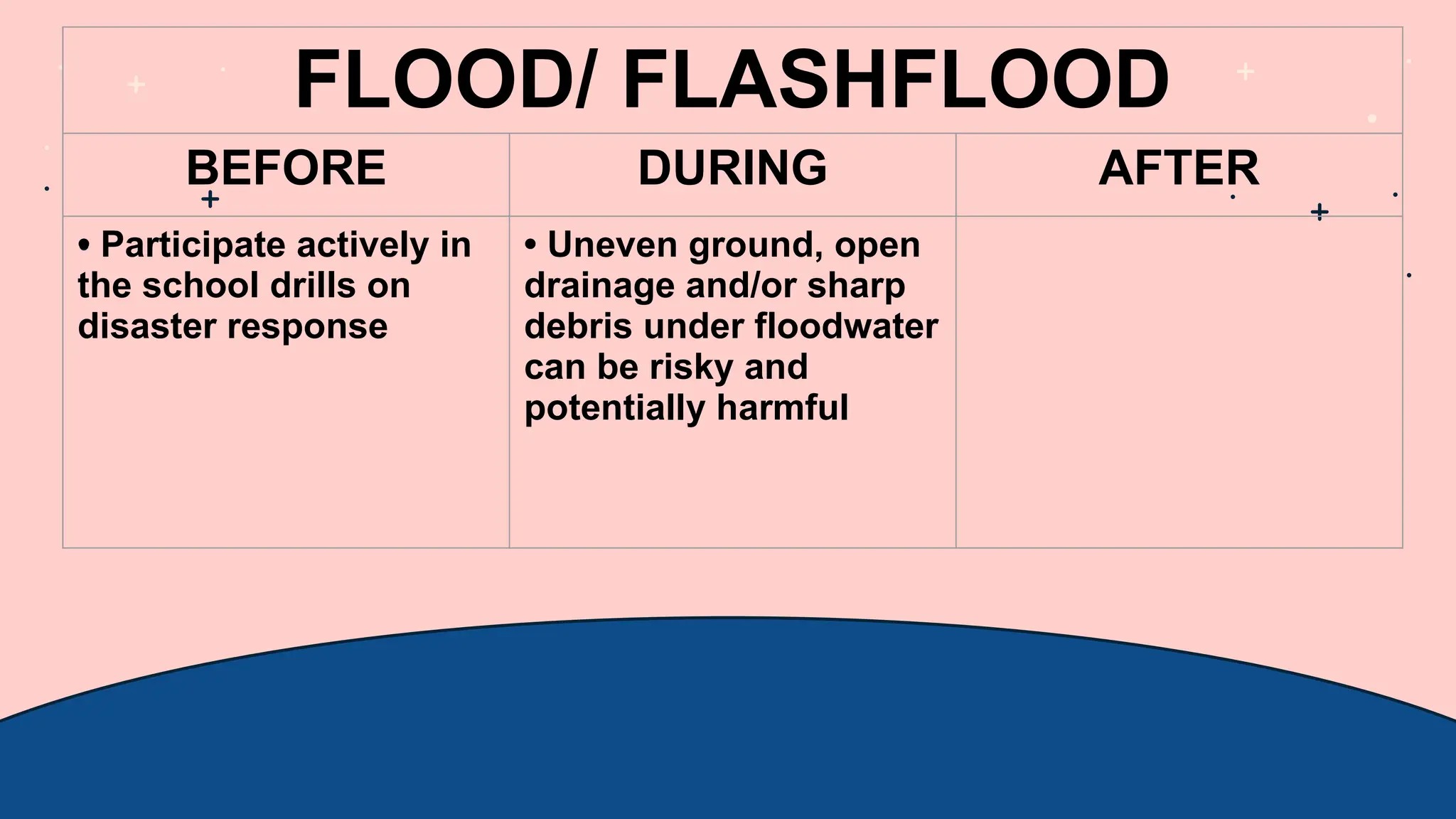
FLOOD/ FLASHFLOOD
BEFORE DURING AFTER
• Participate actively in
the school drills on
disaster response
• Uneven ground, open
drainage and/or sharp
debris under floodwater
can be risky and
potentially harmful
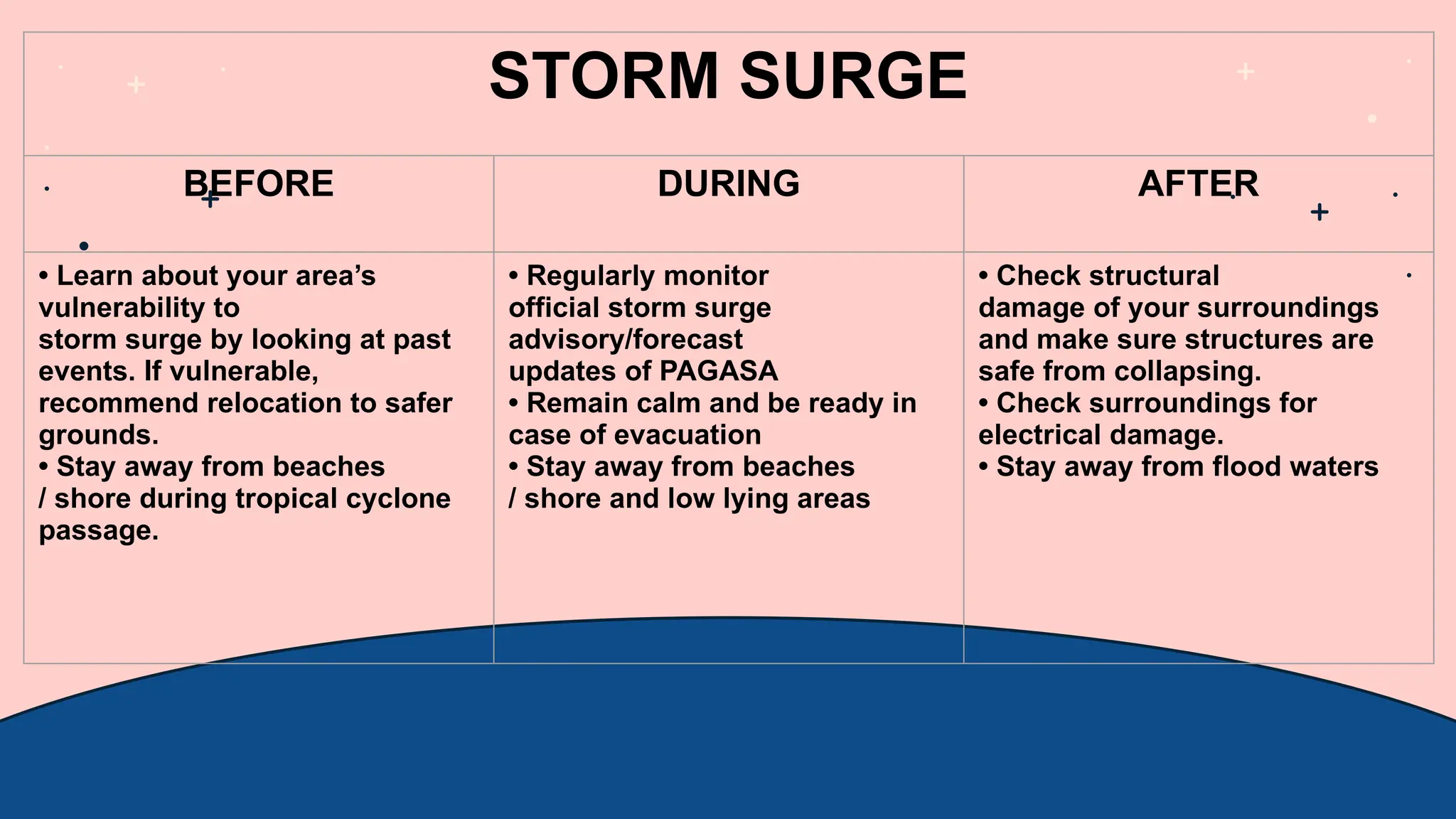
STORM SURGE
BEFORE DURING AFTER
• Learn about your area’s
vulnerability to
storm surge by looking at past
events. If vulnerable,
recommend relocation to safer
grounds.
• Stay away from beaches
/ shore during tropical cyclone
passage.
• Regularly monitor
official storm surge
advisory/forecast
updates of PAGASA
• Remain calm and be ready in
case of evacuation
• Stay away from beaches
/ shore and low lying areas
• Check structural
damage of your surroundings
and make sure structures are
safe from collapsing.
• Check surroundings for
electrical damage.
• Stay away from flood waters
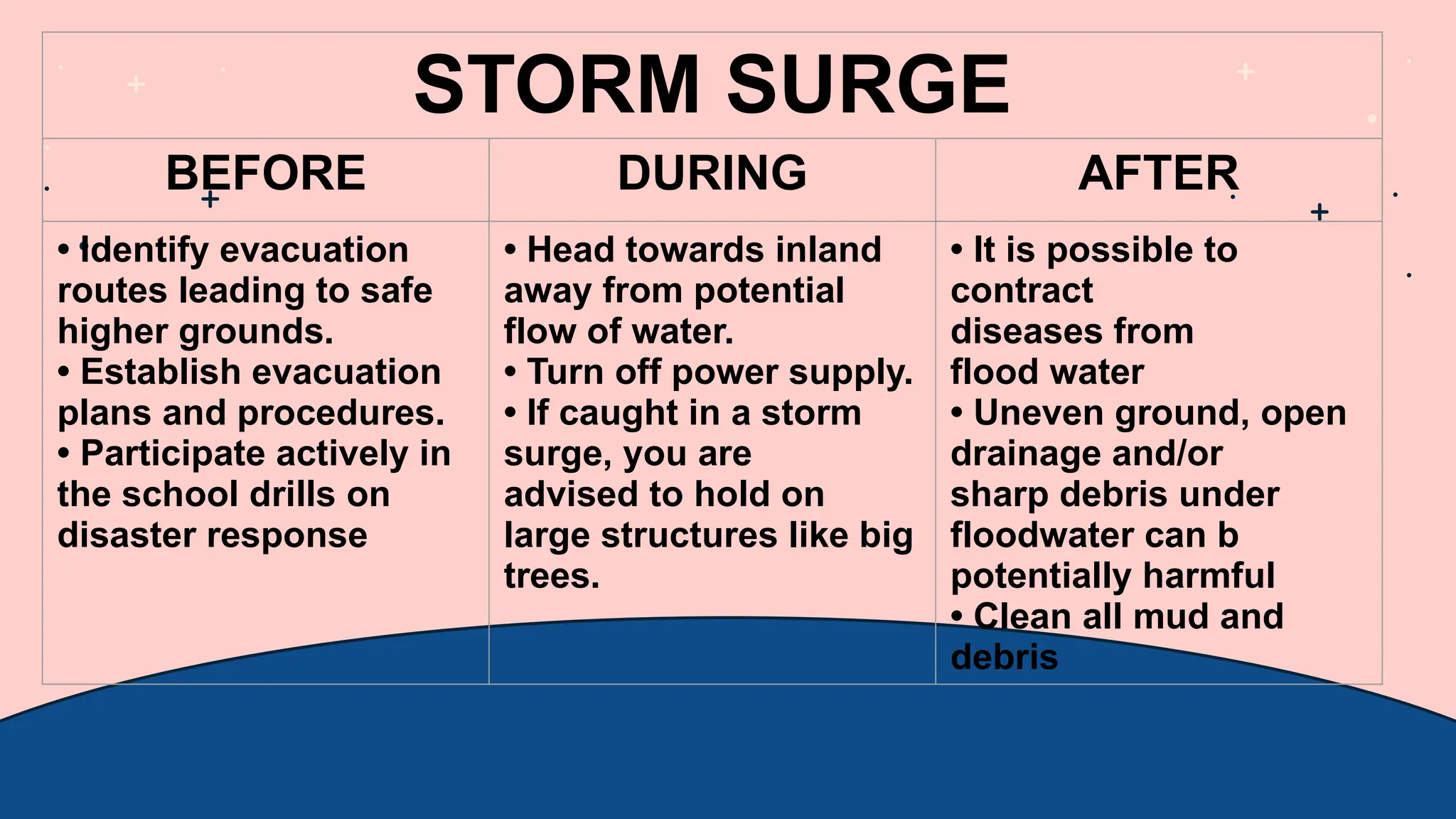
STORM SURGE
BEFORE DURING AFTER
• Identify evacuation
routes leading to safe
higher grounds.
• Establish evacuation
plans and procedures.
• Participate actively in
the school drills on
disaster response
• Head towards inland
away from potential
flow of water.
• Turn off power supply.
• If caught in a storm
surge, you are
advised to hold on
large structures like big
trees.
• It is possible to
contract
diseases from
flood water
• Uneven ground, open
drainage and/or
sharp debris under
floodwater can b
potentially harmful
• Clean all mud and
debris
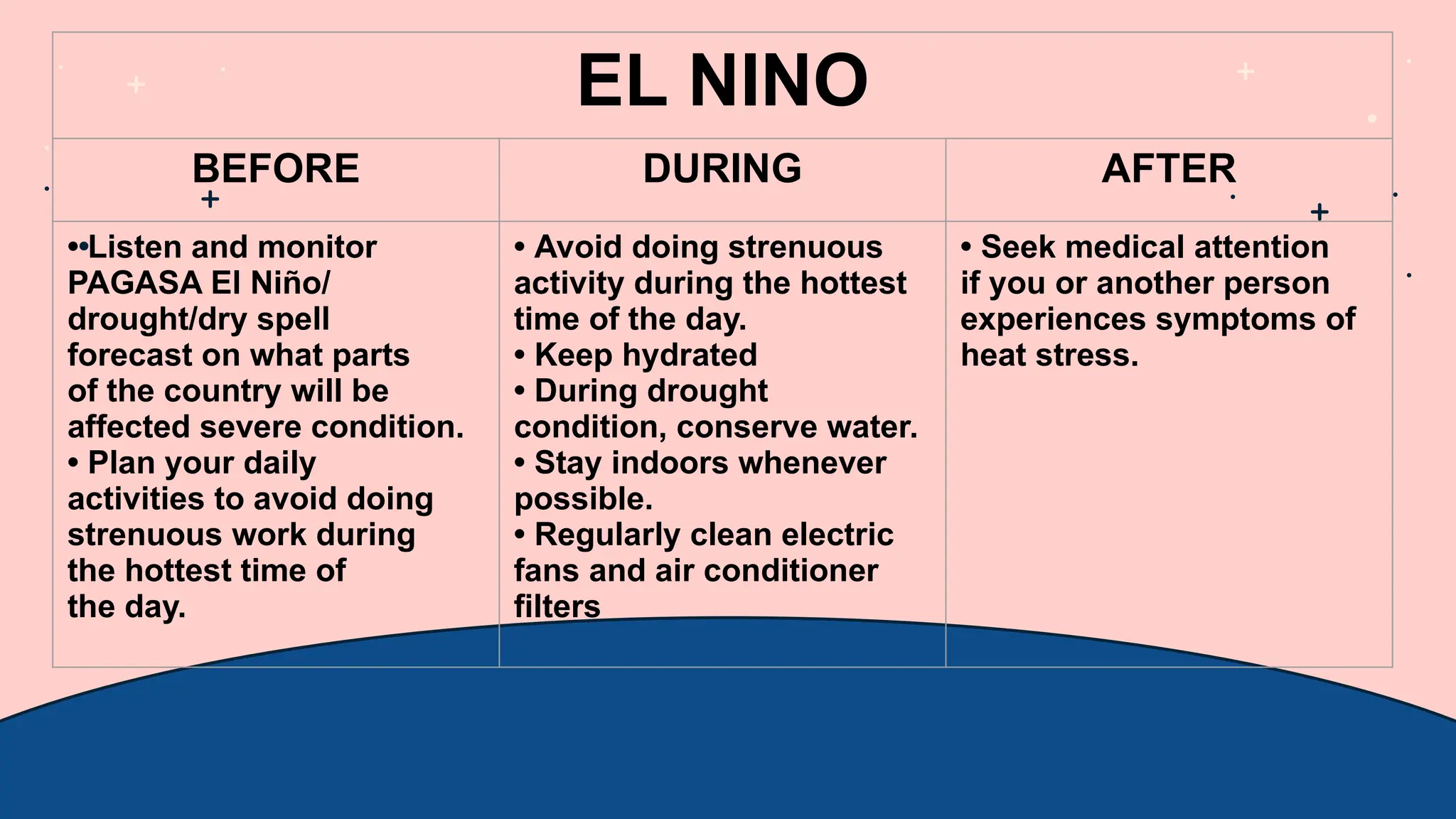
EL NINO
BEFORE DURING AFTER
• Listen and monitor
PAGASA El Niño/
drought/dry spell
forecast on what parts
of the country will be
affected severe condition.
• Plan your daily
activities to avoid doing
strenuous work during
the hottest time of
the day.
• Avoid doing strenuous
activity during the hottest
time of the day.
• Keep hydrated
• During drought
condition, conserve water.
• Stay indoors whenever
possible.
• Regularly clean electric
fans and air conditioner
filters
• Seek medical attention
if you or another person
experiences symptoms of
heat stress.
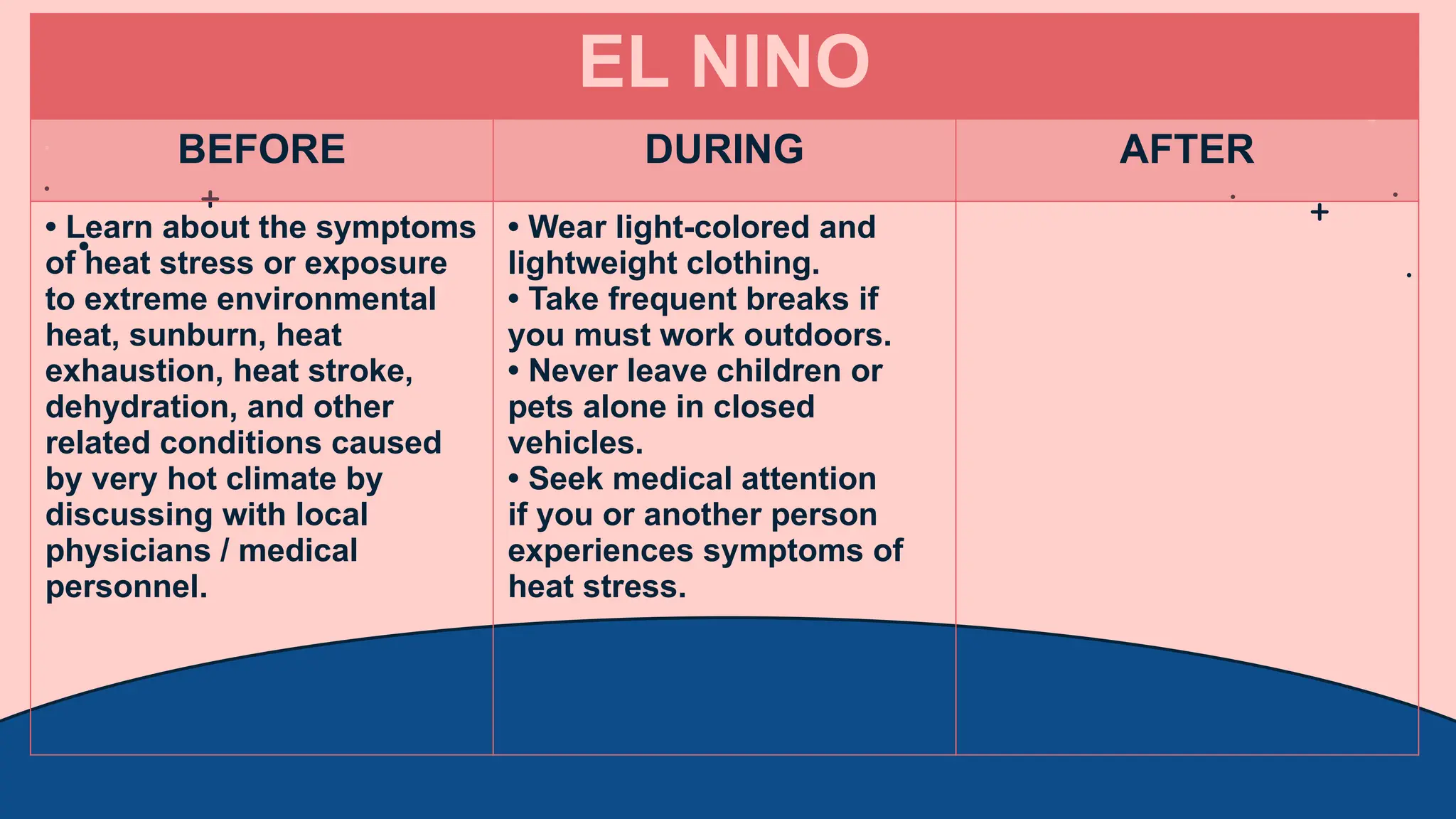
EL NINO
BEFORE DURING AFTER
• Learn about the symptoms
of heat stress or exposure
to extreme environmental
heat, sunburn, heat
exhaustion, heat stroke,
dehydration, and other
related conditions caused
by very hot climate by
discussing with local
physicians / medical
personnel.
• Wear light-colored and
lightweight clothing.
• Take frequent breaks if
you must work outdoors.
• Never leave children or
pets alone in closed
vehicles.
• Seek medical attention
if you or another person
experiences symptoms of
heat stress.
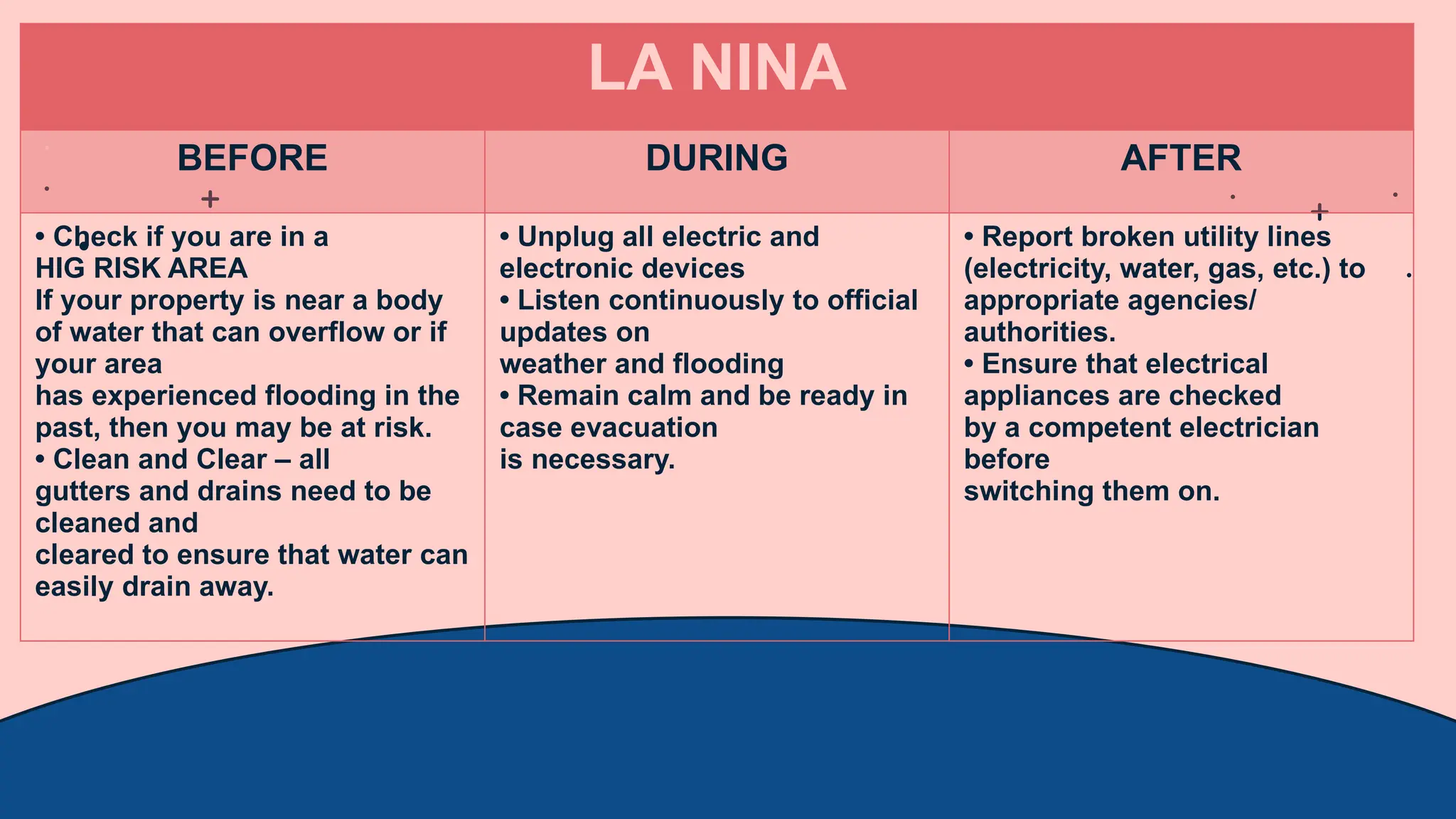
LA NINA
BEFORE DURING AFTER
• Check if you are in a
HIG RISK AREA
If your property is near a body
of water that can overflow or if
your area
has experienced flooding in the
past, then you may be at risk.
• Clean and Clear – all
gutters and drains need to be
cleaned and
cleared to ensure that water can
easily drain away.
• Unplug all electric and
electronic devices
• Listen continuously to official
updates on
weather and flooding
• Remain calm and be ready in
case evacuation
is necessary.
• Report broken utility lines
(electricity, water, gas, etc.) to
appropriate agencies/
authorities.
• Ensure that electrical
appliances are checked
by a competent electrician
before
switching them on.
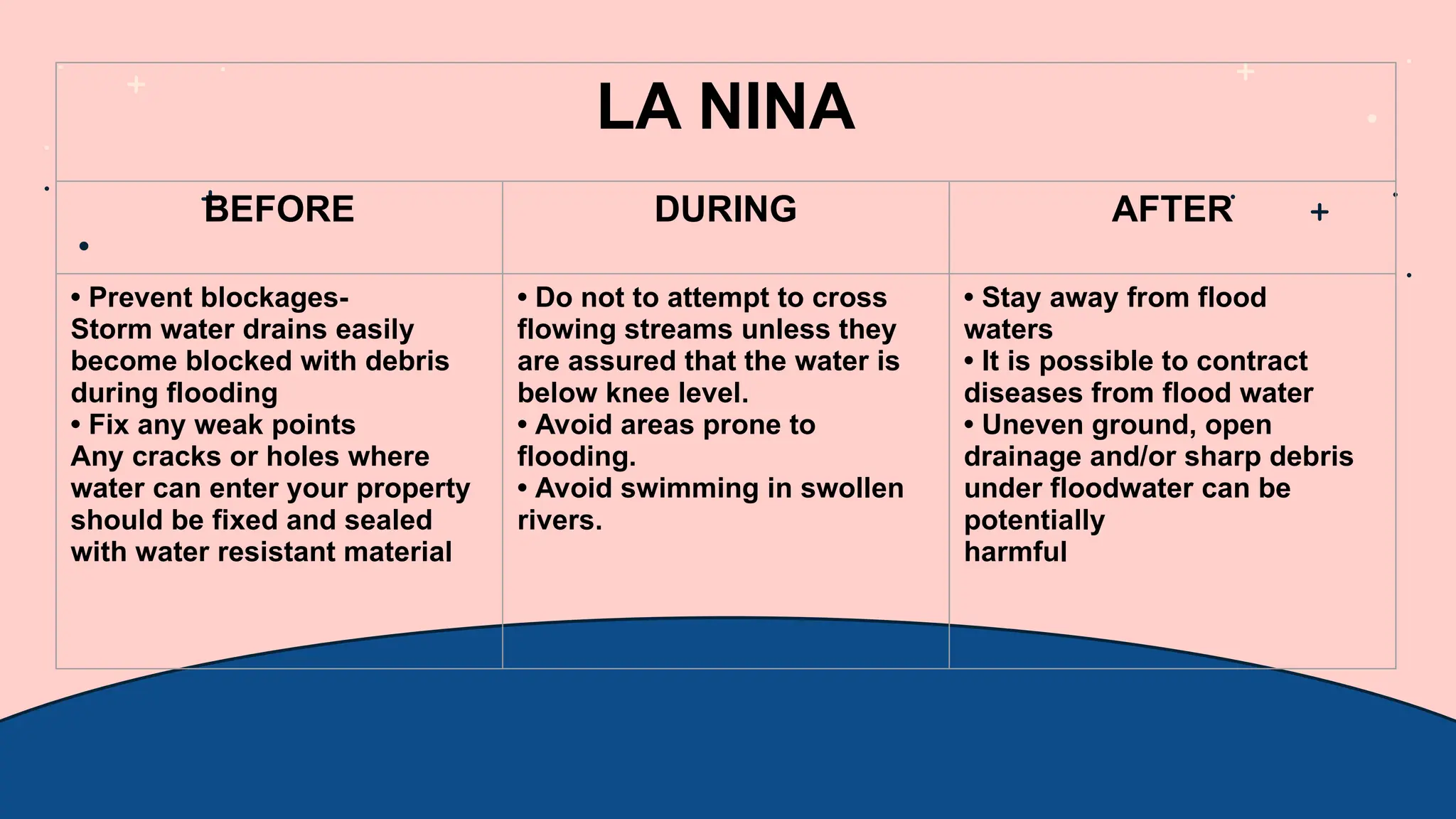
LA NINA
BEFORE DURING AFTER
• Prevent blockages-
Storm water drains easily
become blocked with debris
during flooding
• Fix any weak points
Any cracks or holes where
water can enter your property
should be fixed and sealed
with water resistant material
• Do not to attempt to cross
flowing streams unless they
are assured that the water is
below knee level.
• Avoid areas prone to
flooding.
• Avoid swimming in swollen
rivers.
• Stay away from flood
waters
• It is possible to contract
diseases from flood water
• Uneven ground, open
drainage and/or sharp debris
under floodwater can be
potentially
harmful
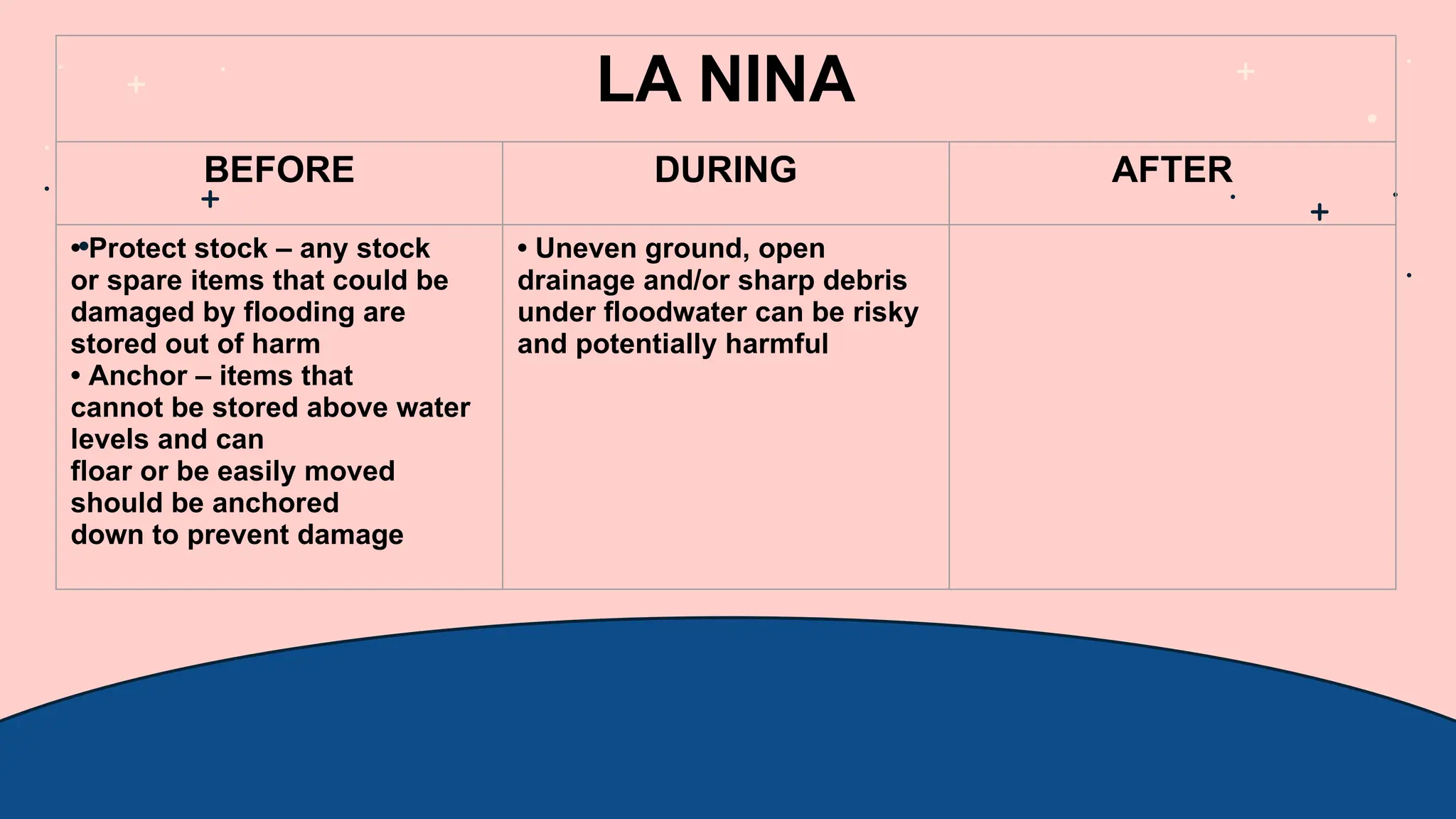
LA NINA
BEFORE DURING AFTER
• Protect stock – any stock
or spare items that could be
damaged by flooding are
stored out of harm
• Anchor – items that
cannot be stored above water
levels and can
floar or be easily moved
should be anchored
down to prevent damage
• Uneven ground, open
drainage and/or sharp debris
under floodwater can be risky
and potentially harmful
LA NINA
BEFORE DURING AFTER
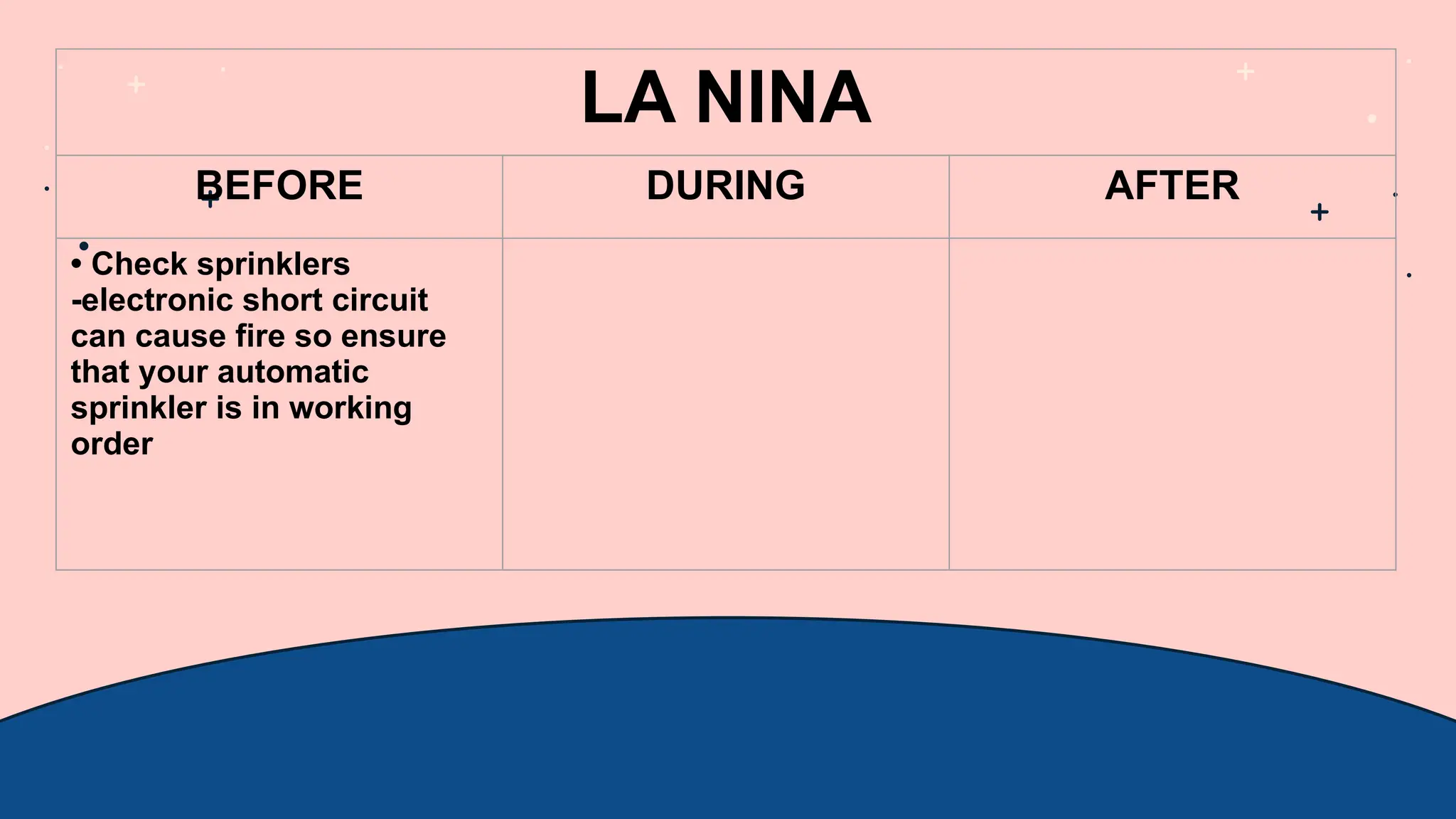
• Check sprinklers
-electronic short circuit
can cause fire so ensure
that your automatic
sprinkler is in working
order

THANK YOU!

Ppt Copy of MODULE-3 .pptx POWERPOINT PRES

  • 1.
  • 2.
    Disaster Readiness and RiskReduction Hydrometeorological Hazards
  • 3.
  • 4.
    Hydrometeorology is abranch of meteorology that deals with water in the atmosphere especially as precipitation. (Merriam-Webster)
  • 5.
    THUNDERSTORM BEFORE DURING AFTER •Discuss the rainfall / thunderstorm warning system of PAGASA. • Recommend trimming and removal of unstable trees, electric posts, or any infrastructure that could fall and may cause damage or injury. • Turn off and unplug all electrical and electronic devices • Refrain from using phones (mobile, landline) until the storm passes over. If no immediate shelter and threat of lightning is eminent: • Watch out for fallen tree branches, trunks, electric lines, etc. and report them to authorities. • Stay away from flood waters • It is possible to contract diseases from flood water
  • 6.
    THUNDERSTORM BEFORE DURING AFTER •Ensure proper drainage in the surrounding by removing things that may hinder proper drainage flow • Participate actively in the school drills in disaster response. • Stay low • Stay away from structures such as trees, electrical lines, towers, or fences. • Water can conduct electricity, refrain from swimming or being in contact/submerged in bodies of water. • It is possible to contract diseases from flood water • Uneven ground, open drainage and/or sharp debris under floodwater can be potentially harmful
  • 7.
    THUNDERSTORM BEFORE DURING AFTER •Distance of thunderstorm cloud can be estimated by counting the time interval between seeing lightning and hearing thunder. (1 second = 330m, 3 sec = 1 km). • Remain indoors at least 30 minutes after hearing the last thunder
  • 8.
    FLOOD/ FLASHFLOOD BEFORE DURINGAFTER • Learn about your area’s flood risk by looking at past events. These risks differ for different places and different months • Know the flood hazard map in your community • Unplug all electric and electronic devices • Listen continuously to official updates on weather and flooding • Remain calm and be ready in case evacuation is necessary. • Report broken utility lines (electricity, water, gas, etc.) to appropriate agencies/ authorities. • Ensure that electrical appliances are checked by a competent electrician before switching them on.
  • 9.
    FLOOD/ FLASHFLOOD BEFORE DURINGAFTER • Learn from previous occurrences how frequent, how high and how fast flood can occur. • Take notice of rapidly rising water and prepare plans for evacuation. • Do not to attempt to cross flowing streams unless they are assured that the water is below knee level. • Avoid areas prone to flooding. • Stay away from flood waters • It is possible to contract diseases from flood water • Uneven ground, open drainage and/or sharp debris under floodwater can be potentially harmful
  • 10.
    FLOOD/ FLASHFLOOD BEFORE DURINGAFTER • Have a survival kit containing battery operated radio, flashlight, emergency cooking equipment, candles, matches and first aid kit • As the ground soak up more water from continuous rains, possibility of flooding increases. • Avoid swimming in swollen rivers. • Make sure you only drink clean water • Stay away from flood waters as it is possible to contract diseases from flood water
  • 11.
    FLOOD/ FLASHFLOOD BEFORE DURINGAFTER • Participate actively in the school drills on disaster response • Uneven ground, open drainage and/or sharp debris under floodwater can be risky and potentially harmful
  • 12.
    STORM SURGE BEFORE DURINGAFTER • Learn about your area’s vulnerability to storm surge by looking at past events. If vulnerable, recommend relocation to safer grounds. • Stay away from beaches / shore during tropical cyclone passage. • Regularly monitor official storm surge advisory/forecast updates of PAGASA • Remain calm and be ready in case of evacuation • Stay away from beaches / shore and low lying areas • Check structural damage of your surroundings and make sure structures are safe from collapsing. • Check surroundings for electrical damage. • Stay away from flood waters
  • 13.
    STORM SURGE BEFORE DURINGAFTER • Identify evacuation routes leading to safe higher grounds. • Establish evacuation plans and procedures. • Participate actively in the school drills on disaster response • Head towards inland away from potential flow of water. • Turn off power supply. • If caught in a storm surge, you are advised to hold on large structures like big trees. • It is possible to contract diseases from flood water • Uneven ground, open drainage and/or sharp debris under floodwater can b potentially harmful • Clean all mud and debris
  • 14.
    EL NINO BEFORE DURINGAFTER • Listen and monitor PAGASA El Niño/ drought/dry spell forecast on what parts of the country will be affected severe condition. • Plan your daily activities to avoid doing strenuous work during the hottest time of the day. • Avoid doing strenuous activity during the hottest time of the day. • Keep hydrated • During drought condition, conserve water. • Stay indoors whenever possible. • Regularly clean electric fans and air conditioner filters • Seek medical attention if you or another person experiences symptoms of heat stress.
  • 15.
    EL NINO BEFORE DURINGAFTER • Learn about the symptoms of heat stress or exposure to extreme environmental heat, sunburn, heat exhaustion, heat stroke, dehydration, and other related conditions caused by very hot climate by discussing with local physicians / medical personnel. • Wear light-colored and lightweight clothing. • Take frequent breaks if you must work outdoors. • Never leave children or pets alone in closed vehicles. • Seek medical attention if you or another person experiences symptoms of heat stress.
  • 16.
    LA NINA BEFORE DURINGAFTER • Check if you are in a HIG RISK AREA If your property is near a body of water that can overflow or if your area has experienced flooding in the past, then you may be at risk. • Clean and Clear – all gutters and drains need to be cleaned and cleared to ensure that water can easily drain away. • Unplug all electric and electronic devices • Listen continuously to official updates on weather and flooding • Remain calm and be ready in case evacuation is necessary. • Report broken utility lines (electricity, water, gas, etc.) to appropriate agencies/ authorities. • Ensure that electrical appliances are checked by a competent electrician before switching them on.
  • 17.
    LA NINA BEFORE DURINGAFTER • Prevent blockages- Storm water drains easily become blocked with debris during flooding • Fix any weak points Any cracks or holes where water can enter your property should be fixed and sealed with water resistant material • Do not to attempt to cross flowing streams unless they are assured that the water is below knee level. • Avoid areas prone to flooding. • Avoid swimming in swollen rivers. • Stay away from flood waters • It is possible to contract diseases from flood water • Uneven ground, open drainage and/or sharp debris under floodwater can be potentially harmful
  • 18.
    LA NINA BEFORE DURINGAFTER • Protect stock – any stock or spare items that could be damaged by flooding are stored out of harm • Anchor – items that cannot be stored above water levels and can floar or be easily moved should be anchored down to prevent damage • Uneven ground, open drainage and/or sharp debris under floodwater can be risky and potentially harmful
  • 19.
    LA NINA BEFORE DURINGAFTER • Check sprinklers -electronic short circuit can cause fire so ensure that your automatic sprinkler is in working order
  • 20.