CONTENTSCONTENTS
 DISASTERDISASTER
 TYPES OF DISASTERTYPES OF DISASTER
 EARTHQUAKESEARTHQUAKES
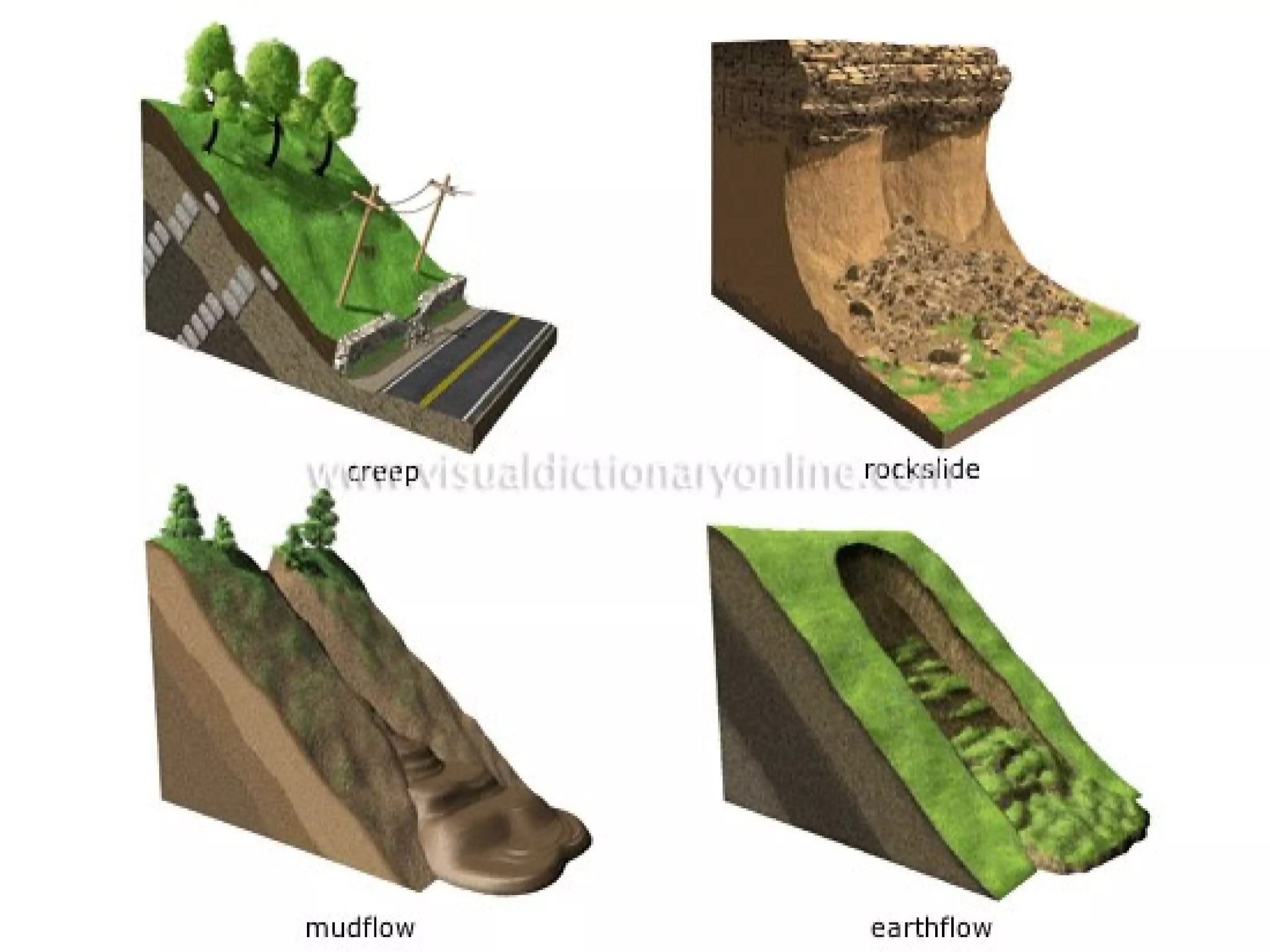
 LANDSLIDESLANDSLIDES
 FLOODSFLOODS
 CYCLONESCYCLONES
 REFERENCESREFERENCES
DISASTERDISASTER
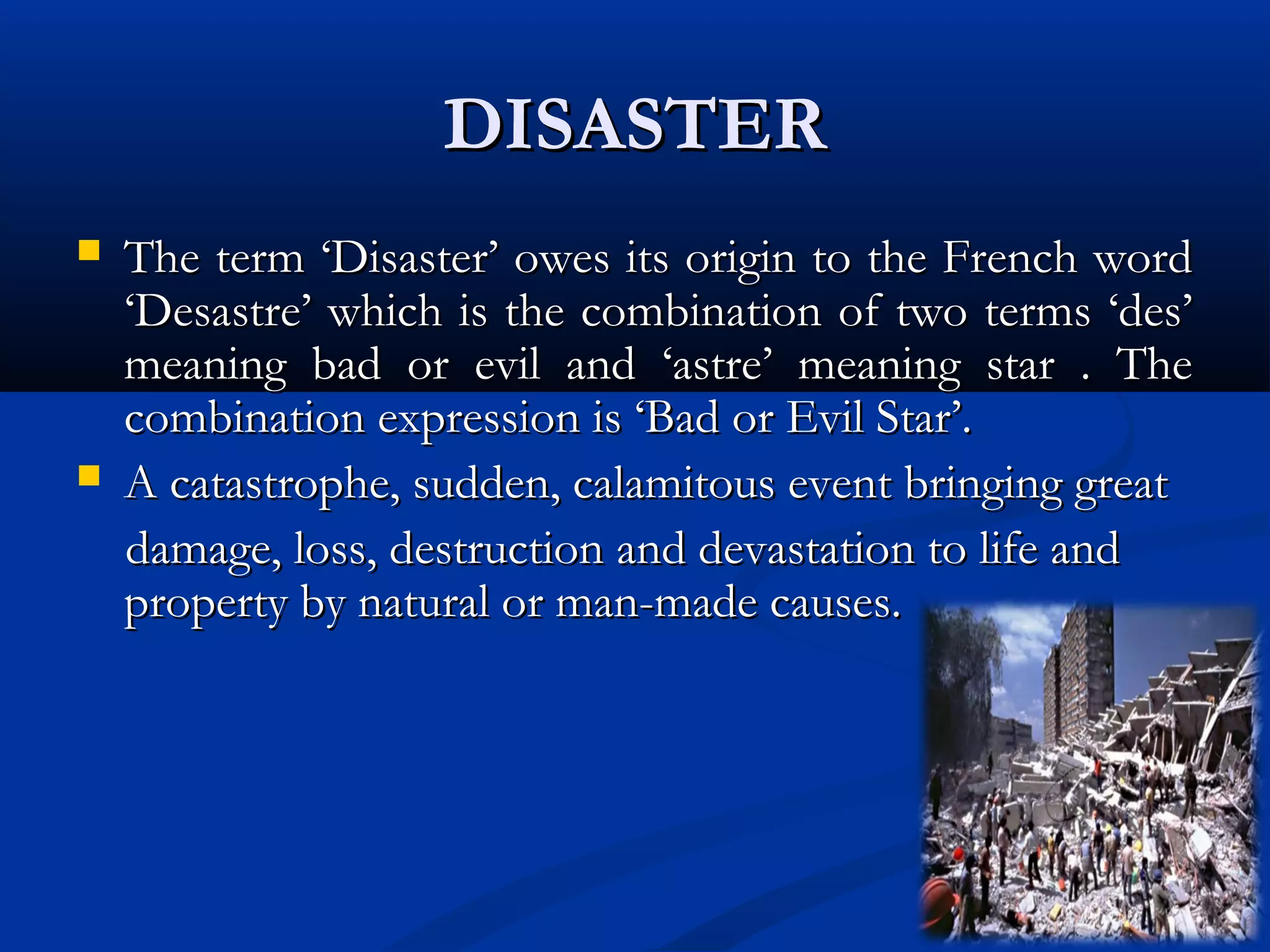
 The term ‘Disaster’ owes its origin to the French wordThe term ‘Disaster’ owes its origin to the French word
‘Desastre’ which is the combination of two terms ‘des’‘Desastre’ which is the combination of two terms ‘des’
meaning bad or evil and ‘astre’ meaning star . Themeaning bad or evil and ‘astre’ meaning star . The
combination expression is ‘Bad or Evil Star’.combination expression is ‘Bad or Evil Star’.
 A catastrophe, sudden, calamitous event bringing greatA catastrophe, sudden, calamitous event bringing great
damage, loss, destruction and devastation to life anddamage, loss, destruction and devastation to life and
property by natural or man-made causes.property by natural or man-made causes.
TYPES OF DISASTERTYPES OF DISASTER
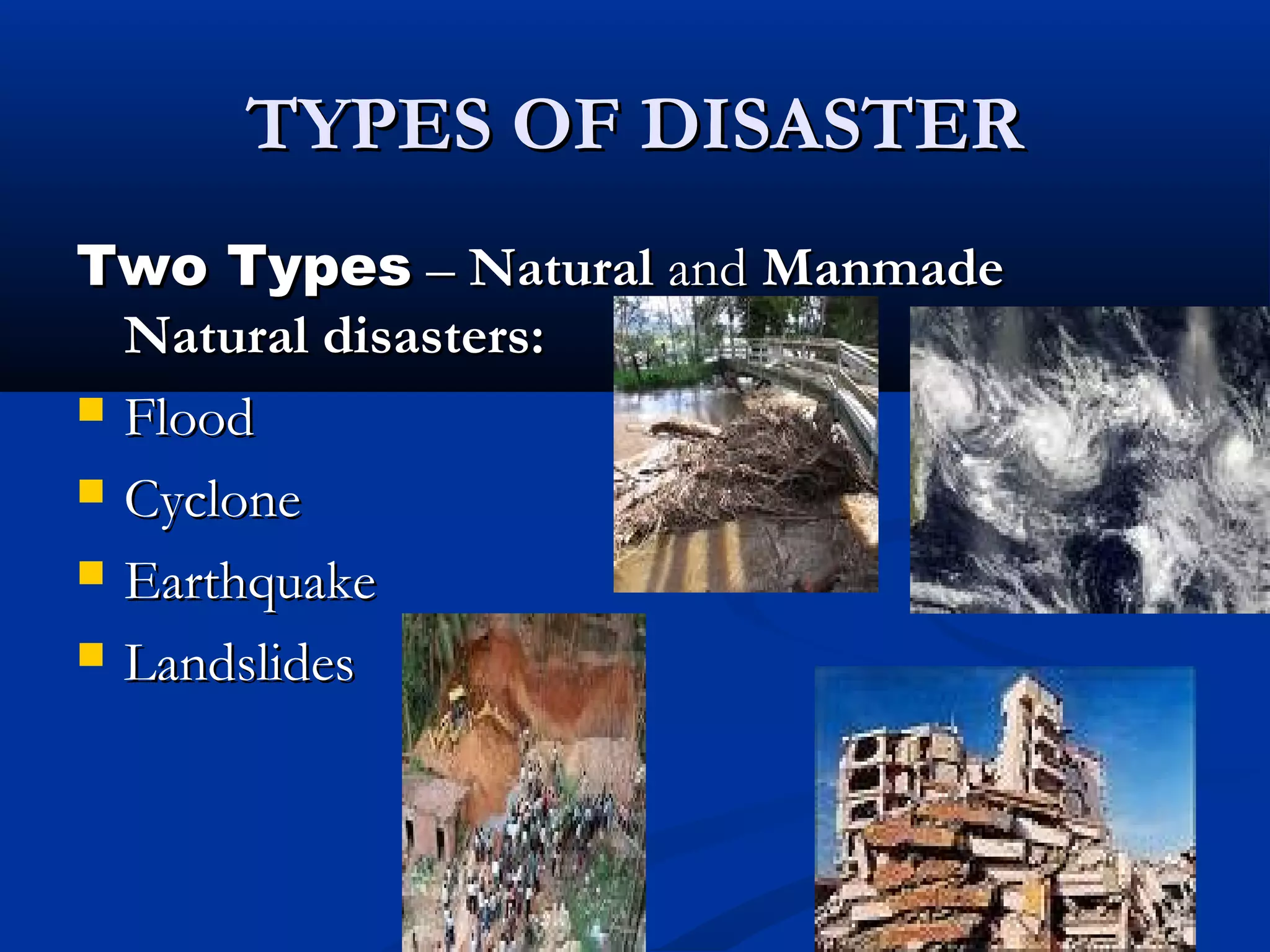
Two TypesTwo Types –– NaturalNatural andand ManmadeManmade
Natural disasters:Natural disasters:    
 FloodFlood
 CycloneCyclone
 EarthquakeEarthquake
 LandslidesLandslides
EARTHQUAKESEARTHQUAKES
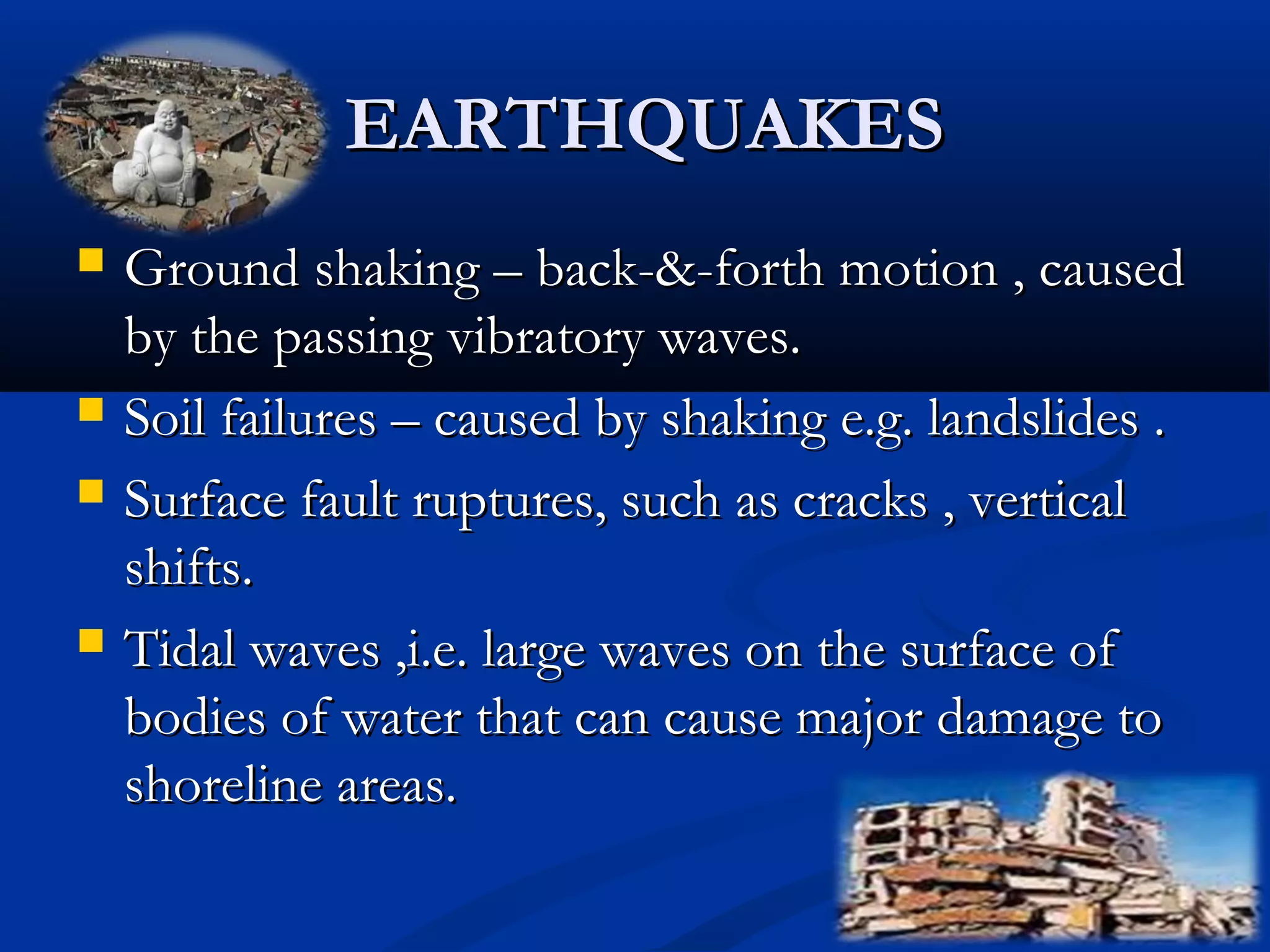
 Ground shaking – back-&-forth motion , causedGround shaking – back-&-forth motion , caused
by the passing vibratory waves.by the passing vibratory waves.
 Soil failures – caused by shaking e.g. landslides .Soil failures – caused by shaking e.g. landslides .
 Surface fault ruptures, such as cracks , verticalSurface fault ruptures, such as cracks , vertical
shifts.shifts.
 Tidal waves ,i.e. large waves on the surface ofTidal waves ,i.e. large waves on the surface of
bodies of water that can cause major damage tobodies of water that can cause major damage to
shoreline areas.shoreline areas.
EFFECTS ON BUILDINGSEFFECTS ON BUILDINGS
 As vibrations & waves continue to moveAs vibrations & waves continue to move
through the earth –buildings ,set in motion.through the earth –buildings ,set in motion.
 Each building response differently ,acc.to itsEach building response differently ,acc.to its
construction.construction.
 When waves strike ,earth moves backward &When waves strike ,earth moves backward &
forward .forward .
 The lower part of building moves with the earth.The lower part of building moves with the earth.
 The upper portion –initially remains at rest.The upper portion –initially remains at rest.
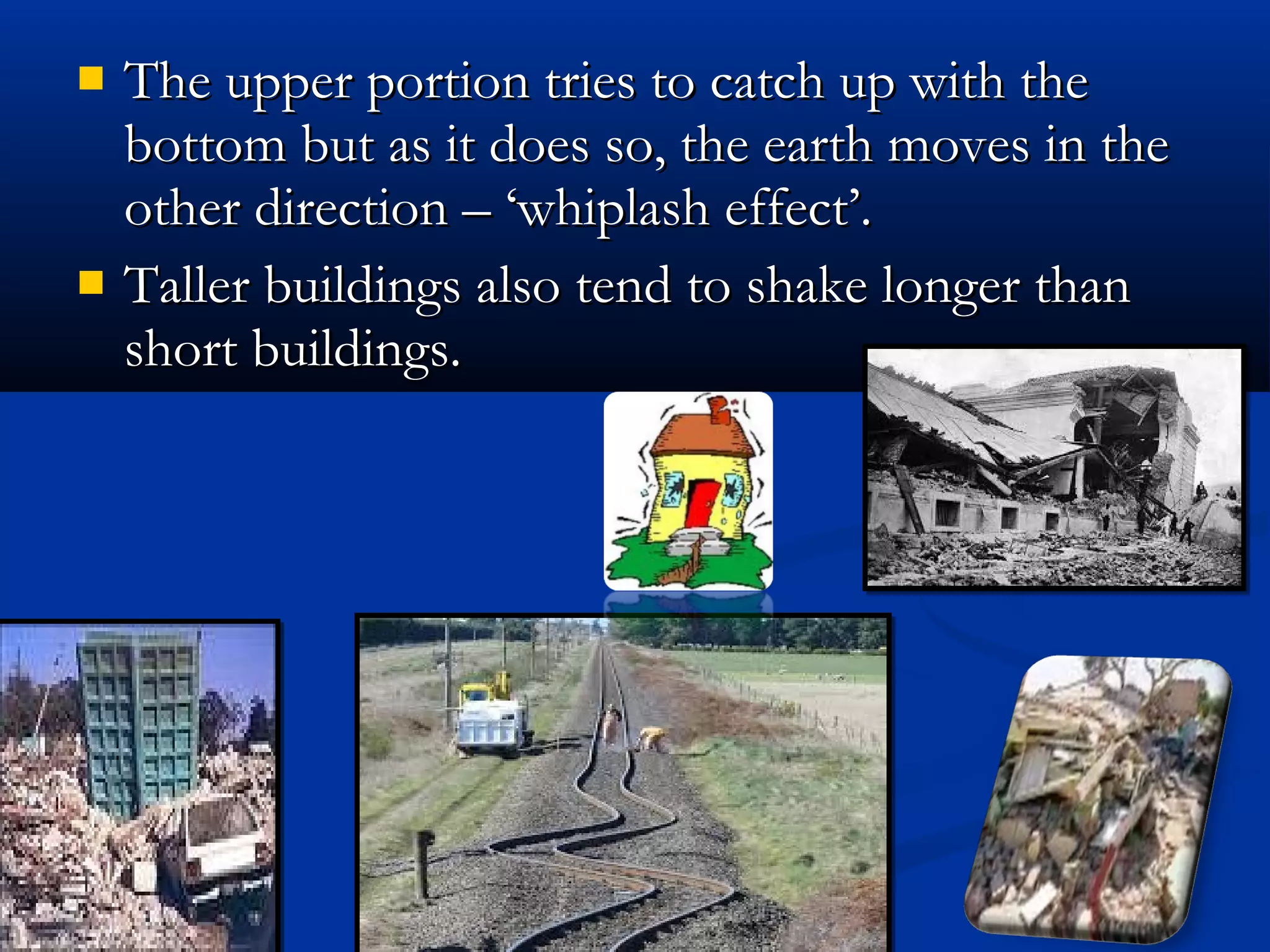
 The upper portion tries to catch up with theThe upper portion tries to catch up with the
bottom but as it does so, the earth moves in thebottom but as it does so, the earth moves in the
other direction – ‘whiplash effect’.other direction – ‘whiplash effect’.
 Taller buildings also tend to shake longer thanTaller buildings also tend to shake longer than
short buildings.short buildings.
PROTECTION MEASURESPROTECTION MEASURES
 The building should have a simple rectangularThe building should have a simple rectangular
plan.plan.
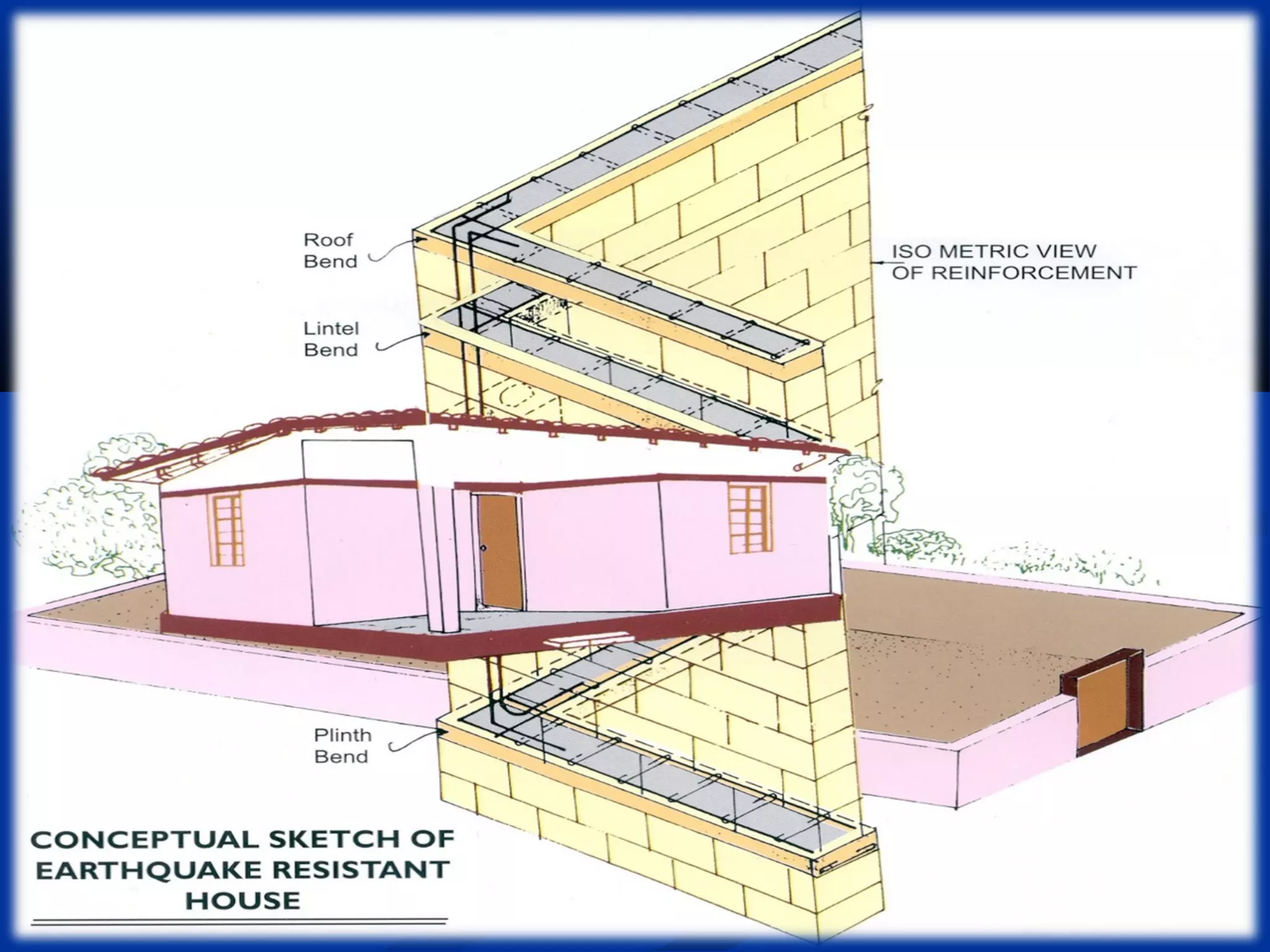
 Long walls should be supported by reinforcedLong walls should be supported by reinforced
concrete columns.concrete columns.
 Large buildings having plans with shapes likeLarge buildings having plans with shapes like
T,U,L and X.T,U,L and X.
 It should preferably be separated intoIt should preferably be separated into
rectangular blocks by providing gaps in between.rectangular blocks by providing gaps in between.
 Doors and window openings in walls ,Doors and window openings in walls ,
preferably be small & more centrally located.preferably be small & more centrally located.
 The location of openings should not be tooThe location of openings should not be too
close to the edge of the wall.close to the edge of the wall.
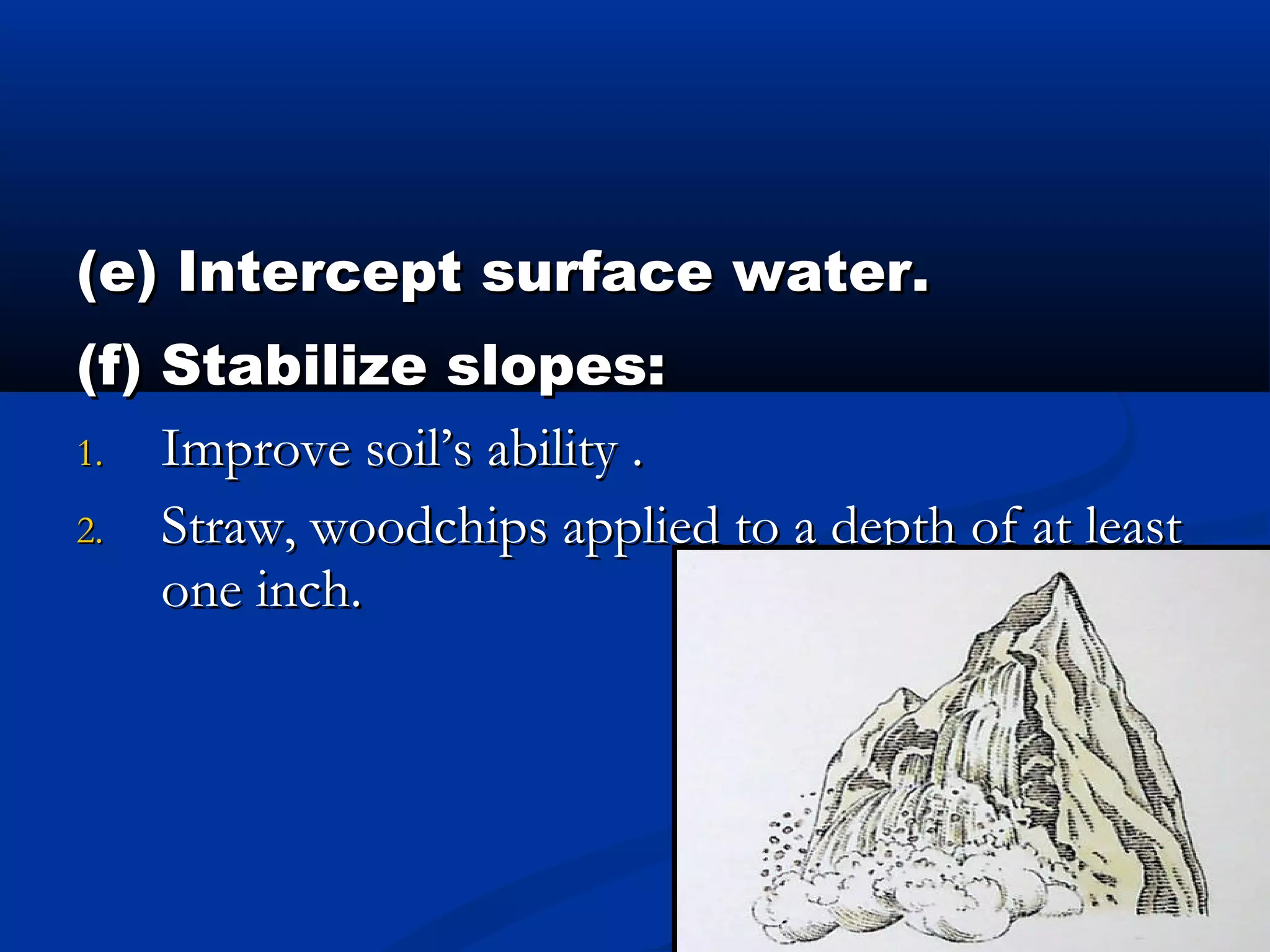
LANDSLIDESLANDSLIDES
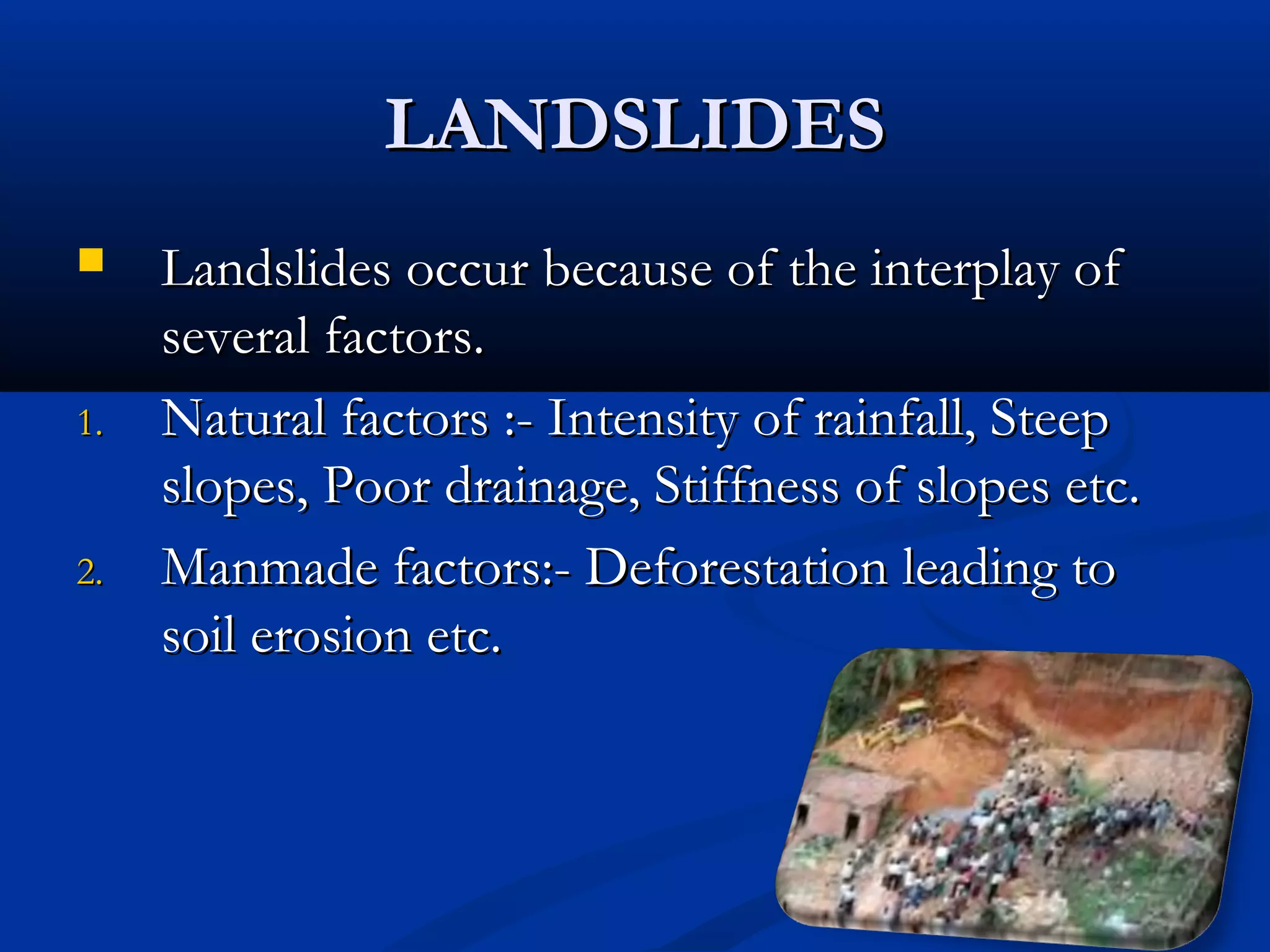
 Landslides occur because of the interplay ofLandslides occur because of the interplay of
several factors.several factors.
1.1. Natural factors :- Intensity of rainfall, SteepNatural factors :- Intensity of rainfall, Steep
slopes, Poor drainage, Stiffness of slopes etc.slopes, Poor drainage, Stiffness of slopes etc.
2.2. Manmade factors:- Deforestation leading toManmade factors:- Deforestation leading to
soil erosion etc.soil erosion etc.
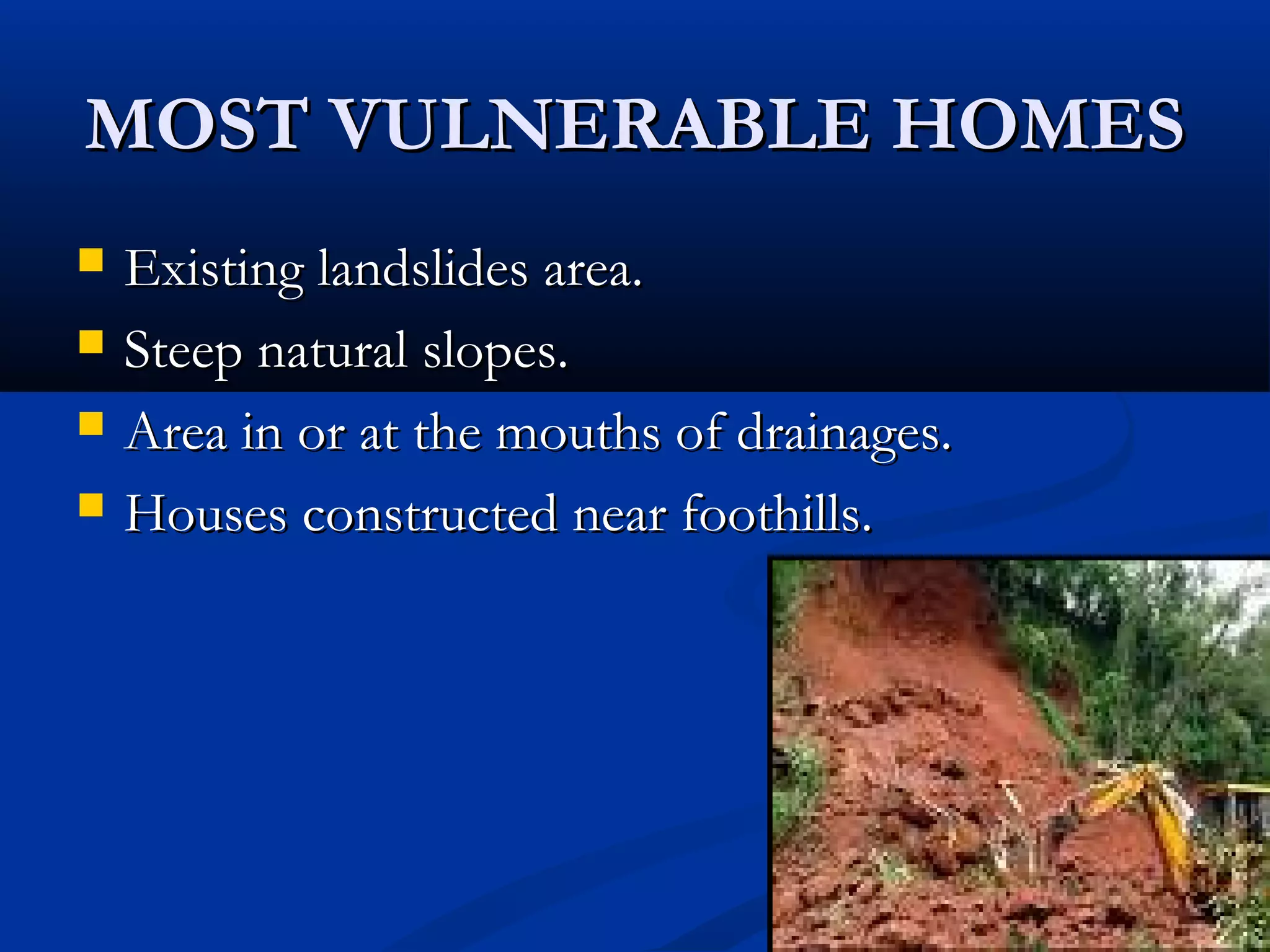
MOST VULNERABLE HOMESMOST VULNERABLE HOMES
 Existing landslides area.Existing landslides area.
 Steep natural slopes.Steep natural slopes.
 Area in or at the mouths of drainages.Area in or at the mouths of drainages.
 Houses constructed near foothills.Houses constructed near foothills.
PROTECTION MEASURESPROTECTION MEASURES
FROM DAMAGE TO BUILDINGSFROM DAMAGE TO BUILDINGS
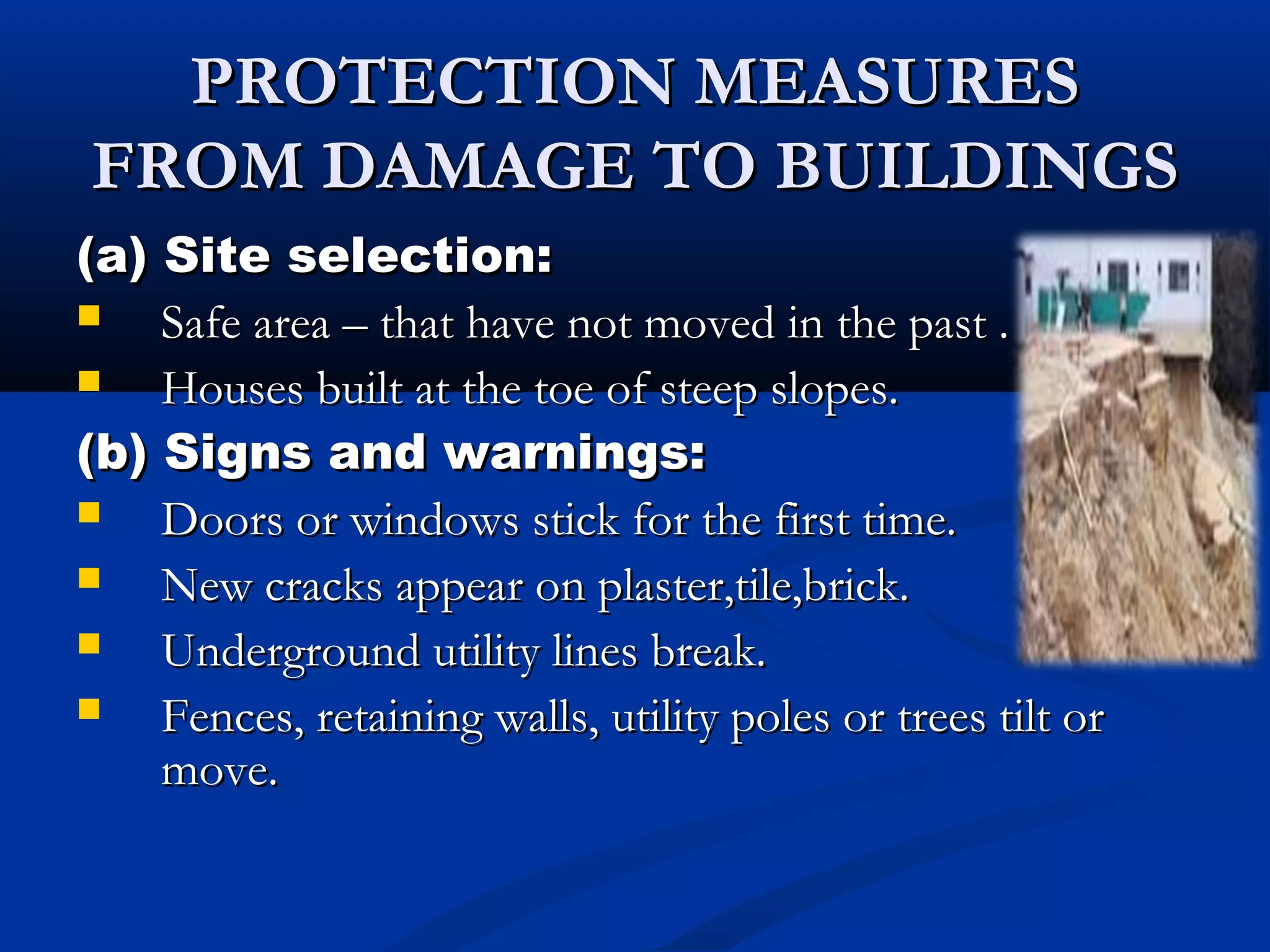
(a) Site selection:(a) Site selection:
 Safe area – that have not moved in the past .Safe area – that have not moved in the past .
 Houses built at the toe of steep slopes.Houses built at the toe of steep slopes.
(b) Signs and warnings:(b) Signs and warnings:
 Doors or windows stick for the first time.Doors or windows stick for the first time.
 New cracks appear on plaster,tile,brick.New cracks appear on plaster,tile,brick.
 Underground utility lines break.Underground utility lines break.
 Fences, retaining walls, utility poles or trees tilt orFences, retaining walls, utility poles or trees tilt or
move.move.
(c) Preventive action:(c) Preventive action:
1.1. Proper development.Proper development.
2.2. Sound construction techniques.Sound construction techniques.
3.3. Seasonal inspections.Seasonal inspections.
4.4. Regular maintenance of drainage facilities.Regular maintenance of drainage facilities.
(d) Protect vulnerable area:(d) Protect vulnerable area:
Keep surface drainage water away from vulnerable areasKeep surface drainage water away from vulnerable areas
(steep slopes, loose soils & non-vegetated surfaces.)(steep slopes, loose soils & non-vegetated surfaces.)
(e) Intercept surface water.(e) Intercept surface water.
(f) Stabilize slopes:(f) Stabilize slopes:
1.1. Improve soil’s ability .Improve soil’s ability .
2.2. Straw, woodchips applied to a depth of at leastStraw, woodchips applied to a depth of at least
one inch.one inch.
FLOODSFLOODS
Water is a source for all life forms . Without waterWater is a source for all life forms . Without water
no life is sustainable. ‘no life is sustainable. ‘How tragic it is’ ,How tragic it is’ , whenwhen
water in the form of floods takes away thousandwater in the form of floods takes away thousand
of human and cattle lives. More than one millionof human and cattle lives. More than one million
huts and poor houses are lost every year inhuts and poor houses are lost every year in
floods in India. CAN WE PREVENT THISfloods in India. CAN WE PREVENT THIS
LOSS ????????????LOSS ????????????
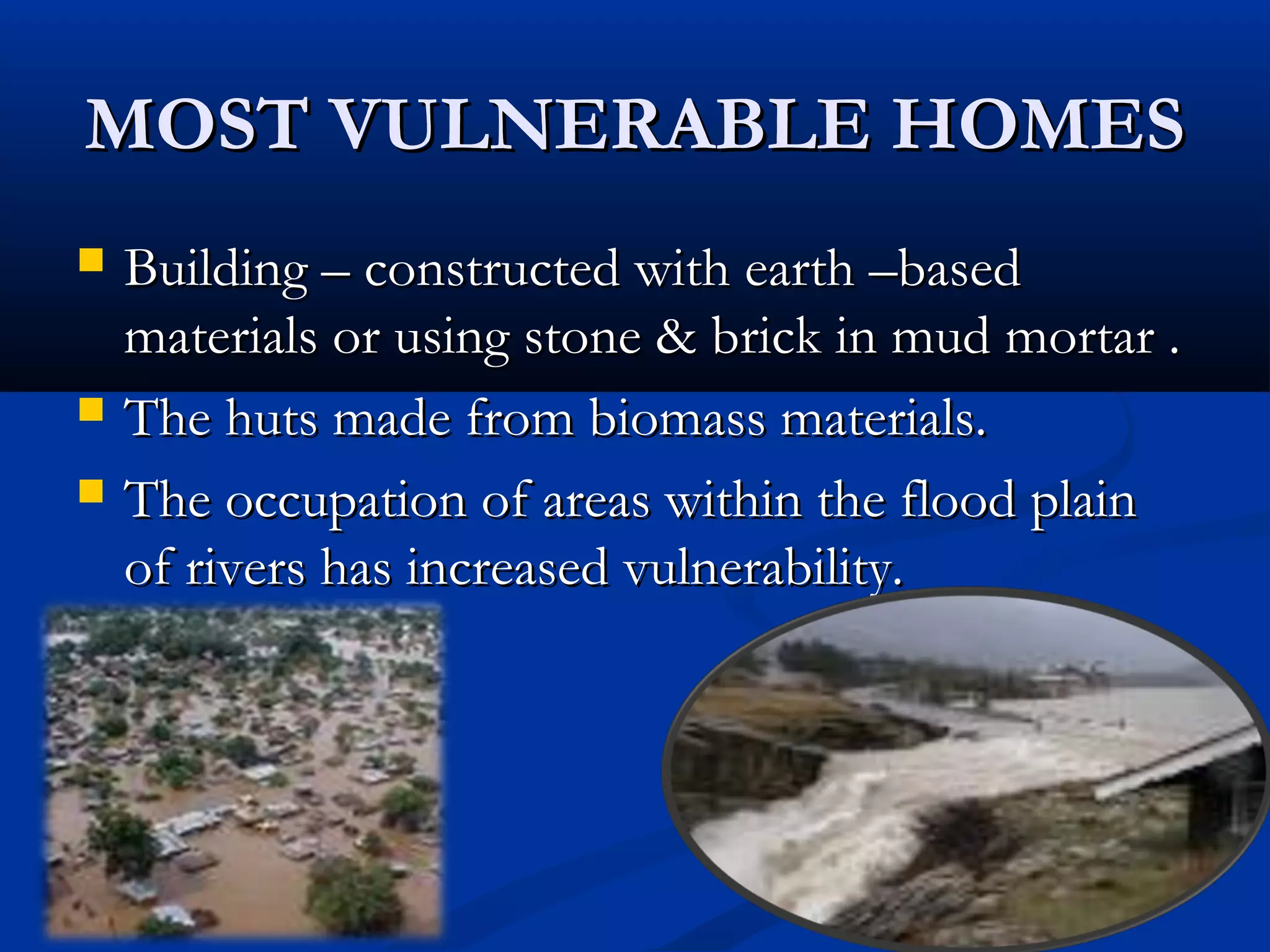
MOST VULNERABLE HOMESMOST VULNERABLE HOMES
 Building – constructed with earth –basedBuilding – constructed with earth –based
materials or using stone & brick in mud mortar .materials or using stone & brick in mud mortar .
 The huts made from biomass materials.The huts made from biomass materials.
 The occupation of areas within the flood plainThe occupation of areas within the flood plain
of rivers has increased vulnerability.of rivers has increased vulnerability.
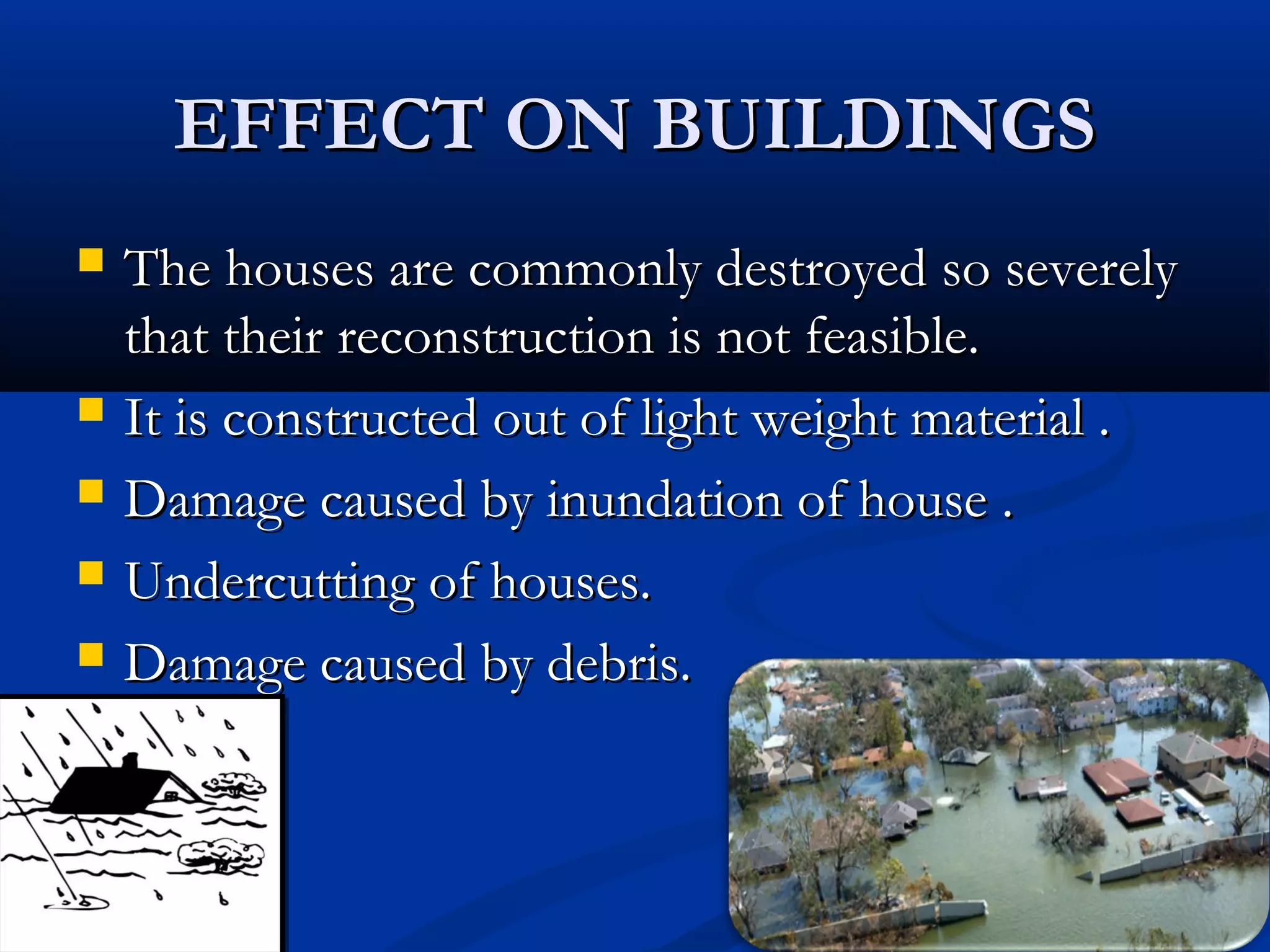
EFFECT ON BUILDINGSEFFECT ON BUILDINGS
 The houses are commonly destroyed so severelyThe houses are commonly destroyed so severely
that their reconstruction is not feasible.that their reconstruction is not feasible.
 It is constructed out of light weight material .It is constructed out of light weight material .
 Damage caused by inundation of house .Damage caused by inundation of house .
 Undercutting of houses.Undercutting of houses.
 Damage caused by debris.Damage caused by debris.
PROTECTION MEASURESPROTECTION MEASURES
FROM DAMAGE TO BUILDINGSFROM DAMAGE TO BUILDINGS
 To avoid residing on river banks & slopes onTo avoid residing on river banks & slopes on
river sides.river sides.
 To build at least 250 mts away from the seaTo build at least 250 mts away from the sea
coast .coast .
 To build proper drainage system in all floodTo build proper drainage system in all flood
prone areas.prone areas.
 To construct the building with a plinth levelTo construct the building with a plinth level
higher than the known high flood level.higher than the known high flood level.
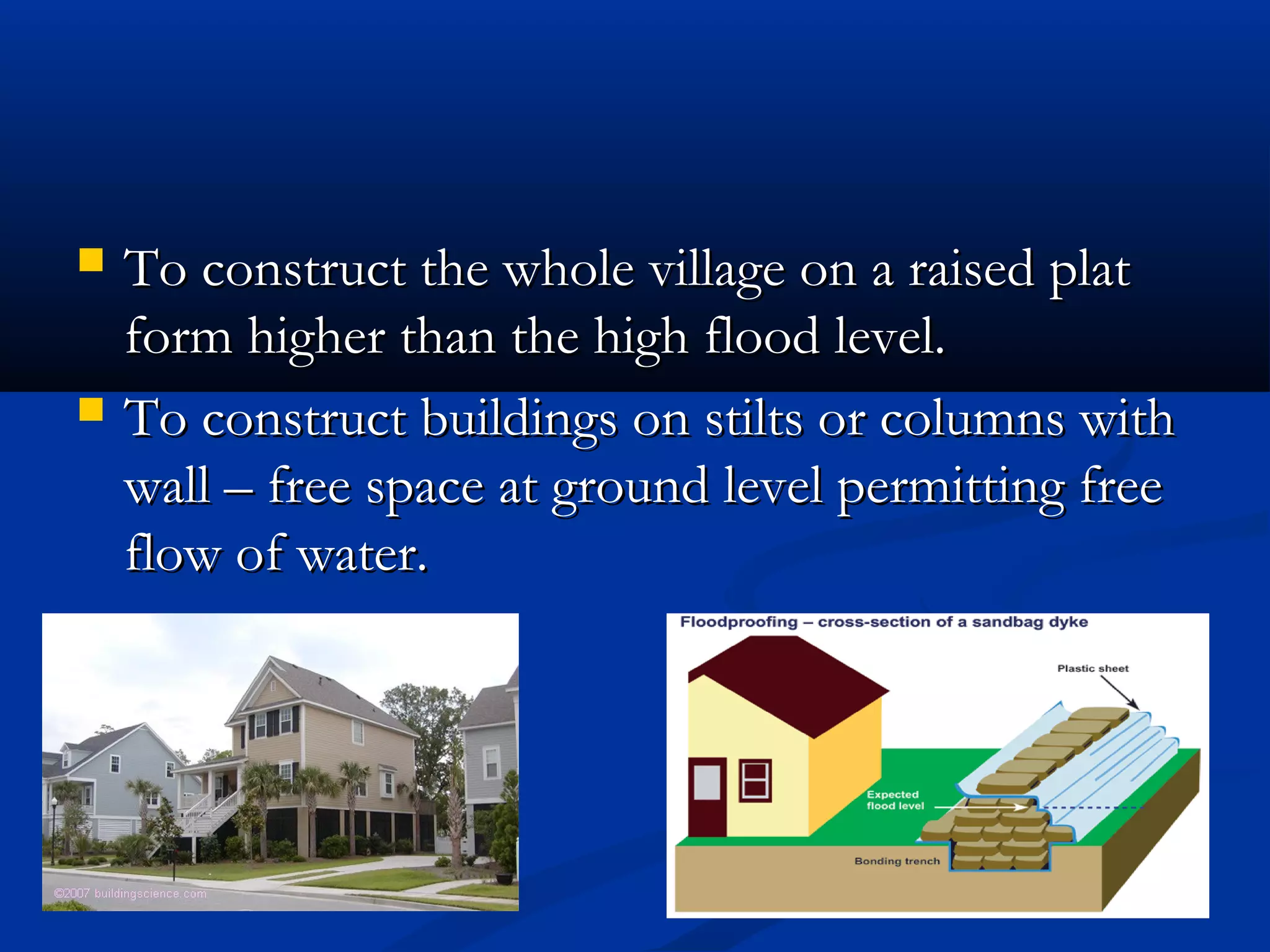
 To construct the whole village on a raised platTo construct the whole village on a raised plat
form higher than the high flood level.form higher than the high flood level.
 To construct buildings on stilts or columns withTo construct buildings on stilts or columns with
wall – free space at ground level permitting freewall – free space at ground level permitting free
flow of water.flow of water.
CYCLONESCYCLONES
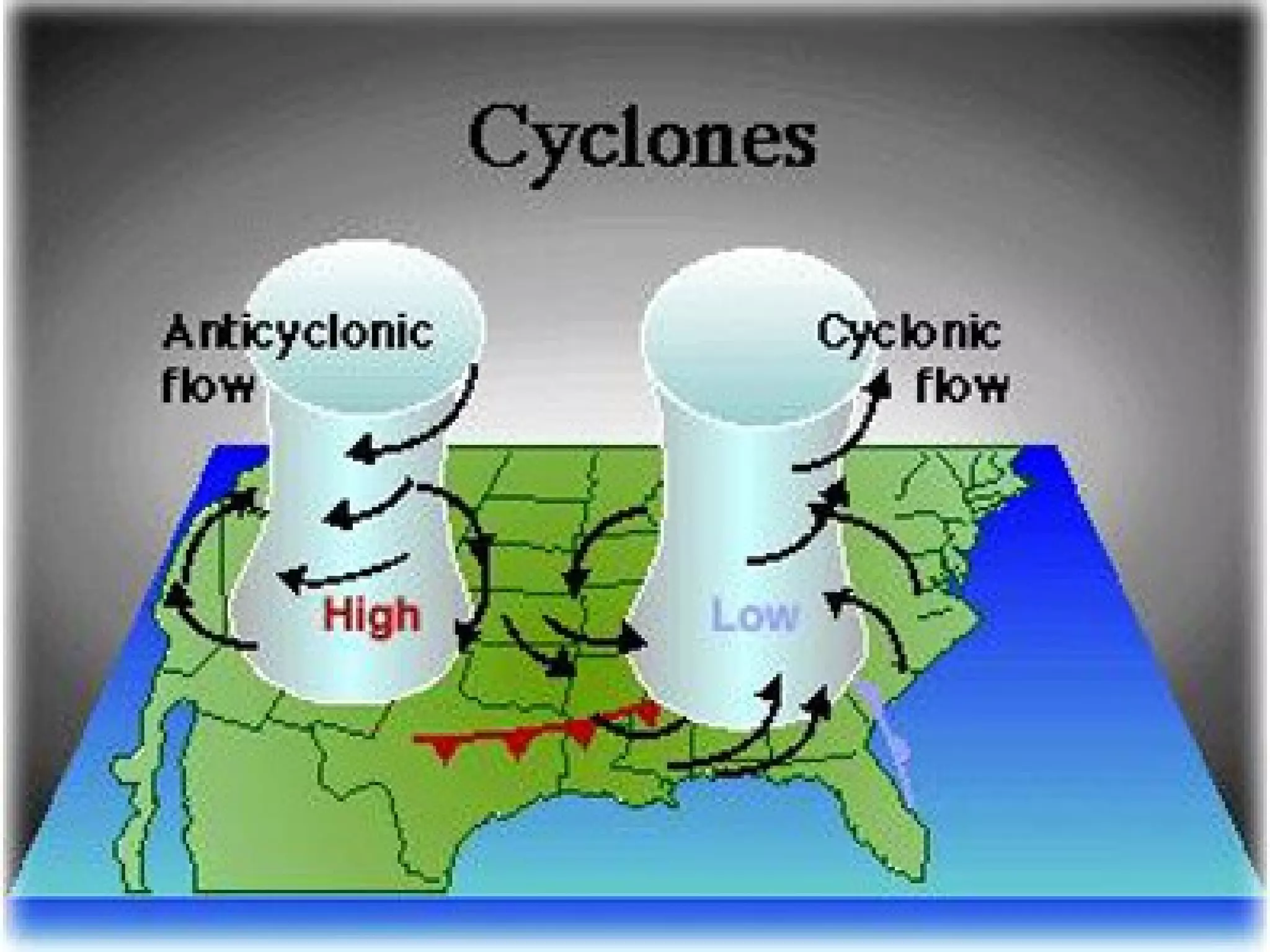
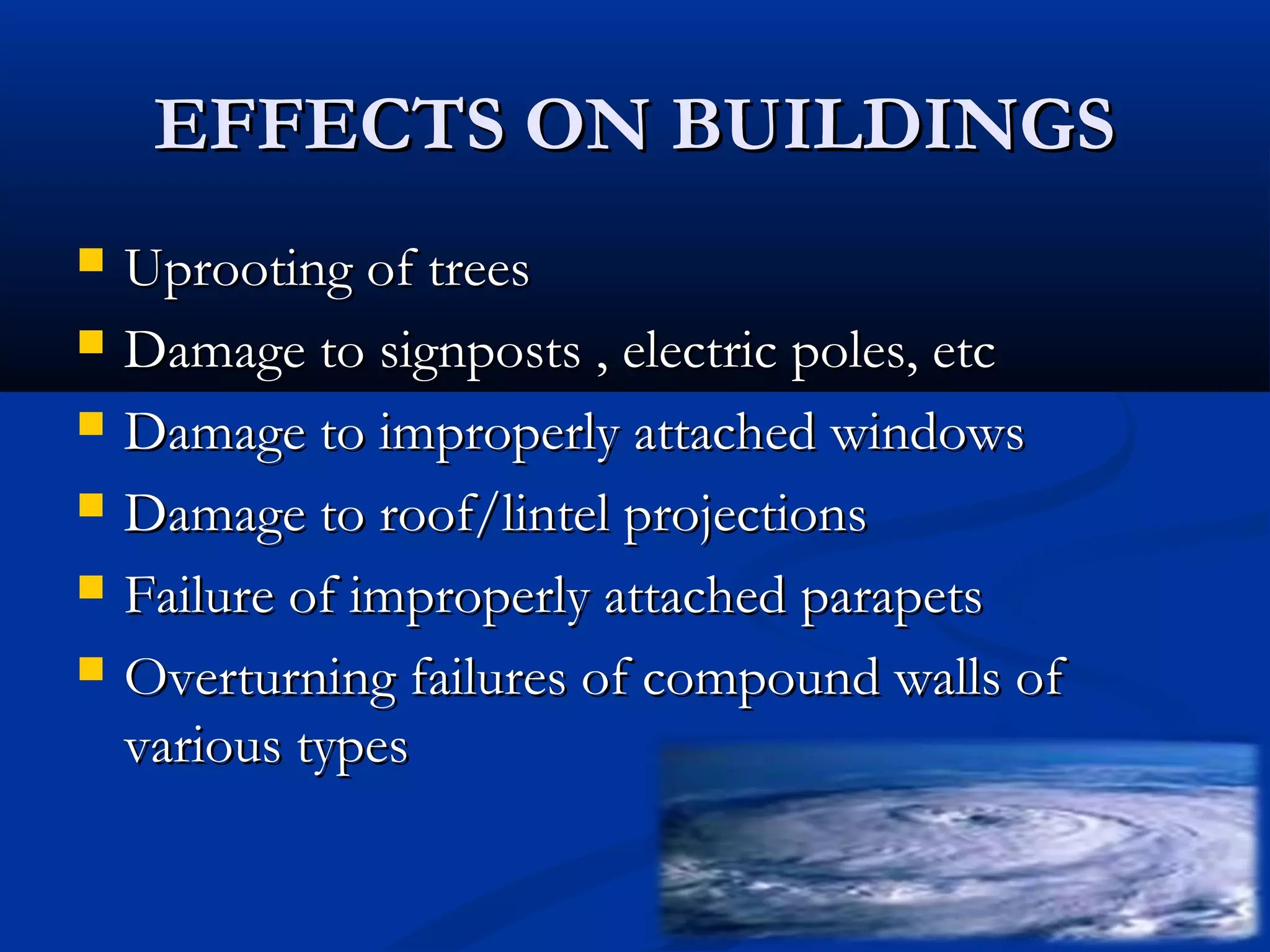
 Cyclones pose a major threat to life and propertyCyclones pose a major threat to life and property
in many parts of the world. Every year thesein many parts of the world. Every year these
sudden, violent cyclones bring widespreadsudden, violent cyclones bring widespread
devastation to coastlines and islands lying indevastation to coastlines and islands lying in
their erratic paths. A windstorm's destructivetheir erratic paths. A windstorm's destructive
work is done by the high wind; flood producingwork is done by the high wind; flood producing
rains and associated storm surges.rains and associated storm surges.
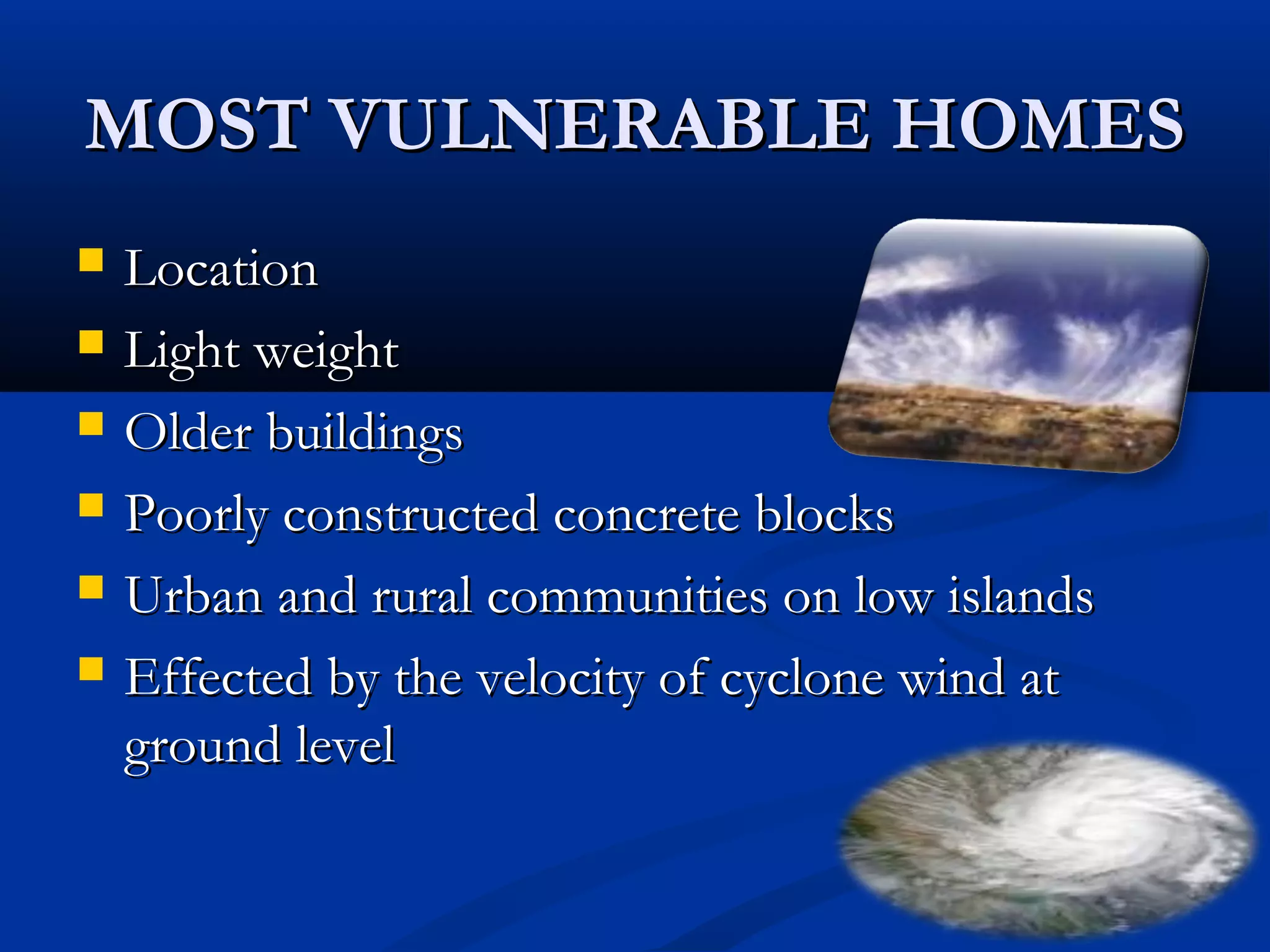
MOST VULNERABLE HOMESMOST VULNERABLE HOMES
 LocationLocation
 Light weightLight weight
 Older buildingsOlder buildings
 Poorly constructed concrete blocksPoorly constructed concrete blocks
 Urban and rural communities on low islandsUrban and rural communities on low islands
 Effected by the velocity of cyclone wind atEffected by the velocity of cyclone wind at
ground levelground level
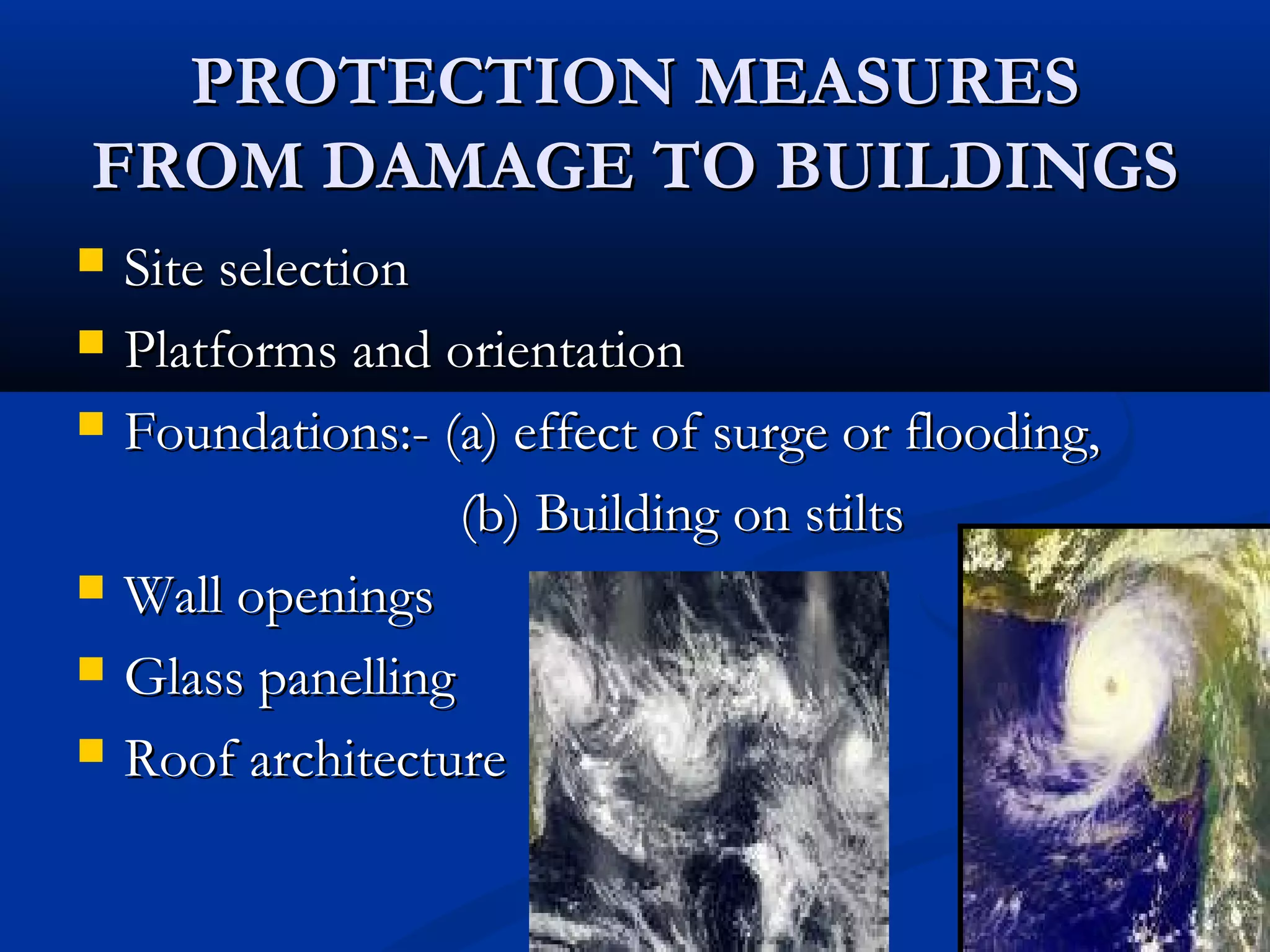
EFFECTS ON BUILDINGSEFFECTS ON BUILDINGS
 Uprooting of treesUprooting of trees
 Damage to signposts , electric poles, etcDamage to signposts , electric poles, etc
 Damage to improperly attached windowsDamage to improperly attached windows
 Damage to roof/lintel projectionsDamage to roof/lintel projections
 Failure of improperly attached parapetsFailure of improperly attached parapets
 Overturning failures of compound walls ofOverturning failures of compound walls of
various typesvarious types
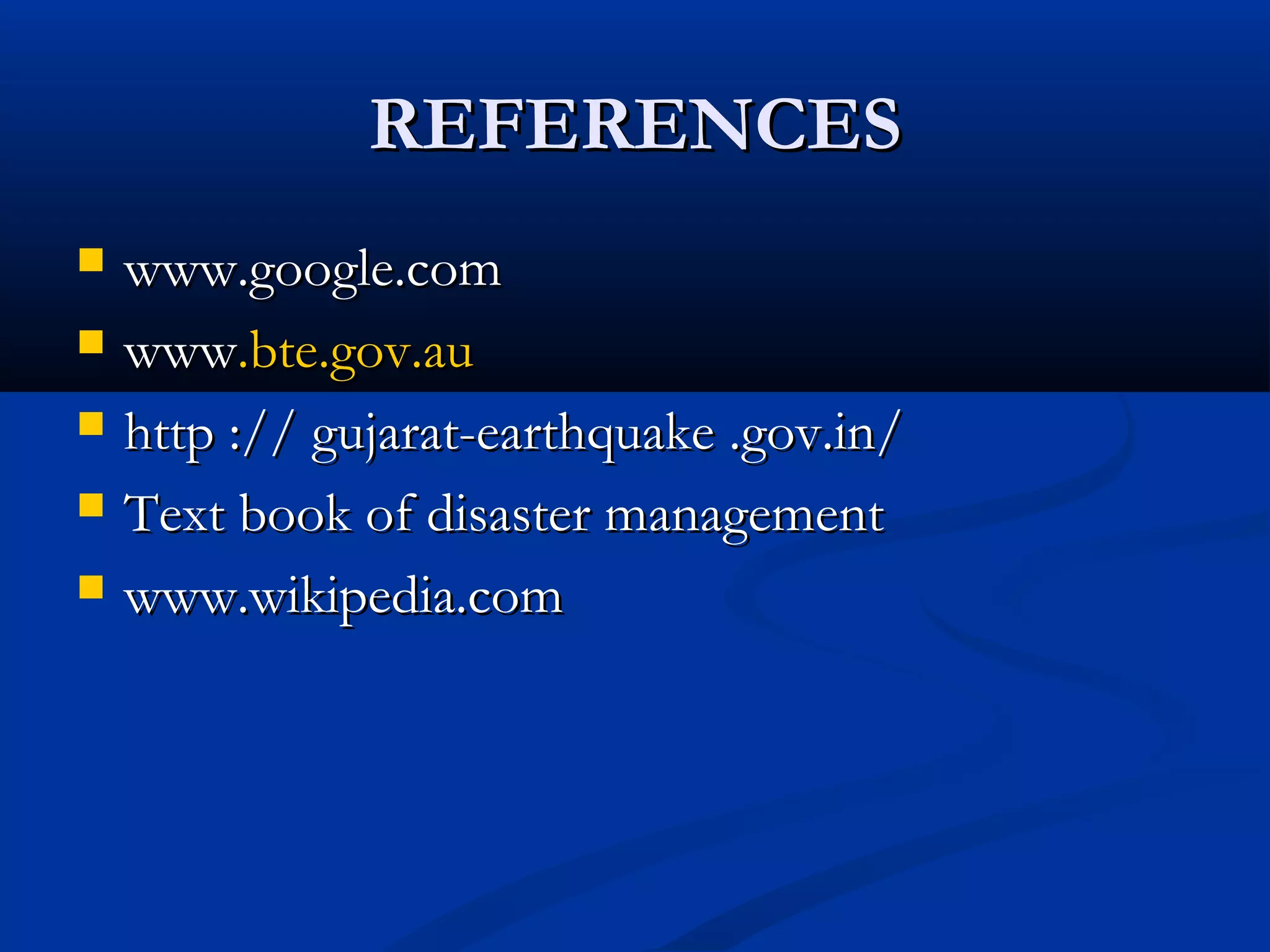
PROTECTION MEASURESPROTECTION MEASURES
FROM DAMAGE TO BUILDINGSFROM DAMAGE TO BUILDINGS
 Site selectionSite selection
 Platforms and orientationPlatforms and orientation
 Foundations:- (a) effect of surge or flooding,Foundations:- (a) effect of surge or flooding,
(b) Building on stilts(b) Building on stilts
 Wall openingsWall openings
 Glass panellingGlass panelling
 Roof architectureRoof architecture
REFERENCESREFERENCES
 www.google.comwww.google.com
 wwwwww.bte.gov.au.bte.gov.au
 http :// gujarat-earthquake .gov.in/http :// gujarat-earthquake .gov.in/
 Text book of disaster managementText book of disaster management
 www.wikipedia.comwww.wikipedia.com
 ANAMIKA PRAKASH ©ANAMIKA PRAKASH ©
 KALYANI JOSHYKALYANI JOSHY
 J ANANTHA NARAYANANJ ANANTHA NARAYANAN
 RAJALAKSHMI P SAJEEVRAJALAKSHMI P SAJEEV
 NIKHIL NANDHAKUMARNIKHIL NANDHAKUMAR
 AMIT. MAMIT. M
 SHRADHA HARIKRISHNANSHRADHA HARIKRISHNAN
 DANNY M VARGHESEDANNY M VARGHESE

S a fe construction practices class X social project , flood, cyclone, disasters

  • 3.
    CONTENTSCONTENTS  DISASTERDISASTER  TYPESOF DISASTERTYPES OF DISASTER  EARTHQUAKESEARTHQUAKES  LANDSLIDESLANDSLIDES  FLOODSFLOODS  CYCLONESCYCLONES  REFERENCESREFERENCES
  • 4.
    DISASTERDISASTER  The term‘Disaster’ owes its origin to the French wordThe term ‘Disaster’ owes its origin to the French word ‘Desastre’ which is the combination of two terms ‘des’‘Desastre’ which is the combination of two terms ‘des’ meaning bad or evil and ‘astre’ meaning star . Themeaning bad or evil and ‘astre’ meaning star . The combination expression is ‘Bad or Evil Star’.combination expression is ‘Bad or Evil Star’.  A catastrophe, sudden, calamitous event bringing greatA catastrophe, sudden, calamitous event bringing great damage, loss, destruction and devastation to life anddamage, loss, destruction and devastation to life and property by natural or man-made causes.property by natural or man-made causes.
  • 5.
    TYPES OF DISASTERTYPESOF DISASTER Two TypesTwo Types –– NaturalNatural andand ManmadeManmade Natural disasters:Natural disasters:      FloodFlood  CycloneCyclone  EarthquakeEarthquake  LandslidesLandslides
  • 6.
    EARTHQUAKESEARTHQUAKES  Ground shaking– back-&-forth motion , causedGround shaking – back-&-forth motion , caused by the passing vibratory waves.by the passing vibratory waves.  Soil failures – caused by shaking e.g. landslides .Soil failures – caused by shaking e.g. landslides .  Surface fault ruptures, such as cracks , verticalSurface fault ruptures, such as cracks , vertical shifts.shifts.  Tidal waves ,i.e. large waves on the surface ofTidal waves ,i.e. large waves on the surface of bodies of water that can cause major damage tobodies of water that can cause major damage to shoreline areas.shoreline areas.
  • 7.
    EFFECTS ON BUILDINGSEFFECTSON BUILDINGS  As vibrations & waves continue to moveAs vibrations & waves continue to move through the earth –buildings ,set in motion.through the earth –buildings ,set in motion.  Each building response differently ,acc.to itsEach building response differently ,acc.to its construction.construction.  When waves strike ,earth moves backward &When waves strike ,earth moves backward & forward .forward .  The lower part of building moves with the earth.The lower part of building moves with the earth.  The upper portion –initially remains at rest.The upper portion –initially remains at rest.
  • 8.
     The upperportion tries to catch up with theThe upper portion tries to catch up with the bottom but as it does so, the earth moves in thebottom but as it does so, the earth moves in the other direction – ‘whiplash effect’.other direction – ‘whiplash effect’.  Taller buildings also tend to shake longer thanTaller buildings also tend to shake longer than short buildings.short buildings.
  • 9.
    PROTECTION MEASURESPROTECTION MEASURES The building should have a simple rectangularThe building should have a simple rectangular plan.plan.  Long walls should be supported by reinforcedLong walls should be supported by reinforced concrete columns.concrete columns.  Large buildings having plans with shapes likeLarge buildings having plans with shapes like T,U,L and X.T,U,L and X.  It should preferably be separated intoIt should preferably be separated into rectangular blocks by providing gaps in between.rectangular blocks by providing gaps in between.
  • 10.
     Doors andwindow openings in walls ,Doors and window openings in walls , preferably be small & more centrally located.preferably be small & more centrally located.  The location of openings should not be tooThe location of openings should not be too close to the edge of the wall.close to the edge of the wall.
  • 12.
    LANDSLIDESLANDSLIDES  Landslides occurbecause of the interplay ofLandslides occur because of the interplay of several factors.several factors. 1.1. Natural factors :- Intensity of rainfall, SteepNatural factors :- Intensity of rainfall, Steep slopes, Poor drainage, Stiffness of slopes etc.slopes, Poor drainage, Stiffness of slopes etc. 2.2. Manmade factors:- Deforestation leading toManmade factors:- Deforestation leading to soil erosion etc.soil erosion etc.
  • 14.
    MOST VULNERABLE HOMESMOSTVULNERABLE HOMES  Existing landslides area.Existing landslides area.  Steep natural slopes.Steep natural slopes.  Area in or at the mouths of drainages.Area in or at the mouths of drainages.  Houses constructed near foothills.Houses constructed near foothills.
  • 15.
    PROTECTION MEASURESPROTECTION MEASURES FROMDAMAGE TO BUILDINGSFROM DAMAGE TO BUILDINGS (a) Site selection:(a) Site selection:  Safe area – that have not moved in the past .Safe area – that have not moved in the past .  Houses built at the toe of steep slopes.Houses built at the toe of steep slopes. (b) Signs and warnings:(b) Signs and warnings:  Doors or windows stick for the first time.Doors or windows stick for the first time.  New cracks appear on plaster,tile,brick.New cracks appear on plaster,tile,brick.  Underground utility lines break.Underground utility lines break.  Fences, retaining walls, utility poles or trees tilt orFences, retaining walls, utility poles or trees tilt or move.move.
  • 16.
    (c) Preventive action:(c)Preventive action: 1.1. Proper development.Proper development. 2.2. Sound construction techniques.Sound construction techniques. 3.3. Seasonal inspections.Seasonal inspections. 4.4. Regular maintenance of drainage facilities.Regular maintenance of drainage facilities. (d) Protect vulnerable area:(d) Protect vulnerable area: Keep surface drainage water away from vulnerable areasKeep surface drainage water away from vulnerable areas (steep slopes, loose soils & non-vegetated surfaces.)(steep slopes, loose soils & non-vegetated surfaces.)
  • 17.
    (e) Intercept surfacewater.(e) Intercept surface water. (f) Stabilize slopes:(f) Stabilize slopes: 1.1. Improve soil’s ability .Improve soil’s ability . 2.2. Straw, woodchips applied to a depth of at leastStraw, woodchips applied to a depth of at least one inch.one inch.
  • 18.
    FLOODSFLOODS Water is asource for all life forms . Without waterWater is a source for all life forms . Without water no life is sustainable. ‘no life is sustainable. ‘How tragic it is’ ,How tragic it is’ , whenwhen water in the form of floods takes away thousandwater in the form of floods takes away thousand of human and cattle lives. More than one millionof human and cattle lives. More than one million huts and poor houses are lost every year inhuts and poor houses are lost every year in floods in India. CAN WE PREVENT THISfloods in India. CAN WE PREVENT THIS LOSS ????????????LOSS ????????????
  • 19.
    MOST VULNERABLE HOMESMOSTVULNERABLE HOMES  Building – constructed with earth –basedBuilding – constructed with earth –based materials or using stone & brick in mud mortar .materials or using stone & brick in mud mortar .  The huts made from biomass materials.The huts made from biomass materials.  The occupation of areas within the flood plainThe occupation of areas within the flood plain of rivers has increased vulnerability.of rivers has increased vulnerability.
  • 20.
    EFFECT ON BUILDINGSEFFECTON BUILDINGS  The houses are commonly destroyed so severelyThe houses are commonly destroyed so severely that their reconstruction is not feasible.that their reconstruction is not feasible.  It is constructed out of light weight material .It is constructed out of light weight material .  Damage caused by inundation of house .Damage caused by inundation of house .  Undercutting of houses.Undercutting of houses.  Damage caused by debris.Damage caused by debris.
  • 21.
    PROTECTION MEASURESPROTECTION MEASURES FROMDAMAGE TO BUILDINGSFROM DAMAGE TO BUILDINGS  To avoid residing on river banks & slopes onTo avoid residing on river banks & slopes on river sides.river sides.  To build at least 250 mts away from the seaTo build at least 250 mts away from the sea coast .coast .  To build proper drainage system in all floodTo build proper drainage system in all flood prone areas.prone areas.  To construct the building with a plinth levelTo construct the building with a plinth level higher than the known high flood level.higher than the known high flood level.
  • 22.
     To constructthe whole village on a raised platTo construct the whole village on a raised plat form higher than the high flood level.form higher than the high flood level.  To construct buildings on stilts or columns withTo construct buildings on stilts or columns with wall – free space at ground level permitting freewall – free space at ground level permitting free flow of water.flow of water.
  • 23.
    CYCLONESCYCLONES  Cyclones posea major threat to life and propertyCyclones pose a major threat to life and property in many parts of the world. Every year thesein many parts of the world. Every year these sudden, violent cyclones bring widespreadsudden, violent cyclones bring widespread devastation to coastlines and islands lying indevastation to coastlines and islands lying in their erratic paths. A windstorm's destructivetheir erratic paths. A windstorm's destructive work is done by the high wind; flood producingwork is done by the high wind; flood producing rains and associated storm surges.rains and associated storm surges.
  • 25.
    MOST VULNERABLE HOMESMOSTVULNERABLE HOMES  LocationLocation  Light weightLight weight  Older buildingsOlder buildings  Poorly constructed concrete blocksPoorly constructed concrete blocks  Urban and rural communities on low islandsUrban and rural communities on low islands  Effected by the velocity of cyclone wind atEffected by the velocity of cyclone wind at ground levelground level
  • 26.
    EFFECTS ON BUILDINGSEFFECTSON BUILDINGS  Uprooting of treesUprooting of trees  Damage to signposts , electric poles, etcDamage to signposts , electric poles, etc  Damage to improperly attached windowsDamage to improperly attached windows  Damage to roof/lintel projectionsDamage to roof/lintel projections  Failure of improperly attached parapetsFailure of improperly attached parapets  Overturning failures of compound walls ofOverturning failures of compound walls of various typesvarious types
  • 27.
    PROTECTION MEASURESPROTECTION MEASURES FROMDAMAGE TO BUILDINGSFROM DAMAGE TO BUILDINGS  Site selectionSite selection  Platforms and orientationPlatforms and orientation  Foundations:- (a) effect of surge or flooding,Foundations:- (a) effect of surge or flooding, (b) Building on stilts(b) Building on stilts  Wall openingsWall openings  Glass panellingGlass panelling  Roof architectureRoof architecture
  • 28.
    REFERENCESREFERENCES  www.google.comwww.google.com  wwwwww.bte.gov.au.bte.gov.au http :// gujarat-earthquake .gov.in/http :// gujarat-earthquake .gov.in/  Text book of disaster managementText book of disaster management  www.wikipedia.comwww.wikipedia.com
  • 29.
     ANAMIKA PRAKASH©ANAMIKA PRAKASH ©  KALYANI JOSHYKALYANI JOSHY  J ANANTHA NARAYANANJ ANANTHA NARAYANAN  RAJALAKSHMI P SAJEEVRAJALAKSHMI P SAJEEV  NIKHIL NANDHAKUMARNIKHIL NANDHAKUMAR  AMIT. MAMIT. M  SHRADHA HARIKRISHNANSHRADHA HARIKRISHNAN  DANNY M VARGHESEDANNY M VARGHESE