
THE DIRECT TAXES
   CODE, 2010
  Bill No. 110 of 2010

      PRESENTED BY :-
               SUPRIT SHARAN
               ARPITA SINGH
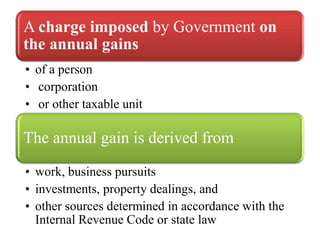
A charge imposed by Government on
the annual gains
• of a person
• corporation
• or other taxable unit

The annual gain is derived from
• work, business pursuits
• investments, property dealings, and
• other sources determined in accordance with the
  Internal Revenue Code or state law
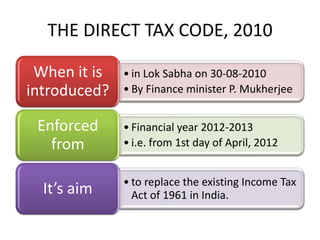
THE DIRECT TAX CODE, 2010

 When it is   • in Lok Sabha on 30-08-2010
introduced?   • By Finance minister P. Mukherjee


 Enforced     • Financial year 2012-2013
   from       • i.e. from 1st day of April, 2012


              • to replace the existing Income Tax
  It’s aim      Act of 1961 in India.
WHY DTC IS REQUIRED???


                     Tax deduction limit         Security
Rates of tax to be
                       on savings to be     transaction tax to
    uniform
                      hiked to Rs 3 lakh       be abolished


             To scrap long,     Business losses can
           short-term capital   be carried forward
            gains distinction       indefinitely
No tax deduction on
                              Effective corporate tax
interest payable on any
                                    rate at 30 %
 Government security


             Highest tax rate of 30% for
             individual of income over
                     Rs 25 lakh
AND…


TO PROMOTE
    THE
 LONG-TERM
INVESTMENT
BASIS OF CHARGE

       RESIDENTIAL
         STATUS

         TOTAL
        INCOME
An individual shall be resident in India
in any financial year, if he is in India-

for a period, or for a period, or     ii) three
     periods,        periods,      hundred and
 amounting in     amounting in sixty-five days
    all to one        all to-     or more within
 hundred and                       the four years
   eighty-two    i)sixty days or    immediately
days or more in more in that      preceding that
  that year; or     year; and           year.
The previous
                provisions shall
                 not apply in
                 respect of an
               individual who is
                       :-

a citizen of India and
 who leaves India in
     that year as a
member of the crew
of an Indian ship; or
the total income of any financial year of a
person, who is a resident, shall include all
income from whatever source derived which—

                 • accrues, or is deemed to accrue
                   to him in India
 In India        • is received, or is deemed to be
                   received, by him, or on his
                   behalf in India during the year


                 • accrues to him outside India
 Outside         • is received by him, or on his
                   behalf, outside India during the
  India            year.
For Non- Resident
Subject to the provisions of this Code, the total income of any
financial year of a person, who is a non-resident, shall include all
income from whatever source derived which—


accrues, or is deemed to accrue, to him in
India during the year; or


is received, or is deemed to be received, by
him, or on his behalf, in India during the year.
• `
CLASSIFICATION OF SOURCES OF
           INCOME

  Income from
 Special sources


                    TOTAL
                   INCOME
  Income from
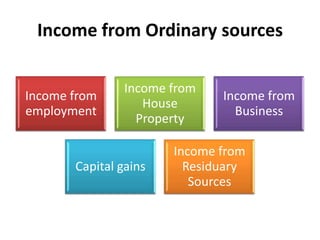
Ordinary sources
Income from Special sources


Income from Special Sources
include interest, dividends on
which distribution tax has not
been paid, capital gains, any
other     investment    income,
royalty, fees for technical
services, amongst others.
Income from Ordinary sources

                Income from
Income from                   Income from
                   House
employment                      Business
                  Property

                       Income from
       Capital gains     Residuary
                          Sources
Income from employment


Gross salary, including the value of perquisites and
profits in lieu of salary, to be taxed on due or
receipt basis, whichever is earlier and to be reduced
by permissible deductions

Permissible deductions to include professional tax,
transport allowance, prescribed special allowance,
compensation under voluntary retirement scheme,
gratuity, commutation of pension, amongst others
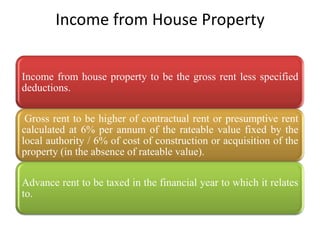
Income from House Property


Income from house property to be the gross rent less specified
deductions.

 Gross rent to be higher of contractual rent or presumptive rent
calculated at 6% per annum of the rateable value fixed by the
local authority / 6% of cost of construction or acquisition of the
property (in the absence of rateable value).

Advance rent to be taxed in the financial year to which it relates
to.
Income from Business
All assets to be classified into business and
investment assets, wherein business assets to be
further classified into business trading assets and
business capital assets.


Only income from transactions in business assets to
form part of business income


Profit on sale of business capital assets, profit on sale
of an undertaking under a slump sale, transfer of any
self generated business asset, etc. to be treated as
business income
Capital gains

Income from transactions in all investment assets to be
taxed under the head “capital gains”.


Gains and losses to be included in the total income of the
financial year in which the investment asset is transferred
irrespective of the year of receipt of consideration, except
in the case of compulsory acquisition of an asset.
Income from Residuary Sources
Residuary income to comprise any income which does not
form part of any other head of income


The scope of gross residuary income widened to include
income having incidental nexus with some other head of
income


Any amount exceeding Rs. 20,000, taken or accepted or
repaid as loan or deposit otherwise than by account payee
cheque or draft to be taxed as income from residuary
sources.
TAX INCENTIVES
Major Deductions applicable under the Tax Incentives for an
individual are:
              Investments through PFRDA approved agencies
             Payment of tuition fees
             Medical treatment
             Health insurance
             Donations
             Interest on loan taken for higher education
             Maintenance of a disabled dependant
             Interest income on Government Bonds
The EET Model for Investments


                            Taxed
                            when it is
               Exempted     withdrawn
               till it is
               remained
    Exempted   invested
    when
    invested
EARLIER
                      EEE - MODEL


                      INVESTED
INVESTED


                                            WITHDRAWN
           Exempted              Exempted               Exempted
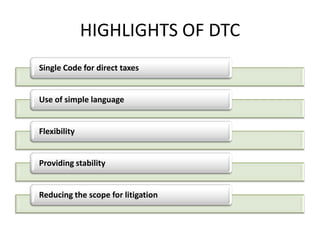
HIGHLIGHTS OF DTC
Single Code for direct taxes


Use of simple language


Flexibility


Providing stability


Reducing the scope for litigation
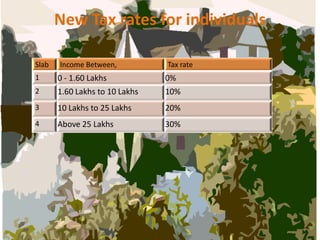
New Tax rates for individuals

Slab   Income Between,          Tax rate
1      0 - 1.60 Lakhs           0%
2      1.60 Lakhs to 10 Lakhs   10%
3      10 Lakhs to 25 Lakhs     20%
4      Above 25 Lakhs           30%
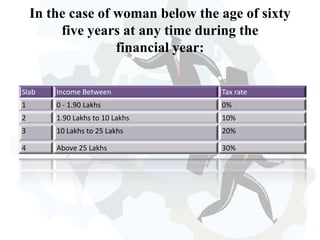
In the case of woman below the age of sixty
         five years at any time during the
                   financial year:

Slab    Income Between             Tax rate
1       0 - 1.90 Lakhs             0%
2       1.90 Lakhs to 10 Lakhs     10%
3       10 Lakhs to 25 Lakhs       20%

4       Above 25 Lakhs             30%
In the case of senior citizens
Slab     Income Between           Tax rate
1        0 - 2.40 Lakhs           0%
2        2.40 Lakhs to 10 Lakhs   10%
3        10 Lakhs to 25 Lakhs     20%
4        Above 25 Lakhs           30%
New due dates for Tax Returns:
Sl. No Type                 Date          First filing
                                          (under DTC)
1     Non-Business / Non-   30th June         30/06/2013
      Corporate
2     Others                31st August       31/08/2013
Income
Tax Act


          DTC
Wealth
tax Act
Previous               Assessment
  Year                    Year


           Financial
             Year
Terminology of Assessed
          • terminology of assessed was meant
            for the person who is paying tax

Earlier     and/or
          • who is liable for proceeding under
            the Act


          • Two more definitions
          • a person, whom the amount is
Now         refundable, and/or,
          • who voluntarily files tax return
            irrespective of tax liability
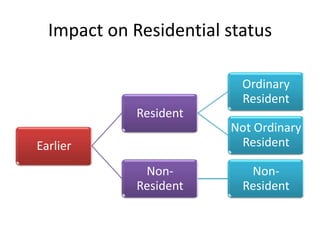
Impact on Residential status

                          Ordinary
                          Resident
             Resident
                        Not Ordinary
Earlier                  Resident

              Non-         Non-
             Resident     Resident
NOW

  Non
Resident   Resident of
              India
Recent Tax Code v/s DTC
Sl. No.   Before DTC                                         After DTC

1         At present there are two legislation i.e. Income   Single code for Income Tax Act and Wealth Tax Act.
          Tax Act, 1961 and Wealth Tax Act, 1957.            The code consists of 285 sections.
2         There are three kind of Residential status i.e     Residential status of “Resident but not ordinarily
          ‘Resident’, ‘Non Resident’ and ‘Resident but       resident” has been done away with.
          not Ordinarily Resident’.
3         There are ‘previous year’ and ‘assessment          To eliminate confusion only ‘Financial Year’ will
          year’.                                             prevail.
4         Date of filing of tax return 31st July for non-    Date of filing of tax return preponed to 30th June
          business non-corporate assessee and 30th Sept      for non-business non-corporate assessee and 31st
          for others.                                        Aug for others
5         The corporate tax rate of domestic company is      The corporate tax rate of all companies reduced to
          30% and for foreign company, it is 40%.            30%. Business losses can be carry forward for
          Business losses can be carry forward for 8 yrs.    unlimited period. Dividend distribution tax
          Dividend distribution is at 15%.                   remains at 15%.
6         Wealth tax rate is 1% above Rs.30 lacs.            Wealth tax rate reduced to 0.25% above Rs.50
          Definition of wealth includes some specific        crore except for private discretionary trust, for
          assets excluding investments in shares. It was     which no threshold limit will be available.
          applicable to all assessee.                        Definition of wealth has been expanded to include
                                                             all assets, including investments.
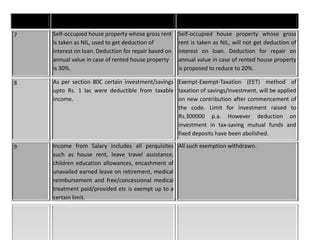
7   Self-occupied house property whose gross rent     Self-occupied house property whose gross
    is taken as NIL, used to get deduction of         rent is taken as NIL, will not get deduction of
    interest on loan. Deduction for repair based on   interest on loan. Deduction for repair on
    annual value in case of rented house property     annual value in case of rented house property
    is 30%.                                           is proposed to reduce to 20%.

8   As per section 80C certain investment/savings Exempt-Exempt-Taxation (EET) method of
    upto Rs. 1 lac were deductible from taxable taxation of savings/investment, will be applied
    income.                                       on new contribution after commencement of
                                                  the code. Limit for investment raised to
                                                  Rs.300000 p.a. However deduction on
                                                  investment in tax-saving mutual funds and
                                                  fixed deposits have been abolished.

9   Income from Salary includes all perquisites All such exemption withdrawn.
    such as house rent, leave travel assistance,
    children education allowances, encashment of
    unavailed earned leave on retirement, medical
    reimbursement and free/concessional medical
    treatment paid/provided etc is exempt up to a
    certain limit.
Positives of DTC
Savings of up to '41,000 for those earning
                  '10 lakh


 Corporate tax rate lowered from 40% to
                   30%


Foreign companies to pay tax at the same
         rate as local companies


   No tax on maturity amount of New
Pension Scheme at the time of withdrawal
Negatives of DTC
  Women will not get any additional tax benefits


 SEZ developers face tax burden starting April 2012


Fund houses face 5% tax on distribution income for
             Ulips, equity-linked MFs


 More non-profit firms will come under the tax net


 As per the current laws, a NRI is liable to pay tax on
global income if he is in India for a period more than
              60 days in a financial year
How insurance gets impacted:
Under DTC, to be eligible for tax
deduction, a policy should give life cover
of at least 20 times the annual premium

If this condition is not met, you will not get
any tax deduction on the premium and
even the income from the policy will be
taxable

Right now income received from insurance
policies is free.
Impact on Pension Funds:
Under the DTC, most of current tax saving investment will
not be eligible for deduction

An Annuity is an investment that gives out a regular income
of the investor.

DTC has proposed to make annuity income exempt from
taxation which makes them good tax saving instrument


The New Pension scheme is low cost pension fund which an
investor can consider.
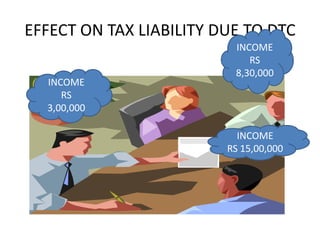
EFFECT ON TAX LIABILITY DUE TO DTC
                          INCOME
                             RS
                          8,30,000
  INCOME
     RS
  3,00,000

                           INCOME
                         RS 15,00,000
EFFECT ON TAX LIABILITY DUE TO DTC
SUPPOSE THE TAXABLE INCOME IS RS 3,00,000
FROM CURRENT TAX SLAB
TAX FOR 1ST RS 1,60,000 = NIL
TAX FOR NEXT1,40,000= RS 14,000 @ 10 %
TOTAL TAX LIABILITY (EXCLUDING EDUCATION
  CESS @ 3% )             = RS 14,000
NOW, AFTER DTC
TAXABLE INCOME = RS 3,00,000
TAX FOR 1ST RS1,60,000 = NIL
TAX FOR NEXT RS 1,40,000 = RS 14,000@ 10%
TOTAL TAX LIABILITY (EXCLUDING EDUCATION CESS
  @ 3%)          = RS 14,000

TOTAL SAVING   = RS ( 14,000 – 14,000)
               = RS 0
SUPPOSE THE TAXABLE INCOME IS RS 8,30,000
FROM CURRENT TAX SLAB
TAX FOR 1ST RS 1,60,000 = NIL
TAX FOR NEXT3,40,000= RS 34,000 @ 10 %
TAX FOR NEXT 3,00,000 = RS 60,000 @ 20%
TAX FOR NEXT 30,000 = RS 9000@ 30%

TOTAL TAX LIABILITY (EXCLUDING EDUCATION CESS
  @ 3% )              = RS(34000+ 60000+9000)
                      = RS 1,03,000
NOW, AFTER DTC
TAXABLE INCOME = RS 8,30,000
TAX FOR 1ST RS1,60,000 = NIL
TAX FOR NEXT RS 6,70,000 = RS 67000@ 10%
TOTAL TAX LIABILITY (EXCLUDING EDUCATION CESS
  @ 3%) = RS 67,000

TOTAL SAVING   = RS ( 1,03,000 – 67,000)
               = RS 36000
SUPPOSE THE TAXABLE INCOME IS RS 10,00,000
FROM CURRENT TAX SLAB
TAX FOR 1ST RS 1,60,000 = NIL
TAX FOR NEXT3,40,000= RS 34,000 @ 10 %
TAX FOR NEXT 3,00,000 = RS 60,000 @ 20%
TAX FOR NEXT 2,00,000 = RS 60,000@ 30%

TOTAL TAX LIABILITY (EXCLUDING EDUCATION CESS
  @ 3% )              = RS(34000+ 60000+60000)
                      = RS 1,54,000
NOW, AFTER DTC
TAXABLE INCOME = RS 10,00,000
TAX FOR 1ST RS1,60,000 = NIL
TAX FOR NEXT RS 8,40,000 = RS 84,000@ 10%
TOTAL TAX LIABILITY (EXCLUDING EDUCATION CESS
  @ 3%) = RS 84,000

TOTAL SAVING   = RS ( 1,54,000 – 84,000)
               = RS 70,000
SUPPOSE THE TAXABLE INCOME IS RS 15,00,000
FROM CURRENT TAX SLAB
TAX FOR 1ST RS 1,60,000 = NIL
TAX FOR NEXT RS 3,40,000= RS 34,000 @ 10 %
TAX FOR NEXT RS 3,00,000 = RS 60,000 @ 20%
TAX FOR NEXT RS 7,00,000 = RS 2,10,000@ 30%

TOTAL TAX LIABILITY (EXCLUDING EDUCATION CESS
  @ 3% )              = RS(34000+ 60000+210000)
                      = RS 3,04,000
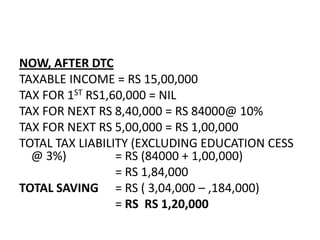
NOW, AFTER DTC
TAXABLE INCOME = RS 15,00,000
TAX FOR 1ST RS1,60,000 = NIL
TAX FOR NEXT RS 8,40,000 = RS 84000@ 10%
TAX FOR NEXT RS 5,00,000 = RS 1,00,000
TOTAL TAX LIABILITY (EXCLUDING EDUCATION CESS
  @ 3%)          = RS (84000 + 1,00,000)
                 = RS 1,84,000
TOTAL SAVING = RS ( 3,04,000 – ,184,000)
                 = RS RS 1,20,000
Direct tax code

Direct tax code

  • 1.
    THE DIRECT TAXES CODE, 2010 Bill No. 110 of 2010 PRESENTED BY :- SUPRIT SHARAN ARPITA SINGH
  • 3.
    A charge imposedby Government on the annual gains • of a person • corporation • or other taxable unit The annual gain is derived from • work, business pursuits • investments, property dealings, and • other sources determined in accordance with the Internal Revenue Code or state law
  • 4.
    THE DIRECT TAXCODE, 2010 When it is • in Lok Sabha on 30-08-2010 introduced? • By Finance minister P. Mukherjee Enforced • Financial year 2012-2013 from • i.e. from 1st day of April, 2012 • to replace the existing Income Tax It’s aim Act of 1961 in India.
  • 5.
    WHY DTC ISREQUIRED??? Tax deduction limit Security Rates of tax to be on savings to be transaction tax to uniform hiked to Rs 3 lakh be abolished To scrap long, Business losses can short-term capital be carried forward gains distinction indefinitely
  • 6.
    No tax deductionon Effective corporate tax interest payable on any rate at 30 % Government security Highest tax rate of 30% for individual of income over Rs 25 lakh
  • 7.
    AND… TO PROMOTE THE LONG-TERM INVESTMENT
  • 8.
    BASIS OF CHARGE RESIDENTIAL STATUS TOTAL INCOME
  • 9.
    An individual shallbe resident in India in any financial year, if he is in India- for a period, or for a period, or ii) three periods, periods, hundred and amounting in amounting in sixty-five days all to one all to- or more within hundred and the four years eighty-two i)sixty days or immediately days or more in more in that preceding that that year; or year; and year.
  • 10.
    The previous provisions shall not apply in respect of an individual who is :- a citizen of India and who leaves India in that year as a member of the crew of an Indian ship; or
  • 11.
    the total incomeof any financial year of a person, who is a resident, shall include all income from whatever source derived which— • accrues, or is deemed to accrue to him in India In India • is received, or is deemed to be received, by him, or on his behalf in India during the year • accrues to him outside India Outside • is received by him, or on his behalf, outside India during the India year.
  • 12.
    For Non- Resident Subjectto the provisions of this Code, the total income of any financial year of a person, who is a non-resident, shall include all income from whatever source derived which— accrues, or is deemed to accrue, to him in India during the year; or is received, or is deemed to be received, by him, or on his behalf, in India during the year.
  • 13.
  • 14.
    CLASSIFICATION OF SOURCESOF INCOME Income from Special sources TOTAL INCOME Income from Ordinary sources
  • 15.
    Income from Specialsources Income from Special Sources include interest, dividends on which distribution tax has not been paid, capital gains, any other investment income, royalty, fees for technical services, amongst others.
  • 17.
    Income from Ordinarysources Income from Income from Income from House employment Business Property Income from Capital gains Residuary Sources
  • 18.
    Income from employment Grosssalary, including the value of perquisites and profits in lieu of salary, to be taxed on due or receipt basis, whichever is earlier and to be reduced by permissible deductions Permissible deductions to include professional tax, transport allowance, prescribed special allowance, compensation under voluntary retirement scheme, gratuity, commutation of pension, amongst others
  • 19.
    Income from HouseProperty Income from house property to be the gross rent less specified deductions. Gross rent to be higher of contractual rent or presumptive rent calculated at 6% per annum of the rateable value fixed by the local authority / 6% of cost of construction or acquisition of the property (in the absence of rateable value). Advance rent to be taxed in the financial year to which it relates to.
  • 20.
    Income from Business Allassets to be classified into business and investment assets, wherein business assets to be further classified into business trading assets and business capital assets. Only income from transactions in business assets to form part of business income Profit on sale of business capital assets, profit on sale of an undertaking under a slump sale, transfer of any self generated business asset, etc. to be treated as business income
  • 21.
    Capital gains Income fromtransactions in all investment assets to be taxed under the head “capital gains”. Gains and losses to be included in the total income of the financial year in which the investment asset is transferred irrespective of the year of receipt of consideration, except in the case of compulsory acquisition of an asset.
  • 22.
    Income from ResiduarySources Residuary income to comprise any income which does not form part of any other head of income The scope of gross residuary income widened to include income having incidental nexus with some other head of income Any amount exceeding Rs. 20,000, taken or accepted or repaid as loan or deposit otherwise than by account payee cheque or draft to be taxed as income from residuary sources.
  • 23.
    TAX INCENTIVES Major Deductionsapplicable under the Tax Incentives for an individual are: Investments through PFRDA approved agencies Payment of tuition fees Medical treatment Health insurance Donations Interest on loan taken for higher education Maintenance of a disabled dependant Interest income on Government Bonds
  • 24.
    The EET Modelfor Investments Taxed when it is Exempted withdrawn till it is remained Exempted invested when invested
  • 25.
    EARLIER EEE - MODEL INVESTED INVESTED WITHDRAWN Exempted Exempted Exempted
  • 26.
    HIGHLIGHTS OF DTC SingleCode for direct taxes Use of simple language Flexibility Providing stability Reducing the scope for litigation
  • 27.
    New Tax ratesfor individuals Slab Income Between, Tax rate 1 0 - 1.60 Lakhs 0% 2 1.60 Lakhs to 10 Lakhs 10% 3 10 Lakhs to 25 Lakhs 20% 4 Above 25 Lakhs 30%
  • 28.
    In the caseof woman below the age of sixty five years at any time during the financial year: Slab Income Between Tax rate 1 0 - 1.90 Lakhs 0% 2 1.90 Lakhs to 10 Lakhs 10% 3 10 Lakhs to 25 Lakhs 20% 4 Above 25 Lakhs 30%
  • 29.
    In the caseof senior citizens Slab Income Between Tax rate 1 0 - 2.40 Lakhs 0% 2 2.40 Lakhs to 10 Lakhs 10% 3 10 Lakhs to 25 Lakhs 20% 4 Above 25 Lakhs 30%
  • 30.
    New due datesfor Tax Returns: Sl. No Type Date First filing (under DTC) 1 Non-Business / Non- 30th June 30/06/2013 Corporate 2 Others 31st August 31/08/2013
  • 32.
    Income Tax Act DTC Wealth tax Act
  • 33.
    Previous Assessment Year Year Financial Year
  • 34.
    Terminology of Assessed • terminology of assessed was meant for the person who is paying tax Earlier and/or • who is liable for proceeding under the Act • Two more definitions • a person, whom the amount is Now refundable, and/or, • who voluntarily files tax return irrespective of tax liability
  • 35.
    Impact on Residentialstatus Ordinary Resident Resident Not Ordinary Earlier Resident Non- Non- Resident Resident
  • 36.
    NOW Non Resident Resident of India
  • 37.
    Recent Tax Codev/s DTC Sl. No. Before DTC After DTC 1 At present there are two legislation i.e. Income Single code for Income Tax Act and Wealth Tax Act. Tax Act, 1961 and Wealth Tax Act, 1957. The code consists of 285 sections. 2 There are three kind of Residential status i.e Residential status of “Resident but not ordinarily ‘Resident’, ‘Non Resident’ and ‘Resident but resident” has been done away with. not Ordinarily Resident’. 3 There are ‘previous year’ and ‘assessment To eliminate confusion only ‘Financial Year’ will year’. prevail. 4 Date of filing of tax return 31st July for non- Date of filing of tax return preponed to 30th June business non-corporate assessee and 30th Sept for non-business non-corporate assessee and 31st for others. Aug for others 5 The corporate tax rate of domestic company is The corporate tax rate of all companies reduced to 30% and for foreign company, it is 40%. 30%. Business losses can be carry forward for Business losses can be carry forward for 8 yrs. unlimited period. Dividend distribution tax Dividend distribution is at 15%. remains at 15%. 6 Wealth tax rate is 1% above Rs.30 lacs. Wealth tax rate reduced to 0.25% above Rs.50 Definition of wealth includes some specific crore except for private discretionary trust, for assets excluding investments in shares. It was which no threshold limit will be available. applicable to all assessee. Definition of wealth has been expanded to include all assets, including investments.
  • 38.
    7 Self-occupied house property whose gross rent Self-occupied house property whose gross is taken as NIL, used to get deduction of rent is taken as NIL, will not get deduction of interest on loan. Deduction for repair based on interest on loan. Deduction for repair on annual value in case of rented house property annual value in case of rented house property is 30%. is proposed to reduce to 20%. 8 As per section 80C certain investment/savings Exempt-Exempt-Taxation (EET) method of upto Rs. 1 lac were deductible from taxable taxation of savings/investment, will be applied income. on new contribution after commencement of the code. Limit for investment raised to Rs.300000 p.a. However deduction on investment in tax-saving mutual funds and fixed deposits have been abolished. 9 Income from Salary includes all perquisites All such exemption withdrawn. such as house rent, leave travel assistance, children education allowances, encashment of unavailed earned leave on retirement, medical reimbursement and free/concessional medical treatment paid/provided etc is exempt up to a certain limit.
  • 39.
    Positives of DTC Savingsof up to '41,000 for those earning '10 lakh Corporate tax rate lowered from 40% to 30% Foreign companies to pay tax at the same rate as local companies No tax on maturity amount of New Pension Scheme at the time of withdrawal
  • 40.
    Negatives of DTC Women will not get any additional tax benefits SEZ developers face tax burden starting April 2012 Fund houses face 5% tax on distribution income for Ulips, equity-linked MFs More non-profit firms will come under the tax net As per the current laws, a NRI is liable to pay tax on global income if he is in India for a period more than 60 days in a financial year
  • 41.
    How insurance getsimpacted: Under DTC, to be eligible for tax deduction, a policy should give life cover of at least 20 times the annual premium If this condition is not met, you will not get any tax deduction on the premium and even the income from the policy will be taxable Right now income received from insurance policies is free.
  • 42.
    Impact on PensionFunds: Under the DTC, most of current tax saving investment will not be eligible for deduction An Annuity is an investment that gives out a regular income of the investor. DTC has proposed to make annuity income exempt from taxation which makes them good tax saving instrument The New Pension scheme is low cost pension fund which an investor can consider.
  • 43.
    EFFECT ON TAXLIABILITY DUE TO DTC INCOME RS 8,30,000 INCOME RS 3,00,000 INCOME RS 15,00,000
  • 44.
    EFFECT ON TAXLIABILITY DUE TO DTC SUPPOSE THE TAXABLE INCOME IS RS 3,00,000 FROM CURRENT TAX SLAB TAX FOR 1ST RS 1,60,000 = NIL TAX FOR NEXT1,40,000= RS 14,000 @ 10 % TOTAL TAX LIABILITY (EXCLUDING EDUCATION CESS @ 3% ) = RS 14,000
  • 45.
    NOW, AFTER DTC TAXABLEINCOME = RS 3,00,000 TAX FOR 1ST RS1,60,000 = NIL TAX FOR NEXT RS 1,40,000 = RS 14,000@ 10% TOTAL TAX LIABILITY (EXCLUDING EDUCATION CESS @ 3%) = RS 14,000 TOTAL SAVING = RS ( 14,000 – 14,000) = RS 0
  • 46.
    SUPPOSE THE TAXABLEINCOME IS RS 8,30,000 FROM CURRENT TAX SLAB TAX FOR 1ST RS 1,60,000 = NIL TAX FOR NEXT3,40,000= RS 34,000 @ 10 % TAX FOR NEXT 3,00,000 = RS 60,000 @ 20% TAX FOR NEXT 30,000 = RS 9000@ 30% TOTAL TAX LIABILITY (EXCLUDING EDUCATION CESS @ 3% ) = RS(34000+ 60000+9000) = RS 1,03,000
  • 47.
    NOW, AFTER DTC TAXABLEINCOME = RS 8,30,000 TAX FOR 1ST RS1,60,000 = NIL TAX FOR NEXT RS 6,70,000 = RS 67000@ 10% TOTAL TAX LIABILITY (EXCLUDING EDUCATION CESS @ 3%) = RS 67,000 TOTAL SAVING = RS ( 1,03,000 – 67,000) = RS 36000
  • 48.
    SUPPOSE THE TAXABLEINCOME IS RS 10,00,000 FROM CURRENT TAX SLAB TAX FOR 1ST RS 1,60,000 = NIL TAX FOR NEXT3,40,000= RS 34,000 @ 10 % TAX FOR NEXT 3,00,000 = RS 60,000 @ 20% TAX FOR NEXT 2,00,000 = RS 60,000@ 30% TOTAL TAX LIABILITY (EXCLUDING EDUCATION CESS @ 3% ) = RS(34000+ 60000+60000) = RS 1,54,000
  • 49.
    NOW, AFTER DTC TAXABLEINCOME = RS 10,00,000 TAX FOR 1ST RS1,60,000 = NIL TAX FOR NEXT RS 8,40,000 = RS 84,000@ 10% TOTAL TAX LIABILITY (EXCLUDING EDUCATION CESS @ 3%) = RS 84,000 TOTAL SAVING = RS ( 1,54,000 – 84,000) = RS 70,000
  • 50.
    SUPPOSE THE TAXABLEINCOME IS RS 15,00,000 FROM CURRENT TAX SLAB TAX FOR 1ST RS 1,60,000 = NIL TAX FOR NEXT RS 3,40,000= RS 34,000 @ 10 % TAX FOR NEXT RS 3,00,000 = RS 60,000 @ 20% TAX FOR NEXT RS 7,00,000 = RS 2,10,000@ 30% TOTAL TAX LIABILITY (EXCLUDING EDUCATION CESS @ 3% ) = RS(34000+ 60000+210000) = RS 3,04,000
  • 51.
    NOW, AFTER DTC TAXABLEINCOME = RS 15,00,000 TAX FOR 1ST RS1,60,000 = NIL TAX FOR NEXT RS 8,40,000 = RS 84000@ 10% TAX FOR NEXT RS 5,00,000 = RS 1,00,000 TOTAL TAX LIABILITY (EXCLUDING EDUCATION CESS @ 3%) = RS (84000 + 1,00,000) = RS 1,84,000 TOTAL SAVING = RS ( 3,04,000 – ,184,000) = RS RS 1,20,000