RUBEN DARIO ARISMENDI RUEDA
CHAPTER 4: ‘Direct Methods to solve lineal ecuation systems’
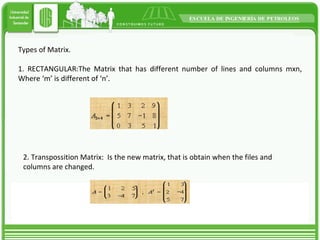
Types of Matrix. 1. RECTANGULAR:The Matrix that has different number of lines and columns mxn, Where ‘m’ is different of ‘n’. 2. Transpossition Matrix:  Is the new matrix, that is obtain when the files and columns are changed.
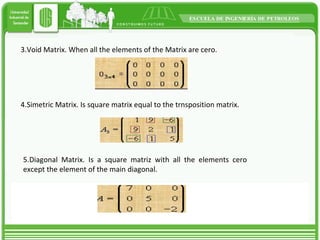
3.Void Matrix. When all the elements of the Matrix are cero. 4.Simetric Matrix. Is square matrix equal to the trnsposition matrix. 5.Diagonal Matrix. Is a square matriz with all the elements cero except the element of the main diagonal.
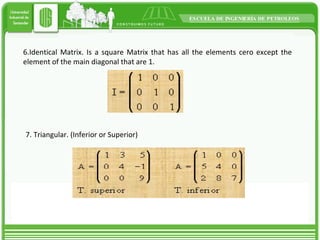
6.Identical Matrix. Is a square Matrix that has all the elements cero except the element of the main diagonal that are 1. 7. Triangular. (Inferior or Superior)
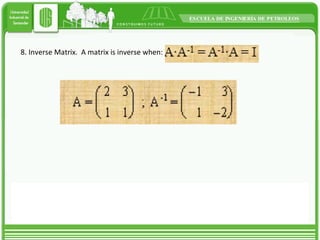
8. Inverse Matrix.  A matrix is inverse when:
METHODS. SIMPLE GAUSS. This method has two main steps. a- Forward elimination: Consist in convert the Matrix into a Superior Triangular  b- Backward sustitution: With the Inferior Matrix the last unkown value is obtained and then we have to start making substitutions.
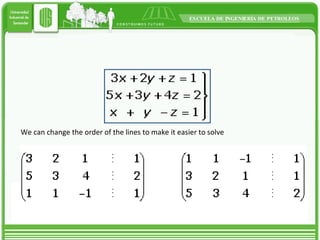
We can change the order of the lines to make it easier to solve
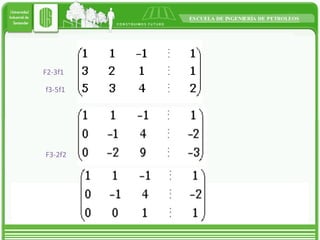
F2-3f1 f3-5f1 F3-2f2
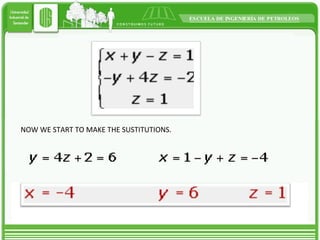
NOW WE START TO MAKE THE SUSTITUTIONS.
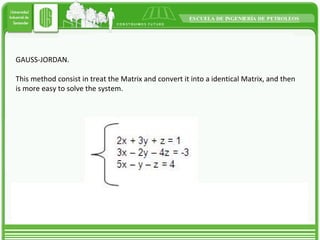
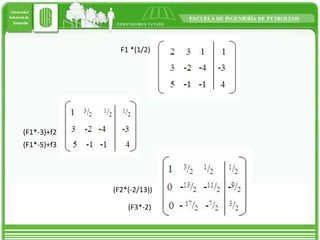
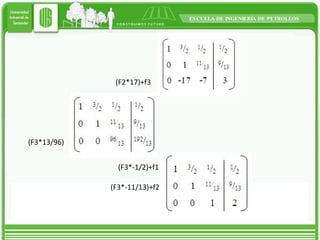
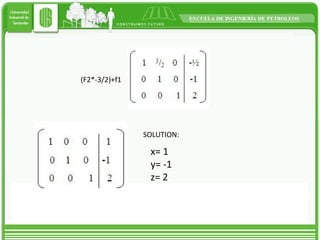
GAUSS-JORDAN. This method consist in treat the Matrix and convert it into a identical Matrix, and then is more easy to solve the system.
F1 *(1/2) (F1*-3)+f2 (F1*-5)+f3 (F2*(-2/13)) (F3*-2)
(F2*17)+f3 (F3*13/96) (F3*-1/2)+f1 (F3*-11/13)+f2
(F2*-3/2)+f1 x= 1 y= -1 z= 2 SOLUTION:
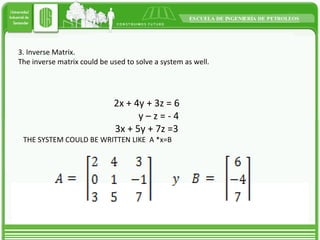
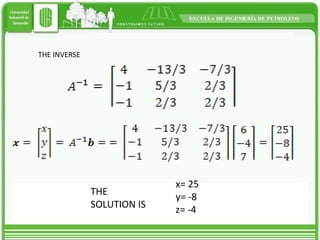
3. Inverse Matrix.  The inverse matrix could be used to solve a system as well. 2x + 4y + 3z = 6 y – z = - 4 3x + 5y + 7z =3 THE SYSTEM COULD BE WRITTEN LIKE  A *x=B
THE INVERSE x=  25 y= - 8 z=  -4 THE SOLUTION IS

Direct sustitution methods

  • 1.
  • 2.
    CHAPTER 4: ‘DirectMethods to solve lineal ecuation systems’
  • 3.
    Types of Matrix.1. RECTANGULAR:The Matrix that has different number of lines and columns mxn, Where ‘m’ is different of ‘n’. 2. Transpossition Matrix: Is the new matrix, that is obtain when the files and columns are changed.
  • 4.
    3.Void Matrix. Whenall the elements of the Matrix are cero. 4.Simetric Matrix. Is square matrix equal to the trnsposition matrix. 5.Diagonal Matrix. Is a square matriz with all the elements cero except the element of the main diagonal.
  • 5.
    6.Identical Matrix. Isa square Matrix that has all the elements cero except the element of the main diagonal that are 1. 7. Triangular. (Inferior or Superior)
  • 6.
    8. Inverse Matrix. A matrix is inverse when:
  • 7.
    METHODS. SIMPLE GAUSS.This method has two main steps. a- Forward elimination: Consist in convert the Matrix into a Superior Triangular b- Backward sustitution: With the Inferior Matrix the last unkown value is obtained and then we have to start making substitutions.
  • 8.
    We can changethe order of the lines to make it easier to solve
  • 9.
  • 10.
    NOW WE STARTTO MAKE THE SUSTITUTIONS.
  • 11.
    GAUSS-JORDAN. This methodconsist in treat the Matrix and convert it into a identical Matrix, and then is more easy to solve the system.
  • 12.
    F1 *(1/2) (F1*-3)+f2(F1*-5)+f3 (F2*(-2/13)) (F3*-2)
  • 13.
  • 14.
    (F2*-3/2)+f1 x= 1y= -1 z= 2 SOLUTION:
  • 15.
    3. Inverse Matrix. The inverse matrix could be used to solve a system as well. 2x + 4y + 3z = 6 y – z = - 4 3x + 5y + 7z =3 THE SYSTEM COULD BE WRITTEN LIKE A *x=B
  • 16.
    THE INVERSE x= 25 y= - 8 z= -4 THE SOLUTION IS