Direct, purposeful experiences involve firsthand interactions that form the foundation of learning through our senses. Contrived experiences are substitutes used when direct experiences are not practical, and include models, simulations, and specimens. Both types of experiences are important for learning if purposefully designed and facilitated to stimulate questioning and draw meaning from interactions. The document discusses examples and rationales for using direct experiences like cooking or presentations, and contrived experiences like atom models or preserved specimens in biology classrooms.
In this document
Powered by AI
Discusses the significance of direct and purposeful experiences in learning, emphasizing real-action learning and sensory engagement.
Explains contrived experiences as substitutes for real experiences in education, highlighting their types, uses, and advantages.
Encourages listing subjects to apply direct, purposeful, and contrived experiences in educational contexts.
Testimony “ It was only when I went to the Manila zoo that I learned that a giraffe is that tall and an elephant is that big” – Grade 2 pupil.
3.
What are directand purposeful experiences? These are concrete and firsthand experiences that make up the foundation of our learning. These are the rich experiences that our senses bring from which we construct the ideas, the concepts, the generalization that give meaning and order to our lives. Ex. preparing a meal, making a piece of furniture doing power point presentation, performing a laboratory experiment, delivering a speech, taking a trip, or climbing a mountain.
4.
Why are thedirect experiences purposeful? They are not mechanical and a matter of going through the motion. They are not mere sensory excitement. They are experiences that are internalized in the sense that these experiences involve the asking of questions that have significance in the life of the person undergoing the experience.
5.
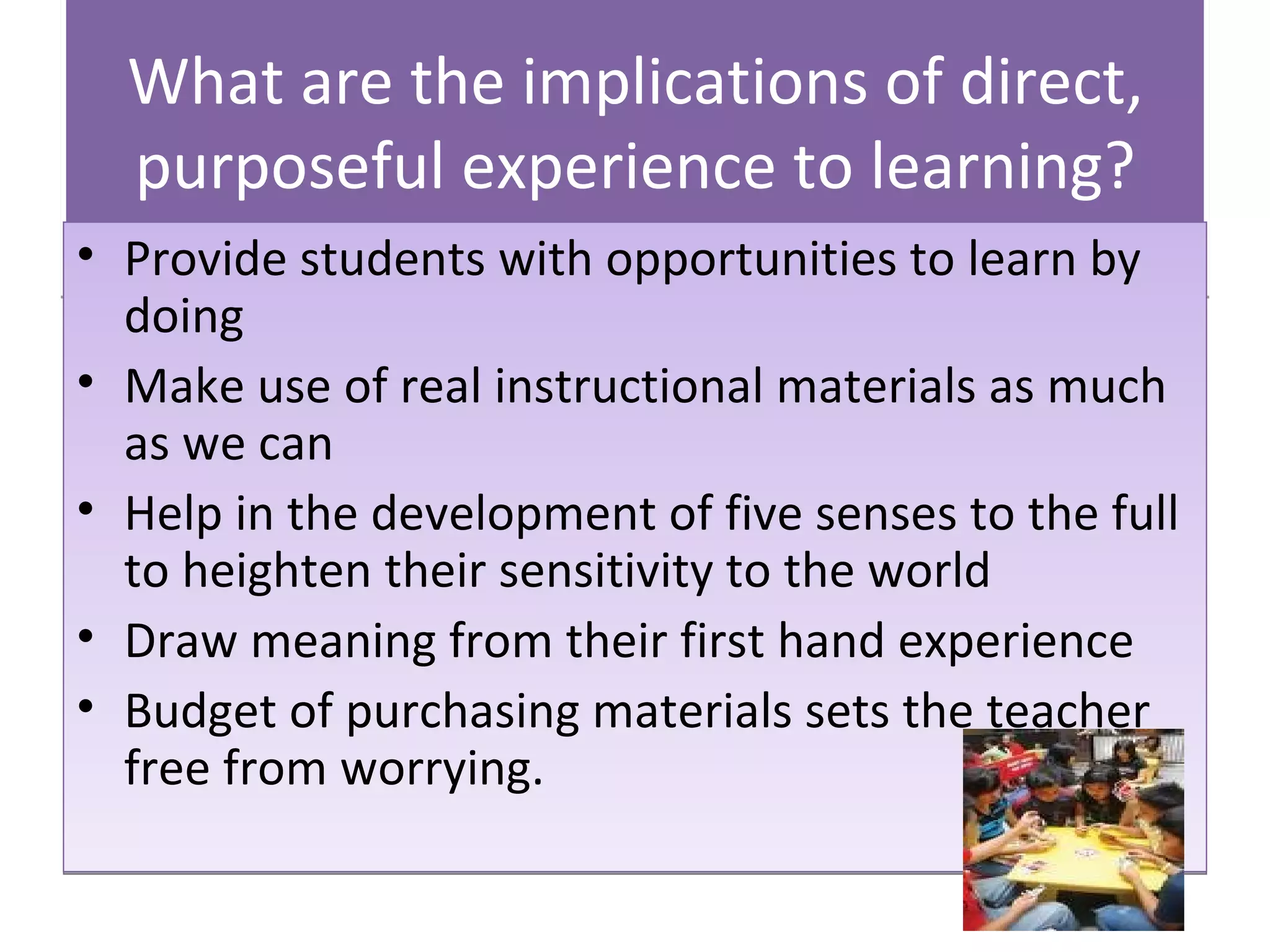
What are theimplications of direct, purposeful experience to learning? Provide students with opportunities to learn by doing Make use of real instructional materials as much as we can Help in the development of five senses to the full to heighten their sensitivity to the world Draw meaning from their first hand experience Budget of purchasing materials sets the tea cher free from worrying.
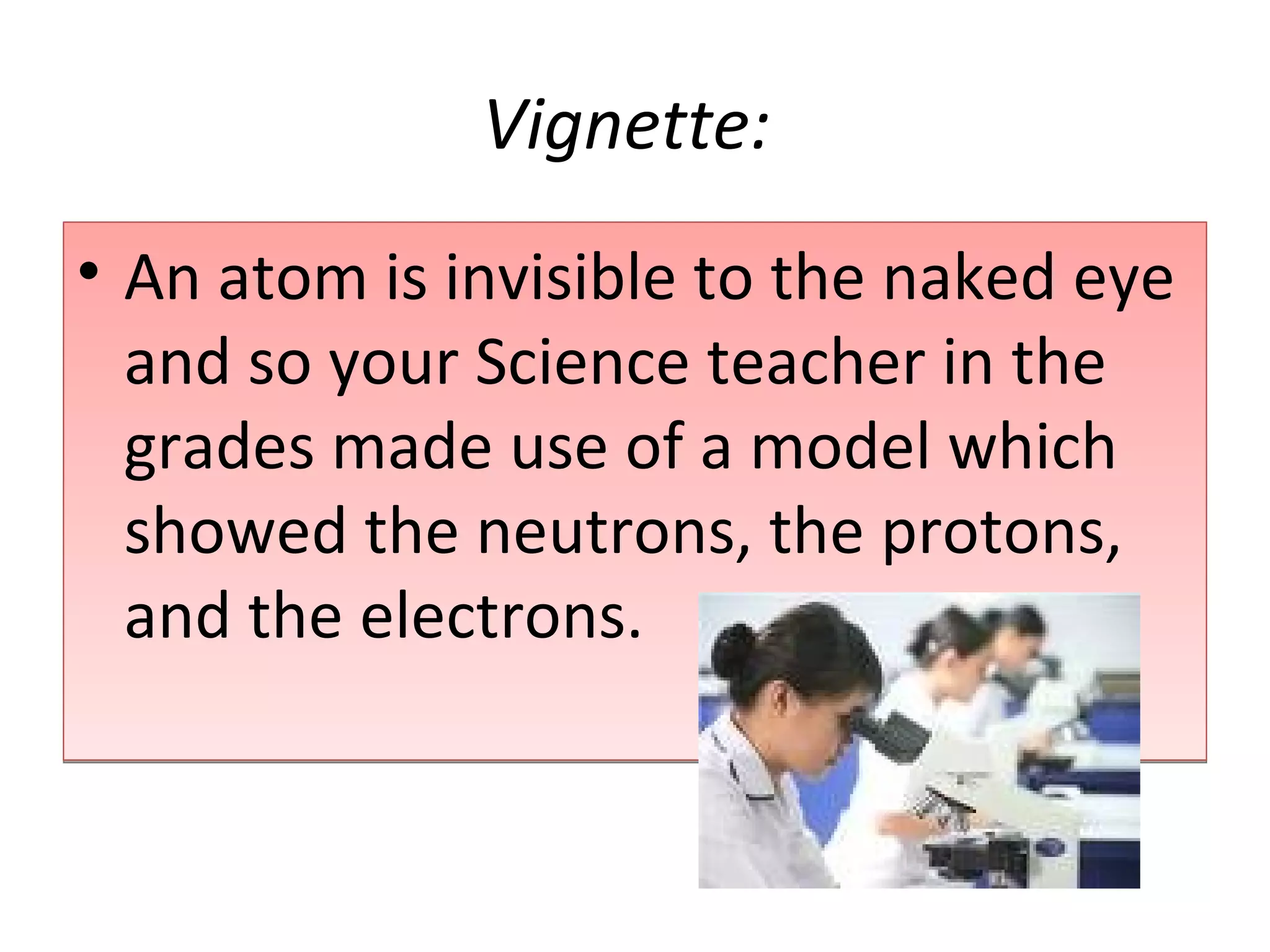
Vignette: An atom is invisible to the naked eye and so your Science teacher in the grades made use of a model which showed the neutrons, the protons, and the electrons.
8.
Statements to PonderWhy is the atom depicted by a model? Is it not better if you see the real atom itself? Can you think of a better way of seeing planet earth other than the globe? Is there a more interesting way of showing the rotation of the planets on their axis and their revolution around the sun? Biology is real science of life if what you study are alive. Justify the use of preserve specimens in Biology.
9.
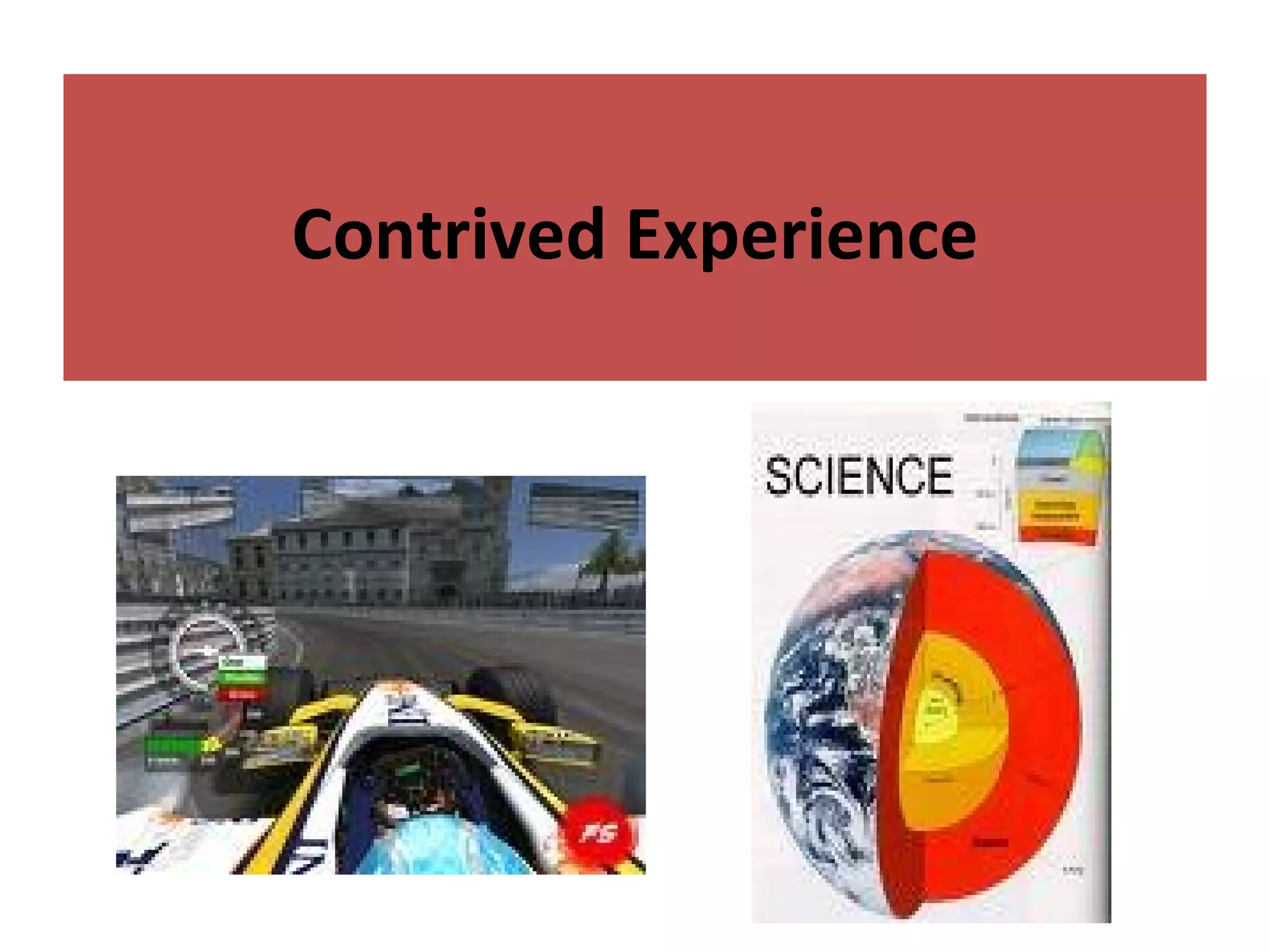
What are contrivedexperiences? These are edited copies of reality and are used a substitutes for real things when it is not practical or not possible to bring or do the real think in the classroom. These contrived experiences are designe d to simulate to real-life situations. The atoms, planetarium, globe, the simulated election process and preserve specimen are examples of contrived experiences
10.
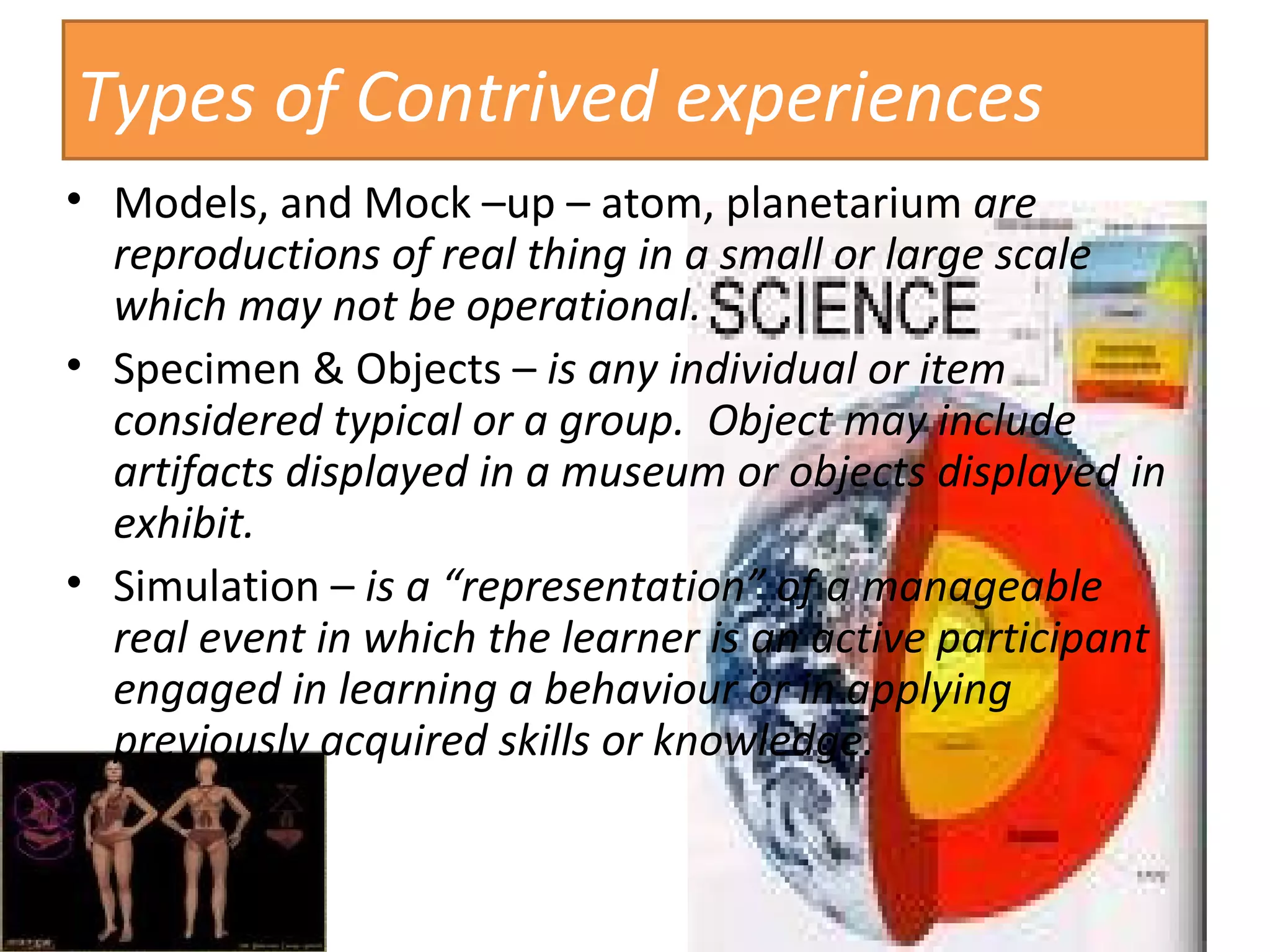
Types of Contrivedexperiences Models, and Mock –up – atom, planetarium are reproductions of real thing in a small or large scale which may not be operational. Specimen & Objects – is any individual or item considered typical or a group. Object may include artifacts displayed in a museum or objects displayed in exhibit. Simulation – is a “representation” of a manageable real event in which the learner is an active participant engaged in learning a behaviour or in applying previously acquired skills or knowledge.
11.
Types of Contrivedexperiences Games – are use for any of these purposes: To practice and/or refine knowledge/skills already acquired, To identify gaps or weaknesses in knowledge or skills To serve as a sum mation or review and 4. To develop new r elationships among concepts and principles.
12.
Why do weuse them? Having the original is impossible It is the most effective and appropriate way to portray the idea it can justify the cost if purchased It can stimulate to further learning
13.
Enrichment: What arethe advantages and disadvantages in using direct, purposeful and contrived experiences? Make a list of subjects or requirements of your course in which you can use these experiences.