Analysis
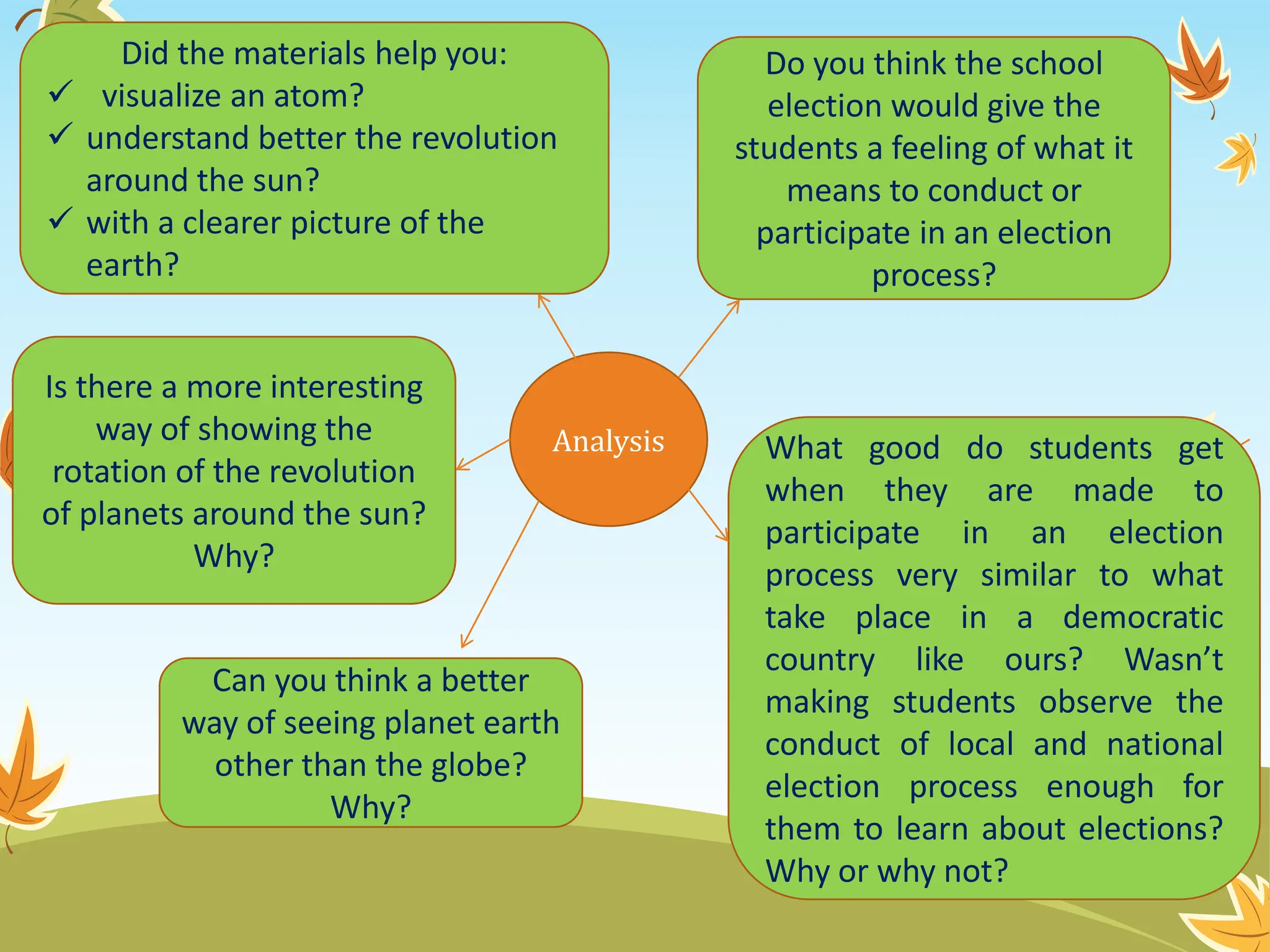
Did the materials help you:
 visualize an atom?
 understand better the revolution
around the sun?
 with a clearer picture of the
earth?
Do you think the school
election would give the
students a feeling of what it
means to conduct or
participate in an election
process?
Can you think a better
way of seeing planet earth
other than the globe?
Why?
Is there a more interesting
way of showing the
rotation of the revolution
of planets around the sun?
Why?
What good do students get
when they are made to
participate in an election
process very similar to what
take place in a democratic
country like ours? Wasn’t
making students observe the
conduct of local and national
election process enough for
them to learn about elections?
Why or why not?
Teaching with
Contrived Experiences
Presented by: Ms. Emelyn T. Aborot
Submitted to: Ms. Rommelyn T. Dacanay
Focus
Questions
:
What are contrived experiences?
What are varied types of contrived
experiences?
Why do we use contrived experiences?
What standards can be use to evaluate
contrived experiences?
Contrived Experiences
- These are edited copies of reality
and are used as substitute for real
things when it is not practical or not
possible to bring or do the real thing
in the classroom.
- Designed to simulate to real-life
situations.
Varied types of contrived experiences
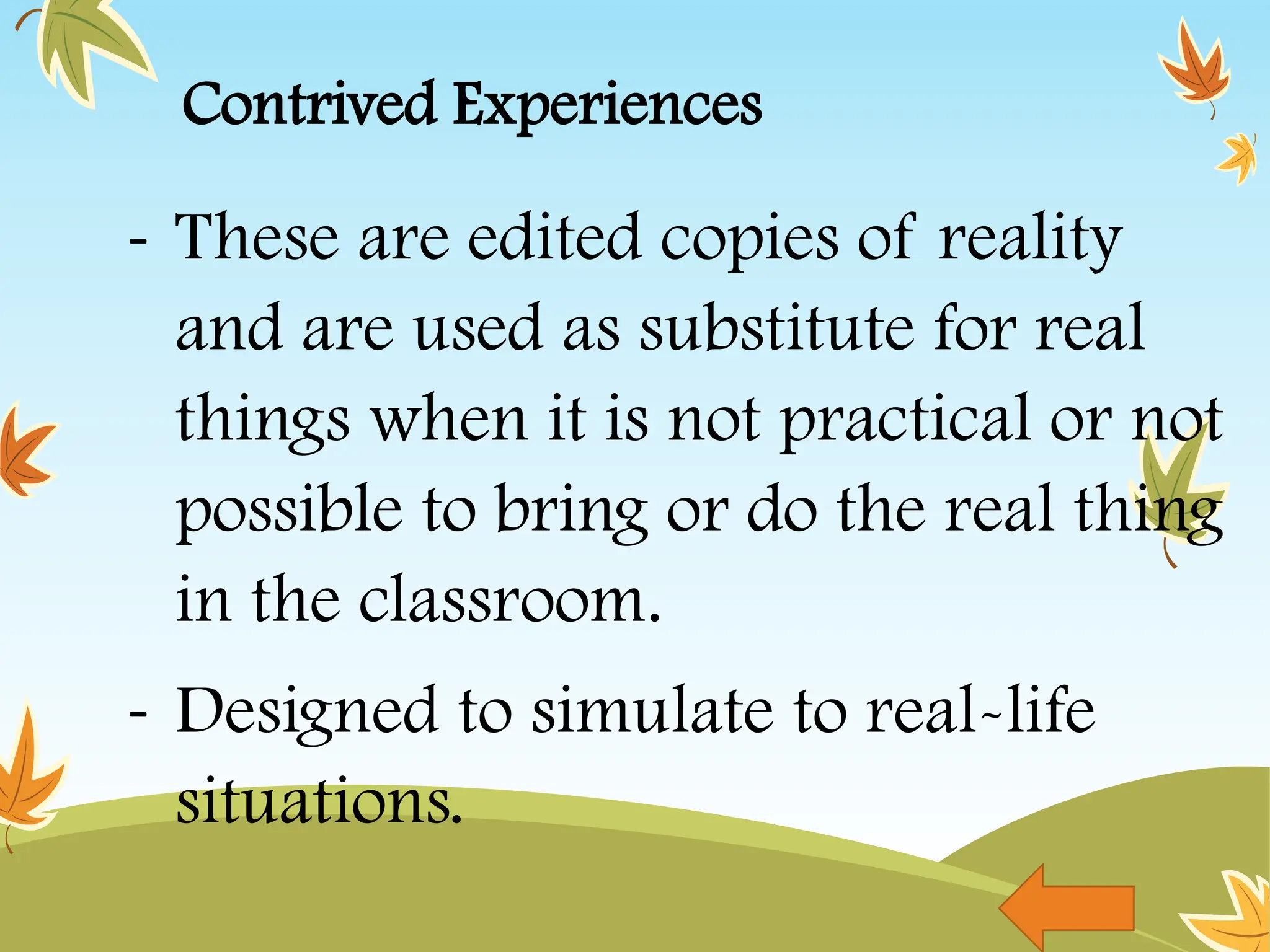
1.Model – is a reproduction of a real thing in a
small scale, or large scale, or exact size-but
made of synthetic materials. It is a substitute
for a real thing which may or may not be
operational” (Brown et al, 1969)
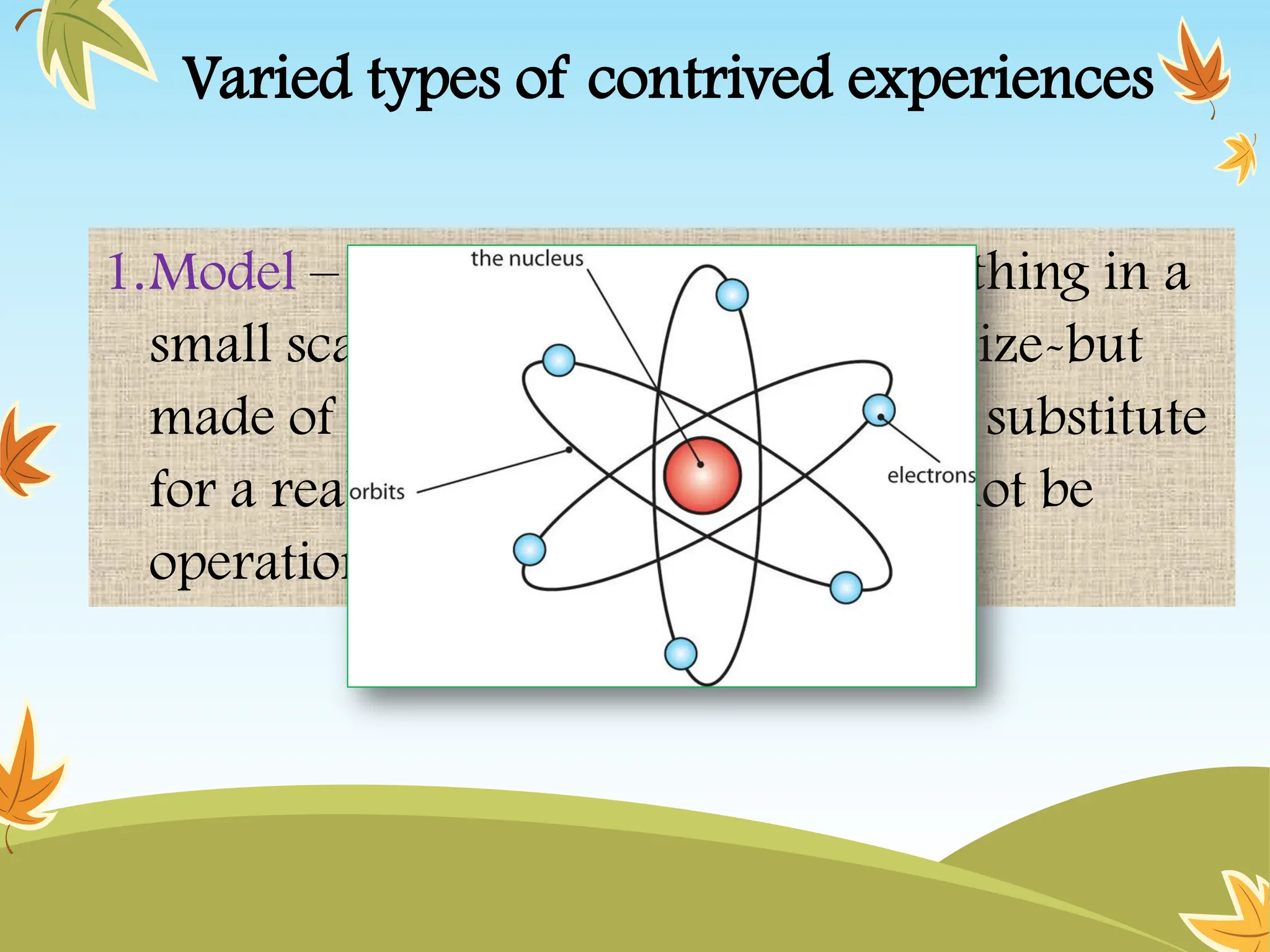
2. Mock-up – is an arrangement of real device or
associated devices, displayed in such a way that
presentation of reality. The mock up may be
simplified in order to emphasize certain features.
It may be an economical reproduction of a
complicated or costly device, to be observed for
learning process. (Brown 1969).
- Is a special model where the parts of a model
are singled out, heightened and magnified in
order to focus on that part or process under
study.
3. Specimen and objects
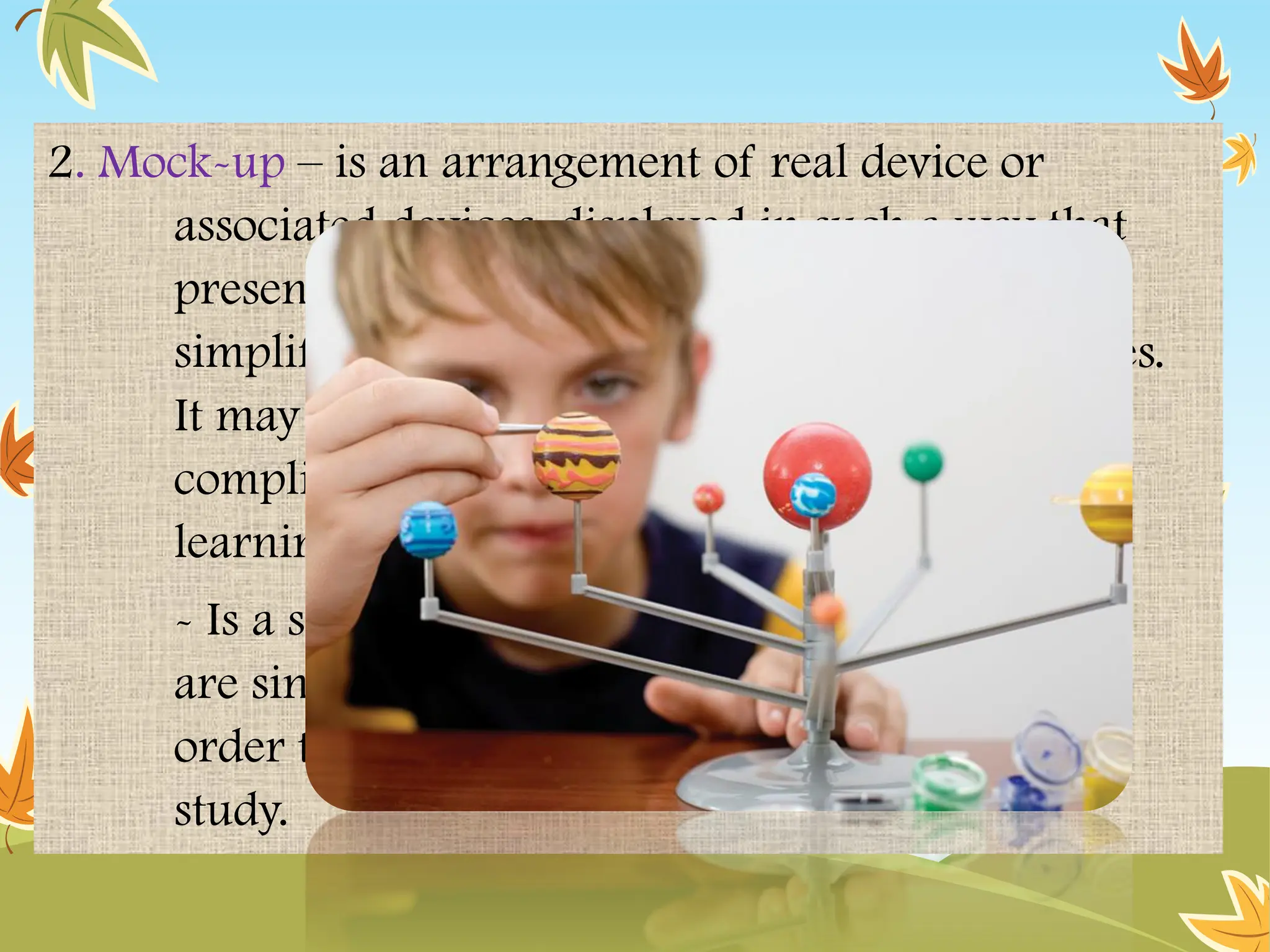
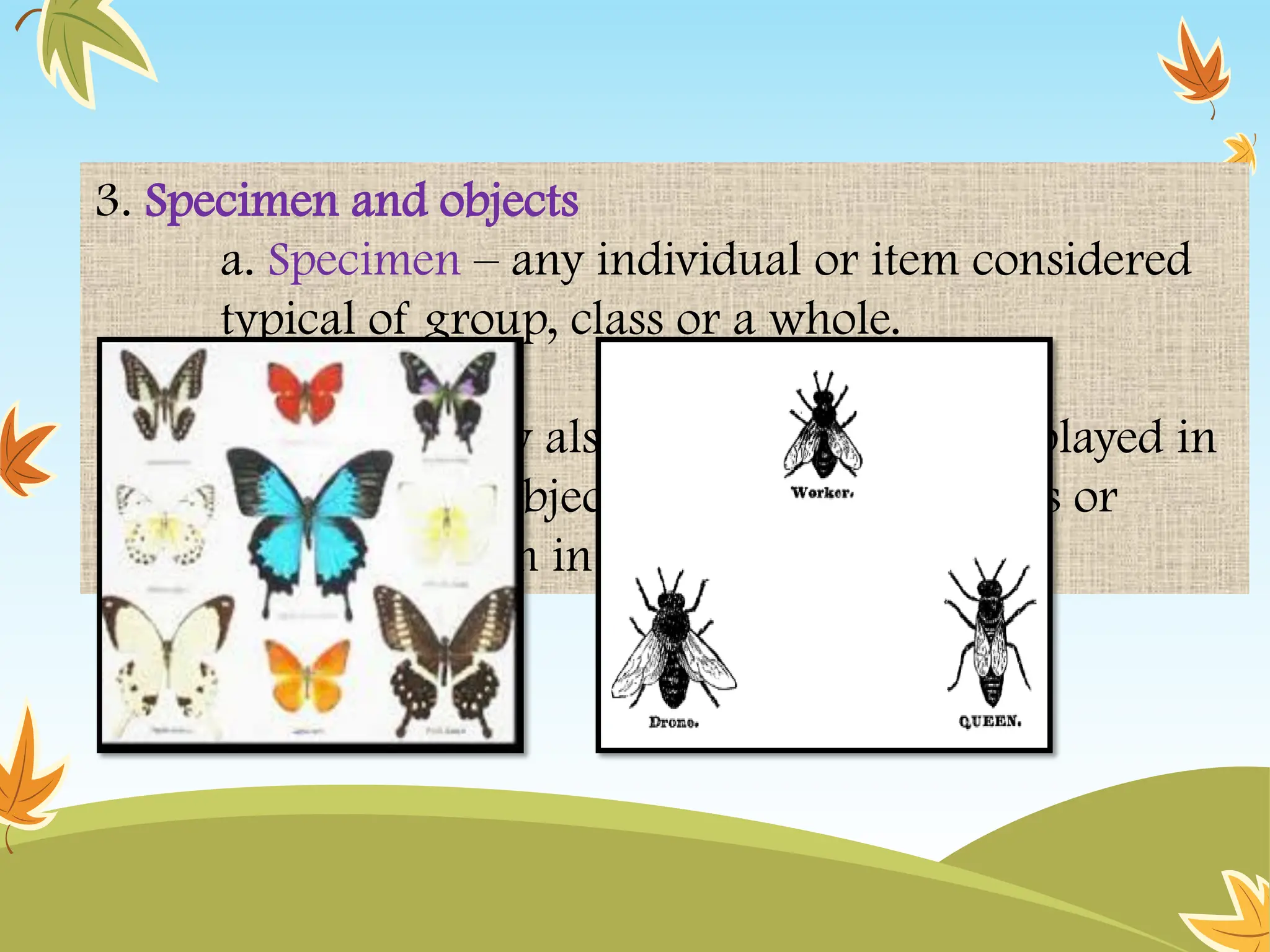
a. Specimen – any individual or item considered
typical of group, class or a whole.
b. Object – may also include artifacts displayed in
a museum or objects displayed in exhibits or
insect specimen in science.
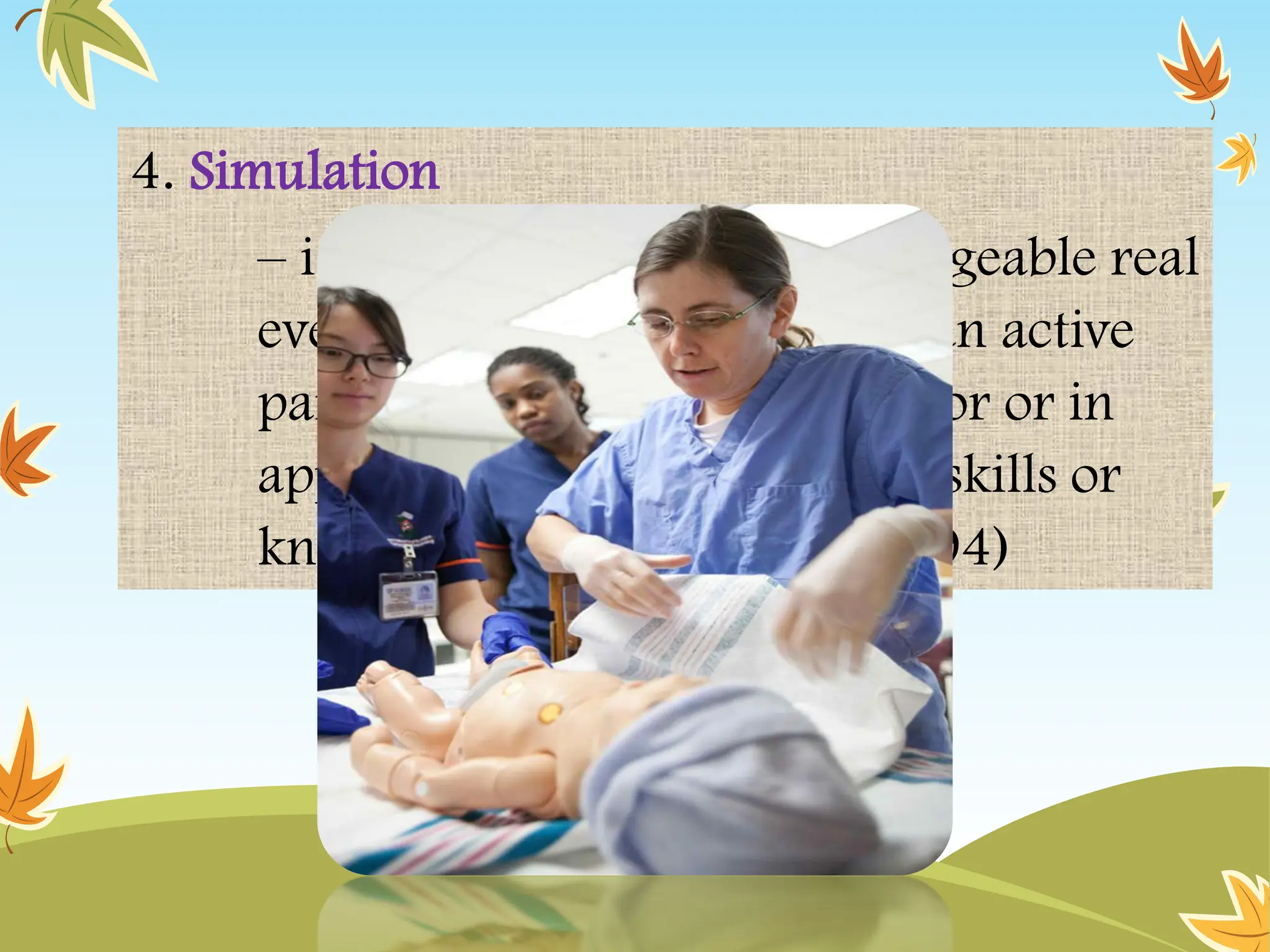
4. Simulation
– is a “presentation of a manageable real
event in which the learner is an active
participant engaged in behavior or in
applying previously acquired skills or
knowledge” (Orlich, et al, 1994)
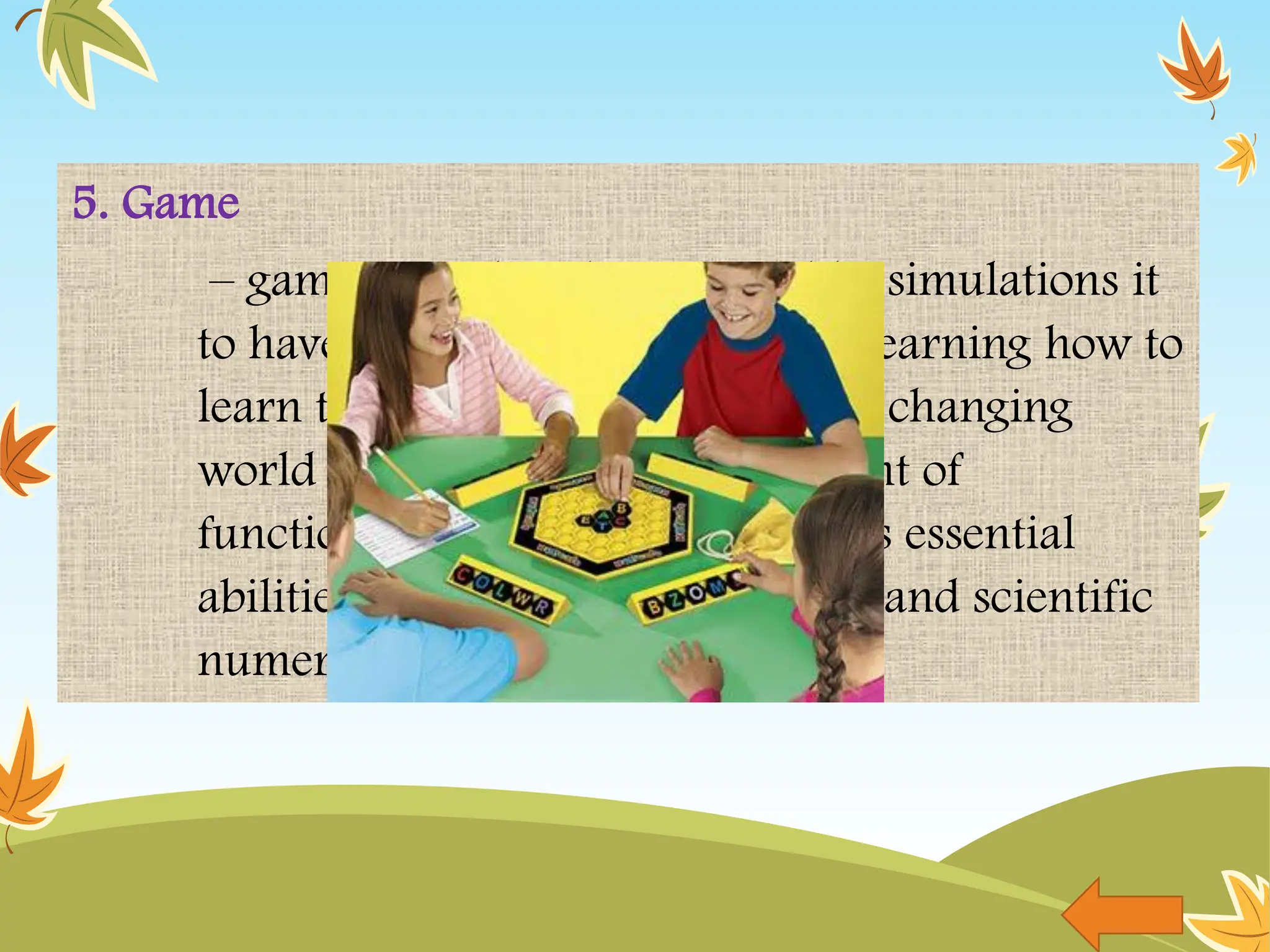
5. Game
– games are played to win unlike simulations it
to have a winner. Competence is learning how to
learn throughout one’s life in this changing
world entails the secure attainment of
functional literacy, which includes essential
abilities such as linguistic fluency and scientific
numerical competence.
We use models, mock-up, specimens and
objects to:
1. Overcome limitation of space and time.
2. To edit reality for us to be able to focus on parts or a
process of a system that we intend to study.
3. To overcome difficulties of size.
4. Understand the inaccessible.
5. Help the learners understand abstractions.
We use simulations and games to make our classes interactive and
develop the decision-making skills and knowledge construction
skills of our students. Orlich, et al (1994) enumerates ten (10)
general purposes of simulations and games in education:
1. To develop changes attitudes.
2. To change specific behaviors.
3. To prepare participants for assuming new roles
in the future.
4. To help individuals understand their current
roles.
5. To increase the students’ ability to apply
principles .
6. To reduce complex problems or situations to
manageable elements.
7. To illustrate roles that may affect one’s life but that
one may never assume.
8. To motivate learners.
9. To develop analytical processes
10. To sanitize individuals to another person’s life
role.
Cont.….
Games are used for any of these purposes:
1.To practice and/or to refine knowledge/skills
already acquired.
2.To identify gaps or weaknesses in
knowledge/skills.
3.To serve as a summation or review
4.To develop new relationships among concepts
and principles.
Examples of games using Multiple Intelligence Tasks in the
classroom by Thomas Armstrong (1994)
Find someone who can:
- Whistle a few songs notes of any Filipino song
- Stand on one foot with her eye closed for at least five seconds
- Recite at least four lines from any poem he has learned.
- Draw a stick figure of a man and woman.
- Briefly share a dream he/she had in the past month
- Complete this numerical sequence: 36, 30, 24, 18 ____ and
explain logic behind it.
- Honestly say he is relaxed and comfortable relating to other
people during the exercise
- Easily derive lesson from nature
- Share his philosophy of life.
Guide Questions in Evaluating Contrived Experiences
Edgar Dale (1969) enumerates the following question to
evaluate contrives experiences:
Is the model or mock-up necessary or can you make
use the original?
Could some other device such as a photograph or chart
portray the idea more effectively?
Is the idea appropriate for representation in a
model?(is it too elementary? Too complicated?
Are the important details of construction correct?
Could wrong impressions of size, color and shape
result from using this model?
Does the model oversimplify the idea?
If it is workable, will it stand up under frequent
use?
If it is purchased, will the model be used often
enough to justify its cost?
Will the model act as a stimulus to further
learning?
Does the simulated procedure reduce the amount of
instruction required to master the desired skills,
attitudes and information?
Group 1
Present contrived
experiences and their
various forms by means of a
graphic organizer
Group 1
Present contrived
experiences and their various
forms by means of a graphic
organizer
Group 3
Illustrate with examples the
five reasons why we make
use of models, mock ups,
specimens and objects given
above
Group 4
Go over K to 12 Curriculum
Guide. Identify objectives and
topics which can be taught
with contrived experiences –
models, mock ups, specimens
and objects, simulation and
games
Thank You for
Listening

Presentation for Teaching with Contrive Experience.pdf

  • 2.
    Analysis Did the materialshelp you:  visualize an atom?  understand better the revolution around the sun?  with a clearer picture of the earth? Do you think the school election would give the students a feeling of what it means to conduct or participate in an election process? Can you think a better way of seeing planet earth other than the globe? Why? Is there a more interesting way of showing the rotation of the revolution of planets around the sun? Why? What good do students get when they are made to participate in an election process very similar to what take place in a democratic country like ours? Wasn’t making students observe the conduct of local and national election process enough for them to learn about elections? Why or why not?
  • 3.
    Teaching with Contrived Experiences Presentedby: Ms. Emelyn T. Aborot Submitted to: Ms. Rommelyn T. Dacanay
  • 4.
    Focus Questions : What are contrivedexperiences? What are varied types of contrived experiences? Why do we use contrived experiences? What standards can be use to evaluate contrived experiences?
  • 5.
    Contrived Experiences - Theseare edited copies of reality and are used as substitute for real things when it is not practical or not possible to bring or do the real thing in the classroom. - Designed to simulate to real-life situations.
  • 6.
    Varied types ofcontrived experiences 1.Model – is a reproduction of a real thing in a small scale, or large scale, or exact size-but made of synthetic materials. It is a substitute for a real thing which may or may not be operational” (Brown et al, 1969)
  • 7.
    2. Mock-up –is an arrangement of real device or associated devices, displayed in such a way that presentation of reality. The mock up may be simplified in order to emphasize certain features. It may be an economical reproduction of a complicated or costly device, to be observed for learning process. (Brown 1969). - Is a special model where the parts of a model are singled out, heightened and magnified in order to focus on that part or process under study.
  • 8.
    3. Specimen andobjects a. Specimen – any individual or item considered typical of group, class or a whole. b. Object – may also include artifacts displayed in a museum or objects displayed in exhibits or insect specimen in science.
  • 9.
    4. Simulation – isa “presentation of a manageable real event in which the learner is an active participant engaged in behavior or in applying previously acquired skills or knowledge” (Orlich, et al, 1994)
  • 10.
    5. Game – gamesare played to win unlike simulations it to have a winner. Competence is learning how to learn throughout one’s life in this changing world entails the secure attainment of functional literacy, which includes essential abilities such as linguistic fluency and scientific numerical competence.
  • 11.
    We use models,mock-up, specimens and objects to: 1. Overcome limitation of space and time. 2. To edit reality for us to be able to focus on parts or a process of a system that we intend to study. 3. To overcome difficulties of size. 4. Understand the inaccessible. 5. Help the learners understand abstractions.
  • 12.
    We use simulationsand games to make our classes interactive and develop the decision-making skills and knowledge construction skills of our students. Orlich, et al (1994) enumerates ten (10) general purposes of simulations and games in education: 1. To develop changes attitudes. 2. To change specific behaviors. 3. To prepare participants for assuming new roles in the future. 4. To help individuals understand their current roles. 5. To increase the students’ ability to apply principles .
  • 13.
    6. To reducecomplex problems or situations to manageable elements. 7. To illustrate roles that may affect one’s life but that one may never assume. 8. To motivate learners. 9. To develop analytical processes 10. To sanitize individuals to another person’s life role. Cont.….
  • 14.
    Games are usedfor any of these purposes: 1.To practice and/or to refine knowledge/skills already acquired. 2.To identify gaps or weaknesses in knowledge/skills. 3.To serve as a summation or review 4.To develop new relationships among concepts and principles.
  • 15.
    Examples of gamesusing Multiple Intelligence Tasks in the classroom by Thomas Armstrong (1994) Find someone who can: - Whistle a few songs notes of any Filipino song - Stand on one foot with her eye closed for at least five seconds - Recite at least four lines from any poem he has learned. - Draw a stick figure of a man and woman. - Briefly share a dream he/she had in the past month - Complete this numerical sequence: 36, 30, 24, 18 ____ and explain logic behind it. - Honestly say he is relaxed and comfortable relating to other people during the exercise - Easily derive lesson from nature - Share his philosophy of life.
  • 16.
    Guide Questions inEvaluating Contrived Experiences Edgar Dale (1969) enumerates the following question to evaluate contrives experiences: Is the model or mock-up necessary or can you make use the original? Could some other device such as a photograph or chart portray the idea more effectively? Is the idea appropriate for representation in a model?(is it too elementary? Too complicated? Are the important details of construction correct?
  • 17.
    Could wrong impressionsof size, color and shape result from using this model? Does the model oversimplify the idea? If it is workable, will it stand up under frequent use? If it is purchased, will the model be used often enough to justify its cost? Will the model act as a stimulus to further learning? Does the simulated procedure reduce the amount of instruction required to master the desired skills, attitudes and information?
  • 18.
    Group 1 Present contrived experiencesand their various forms by means of a graphic organizer Group 1 Present contrived experiences and their various forms by means of a graphic organizer Group 3 Illustrate with examples the five reasons why we make use of models, mock ups, specimens and objects given above Group 4 Go over K to 12 Curriculum Guide. Identify objectives and topics which can be taught with contrived experiences – models, mock ups, specimens and objects, simulation and games
  • 19.