DINING ETIQUETTE WORKSHOP
       FEBRUARY 1, 2012


                          MSB, Richfield Career Services:
                                        Sara Shore, Director
                         Melody Maxted, Associate Director
                                  Ben Hansen, Coordinator
                      Sam Kovar, Creative Programs Director
WORKSHOP OUTCOMES


 Know the purpose of professional luncheons/dinners and the
  value of networking
 Learn what table manners are deemed socially acceptable in a
  professional setting
 Learn the flow of the different courses in a meal and the proper
  use of utensils and glassware
 Learn the skills involved in making appropriate small-talk and
  knowing which subjects to avoid in social interactions
 Know proper planning steps and how to do research to make the
  most out of a professional dining experience.
PROFESSIONAL DINING ETIQUETTE:
                                   WHY DOES IT MATTER?
Did you know…
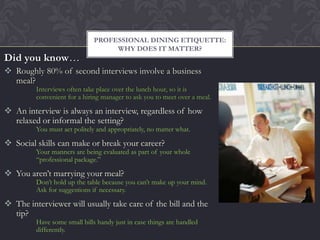
 Roughly 80% of second interviews involve a business
  meal?
         Interviews often take place over the lunch hour, so it is
         convenient for a hiring manager to ask you to meet over a meal.

 An interview is always an interview, regardless of how
  relaxed or informal the setting?
         You must act politely and appropriately, no matter what.

 Social skills can make or break your career?
         Your manners are being evaluated as part of your whole
         “professional package.”

 You aren’t marrying your meal?
         Don’t hold up the table because you can’t make up your mind.
         Ask for suggestions if necessary.

 The interviewer will usually take care of the bill and the
  tip?
         Have some small bills handy just in case things are handled
         differently.
THE POWER OF PROFESSIONAL
                                 NETWORKING

Tips for a successful business lunch:
 Involve others
•   Don’t be afraid to say hello to a stranger
•   At sit-down business lunches with open seating, try to sit with people you haven’t met
    before
•   “Act like the host” and invite those at the table to introduce themselves in turn
 Look before you lunch
•   Look at industry associations, business networking groups, special interest groups
•   Choose networks that fit with your interests and area of business
•   By attending business lunches with guest speakers you’ll get a regular motivational
    injection and learn something too
 Follow up sooner rather than later
•   Guests leaving the function will go straight back to their daily activities and the
    normality of life and, unless you establish the connection, your foundation on which to
    build a relationship will be very weak.
•   Take the time to nurture your new contacts and who knows where they may lead.
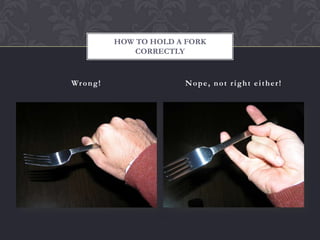
HOW TO HOLD A FORK
                 CORRECTLY


Wr o n g !                Nope, not right either!
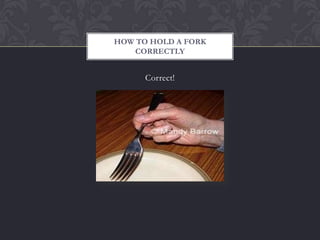
HOW TO HOLD A FORK
    CORRECTLY


      Correct!
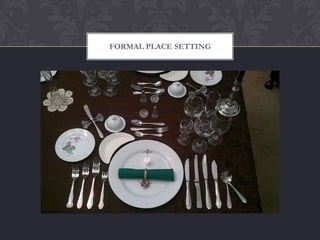
FORMAL PLACE SETTING
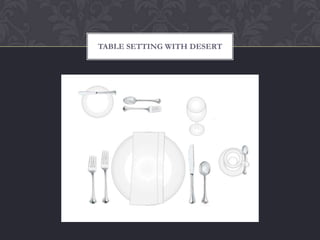
TABLE SETTING WITH DESERT
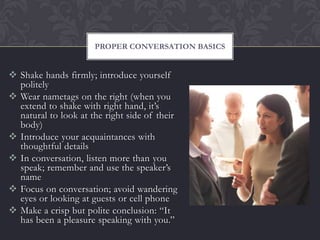
PROPER CONVERSATION BASICS


 Shake hands firmly; introduce yourself
  politely
 Wear nametags on the right (when you
  extend to shake with right hand, it’s
  natural to look at the right side of their
  body)
 Introduce your acquaintances with
  thoughtful details
 In conversation, listen more than you
  speak; remember and use the speaker’s
  name
 Focus on conversation; avoid wandering
  eyes or looking at guests or cell phone
 Make a crisp but polite conclusion: “It
  has been a pleasure speaking with you.”
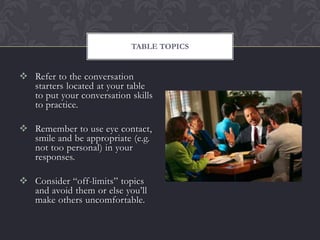
TABLE TOPICS


 Refer to the conversation
  starters located at your table
  to put your conversation skills
  to practice.

 Remember to use eye contact,
  smile and be appropriate (e.g.
  not too personal) in your
  responses.

 Consider “off-limits” topics
  and avoid them or else you’ll
  make others uncomfortable.
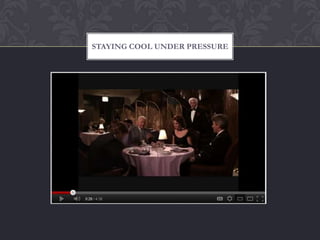
STAYING COOL UNDER PRESSURE
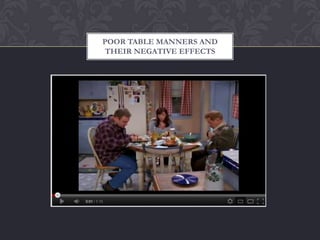
POOR TABLE MANNERS AND
THEIR NEGATIVE EFFECTS
RESEARCHING AN
                      EMPLOYER/ORGANIZATION


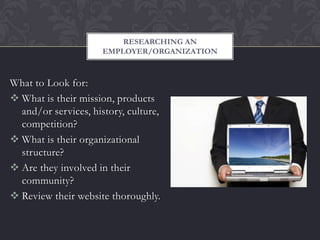
What to Look for:
 What is their mission, products
  and/or services, history, culture,
  competition?
 What is their organizational
  structure?
 Are they involved in their
  community?
 Review their website thoroughly.
RESEARCHING AN
                   EMPLOYER/ORGANIZATION


What to Look for, cont.:
 Check-out third party resources for a
  more accurate, less-biased view.
 Conduct a Google search.
 Use the Library’s ProQuest database
  to uncover recent news articles.
 Are they using social media?
 What kind of activity or presence do
  they have on various websites?
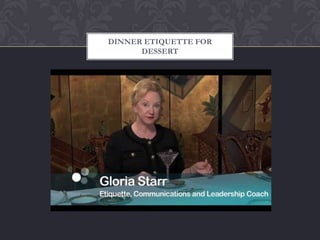
DINNER ETIQUETTE FOR
      DESSERT
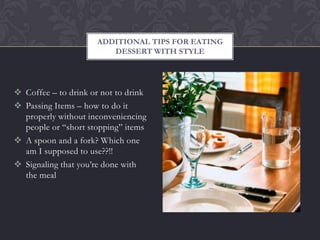
ADDITIONAL TIPS FOR EATING
                         DESSERT WITH STYLE


 Coffee – to drink or not to drink
 Passing Items – how to do it
  properly without inconveniencing
  people or “short stopping” items
 A spoon and a fork? Which one
  am I supposed to use??!!
 Signaling that you’re done with
  the meal
QUESTIONS/COMMENTS


 The purpose of professional luncheons/dinners and the value of
  networking
 What table manners are deemed socially acceptable in a
  professional setting
 The flow of the different courses in a meal and the proper use of
  utensils and glassware
 Skills involved in making appropriate small-talk and knowing
  which subjects to avoid in social interactions
 Proper planning steps and how to do research to make the most
  out of a professional dining experience.
CAREER SERVICES CONTACTS


                             MSB, Richfield Career Services:

Sara Shore, Director                    612-436-7538    sshore@msbcollege.edu
Melody Maxted , Associate Director      612-436-7536    mmaxted-wittry@msbcollege.edu
Ben Hansen, Coordinator                 612-436-7526    bhansen@msbcollege.edu
Sam Kovar, Creative Programs Director   612-455-4777    skovar@msbcollege.edu

Dining Etiquette Workshop Ppt

  • 1.
    DINING ETIQUETTE WORKSHOP FEBRUARY 1, 2012 MSB, Richfield Career Services: Sara Shore, Director Melody Maxted, Associate Director Ben Hansen, Coordinator Sam Kovar, Creative Programs Director
  • 2.
    WORKSHOP OUTCOMES  Knowthe purpose of professional luncheons/dinners and the value of networking  Learn what table manners are deemed socially acceptable in a professional setting  Learn the flow of the different courses in a meal and the proper use of utensils and glassware  Learn the skills involved in making appropriate small-talk and knowing which subjects to avoid in social interactions  Know proper planning steps and how to do research to make the most out of a professional dining experience.
  • 3.
    PROFESSIONAL DINING ETIQUETTE: WHY DOES IT MATTER? Did you know…  Roughly 80% of second interviews involve a business meal? Interviews often take place over the lunch hour, so it is convenient for a hiring manager to ask you to meet over a meal.  An interview is always an interview, regardless of how relaxed or informal the setting? You must act politely and appropriately, no matter what.  Social skills can make or break your career? Your manners are being evaluated as part of your whole “professional package.”  You aren’t marrying your meal? Don’t hold up the table because you can’t make up your mind. Ask for suggestions if necessary.  The interviewer will usually take care of the bill and the tip? Have some small bills handy just in case things are handled differently.
  • 4.
    THE POWER OFPROFESSIONAL NETWORKING Tips for a successful business lunch:  Involve others • Don’t be afraid to say hello to a stranger • At sit-down business lunches with open seating, try to sit with people you haven’t met before • “Act like the host” and invite those at the table to introduce themselves in turn  Look before you lunch • Look at industry associations, business networking groups, special interest groups • Choose networks that fit with your interests and area of business • By attending business lunches with guest speakers you’ll get a regular motivational injection and learn something too  Follow up sooner rather than later • Guests leaving the function will go straight back to their daily activities and the normality of life and, unless you establish the connection, your foundation on which to build a relationship will be very weak. • Take the time to nurture your new contacts and who knows where they may lead.
  • 5.
    HOW TO HOLDA FORK CORRECTLY Wr o n g ! Nope, not right either!
  • 6.
    HOW TO HOLDA FORK CORRECTLY Correct!
  • 7.
  • 8.
  • 9.
    PROPER CONVERSATION BASICS Shake hands firmly; introduce yourself politely  Wear nametags on the right (when you extend to shake with right hand, it’s natural to look at the right side of their body)  Introduce your acquaintances with thoughtful details  In conversation, listen more than you speak; remember and use the speaker’s name  Focus on conversation; avoid wandering eyes or looking at guests or cell phone  Make a crisp but polite conclusion: “It has been a pleasure speaking with you.”
  • 10.
    TABLE TOPICS  Referto the conversation starters located at your table to put your conversation skills to practice.  Remember to use eye contact, smile and be appropriate (e.g. not too personal) in your responses.  Consider “off-limits” topics and avoid them or else you’ll make others uncomfortable.
  • 11.
  • 12.
    POOR TABLE MANNERSAND THEIR NEGATIVE EFFECTS
  • 17.
    RESEARCHING AN EMPLOYER/ORGANIZATION What to Look for:  What is their mission, products and/or services, history, culture, competition?  What is their organizational structure?  Are they involved in their community?  Review their website thoroughly.
  • 18.
    RESEARCHING AN EMPLOYER/ORGANIZATION What to Look for, cont.:  Check-out third party resources for a more accurate, less-biased view.  Conduct a Google search.  Use the Library’s ProQuest database to uncover recent news articles.  Are they using social media?  What kind of activity or presence do they have on various websites?
  • 19.
  • 20.
    ADDITIONAL TIPS FOREATING DESSERT WITH STYLE  Coffee – to drink or not to drink  Passing Items – how to do it properly without inconveniencing people or “short stopping” items  A spoon and a fork? Which one am I supposed to use??!!  Signaling that you’re done with the meal
  • 21.
    QUESTIONS/COMMENTS  The purposeof professional luncheons/dinners and the value of networking  What table manners are deemed socially acceptable in a professional setting  The flow of the different courses in a meal and the proper use of utensils and glassware  Skills involved in making appropriate small-talk and knowing which subjects to avoid in social interactions  Proper planning steps and how to do research to make the most out of a professional dining experience.
  • 22.
    CAREER SERVICES CONTACTS MSB, Richfield Career Services: Sara Shore, Director 612-436-7538 sshore@msbcollege.edu Melody Maxted , Associate Director 612-436-7536 mmaxted-wittry@msbcollege.edu Ben Hansen, Coordinator 612-436-7526 bhansen@msbcollege.edu Sam Kovar, Creative Programs Director 612-455-4777 skovar@msbcollege.edu