Dimensions of personalisation in
technology-enhanced learning:
A framework and implications for design
Elizabeth FitzGerald
LTI-Academic/IET
Introduction
• Personalisation is a recurring trend in education,
with a number of programmes designed to
deliver learner-centred education.
• Personalisation can occur in a number of
different ways, both in technology- enhanced
learning (TEL) and non-TEL environments.
• Personalisation lends itself well to TEL
environments but there are no design guidelines,
frameworks or tools to guide its implementation
and hence practice can vary widely.
Key aspects of non-TEL personalisation
• Much literature in this area – usually
formal/compulsory education, classroom-
based
• UK govt (DfES) in 2004 suggested 5 aspects:
– assessment for learning; teaching and learning
strategies; curriculum entitlement and choice; a
student-centred approach to school organisation;
and a strong partnership beyond the school
• Hargreaves suggested 4 more:
– new technologies; workforce development; advice
and guidance; and mentoring and coaching
Not much about TEL personalisation though…
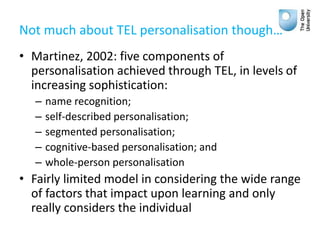
• Martinez, 2002: five components of
personalisation achieved through TEL, in levels of
increasing sophistication:
– name recognition;
– self-described personalisation;
– segmented personalisation;
– cognitive-based personalisation; and
– whole-person personalisation
• Fairly limited model in considering the wide range
of factors that impact upon learning and only
really considers the individual
Process of identifying dimensions
• Grounded approach: careful scrutiny and
conceptual analysis of the published literature of
personalisation in TEL in the last decade
• Independently classified the different aspects
found, before discussing the overlap
• Heuristic and iterative development of the
dimensions with multiple cycles to ensure full
coverage of the emerging themes and to
ascertain full analysis of the literature/projects
examined
Dimensions of TEL personalisation
• What is being personalised
• The type of learning where personalisation
occurs
• What personal characteristics of the learner
may be addressed
• Who/what is doing the personalisation
• How is personalisation carried out
• The impact/beneficiaries of the
personalisation
Dimension 1:
What is being
personalised?
Dimension 2:
Type of learning
Dimension 3:
Personal
characteristics
of the learner
Dimension 4:
Who/what is doing
the personalisation
Dimension 5:
How is
personalisation
carried out?
Dimension 6:
Impact/beneficiaries
 Content
 Assessment
 Teaching and
learning strategy
(e.g. group work;
individual; peer
learning)
 Learner choice
(e.g. of resources,
topics or
mode/approach
of study)
 Teacher choice
(e.g. curriculum
choices or
ordering of
curriculum)
 Formal (e.g.
compulsory,
primary,
secondary etc)
 Non-formal
 Informal
 Demographic
(e.g. age, cultural
background)
 Prior knowledge
(e.g. based on
recent
assessment
scores)
 Self-assessed
knowledge (by
teacher or
learner)
 Demonstrated
interests or
personal
relevance (e.g.
could feed into
learner profile)
 Preferred mode
of learning e.g.
distance, online,
evening classes
 Level of learner
commitment/mot
ivation and self-
regulation
 Learner
 Teacher
 Peer
 Computer
software and/or
algorithms
 Name recognition
 Self-described
personalisation
 Segmented
personalisation
 Cognitive-based
personalisation
 Whole-person
personalisation
(affective
elements)
 Organisation of
resources
 Learners
 Teachers
 Trainers and
training providers
 School/organisati
on
 Government
(local or national
level)
 Commercial
entities e.g.
software
developers
Table 1:
Framework for modelling dimensions of personalisation in TEL
Theoretical basis
• Builds mainly on cognitive and constructivist
theories of learning based on work by
Vygotsky
• Emphasis on socio-cultural aspects and need
to examine learning from number of different
perspectives
Case studies in the paper
• Intelligent Tutoring Systems (ITS) and Adaptive
Educational Hypermedia (AEH)
• Adaptive assessment
• Science inquiry learning
• Gaming and informal learning
• Learning analytics
• Personalised books
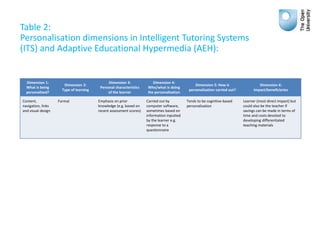
Example 1: Intelligent Tutoring Systems (ITS) and
Adaptive Educational Hypermedia (AEH)
• ITS from psychology, AEH from computer science
• Learner model/profile as basis for personalisation
• Learning environment/VLE is modified to match learner
profile: adaptive links (different links), adaptive content or
adaptive presentation of resources (e.g. different colour
schemes, designs or website navigation)
• Ideally system automatically updates in real time to match
learner engagement/improvement
• In reality, this synchronicity rarely occurs and usually needs
manual updating
Dimension 1:
What is being
personalised?
Dimension 2:
Type of learning
Dimension 3:
Personal characteristics
of the learner
Dimension 4:
Who/what is doing
the personalisation
Dimension 5: How is
personalisation carried out?
Dimension 6:
Impact/beneficiaries
Content,
navigation, links
and visual design
Formal Emphasis on prior
knowledge (e.g. based on
recent assessment scores)
Carried out by
computer software,
sometimes based on
information inputted
by the learner e.g.
response to a
questionnaire
Tends to be cognitive-based
personalisation
Learner (most direct impact) but
could also be the teacher if
savings can be made in terms of
time and costs devoted to
developing differentiated
teaching materials
Table 2:
Personalisation dimensions in Intelligent Tutoring Systems
(ITS) and Adaptive Educational Hypermedia (AEH):
Example 2: Learning analytics
• Learning analytics can be used currently to provide
personalised feedback and support
• Sits at a crossroads between technical and social learning
theory fields
• Learner affect can help create a more effective model of
the learner
• Could capture learner data and model their emotions, via
facial recognition, processing voice recorded data,
sentiment analysis of student comments, and heart rate
detection using video cameras, etc.
• Exemplified by the ‘whole person’ personalisation element
in Dimension 5 and have a high level of sophistication,
taking into account a large number of learning
characteristics
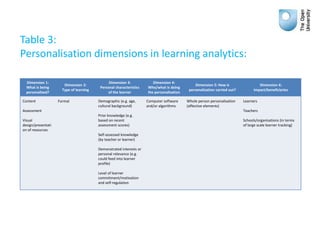
Dimension 1:
What is being
personalised?
Dimension 2:
Type of learning
Dimension 3:
Personal characteristics
of the learner
Dimension 4:
Who/what is doing
the personalisation
Dimension 5: How is
personalisation carried out?
Dimension 6:
Impact/beneficiaries
Content
Assessment
Visual
design/presentati
on of resources
Formal Demographic (e.g. age,
cultural background)
Prior knowledge (e.g.
based on recent
assessment scores)
Self-assessed knowledge
(by teacher or learner)
Demonstrated interests or
personal relevance (e.g.
could feed into learner
profile)
Level of learner
commitment/motivation
and self-regulation
Computer software
and/or algorithms
Whole person personalisation
(affective elements)
Learners
Teachers
Schools/organisations (in terms
of large scale learner tracking)
Table 3:
Personalisation dimensions in learning analytics:
Summary
• Initial attempt at mapping the key dimensions of, and providing the
language for, personalised TEL approaches.
• Future research could expand the facets and levels of our key dimensions
(e.g. , micro, meso, macro; or at a learner’s individual level compared to
an institutional level).
• Useful for variety of stakeholders including:
– Developers of educational software, who are being urged to consider
how to integrate personalisation into their new solutions
– Teachers, in considering how to provide personal support for all their
students, particularly in their online activities.
• Framework could be used to support teacher professional development,
to help them understand how personalisation might occur already and to
see how it might be integrated more closely in the future, into their daily
activities.
Implications for practice and/or policy
• The framework can be used to analyse existing
personalisation in TEL and also help guide the design
of new implementations.
• The article provides a shared understanding of what
personalisation is in TEL environments and suggests a
useful shared language for onward discussions.
• The dimensions in the framework can be used as the
basis for future systematic reviews, which may help
identify which aspects of personalisation are
effective for learning.
Questions/discussion
• Thanks for listening – questions, discussion etc?
• Full paper reference:
FitzGerald, Elizabeth; Kucirkova, Natalia; Jones, Ann; Cross, Simon;
Ferguson, Rebecca; Herodotou, Christothea; Hillaire, Garron and Scanlon,
Eileen (2017). Dimensions of personalisation in technology-enhanced
learning: a framework and implications for design. British Journal of
Educational Technology (In press).
ORO link || Available to download from ResearchGate || Official BJET link
Email: elizabeth.fitzgerald@open.ac.uk
Twitter: @elara99
ResearchGate: http://tinyurl.com/RG-EFitzgerald

Dimensions of personalisation in TEL: a framework and implications for design

  • 1.
    Dimensions of personalisationin technology-enhanced learning: A framework and implications for design Elizabeth FitzGerald LTI-Academic/IET
  • 2.
    Introduction • Personalisation isa recurring trend in education, with a number of programmes designed to deliver learner-centred education. • Personalisation can occur in a number of different ways, both in technology- enhanced learning (TEL) and non-TEL environments. • Personalisation lends itself well to TEL environments but there are no design guidelines, frameworks or tools to guide its implementation and hence practice can vary widely.
  • 3.
    Key aspects ofnon-TEL personalisation • Much literature in this area – usually formal/compulsory education, classroom- based • UK govt (DfES) in 2004 suggested 5 aspects: – assessment for learning; teaching and learning strategies; curriculum entitlement and choice; a student-centred approach to school organisation; and a strong partnership beyond the school • Hargreaves suggested 4 more: – new technologies; workforce development; advice and guidance; and mentoring and coaching
  • 4.
    Not much aboutTEL personalisation though… • Martinez, 2002: five components of personalisation achieved through TEL, in levels of increasing sophistication: – name recognition; – self-described personalisation; – segmented personalisation; – cognitive-based personalisation; and – whole-person personalisation • Fairly limited model in considering the wide range of factors that impact upon learning and only really considers the individual
  • 5.
    Process of identifyingdimensions • Grounded approach: careful scrutiny and conceptual analysis of the published literature of personalisation in TEL in the last decade • Independently classified the different aspects found, before discussing the overlap • Heuristic and iterative development of the dimensions with multiple cycles to ensure full coverage of the emerging themes and to ascertain full analysis of the literature/projects examined
  • 6.
    Dimensions of TELpersonalisation • What is being personalised • The type of learning where personalisation occurs • What personal characteristics of the learner may be addressed • Who/what is doing the personalisation • How is personalisation carried out • The impact/beneficiaries of the personalisation
  • 7.
    Dimension 1: What isbeing personalised? Dimension 2: Type of learning Dimension 3: Personal characteristics of the learner Dimension 4: Who/what is doing the personalisation Dimension 5: How is personalisation carried out? Dimension 6: Impact/beneficiaries  Content  Assessment  Teaching and learning strategy (e.g. group work; individual; peer learning)  Learner choice (e.g. of resources, topics or mode/approach of study)  Teacher choice (e.g. curriculum choices or ordering of curriculum)  Formal (e.g. compulsory, primary, secondary etc)  Non-formal  Informal  Demographic (e.g. age, cultural background)  Prior knowledge (e.g. based on recent assessment scores)  Self-assessed knowledge (by teacher or learner)  Demonstrated interests or personal relevance (e.g. could feed into learner profile)  Preferred mode of learning e.g. distance, online, evening classes  Level of learner commitment/mot ivation and self- regulation  Learner  Teacher  Peer  Computer software and/or algorithms  Name recognition  Self-described personalisation  Segmented personalisation  Cognitive-based personalisation  Whole-person personalisation (affective elements)  Organisation of resources  Learners  Teachers  Trainers and training providers  School/organisati on  Government (local or national level)  Commercial entities e.g. software developers Table 1: Framework for modelling dimensions of personalisation in TEL
  • 8.
    Theoretical basis • Buildsmainly on cognitive and constructivist theories of learning based on work by Vygotsky • Emphasis on socio-cultural aspects and need to examine learning from number of different perspectives
  • 9.
    Case studies inthe paper • Intelligent Tutoring Systems (ITS) and Adaptive Educational Hypermedia (AEH) • Adaptive assessment • Science inquiry learning • Gaming and informal learning • Learning analytics • Personalised books
  • 10.
    Example 1: IntelligentTutoring Systems (ITS) and Adaptive Educational Hypermedia (AEH) • ITS from psychology, AEH from computer science • Learner model/profile as basis for personalisation • Learning environment/VLE is modified to match learner profile: adaptive links (different links), adaptive content or adaptive presentation of resources (e.g. different colour schemes, designs or website navigation) • Ideally system automatically updates in real time to match learner engagement/improvement • In reality, this synchronicity rarely occurs and usually needs manual updating
  • 11.
    Dimension 1: What isbeing personalised? Dimension 2: Type of learning Dimension 3: Personal characteristics of the learner Dimension 4: Who/what is doing the personalisation Dimension 5: How is personalisation carried out? Dimension 6: Impact/beneficiaries Content, navigation, links and visual design Formal Emphasis on prior knowledge (e.g. based on recent assessment scores) Carried out by computer software, sometimes based on information inputted by the learner e.g. response to a questionnaire Tends to be cognitive-based personalisation Learner (most direct impact) but could also be the teacher if savings can be made in terms of time and costs devoted to developing differentiated teaching materials Table 2: Personalisation dimensions in Intelligent Tutoring Systems (ITS) and Adaptive Educational Hypermedia (AEH):
  • 12.
    Example 2: Learninganalytics • Learning analytics can be used currently to provide personalised feedback and support • Sits at a crossroads between technical and social learning theory fields • Learner affect can help create a more effective model of the learner • Could capture learner data and model their emotions, via facial recognition, processing voice recorded data, sentiment analysis of student comments, and heart rate detection using video cameras, etc. • Exemplified by the ‘whole person’ personalisation element in Dimension 5 and have a high level of sophistication, taking into account a large number of learning characteristics
  • 13.
    Dimension 1: What isbeing personalised? Dimension 2: Type of learning Dimension 3: Personal characteristics of the learner Dimension 4: Who/what is doing the personalisation Dimension 5: How is personalisation carried out? Dimension 6: Impact/beneficiaries Content Assessment Visual design/presentati on of resources Formal Demographic (e.g. age, cultural background) Prior knowledge (e.g. based on recent assessment scores) Self-assessed knowledge (by teacher or learner) Demonstrated interests or personal relevance (e.g. could feed into learner profile) Level of learner commitment/motivation and self-regulation Computer software and/or algorithms Whole person personalisation (affective elements) Learners Teachers Schools/organisations (in terms of large scale learner tracking) Table 3: Personalisation dimensions in learning analytics:
  • 14.
    Summary • Initial attemptat mapping the key dimensions of, and providing the language for, personalised TEL approaches. • Future research could expand the facets and levels of our key dimensions (e.g. , micro, meso, macro; or at a learner’s individual level compared to an institutional level). • Useful for variety of stakeholders including: – Developers of educational software, who are being urged to consider how to integrate personalisation into their new solutions – Teachers, in considering how to provide personal support for all their students, particularly in their online activities. • Framework could be used to support teacher professional development, to help them understand how personalisation might occur already and to see how it might be integrated more closely in the future, into their daily activities.
  • 15.
    Implications for practiceand/or policy • The framework can be used to analyse existing personalisation in TEL and also help guide the design of new implementations. • The article provides a shared understanding of what personalisation is in TEL environments and suggests a useful shared language for onward discussions. • The dimensions in the framework can be used as the basis for future systematic reviews, which may help identify which aspects of personalisation are effective for learning.
  • 16.
    Questions/discussion • Thanks forlistening – questions, discussion etc? • Full paper reference: FitzGerald, Elizabeth; Kucirkova, Natalia; Jones, Ann; Cross, Simon; Ferguson, Rebecca; Herodotou, Christothea; Hillaire, Garron and Scanlon, Eileen (2017). Dimensions of personalisation in technology-enhanced learning: a framework and implications for design. British Journal of Educational Technology (In press). ORO link || Available to download from ResearchGate || Official BJET link Email: elizabeth.fitzgerald@open.ac.uk Twitter: @elara99 ResearchGate: http://tinyurl.com/RG-EFitzgerald

Editor's Notes

  • #3 Explored in Innovating Pedagogy reports – one of six key themes
  • #5 Name recognition is when learners are acknowledged personally. Self-described personalisation is where a learner’s preferences or attributes described by, for example, a prior questionnaire, providing the basis for options or instructional experiences. Segmented personalisation is where groups of people with similar attributes receive content relevant to that group. In cognitive-based personalisation, content or resources are presented differently based upon cognitive models or “learner profiles” of the user that update—or are updated—as the learner progresses. These cognitive models may include how information is presented (e.g., a summary followed by the details or vice versa), or media formats (listening to audio information rather than reading the equivalent text). Whole-person personalisation explores how learner motivations and emotions combine with analytics to suggest optimal delivery of learner resources in real time. Martinez describes how the system “learns” and adapts, based on regular updating of a dynamic learner model, along with pattern analysis and comparison with other learner responses and data on a larger scale