Materials and methods of construction
CT-154
Lecture no 1
Instructor
Engr Nazeer Alam
Course outline
 Stones
 Bricks, Blocks and tiles
 Aggregates
 Water ,
 lime ,
 Cement
 timber
 Paints and Varnishes
 Metals
 Glass and plastics
Stone
Presentation outline
 Introduction of stones
 Characteristics of good Quality of stone
 Dressing of Building stone
 Properties and uses of common stone
 Quarrying of stones
 Dressing of stones
 Testing of stones
Introductions
 Stone has been defined as the natural, hard substance formed from
minerals and earth material which are present in rocks.
 Rock may be defined as the portion of the earth’s crust having no definite
shape and structure.
 Almost all rocks have a definite chemical composition and are made up of
minerals and organic matter. Some of the rock-forming minerals are
quartz, feldspar, mica, dolomite, etc.
 Use of stone in building construction is traditional in the places where it is
produced,
 Although even there its high cost imposes limitations on its use. The
conditions which govern the selection of stone for structural purposes are
cost, fashion, ornamental value and durability.
 Stone has been used in the construction of most of the important
structures since prehistoric age. Most of the forts world over, the Taj Mahal
of India, the famous pyramids of Egypt and the great wall of China
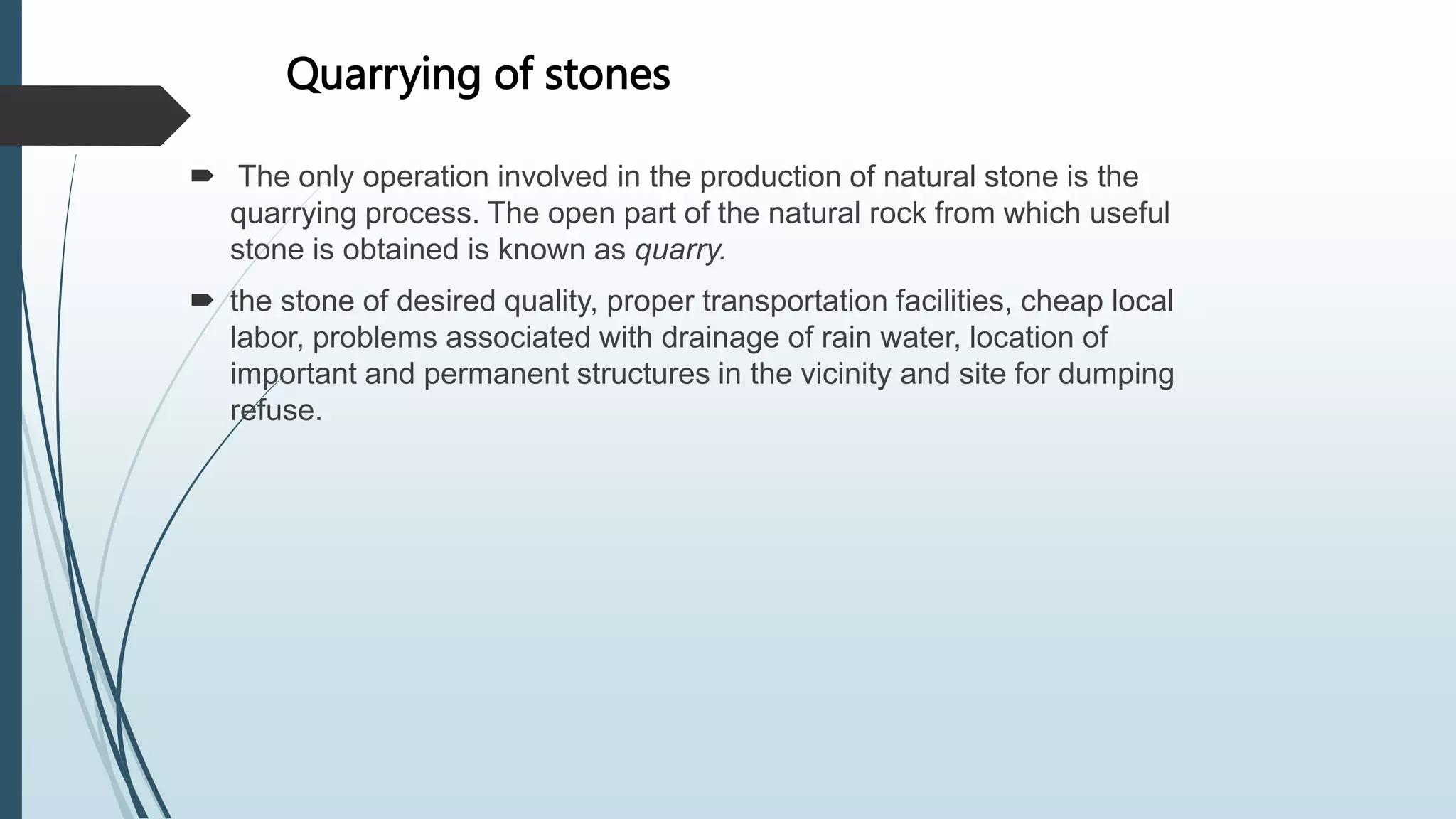
Classification of Rocks
 The rocks may be classified on the basis of their
 Geological formation,
 Physical characteristics
 Chemical composition
Quarrying of stones
 The only operation involved in the production of natural stone is the
quarrying process. The open part of the natural rock from which useful
stone is obtained is known as quarry.
 the stone of desired quality, proper transportation facilities, cheap local
labor, problems associated with drainage of rain water, location of
important and permanent structures in the vicinity and site for dumping
refuse.
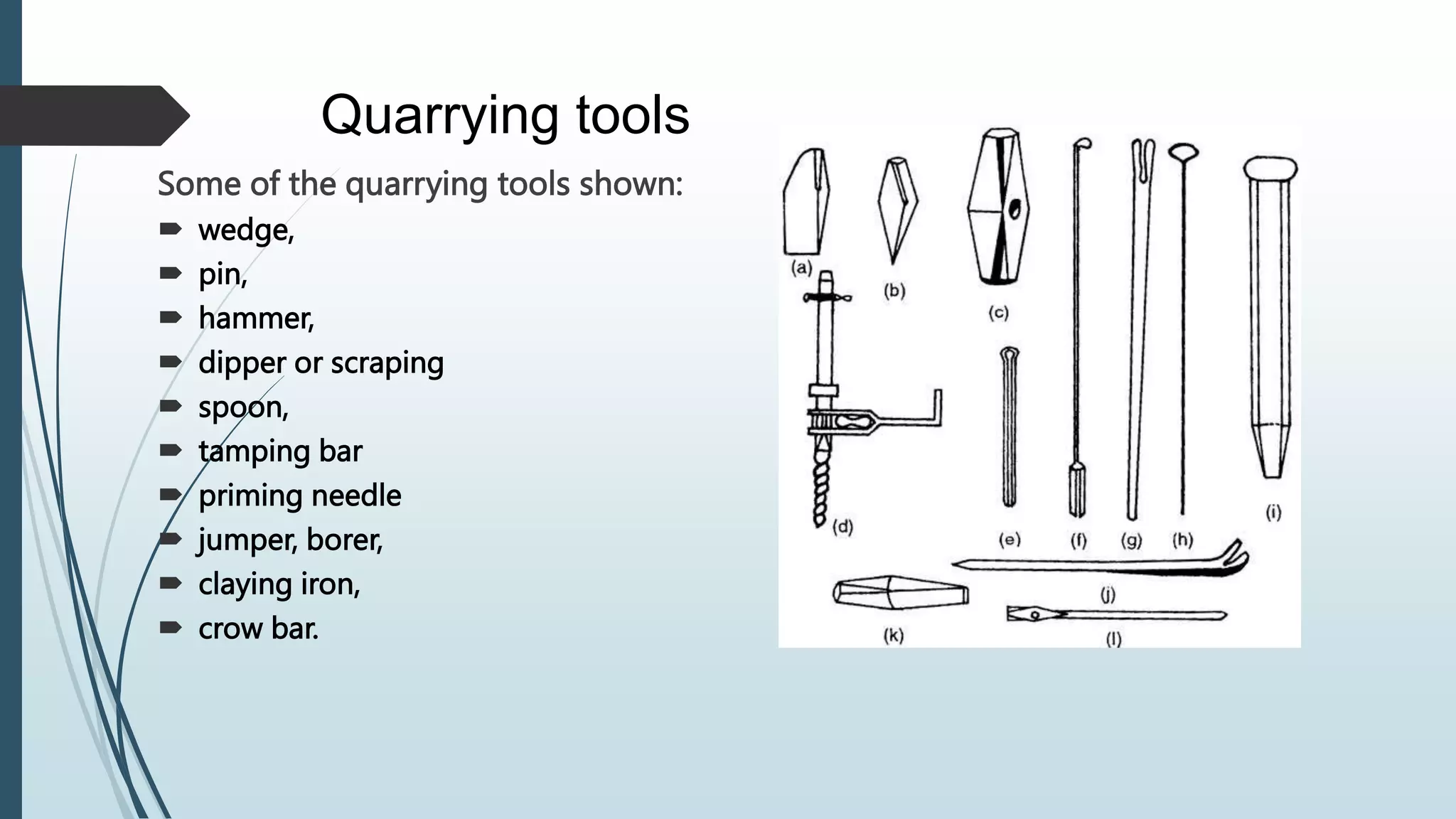
Quarrying tools
Some of the quarrying tools shown:
 wedge,
 pin,
 hammer,
 dipper or scraping
 spoon,
 tamping bar
 priming needle
 jumper, borer,
 claying iron,
 crow bar.
Methods of Quarrying
Excavation
 Stones buried in earth or under loose overburden are excavated with pick axes, crow bars, chisels,
hammers, etc.
Wedging
 This method of quarrying is suitable for
 costly, soft and stratified rocks such as sandstone,
 limestone, laterite, marble and slate.
 About 10–15 cm deep holes, at around 10 cm
 Spacing, are made vertically in the rock. Steel pins and wedges or plugs
Heating
 is most suitable for quarrying small, thin
 and regular blocks of stones from rocks, such as
 granite and gneiss. A heap of fuel is piled and fired on the surface of rock in small area.
Blasting
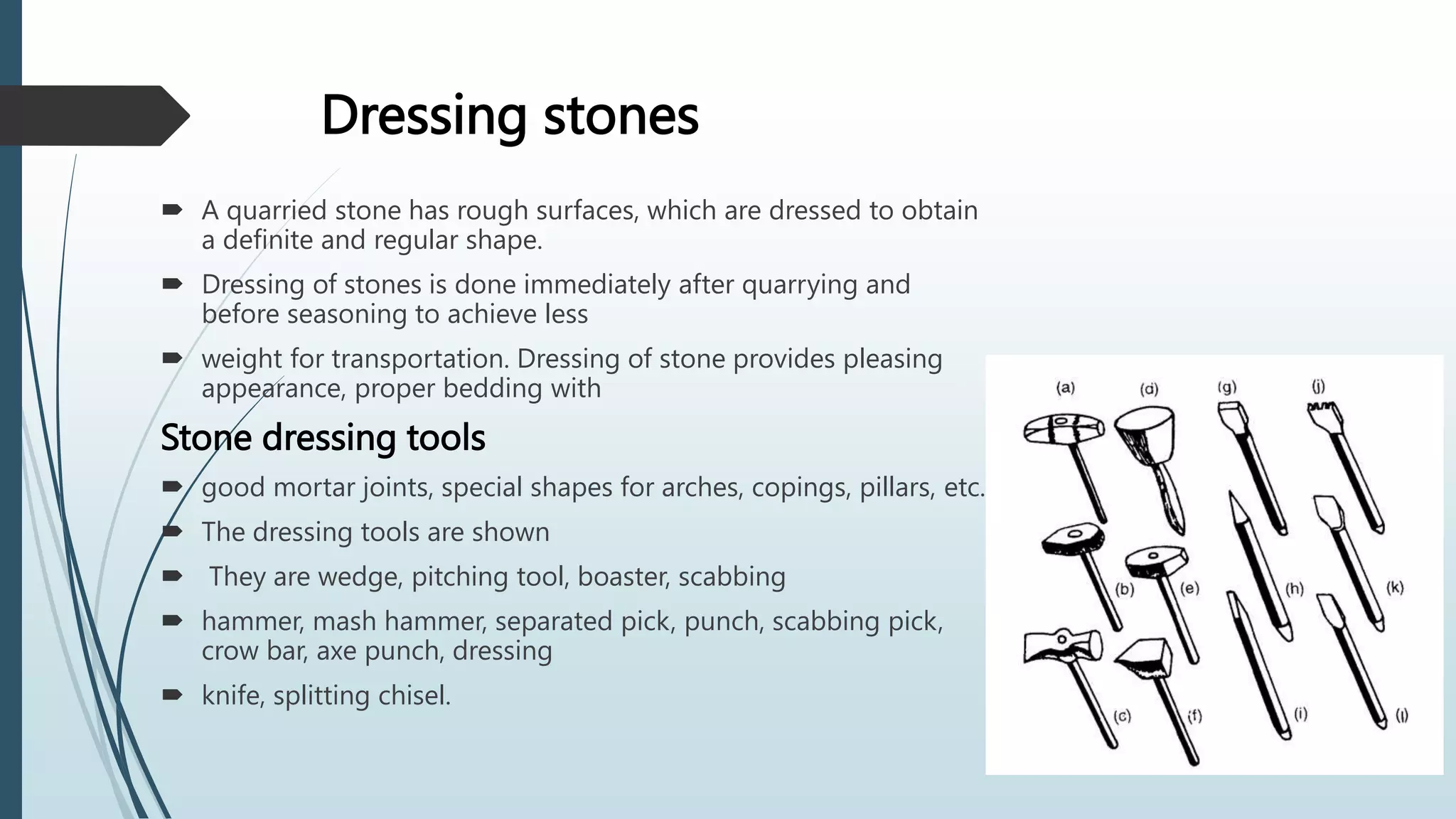
 Explosives such as blasting powder, blasting cotton,
dynamite and cordite are used.
 The operations involved are boring, charging, tamping
and firing.
Borings
 Holes are drilled or bored in the rock to be dislodged.
For vertical holes, jumper is used
 whereas for inclined or horizontal holes, boring bars are
used. One person holds the jumper
 exactly in the place where hole is to be mad
Dressing stones
 A quarried stone has rough surfaces, which are dressed to obtain
a definite and regular shape.
 Dressing of stones is done immediately after quarrying and
before seasoning to achieve less
 weight for transportation. Dressing of stone provides pleasing
appearance, proper bedding with
Stone dressing tools
 good mortar joints, special shapes for arches, copings, pillars, etc.
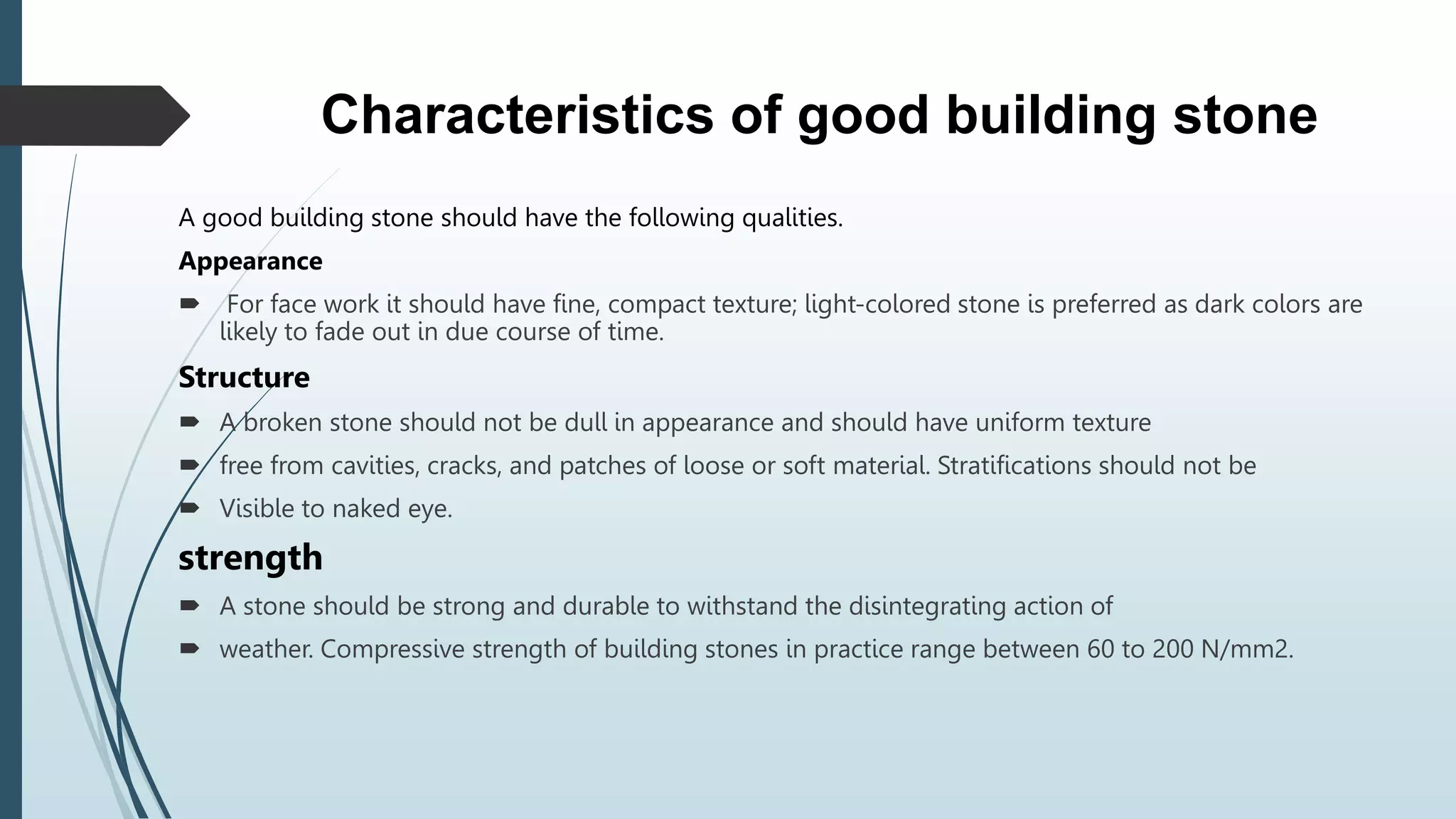
 The dressing tools are shown
 They are wedge, pitching tool, boaster, scabbing
 hammer, mash hammer, separated pick, punch, scabbing pick,
crow bar, axe punch, dressing
 knife, splitting chisel.
Characteristics of good building stone
A good building stone should have the following qualities.
Appearance
 For face work it should have fine, compact texture; light-colored stone is preferred as dark colors are
likely to fade out in due course of time.
Structure
 A broken stone should not be dull in appearance and should have uniform texture
 free from cavities, cracks, and patches of loose or soft material. Stratifications should not be
 Visible to naked eye.
strength
 A stone should be strong and durable to withstand the disintegrating action of
 weather. Compressive strength of building stones in practice range between 60 to 200 N/mm2.
weight
 It is an indication of the porosity and density. For stability of structures such as dams.
 retaining walls, etc. heavier stones are required, whereas for arches, vaults, domes, etc.
 Light stones may be the choice.
Hardness
 This property is important for floors, pavements, aprons of bridges, etc. hardness
 is determined by the Mohr's scale
Toughness
 The measure of impact that a stone can withstand is defined as toughness. The
 stone used should be tough when vibratory or moving loads are anticipated.
Porosity and Water absorption
 Porosity depends on the mineral constituents, cooling time and
 structural formation. A porous stone disintegrates as the absorbed rain water freezes,
expands,
 and causes cracking. Permissible water absorption for some of the stones is given in Table
Seasoning
 The stone should be well seasoned.
Weathering
 " The resistance of stone against the wear and tear due to natural agencies should be high
Workability
 Stone should be workable so that cutting, dressing and bringing it out in the
 required shape and size may not be uneconomical
Specific Gravity
The specific gravity of most of the stones lies between 2.3 to 2.5.
Fire Resistance
 Stones should be free from calcium carbonate, oxides of iron, and minerals
 having different coefficients of thermal expansion. Igneous rock show marked
disintegration
 principally because of quartz which disintegrates into small particles at a temperature of
about
 575°C. Limestone, however, can withstand a little higher temperature; i.e. up to 800°C
after which they disintegrate.
Testing of stones
Building stones are available in large quantity in various parts
of the country and to choose and utilize them for their
satisfactory performance, it is necessary to test the stone for
its
strength properties,
durability
quality.
Thank you
for Your attention

lecture 01 Materials and methods of construction.pptx

  • 1.
    Materials and methodsof construction CT-154 Lecture no 1 Instructor Engr Nazeer Alam
  • 2.
    Course outline  Stones Bricks, Blocks and tiles  Aggregates  Water ,  lime ,  Cement  timber  Paints and Varnishes  Metals  Glass and plastics
  • 3.
    Stone Presentation outline  Introductionof stones  Characteristics of good Quality of stone  Dressing of Building stone  Properties and uses of common stone  Quarrying of stones  Dressing of stones  Testing of stones
  • 4.
    Introductions  Stone hasbeen defined as the natural, hard substance formed from minerals and earth material which are present in rocks.  Rock may be defined as the portion of the earth’s crust having no definite shape and structure.  Almost all rocks have a definite chemical composition and are made up of minerals and organic matter. Some of the rock-forming minerals are quartz, feldspar, mica, dolomite, etc.
  • 5.
     Use ofstone in building construction is traditional in the places where it is produced,  Although even there its high cost imposes limitations on its use. The conditions which govern the selection of stone for structural purposes are cost, fashion, ornamental value and durability.  Stone has been used in the construction of most of the important structures since prehistoric age. Most of the forts world over, the Taj Mahal of India, the famous pyramids of Egypt and the great wall of China
  • 6.
    Classification of Rocks The rocks may be classified on the basis of their  Geological formation,  Physical characteristics  Chemical composition
  • 7.
    Quarrying of stones The only operation involved in the production of natural stone is the quarrying process. The open part of the natural rock from which useful stone is obtained is known as quarry.  the stone of desired quality, proper transportation facilities, cheap local labor, problems associated with drainage of rain water, location of important and permanent structures in the vicinity and site for dumping refuse.
  • 8.
    Quarrying tools Some ofthe quarrying tools shown:  wedge,  pin,  hammer,  dipper or scraping  spoon,  tamping bar  priming needle  jumper, borer,  claying iron,  crow bar.
  • 9.
    Methods of Quarrying Excavation Stones buried in earth or under loose overburden are excavated with pick axes, crow bars, chisels, hammers, etc. Wedging  This method of quarrying is suitable for  costly, soft and stratified rocks such as sandstone,  limestone, laterite, marble and slate.  About 10–15 cm deep holes, at around 10 cm  Spacing, are made vertically in the rock. Steel pins and wedges or plugs Heating  is most suitable for quarrying small, thin  and regular blocks of stones from rocks, such as  granite and gneiss. A heap of fuel is piled and fired on the surface of rock in small area.
  • 10.
    Blasting  Explosives suchas blasting powder, blasting cotton, dynamite and cordite are used.  The operations involved are boring, charging, tamping and firing. Borings  Holes are drilled or bored in the rock to be dislodged. For vertical holes, jumper is used  whereas for inclined or horizontal holes, boring bars are used. One person holds the jumper  exactly in the place where hole is to be mad
  • 11.
    Dressing stones  Aquarried stone has rough surfaces, which are dressed to obtain a definite and regular shape.  Dressing of stones is done immediately after quarrying and before seasoning to achieve less  weight for transportation. Dressing of stone provides pleasing appearance, proper bedding with Stone dressing tools  good mortar joints, special shapes for arches, copings, pillars, etc.  The dressing tools are shown  They are wedge, pitching tool, boaster, scabbing  hammer, mash hammer, separated pick, punch, scabbing pick, crow bar, axe punch, dressing  knife, splitting chisel.
  • 12.
    Characteristics of goodbuilding stone A good building stone should have the following qualities. Appearance  For face work it should have fine, compact texture; light-colored stone is preferred as dark colors are likely to fade out in due course of time. Structure  A broken stone should not be dull in appearance and should have uniform texture  free from cavities, cracks, and patches of loose or soft material. Stratifications should not be  Visible to naked eye. strength  A stone should be strong and durable to withstand the disintegrating action of  weather. Compressive strength of building stones in practice range between 60 to 200 N/mm2.
  • 13.
    weight  It isan indication of the porosity and density. For stability of structures such as dams.  retaining walls, etc. heavier stones are required, whereas for arches, vaults, domes, etc.  Light stones may be the choice. Hardness  This property is important for floors, pavements, aprons of bridges, etc. hardness  is determined by the Mohr's scale Toughness  The measure of impact that a stone can withstand is defined as toughness. The  stone used should be tough when vibratory or moving loads are anticipated.
  • 14.
    Porosity and Waterabsorption  Porosity depends on the mineral constituents, cooling time and  structural formation. A porous stone disintegrates as the absorbed rain water freezes, expands,  and causes cracking. Permissible water absorption for some of the stones is given in Table Seasoning  The stone should be well seasoned. Weathering  " The resistance of stone against the wear and tear due to natural agencies should be high Workability  Stone should be workable so that cutting, dressing and bringing it out in the  required shape and size may not be uneconomical Specific Gravity The specific gravity of most of the stones lies between 2.3 to 2.5.
  • 15.
    Fire Resistance  Stonesshould be free from calcium carbonate, oxides of iron, and minerals  having different coefficients of thermal expansion. Igneous rock show marked disintegration  principally because of quartz which disintegrates into small particles at a temperature of about  575°C. Limestone, however, can withstand a little higher temperature; i.e. up to 800°C after which they disintegrate.
  • 16.
    Testing of stones Buildingstones are available in large quantity in various parts of the country and to choose and utilize them for their satisfactory performance, it is necessary to test the stone for its strength properties, durability quality.
  • 17.