Annual Members`Meeting
Berlin, Germany, December 2nd 2008
DIGITAL UNIVERSITY 2010 WHITE PAPER
FRANCISCO JOSÉ GARCÍA PEÑALVO
TECHNOLOGICAL & ACADEMIC COMMITTEE MEMBER
UpdatedSeptember2015
2
Summary
1.  Introduction
2.  Digital University 2010 White Paper
3.  Digital University 2010 Reference
Model
4.  Conclusions
3
1. INTRODUCTION
4
Digital Era
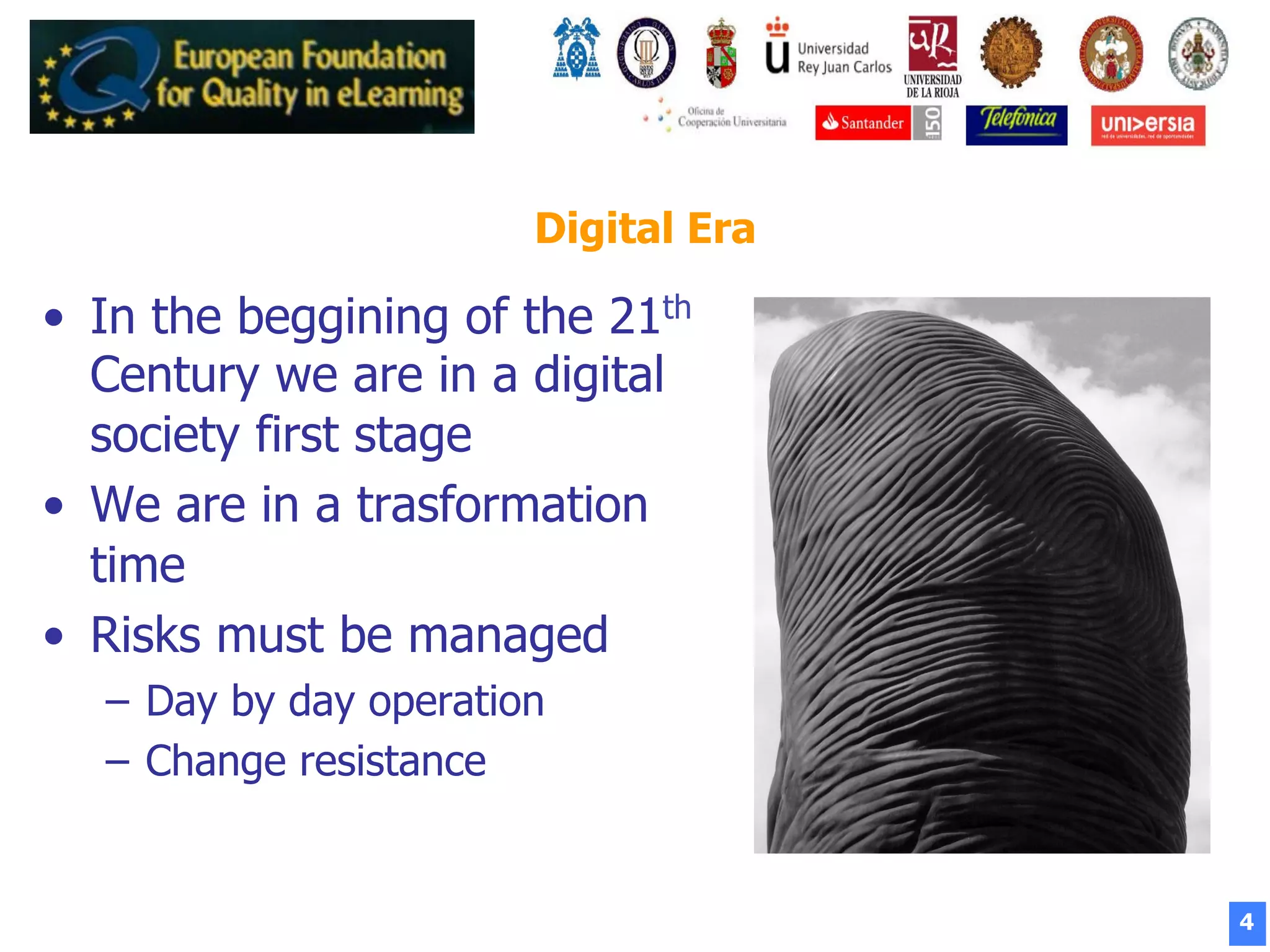
•  In the beggining of the 21th
Century we are in a digital
society first stage
•  We are in a trasformation
time
•  Risks must be managed
–  Day by day operation
–  Change resistance
5
New rules
•  Services are the
business center
•  Flexibility
•  Distance and time
difference are not
relevant
•  Information and knowledge will be
where activity requires them
6
Motivation
•  Higher Education must be adequate and
integrated with the digital world
•  A higher education organization should offer
its services through telematic media, in
order to
–  Be a higher education and research leader
–  Speed up its operating processes
–  Remove every accesibility barrier
7
Context
•  Economic and politic connotations
– Digital economic based on knowledge
•  Legal connotations
– European and local country laws and
guidelines
•  Academic connotations
– European space for higher education
8
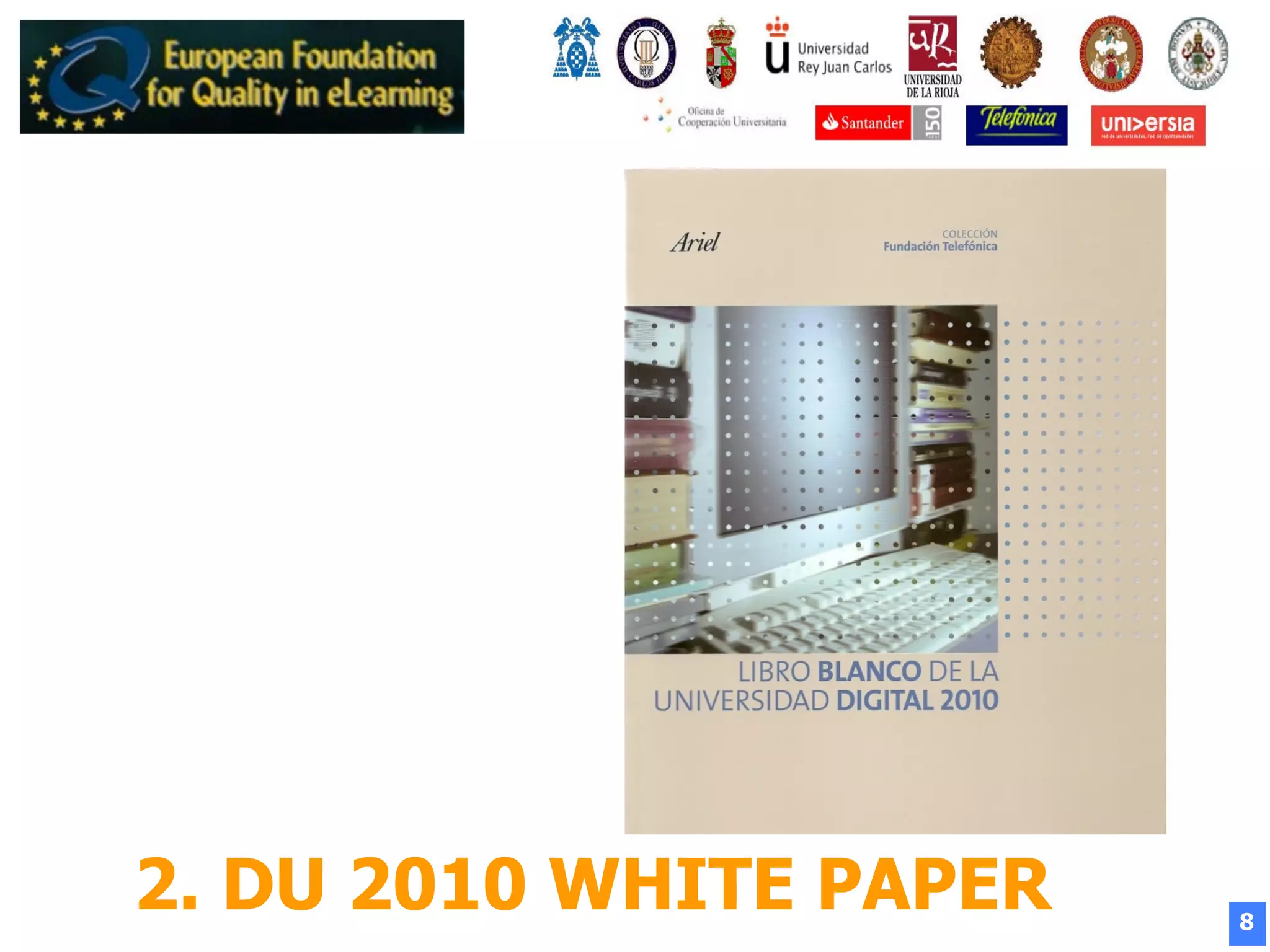
2. DU 2010 WHITE PAPER
9
Presentation
•  Digital University 2010 White Paper
§  Presented at the Salamanca University, October 2nd 2008
§  Made by
§  Alcalá University, Carlos III University, Castilla-La
Mancha University, Rey Juan Carlos University, La
Rioja University, Salamanca University, Seville
University & Valladolid University
§  Banco Santander, Telefónica, Universia & OCU
10
What is the DU2010 White Paper?
The Digital University 2010 White Paper is the result of a
collective discussion between universities and enterprises about
the technological transformation that Spanish (European)
University must tackle due to the goals and challenges from the
European Space for Higher Education
11
DU2010 White Paper Structure
DU	
  2010	
  GLOBAL	
  MODEL	
  
UNIVERSITY	
  	
  MISSIONS	
   	
  
F	
  
U	
  
N	
  
C	
  
T	
  
I	
  
O	
  
N	
  
A	
  
L	


A	
  
R	
  
E	
  
A	
  
S	


TEACHING	
  
RESEARCH	
  
THIRD	
  MISSION	
  
MANAGEMENT	
  
ECONOMICAL-­‐FINANCIAL	
  AND	
  
HUMAN	
  RESOURCES	
  
MANAGEMENT	
  
ACADEMIC	
  AND	
  RESEARCH	
  
MANAGEMENT	
  
T	
  
R	
  
A	
  
N	
  
S	
  
V	
  
E	
  
R	
  
S	
  
A	
  
L	
  
S	


V	
  
I	
  
E	
  
W	
  
S	
  
INFORMATION & SERVICES ACCESS
IST MANAGEMENT & GOVERNMENT
KNOW HOW & KNOWLEDGE
MANAGEMENT
INTEGRATED DASHBOARD &
QUALITY
12
Chapter Structure
STRATEGIC FRAMEWORK
FUNCTIONAL IMPACTS
TECHNOLOGICAL REQUIREMENTS
BEST PRACTICES
SUMMARY
13
Academic & Technological Committee
Chairman: Mario Piattini Velthius UCLM Technology and Information Systems Full Professor
Ángel Sánchez Temprano UAH Computer Science Director
José Manuel Torralba Castelló UC3M Materials Science & Enginnering Full Professor
José Luís Moraga Alcázar UCLM Manager
Eugenio Fernández Vicente URJC Computer Science Director
Eliseo Vergara González UR Infrastructure & New Technologies Vice-chancellorship
Francisco José García Peñalvo USAL Technological Innovation Vice-chancellorship
Juan Camarillo Casado USE Digital University Director
Rubén Lorenzo Toledo UVa Telecommunication Dean
Alfredo Albáizar Fernández Santander Santander Universidades Director
Antonio Castillo Holgado Telefónica Competitive Intelligence General Subdirector
David Álvarez Ramos OCU OCU Group Technology Director
Project Leader: Jaime Laviña Orueta Freelance Consultor
Technical Coordination: Laura Mengual Pavón OCU Group Studies, Planification & Quality Director
14
3. DIGITAL UNIVERSITY 2010
REFERENCE MODEL
15
General Strategy
•  Internationalization and integration in the higher education commun
spaces
•  More connection with the working mechanism
•  Improvement of the knowledge transfer channels
•  Searching of the academic and research excellence
•  Achievement of high quality levels
•  Performance of the European current legistlation
•  Full transparency, accountability and optimizing the management of
public and private funds
•  Change of the educative methodology paradigm
16
A new environment for University
•  Globalization and internacionalization
ESPACIO COMÚN
CANADÁ, EEUU, MÉXICO
ESPACIO IBEROAMERICANO
DE EDUCACIÓN SUPERIOR
ESPACIO COMÚN
ASIA PACÍFICO
(AUSTRALIA, NUEVA ZELANDA,
INDIA, SINGAPUR, CHINA
ESPACIO EUROPEO DE
EDUCACIÓN SUPERIOR (EEES)
ESPACIO COMÚN
DE EDUCACIÓN SUPERIOR
DE AMÉRICA LATINA, EL CARIBE
Y UE (ALCUE)
ESPACIO COMÚN
CANADÁ, EEUU, MÉXICO
ESPACIO IBEROAMERICANO
DE EDUCACIÓN SUPERIOR
ESPACIO COMÚN
ASIA PACÍFICO
(AUSTRALIA, NUEVA ZELANDA,
INDIA, SINGAPUR, CHINA
ESPACIO EUROPEO DE
EDUCACIÓN SUPERIOR (EEES)
ESPACIO COMÚN
DE EDUCACIÓN SUPERIOR
DE AMÉRICA LATINA, EL CARIBE
Y UE (ALCUE)
European Space for Higher
Education (ESHE)Common Space for Canada,
USA, Mexico
Iberoamerican Space for
Higher Education
Common Area in Higher
Education Latin America and
The Caribbean – The European
Union (ALCUE)
Common Area Asia-Pacific
(Australia, New Zealand,
India, Singapore, China)
17
Technology
•  Technology is a fundamental key in the
21st Century University
–  Web & Web 2.0
–  Service Oriented Computing (SOC) &
Business Process Management System
(BPMS)
–  Document management & XML
–  Workflow Management Systems (WFMS)
–  Datawarehouses & datamining
–  Enterprise Resource Planning (ERP)
http://www.wordle.net/
18
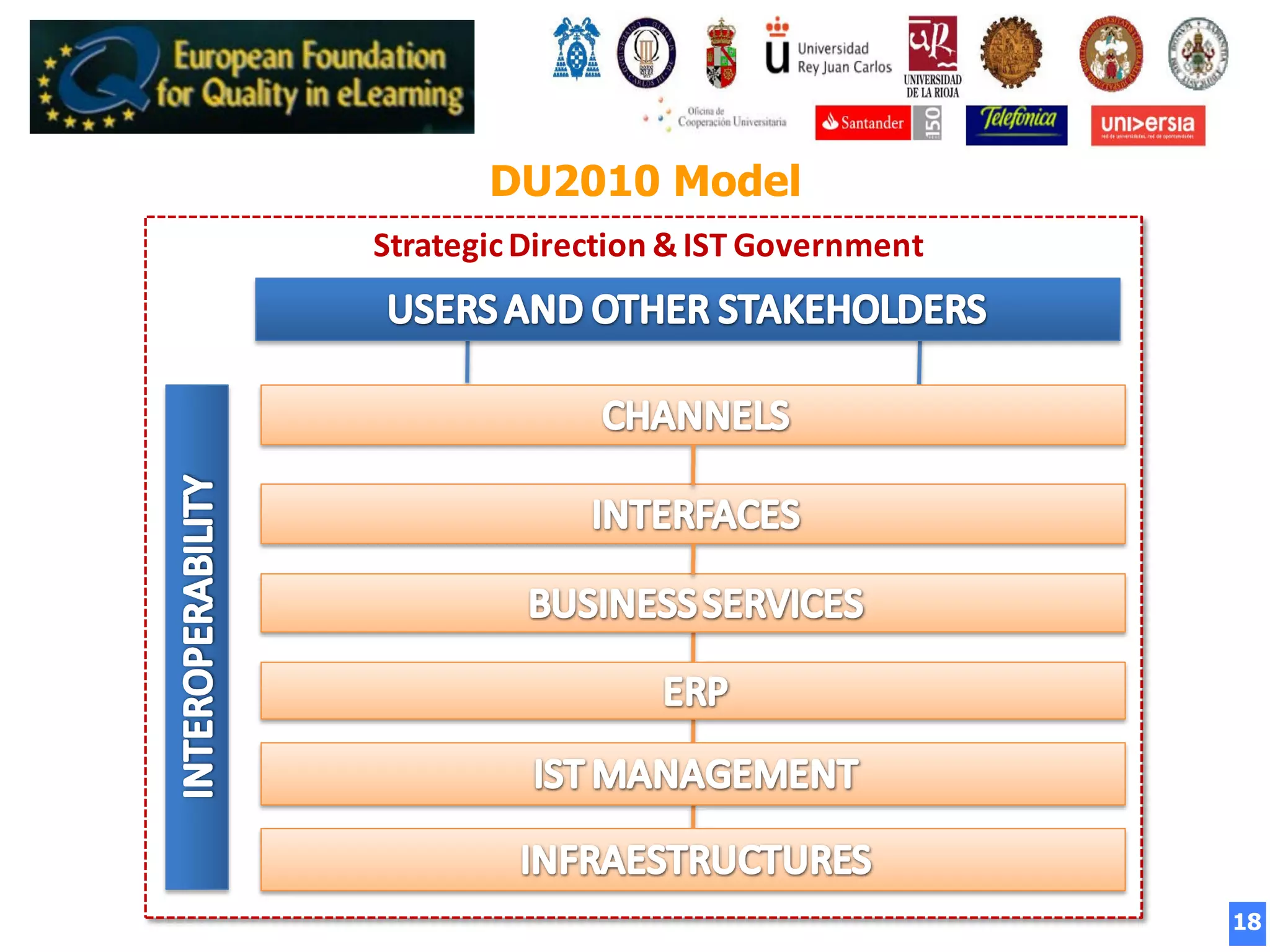
DU2010 Model
Strategic	
  Direction	
  &	
  IST	
  Government
19
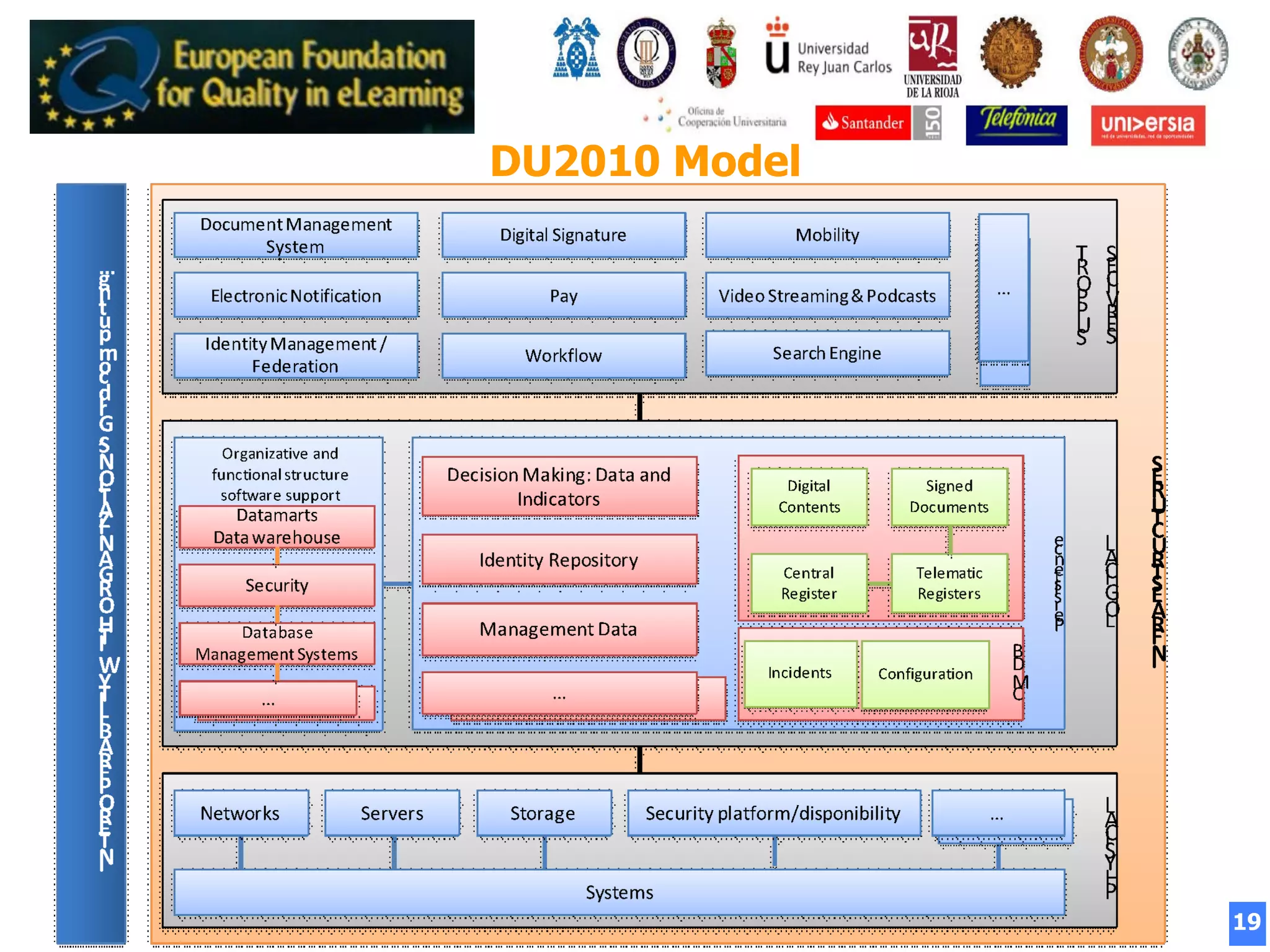
DU2010 Model
20
DU2010 Model
La	
  Universidad	
  Digital	
  de	
  2010
IST
MANAGEMENT
Continuity Management
……
Software	
  Configuration	
  
Management
Availability	
  Management
Problem	
  Management
Security	
  Management
Capacity	
  Management
ERP
Academic	
  Managament CRMEconomic	
  Managament
Human	
  Resources	
  Management LMS/CMS
……
Research	
  Management
BUSINESS	
  SERVICES
Teaching
Teacher/Student	
  
interaction
Contents
eLearning
Research Extension Economic	
  &	
  HR	
  Management
Knowledge	
  ManagementAcademic	
  &	
  Research	
  Mng.
ERP	
  TelematicServices
……
Integrated	
  Dashboard	
  &	
  Quality Student	
  Relationship	
  Mng.	
  (SRM)
Prospective	
  Students,	
  Enterprises,	
  Current	
  Students,	
  Faculty,	
  Staff,	
  Leadership,	
  Society,	
  Alumni,	
  
Institutions,	
  Foundations,	
  Centres,	
  Administration,	
  Visitors…
INTER-­‐
FACES
Web	
  Portal
INTEROPERABILITY	
  WITH	
  ORGANIZATIONS	
  &	
  SERVICES
Multi-­‐channel	
  Helpdesk
……
.
.
.
Collaboration
Virtual	
  Communities
Publication	
  Service
.
.
.
Transfer	
  Spaces
Cooperative	
  Spaces
Electronic	
  Spreading
.
.
.
Teacher/Student	
  
interaction
Contents
eLearning
.
.
.
Requests
Consultations
Processing
.
.
.
Academic	
  
Organization
Portfolio
R&D	
  Infrastructures
.
.
.
Repositories	
  &	
  web	
  
publication
LRC	
  /	
  Library
Data	
  analysis
.
.
.
Tracking	
  and	
  
assessment	
  
Decision	
  Making
Measurement
.
.
.
Employment	
  bureau	
  
Recruitment	
  
Graduate	
  tracking
.
.
.
Virtual	
  Campus
Strategic	
  Direction	
  Portal
Other	
  Web	
  Portals
CHANNELS
Student	
  card
Digital	
  TV
……
SMS
IP	
  Telephony
eMail
21
4. CONCLUSIONS
22
Conclusions
•  A University new model is being
constructed. Some keys
–  Technology is not an expense, it is a distinctive
element
–  Lifelong learning
–  Education goes beyond of the classroom limits
–  University rivals in a globalized
–  University must be a partnership of the Society
23
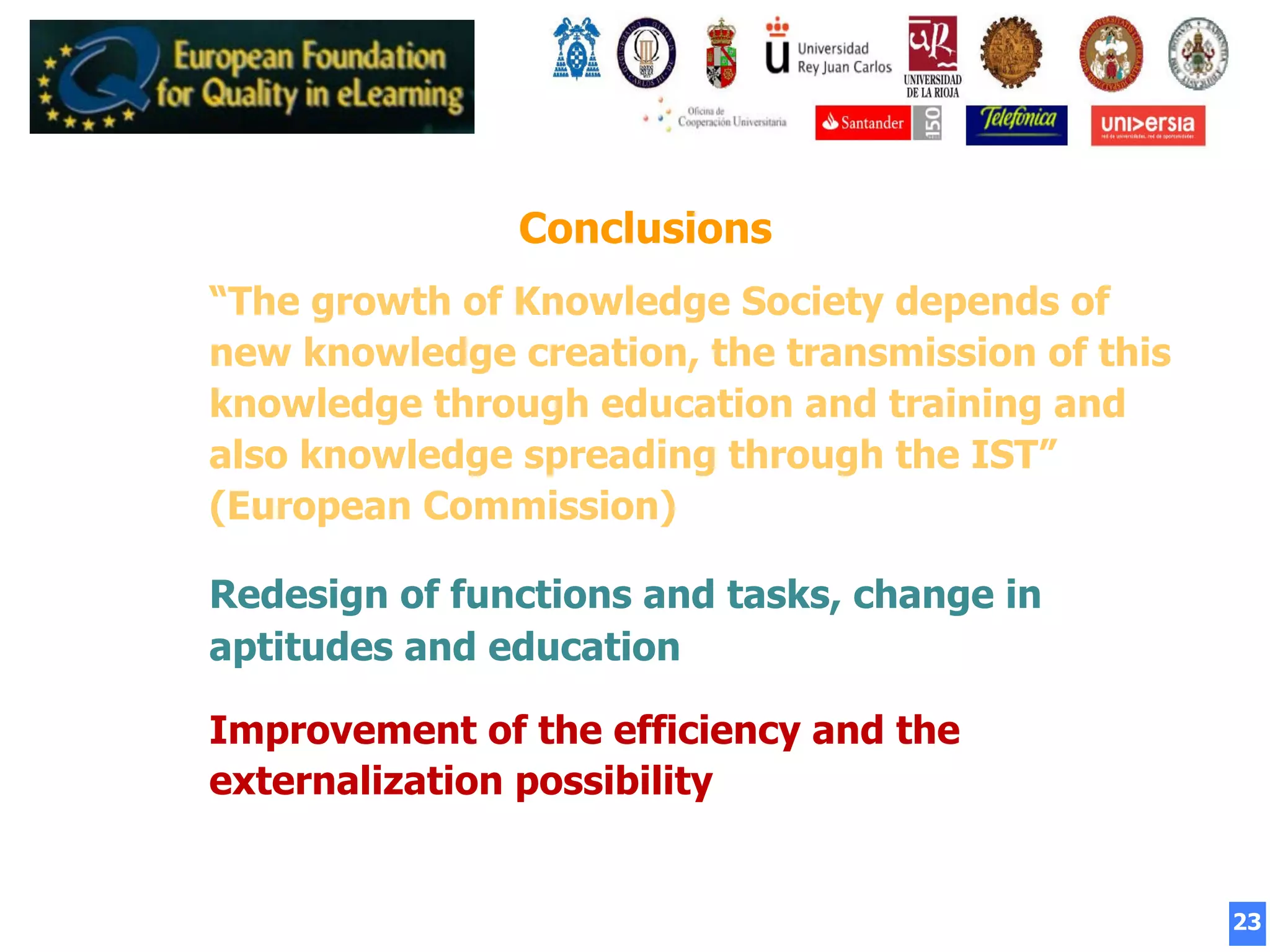
Conclusions
“The growth of Knowledge Society depends of
new knowledge creation, the transmission of this
knowledge through education and training and
also knowledge spreading through the IST”
(European Commission)
Redesign of functions and tasks, change in
aptitudes and education
Improvement of the efficiency and the
externalization possibility
24
Conclusions
In line with the
organization's vision
Investment in IST
infrastructure
Strong implication of the
University leadership
Better IST
government
25
Conclusions
26
Conclusions
27
References
•  Berlanga, A. J., García-Peñalvo, F. J., & Sloep, P. B. (2010). Towards
eLearning 2.0 University. Interactive Learning Environments, 18(3), 199-201.
doi:10.1080/10494820.2010.500498
•  García-Peñalvo, F. J. (2005). Estado actual de los sistemas E-Learning. Teoría
de la Educación. Educación y Cultura en la Sociedad de la Información, 6(2)
•  García-Peñalvo, F. J. (Ed.). (2008). Advances in E-Learning: Experiences and
Methodologies. Hershey, PA, USA: Information Science Reference (formerly
Idea Group Reference).
•  García-Peñalvo, F. J. (2008). Docencia. In J. Laviña Orueta & L. Mengual
Pavón (Eds.), Libro Blanco de la Universidad Digital 2010 (pp. 29-61).
Barcelona, España: Ariel.
•  García-Peñalvo, F. J. (2011). La Universidad de la próxima década: La
Universidad Digital. In C. Suárez-Guerrero & F. J. García-Peñalvo (Eds.),
Universidad y Desarrollo Social de la Web (pp. 181-197). Washington DC,
USA: Editandum.
•  García-Peñalvo, F. J., García de Figuerola, C., & Merlo, J. A. (2010). Open
knowledge management in higher education. Online Information Review,
34(4), 517-519.
28
References
•  García-Peñalvo, F. J., García de Figuerola, C., & Merlo, J. A. (2010). Open
knowledge: Challenges and facts. Online Information Review, 34(4), 520-539.
doi: 10.1108/14684521011072963
•  García-Peñalvo, F. J., & Rivera, S., M. (2009). Digital University 2010. In J. R.
Canay, J. Franco, & P. J. Rey (Eds.), EUNIS 2009. IT: Key of the European
Space of Knowledge. (Santiago de Compostela, Spain, June 23rd - 26th,
2009) (pp. 32). Santiago de Compostela, Spain: Universidade de Santiago de
Compostela Publicacións.
•  García-Peñalvo, F. J., & Seoane Pardo, A. M. (2015). Una revisión actualizada
del concepto de eLearning. Décimo Aniversario. Education in the Knowledge
Society, 16(1), 119-144. doi: http://dx.doi.org/10.14201/eks2015161119144
•  Laviña Orueta, J., & Mengual Pavón, L. (2008). Libro Blanco de la Universidad
Digital 2010. Barcelona, España: Ariel.
•  Llorens, F. (2011). La biblioteca universitaria como difusor de la innovación
educativa. Estrategia y política institucional de la Universidad de Alicante.
Arbor, 187(Extra_3), 89-100.
•  Llorens, F. (2014). Campus virtuales: De gestores de contenidos a gestores
de metodologías. RED, Revista de Educación a Distancia, 42, 1-12.
29
References
•  López, C., García-Peñalvo, F., & Pernías, P. (2005). Desarrollo de Repositorios
de Objetos de Aprendizaje a través de la Reutilización de los Metadatos de
una Colección Digital: De Dublin Core a IMS. RED. Revista de Educación a
Distancia, IV(Número monográfico II). Retrieved from
http://www.um.es/ead/red/M2
•  Negroponte, N. (1995). Being digital. New York: Vintage Publishing.
•  Piattini Velthuis, M., García-Peñalvo, F. J., & Laviña Orueta, J. (2008). Libro
Blanco UD 2010. In J. Á. Velázquez Iturbide, F. J. García-Peñalvo, & A. B. Gil
González (Eds.), Actas del X Simposio Internacional de Informática Educativa
- SIIE’08 (Salamanca, España, 1-3 de Octubre de 2008). Salamanca, Spain:
Ediciones Universidad de Salamanca.
•  Ramírez Montoya, M. S. (2015). Acceso abierto y su repercusión en la
Sociedad del Conocimiento: Reflexiones de casos prácticos en Latinoamérica.
Education in the Knowledge Society (EKS), 16(1), 103-118. doi:
http://dx.doi.org/10.14201/eks2015161103118
30
References
•  Suárez Guerrero, C., & García Peñalvo, F. J. (Eds.). (2011). Universidad y
Desarrollo Social de la Web. Washington DC, USA: Editandum.
•  Toffler, A., Toffler, H. (2006) La Revolución de la Riqueza. Barcelona: Debate
•  Uceda, J., Barro, S., Llorens, F., Franco, J., Fernández, A., Fernández, S.,
Rodeiro, D., Ruzo, E., Canay, J. R. (2008) Las TIC en el Sistema Universitario
Español (2008): Evolución. UNIVERSITIC 2008. Madrid: Conferencia de
Rectores de las Universidades Españolas (CRUE)
Annual Members`Meeting
Berlin, Germany, December 2nd 2008
DIGITAL UNIVERSITY 2010 WHITE PAPER
FRANCISCO JOSÉ GARCÍA PEÑALVO
TECHNOLOGICAL & ACADEMIC COMMITTEE MEMBER
UpdatedSeptember2015

DIGITAL UNIVERSITY 2010 WHITE PAPER

  • 1.
    Annual Members`Meeting Berlin, Germany,December 2nd 2008 DIGITAL UNIVERSITY 2010 WHITE PAPER FRANCISCO JOSÉ GARCÍA PEÑALVO TECHNOLOGICAL & ACADEMIC COMMITTEE MEMBER UpdatedSeptember2015
  • 2.
    2 Summary 1.  Introduction 2.  DigitalUniversity 2010 White Paper 3.  Digital University 2010 Reference Model 4.  Conclusions
  • 3.
  • 4.
    4 Digital Era •  Inthe beggining of the 21th Century we are in a digital society first stage •  We are in a trasformation time •  Risks must be managed –  Day by day operation –  Change resistance
  • 5.
    5 New rules •  Servicesare the business center •  Flexibility •  Distance and time difference are not relevant •  Information and knowledge will be where activity requires them
  • 6.
    6 Motivation •  Higher Educationmust be adequate and integrated with the digital world •  A higher education organization should offer its services through telematic media, in order to –  Be a higher education and research leader –  Speed up its operating processes –  Remove every accesibility barrier
  • 7.
    7 Context •  Economic andpolitic connotations – Digital economic based on knowledge •  Legal connotations – European and local country laws and guidelines •  Academic connotations – European space for higher education
  • 8.
    8 2. DU 2010WHITE PAPER
  • 9.
    9 Presentation •  Digital University2010 White Paper §  Presented at the Salamanca University, October 2nd 2008 §  Made by §  Alcalá University, Carlos III University, Castilla-La Mancha University, Rey Juan Carlos University, La Rioja University, Salamanca University, Seville University & Valladolid University §  Banco Santander, Telefónica, Universia & OCU
  • 10.
    10 What is theDU2010 White Paper? The Digital University 2010 White Paper is the result of a collective discussion between universities and enterprises about the technological transformation that Spanish (European) University must tackle due to the goals and challenges from the European Space for Higher Education
  • 11.
    11 DU2010 White PaperStructure DU  2010  GLOBAL  MODEL   UNIVERSITY    MISSIONS     F   U   N   C   T   I   O   N   A   L     A   R   E   A   S       TEACHING   RESEARCH   THIRD  MISSION   MANAGEMENT   ECONOMICAL-­‐FINANCIAL  AND   HUMAN  RESOURCES   MANAGEMENT   ACADEMIC  AND  RESEARCH   MANAGEMENT   T   R   A   N   S   V   E   R   S   A   L   S     V   I   E   W   S   INFORMATION & SERVICES ACCESS IST MANAGEMENT & GOVERNMENT KNOW HOW & KNOWLEDGE MANAGEMENT INTEGRATED DASHBOARD & QUALITY
  • 12.
    12 Chapter Structure STRATEGIC FRAMEWORK FUNCTIONALIMPACTS TECHNOLOGICAL REQUIREMENTS BEST PRACTICES SUMMARY
  • 13.
    13 Academic & TechnologicalCommittee Chairman: Mario Piattini Velthius UCLM Technology and Information Systems Full Professor Ángel Sánchez Temprano UAH Computer Science Director José Manuel Torralba Castelló UC3M Materials Science & Enginnering Full Professor José Luís Moraga Alcázar UCLM Manager Eugenio Fernández Vicente URJC Computer Science Director Eliseo Vergara González UR Infrastructure & New Technologies Vice-chancellorship Francisco José García Peñalvo USAL Technological Innovation Vice-chancellorship Juan Camarillo Casado USE Digital University Director Rubén Lorenzo Toledo UVa Telecommunication Dean Alfredo Albáizar Fernández Santander Santander Universidades Director Antonio Castillo Holgado Telefónica Competitive Intelligence General Subdirector David Álvarez Ramos OCU OCU Group Technology Director Project Leader: Jaime Laviña Orueta Freelance Consultor Technical Coordination: Laura Mengual Pavón OCU Group Studies, Planification & Quality Director
  • 14.
    14 3. DIGITAL UNIVERSITY2010 REFERENCE MODEL
  • 15.
    15 General Strategy •  Internationalizationand integration in the higher education commun spaces •  More connection with the working mechanism •  Improvement of the knowledge transfer channels •  Searching of the academic and research excellence •  Achievement of high quality levels •  Performance of the European current legistlation •  Full transparency, accountability and optimizing the management of public and private funds •  Change of the educative methodology paradigm
  • 16.
    16 A new environmentfor University •  Globalization and internacionalization ESPACIO COMÚN CANADÁ, EEUU, MÉXICO ESPACIO IBEROAMERICANO DE EDUCACIÓN SUPERIOR ESPACIO COMÚN ASIA PACÍFICO (AUSTRALIA, NUEVA ZELANDA, INDIA, SINGAPUR, CHINA ESPACIO EUROPEO DE EDUCACIÓN SUPERIOR (EEES) ESPACIO COMÚN DE EDUCACIÓN SUPERIOR DE AMÉRICA LATINA, EL CARIBE Y UE (ALCUE) ESPACIO COMÚN CANADÁ, EEUU, MÉXICO ESPACIO IBEROAMERICANO DE EDUCACIÓN SUPERIOR ESPACIO COMÚN ASIA PACÍFICO (AUSTRALIA, NUEVA ZELANDA, INDIA, SINGAPUR, CHINA ESPACIO EUROPEO DE EDUCACIÓN SUPERIOR (EEES) ESPACIO COMÚN DE EDUCACIÓN SUPERIOR DE AMÉRICA LATINA, EL CARIBE Y UE (ALCUE) European Space for Higher Education (ESHE)Common Space for Canada, USA, Mexico Iberoamerican Space for Higher Education Common Area in Higher Education Latin America and The Caribbean – The European Union (ALCUE) Common Area Asia-Pacific (Australia, New Zealand, India, Singapore, China)
  • 17.
    17 Technology •  Technology isa fundamental key in the 21st Century University –  Web & Web 2.0 –  Service Oriented Computing (SOC) & Business Process Management System (BPMS) –  Document management & XML –  Workflow Management Systems (WFMS) –  Datawarehouses & datamining –  Enterprise Resource Planning (ERP) http://www.wordle.net/
  • 18.
  • 19.
  • 20.
    20 DU2010 Model La  Universidad  Digital  de  2010 IST MANAGEMENT Continuity Management …… Software  Configuration   Management Availability  Management Problem  Management Security  Management Capacity  Management ERP Academic  Managament CRMEconomic  Managament Human  Resources  Management LMS/CMS …… Research  Management BUSINESS  SERVICES Teaching Teacher/Student   interaction Contents eLearning Research Extension Economic  &  HR  Management Knowledge  ManagementAcademic  &  Research  Mng. ERP  TelematicServices …… Integrated  Dashboard  &  Quality Student  Relationship  Mng.  (SRM) Prospective  Students,  Enterprises,  Current  Students,  Faculty,  Staff,  Leadership,  Society,  Alumni,   Institutions,  Foundations,  Centres,  Administration,  Visitors… INTER-­‐ FACES Web  Portal INTEROPERABILITY  WITH  ORGANIZATIONS  &  SERVICES Multi-­‐channel  Helpdesk …… . . . Collaboration Virtual  Communities Publication  Service . . . Transfer  Spaces Cooperative  Spaces Electronic  Spreading . . . Teacher/Student   interaction Contents eLearning . . . Requests Consultations Processing . . . Academic   Organization Portfolio R&D  Infrastructures . . . Repositories  &  web   publication LRC  /  Library Data  analysis . . . Tracking  and   assessment   Decision  Making Measurement . . . Employment  bureau   Recruitment   Graduate  tracking . . . Virtual  Campus Strategic  Direction  Portal Other  Web  Portals CHANNELS Student  card Digital  TV …… SMS IP  Telephony eMail
  • 21.
  • 22.
    22 Conclusions •  A Universitynew model is being constructed. Some keys –  Technology is not an expense, it is a distinctive element –  Lifelong learning –  Education goes beyond of the classroom limits –  University rivals in a globalized –  University must be a partnership of the Society
  • 23.
    23 Conclusions “The growth ofKnowledge Society depends of new knowledge creation, the transmission of this knowledge through education and training and also knowledge spreading through the IST” (European Commission) Redesign of functions and tasks, change in aptitudes and education Improvement of the efficiency and the externalization possibility
  • 24.
    24 Conclusions In line withthe organization's vision Investment in IST infrastructure Strong implication of the University leadership Better IST government
  • 25.
  • 26.
  • 27.
    27 References •  Berlanga, A.J., García-Peñalvo, F. J., & Sloep, P. B. (2010). Towards eLearning 2.0 University. Interactive Learning Environments, 18(3), 199-201. doi:10.1080/10494820.2010.500498 •  García-Peñalvo, F. J. (2005). Estado actual de los sistemas E-Learning. Teoría de la Educación. Educación y Cultura en la Sociedad de la Información, 6(2) •  García-Peñalvo, F. J. (Ed.). (2008). Advances in E-Learning: Experiences and Methodologies. Hershey, PA, USA: Information Science Reference (formerly Idea Group Reference). •  García-Peñalvo, F. J. (2008). Docencia. In J. Laviña Orueta & L. Mengual Pavón (Eds.), Libro Blanco de la Universidad Digital 2010 (pp. 29-61). Barcelona, España: Ariel. •  García-Peñalvo, F. J. (2011). La Universidad de la próxima década: La Universidad Digital. In C. Suárez-Guerrero & F. J. García-Peñalvo (Eds.), Universidad y Desarrollo Social de la Web (pp. 181-197). Washington DC, USA: Editandum. •  García-Peñalvo, F. J., García de Figuerola, C., & Merlo, J. A. (2010). Open knowledge management in higher education. Online Information Review, 34(4), 517-519.
  • 28.
    28 References •  García-Peñalvo, F.J., García de Figuerola, C., & Merlo, J. A. (2010). Open knowledge: Challenges and facts. Online Information Review, 34(4), 520-539. doi: 10.1108/14684521011072963 •  García-Peñalvo, F. J., & Rivera, S., M. (2009). Digital University 2010. In J. R. Canay, J. Franco, & P. J. Rey (Eds.), EUNIS 2009. IT: Key of the European Space of Knowledge. (Santiago de Compostela, Spain, June 23rd - 26th, 2009) (pp. 32). Santiago de Compostela, Spain: Universidade de Santiago de Compostela Publicacións. •  García-Peñalvo, F. J., & Seoane Pardo, A. M. (2015). Una revisión actualizada del concepto de eLearning. Décimo Aniversario. Education in the Knowledge Society, 16(1), 119-144. doi: http://dx.doi.org/10.14201/eks2015161119144 •  Laviña Orueta, J., & Mengual Pavón, L. (2008). Libro Blanco de la Universidad Digital 2010. Barcelona, España: Ariel. •  Llorens, F. (2011). La biblioteca universitaria como difusor de la innovación educativa. Estrategia y política institucional de la Universidad de Alicante. Arbor, 187(Extra_3), 89-100. •  Llorens, F. (2014). Campus virtuales: De gestores de contenidos a gestores de metodologías. RED, Revista de Educación a Distancia, 42, 1-12.
  • 29.
    29 References •  López, C.,García-Peñalvo, F., & Pernías, P. (2005). Desarrollo de Repositorios de Objetos de Aprendizaje a través de la Reutilización de los Metadatos de una Colección Digital: De Dublin Core a IMS. RED. Revista de Educación a Distancia, IV(Número monográfico II). Retrieved from http://www.um.es/ead/red/M2 •  Negroponte, N. (1995). Being digital. New York: Vintage Publishing. •  Piattini Velthuis, M., García-Peñalvo, F. J., & Laviña Orueta, J. (2008). Libro Blanco UD 2010. In J. Á. Velázquez Iturbide, F. J. García-Peñalvo, & A. B. Gil González (Eds.), Actas del X Simposio Internacional de Informática Educativa - SIIE’08 (Salamanca, España, 1-3 de Octubre de 2008). Salamanca, Spain: Ediciones Universidad de Salamanca. •  Ramírez Montoya, M. S. (2015). Acceso abierto y su repercusión en la Sociedad del Conocimiento: Reflexiones de casos prácticos en Latinoamérica. Education in the Knowledge Society (EKS), 16(1), 103-118. doi: http://dx.doi.org/10.14201/eks2015161103118
  • 30.
    30 References •  Suárez Guerrero,C., & García Peñalvo, F. J. (Eds.). (2011). Universidad y Desarrollo Social de la Web. Washington DC, USA: Editandum. •  Toffler, A., Toffler, H. (2006) La Revolución de la Riqueza. Barcelona: Debate •  Uceda, J., Barro, S., Llorens, F., Franco, J., Fernández, A., Fernández, S., Rodeiro, D., Ruzo, E., Canay, J. R. (2008) Las TIC en el Sistema Universitario Español (2008): Evolución. UNIVERSITIC 2008. Madrid: Conferencia de Rectores de las Universidades Españolas (CRUE)
  • 31.
    Annual Members`Meeting Berlin, Germany,December 2nd 2008 DIGITAL UNIVERSITY 2010 WHITE PAPER FRANCISCO JOSÉ GARCÍA PEÑALVO TECHNOLOGICAL & ACADEMIC COMMITTEE MEMBER UpdatedSeptember2015