Digital Security by Design
Vision
The Digital Security by Design (DSbD) challenge will radically update the foundation of
the insecure digital computing infrastructure by creating a new, more secure hardware
and software ecosystem. Built on new security capabilities, the technology developed
through this programme will underpin future digital products and services.
The Challenge
The government’s Industrial Strategy Challenge Fund (ISCF)
brings together leading research and business to tackle the
big societal and industrial challenges today.
DSbD is a wave 3 Programme from the ISCF (run by UK
Research and Innovation) bringing £70m of government
funding matched by £117m of industry co-investment.
Until now, the improvements that DSbD will provide
have been blocked by the need to develop hardware
and software simultaneously. To move both at the same
time requires a revolution to the way these processes
currently work rather than just an evolution of the current
technology. This challenge pulls together the right strands
to move the entire sector in the same direction and
overcome this huge market barrier.
Foreword
Only once in every few generations is there an opportunity to
change something as fundamental as the changes DSbD are
making. Today’s computer can be traced back to the designs
developed in the UK during the 1940’s and 50’s. By as early as
the 1970’s, academics were documenting major issues in its
design with respect to the protection and security of data. UK
academic research has continued to lead the field in this area,
however, the supply chain demands for software compatibility
has meant we have been stuck with solutions designed without
security in mind.
The Arm technology developed in Cambridge UK has become
the underpinning technology for most digital devices and
services across the world. It is from this base that DSbD
creates a programme of activities that have the opportunity
to touch the lives of just about everyone in the world, without
needing to change the way in which they interact with
technology. This programme will ensure that the UK continues
to lead both in the core technologies and the business
opportunities this change will create.
 John Goodacre – Challenge Director
Programme Objectives
This programme has three key objectives to enable the
success and delivery of the vision:
1. Demonstrate a more secure hardware platform capable
of protecting the integrity and resilience of software in
response to significant market need for cyber security.
2. Enable more secure platforms, for services which make
extensive use of secured, personal data and create
investment in new scalable businesses, digital products
and services.
3. Accelerate the move towards digital transformation
of industry, with the accompanying investment in
productivity and improved reliability of digital services.
DSbD Advisory Group Chair
The DSbD challenge aims to ease the burden on developers
of ensuring their products are hard to exploit. Classes of
software attacks which have plagued the ecosystem for
decades can be mitigated in the underlying hardware.
Resilient computing platforms are required to provide
the confidence necessary to enable increasing uses of
connected devices across the UK and around the world.
Leadership in new areas of technology will demand strong
foundations. This project is essential in order to lay those
foundations, and to encourage development of the tools
and supporting components required to make maximum
use of the new protections. Paul Waller - NCSC
Outcomes
The challenge aims to achieve the following:
• UK industry are motivated for change
• The UK develop new skills and jobs aligned
with the new hardware and software
• Computer industry deploy new advanced
security architecture
• UK to lead the world in computer security
• Increased difficulty in cyber attacks
• Lower costs to digital security
• Increased research in digital security
• Production of scalable secured products and services
For more information visit the DSbD website or sign up to
the DSbD mailing list.
The Foundations
Technology –
Capability Hardware
University of Cambridge
Mainstream computer systems
are chronically insecure, in large part because the
conventional hardware architectures and C/C++ languages
provide only coarse-grained memory protection – so coding
errors become exploitable security vulnerabilities. CHERI
revises the hardware/software architectural interface with
hardware support for unforgeable _capabilities_, usable
for fine-grained memory protection and scalable software
compartmentalisation. CHERI aims to provide practically
deployable performance and compatibility, requiring
only minimal changes to existing software and hardware:
recompiling existing C/C++, with mild adaption, can protect
pointers with capabilities.
CHERI has been developed in a University of Cambridge / SRI
International hardware/software/semantics co-design project
since 2010. This combines hardware implementation, as FPGA
processors adapting MIPS and RISC-V; a complete software
stack, adapting widely used open-source software such as
Clang/LLVM, FreeBSD, FreeRTOS, and applications such as
WebKit, OpenSSH, and PostgreSQL; and formal modelling
and machine-checked proof of security properties of the
architecture.
See https://www.cl.cam.ac.uk/research/security/ctsrd/cheri/
All this provides strong academic validation of the ideas.
We have been discussing their potential industrial deployment
with Arm since 2014, and DSbD and the Morello board will
create an industrial prototype, enabling the industrial evaluation
that is essential to deploying CHERI in mass-market systems.
This will protect all of us from a wide range of existing and
future security vulnerabilities.
Technology –
What is it?
Arm – Morello Programme
Arm is leading and contributing to
Innovate UK’s 5-year project, Digital Security by Design,
which we are calling the Morello Programme.
Arm’s contribution centres on developing and implementing
capability architectures, building on Cambridge/SRI CHERI
research, that will enable fine-grained protection of memory
to provide enhanced security for processor designs of the
future. This protection ensures that code can only access the
memory it is supposed to, and that even a successful break-in
remains contained.
Since this concept proposes an architecture that will allow a
radical shift in approach to combat constantly-evolving cyber
threats, it needs a wide-ranging set of skills and a number of
key partners in both academia and industry to move it from
the research labs to a pre-prototype testing phase.
The Morello programme involves extensive work, taking the
capability architecture from a research level and designing
and creating a small number of prototype evaluation boards
(the Morello dev board). Working with Morello project partners,
we will thoroughly test the proposition of Morello capability
architecture from how the hardware performs to how to write
software for it.
The result of this five-year program could be a complete shift
in both hardware design for computing devices and how the
software running on these devices is programmed, so that it
can take advantage of the new hardware features.
https://developer.arm.com/architectures/cpu-architecture/a-
profile/morello
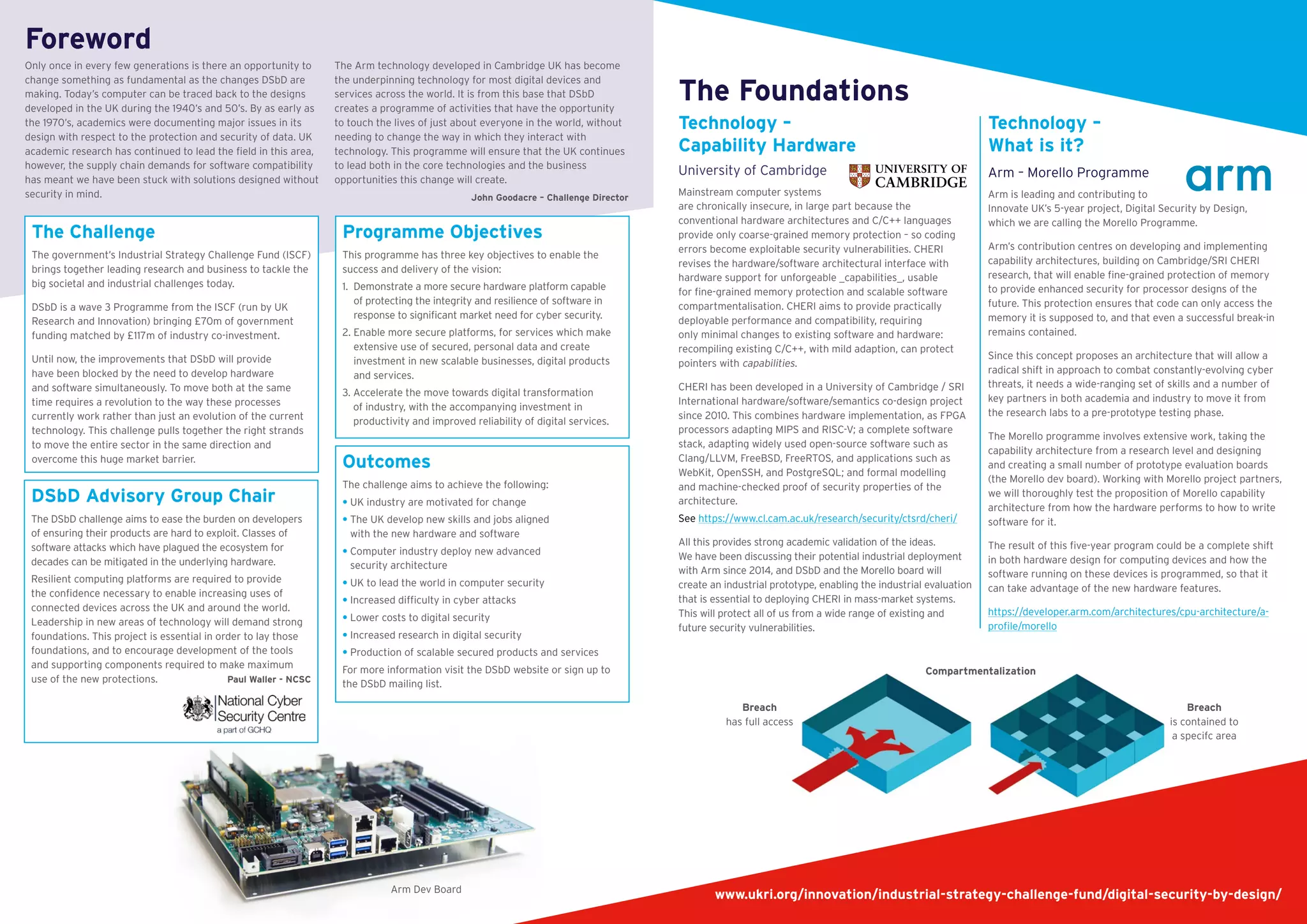
www.ukri.org/innovation/industrial-strategy-challenge-fund/digital-security-by-design/Arm Dev Board
Breach
has full access
Breach
is contained to
a specifc area
Compartmentalization
Programme Activity
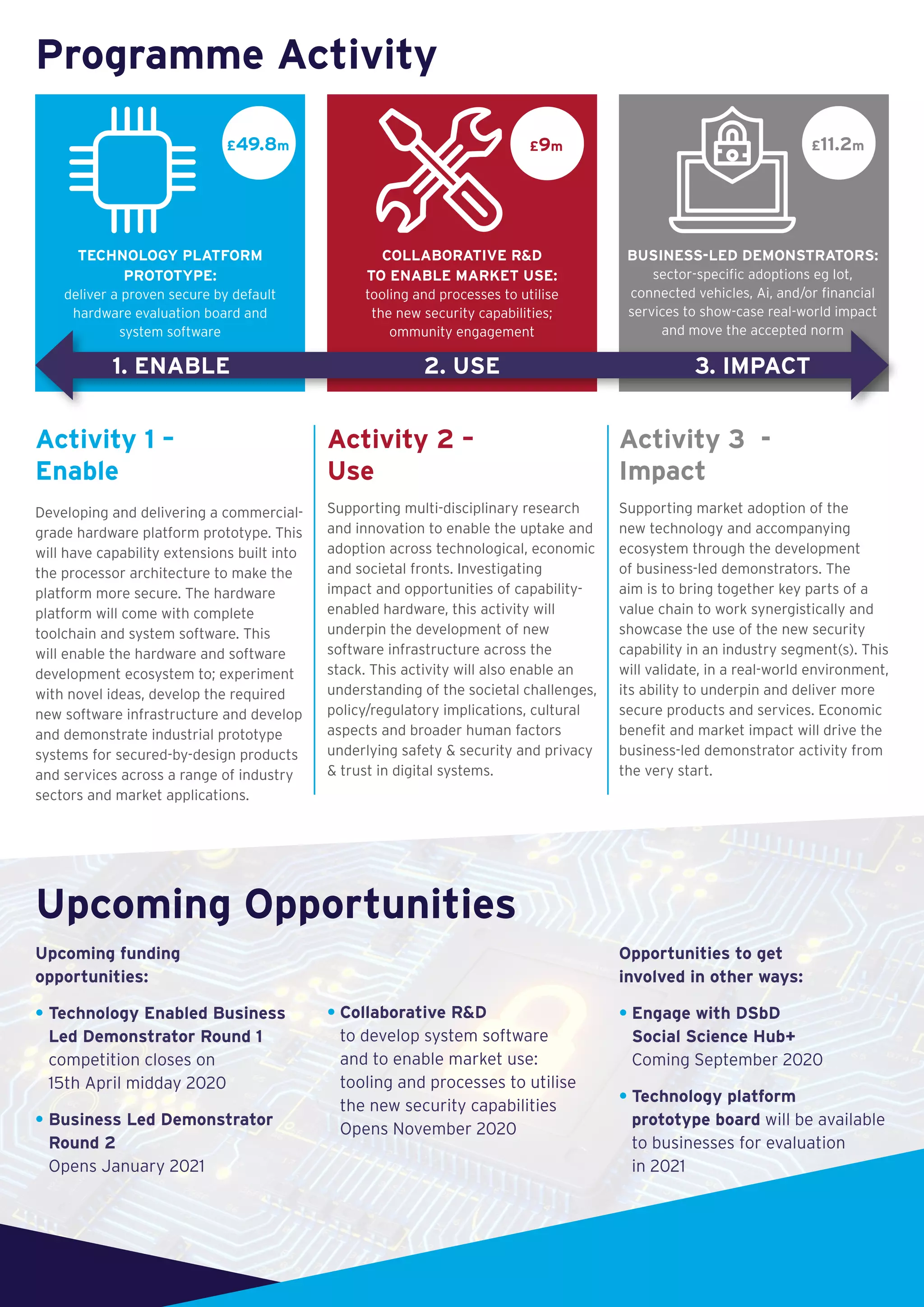
Activity 1 –
Enable
Developing and delivering a commercial-
grade hardware platform prototype. This
will have capability extensions built into
the processor architecture to make the
platform more secure. The hardware
platform will come with complete
toolchain and system software. This
will enable the hardware and software
development ecosystem to; experiment
with novel ideas, develop the required
new software infrastructure and develop
and demonstrate industrial prototype
systems for secured-by-design products
and services across a range of industry
sectors and market applications.
Activity 2 –
Use
Supporting multi-disciplinary research
and innovation to enable the uptake and
adoption across technological, economic
and societal fronts. Investigating
impact and opportunities of capability-
enabled hardware, this activity will
underpin the development of new
software infrastructure across the
stack. This activity will also enable an
understanding of the societal challenges,
policy/regulatory implications, cultural
aspects and broader human factors
underlying safety  security and privacy
 trust in digital systems.
Activity 3 -
Impact
Supporting market adoption of the
new technology and accompanying
ecosystem through the development
of business-led demonstrators. The
aim is to bring together key parts of a
value chain to work synergistically and
showcase the use of the new security
capability in an industry segment(s). This
will validate, in a real-world environment,
its ability to underpin and deliver more
secure products and services. Economic
benefit and market impact will drive the
business-led demonstrator activity from
the very start.
Upcoming Opportunities
Upcoming funding
opportunities:
• Technology Enabled Business
Led Demonstrator Round 1
competition closes on
15th April midday 2020
• Business Led Demonstrator
Round 2
Opens January 2021
• Collaborative RD
to develop system software
and to enable market use:
tooling and processes to utilise
the new security capabilities
Opens November 2020
Opportunities to get
involved in other ways:
• Engage with DSbD
Social Science Hub+
Coming September 2020
• Technology platform
prototype board will be available
to businesses for evaluation
in 2021
1. ENABLE 2. USE 3. IMPACT
TECHNOLOGY PLATFORM
PROTOTYPE:
deliver a proven secure by default
hardware evaluation board and
system software
COLLABORATIVE RD
TO ENABLE MARKET USE:
tooling and processes to utilise
the new security capabilities;
ommunity engagement
BUSINESS-LED DEMONSTRATORS:
sector-specific adoptions eg Iot,
connected vehicles, Ai, and/or financial
services to show-case real-world impact
and move the accepted norm
£49.8m £9m £11.2m

Digital Security by Design Vision

  • 1.
    Digital Security byDesign Vision The Digital Security by Design (DSbD) challenge will radically update the foundation of the insecure digital computing infrastructure by creating a new, more secure hardware and software ecosystem. Built on new security capabilities, the technology developed through this programme will underpin future digital products and services.
  • 2.
    The Challenge The government’sIndustrial Strategy Challenge Fund (ISCF) brings together leading research and business to tackle the big societal and industrial challenges today. DSbD is a wave 3 Programme from the ISCF (run by UK Research and Innovation) bringing £70m of government funding matched by £117m of industry co-investment. Until now, the improvements that DSbD will provide have been blocked by the need to develop hardware and software simultaneously. To move both at the same time requires a revolution to the way these processes currently work rather than just an evolution of the current technology. This challenge pulls together the right strands to move the entire sector in the same direction and overcome this huge market barrier. Foreword Only once in every few generations is there an opportunity to change something as fundamental as the changes DSbD are making. Today’s computer can be traced back to the designs developed in the UK during the 1940’s and 50’s. By as early as the 1970’s, academics were documenting major issues in its design with respect to the protection and security of data. UK academic research has continued to lead the field in this area, however, the supply chain demands for software compatibility has meant we have been stuck with solutions designed without security in mind. The Arm technology developed in Cambridge UK has become the underpinning technology for most digital devices and services across the world. It is from this base that DSbD creates a programme of activities that have the opportunity to touch the lives of just about everyone in the world, without needing to change the way in which they interact with technology. This programme will ensure that the UK continues to lead both in the core technologies and the business opportunities this change will create. John Goodacre – Challenge Director Programme Objectives This programme has three key objectives to enable the success and delivery of the vision: 1. Demonstrate a more secure hardware platform capable of protecting the integrity and resilience of software in response to significant market need for cyber security. 2. Enable more secure platforms, for services which make extensive use of secured, personal data and create investment in new scalable businesses, digital products and services. 3. Accelerate the move towards digital transformation of industry, with the accompanying investment in productivity and improved reliability of digital services. DSbD Advisory Group Chair The DSbD challenge aims to ease the burden on developers of ensuring their products are hard to exploit. Classes of software attacks which have plagued the ecosystem for decades can be mitigated in the underlying hardware. Resilient computing platforms are required to provide the confidence necessary to enable increasing uses of connected devices across the UK and around the world. Leadership in new areas of technology will demand strong foundations. This project is essential in order to lay those foundations, and to encourage development of the tools and supporting components required to make maximum use of the new protections. Paul Waller - NCSC Outcomes The challenge aims to achieve the following: • UK industry are motivated for change • The UK develop new skills and jobs aligned with the new hardware and software • Computer industry deploy new advanced security architecture • UK to lead the world in computer security • Increased difficulty in cyber attacks • Lower costs to digital security • Increased research in digital security • Production of scalable secured products and services For more information visit the DSbD website or sign up to the DSbD mailing list. The Foundations Technology – Capability Hardware University of Cambridge Mainstream computer systems are chronically insecure, in large part because the conventional hardware architectures and C/C++ languages provide only coarse-grained memory protection – so coding errors become exploitable security vulnerabilities. CHERI revises the hardware/software architectural interface with hardware support for unforgeable _capabilities_, usable for fine-grained memory protection and scalable software compartmentalisation. CHERI aims to provide practically deployable performance and compatibility, requiring only minimal changes to existing software and hardware: recompiling existing C/C++, with mild adaption, can protect pointers with capabilities. CHERI has been developed in a University of Cambridge / SRI International hardware/software/semantics co-design project since 2010. This combines hardware implementation, as FPGA processors adapting MIPS and RISC-V; a complete software stack, adapting widely used open-source software such as Clang/LLVM, FreeBSD, FreeRTOS, and applications such as WebKit, OpenSSH, and PostgreSQL; and formal modelling and machine-checked proof of security properties of the architecture. See https://www.cl.cam.ac.uk/research/security/ctsrd/cheri/ All this provides strong academic validation of the ideas. We have been discussing their potential industrial deployment with Arm since 2014, and DSbD and the Morello board will create an industrial prototype, enabling the industrial evaluation that is essential to deploying CHERI in mass-market systems. This will protect all of us from a wide range of existing and future security vulnerabilities. Technology – What is it? Arm – Morello Programme Arm is leading and contributing to Innovate UK’s 5-year project, Digital Security by Design, which we are calling the Morello Programme. Arm’s contribution centres on developing and implementing capability architectures, building on Cambridge/SRI CHERI research, that will enable fine-grained protection of memory to provide enhanced security for processor designs of the future. This protection ensures that code can only access the memory it is supposed to, and that even a successful break-in remains contained. Since this concept proposes an architecture that will allow a radical shift in approach to combat constantly-evolving cyber threats, it needs a wide-ranging set of skills and a number of key partners in both academia and industry to move it from the research labs to a pre-prototype testing phase. The Morello programme involves extensive work, taking the capability architecture from a research level and designing and creating a small number of prototype evaluation boards (the Morello dev board). Working with Morello project partners, we will thoroughly test the proposition of Morello capability architecture from how the hardware performs to how to write software for it. The result of this five-year program could be a complete shift in both hardware design for computing devices and how the software running on these devices is programmed, so that it can take advantage of the new hardware features. https://developer.arm.com/architectures/cpu-architecture/a- profile/morello www.ukri.org/innovation/industrial-strategy-challenge-fund/digital-security-by-design/Arm Dev Board Breach has full access Breach is contained to a specifc area Compartmentalization
  • 3.
    Programme Activity Activity 1– Enable Developing and delivering a commercial- grade hardware platform prototype. This will have capability extensions built into the processor architecture to make the platform more secure. The hardware platform will come with complete toolchain and system software. This will enable the hardware and software development ecosystem to; experiment with novel ideas, develop the required new software infrastructure and develop and demonstrate industrial prototype systems for secured-by-design products and services across a range of industry sectors and market applications. Activity 2 – Use Supporting multi-disciplinary research and innovation to enable the uptake and adoption across technological, economic and societal fronts. Investigating impact and opportunities of capability- enabled hardware, this activity will underpin the development of new software infrastructure across the stack. This activity will also enable an understanding of the societal challenges, policy/regulatory implications, cultural aspects and broader human factors underlying safety security and privacy trust in digital systems. Activity 3 - Impact Supporting market adoption of the new technology and accompanying ecosystem through the development of business-led demonstrators. The aim is to bring together key parts of a value chain to work synergistically and showcase the use of the new security capability in an industry segment(s). This will validate, in a real-world environment, its ability to underpin and deliver more secure products and services. Economic benefit and market impact will drive the business-led demonstrator activity from the very start. Upcoming Opportunities Upcoming funding opportunities: • Technology Enabled Business Led Demonstrator Round 1 competition closes on 15th April midday 2020 • Business Led Demonstrator Round 2 Opens January 2021 • Collaborative RD to develop system software and to enable market use: tooling and processes to utilise the new security capabilities Opens November 2020 Opportunities to get involved in other ways: • Engage with DSbD Social Science Hub+ Coming September 2020 • Technology platform prototype board will be available to businesses for evaluation in 2021 1. ENABLE 2. USE 3. IMPACT TECHNOLOGY PLATFORM PROTOTYPE: deliver a proven secure by default hardware evaluation board and system software COLLABORATIVE RD TO ENABLE MARKET USE: tooling and processes to utilise the new security capabilities; ommunity engagement BUSINESS-LED DEMONSTRATORS: sector-specific adoptions eg Iot, connected vehicles, Ai, and/or financial services to show-case real-world impact and move the accepted norm £49.8m £9m £11.2m