



Digital Security by Design
EPSRC Call for Proposals:
ISCF Digital Security by Design Research Projects
Opening date: 26 September 2019
Closing date: 07 January 2020
Panel meeting: April 2020
Grants start date: June 2020
• Leveraging the Capability Hardware concepts and approaches
investigated by the CHERI program (led by the University of
Cambridge), a consortium led by Arm is investigating a prototype
silicon-based solution based on Arm AArch64 architecture.
• This prototype solution will be made openly available to academics
and businesses across the UK, so as to provide early access,
evaluation, and the opportunity to feed back on the proposed major
change to the instruction set architecture of a processor, while
investigating the broader impact to various aspects of computer
science and ICT in general.
Background
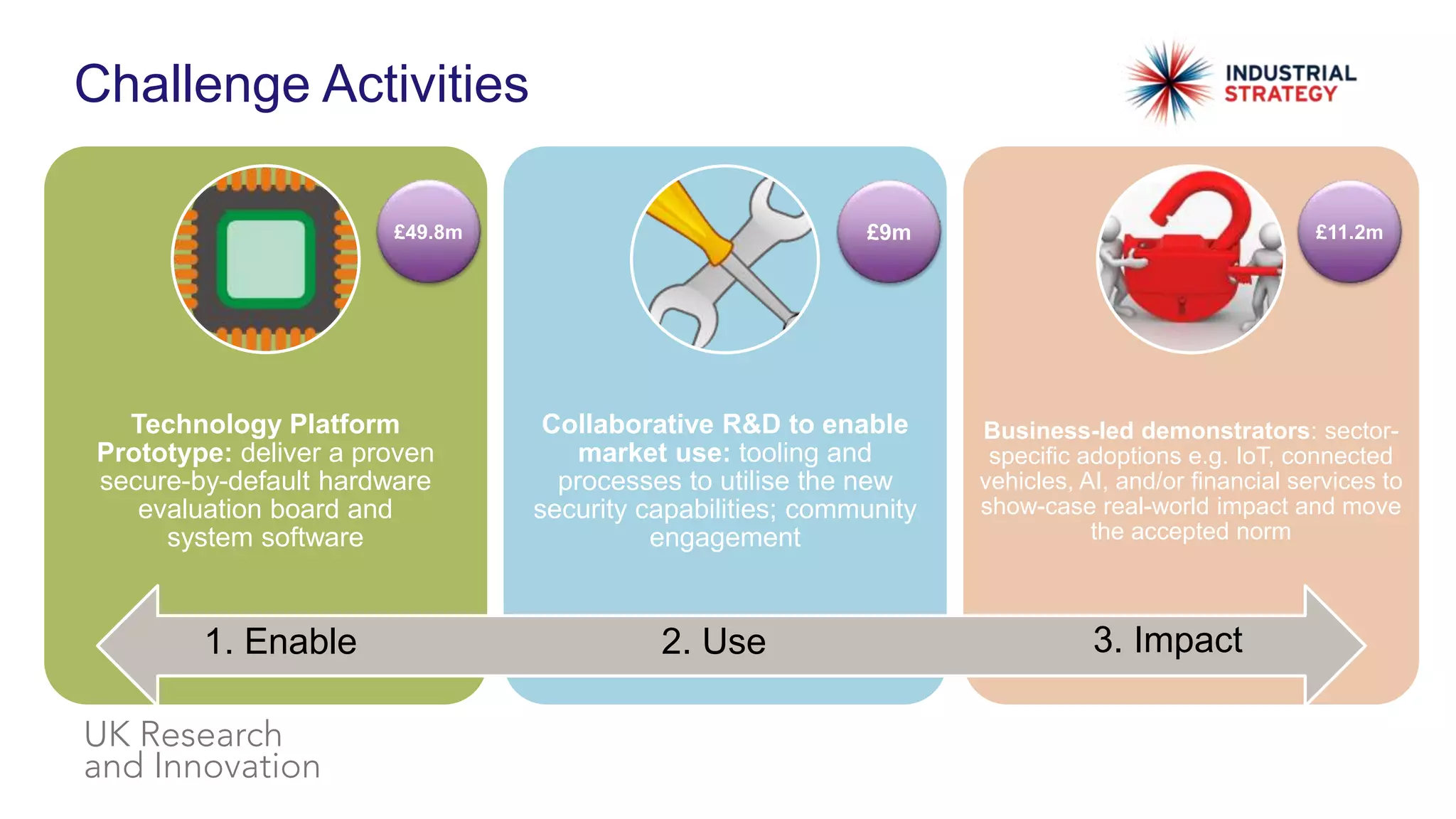
Challenge Activities
Technology Platform
Prototype: deliver a proven
secure-by-default hardware
evaluation board and
system software
Collaborative R&D to enable
market use: tooling and
processes to utilise the new
security capabilities; community
engagement
Business-led demonstrators: sector-
specific adoptions e.g. IoT, connected
vehicles, AI, and/or financial services to
show-case real-world impact and move
the accepted norm
£9m£49.8m £11.2m
1. Enable 2. Use 3. Impact
• The University of Cambridge have published a descriptive article:
‘Introduction to CHERI’ – available at
https://www.cl.cam.ac.uk/research/security/ctsrd/cheri/dsbd.html.
• (Link is accessible from the EPSRC Call webpage and the Call
document)
Capability Hardware: CHERI
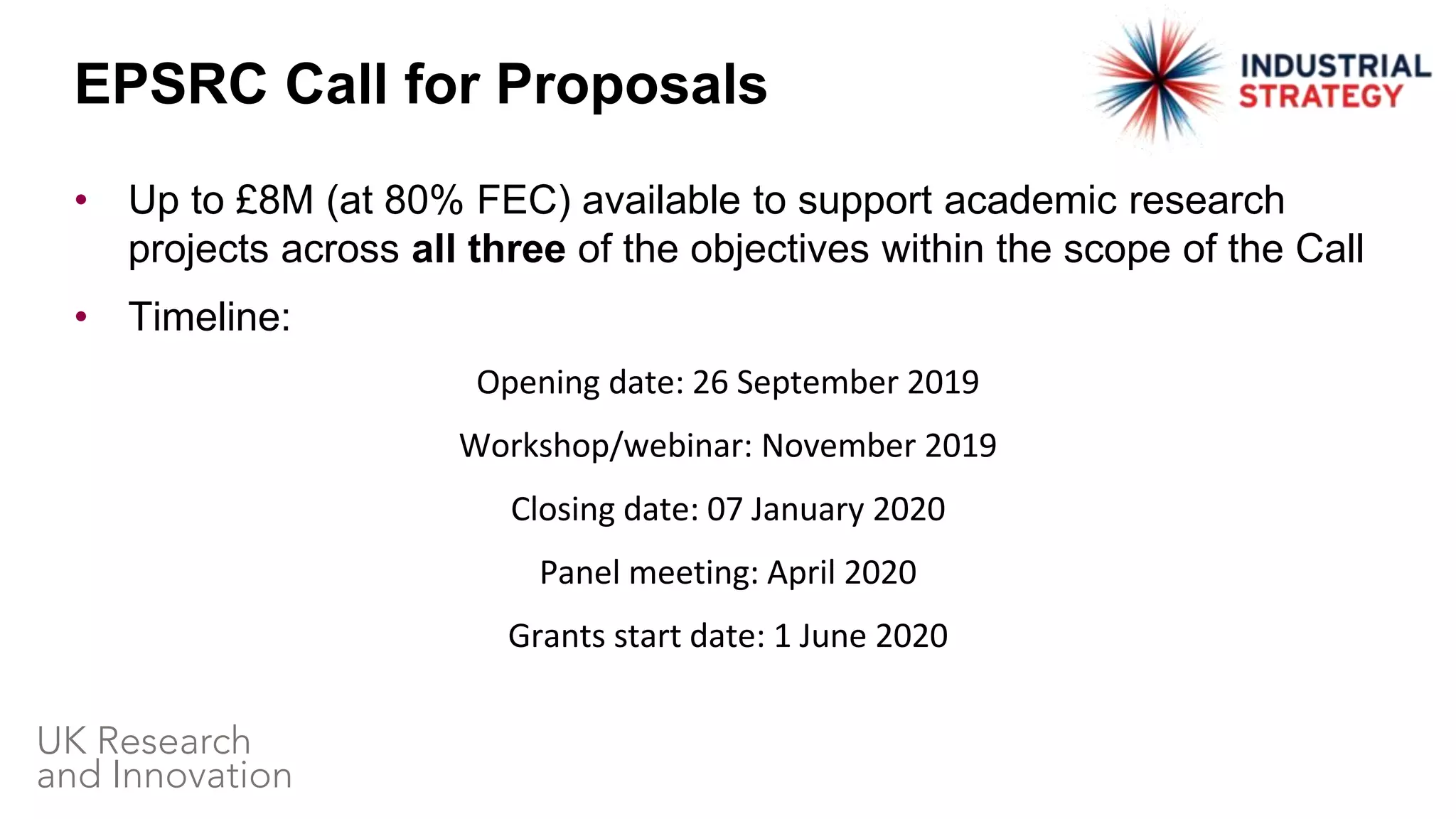
• Up to £8M (at 80% FEC) available to support academic research
projects across all three of the objectives within the scope of the Call
• Timeline:
Opening date: 26 September 2019
Workshop/webinar: November 2019
Closing date: 07 January 2020
Panel meeting: April 2020
Grants start date: 1 June 2020
EPSRC Call for Proposals
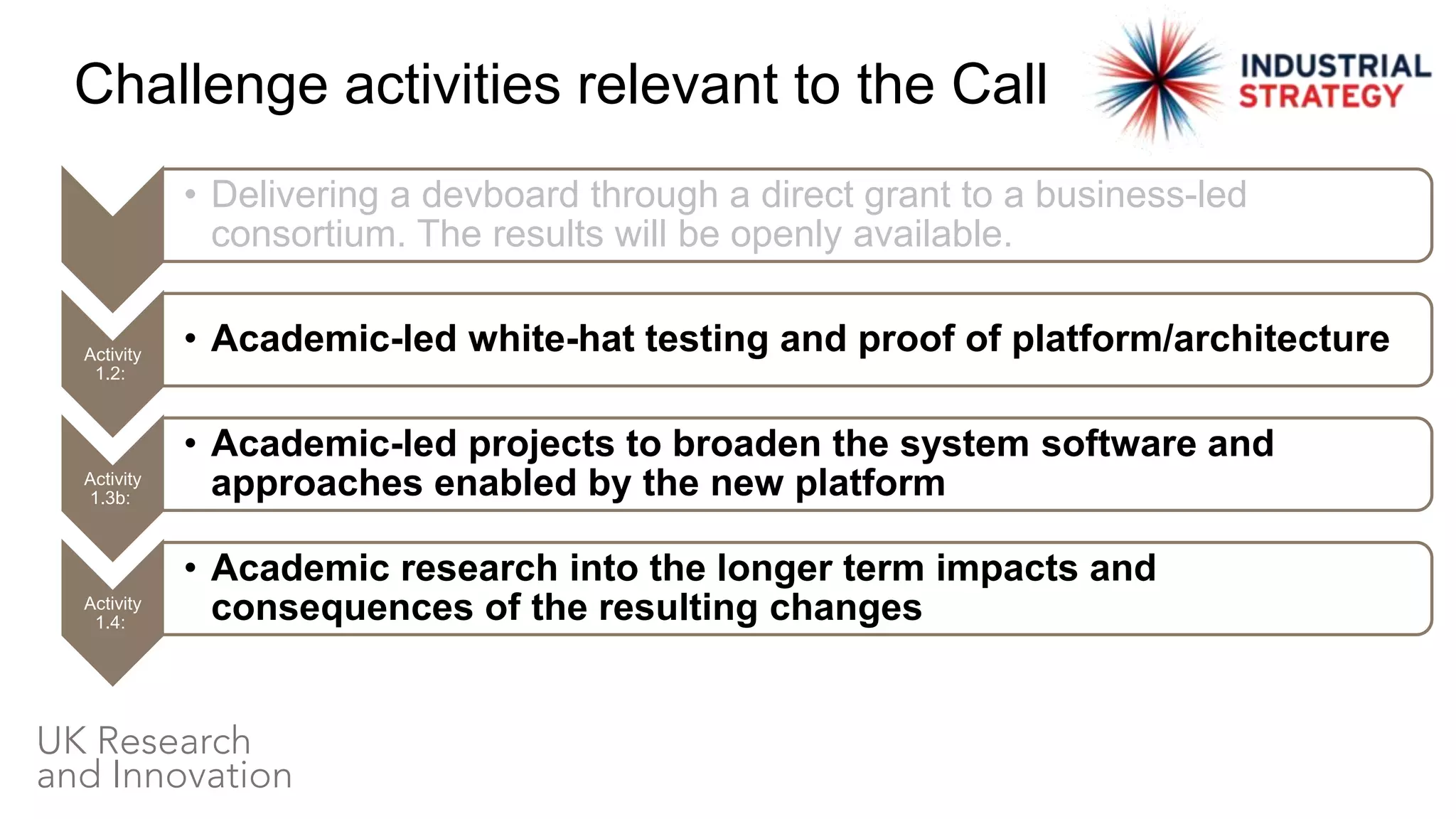
Activity
1.1:
• Delivering a devboard through a direct grant to a business-led
consortium. The results will be openly available.
Activity
1.2:
• Academic-led white-hat testing and proof of platform/architecture
Activity
1.3b:
• Academic-led projects to broaden the system software and
approaches enabled by the new platform
Activity
1.4:
• Academic research into the longer term impacts and
consequences of the resulting changes
Challenge activities relevant to the Call
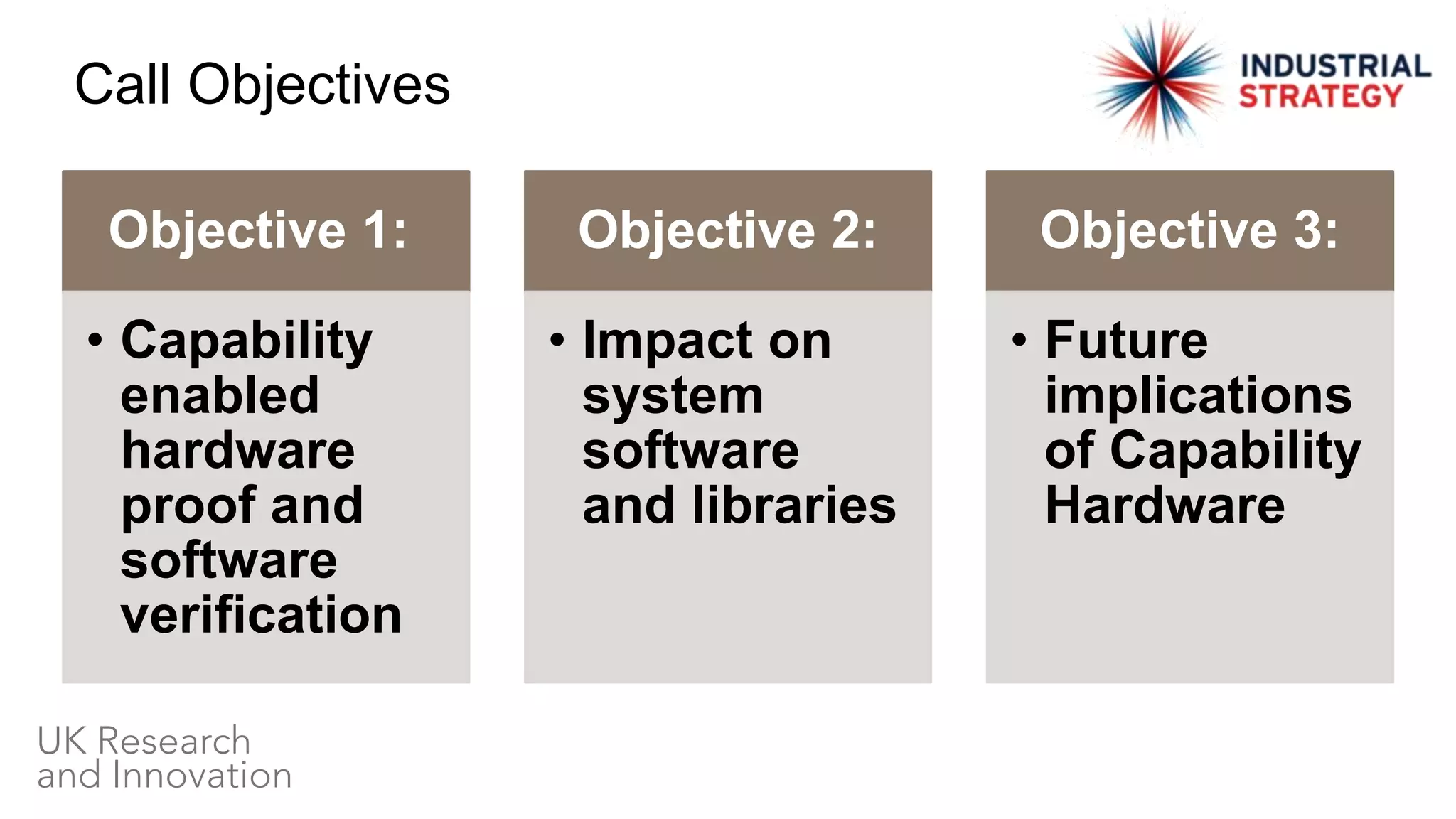
Objective 1:
• Capability
enabled
hardware
proof and
software
verification
Objective 2:
• Impact on
system
software
and libraries
Objective 3:
• Future
implications
of Capability
Hardware
Call Objectives
• Despite the historical best efforts of hardware to execute software as
expected by software, it became impossible to reason on its completeness
given the lack of formal specification of the hardware architecture and the
complexity of any specific design.
• Various advances are being made with respect to the formal proof of
hardware resulting in the increasing accuracy and formal specification of
the hardware architecture. However, linking the work of hardware proof
with software reasoning and verification in the context of Capability
Hardware needs significant research to find a methodology by which the
final intent of an application can be understood and verified, including side-
channel effect in the hardware, and the limited specification for data
encapsulation and privilege in software.
Objective 1: Capability enabled hardware
and software verification
• Through the introduction of Capability enabled Hardware, what tools or techniques can
be applied in limiting and/or identifying leakage of information, including but not limited
to, containment analysis and various forms of information flow within software?
• Can (and if so, how can) the formal specifications of hardware be extended to include
microarchitectural artefacts beyond the architectural specification often responsible for
side-channel or inference-based information leakage?
• How can a system dynamically learn and monitor the correct operation of a platform’s
intent, to provide necessary information to mitigate inappropriate operations potentially
identified as a divergence from a runtime specification or a learning associated with
historic operation?
• Given a formal executable hardware architectural specification, how can we increase the
capabilities and understanding of formal method and proof with respect to the expected
execution of software, its proof and verification?
Objective 1: Example research questions
• There are various implications and potential solutions to extending current software
and “end-2-end” security schemes to include the movement of data with fine grain
protection and inherited rights. For example, how to extend cryptography frameworks to
extend the protection of information from the point of encryption to the point of use in an
application, through the application of Capability Hardware.
• Existing platforms support various software and hardware assisted mechanisms to
encapsulate the various states of an application as an aid towards increasing security or
limiting visibility of data. Whether this is through a managed runtime, a trusted execution
engine, the interpretation and translation of binaries, or larger grain hardware protection
schemes, the introduction of fine grain data containerisation and access privilege will
bring new opportunities and new threats. Investigations are required to understand these
implications and to propose how existing system software and libraries will adapt to such
new hardware mechanisms.
Objective 2: Impact on system software
and libraries
• How can existing managed runtimes, high-level languages or systems
leveraging binary translation of code benefit from the introduction of
Capability enabled Hardware and improve the security of applications
and services?
• What are the impacts and opportunities from Capability Hardware to
increase the security between and within platforms, using a trusted
execution engine (TEE) or other virtualization technologies? How will
the delivery or use of such technologies change?
• How can the increased security provided by Capability Hardware be
extended robustly to operate security over a distributed system?
Objective 2: Example research questions
• When virtual memory was first introduced, the ways in which this
coarse grain memory partitioning and access privilege would be used
was unknown. Although various characteristics of how virtual
memory is managed by a processor has evolved, the fundamental
concepts remain unchanged.
• Given the wider challenge objective to introduce fine grain
compartmentalisation and inherited privilege capabilities to a
processor, the future implications and potential use cases are
unknown. The aim of this objective is to fund early stage research
into the longer term implications of the new memory projection
paradigm.
Objective 3: Future implications of
Capability Hardware
• Today’s operating systems use virtual memory for the protection of code
and data, process isolation and the associated scheduling mechanisms.
Since a Capability enabled processor offers stronger and more fine
grained protection than current systems, what might the implications and
opportunities be when reconsidering these requirements of an operating
system?
• What are the implications and opportunities of Capability Hardware
existing in the central processing unit (CPU) on other hardware devices
such as direct memory access (DMA) devices and processors of a digital
system and their associated software stacks?
Objective 3: Example research questions
• Applicants invited to submit proposals that meet one of the three
objectives within the Call
• Eligibility: any single investigator can only apply once, as either a PI
or Co-I
• Postal peer review followed by prioritisation panel (if reviews are
sufficiently supportive)
• Portfolio approach will be taken to final funding decisions to ensure
coverage across, and within, the three objectives
Call structure and format
• Event before the Call closes - to allow for further discussion between
potential applicants/collaborators, and with the CHERI investigators
and Arm representatives
• Format tbc – face to face workshop or webinar
• To be held November 2019
Workshop / webinar
Thank you

Digital Security by Design: ISCF Digital Security by Design Research Projects - Natasha Richardson

  • 1.
    Digital Security byDesign EPSRC Call for Proposals: ISCF Digital Security by Design Research Projects Opening date: 26 September 2019 Closing date: 07 January 2020 Panel meeting: April 2020 Grants start date: June 2020
  • 2.
    • Leveraging theCapability Hardware concepts and approaches investigated by the CHERI program (led by the University of Cambridge), a consortium led by Arm is investigating a prototype silicon-based solution based on Arm AArch64 architecture. • This prototype solution will be made openly available to academics and businesses across the UK, so as to provide early access, evaluation, and the opportunity to feed back on the proposed major change to the instruction set architecture of a processor, while investigating the broader impact to various aspects of computer science and ICT in general. Background
  • 3.
    Challenge Activities Technology Platform Prototype:deliver a proven secure-by-default hardware evaluation board and system software Collaborative R&D to enable market use: tooling and processes to utilise the new security capabilities; community engagement Business-led demonstrators: sector- specific adoptions e.g. IoT, connected vehicles, AI, and/or financial services to show-case real-world impact and move the accepted norm £9m£49.8m £11.2m 1. Enable 2. Use 3. Impact
  • 4.
    • The Universityof Cambridge have published a descriptive article: ‘Introduction to CHERI’ – available at https://www.cl.cam.ac.uk/research/security/ctsrd/cheri/dsbd.html. • (Link is accessible from the EPSRC Call webpage and the Call document) Capability Hardware: CHERI
  • 5.
    • Up to£8M (at 80% FEC) available to support academic research projects across all three of the objectives within the scope of the Call • Timeline: Opening date: 26 September 2019 Workshop/webinar: November 2019 Closing date: 07 January 2020 Panel meeting: April 2020 Grants start date: 1 June 2020 EPSRC Call for Proposals
  • 6.
    Activity 1.1: • Delivering adevboard through a direct grant to a business-led consortium. The results will be openly available. Activity 1.2: • Academic-led white-hat testing and proof of platform/architecture Activity 1.3b: • Academic-led projects to broaden the system software and approaches enabled by the new platform Activity 1.4: • Academic research into the longer term impacts and consequences of the resulting changes Challenge activities relevant to the Call
  • 7.
    Objective 1: • Capability enabled hardware proofand software verification Objective 2: • Impact on system software and libraries Objective 3: • Future implications of Capability Hardware Call Objectives
  • 8.
    • Despite thehistorical best efforts of hardware to execute software as expected by software, it became impossible to reason on its completeness given the lack of formal specification of the hardware architecture and the complexity of any specific design. • Various advances are being made with respect to the formal proof of hardware resulting in the increasing accuracy and formal specification of the hardware architecture. However, linking the work of hardware proof with software reasoning and verification in the context of Capability Hardware needs significant research to find a methodology by which the final intent of an application can be understood and verified, including side- channel effect in the hardware, and the limited specification for data encapsulation and privilege in software. Objective 1: Capability enabled hardware and software verification
  • 9.
    • Through theintroduction of Capability enabled Hardware, what tools or techniques can be applied in limiting and/or identifying leakage of information, including but not limited to, containment analysis and various forms of information flow within software? • Can (and if so, how can) the formal specifications of hardware be extended to include microarchitectural artefacts beyond the architectural specification often responsible for side-channel or inference-based information leakage? • How can a system dynamically learn and monitor the correct operation of a platform’s intent, to provide necessary information to mitigate inappropriate operations potentially identified as a divergence from a runtime specification or a learning associated with historic operation? • Given a formal executable hardware architectural specification, how can we increase the capabilities and understanding of formal method and proof with respect to the expected execution of software, its proof and verification? Objective 1: Example research questions
  • 10.
    • There arevarious implications and potential solutions to extending current software and “end-2-end” security schemes to include the movement of data with fine grain protection and inherited rights. For example, how to extend cryptography frameworks to extend the protection of information from the point of encryption to the point of use in an application, through the application of Capability Hardware. • Existing platforms support various software and hardware assisted mechanisms to encapsulate the various states of an application as an aid towards increasing security or limiting visibility of data. Whether this is through a managed runtime, a trusted execution engine, the interpretation and translation of binaries, or larger grain hardware protection schemes, the introduction of fine grain data containerisation and access privilege will bring new opportunities and new threats. Investigations are required to understand these implications and to propose how existing system software and libraries will adapt to such new hardware mechanisms. Objective 2: Impact on system software and libraries
  • 11.
    • How canexisting managed runtimes, high-level languages or systems leveraging binary translation of code benefit from the introduction of Capability enabled Hardware and improve the security of applications and services? • What are the impacts and opportunities from Capability Hardware to increase the security between and within platforms, using a trusted execution engine (TEE) or other virtualization technologies? How will the delivery or use of such technologies change? • How can the increased security provided by Capability Hardware be extended robustly to operate security over a distributed system? Objective 2: Example research questions
  • 12.
    • When virtualmemory was first introduced, the ways in which this coarse grain memory partitioning and access privilege would be used was unknown. Although various characteristics of how virtual memory is managed by a processor has evolved, the fundamental concepts remain unchanged. • Given the wider challenge objective to introduce fine grain compartmentalisation and inherited privilege capabilities to a processor, the future implications and potential use cases are unknown. The aim of this objective is to fund early stage research into the longer term implications of the new memory projection paradigm. Objective 3: Future implications of Capability Hardware
  • 13.
    • Today’s operatingsystems use virtual memory for the protection of code and data, process isolation and the associated scheduling mechanisms. Since a Capability enabled processor offers stronger and more fine grained protection than current systems, what might the implications and opportunities be when reconsidering these requirements of an operating system? • What are the implications and opportunities of Capability Hardware existing in the central processing unit (CPU) on other hardware devices such as direct memory access (DMA) devices and processors of a digital system and their associated software stacks? Objective 3: Example research questions
  • 14.
    • Applicants invitedto submit proposals that meet one of the three objectives within the Call • Eligibility: any single investigator can only apply once, as either a PI or Co-I • Postal peer review followed by prioritisation panel (if reviews are sufficiently supportive) • Portfolio approach will be taken to final funding decisions to ensure coverage across, and within, the three objectives Call structure and format
  • 15.
    • Event beforethe Call closes - to allow for further discussion between potential applicants/collaborators, and with the CHERI investigators and Arm representatives • Format tbc – face to face workshop or webinar • To be held November 2019 Workshop / webinar
  • 16.