Ontotext – Impelsys Webinar Series
END-TO-END SMART PUBLISHING AND E-LEARNING
GAINING ADVANTAGE IN E-LEARNING WITH SEMANTIC ADAPTIVE TECHNOLOGY
THURSDAY 28 JULY | 11AM EDT | 4PM BST | 6PM EEST
July 2016
We will talk about…
 Introduction
 About Impelsys and Ontotext
 Adaptive Semantic Solution
 Adaptive Semantic Platform
 Use cases
 Demonstrations
 Adaptive Semantic Solution – Production Process
 Questions & Answers
Impelsys & Ontotext: Partnership
Publishing x Technology | Content x Semantics
Introduction1
About Impelsys
15 YEARS
100%PUBLISHING &
EDUCATION
FOCUS
350+ EMPLOYEES
New York HEAD QUARTERS
• Digital Product Development
• Content Delivery Solution – iPublishCentral
• Authoring & Editorial Workflows
• Mobility & Bespoke solutions
• DRM & Analytics
Bangalore R&D
• Global team, local sales & accounts support
• Innovation Hub & Global Delivery Center at
Bangalore
• Technology partners
• Cutting-edge infrastructure on Amazon & Rackspace
New York Bangalore London SFO
iPublishCentral – Global Reach
Millions
Of B2B
Users
Students
Instructors
Professionals
15,000
LIBRARIES
Million+
B2C Users
LIVE
PORTALS
100+
TITLES
250,000
Global
Customer Presence
Supporting Content Delivery For Global Brands
About Ontotext
16 YEARS
100%SEM.TECH. FOCUS
350+ EMPLOYEES
Sofia HEAD QUARTERS
• Semantic graph database engine combined
with Content management solutions
• Interlinking text and data to unveil meaning
• Delivering unmatched search and exploration
Sofia R&D
• Global team, local sales & accounts support
• R&D Center at Sofia, Bulgaria
• Serving BBC, FT, Wiley, Oxford UP, IET, …
• SaaS infrastructure on Amazon and on premise
New York Sofia London Frankfurt
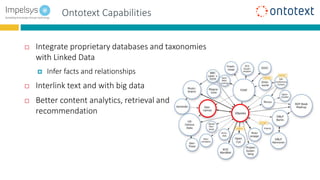
Ontotext Capabilities
 Integrate proprietary databases and taxonomies
with Linked Data
 Infer facts and relationships
 Interlink text and with big data
 Better content analytics, retrieval and
recommendation
Positioning in Graph DBs
“Despite all of this attention the market is
dominated by Neo4J and OntoText
(GraphDB), which are graph and RDF
database providers respectively. These are
the longest established vendors in this space
(both founded in 2000) so they have a
longevity and experience that other
suppliers cannot yet match. How long this
will remain the case remains to be seen.”
Bloor Group whitepaper
Graph Databases, April 2015
http://www.bloorresearch.com/technology/graph-databases/
Ontotext Clients (selection)
Major financial
Information agency
Major business and legal
Information agency
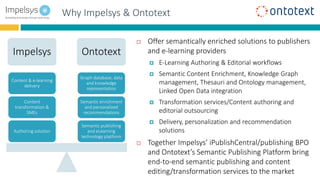
Why Impelsys & Ontotext
Impelsys Ontotext
Semantic publishing
and eLearning
technology platform
Semantic enrichment
and personalized
recommendations
Graph database, data
and knowledge
representation
Authoring solution
Content
transformation &
SMEs
Content & e-learning
delivery
 Offer semantically enriched solutions to publishers
and e-learning providers
 E-Learning Authoring & Editorial workflows
 Semantic Content Enrichment, Knowledge Graph
management, Thesauri and Ontology management,
Linked Open Data integration
 Transformation services/Content authoring and
editorial outsourcing
 Delivery, personalization and recommendation
solutions
 Together Impelsys’ iPublishCentral/publishing BPO
and Ontotext’s Semantic Publishing Platform bring
end-to-end semantic publishing and content
editing/transformation services to the market
Personalized learning for effective and efficient learning outcome
Adaptive Semantic Solution3
Adaptive Learning
Adaptive learning is an educational method to orchestrate the
allocation of mediated resources according to the unique needs of
each learner.
Typical Courseware
Adaptive Courseware
Presentation of Concepts – Typical Courseware
Presentation of Concepts – Adaptive Courseware
Adaptive Technology Architectures
Traditional
Approach
Impelsys
Approach
Value Proposition
 Traditional server based Adaptive system is:
 Costly
 Complex to implement
 Not flexible
 SemTech powered Adaptive Technology is:
 Inexpensive
 Simple to implement
 Flexible
 Platform independent
Adaptive Semantic Platform2
eLearning vertical
Dynamic Added Value
Adaptive Semantic Platform
API stack
Mapping Across Curricula
Mapping Content and Curricula: Details
Adaptive Semantic Technology
Adaptive Semantic Technology: Details
Use cases4
• Goals
− Better management and
enrichment of e-learning
content
− Improved reuse of legacy
content
− Increase user engagement
• Challenges
− Content locked only for specific
products instead of being
enriched and reused for
development of dynamic
content offerings
• Approach
− Semantic enrichment of learning
objects across different subjects
and product lines
− Smarter search and contextual
recommendations of relevant
learning objects
Use case 1: Global Educational Publisher
• Goals
− Improved and more efficient vocabulary
management
− Metadata enrichment of all available assets
− Efficient search and relevant recommendations
− Automatic association of assets to curricula
• Challenges
− Lack of integration between the different systems
of the customer
− A lot of manual operations on metadata
enrichment and association of asset to curricula
• Approach
− Knowledge Base development, responsible for
managing vocabularies, curricula, ontologies,
assets metadata
− Semantic enrichment of metadata
− Semantic recommendation engine
Use case 2: Global Provider of Multimedia
Assets for Educational Publishers
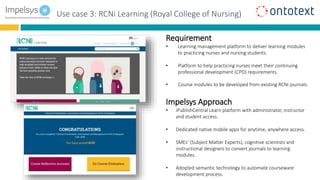
Use case 3: RCNi Learning (Royal College of Nursing)
Requirement
• Learning management platform to deliver learning modules
to practicing nurses and nursing students.
• Platform to help practicing nurses meet their continuing
professional development (CPD) requirements.
• Course modules to be developed from existing RCNi journals.
Impelsys Approach
• iPublishCentral Learn platform with administrator, instructor
and student access.
• Dedicated native mobile apps for anytime, anywhere access.
• SMEs’ (Subject Matter Experts), cognitive scientists and
instructional designers to convert journals to learning
modules.
• Adopted semantic technology to automate courseware
development process.
Demonstrations5
Demo 1: Impelsys Adaptive Content
Demo 2: BBC Wildlife Portal
Production process6
Production Process
 SMEs and IDs analyze the subject/ topic, identify Concepts and
prepare the Courseware
 Prepare different levels of concepts (normal, medium, and
detailed)
 Specify different kinds of content (textual, A/V, simulation, etc.)
 Prepare Pre-test, topic level tests and transition rules
 Transition rules are created as a special language interpreted by
Adaptive Engine
Analyze
Atomize &
Enrich
Reprocess Package, Test &
Deploy
Analyze
- Assets (text, A/V, Images,
Simulations)
- Learning Objects
- Topics
- Assessments
- Metadata and taxonomy /
ontology analysis
- Data consolidation analysis
Chunking & data modelling
- Breakdown into smaller LOs
(Nodes)
- Assign weights to Nodes
- Create concept-wise mini
quizzes
- Associate Nodes with quizzes
- Identify Node transition paths
& conditions
- Ontology & Thesauri
Semantic enrichment of content
- Repackaging of content (eg.
Text with images, etc)
- Automatic tagging of LOs
Quality assurance
- Verify Atomized Content by
SMEs and Customer
- Verify data model and
semantic enrichment
Reprocess
- Create pre-test to measure
learner’s initial knowledge
level and learning reference
Create instrumentation at
each Node (using xAPI or
TINCAN)
- Define rich LOs in the
knowledge graph
- Specify transition rules for
each node
- Create initial Learning Path
using Instruction Design and
Pedagogic principles
Quality assurance
- Verify transition rules with
SMEs and teachers / trainers
Package
- Create UI
- Package as per SCORM or
plain HTML5/ JavaScript
Test
- Test UI transitions
- Verify content
Quality Check
- Verify Adaptive Course with
SMEs and teachers / trainers
- Verify UX and Adaptive Course
with pilot user groups
Non-
Adaptive
Course
Adaptive
Course
Production Process - Detailed
Analyze
Atomize &
Enrich
Reprocess Package, Test &
Deploy
2-3 weeks 1-1,5 months 3-4 weeks 1-2 weeks
Non-
Adaptive
Course
Adaptive
Course
Production Process - Timeframe
QUESTIONS?
July 2016

Gaining Advantage in e-Learning with Semantic Adaptive Technology

  • 1.
    Ontotext – ImpelsysWebinar Series END-TO-END SMART PUBLISHING AND E-LEARNING GAINING ADVANTAGE IN E-LEARNING WITH SEMANTIC ADAPTIVE TECHNOLOGY THURSDAY 28 JULY | 11AM EDT | 4PM BST | 6PM EEST July 2016
  • 2.
    We will talkabout…  Introduction  About Impelsys and Ontotext  Adaptive Semantic Solution  Adaptive Semantic Platform  Use cases  Demonstrations  Adaptive Semantic Solution – Production Process  Questions & Answers
  • 3.
    Impelsys & Ontotext:Partnership Publishing x Technology | Content x Semantics Introduction1
  • 4.
    About Impelsys 15 YEARS 100%PUBLISHING& EDUCATION FOCUS 350+ EMPLOYEES New York HEAD QUARTERS • Digital Product Development • Content Delivery Solution – iPublishCentral • Authoring & Editorial Workflows • Mobility & Bespoke solutions • DRM & Analytics Bangalore R&D • Global team, local sales & accounts support • Innovation Hub & Global Delivery Center at Bangalore • Technology partners • Cutting-edge infrastructure on Amazon & Rackspace New York Bangalore London SFO
  • 5.
    iPublishCentral – GlobalReach Millions Of B2B Users Students Instructors Professionals 15,000 LIBRARIES Million+ B2C Users LIVE PORTALS 100+ TITLES 250,000 Global Customer Presence
  • 6.
    Supporting Content DeliveryFor Global Brands
  • 7.
    About Ontotext 16 YEARS 100%SEM.TECH.FOCUS 350+ EMPLOYEES Sofia HEAD QUARTERS • Semantic graph database engine combined with Content management solutions • Interlinking text and data to unveil meaning • Delivering unmatched search and exploration Sofia R&D • Global team, local sales & accounts support • R&D Center at Sofia, Bulgaria • Serving BBC, FT, Wiley, Oxford UP, IET, … • SaaS infrastructure on Amazon and on premise New York Sofia London Frankfurt
  • 8.
    Ontotext Capabilities  Integrateproprietary databases and taxonomies with Linked Data  Infer facts and relationships  Interlink text and with big data  Better content analytics, retrieval and recommendation
  • 9.
    Positioning in GraphDBs “Despite all of this attention the market is dominated by Neo4J and OntoText (GraphDB), which are graph and RDF database providers respectively. These are the longest established vendors in this space (both founded in 2000) so they have a longevity and experience that other suppliers cannot yet match. How long this will remain the case remains to be seen.” Bloor Group whitepaper Graph Databases, April 2015 http://www.bloorresearch.com/technology/graph-databases/
  • 10.
    Ontotext Clients (selection) Majorfinancial Information agency Major business and legal Information agency
  • 11.
    Why Impelsys &Ontotext Impelsys Ontotext Semantic publishing and eLearning technology platform Semantic enrichment and personalized recommendations Graph database, data and knowledge representation Authoring solution Content transformation & SMEs Content & e-learning delivery  Offer semantically enriched solutions to publishers and e-learning providers  E-Learning Authoring & Editorial workflows  Semantic Content Enrichment, Knowledge Graph management, Thesauri and Ontology management, Linked Open Data integration  Transformation services/Content authoring and editorial outsourcing  Delivery, personalization and recommendation solutions  Together Impelsys’ iPublishCentral/publishing BPO and Ontotext’s Semantic Publishing Platform bring end-to-end semantic publishing and content editing/transformation services to the market
  • 12.
    Personalized learning foreffective and efficient learning outcome Adaptive Semantic Solution3
  • 13.
    Adaptive Learning Adaptive learningis an educational method to orchestrate the allocation of mediated resources according to the unique needs of each learner.
  • 14.
  • 15.
  • 16.
    Presentation of Concepts– Typical Courseware
  • 17.
    Presentation of Concepts– Adaptive Courseware
  • 18.
  • 19.
    Value Proposition  Traditionalserver based Adaptive system is:  Costly  Complex to implement  Not flexible  SemTech powered Adaptive Technology is:  Inexpensive  Simple to implement  Flexible  Platform independent
  • 20.
  • 21.
  • 22.
  • 23.
  • 24.
  • 25.
    Mapping Content andCurricula: Details
  • 26.
  • 27.
  • 28.
  • 29.
    • Goals − Bettermanagement and enrichment of e-learning content − Improved reuse of legacy content − Increase user engagement • Challenges − Content locked only for specific products instead of being enriched and reused for development of dynamic content offerings • Approach − Semantic enrichment of learning objects across different subjects and product lines − Smarter search and contextual recommendations of relevant learning objects Use case 1: Global Educational Publisher
  • 30.
    • Goals − Improvedand more efficient vocabulary management − Metadata enrichment of all available assets − Efficient search and relevant recommendations − Automatic association of assets to curricula • Challenges − Lack of integration between the different systems of the customer − A lot of manual operations on metadata enrichment and association of asset to curricula • Approach − Knowledge Base development, responsible for managing vocabularies, curricula, ontologies, assets metadata − Semantic enrichment of metadata − Semantic recommendation engine Use case 2: Global Provider of Multimedia Assets for Educational Publishers
  • 31.
    Use case 3:RCNi Learning (Royal College of Nursing) Requirement • Learning management platform to deliver learning modules to practicing nurses and nursing students. • Platform to help practicing nurses meet their continuing professional development (CPD) requirements. • Course modules to be developed from existing RCNi journals. Impelsys Approach • iPublishCentral Learn platform with administrator, instructor and student access. • Dedicated native mobile apps for anytime, anywhere access. • SMEs’ (Subject Matter Experts), cognitive scientists and instructional designers to convert journals to learning modules. • Adopted semantic technology to automate courseware development process.
  • 32.
  • 33.
    Demo 1: ImpelsysAdaptive Content
  • 34.
    Demo 2: BBCWildlife Portal
  • 35.
  • 36.
    Production Process  SMEsand IDs analyze the subject/ topic, identify Concepts and prepare the Courseware  Prepare different levels of concepts (normal, medium, and detailed)  Specify different kinds of content (textual, A/V, simulation, etc.)  Prepare Pre-test, topic level tests and transition rules  Transition rules are created as a special language interpreted by Adaptive Engine
  • 37.
    Analyze Atomize & Enrich Reprocess Package,Test & Deploy Analyze - Assets (text, A/V, Images, Simulations) - Learning Objects - Topics - Assessments - Metadata and taxonomy / ontology analysis - Data consolidation analysis Chunking & data modelling - Breakdown into smaller LOs (Nodes) - Assign weights to Nodes - Create concept-wise mini quizzes - Associate Nodes with quizzes - Identify Node transition paths & conditions - Ontology & Thesauri Semantic enrichment of content - Repackaging of content (eg. Text with images, etc) - Automatic tagging of LOs Quality assurance - Verify Atomized Content by SMEs and Customer - Verify data model and semantic enrichment Reprocess - Create pre-test to measure learner’s initial knowledge level and learning reference Create instrumentation at each Node (using xAPI or TINCAN) - Define rich LOs in the knowledge graph - Specify transition rules for each node - Create initial Learning Path using Instruction Design and Pedagogic principles Quality assurance - Verify transition rules with SMEs and teachers / trainers Package - Create UI - Package as per SCORM or plain HTML5/ JavaScript Test - Test UI transitions - Verify content Quality Check - Verify Adaptive Course with SMEs and teachers / trainers - Verify UX and Adaptive Course with pilot user groups Non- Adaptive Course Adaptive Course Production Process - Detailed
  • 38.
    Analyze Atomize & Enrich Reprocess Package,Test & Deploy 2-3 weeks 1-1,5 months 3-4 weeks 1-2 weeks Non- Adaptive Course Adaptive Course Production Process - Timeframe
  • 39.

Editor's Notes

  • #12 Illian will fix the text
  • #22 Lms – learning management systems; and VLE – virtual learning environment