THE SEMANTIC WEB AND LIBRARIES IN THE UNITED STATES: EXPERIMENTATION AND ACHIEVEMENTS   75 th  IFLA General Conference and Assembly  Satellite Meeting: Emerging Trends in Technology: Libraries between  Web 2.0, Semantic Web and Search Technology 8/19-20/2009, Florence, Italy  Sharon Yang, Associate Professor/Librarian, Rider University Yanyi Lee, Systems Librarian, Wagner College Amanda Xu, Assistant Professor/Librarian, St. John’s University
Overview Introduction to Semantic Web Library’s Role in Semantic Web Semantic Web Development in the U.S. Libraries Library Semantic Web Development in the United States and Europe-A Comparison Conclusion Questions & Answers
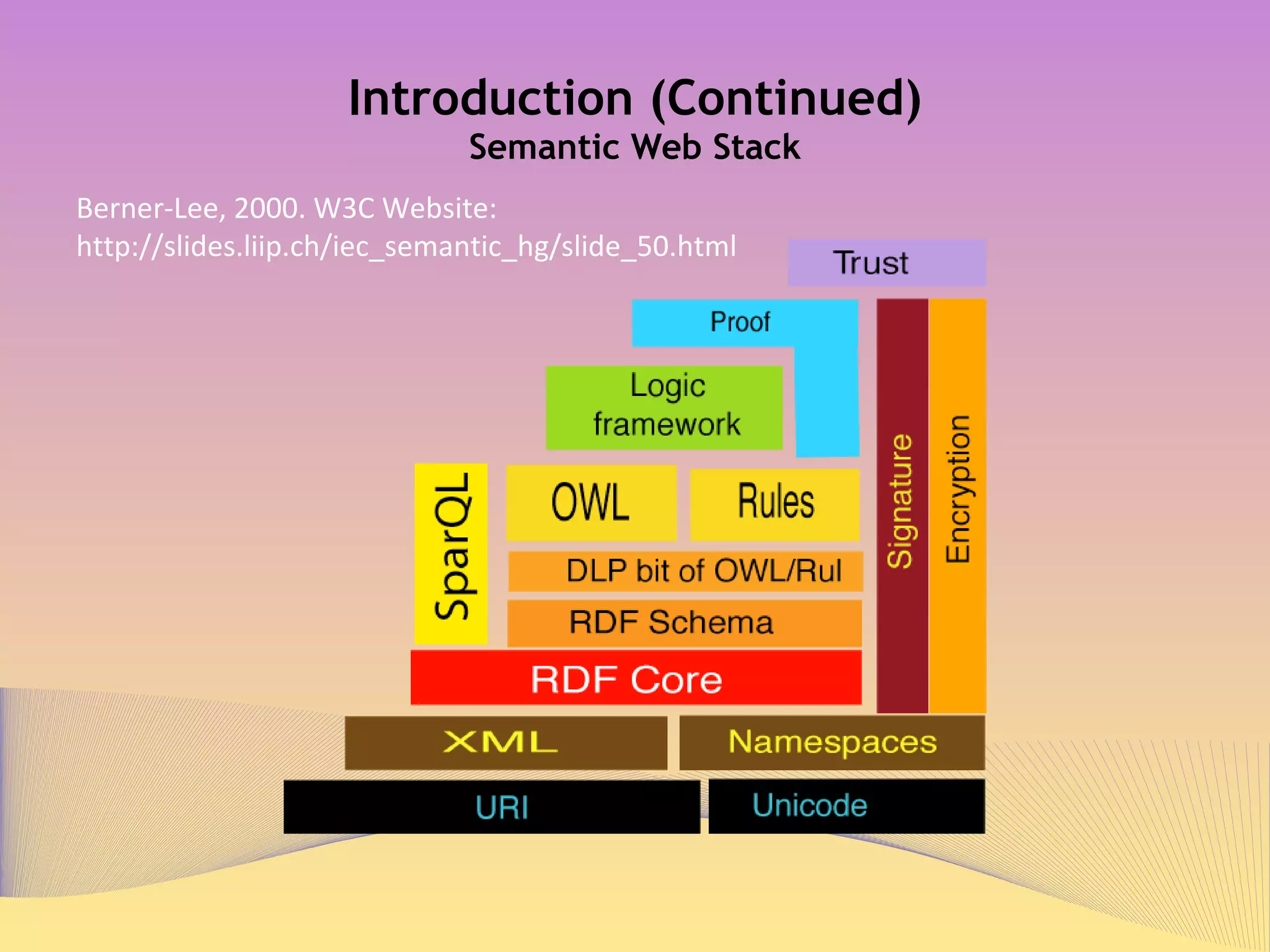
Introduction Semantic Web -A vision by Tim Berners-Lee; An extension of the current Web;  Web of data for machine-processing; Smart applications making connection of people, communities, things, and knowledge on the Web  Semantic Web technologies (loosely a.k.a. Semantic Stack) URIs – naming things and info resources, and providing means to access info about them over the Web Meta-Languages, e.g. RDF, RDFS, OWL, SPARQL, etc. and their serialization in RDF/XML, N-Triples, N3, Turtle, RDF/JASON, etc. Logic for reasoning, e.g. making inferences based on classes, subclasses, properties, sub-properties, domains, ranges, and logical operations (unions, intersection, etc. ) in RDFS; and value restrictions, cardinality, transitivity, equivalence, and logical operations  in OWL  Proof for validation Trust via digital signatures and other knowledge, e.g. recommendation, rating, and certifications
Introduction (Continued) Semantic Web Architecture/Stack 1
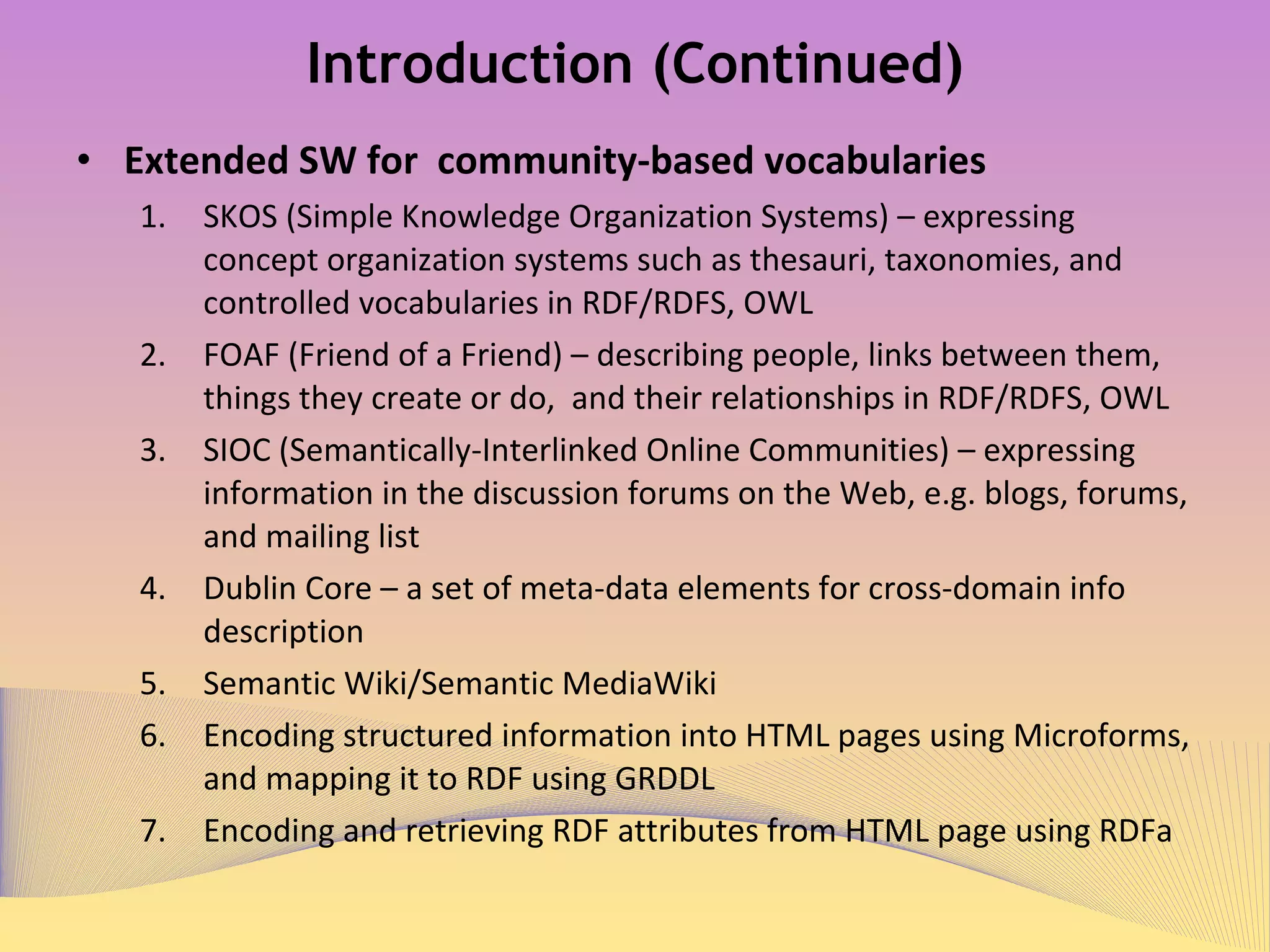
Introduction (Continued) Extended SW for  community-based vocabularies SKOS (Simple Knowledge Organization Systems) – expressing concept organization systems such as thesauri, taxonomies, and controlled vocabularies in RDF/RDFS, OWL FOAF (Friend of a Friend) – describing people, links between them, things they create or do,  and their relationships in RDF/RDFS, OWL SIOC (Semantically-Interlinked Online Communities) – expressing information in the discussion forums on the Web, e.g. blogs, forums, and mailing list Dublin Core – a set of meta-data elements for cross-domain info description Semantic Wiki/Semantic MediaWiki  Encoding structured information into HTML pages using Microforms, and mapping it to RDF using GRDDL Encoding and retrieving RDF attributes from HTML page using RDFa
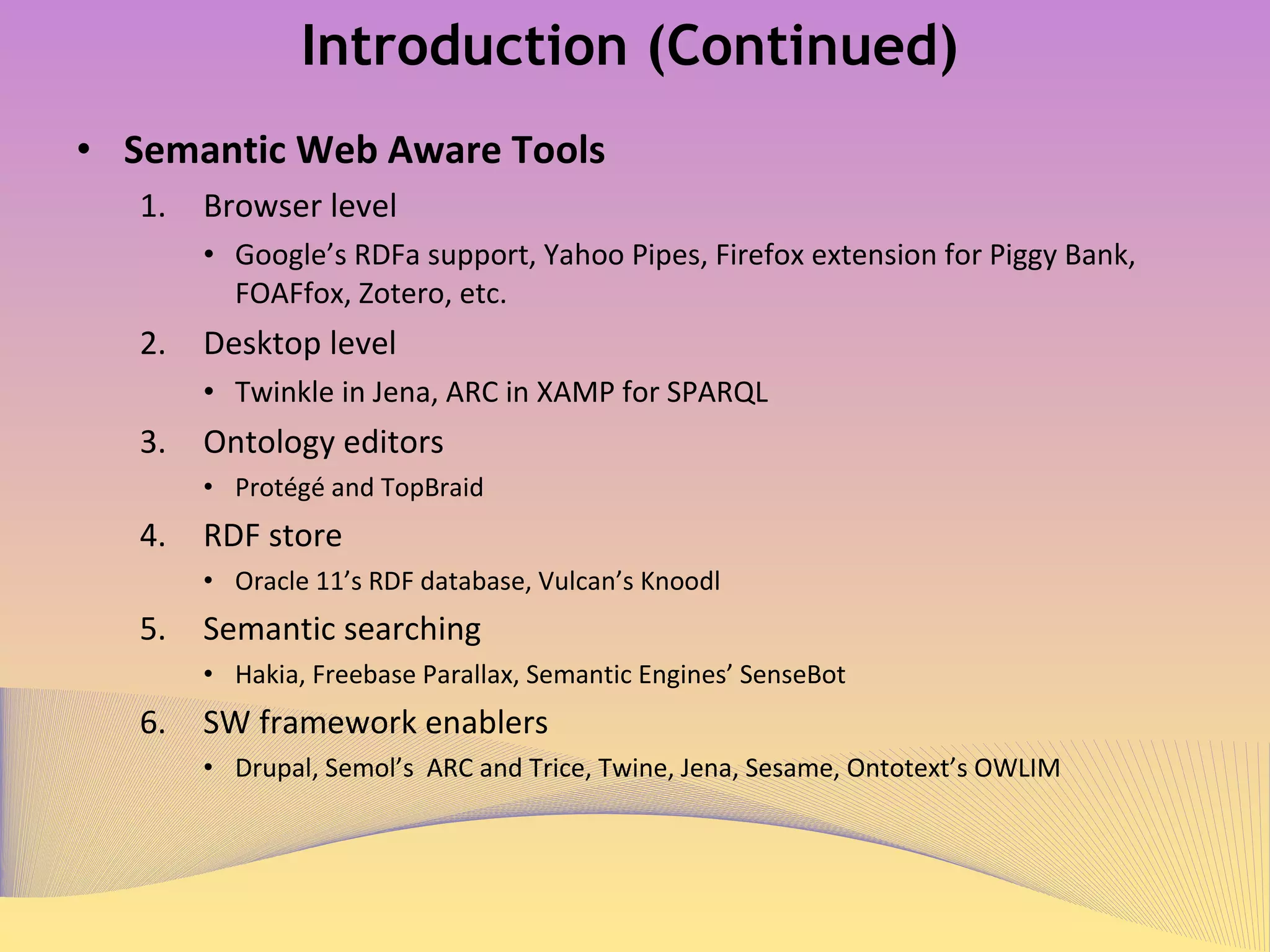
Introduction (Continued) Semantic Web Aware Tools Browser level Google’s RDFa support 1 ,  Yahoo Pipes 2 ,  Firefox extension for Piggy Bank 3 ,  FOAFfox 4 ,  Zotero 5 ,  etc. Desktop level Twinkle in Jena 6 ,   and ARC in XAMP for SPARQL 7 Ontology editors  Protégé 8   and TopBraid 9 RDF store Oracle 11’s RDF database 10 ,  Vulcan’s Knoodl 11 Semantic searching Hakia 12 ,  Freebase Parallax 13 ,  Semantic Engines’ SenseBot 14 SW framework enablers Drupal 15 ,  Semol’s  ARC and Trice 16 ,  Twine 17 ,  Jena 18 ,  Sesame  19 ,  Ontotext’s OWLIM 20
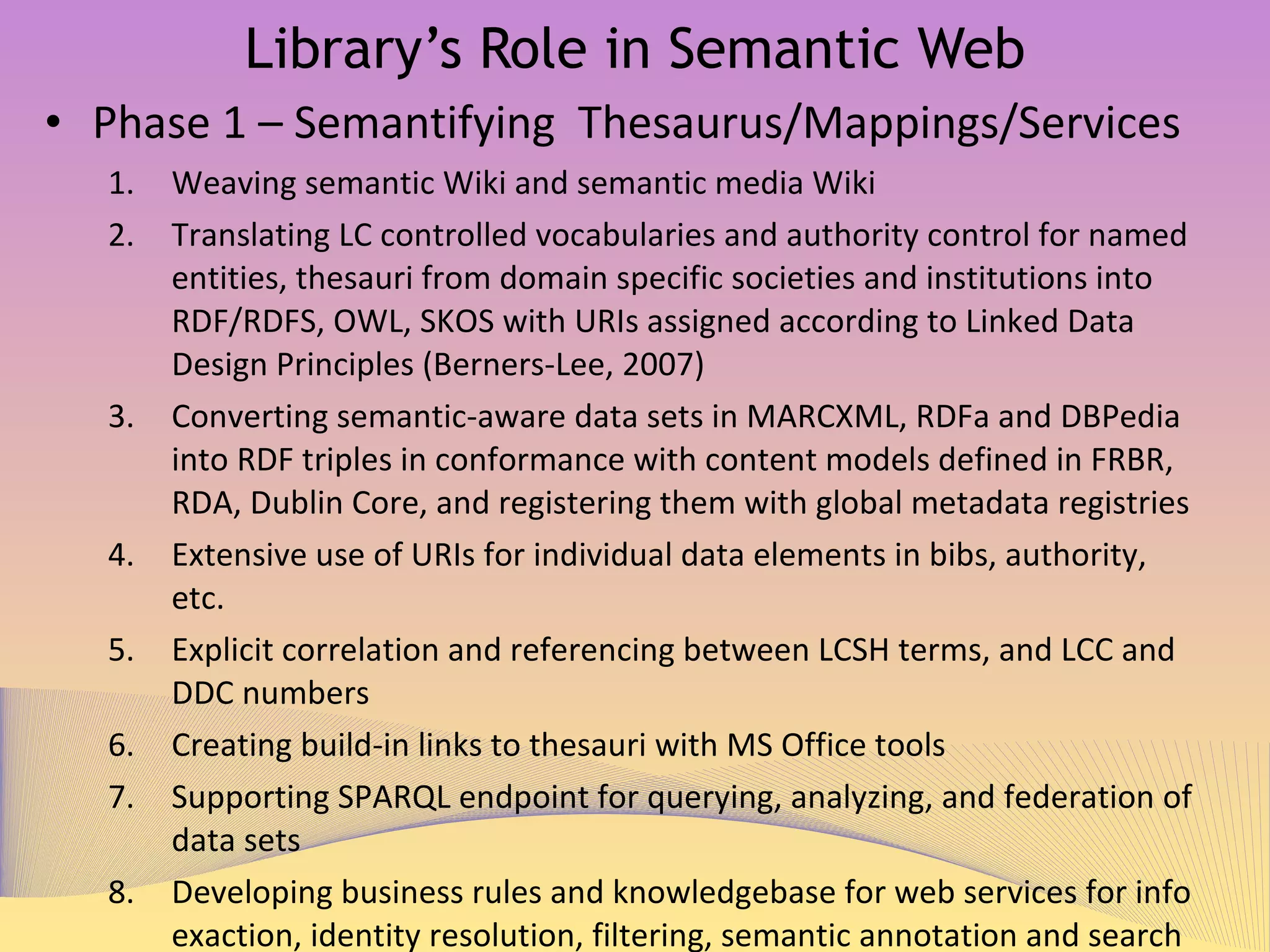
Library’s Role in Semantic Web Phase 1 – Semantifying Thesaurus/Mappings/Services Weaving semantic Wiki and semantic media Wiki Translating LC controlled vocabularies and authority control for named entities, thesauri from domain specific societies and institutions into RDF/RDFS, OWL, SKOS with URIs assigned according to ‘Linked Data Design Principles (Berners-Lee, 2007)’ Converting semantic-aware data sets in MARCXML, RDFa and DBPedia into RDF triples in conformance with content models defined in FRBR, RDA, Dublin Core, and registering them with global metadata registries Extensive use of URIs for individual data elements in bibs, authority, etc. Explicit correlation and referencing between LCSH terms, and LCC and DDC numbers  Creating build-in links to thesauri with MS Office tools Supporting SPARQL endpoint for querying, analyzing, and federation of  data sets  Developing business rules and knowledgebase for web services for info exaction, identity resolution, filtering, semantic annotation and search
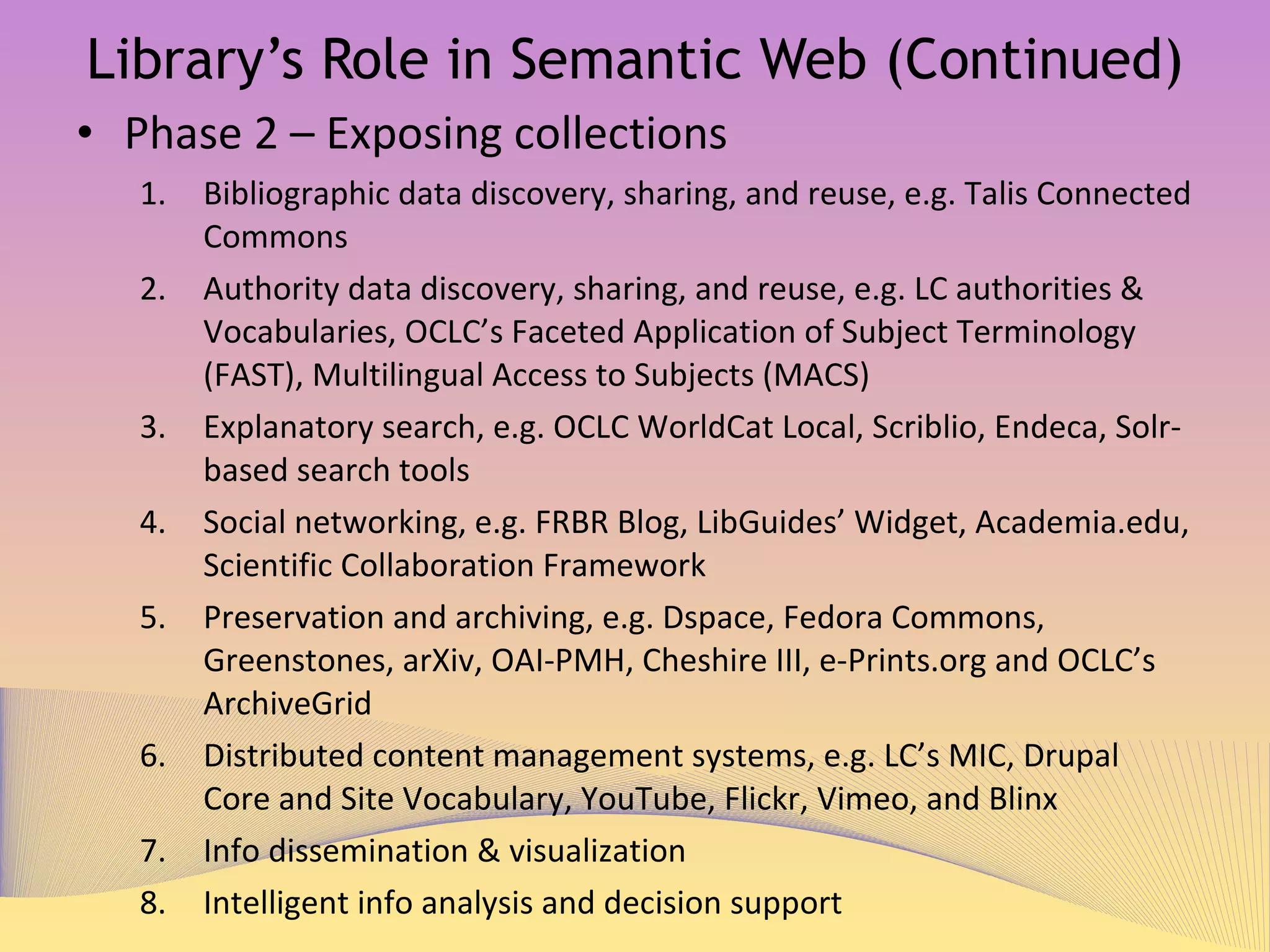
Library’s Role in Semantic Web (Continued) Phase 2 – Exposing collections Bibliographic data discovery, sharing, and reuse, e.g. Talis Connected Commons 1 Authority data discovery, sharing, and reuse, e.g. LC authorities & Vocabularies 2 ,  OCLC’s Faceted Application of Subject Terminology (FAST) 3 ,  Multilingual Access to Subjects (MACS) 4 Explanatory search, e.g. OCLC WorldCat Local 5 ,  Scriblio 6 ,  Endeca 7 ,   and Solr-based search tools, e.g. Vufind 8 ,  Primo 9 ,  and Blacklight 10 Social networking, e.g. FRBR Blog 11 ,  LibGuides’ Widget 12 ,  Academia.edu 13 ,  Scientific Collaboration Framework 14 Preservation and archiving, e.g. Dspace 15 ,  Fedora Commons 16 ,  Greenstones 17 ,  arXiv 18 , OAI-PMH 19 ,  Cheshire III 20 ,  e-Prints.org  21   and OCLC’s ArchiveGrid  22 Distributed content management systems, e.g. LC’s MIC 23 ,  Drupal Core and Site Vocabulary 24 ,  YouTube 25 ,  Flickr 26 ,  Vimeo 27 ,  and Blinx 28 Info dissemination, e.g. email alerts from LinkedIn  29  & visualization Intelligent info analysis and decision support
Semantic Web Development in the U.S. Libraries Most Semantic Web projects in the U.S. Libraries :  By national libraries or big organizations such as LC , NLM, NAL, OCLC, and DCMI In the process of creating Semantic Web tools and infrastructures, e.g. exposing collections In the area of converting MARC records and controlled vocabularies/thesauri into URIs and RDF/XML  Semantic Web technologies  are slowly and steadily incorporated into digital library management systems
Library of Congress Semantic Web Projects Participated in the creation of the W3C standard on SKOS and SKOS Primer  LCSH/SKOS project  (several small projects) LCCN Permalink project (persistent URLs from LC bibs completed, and authorities in planning) LCSH in RDF/XML using SKOS (entire subject authority records downloadable at http://id.loc.gov/authorities) Supporting SKOS in RDA, MARC, PREMIS, and METS  (experimental stage) Maintaining registries for SKOS, and related standards & data elements (on-going) Correlating DDC, LCC/LCSH in Classification Web (on-going)
Library of Congress Semantic Web Projects (Continued) Other initiatives influenced by Semantic Web  Developing content and format guidelines for submission of ONIX data to CIP  program, and retooling ECIP program (completed) Enabling OAI-PMH Retrieval from VIAF (Virtual International Authority File) (completed) Making all access points in LC ILS under authority control (on-going) Enabling RDA in MARCXML, MODS, and MADS (testing stage) Linking TOCs, publisher descriptions, contributor-supplied biographies, sample pages, reading guides, reviews and user-added data to Bibs (on-going)  Joining JSC, DCMI, CNL, BNL, NLA and others on making RDA records readily adaptable to Semantic Web (planned)
Library’s Role in Semantic Web (Continued) Phase 3 – Future Semantic Web Web of Linked Data 1  &   2 DBPedia 3 GeoNames 4 Other public data in Cloud Computing, e.g. Amazon Web Services 5 Librarything 6 Trust layer Semantifying Web services for reviews and rating of library related application services, e.g. journal ranking and acceptance rates 7 ,  CiteUlike 8 ,  ISI Web of Science
OCLC Semantic Web Projects FRBR-izing projects Developed FRBR work set algorithms 1   and xISBN Web Services 2 FictionFinder (2.8 million records in WorldCat) 3  &  4 WorldCat Identities (20 million identities) 5 PREMIS Data Dictionary 6   &  7 Sponsored PREMIS working group Developed common data model for metadata preservation, and implementation strategies (Release 2.0)
OCLC Semantic Projects (Continued) ECHODEP at UIUC partnered with OCLC , etc. & funded under LC’s NDIIP 1 “ Phase I (2004-2007) - Web archiving tool development, repository evaluation, interoperability tool development for METS, and long term semantic preservation research” “ Phase II (2008-2009) – expansion of repository architecture; semantic archiving for preservation of meaning and structure; auto metadata extraction and creation, and user evaluation; data format risk assessment based on INFORM methodology”
Other U.S. Semantic Web Projects Semantic Web Features in Dspace  MIT SIMILE 1  Add-ons to enhance inter-operability among digital assets, schemata/vocabularies/ontologies, metadata and services with RDF-based tools for Open Source Longwell (faceted browser for visualizing RDF data set) Piggy Bank (Firefox Extension for website scrappers & mash-ups) RDFizer (Converting structured data into RDF, e.g. JPEG, MARC, MODS, OAI-PMH, OCW, BibTeX) Welkin (Graph-based RDF visualizer) & Gadget (Data graph viewer for XML) Timeline (Temporal data visualizer) Semantic Search of Dspace 2   contents by HPCLab, Univ. of Patras using OWL 2.0 API to support DL Reasoner & DL-query Tab of Protégé 4.0  SKOS controlled vocabulary list in DSPace 3 ,  e.g. WindMusic.org 4
Other U.S. Semantic Web  Projects  (Continued) Semantic Web Features in Fedora  Joint Project of Fedora Commons, Cornell Univ., and Univ. of Virginia Digital Asset Management (DAM) architecture Mulgara 1   – RDF databases for Web front-end of Fedora repository with SPARQL and OTM (Object to Tripple Mapper) endpoints & SWRL support by Revelytix NSDL’s Ncore Repository Architecture – Implement Fedora-based digital repository, Ncore Model, an API, and a set of middleware Webapp for collaborative, and fully functional semantic digital library 2 Semantic Web Features in NSDL 3   Providing metadata registry for controlled vocabularies deployed in SKOS, and for ARC SPARQL + Endpoint  DuraSpace 4 Open source initiatives supported by Dspace and Fedora to develop synergistic technologies, services and programs to increase the interoperability of the two platforms, including Mulgara implementation DuraCoud project funded LC NDIPP & participated by NYPL and Biodiversity Library aiming to help organizations to take advantage of cloud technologies in providing access to digital materials 5
A Comparison Semantic Projects by European Libraries More aggressive and bold More enthusiasm Aims at delivering digital  and semantic library applications More visible to the public Frequent conferences on digital libraries and semantic web Semantic Web Projects by U.S. Libraries Creating semantic tools and infrastructure Converting controlled vocabularies and laying ground  work Less visible to the public Domain specific applications Cautious and slow
Conclusion Semantic-aware tools have been increasingly embedded in current Web applications with different levels of semantic support from browsers to desktops, from clients to servers, and servers to servers IT vendors started to view the capability of combining the Web of Data as an opportunity to move from current HTML-based Web to the Web of Linked Data, especially big vendors such as Google, Yahoo, Oracle and others The vast amount of library data, e.g. bibliographic data, authority data, controlled vocabularies, non-MARC oriented meta-data and classification schemes have been standardized for representations, controlled for quality and entity resolutions, and cross-mapped for interoperability and reuse The  library-related Web of Data is ready to be exposed to Semantic Web application development.
References Allemang, D. & Hendler, J.  (2008).  Semantic Web for the Working Ontologist : Effective Modeling in  RDFS and OWL.  Boston, MA:  Morgan Kaufmann Publisher/Elsevier Berners-Lee, T. (2000).  Semantic Web – XML2000.  In W3C Website.  Retrieved Aug. 24, 2009, from  http://www.w3.org/2000/Talks/1206-xml2k-tbl/slide10-0.html Berners-Lee, T. (2007).  Linked Data.  In W3C Website.  Retrieved Aug. 24, 2009, from  http://www.w3.org/DesignIssues/LinkedData.html Dupriez, C. (2009).  Integrating SKOS Thesauri and Authority Lists in Dspace.  In wiki.dspace.org.  Retrieved Aug. 24, 2009, from  http://wiki.dspace.org/index.php/User:Christophe.Dupriez FedoraCommons Dashboard.  Retrieved Aug. 24, 2009, from  http://www.fedora-commons.org/confluence/dashboard.action Harper, C.A., & Tillet, B.B. (2007).  Library of Congress Controlled Vocabularies and Their Application to the Semantic Web.  Cataloging  & Classification Quarterly,  43(3/4), 47-68 Koutsomitropoulos, D.  (2009).  Semantic Search Facility for Dspace: Overview.  In  wiki.dspace.org.  Retrieved Aug. 24, 2009, from  http://wiki.dspace.org/index.php/User:Kotsomit Malmsten, M. (2008).  Making a Library Catalogue Part of the Semantic Web.  In Berlin Proc. Int’l Conf. on Dublin Core and Metadata Applications.  Retrieved Aug. 24, 2009, from  http://dcpapers.dublincore.org/ojs/pubs/article/view/927/923 Marcum, D.B. (2008).  Response to On the Record: Report of the Library of Congress Working Group on the Future of Bibliographic Control.  Retrieved Aug. 24, 2009, from http://www.loc.gov/bibliographic-future/news/LCWGResponse-Marcum-Final-061008.pdf
References (Continued) Morris, C.M. (2009).  LC and DuroCloud Launch Pilot Program …  In DuraSpace Blog.  Retrieved Aug. 24, 2009, from  http://expertvoices.nsdl.org/duraspace/2009/07/15/library-of-congress-and-duracloud-launch-pilot-program-using-cloud-technologies-to-test-perpetual-access-to-digital-content-service-is-part-of-national-digital-information-infrastructure-and-preserva/ SIMILE Overview.  Retrieved Aug. 24, 2009, from  http://web.mit.edu/dspace-dev/www/simile/resources/overview.html SIMILE  Projects.  Retrieved Aug. 24, 2009, from  http://simile.mit.edu/wiki/Category:Project Summers, E., Isaac, A.,  Redding, C., & Krech, D. (2008).  LCSH, SKOS, and Linked Data.  Proceedings of the International Conference on Dublin Core and Meta-data Applications.  Retrieved Aug. 24, 2009, from  http://dcpapers.dublincore.org/ojs/pubs/article/view/916/912 Yang, S., Lee, Y.Y., Xu, A. (2009).  Semantic Web and Libraries in the United States: Experimentation and Achievements.  Proceedings of Emerging Trends in Technology: Libraries between Web 2.0, Semantic Web and Search Technology: IFLA 2009 Milan –Italy , Satellite Meetings in Florence.  [CD-ROM].  [Firenze, Italia]:  Ente Cassa di Risparmio di Firenze
Questions & Answers

The Semantic Web and Libraries in the United States: Experimentation and Achievements

  • 1.
    THE SEMANTIC WEBAND LIBRARIES IN THE UNITED STATES: EXPERIMENTATION AND ACHIEVEMENTS 75 th IFLA General Conference and Assembly Satellite Meeting: Emerging Trends in Technology: Libraries between Web 2.0, Semantic Web and Search Technology 8/19-20/2009, Florence, Italy Sharon Yang, Associate Professor/Librarian, Rider University Yanyi Lee, Systems Librarian, Wagner College Amanda Xu, Assistant Professor/Librarian, St. John’s University
  • 2.
    Overview Introduction toSemantic Web Library’s Role in Semantic Web Semantic Web Development in the U.S. Libraries Library Semantic Web Development in the United States and Europe-A Comparison Conclusion Questions & Answers
  • 3.
    Introduction Semantic Web-A vision by Tim Berners-Lee; An extension of the current Web; Web of data for machine-processing; Smart applications making connection of people, communities, things, and knowledge on the Web Semantic Web technologies (loosely a.k.a. Semantic Stack) URIs – naming things and info resources, and providing means to access info about them over the Web Meta-Languages, e.g. RDF, RDFS, OWL, SPARQL, etc. and their serialization in RDF/XML, N-Triples, N3, Turtle, RDF/JASON, etc. Logic for reasoning, e.g. making inferences based on classes, subclasses, properties, sub-properties, domains, ranges, and logical operations (unions, intersection, etc. ) in RDFS; and value restrictions, cardinality, transitivity, equivalence, and logical operations in OWL Proof for validation Trust via digital signatures and other knowledge, e.g. recommendation, rating, and certifications
  • 4.
    Introduction (Continued) SemanticWeb Architecture/Stack 1
  • 5.
    Introduction (Continued) ExtendedSW for community-based vocabularies SKOS (Simple Knowledge Organization Systems) – expressing concept organization systems such as thesauri, taxonomies, and controlled vocabularies in RDF/RDFS, OWL FOAF (Friend of a Friend) – describing people, links between them, things they create or do, and their relationships in RDF/RDFS, OWL SIOC (Semantically-Interlinked Online Communities) – expressing information in the discussion forums on the Web, e.g. blogs, forums, and mailing list Dublin Core – a set of meta-data elements for cross-domain info description Semantic Wiki/Semantic MediaWiki Encoding structured information into HTML pages using Microforms, and mapping it to RDF using GRDDL Encoding and retrieving RDF attributes from HTML page using RDFa
  • 6.
    Introduction (Continued) SemanticWeb Aware Tools Browser level Google’s RDFa support 1 , Yahoo Pipes 2 , Firefox extension for Piggy Bank 3 , FOAFfox 4 , Zotero 5 , etc. Desktop level Twinkle in Jena 6 , and ARC in XAMP for SPARQL 7 Ontology editors Protégé 8 and TopBraid 9 RDF store Oracle 11’s RDF database 10 , Vulcan’s Knoodl 11 Semantic searching Hakia 12 , Freebase Parallax 13 , Semantic Engines’ SenseBot 14 SW framework enablers Drupal 15 , Semol’s ARC and Trice 16 , Twine 17 , Jena 18 , Sesame 19 , Ontotext’s OWLIM 20
  • 7.
    Library’s Role inSemantic Web Phase 1 – Semantifying Thesaurus/Mappings/Services Weaving semantic Wiki and semantic media Wiki Translating LC controlled vocabularies and authority control for named entities, thesauri from domain specific societies and institutions into RDF/RDFS, OWL, SKOS with URIs assigned according to ‘Linked Data Design Principles (Berners-Lee, 2007)’ Converting semantic-aware data sets in MARCXML, RDFa and DBPedia into RDF triples in conformance with content models defined in FRBR, RDA, Dublin Core, and registering them with global metadata registries Extensive use of URIs for individual data elements in bibs, authority, etc. Explicit correlation and referencing between LCSH terms, and LCC and DDC numbers Creating build-in links to thesauri with MS Office tools Supporting SPARQL endpoint for querying, analyzing, and federation of data sets Developing business rules and knowledgebase for web services for info exaction, identity resolution, filtering, semantic annotation and search
  • 8.
    Library’s Role inSemantic Web (Continued) Phase 2 – Exposing collections Bibliographic data discovery, sharing, and reuse, e.g. Talis Connected Commons 1 Authority data discovery, sharing, and reuse, e.g. LC authorities & Vocabularies 2 , OCLC’s Faceted Application of Subject Terminology (FAST) 3 , Multilingual Access to Subjects (MACS) 4 Explanatory search, e.g. OCLC WorldCat Local 5 , Scriblio 6 , Endeca 7 , and Solr-based search tools, e.g. Vufind 8 , Primo 9 , and Blacklight 10 Social networking, e.g. FRBR Blog 11 , LibGuides’ Widget 12 , Academia.edu 13 , Scientific Collaboration Framework 14 Preservation and archiving, e.g. Dspace 15 , Fedora Commons 16 , Greenstones 17 , arXiv 18 , OAI-PMH 19 , Cheshire III 20 , e-Prints.org 21 and OCLC’s ArchiveGrid 22 Distributed content management systems, e.g. LC’s MIC 23 , Drupal Core and Site Vocabulary 24 , YouTube 25 , Flickr 26 , Vimeo 27 , and Blinx 28 Info dissemination, e.g. email alerts from LinkedIn 29 & visualization Intelligent info analysis and decision support
  • 9.
    Semantic Web Developmentin the U.S. Libraries Most Semantic Web projects in the U.S. Libraries : By national libraries or big organizations such as LC , NLM, NAL, OCLC, and DCMI In the process of creating Semantic Web tools and infrastructures, e.g. exposing collections In the area of converting MARC records and controlled vocabularies/thesauri into URIs and RDF/XML Semantic Web technologies are slowly and steadily incorporated into digital library management systems
  • 10.
    Library of CongressSemantic Web Projects Participated in the creation of the W3C standard on SKOS and SKOS Primer LCSH/SKOS project (several small projects) LCCN Permalink project (persistent URLs from LC bibs completed, and authorities in planning) LCSH in RDF/XML using SKOS (entire subject authority records downloadable at http://id.loc.gov/authorities) Supporting SKOS in RDA, MARC, PREMIS, and METS (experimental stage) Maintaining registries for SKOS, and related standards & data elements (on-going) Correlating DDC, LCC/LCSH in Classification Web (on-going)
  • 11.
    Library of CongressSemantic Web Projects (Continued) Other initiatives influenced by Semantic Web Developing content and format guidelines for submission of ONIX data to CIP program, and retooling ECIP program (completed) Enabling OAI-PMH Retrieval from VIAF (Virtual International Authority File) (completed) Making all access points in LC ILS under authority control (on-going) Enabling RDA in MARCXML, MODS, and MADS (testing stage) Linking TOCs, publisher descriptions, contributor-supplied biographies, sample pages, reading guides, reviews and user-added data to Bibs (on-going) Joining JSC, DCMI, CNL, BNL, NLA and others on making RDA records readily adaptable to Semantic Web (planned)
  • 12.
    Library’s Role inSemantic Web (Continued) Phase 3 – Future Semantic Web Web of Linked Data 1 & 2 DBPedia 3 GeoNames 4 Other public data in Cloud Computing, e.g. Amazon Web Services 5 Librarything 6 Trust layer Semantifying Web services for reviews and rating of library related application services, e.g. journal ranking and acceptance rates 7 , CiteUlike 8 , ISI Web of Science
  • 13.
    OCLC Semantic WebProjects FRBR-izing projects Developed FRBR work set algorithms 1 and xISBN Web Services 2 FictionFinder (2.8 million records in WorldCat) 3 & 4 WorldCat Identities (20 million identities) 5 PREMIS Data Dictionary 6 & 7 Sponsored PREMIS working group Developed common data model for metadata preservation, and implementation strategies (Release 2.0)
  • 14.
    OCLC Semantic Projects(Continued) ECHODEP at UIUC partnered with OCLC , etc. & funded under LC’s NDIIP 1 “ Phase I (2004-2007) - Web archiving tool development, repository evaluation, interoperability tool development for METS, and long term semantic preservation research” “ Phase II (2008-2009) – expansion of repository architecture; semantic archiving for preservation of meaning and structure; auto metadata extraction and creation, and user evaluation; data format risk assessment based on INFORM methodology”
  • 15.
    Other U.S. SemanticWeb Projects Semantic Web Features in Dspace MIT SIMILE 1 Add-ons to enhance inter-operability among digital assets, schemata/vocabularies/ontologies, metadata and services with RDF-based tools for Open Source Longwell (faceted browser for visualizing RDF data set) Piggy Bank (Firefox Extension for website scrappers & mash-ups) RDFizer (Converting structured data into RDF, e.g. JPEG, MARC, MODS, OAI-PMH, OCW, BibTeX) Welkin (Graph-based RDF visualizer) & Gadget (Data graph viewer for XML) Timeline (Temporal data visualizer) Semantic Search of Dspace 2 contents by HPCLab, Univ. of Patras using OWL 2.0 API to support DL Reasoner & DL-query Tab of Protégé 4.0 SKOS controlled vocabulary list in DSPace 3 , e.g. WindMusic.org 4
  • 16.
    Other U.S. SemanticWeb Projects (Continued) Semantic Web Features in Fedora Joint Project of Fedora Commons, Cornell Univ., and Univ. of Virginia Digital Asset Management (DAM) architecture Mulgara 1 – RDF databases for Web front-end of Fedora repository with SPARQL and OTM (Object to Tripple Mapper) endpoints & SWRL support by Revelytix NSDL’s Ncore Repository Architecture – Implement Fedora-based digital repository, Ncore Model, an API, and a set of middleware Webapp for collaborative, and fully functional semantic digital library 2 Semantic Web Features in NSDL 3 Providing metadata registry for controlled vocabularies deployed in SKOS, and for ARC SPARQL + Endpoint DuraSpace 4 Open source initiatives supported by Dspace and Fedora to develop synergistic technologies, services and programs to increase the interoperability of the two platforms, including Mulgara implementation DuraCoud project funded LC NDIPP & participated by NYPL and Biodiversity Library aiming to help organizations to take advantage of cloud technologies in providing access to digital materials 5
  • 17.
    A Comparison SemanticProjects by European Libraries More aggressive and bold More enthusiasm Aims at delivering digital and semantic library applications More visible to the public Frequent conferences on digital libraries and semantic web Semantic Web Projects by U.S. Libraries Creating semantic tools and infrastructure Converting controlled vocabularies and laying ground work Less visible to the public Domain specific applications Cautious and slow
  • 18.
    Conclusion Semantic-aware toolshave been increasingly embedded in current Web applications with different levels of semantic support from browsers to desktops, from clients to servers, and servers to servers IT vendors started to view the capability of combining the Web of Data as an opportunity to move from current HTML-based Web to the Web of Linked Data, especially big vendors such as Google, Yahoo, Oracle and others The vast amount of library data, e.g. bibliographic data, authority data, controlled vocabularies, non-MARC oriented meta-data and classification schemes have been standardized for representations, controlled for quality and entity resolutions, and cross-mapped for interoperability and reuse The library-related Web of Data is ready to be exposed to Semantic Web application development.
  • 19.
    References Allemang, D.& Hendler, J. (2008). Semantic Web for the Working Ontologist : Effective Modeling in RDFS and OWL. Boston, MA: Morgan Kaufmann Publisher/Elsevier Berners-Lee, T. (2000). Semantic Web – XML2000. In W3C Website. Retrieved Aug. 24, 2009, from http://www.w3.org/2000/Talks/1206-xml2k-tbl/slide10-0.html Berners-Lee, T. (2007). Linked Data. In W3C Website. Retrieved Aug. 24, 2009, from http://www.w3.org/DesignIssues/LinkedData.html Dupriez, C. (2009). Integrating SKOS Thesauri and Authority Lists in Dspace. In wiki.dspace.org. Retrieved Aug. 24, 2009, from http://wiki.dspace.org/index.php/User:Christophe.Dupriez FedoraCommons Dashboard. Retrieved Aug. 24, 2009, from http://www.fedora-commons.org/confluence/dashboard.action Harper, C.A., & Tillet, B.B. (2007). Library of Congress Controlled Vocabularies and Their Application to the Semantic Web. Cataloging & Classification Quarterly, 43(3/4), 47-68 Koutsomitropoulos, D. (2009). Semantic Search Facility for Dspace: Overview. In wiki.dspace.org. Retrieved Aug. 24, 2009, from http://wiki.dspace.org/index.php/User:Kotsomit Malmsten, M. (2008). Making a Library Catalogue Part of the Semantic Web. In Berlin Proc. Int’l Conf. on Dublin Core and Metadata Applications. Retrieved Aug. 24, 2009, from http://dcpapers.dublincore.org/ojs/pubs/article/view/927/923 Marcum, D.B. (2008). Response to On the Record: Report of the Library of Congress Working Group on the Future of Bibliographic Control. Retrieved Aug. 24, 2009, from http://www.loc.gov/bibliographic-future/news/LCWGResponse-Marcum-Final-061008.pdf
  • 20.
    References (Continued) Morris,C.M. (2009). LC and DuroCloud Launch Pilot Program … In DuraSpace Blog. Retrieved Aug. 24, 2009, from http://expertvoices.nsdl.org/duraspace/2009/07/15/library-of-congress-and-duracloud-launch-pilot-program-using-cloud-technologies-to-test-perpetual-access-to-digital-content-service-is-part-of-national-digital-information-infrastructure-and-preserva/ SIMILE Overview. Retrieved Aug. 24, 2009, from http://web.mit.edu/dspace-dev/www/simile/resources/overview.html SIMILE Projects. Retrieved Aug. 24, 2009, from http://simile.mit.edu/wiki/Category:Project Summers, E., Isaac, A., Redding, C., & Krech, D. (2008). LCSH, SKOS, and Linked Data. Proceedings of the International Conference on Dublin Core and Meta-data Applications. Retrieved Aug. 24, 2009, from http://dcpapers.dublincore.org/ojs/pubs/article/view/916/912 Yang, S., Lee, Y.Y., Xu, A. (2009). Semantic Web and Libraries in the United States: Experimentation and Achievements. Proceedings of Emerging Trends in Technology: Libraries between Web 2.0, Semantic Web and Search Technology: IFLA 2009 Milan –Italy , Satellite Meetings in Florence. [CD-ROM]. [Firenze, Italia]: Ente Cassa di Risparmio di Firenze
  • 21.

Editor's Notes

  • #16 SIMILE – Semantic Interoperability of Metadata and Information in Unlike Environments. Check : SIMILE Add-ons: http://www.answers.com/topic/simile-2 & http://simile.mit.edu/wiki/Category:Project Semantic Search: http://wiki.dspace.org/index.php/User:Kotsomit & http://repository.upatras.gr/dspace/help/index.html#semantic SKOS - http://wiki.dspace.org/index.php/User:Christophe.Dupriez http://www.windmusic.org/dspace/handle/68502/86407
  • #17 1. Fedora – Flexible, Extensible and Digital Object Repository Architecture Check - http://www.fedora-commons.org/confluence/dashboard.action & http://wiki.nsdl.org/index.php/Community:NCore/NCore_in_Fedora_3.0#figure_1 2. NSDL’s Ncore Repository Architecture – Implement Fedora 2.2 Instances and middleware Webapp providing Ncore-centric API, and model of interaction, e.g. OAI-PMH access to DC metadata in the repository 3. DuraCloud Project - http://expertvoices.nsdl.org/duraspace/2009/07/15/library-of-congress-and-duracloud-launch-pilot-program-using-cloud-technologies-to-test-perpetual-access-to-digital-content-service-is-part-of-national-digital-information-infrastructure-and-preserva/