• Introduction
– Todd Carpenter, NISO Managing Director
• Standards for Digital Preservation
– Priscilla Caplan, Assistant Director for
Digital Library Services, Florida Center for Library Automation
• Understanding PREMIS
– Priscilla Caplan, Assistant Director for Digital Library Services,
Florida Center for Library Automation
• Hathitrust Digital Library: Cooperation for Preservation
– Jeremy York, Assistant Librarian, University of Michigan Library
What It Takes To Make It Last:
E-Resources Preservation
NISO Webinar • February 10, 2010
Thanks to our sponsor!
NISO 2010 Events
http://www.niso.org/news/events/2010/
NISO Webinar • February 10, 2010
• March 8 (Open Call): ERM Data Standards & Best Practices Review Working Group
Update
• March Two-Part Webinar: Identifiers: New Problems, New Solutions
! March 10: What’s in a Name? Latest Developments in Identifiers
! March 17: Content Identification: What’s New with ISO Identifiers, ISBN and ISTC
• March 23 (Atlanta, GA): Discovery to Delivery: Creating a First-Class User Experience
• April 12 (Open Call): Standardized Markup for Journal Articles Working Group Update
• April 14: RFID in Libraries: Standards and Expanding Use
• May 10 (Open Call): Physical Delivery of LIbrary Resources Working Group Update
• May 12: It’s in the Mail: Best Practices for Resource Sharing
NISO Open Calls are Free!
Buy 4 webinars, get 2 free
Buy 6 webinars, get 7 free
Metadata for Preservation
Standards for Digital Preservation
Priscilla Caplan, Assistant Director for Digital Library Services,
Florida Center for Library Automation
NISO Digital Preservation Webinar • February 10, 2010
What is digital preservation?
The process of ensuring that digital
materials are accessible and usable
over the long term with no loss of
authenticity.
• What does it mean to be usable?
• How long is the long term!
• What’s authenticity?
Preservation in practice
• Conceptual framework
• Distributed network of
preservation repositories
• Strategies to counter
obsolescence
• Infrastructure of shared tools and
services
Conceptual Frameworks
• Reference Model for Open Archival Information
Systems (OAIS)
• PLANETS
– conceptual model for preservation planning
– PLATO preservation planning tool
• Process models
– Producer / Archive Interface
Methodology
– InterPARES process models
OAIS
• Reference Model for an Open Archival Information System, ISO
14721:2003
• Framework for understanding and applying concepts needed for long-
term preservation of digital information
• OAIS = an organization of people and systems that has accepted the
responsibility to preserve information for a Designated Community.
• Provides a common vocabulary of concepts to facilitate description
and comparison of archives
• Models what an OAIS must do, not how to do it
– Functional Model
– Information Model
Distributed Network of Preservation
Repositories
• Trustworthy repositories
– Trustworthy Repositories Audit and Certification: Criteria and
Checklist (TRAC)
– DRAMBORA (Digital Repository Audit Method Based on Risk
Assessment)
• Preservation Metadata: PREMIS
• Repository to Repository exchange
– Packaging formats: METS, DIDL, ORE, MXF
– Exchange formats: Repository Exchange Package (RXP)
TRAC
• Trustworthy Repository Audit and Certification: Criteria
and Checklist (TRAC)
–Organizational Infrastructure (governance, procedures,
finance...)
–Digital Object Management (ingest, preservation
planning, storage...)
–Technologies, Technical Infrastructure, Security
• Documentation, Transparency, Adequacy, Measurability
• CRL certification program
• Repository Audit and Certification (RAC) ! ISO
standardization by CCSDS under TC20/SC13
Strategies to counter media and format
obsolescence
• Sustainable formats
– Best practices for creation:
Framework of Guidance for Building
Good Digital Collections
– Criteria for evaluation: LC
Sustainability of digital formats
website, KB, TNA, others
– Sustainable formats: PDF/A, SIARD,
WARC, others
•Format description
–Format specific technical metadata: Z39.87 (MIX), AES Core
Audio (draft), TextMD, DocMD
–Format characterization: XCEL and XCDL
Shared Preservation Infrastructure
•Certifying authorities: CRL
•Central registries: Pronom,
UDFR
•Archival storage systems
•Technology watch services
•Tools and testbeds
For more information...
• Everything mentioned is referenced in webliography
(www.niso.org/news/events/2010/preservation)
• Upcoming spring issue of Information Standards Quarterly
• The Preservation of Digital Materials (Library Technology
Reports, 2008)
Metadata for Preservation
A Gentle Introduction to PREMIS
Priscilla Caplan, Assistant Director for Digital Library Services,
Florida Center for Library Automation
NISO Digital Preservation Webinar • February 10, 2010
PREMIS
• implementable = most elements can be supplied by program
• preservation metadata = “the information a repository uses to
support the digital preservation process”
• core = what most repositories need to know most of the time
•Data Dictionary drafted by an
international working group sponsored
by OCLC & RLG
• Maintained by an Editorial Committee
and Library of Congress.
• Defines an implementable core set of
preservation metadata
Fixity
Viability
Renderability
Preservation Responsibilities
Description
Secure storage
Media management
Availability
Identity
Capture
Selection
Understandability
Authenticity
Format strategies
(migration, emulation..)
Authentication
Documentation
Fixity
Viability
Renderability
Preservation Responsibilities
Description
Secure storage
Media management
Availability
Identity
Capture
Selection
Understandability
Authenticity
Format strategies
(migration, emulation..)
Authentication
Documentation
p
r
e
s
e
r
v
a
t
i
o
n
m
e
t
a
d
a
t
a
fixity
• the quality of not being altered or deleted
• threatened by insecure storage and media degradation
metadata supporting fixity
a message digest (checksum)
• messageDigest
the method used to generate it
• messageDigestAlgorithm
viability
• the quality of being readable from media
• threatened by media degradation and media obsolescence
metadata supporting viability
the type of medium used to store the object
• storageMedium
the age of the specific device
the date the object was written to the device
renderability
• the quality of being displayable or otherwise usable
• threatened by format obsolescence
metadata supporting renderability
the file format
• formatDesignation
• formatRegistry
the creating application
• creatingApplicationName
• creationApplicationVersion
• dateCreatedByApplication
technical details specific to the file format (e.g., colorspace for an
image, number of tracks for audio)
• out of scope for PREMIS but can be recorded by extension
hardware and software needed to render
• environment
authenticity
• the quality that the object is what it purports to be; that both
the source and the content are verifiable
metadata supporting authenticity
Digital Provenance, including
– the source of the object
– a history of the custody of the object
– a history of any changes to the object
• PREMIS Event information
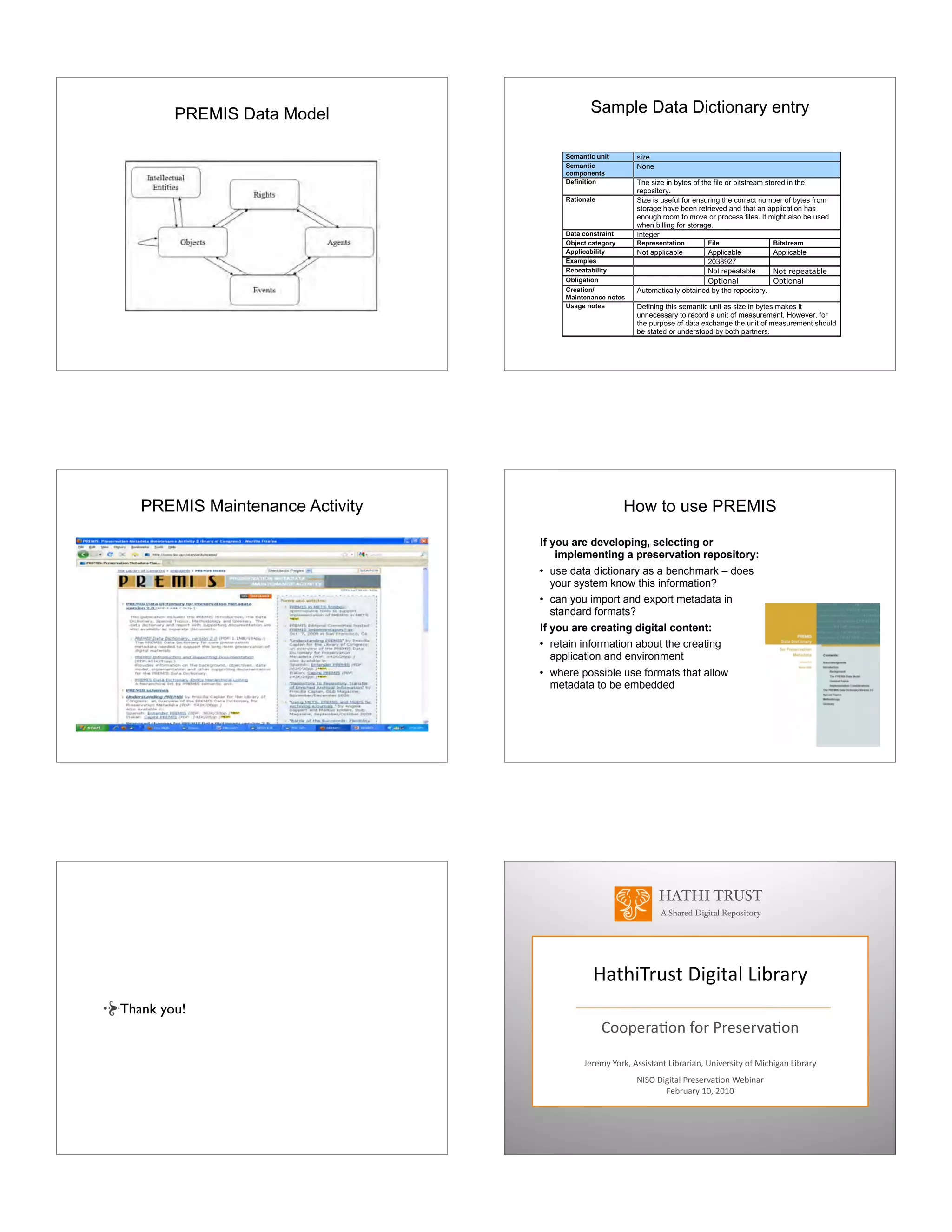
PREMIS Data Model Sample Data Dictionary entry
PREMIS Maintenance Activity How to use PREMIS
If you are developing, selecting or
implementing a preservation repository:
• use data dictionary as a benchmark – does
your system know this information?
• can you import and export metadata in
standard formats?
If you are creating digital content:
• retain information about the creating
application and environment
• where possible use formats that allow
metadata to be embedded
Thank you!
HATHI TRUST
A Shared Digital Repository
!"#$%&'()#*+%,%#"-*.%/'"'0
12234'"526*72'*8'4)4'9"526
:4'4;0*<2'=>*?))%)#"6#*.%/'"'%"6>*@6%94')%#0*27*A%B$%,"6*.%/'"'0
CDEF*+%,%#"-*8'4)4'9"526*G4/%6"'
H4/'("'0*IJ>*KJIJ
F(#-%64
• ?/2(#*!"#$%&'()#
–A%))%26*L*M2"-)
• N"B=,'2(6O
• G$"#*P4*O2
–E4'9%B4)
• !2P*P4*O2*%#
–M294'6"6B4
–8"'#64')$%3*L*Q4)2('B4)
–&4B$62-2,0
• H(#('4*+%'4B526)
?/2(#*
G$"#*%)*!"#$%&'()#
• E$"'4O*+%,%#"-*Q432)%#2'0
–."(6B$4O*KJJR*/0*KS*%6)5#(526)*T62P*KUV
–D6%5"-*72B()*26*O%,%5W4O*/22=*"6O*X2('6"-*B26#46#
–YZ3"6O%6,*#2*626[/22=626[X2('6"->*/2'6*O%,%#"-*
–].%,$#^*"'B$%94
• 12--"/2'"526*
–8'4)4'9"526*"6O*"BB4))
–8'%6#*B2--4B526)
–.2B"-*)4'9%B4)
–8(/-%B*M22O
N"B=,'2(6O**
!%)#2'0
• A%B$%,"6*+%,%5W"526*8'2X4B#*KJJ_
• ]`@*27*A*)$"--*$"94*#$4*'%,$#*#2*()4*#$4*@*27*A*
+%,%#"-*1230>*%6*P$2-4*2'*%6*3"'#*"#*@*27*Aa)*)2-4*
O%)B'4526>*")*3"'#*27*)4'9%B4)*2b4'4O*%6*
B2234'"526*P%#$*3"'#64'*'4)4"'B$*-%/'"'%4)*)(B$*
")*#$4*%6)5#(526)*%6*#$4*+%,%#"-*.%/'"'0*
H4O4'"526`^
!%)#2'0
• 12--4B594*?,'44;46#*P%#$*1D1*?662(6B4O*%6*
:(64*KJJc
• 1D1*",'44O*#2*4)#"/-%)$*"*)$"'4O*O%,%#"-*
'432)%#2'0
!%)#2'0 &$4*8"'#64')
• G$46*"662(6B4O*%6*FB#2/4'*KJJR>*3"'#64')*
%6B-(O4Od
–@6%94')%#0*27*1"-%72'6%"*)0)#4;
–1D1*T12;;%e44*26*D6)5#(526"-*12234'"526V*
–@6%94')%#0*27*f%',%6%"
@6%94')%#0*27*1$%B",2
@6%94')%#0*27*D--%62%)
D6O%"6"*@6%94')%#0
@6%94')%#0*27*D2P"
@6%94')%#0*27*A%B$%,"6*
A%B$%,"6*E#"#4*@6%94')%#0*
@6%94')%#0*27*A%664)2#"
C2'#$P4)#4'6*@6%94')%#0*
F$%2*E#"#4*@6%94')%#0*
8466)0-9"6%"*E#"#4*@6%94')%#0*
8('O(4*@6%94')%#0*
@6%94')%#0*27*G%)B26)%6[A"O%)26*
12-(;/%"*@6%94')%#0
&$4*C";4
• &$4*;4"6%6,*/4$%6O*#$4*6";4
–!"#$%*T$"$[#44V[[!%6O%*72'*4-43$"6#
–N%,>*)#'26,
–C494'*72',4#)>*P%)4
–E4B('4
–&'()#P2'#$0
126#46#*+%)#'%/(526
JgRUh
JgI_h
D6*1230'%,$#
8(/-%B*+2;"%6
?)*27*H4/'("'0*Id
S>iKi>cIU*[*&2#"-
****cU_>_RI*[*8(/-%B*+2;"%6
126#46#*M'2P#$
J
icSJJJJ
cSJJJJJ
IIKSJJJJ
ISJJJJJJ
KSJJJJJ
SKSJJJJ
RJJJJJJ
IIJJJJJJ
I_JJJJJJ
KJJR KJJj KJIJ KJII KJIK
G$"#*P4*O2**
E4'9%B4)
!2P*P4*O2*%#
M294'6"6B4
!"#$%&'()#
YZ4B(594*
12;;%e44
E#'"#4,%B*
?O9%)2'0*
N2"'O
N(O,4#H%6"6B4)
+4B%)%26[;"=%6,
82-%B0
8-"66%6,
YZ4B(594*12;;%e44
• 8"(-*12('"6#>*@6%94')%#0*.%/'"'%"6*"6O*+4"6*27*.%/'"'%4)>*@A
• ."%64*H"'-40>*YZ4B(594*+%'4B#2'>*1+.
• :2$6*k%6,>*f%B4*8'292)#*72'*?B"O4;%B*D672';"526>*@A
• 8"(-"*k"(7;"6>*@6%94')%#0*.%/'"'%"6*"6O*+4"6*27*.%/'"'%4)>*@D
• N'%"6*EB$2e-"46O4'>*@6%94')%#0*.%/'"'%"6>*@1E+
• YO*f"6*M4;4'#>*+%'4B#2'*27*.%/'"'%4)>*@G*[*A"O%)26
• N'46O"*:2$6)26>*+4"6*27*.%/'"'%4)>*D@
• N'"O*G$44-4'>*1$%47*D672';"526*FlB4'>*D@
• :2$6*G%-=%6>*YZ4B(594*+%'4B#2'*27*!"#$%&'()#*"6O*********?))2B%"#4*
@6%94')%#0*.%/'"'0>*.D&>*@A
E#'"#4,%B*?O9%)2'0*N2"'O
• YO*f"6*M4;4'#*T1$"%'V>*+%'4B#2'*27*.%/'"'%4)>*@G*[*A"O%)26
• :2$6*N(#-4'>*?))2B%"#4*@6%94')%#0*.%/'"'%"6*72'*D672';"526*
&4B$62-2,0>*@*A%66
• 8"#'%B%"*1'()4>*+%'4B#2'>*8'4)4'9"526>*1+.
• N4'6%4*!('-40>*+%'4B#2'>*.%/'"'0*&4B$62-2,%4)>*@1*N4'=4-40
• Qg*N'(B4*A%--4'>*@6%94')%#0*.%/'"'%"6>*@1*[*A4'B4O
• E"'"$*8'%#B$"'O>*@6%94')%#0*.%/'"'%"6>*C2'#$P4)#4'6
• 8"(-*E2O4'O"$->*+%'4B#2'>*.D&>*@*D2P"
• :2$6*G%-=%6>*YZ4B(594*+%'4B#2'>*!"#$%&'()#*T4Z*2lB%2V
8"'#64')$%3*L*Q4)2('B4)*TIV
• H(6O4O*72'*"*%6%5"-*S*04"')*P%#$*
/")4[7(6O%6,*7'2;*3"'#64')
• N(O,4#*m*)43"'"#4-0*$4-O*P%#$%6*
@A%B$*/(O,4#*)0)#4;>*;"6",4O*
/0*#$4*YZ4B(594*12;;%e44
• 12)#*A2O4-*m*84'*MN*B2)#*27*)#2'",4*34'*04"'*P%#$*"*264[
5;4*744*26*64P*B26#46#*#2*/(%-O*"*B"3%#"-*7(6O
• Q49%4P*%6*i'O*0'*27*4"B$*S*0'*34'%2O
8"'#64')$%3*L*Q4)2('B4)*TKV
• E#"bYZ34'5)4*m*$%,$-0*%6#4,'"#4O
–8'2X4B#*;"6",4')>*D&*"6O*B2;;(6%B"526)***************************
)#"b>*B230'%,$#*4Z34'#)>*"O;%6%)#'"#2')*T@A>*
D6O%"6"*"6O*@1*#"=%6,*#$4*-4"OV
• G2'=%6,*,'2(3)
• @A*'4B46#-0*$%'4O*"*+%,%#"-*8'4)4'9"526*.%/'"'%"6
• E$"'4O*O494-23;46#*)3"B4
H%6"6B%"-*
B26#'%/(526)*27*
3"'#64') !"#$%&'()#*H(6B526"-*
H'";4P2'=
8"'#64')$%3*L*Q4)2('B4)*TiV
• &2P"'O*"*1-2(O*.%/'"'0
–1.DQ>*A4--26*H2(6O"526
–F1.1*Q4)4"'B$>*C<@>*!"#$%&'()#>*Q4B"3*.%/'"'%4)
• !"#$%&'$()1$"'"B#4'%W4*!"#$%#&'(!#')$*++*'!,%-!.$72'*#/!#'%&0-1-%2$
)&%&2#)#%!$*3$&4&5#)-4$'#6#&'4"$4*00#47*%6*-494'",%6,*B"3"B%#0*27*
0&'2#(64&0#$6"&'#5$+'-%!$&%5$5-2-!&0$'#+*6-!*'-#68
• !*+%,-$.()*++*'!,%-!.$&%5$'-69$&66#66)#%!*/")4O*26*",,'4,"#4*
B2--4B526*"6"-0)%)n*5'&:$6#';-4#$&2'##)#%!*46"/-%6,*,464'%B*B26)(;4'*
-%/'"'0*#2*)4-4B594-0*2(#)2('B4*3'4)4'9"526*"6O*"BB4))*27*-2P[()4*
'4)4"'B$*B2--4B526)*#2*-"',4[)B"-4*3'%6#*"6O*O%,%#"-*'432)%#2'%4)
oH'2;*#$4*Q.M*8"'#64'*@3O"#4*:"6("'0*c>*KJIJ
8"'#64')$%3*L*Q4)2('B4)*T_V
• 1Q.*&Q?1*?(O%#
–82'5B2*"6O*!"#$%&'()#*"))4));46#)*5;4-0
–]14'5pB"526*P%--*"(,;46#*1Q.q)*)#'"#4,%B*"'B$%9%6,*27*3'%6#>*
"6O*)(332'#*"*'4)326)%/-4*#'"6)%526*#2*4-4B#'26%B[26-0*
72';"#)*P$4'4*"33'23'%"#4g^
–G2'=*P%#$*@1*#2*O4)%,6*)$"'4O*3'%6#*X2('6"-*"'B$%9%6,*4b2'#
–]G%#$*#$%)*$0/'%O*)#'"#4,0*1Q.*$234)*#2*46"/-4*%#)*B2;;(6%#0*
#2*"BB4-4'"#4*#$4*)$%r*#2*4-4B#'26%B[26-0*'4)2('B4)*%6*"*
B"'47(-*"6O*'4)326)%/-4*;"664'g^
o*$e3dPPPgB'-g4O("'B$%9%6,[3'4)4'9"526O%,%#"-["'B$%94)B4'5pB"526[
"6O["))4));46#[O%,%#"-['432)%#2'%4)
8"'#64')$%3*L*Q4)2('B4)*TSV
• C4P*B2)#*;2O4-
• N")4O*26*/464p#)*#2*%6)5#(526)
–8(/-%B*+2;"%6
–D6[B230'%,$#
• f2-(;4)*]$4-O^
8"'#64')$%3*L*Q4)2('B4)*TUV
• &%;4-%64d
–D;3-4;46#*%6*KJIi
–?BB43#*64P*3"'#64')*62P*P%#$*B2)#)*/")4O*26*294'-"3*
B"-B(-"526)
• Q4s(%'4;46#)d
–8'%6#*$2-O%6,)*O"#"/")4
–@3O"#4*;4B$"6%);)
–A"6("-*'4;4O%"526
&4B$62-2,0*[*F?DE
MQDC
D6#4'6"-*+"#"*.2"O%6,
M22,-4
tF1?u
D6[$2()4*12694')%26
A?Q1*'4B2'O*4Z#46)%26)
*T?-43$V
Q%,$#)*+N*
8",4*&('64'
!"#$%&'()#*?8D
F?D
M42D8*+N
1CQD*!"6O-4)
tE2-'u*
AY&E8QYADE*2/X4B#
&DHH*M_:8YMKJJJ
F1Q
A+S*B$4B=)(;)
AY&E*2/X4B#
8CM
F1Q
8+H
D)%-26
E%#4*Q43-%B"526
&EA
A+S*B$4B=)(;*9"-%O"526
MQFFfY
T:!FfYV
n
&4B$62-2,0*m*?'B$%#4B#('4
• D6/2(6O*9"-%O"526>*)#"6O"'O)[/")4O***************************************
2/X4B#*)#2'",4*"6O*'4-"#4O*;4#"O"#"
• E#2'",4*%6*?66*?'/2'*"6O*D6O%"6"32-%)
• Y6B'03#4O*/"B=(3*#2*i'O*-2B"526
• Q%,$#)*O"#"/")4*72'*'%,$#)*;4#"O"#"
• F6-%64*B"#"-2,*")*)2('B4*"6O*)#2'",4*72'*O4)B'%3594*
;4#"O"#"
&4B$62-2,0*[*D6,4)#
• ?(#2;"5B*9"-%O"526*%6*MQFFfY
–1$4B=*/"'B2O4*B$4B=*O%,%#*()%6,*.($6*"-,2'%#$;
–H%Z%#0*B$4B=*26*:8MKJJJ>*&DHH>*@&HR*()%6,*A+S
–G4--[72';4O64))*"6O*4;/4OO4O*;4#"O"#"*B$4B=*26*
:8MKJJJ>*&DHH>*@&HR*()%6,*:!FfY
• 1'4"526*27*AY&E*"6O*8QYADE
• D)%-26*)#2'",4
• E%;3-4*p-4)0)#4;*-"02(#
–F64*O%'4B#2'0*34'*92-(;4>*W%3*p-4*"6O*AY&E*p-4
–@)4*27*"*6";4)3"B4*"--2P)*72'*B26v%B56,*%O465p4')
–C";4)3"B4)*72'*%6)5#(526)*"6O>*%7*644O4O>*#034)*27*
%O465p4')*P%#$%6*#$4*%6)5#(526
&4B$62-2,0*[*Q432)%#2'0
• G$0*AY&Ew
–1"6*)4'94*")*?'B$%9"-*D672';"526*
8"B=",4*"6O*"*+%))4;%6"526*
D672';"526*8"B=",4
–+4)%,64O*#2*'4B2'O*#$4*'4-"526)$%3*/4#P446*3%4B4)*27*
B2;3-4Z*O%,%#"-*2/X4B#)
–1"6*/4*B'4"#4O*"(#2;"5B"--0*")*#4Z#)*"'4*-2"O4O*2'*
'4-2"O4O
–8'4)4'9"526*"B526)*T8QYADEV*
&4B$62-2,0*m*AY&E*F/X4B#
• G$"#q)*#$4'4w
–;4#)!O'*P%#$*"6*D+*"6O*1QY?&Y+?&Y
–K*O;OE4B)d*A"'BZ;-*"6O*;OQ47*
–";OE4B*B26#"%6%6,*264*#4B$A+*P%#$*8QYADE*
;4#"O"#"*
–p-4E4B*P%#$*_*p-4M'3)*TW%3>*%;",4)>*F1Q>*$F1QV
–8$0)%B"-*)#'(B#A"3*#0%6,*#2,4#$4'*p-4)*P%#$*;4#"O"#"*
T3,g*6(;/4')*"6O*74"#('4)V
&4B$62-2,0*m*AY&E*F/X4B#
H(#('4*+%'4B526)**
H(#('4*+%'4B526)*TIV
H(#('4*+%'4B526)*TKV .%6=)
• 1"#"-2,>*H(--[#4Z#*)4"'B$>*"6O*12--4B526*N(%-O4'
– $e3dB"#"-2,g$"#$%#'()#g2',
• AY&E*"6O*8QYADE*%;3-4;46#"526
– $e3dPPPg$"#$%#'()#g2',3'4)4'9"526
• &4B$6%B"-*3'2p-4d
– *$e3dPPPg$"#$%#'()#g2',#4B$62-2,0
• &4B$6%B"-*v2P*O%",'";
– $e3dPPPg$"#$%#'()#g2',O2B(;46#)!"#$%&'()#[8?EDM[KJJjIJg3O7
– $e3dPPPg$"#$%#'()#g2',O2B(;46#)!"#$%&'()#[8?EDM[
62#4)[KJJjIJg3O7
• Q%,$#)*;"6",4;46#
– $e3dPPPg$"#$%#'()#g2','%,$#)x;"6",4;46#
• &Q?1
– $e3dPPPg$"#$%#'()#g2',"BB2(6#"/%-%#0
&$"6=*<2(y
$"#$%#'()#[%672z(;%B$g4O(
XX02'=z(;%B$g4O(
$e3dPPPg$"#$%#'()#g2',
Thank you!
All questions will be posted with presenter answers on the NISO
website following the webinar:
www.niso.org/news/events/2010/preservation
What It Takes To Make It Last:
E-Resources Preservation
NISO Webinar • February 10, 2010
Thanks to our sponsor!

Caplan and York, 'What It Takes To Make It Last: E-Resources Preservation"

  • 1.
    • Introduction – ToddCarpenter, NISO Managing Director • Standards for Digital Preservation – Priscilla Caplan, Assistant Director for Digital Library Services, Florida Center for Library Automation • Understanding PREMIS – Priscilla Caplan, Assistant Director for Digital Library Services, Florida Center for Library Automation • Hathitrust Digital Library: Cooperation for Preservation – Jeremy York, Assistant Librarian, University of Michigan Library What It Takes To Make It Last: E-Resources Preservation NISO Webinar • February 10, 2010 Thanks to our sponsor! NISO 2010 Events http://www.niso.org/news/events/2010/ NISO Webinar • February 10, 2010 • March 8 (Open Call): ERM Data Standards & Best Practices Review Working Group Update • March Two-Part Webinar: Identifiers: New Problems, New Solutions ! March 10: What’s in a Name? Latest Developments in Identifiers ! March 17: Content Identification: What’s New with ISO Identifiers, ISBN and ISTC • March 23 (Atlanta, GA): Discovery to Delivery: Creating a First-Class User Experience • April 12 (Open Call): Standardized Markup for Journal Articles Working Group Update • April 14: RFID in Libraries: Standards and Expanding Use • May 10 (Open Call): Physical Delivery of LIbrary Resources Working Group Update • May 12: It’s in the Mail: Best Practices for Resource Sharing NISO Open Calls are Free! Buy 4 webinars, get 2 free Buy 6 webinars, get 7 free Metadata for Preservation Standards for Digital Preservation Priscilla Caplan, Assistant Director for Digital Library Services, Florida Center for Library Automation NISO Digital Preservation Webinar • February 10, 2010 What is digital preservation? The process of ensuring that digital materials are accessible and usable over the long term with no loss of authenticity. • What does it mean to be usable? • How long is the long term! • What’s authenticity? Preservation in practice • Conceptual framework • Distributed network of preservation repositories • Strategies to counter obsolescence • Infrastructure of shared tools and services Conceptual Frameworks • Reference Model for Open Archival Information Systems (OAIS) • PLANETS – conceptual model for preservation planning – PLATO preservation planning tool • Process models – Producer / Archive Interface Methodology – InterPARES process models
  • 2.
    OAIS • Reference Modelfor an Open Archival Information System, ISO 14721:2003 • Framework for understanding and applying concepts needed for long- term preservation of digital information • OAIS = an organization of people and systems that has accepted the responsibility to preserve information for a Designated Community. • Provides a common vocabulary of concepts to facilitate description and comparison of archives • Models what an OAIS must do, not how to do it – Functional Model – Information Model Distributed Network of Preservation Repositories • Trustworthy repositories – Trustworthy Repositories Audit and Certification: Criteria and Checklist (TRAC) – DRAMBORA (Digital Repository Audit Method Based on Risk Assessment) • Preservation Metadata: PREMIS • Repository to Repository exchange – Packaging formats: METS, DIDL, ORE, MXF – Exchange formats: Repository Exchange Package (RXP) TRAC • Trustworthy Repository Audit and Certification: Criteria and Checklist (TRAC) –Organizational Infrastructure (governance, procedures, finance...) –Digital Object Management (ingest, preservation planning, storage...) –Technologies, Technical Infrastructure, Security • Documentation, Transparency, Adequacy, Measurability • CRL certification program • Repository Audit and Certification (RAC) ! ISO standardization by CCSDS under TC20/SC13 Strategies to counter media and format obsolescence • Sustainable formats – Best practices for creation: Framework of Guidance for Building Good Digital Collections – Criteria for evaluation: LC Sustainability of digital formats website, KB, TNA, others – Sustainable formats: PDF/A, SIARD, WARC, others •Format description –Format specific technical metadata: Z39.87 (MIX), AES Core Audio (draft), TextMD, DocMD –Format characterization: XCEL and XCDL Shared Preservation Infrastructure •Certifying authorities: CRL •Central registries: Pronom, UDFR •Archival storage systems •Technology watch services •Tools and testbeds For more information... • Everything mentioned is referenced in webliography (www.niso.org/news/events/2010/preservation) • Upcoming spring issue of Information Standards Quarterly • The Preservation of Digital Materials (Library Technology Reports, 2008)
  • 3.
    Metadata for Preservation AGentle Introduction to PREMIS Priscilla Caplan, Assistant Director for Digital Library Services, Florida Center for Library Automation NISO Digital Preservation Webinar • February 10, 2010 PREMIS • implementable = most elements can be supplied by program • preservation metadata = “the information a repository uses to support the digital preservation process” • core = what most repositories need to know most of the time •Data Dictionary drafted by an international working group sponsored by OCLC & RLG • Maintained by an Editorial Committee and Library of Congress. • Defines an implementable core set of preservation metadata Fixity Viability Renderability Preservation Responsibilities Description Secure storage Media management Availability Identity Capture Selection Understandability Authenticity Format strategies (migration, emulation..) Authentication Documentation Fixity Viability Renderability Preservation Responsibilities Description Secure storage Media management Availability Identity Capture Selection Understandability Authenticity Format strategies (migration, emulation..) Authentication Documentation p r e s e r v a t i o n m e t a d a t a fixity • the quality of not being altered or deleted • threatened by insecure storage and media degradation metadata supporting fixity a message digest (checksum) • messageDigest the method used to generate it • messageDigestAlgorithm
  • 4.
    viability • the qualityof being readable from media • threatened by media degradation and media obsolescence metadata supporting viability the type of medium used to store the object • storageMedium the age of the specific device the date the object was written to the device renderability • the quality of being displayable or otherwise usable • threatened by format obsolescence metadata supporting renderability the file format • formatDesignation • formatRegistry the creating application • creatingApplicationName • creationApplicationVersion • dateCreatedByApplication technical details specific to the file format (e.g., colorspace for an image, number of tracks for audio) • out of scope for PREMIS but can be recorded by extension hardware and software needed to render • environment authenticity • the quality that the object is what it purports to be; that both the source and the content are verifiable metadata supporting authenticity Digital Provenance, including – the source of the object – a history of the custody of the object – a history of any changes to the object • PREMIS Event information
  • 5.
    PREMIS Data ModelSample Data Dictionary entry PREMIS Maintenance Activity How to use PREMIS If you are developing, selecting or implementing a preservation repository: • use data dictionary as a benchmark – does your system know this information? • can you import and export metadata in standard formats? If you are creating digital content: • retain information about the creating application and environment • where possible use formats that allow metadata to be embedded Thank you! HATHI TRUST A Shared Digital Repository !"#$%&'()#*+%,%#"-*.%/'"'0 12234'"526*72'*8'4)4'9"526 :4'4;0*<2'=>*?))%)#"6#*.%/'"'%"6>*@6%94')%#0*27*A%B$%,"6*.%/'"'0 CDEF*+%,%#"-*8'4)4'9"526*G4/%6"' H4/'("'0*IJ>*KJIJ
  • 6.
    F(#-%64 • ?/2(#*!"#$%&'()# –A%))%26*L*M2"-) • N"B=,'2(6O •G$"#*P4*O2 –E4'9%B4) • !2P*P4*O2*%# –M294'6"6B4 –8"'#64')$%3*L*Q4)2('B4) –&4B$62-2,0 • H(#('4*+%'4B526) ?/2(#* G$"#*%)*!"#$%&'()# • E$"'4O*+%,%#"-*Q432)%#2'0 –."(6B$4O*KJJR*/0*KS*%6)5#(526)*T62P*KUV –D6%5"-*72B()*26*O%,%5W4O*/22=*"6O*X2('6"-*B26#46# –YZ3"6O%6,*#2*626[/22=626[X2('6"->*/2'6*O%,%#"-* –].%,$#^*"'B$%94 • 12--"/2'"526* –8'4)4'9"526*"6O*"BB4)) –8'%6#*B2--4B526) –.2B"-*)4'9%B4) –8(/-%B*M22O N"B=,'2(6O** !%)#2'0 • A%B$%,"6*+%,%5W"526*8'2X4B#*KJJ_ • ]`@*27*A*)$"--*$"94*#$4*'%,$#*#2*()4*#$4*@*27*A* +%,%#"-*1230>*%6*P$2-4*2'*%6*3"'#*"#*@*27*Aa)*)2-4* O%)B'4526>*")*3"'#*27*)4'9%B4)*2b4'4O*%6* B2234'"526*P%#$*3"'#64'*'4)4"'B$*-%/'"'%4)*)(B$* ")*#$4*%6)5#(526)*%6*#$4*+%,%#"-*.%/'"'0* H4O4'"526`^ !%)#2'0 • 12--4B594*?,'44;46#*P%#$*1D1*?662(6B4O*%6* :(64*KJJc • 1D1*",'44O*#2*4)#"/-%)$*"*)$"'4O*O%,%#"-* '432)%#2'0
  • 7.
    !%)#2'0 &$4*8"'#64') • G$46*"662(6B4O*%6*FB#2/4'*KJJR>*3"'#64')* %6B-(O4Od –@6%94')%#0*27*1"-%72'6%"*)0)#4; –1D1*T12;;%e44*26*D6)5#(526"-*12234'"526V* –@6%94')%#0*27*f%',%6%" @6%94')%#0*27*1$%B",2 @6%94')%#0*27*D--%62%) D6O%"6"*@6%94')%#0 @6%94')%#0*27*D2P" @6%94')%#0*27*A%B$%,"6* A%B$%,"6*E#"#4*@6%94')%#0* @6%94')%#0*27*A%664)2#" C2'#$P4)#4'6*@6%94')%#0* F$%2*E#"#4*@6%94')%#0* 8466)0-9"6%"*E#"#4*@6%94')%#0* 8('O(4*@6%94')%#0* @6%94')%#0*27*G%)B26)%6[A"O%)26* 12-(;/%"*@6%94')%#0 &$4*C";4 •&$4*;4"6%6,*/4$%6O*#$4*6";4 –!"#$%*T$"$[#44V[[!%6O%*72'*4-43$"6# –N%,>*)#'26, –C494'*72',4#)>*P%)4 –E4B('4 –&'()#P2'#$0 126#46#*+%)#'%/(526 JgRUh JgI_h D6*1230'%,$# 8(/-%B*+2;"%6 ?)*27*H4/'("'0*Id S>iKi>cIU*[*&2#"- ****cU_>_RI*[*8(/-%B*+2;"%6 126#46#*M'2P#$ J icSJJJJ cSJJJJJ IIKSJJJJ ISJJJJJJ KSJJJJJ SKSJJJJ RJJJJJJ IIJJJJJJ I_JJJJJJ KJJR KJJj KJIJ KJII KJIK G$"#*P4*O2**
  • 8.
    E4'9%B4) !2P*P4*O2*%# M294'6"6B4 !"#$%&'()# YZ4B(594* 12;;%e44 E#'"#4,%B* ?O9%)2'0* N2"'O N(O,4#H%6"6B4) +4B%)%26[;"=%6, 82-%B0 8-"66%6, YZ4B(594*12;;%e44 • 8"(-*12('"6#>*@6%94')%#0*.%/'"'%"6*"6O*+4"6*27*.%/'"'%4)>*@A • ."%64*H"'-40>*YZ4B(594*+%'4B#2'>*1+. •:2$6*k%6,>*f%B4*8'292)#*72'*?B"O4;%B*D672';"526>*@A • 8"(-"*k"(7;"6>*@6%94')%#0*.%/'"'%"6*"6O*+4"6*27*.%/'"'%4)>*@D • N'%"6*EB$2e-"46O4'>*@6%94')%#0*.%/'"'%"6>*@1E+ • YO*f"6*M4;4'#>*+%'4B#2'*27*.%/'"'%4)>*@G*[*A"O%)26 • N'46O"*:2$6)26>*+4"6*27*.%/'"'%4)>*D@ • N'"O*G$44-4'>*1$%47*D672';"526*FlB4'>*D@ • :2$6*G%-=%6>*YZ4B(594*+%'4B#2'*27*!"#$%&'()#*"6O*********?))2B%"#4* @6%94')%#0*.%/'"'0>*.D&>*@A E#'"#4,%B*?O9%)2'0*N2"'O • YO*f"6*M4;4'#*T1$"%'V>*+%'4B#2'*27*.%/'"'%4)>*@G*[*A"O%)26 • :2$6*N(#-4'>*?))2B%"#4*@6%94')%#0*.%/'"'%"6*72'*D672';"526* &4B$62-2,0>*@*A%66 • 8"#'%B%"*1'()4>*+%'4B#2'>*8'4)4'9"526>*1+. • N4'6%4*!('-40>*+%'4B#2'>*.%/'"'0*&4B$62-2,%4)>*@1*N4'=4-40 • Qg*N'(B4*A%--4'>*@6%94')%#0*.%/'"'%"6>*@1*[*A4'B4O • E"'"$*8'%#B$"'O>*@6%94')%#0*.%/'"'%"6>*C2'#$P4)#4'6 • 8"(-*E2O4'O"$->*+%'4B#2'>*.D&>*@*D2P" • :2$6*G%-=%6>*YZ4B(594*+%'4B#2'>*!"#$%&'()#*T4Z*2lB%2V 8"'#64')$%3*L*Q4)2('B4)*TIV • H(6O4O*72'*"*%6%5"-*S*04"')*P%#$* /")4[7(6O%6,*7'2;*3"'#64') • N(O,4#*m*)43"'"#4-0*$4-O*P%#$%6* @A%B$*/(O,4#*)0)#4;>*;"6",4O* /0*#$4*YZ4B(594*12;;%e44 • 12)#*A2O4-*m*84'*MN*B2)#*27*)#2'",4*34'*04"'*P%#$*"*264[ 5;4*744*26*64P*B26#46#*#2*/(%-O*"*B"3%#"-*7(6O • Q49%4P*%6*i'O*0'*27*4"B$*S*0'*34'%2O
  • 9.
    8"'#64')$%3*L*Q4)2('B4)*TKV • E#"bYZ34'5)4*m*$%,$-0*%6#4,'"#4O –8'2X4B#*;"6",4')>*D&*"6O*B2;;(6%B"526)*************************** )#"b>*B230'%,$#*4Z34'#)>*"O;%6%)#'"#2')*T@A>* D6O%"6"*"6O*@1*#"=%6,*#$4*-4"OV • G2'=%6,*,'2(3) •@A*'4B46#-0*$%'4O*"*+%,%#"-*8'4)4'9"526*.%/'"'%"6 • E$"'4O*O494-23;46#*)3"B4 H%6"6B%"-* B26#'%/(526)*27* 3"'#64') !"#$%&'()#*H(6B526"-* H'";4P2'= 8"'#64')$%3*L*Q4)2('B4)*TiV • &2P"'O*"*1-2(O*.%/'"'0 –1.DQ>*A4--26*H2(6O"526 –F1.1*Q4)4"'B$>*C<@>*!"#$%&'()#>*Q4B"3*.%/'"'%4) • !"#$%&'$()1$"'"B#4'%W4*!"#$%#&'(!#')$*++*'!,%-!.$72'*#/!#'%&0-1-%2$ )&%&2#)#%!$*3$&4&5#)-4$'#6#&'4"$4*00#47*%6*-494'",%6,*B"3"B%#0*27* 0&'2#(64&0#$6"&'#5$+'-%!$&%5$5-2-!&0$'#+*6-!*'-#68 • !*+%,-$.()*++*'!,%-!.$&%5$'-69$&66#66)#%!*/")4O*26*",,'4,"#4* B2--4B526*"6"-0)%)n*5'&:$6#';-4#$&2'##)#%!*46"/-%6,*,464'%B*B26)(;4'* -%/'"'0*#2*)4-4B594-0*2(#)2('B4*3'4)4'9"526*"6O*"BB4))*27*-2P[()4* '4)4"'B$*B2--4B526)*#2*-"',4[)B"-4*3'%6#*"6O*O%,%#"-*'432)%#2'%4) oH'2;*#$4*Q.M*8"'#64'*@3O"#4*:"6("'0*c>*KJIJ 8"'#64')$%3*L*Q4)2('B4)*T_V • 1Q.*&Q?1*?(O%# –82'5B2*"6O*!"#$%&'()#*"))4));46#)*5;4-0 –]14'5pB"526*P%--*"(,;46#*1Q.q)*)#'"#4,%B*"'B$%9%6,*27*3'%6#>* "6O*)(332'#*"*'4)326)%/-4*#'"6)%526*#2*4-4B#'26%B[26-0* 72';"#)*P$4'4*"33'23'%"#4g^ –G2'=*P%#$*@1*#2*O4)%,6*)$"'4O*3'%6#*X2('6"-*"'B$%9%6,*4b2'# –]G%#$*#$%)*$0/'%O*)#'"#4,0*1Q.*$234)*#2*46"/-4*%#)*B2;;(6%#0* #2*"BB4-4'"#4*#$4*)$%r*#2*4-4B#'26%B[26-0*'4)2('B4)*%6*"* B"'47(-*"6O*'4)326)%/-4*;"664'g^ o*$e3dPPPgB'-g4O("'B$%9%6,[3'4)4'9"526O%,%#"-["'B$%94)B4'5pB"526[ "6O["))4));46#[O%,%#"-['432)%#2'%4) 8"'#64')$%3*L*Q4)2('B4)*TSV • C4P*B2)#*;2O4- • N")4O*26*/464p#)*#2*%6)5#(526) –8(/-%B*+2;"%6 –D6[B230'%,$# • f2-(;4)*]$4-O^ 8"'#64')$%3*L*Q4)2('B4)*TUV • &%;4-%64d –D;3-4;46#*%6*KJIi –?BB43#*64P*3"'#64')*62P*P%#$*B2)#)*/")4O*26*294'-"3* B"-B(-"526) • Q4s(%'4;46#)d –8'%6#*$2-O%6,)*O"#"/")4 –@3O"#4*;4B$"6%);) –A"6("-*'4;4O%"526
  • 10.
    &4B$62-2,0*[*F?DE MQDC D6#4'6"-*+"#"*.2"O%6, M22,-4 tF1?u D6[$2()4*12694')%26 A?Q1*'4B2'O*4Z#46)%26) *T?-43$V Q%,$#)*+N* 8",4*&('64' !"#$%&'()#*?8D F?D M42D8*+N 1CQD*!"6O-4) tE2-'u* AY&E8QYADE*2/X4B# &DHH*M_:8YMKJJJ F1Q A+S*B$4B=)(;) AY&E*2/X4B# 8CM F1Q 8+H D)%-26 E%#4*Q43-%B"526 &EA A+S*B$4B=)(;*9"-%O"526 MQFFfY T:!FfYV n &4B$62-2,0*m*?'B$%#4B#('4 • D6/2(6O*9"-%O"526>*)#"6O"'O)[/")4O*************************************** 2/X4B#*)#2'",4*"6O*'4-"#4O*;4#"O"#" • E#2'",4*%6*?66*?'/2'*"6O*D6O%"6"32-%) •Y6B'03#4O*/"B=(3*#2*i'O*-2B"526 • Q%,$#)*O"#"/")4*72'*'%,$#)*;4#"O"#" • F6-%64*B"#"-2,*")*)2('B4*"6O*)#2'",4*72'*O4)B'%3594* ;4#"O"#" &4B$62-2,0*[*D6,4)# • ?(#2;"5B*9"-%O"526*%6*MQFFfY –1$4B=*/"'B2O4*B$4B=*O%,%#*()%6,*.($6*"-,2'%#$; –H%Z%#0*B$4B=*26*:8MKJJJ>*&DHH>*@&HR*()%6,*A+S –G4--[72';4O64))*"6O*4;/4OO4O*;4#"O"#"*B$4B=*26* :8MKJJJ>*&DHH>*@&HR*()%6,*:!FfY • 1'4"526*27*AY&E*"6O*8QYADE • D)%-26*)#2'",4 • E%;3-4*p-4)0)#4;*-"02(# –F64*O%'4B#2'0*34'*92-(;4>*W%3*p-4*"6O*AY&E*p-4 –@)4*27*"*6";4)3"B4*"--2P)*72'*B26v%B56,*%O465p4') –C";4)3"B4)*72'*%6)5#(526)*"6O>*%7*644O4O>*#034)*27* %O465p4')*P%#$%6*#$4*%6)5#(526 &4B$62-2,0*[*Q432)%#2'0 • G$0*AY&Ew –1"6*)4'94*")*?'B$%9"-*D672';"526* 8"B=",4*"6O*"*+%))4;%6"526* D672';"526*8"B=",4 –+4)%,64O*#2*'4B2'O*#$4*'4-"526)$%3*/4#P446*3%4B4)*27* B2;3-4Z*O%,%#"-*2/X4B#) –1"6*/4*B'4"#4O*"(#2;"5B"--0*")*#4Z#)*"'4*-2"O4O*2'* '4-2"O4O –8'4)4'9"526*"B526)*T8QYADEV* &4B$62-2,0*m*AY&E*F/X4B# • G$"#q)*#$4'4w –;4#)!O'*P%#$*"6*D+*"6O*1QY?&Y+?&Y –K*O;OE4B)d*A"'BZ;-*"6O*;OQ47* –";OE4B*B26#"%6%6,*264*#4B$A+*P%#$*8QYADE* ;4#"O"#"* –p-4E4B*P%#$*_*p-4M'3)*TW%3>*%;",4)>*F1Q>*$F1QV –8$0)%B"-*)#'(B#A"3*#0%6,*#2,4#$4'*p-4)*P%#$*;4#"O"#"* T3,g*6(;/4')*"6O*74"#('4)V &4B$62-2,0*m*AY&E*F/X4B#
  • 11.
    H(#('4*+%'4B526)** H(#('4*+%'4B526)*TIV H(#('4*+%'4B526)*TKV .%6=) • 1"#"-2,>*H(--[#4Z#*)4"'B$>*"6O*12--4B526*N(%-O4' –$e3dB"#"-2,g$"#$%#'()#g2', • AY&E*"6O*8QYADE*%;3-4;46#"526 – $e3dPPPg$"#$%#'()#g2',3'4)4'9"526 • &4B$6%B"-*3'2p-4d – *$e3dPPPg$"#$%#'()#g2',#4B$62-2,0 • &4B$6%B"-*v2P*O%",'"; – $e3dPPPg$"#$%#'()#g2',O2B(;46#)!"#$%&'()#[8?EDM[KJJjIJg3O7 – $e3dPPPg$"#$%#'()#g2',O2B(;46#)!"#$%&'()#[8?EDM[ 62#4)[KJJjIJg3O7 • Q%,$#)*;"6",4;46# – $e3dPPPg$"#$%#'()#g2','%,$#)x;"6",4;46# • &Q?1 – $e3dPPPg$"#$%#'()#g2',"BB2(6#"/%-%#0 &$"6=*<2(y $"#$%#'()#[%672z(;%B$g4O( XX02'=z(;%B$g4O( $e3dPPPg$"#$%#'()#g2', Thank you! All questions will be posted with presenter answers on the NISO website following the webinar: www.niso.org/news/events/2010/preservation What It Takes To Make It Last: E-Resources Preservation NISO Webinar • February 10, 2010 Thanks to our sponsor!