3D Printing And Design
SlideMake.com
Introduction to 3D Printing
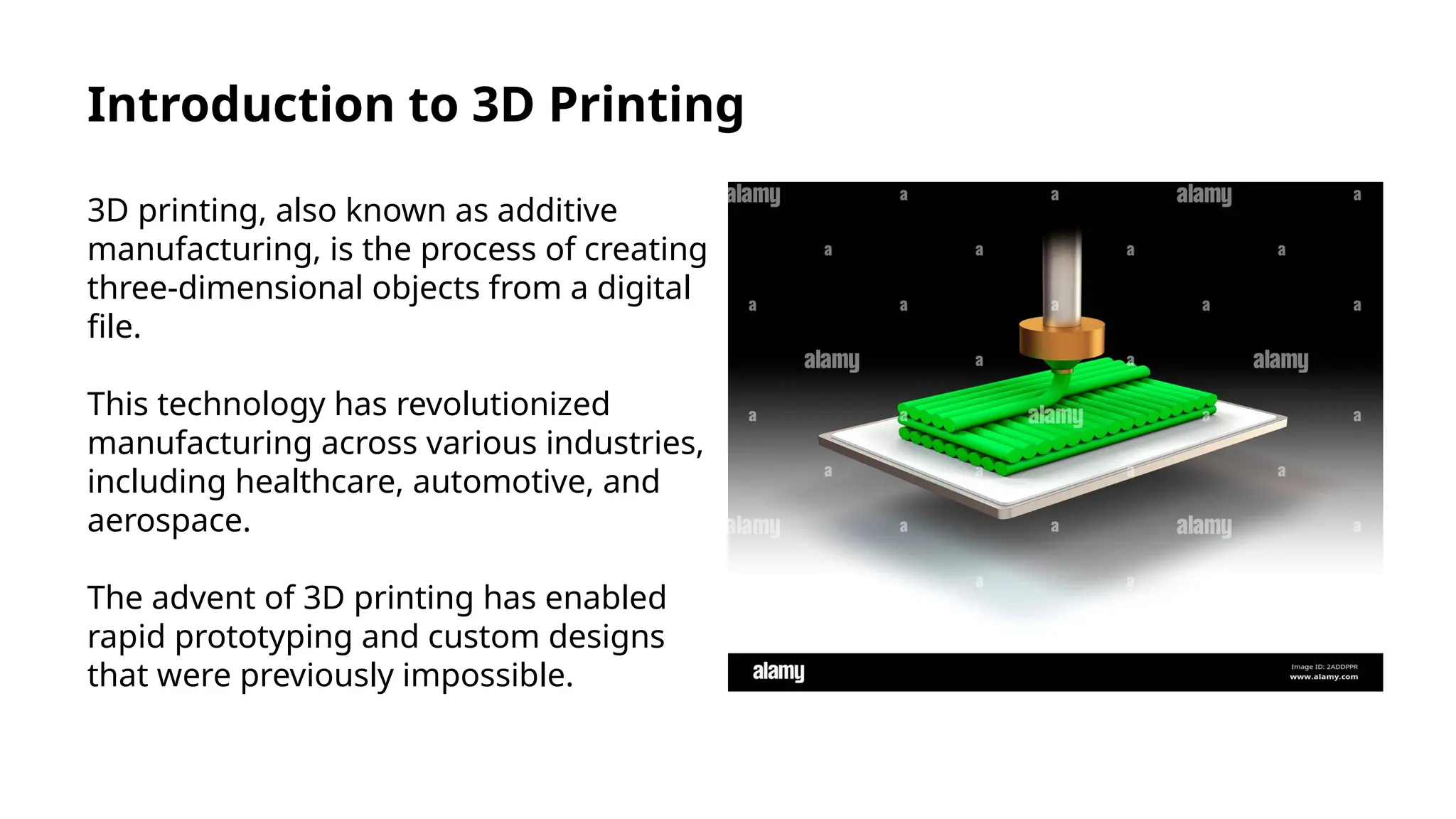
3D printing, also known as additive
manufacturing, is the process of creating
three-dimensional objects from a digital
file.
This technology has revolutionized
manufacturing across various industries,
including healthcare, automotive, and
aerospace.
The advent of 3D printing has enabled
rapid prototyping and custom designs
that were previously impossible.
History of 3D Printing
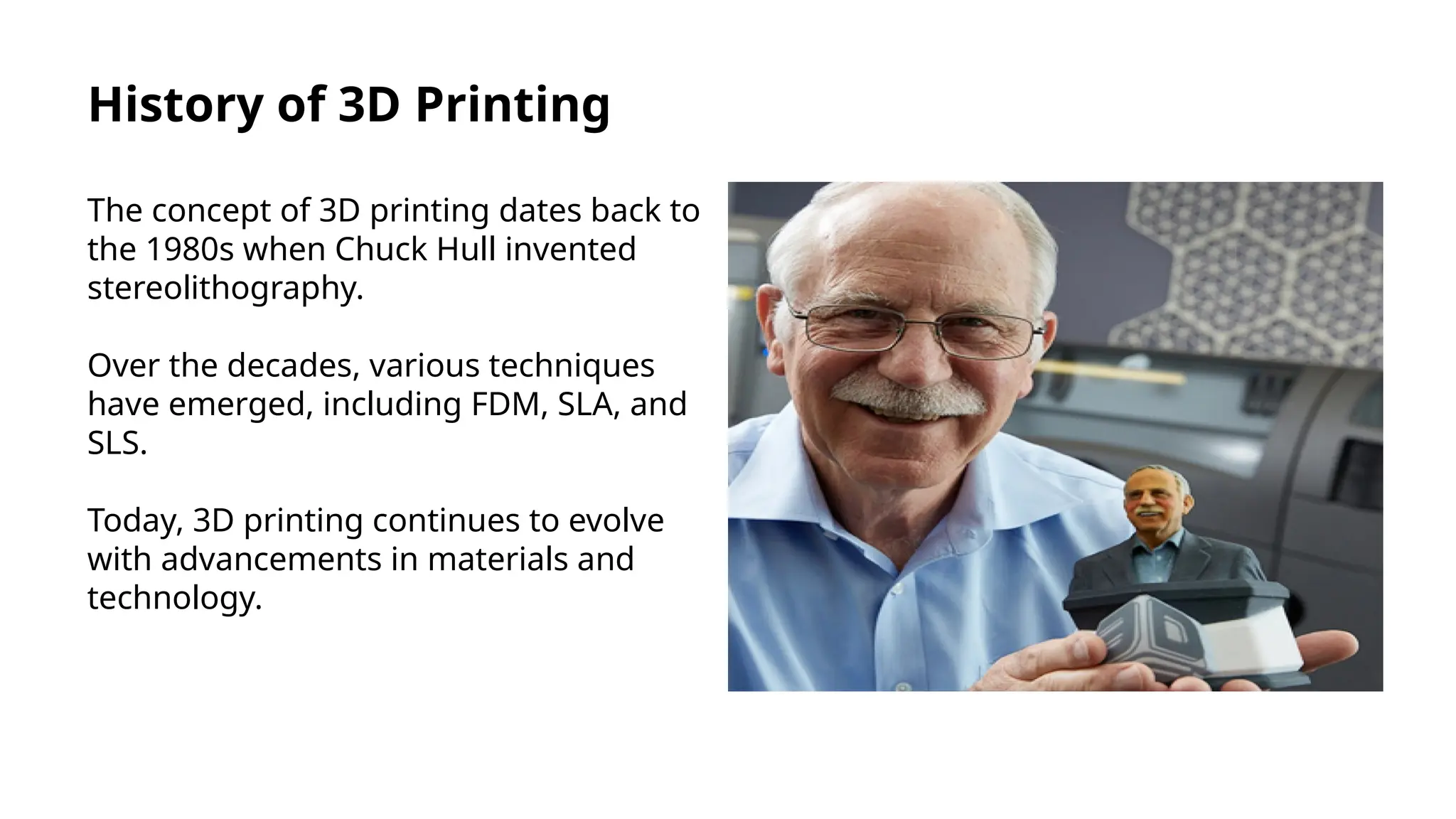
The concept of 3D printing dates back to
the 1980s when Chuck Hull invented
stereolithography.
Over the decades, various techniques
have emerged, including FDM, SLA, and
SLS.
Today, 3D printing continues to evolve
with advancements in materials and
technology.
How 3D Printing Works
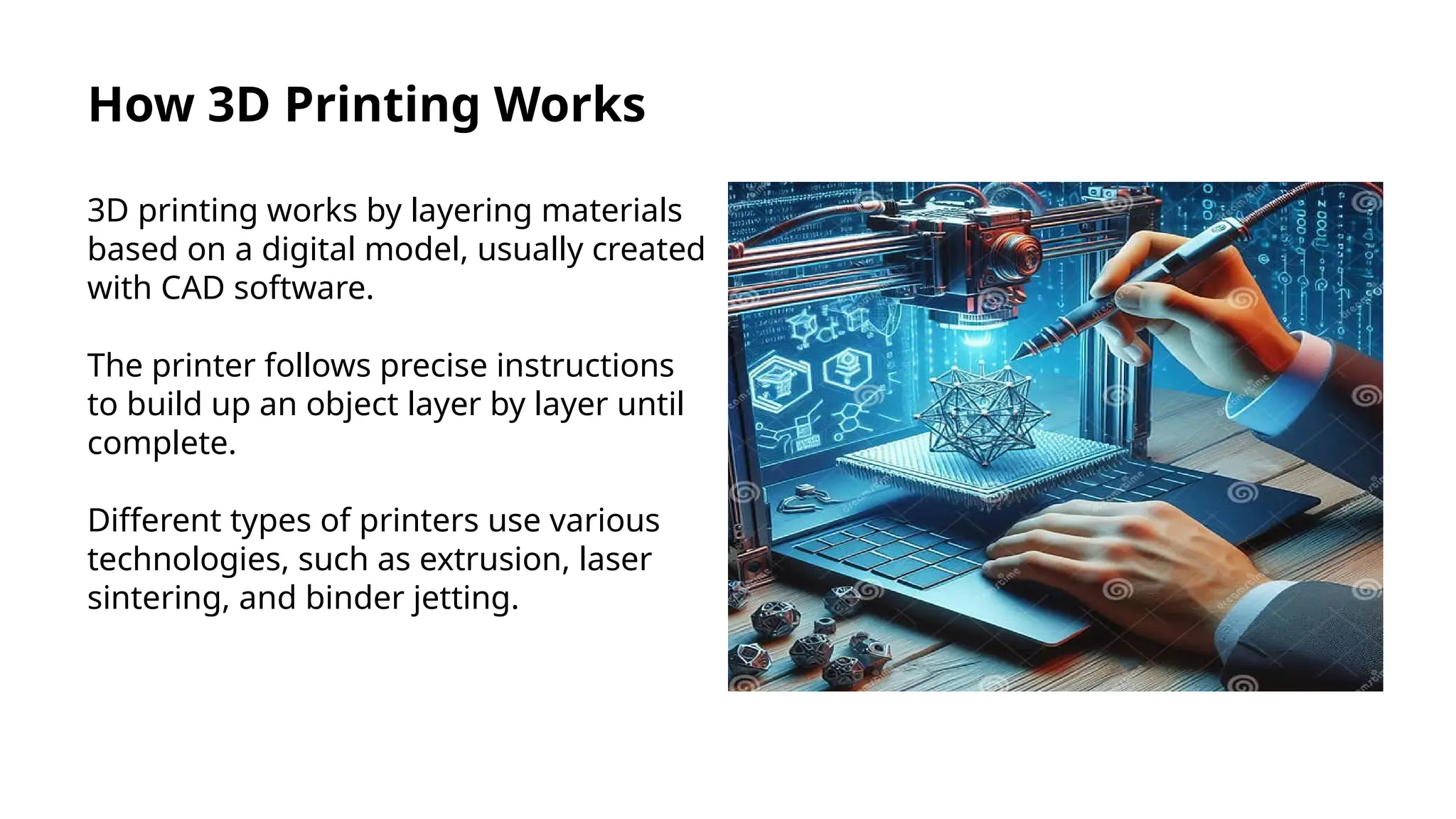
3D printing works by layering materials
based on a digital model, usually created
with CAD software.
The printer follows precise instructions
to build up an object layer by layer until
complete.
Different types of printers use various
technologies, such as extrusion, laser
sintering, and binder jetting.
Types of 3D Printing Technologies
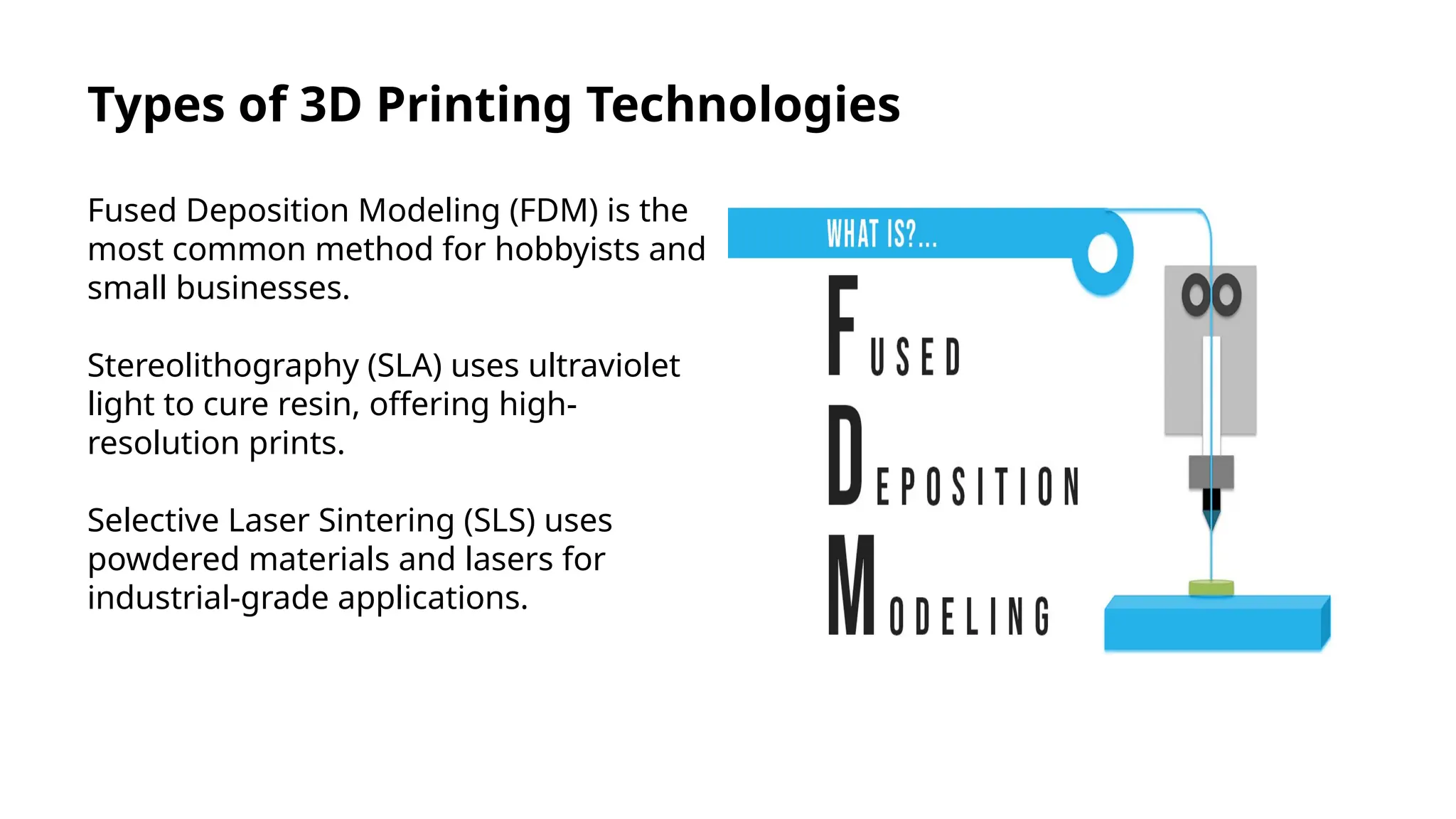
Fused Deposition Modeling (FDM) is the
most common method for hobbyists and
small businesses.
Stereolithography (SLA) uses ultraviolet
light to cure resin, offering high-
resolution prints.
Selective Laser Sintering (SLS) uses
powdered materials and lasers for
industrial-grade applications.
Materials Used in 3D Printing
The most common materials are
thermoplastics such as PLA and ABS,
favored for their ease of use.
Metal powders are utilized in industrial
3D printing, enabling the creation of
complex metal parts.
Advanced materials like ceramics and
composites are becoming increasingly
popular for specialized applications.
Applications in Healthcare
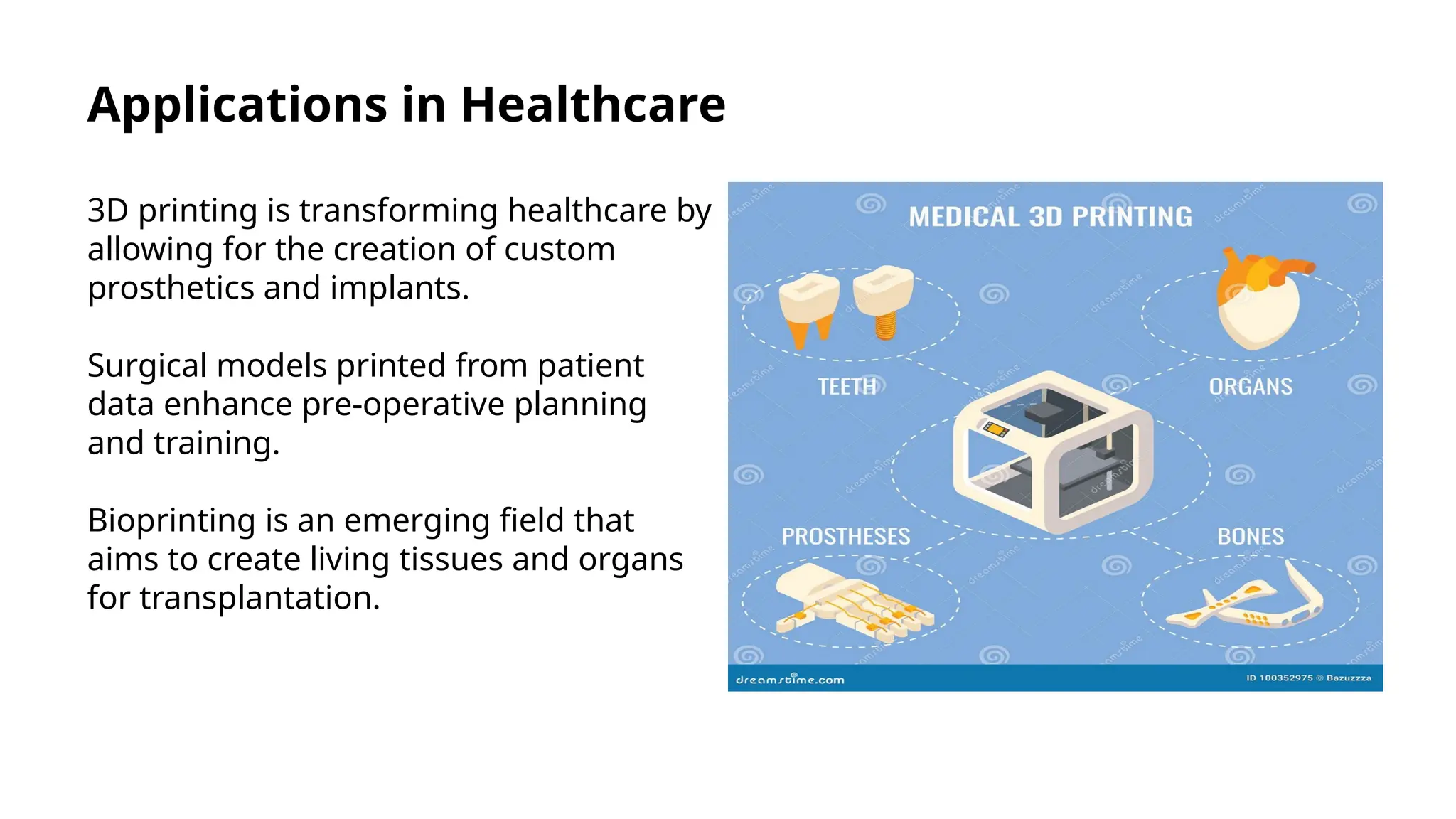
3D printing is transforming healthcare by
allowing for the creation of custom
prosthetics and implants.
Surgical models printed from patient
data enhance pre-operative planning
and training.
Bioprinting is an emerging field that
aims to create living tissues and organs
for transplantation.
Applications in Aerospace
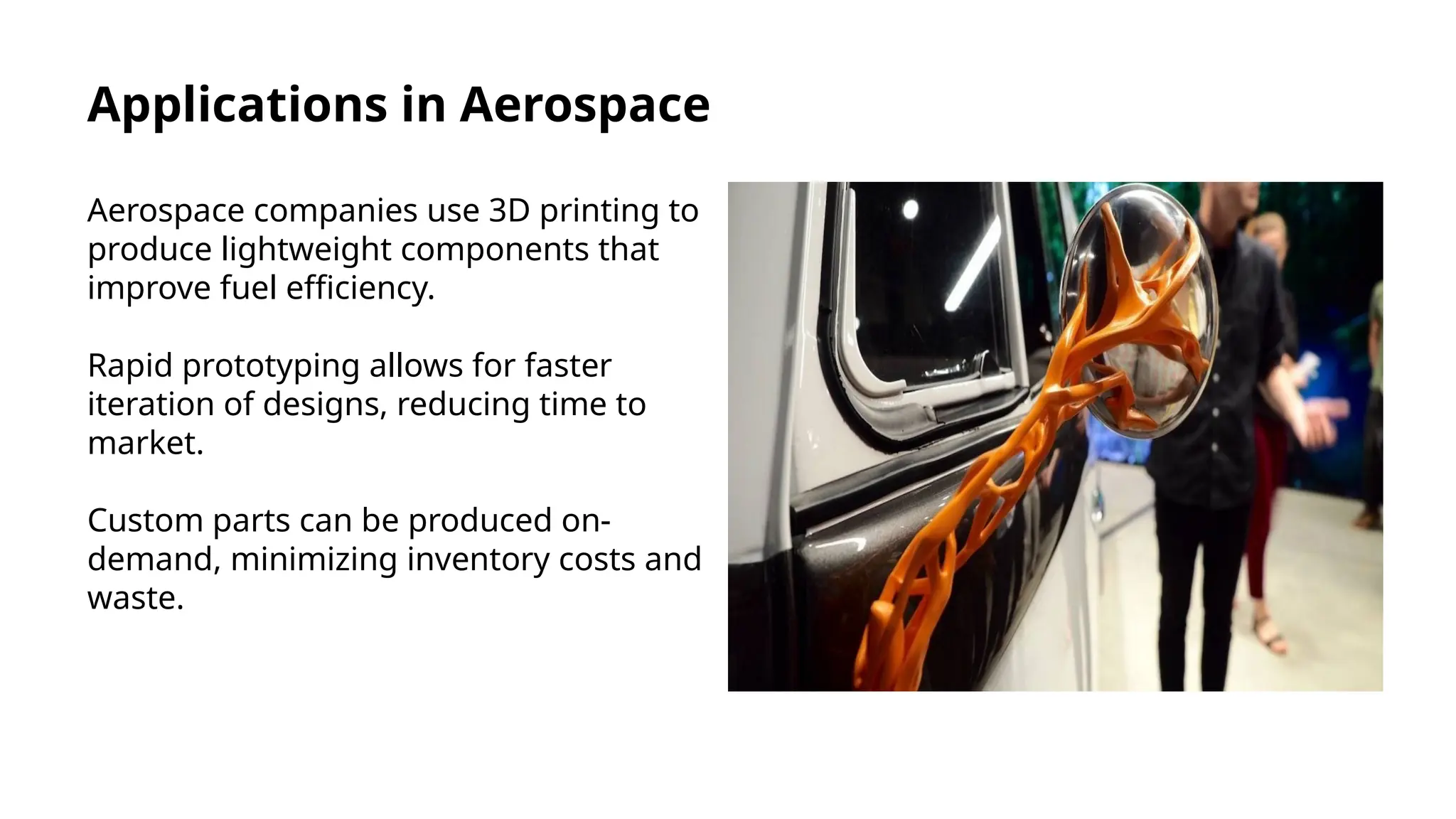
Aerospace companies use 3D printing to
produce lightweight components that
improve fuel efficiency.
Rapid prototyping allows for faster
iteration of designs, reducing time to
market.
Custom parts can be produced on-
demand, minimizing inventory costs and
waste.
Applications in Automotive
The automotive industry leverages 3D
printing for prototyping and testing
vehicle components.
Customization options are expanded,
allowing for tailored designs to meet
consumer preferences.
End-use parts are increasingly being
produced with 3D printing for weight
reduction and performance.
Design Considerations for 3D Printing
Design for additive manufacturing
(DfAM) requires an understanding of the
unique capabilities of 3D printing.
Complex geometries, such as lattice
structures, can be easily achieved
compared to traditional manufacturing.
Designers must consider material
properties and print orientation to
optimize performance.
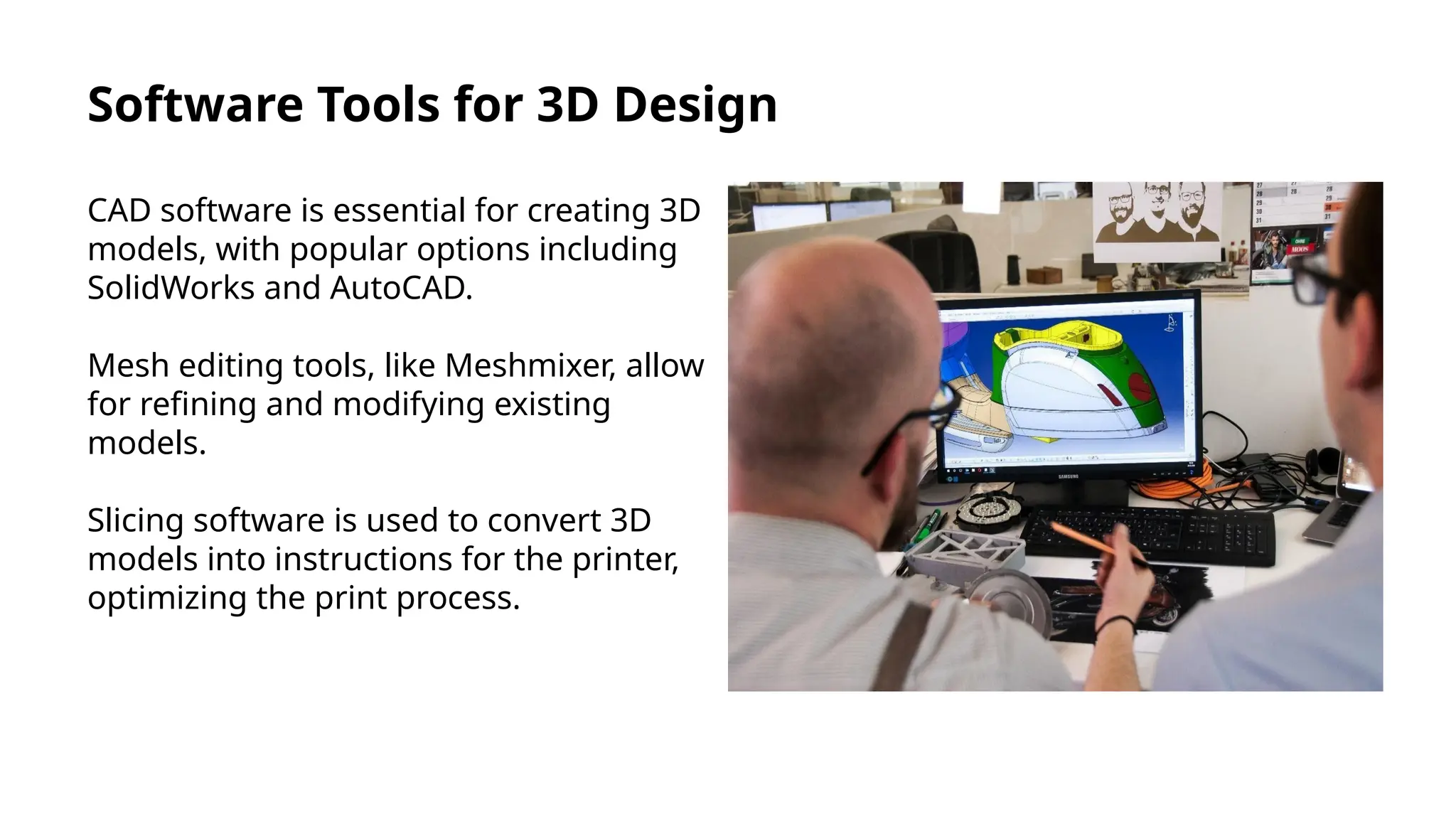
Software Tools for 3D Design
CAD software is essential for creating 3D
models, with popular options including
SolidWorks and AutoCAD.
Mesh editing tools, like Meshmixer, allow
for refining and modifying existing
models.
Slicing software is used to convert 3D
models into instructions for the printer,
optimizing the print process.
The Role of Prototyping
Rapid prototyping expedites the product
development process by allowing for
quick feedback.
Designers can test form, fit, and function
early in the development cycle, saving
time and resources.
Prototypes can be produced in a variety
of materials to simulate final product
characteristics.
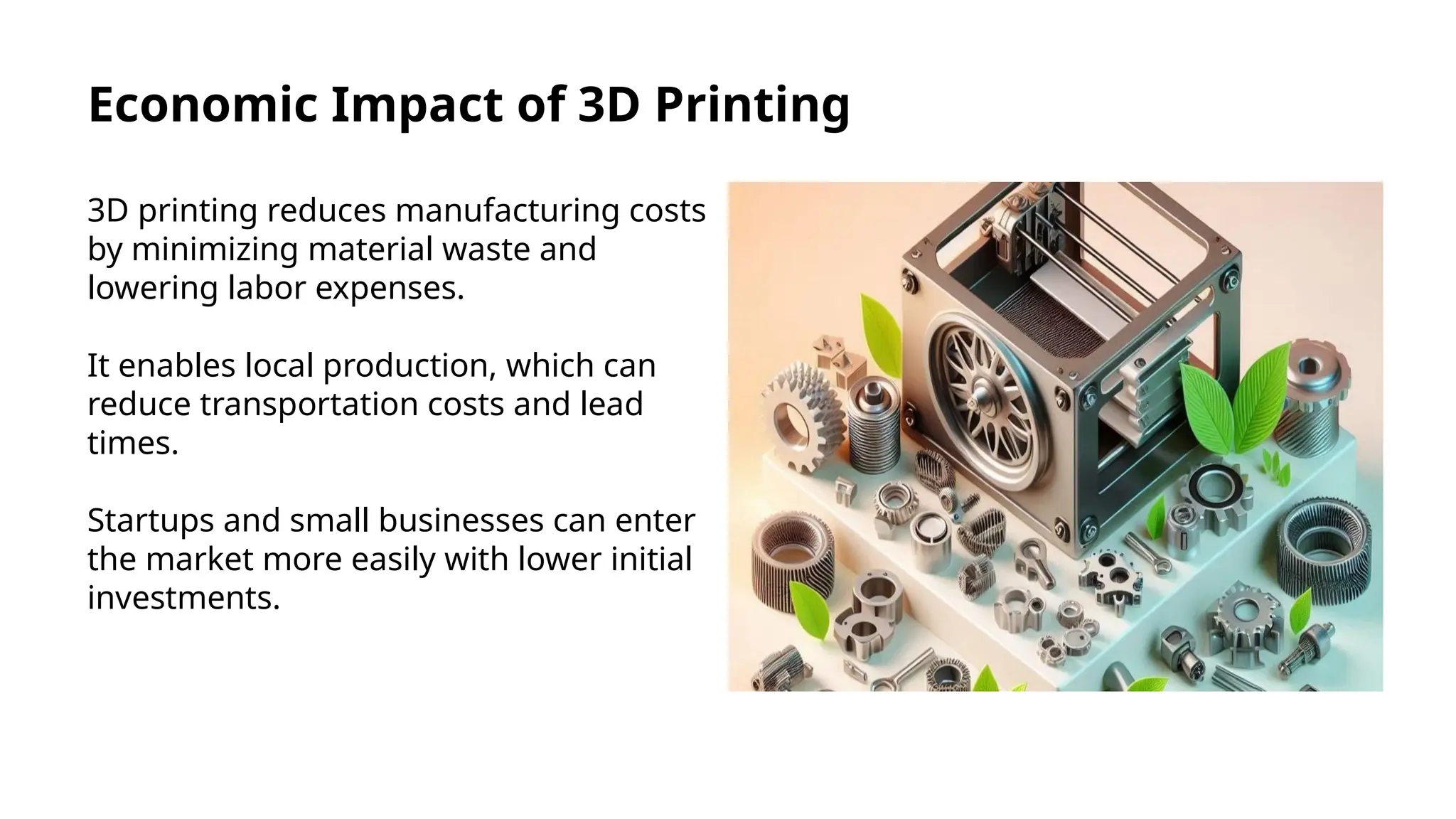
Economic Impact of 3D Printing
3D printing reduces manufacturing costs
by minimizing material waste and
lowering labor expenses.
It enables local production, which can
reduce transportation costs and lead
times.
Startups and small businesses can enter
the market more easily with lower initial
investments.
Challenges and Limitations
While 3D printing offers many
advantages, it also faces challenges,
including speed and scalability.
Material limitations can restrict the range
of applications for certain industries.
Intellectual property concerns arise as
digital files can be easily copied and
distributed.
Future Trends in 3D Printing
The integration of artificial intelligence
and machine learning is poised to
enhance design optimization.
Multi-material printing is expected to
grow, allowing for more complex and
functional parts.
Sustainability initiatives are driving the
development of biodegradable materials
and recycling processes.
3D Printing in Education
Educational institutions are
incorporating 3D printing into curricula
to foster innovation and creativity.
Students can engage in hands-on
learning, developing skills in design and
engineering.
3D printing enables the visualization of
complex concepts, aiding in
understanding and retention.
Community and Maker Movement
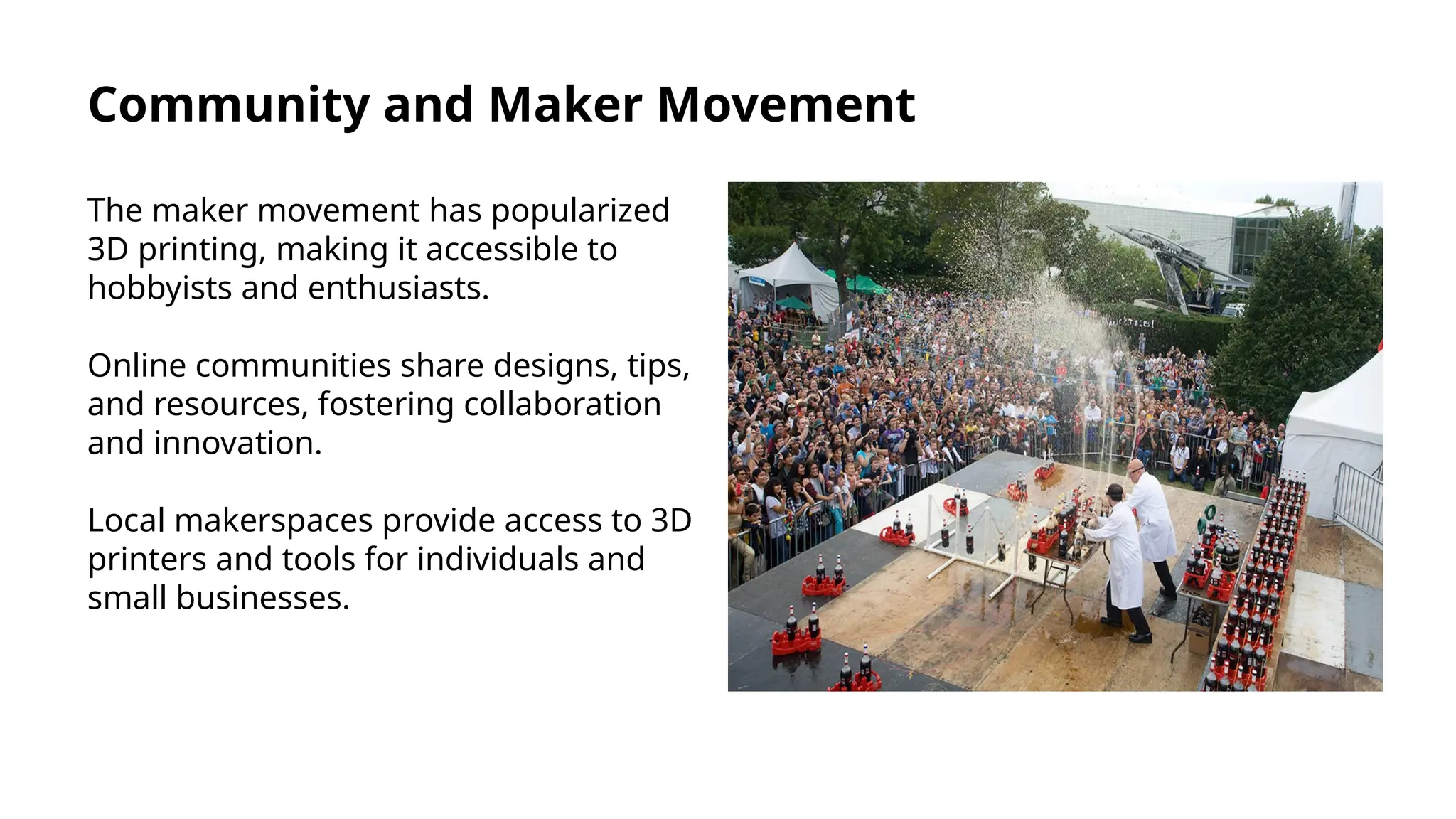
The maker movement has popularized
3D printing, making it accessible to
hobbyists and enthusiasts.
Online communities share designs, tips,
and resources, fostering collaboration
and innovation.
Local makerspaces provide access to 3D
printers and tools for individuals and
small businesses.
Case Studies of Successful 3D Printing
Companies like GE have successfully
integrated 3D printing into their
manufacturing processes for jet engines.
Prosthetics companies are creating
affordable, custom solutions that
significantly improve patient quality of
life.
Fashion brands are experimenting with
3D-printed accessories that push the
boundaries of traditional design.
Regulatory and Safety Considerations
As 3D printing technology evolves,
regulations surrounding its use are
becoming more defined.
Safety standards are essential to ensure
the quality and reliability of printed
products, particularly in critical
applications.
Intellectual property law must adapt to
address the challenges posed by digital
fabrication.
Conclusion
3D printing is a transformative
technology that continues to shape the
future of manufacturing and design.
The opportunities it presents are vast,
spanning various industries and
applications.
As technology advances, the potential
for innovation and creativity in 3D
printing will only expand.
Questions and Discussion
Thank you for your attention; I’d like to
open the floor for any questions or
comments.
Feel free to share your thoughts on the
potential of 3D printing in your field.
Let's discuss how we can leverage 3D
printing to solve real-world problems
together.
Feel free to modify or expand upon any
of the slides to better fit your needs!
3D Printing And Design hanshsjakcsnsubsjye

  • 1.
    3D Printing AndDesign SlideMake.com
  • 2.
    Introduction to 3DPrinting 3D printing, also known as additive manufacturing, is the process of creating three-dimensional objects from a digital file. This technology has revolutionized manufacturing across various industries, including healthcare, automotive, and aerospace. The advent of 3D printing has enabled rapid prototyping and custom designs that were previously impossible.
  • 3.
    History of 3DPrinting The concept of 3D printing dates back to the 1980s when Chuck Hull invented stereolithography. Over the decades, various techniques have emerged, including FDM, SLA, and SLS. Today, 3D printing continues to evolve with advancements in materials and technology.
  • 4.
    How 3D PrintingWorks 3D printing works by layering materials based on a digital model, usually created with CAD software. The printer follows precise instructions to build up an object layer by layer until complete. Different types of printers use various technologies, such as extrusion, laser sintering, and binder jetting.
  • 5.
    Types of 3DPrinting Technologies Fused Deposition Modeling (FDM) is the most common method for hobbyists and small businesses. Stereolithography (SLA) uses ultraviolet light to cure resin, offering high- resolution prints. Selective Laser Sintering (SLS) uses powdered materials and lasers for industrial-grade applications.
  • 6.
    Materials Used in3D Printing The most common materials are thermoplastics such as PLA and ABS, favored for their ease of use. Metal powders are utilized in industrial 3D printing, enabling the creation of complex metal parts. Advanced materials like ceramics and composites are becoming increasingly popular for specialized applications.
  • 7.
    Applications in Healthcare 3Dprinting is transforming healthcare by allowing for the creation of custom prosthetics and implants. Surgical models printed from patient data enhance pre-operative planning and training. Bioprinting is an emerging field that aims to create living tissues and organs for transplantation.
  • 8.
    Applications in Aerospace Aerospacecompanies use 3D printing to produce lightweight components that improve fuel efficiency. Rapid prototyping allows for faster iteration of designs, reducing time to market. Custom parts can be produced on- demand, minimizing inventory costs and waste.
  • 9.
    Applications in Automotive Theautomotive industry leverages 3D printing for prototyping and testing vehicle components. Customization options are expanded, allowing for tailored designs to meet consumer preferences. End-use parts are increasingly being produced with 3D printing for weight reduction and performance.
  • 10.
    Design Considerations for3D Printing Design for additive manufacturing (DfAM) requires an understanding of the unique capabilities of 3D printing. Complex geometries, such as lattice structures, can be easily achieved compared to traditional manufacturing. Designers must consider material properties and print orientation to optimize performance.
  • 11.
    Software Tools for3D Design CAD software is essential for creating 3D models, with popular options including SolidWorks and AutoCAD. Mesh editing tools, like Meshmixer, allow for refining and modifying existing models. Slicing software is used to convert 3D models into instructions for the printer, optimizing the print process.
  • 12.
    The Role ofPrototyping Rapid prototyping expedites the product development process by allowing for quick feedback. Designers can test form, fit, and function early in the development cycle, saving time and resources. Prototypes can be produced in a variety of materials to simulate final product characteristics.
  • 13.
    Economic Impact of3D Printing 3D printing reduces manufacturing costs by minimizing material waste and lowering labor expenses. It enables local production, which can reduce transportation costs and lead times. Startups and small businesses can enter the market more easily with lower initial investments.
  • 14.
    Challenges and Limitations While3D printing offers many advantages, it also faces challenges, including speed and scalability. Material limitations can restrict the range of applications for certain industries. Intellectual property concerns arise as digital files can be easily copied and distributed.
  • 15.
    Future Trends in3D Printing The integration of artificial intelligence and machine learning is poised to enhance design optimization. Multi-material printing is expected to grow, allowing for more complex and functional parts. Sustainability initiatives are driving the development of biodegradable materials and recycling processes.
  • 16.
    3D Printing inEducation Educational institutions are incorporating 3D printing into curricula to foster innovation and creativity. Students can engage in hands-on learning, developing skills in design and engineering. 3D printing enables the visualization of complex concepts, aiding in understanding and retention.
  • 17.
    Community and MakerMovement The maker movement has popularized 3D printing, making it accessible to hobbyists and enthusiasts. Online communities share designs, tips, and resources, fostering collaboration and innovation. Local makerspaces provide access to 3D printers and tools for individuals and small businesses.
  • 18.
    Case Studies ofSuccessful 3D Printing Companies like GE have successfully integrated 3D printing into their manufacturing processes for jet engines. Prosthetics companies are creating affordable, custom solutions that significantly improve patient quality of life. Fashion brands are experimenting with 3D-printed accessories that push the boundaries of traditional design.
  • 19.
    Regulatory and SafetyConsiderations As 3D printing technology evolves, regulations surrounding its use are becoming more defined. Safety standards are essential to ensure the quality and reliability of printed products, particularly in critical applications. Intellectual property law must adapt to address the challenges posed by digital fabrication.
  • 20.
    Conclusion 3D printing isa transformative technology that continues to shape the future of manufacturing and design. The opportunities it presents are vast, spanning various industries and applications. As technology advances, the potential for innovation and creativity in 3D printing will only expand.
  • 21.
    Questions and Discussion Thankyou for your attention; I’d like to open the floor for any questions or comments. Feel free to share your thoughts on the potential of 3D printing in your field. Let's discuss how we can leverage 3D printing to solve real-world problems together. Feel free to modify or expand upon any of the slides to better fit your needs!
Editor's Notes

  • #2 Image source: https://c8.alamy.com
  • #3 Image source: https://3dprintingindustry.com
  • #4 Image source: https://thumbs.dreamstime.com
  • #5 Image source: https://cdn.goengineer.com
  • #6 Image source: https://3dinsider.com
  • #7 Image source: https://thumbs.dreamstime.com
  • #8 Image source: https://i.all3dp.com
  • #9 Image source: https://res.cloudinary.com
  • #10 Image source: https://img.machinedesign.com
  • #11 Image source: https://www.softwaresuggest.com
  • #12 Image source: https://thumbs.dreamstime.com
  • #13 Image source: https://protoandgo.com
  • #14 Image source: https://www.pharmaexcipients.com
  • #15 Image source: https://www.slidemake.com
  • #16 Image source: https://static.wixstatic.com
  • #17 Image source: https://makertech.dk
  • #18 Image source: https://www.slidemake.com
  • #19 Image source: https://www.slidemake.com
  • #20 Image source: https://www.slidemake.com
  • #21 Image source: https://michaelgerharz.com