By Susmita Pandey

1


Dvb.



Dvb –t2 history.



Dvb-t2 modulator.



Architecture model.



Key technologies.



Comparison.



Conclusion.
2


Include DVB-S, DVB-S2, DVB-C, DVB-T and DVBT 2.



DVB-T stands for Digital Video Broadcasting –
Terrestrial.



These standards define the physical layer and data link
layer of the distribution system.



Transmits a compressed digital audio/video
stream, using OFDM modulation with concatenated
channel coding .
3
 The

first country that deployed DVB-T2 is the
UK, launched in March 2010.

 Launched

in Italy, Sweden, and Finland in 2010

and 2011.


Outside of Europe DVB-T2 pay-TV services were
launched in Zambia, Nigeria, Kenya.

 Trials

are currently taking place across the globe, it
is thought to be installed in India by 2014.
4
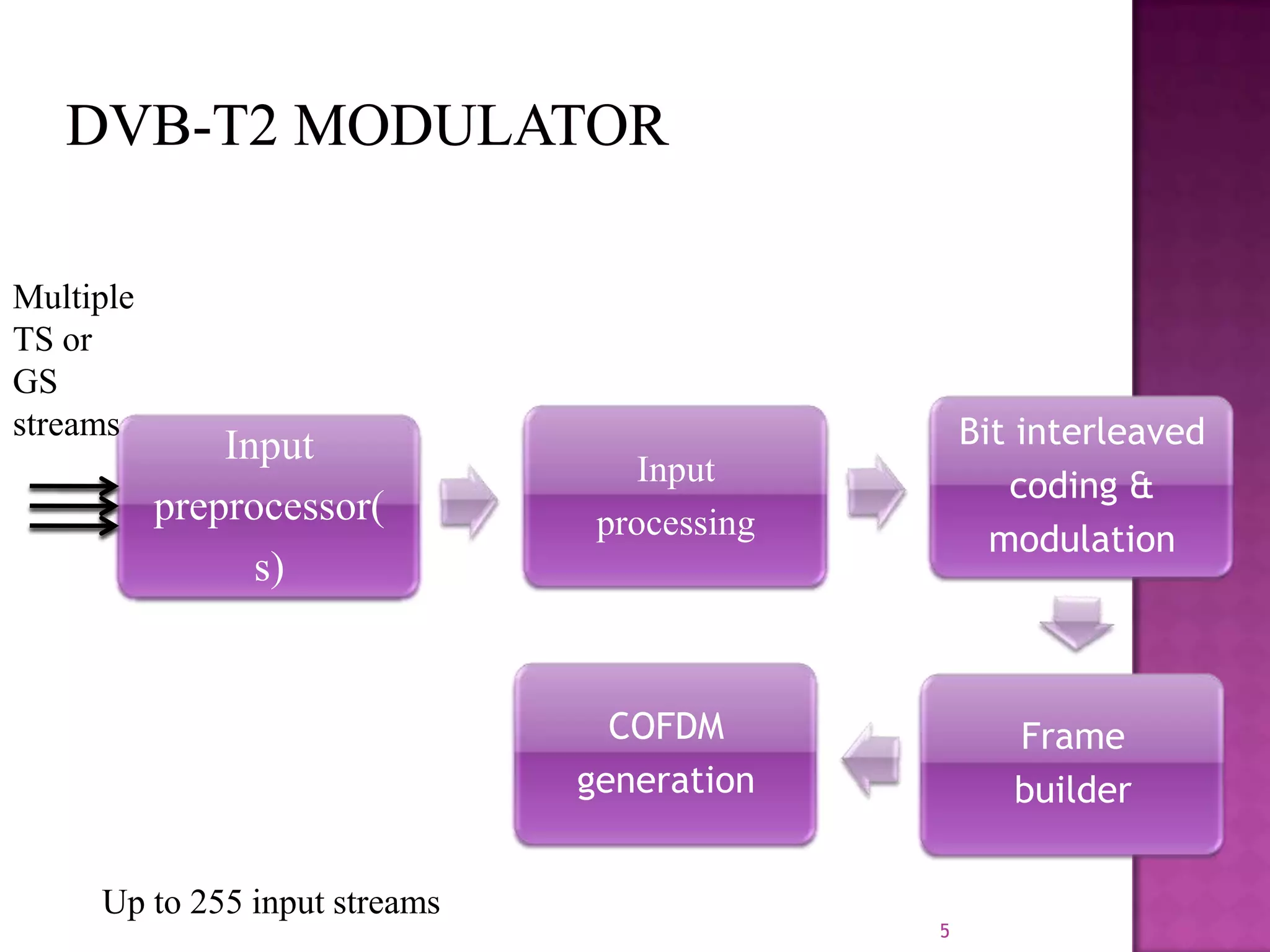
Multiple
TS or
GS
streams

Up to 255 input streams

Input
processing

Bit interleaved
coding &
modulation

COFDM
generation

Input
preprocessor(
s)

Frame
builder

5
6
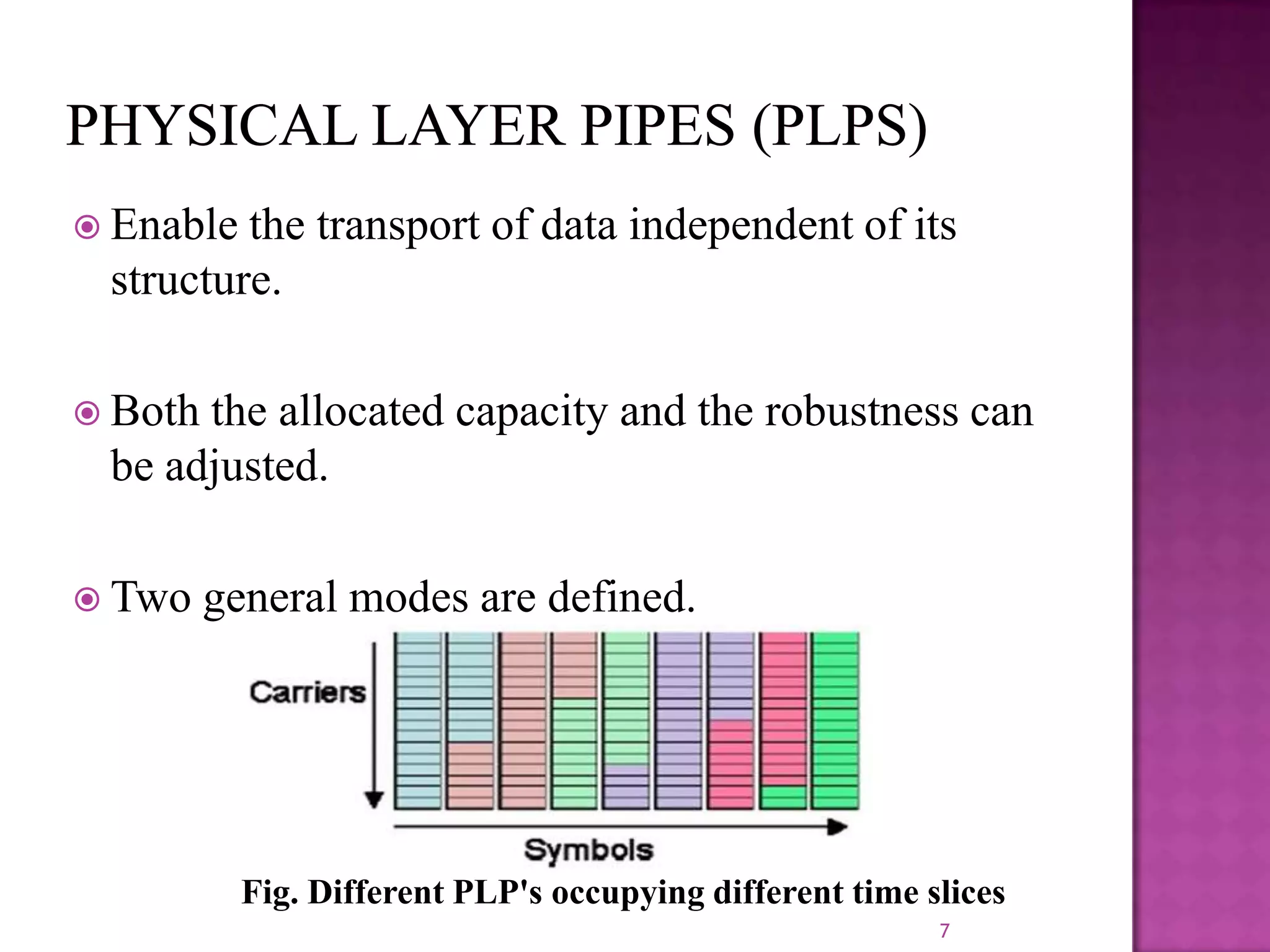
 Enable

the transport of data independent of its
structure.

 Both

the allocated capacity and the robustness can
be adjusted.

 Two

general modes are defined.

Fig. Different PLP's occupying different time slices
7
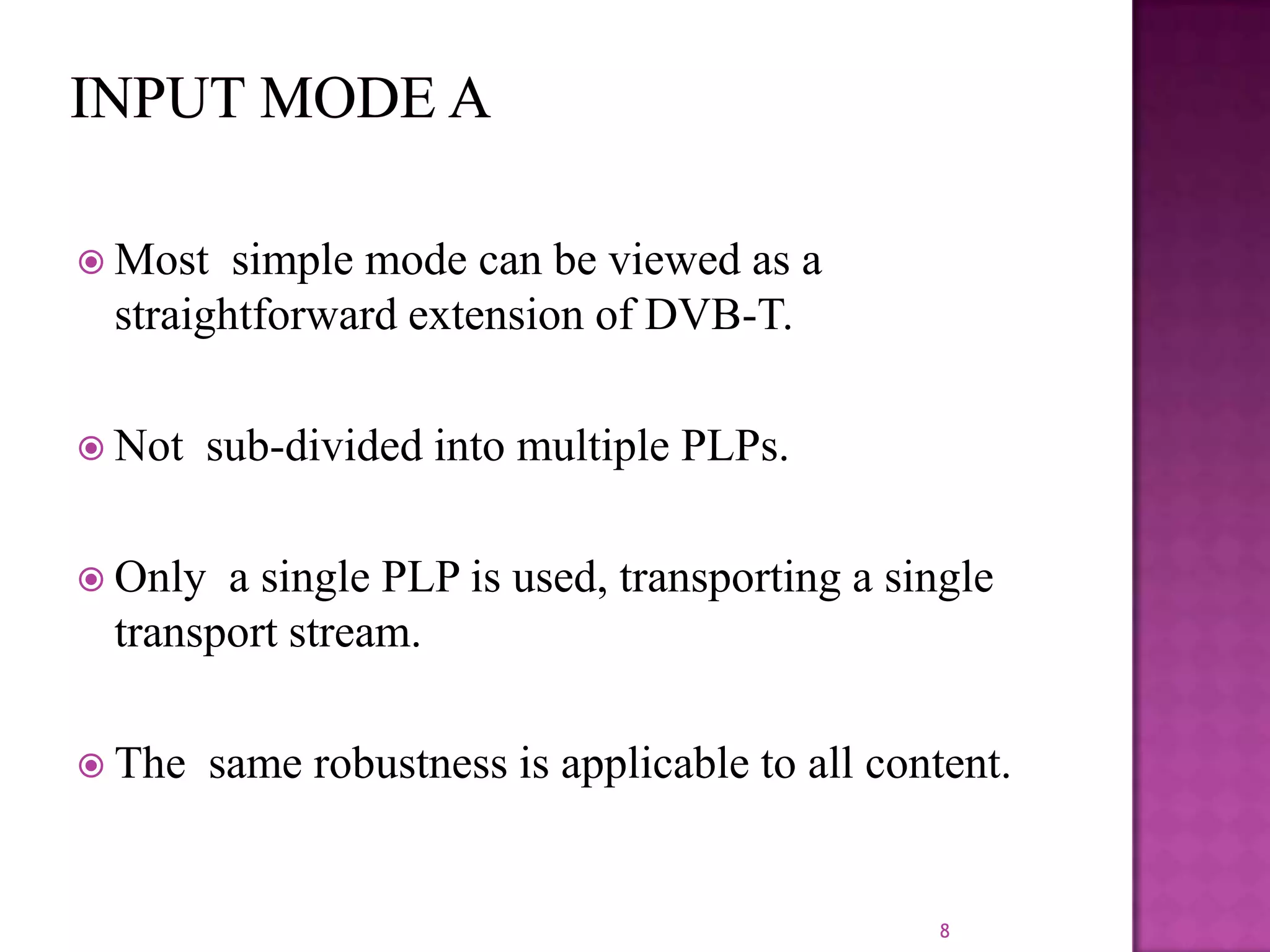
 Most

simple mode can be viewed as a
straightforward extension of DVB-T.

 Not

sub-divided into multiple PLPs.

 Only

a single PLP is used, transporting a single
transport stream.

 The

same robustness is applicable to all content.

8
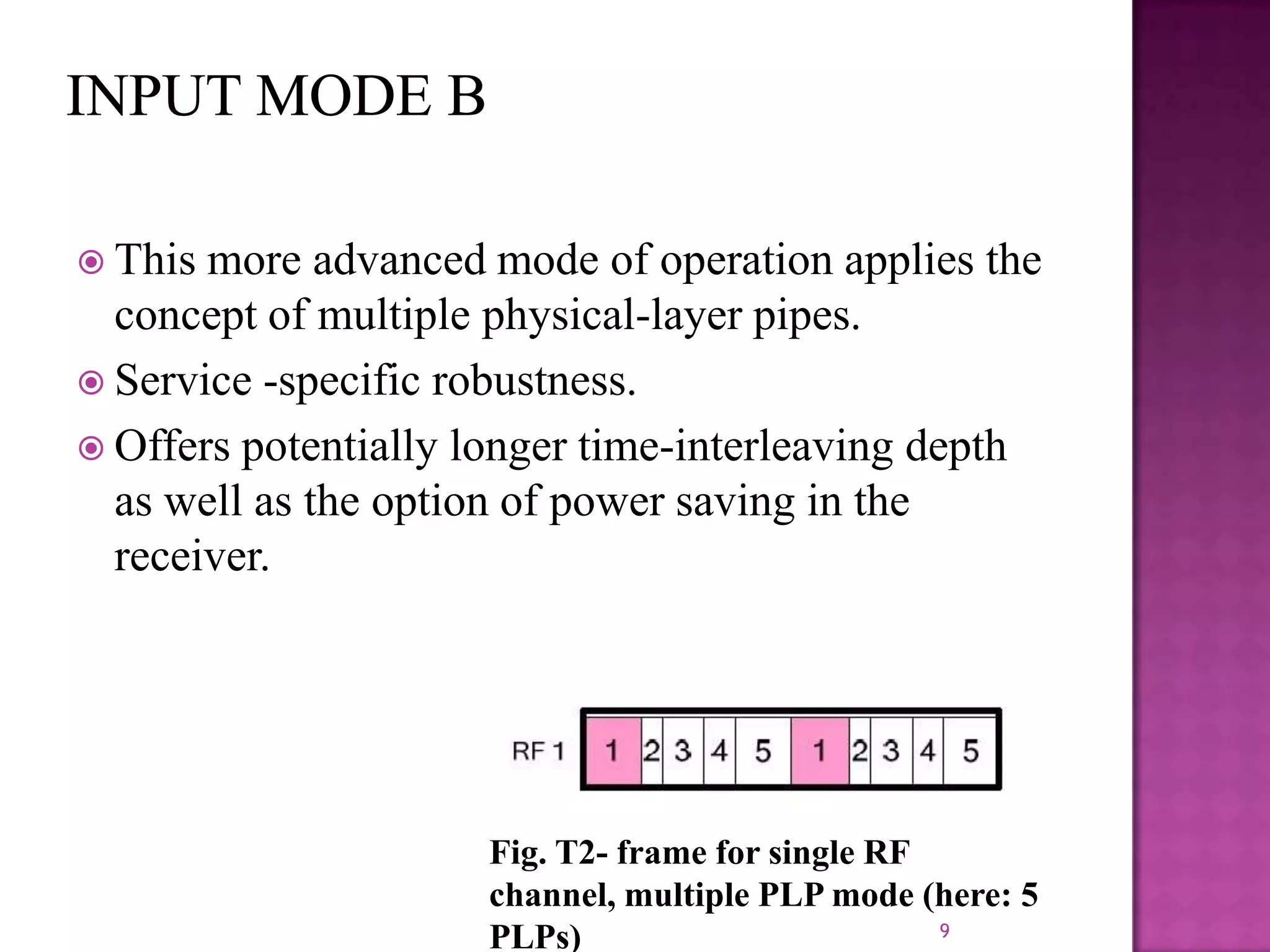
 This

more advanced mode of operation applies the
concept of multiple physical-layer pipes.
 Service -specific robustness.
 Offers potentially longer time-interleaving depth
as well as the option of power saving in the
receiver.

Fig. T2- frame for single RF
channel, multiple PLP mode (here: 5
9
PLPs)
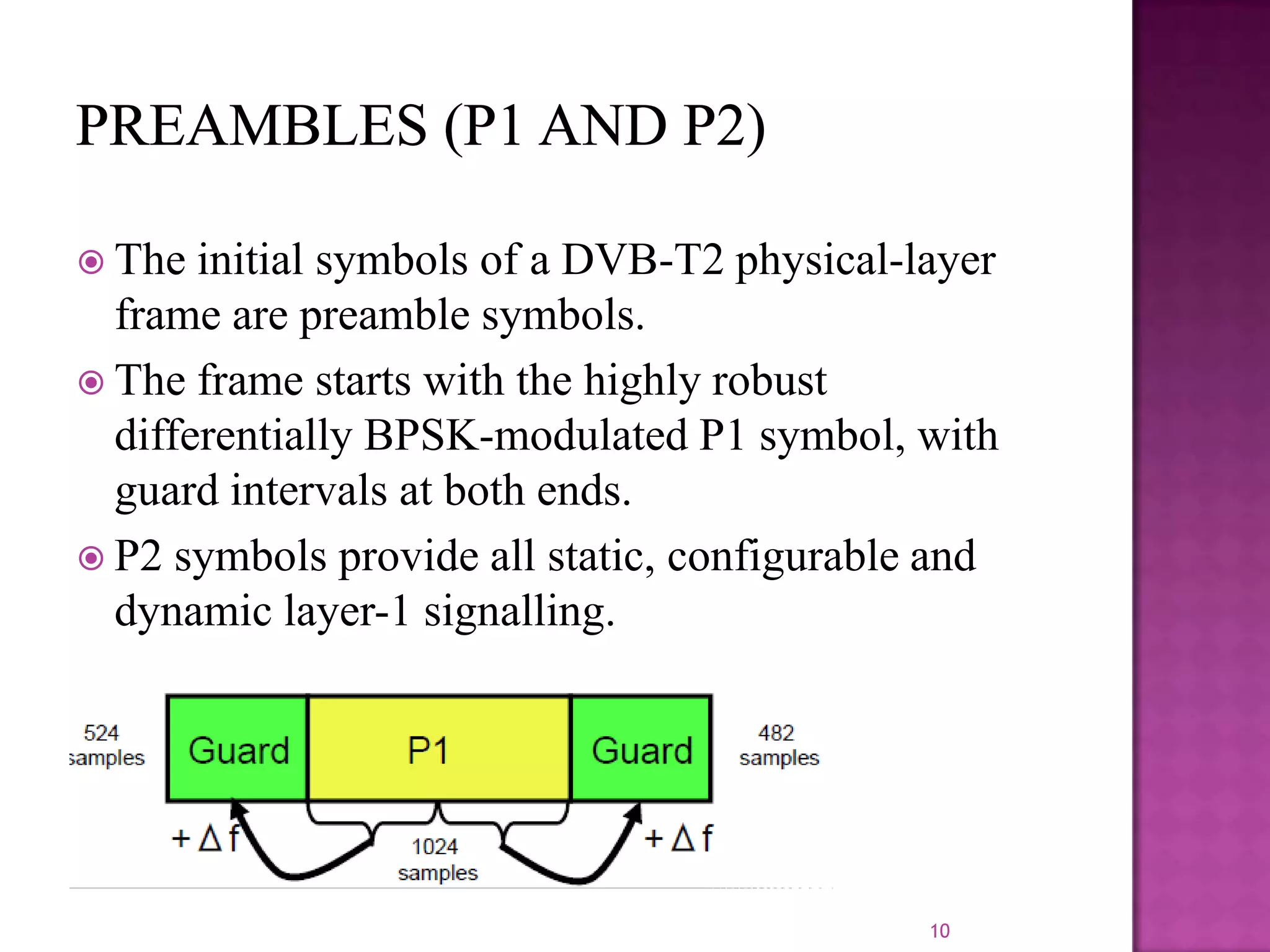
 The

initial symbols of a DVB-T2 physical-layer
frame are preamble symbols.
 The frame starts with the highly robust
differentially BPSK-modulated P1 symbol, with
guard intervals at both ends.
 P2 symbols provide all static, configurable and
dynamic layer-1 signalling.

10


Bit interleaver after FEC based on a LDPC word.

 Cell

interleaver after mapping based on a FEC frame.

 Time

interleaver after cell interleaver based on a TI frame.

 Frequency

interleaver before IFFT based on a symbol

11
12
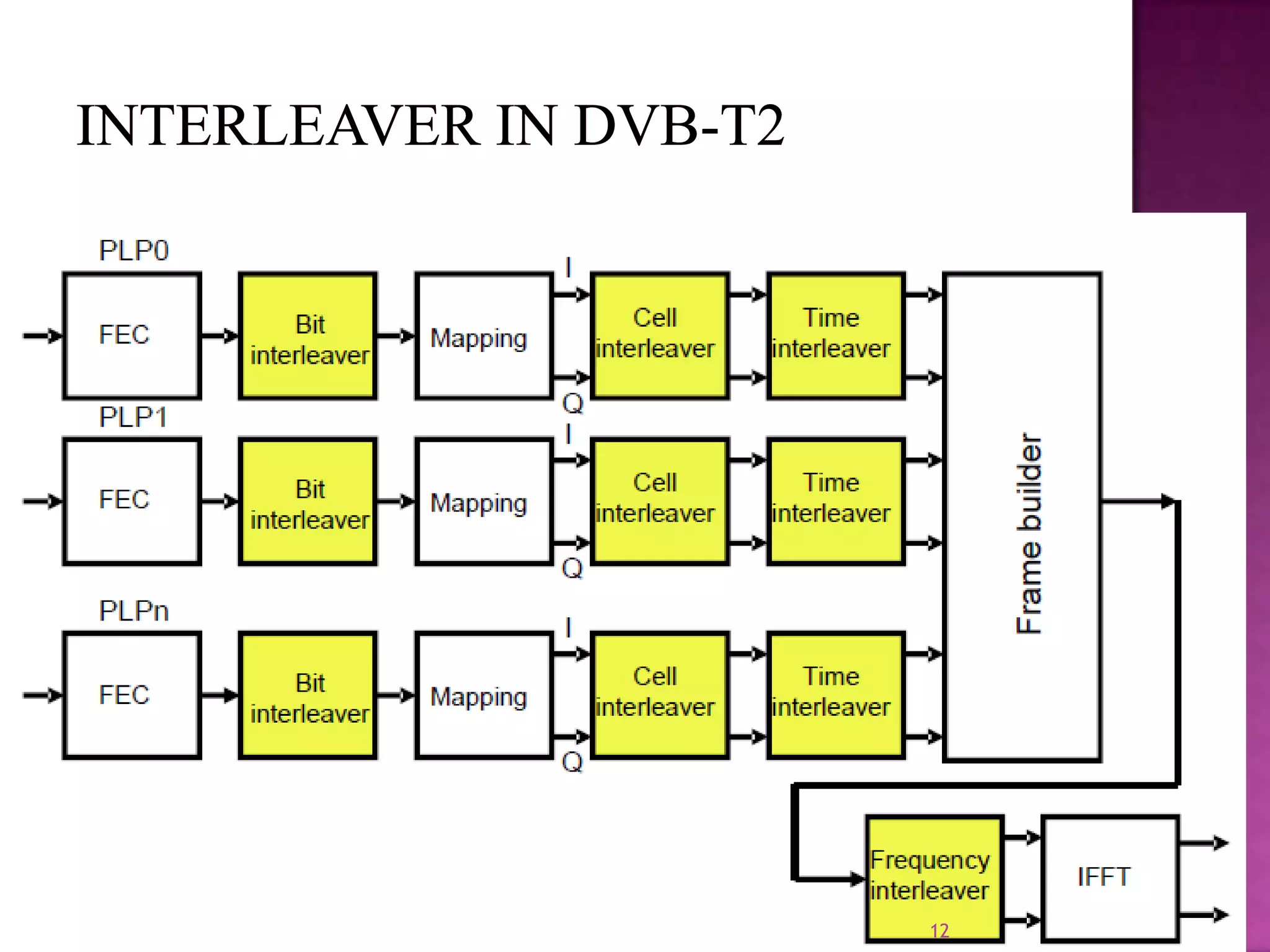
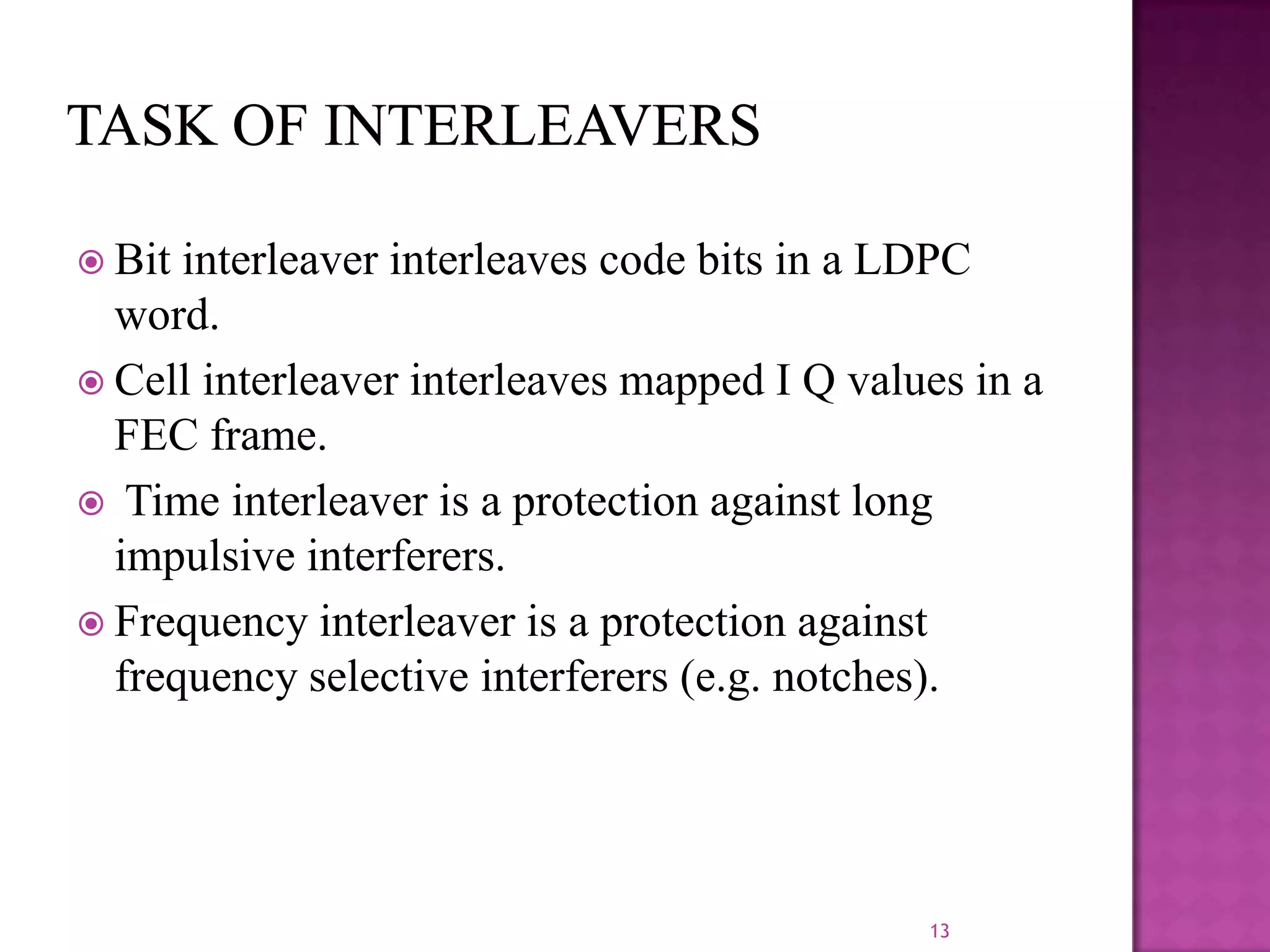
 Bit

interleaver interleaves code bits in a LDPC
word.
 Cell interleaver interleaves mapped I Q values in a
FEC frame.
 Time interleaver is a protection against long
impulsive interferers.
 Frequency interleaver is a protection against
frequency selective interferers (e.g. notches).

13
14
15
16
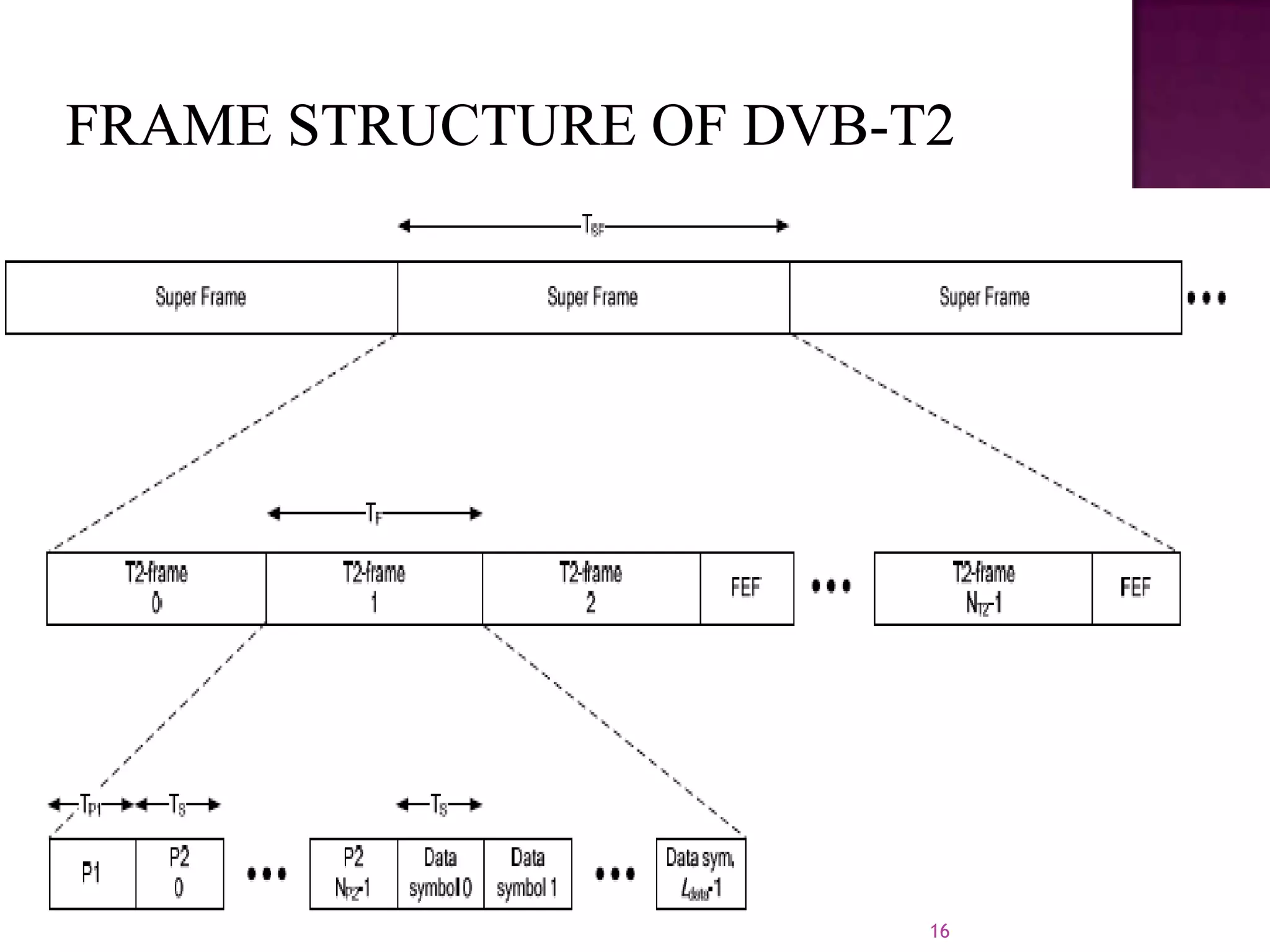
 Largest

entity of a DVB-T2 system.

 Carries

T2-frames and may also carry FutureExtension Frame (FEF).

 The

maximum number of T2-frames in a super
frame is 255.

 The

maximum length of a T2-frame is 250 ms and
the maximum length of a FEF part is 250 ms.
17
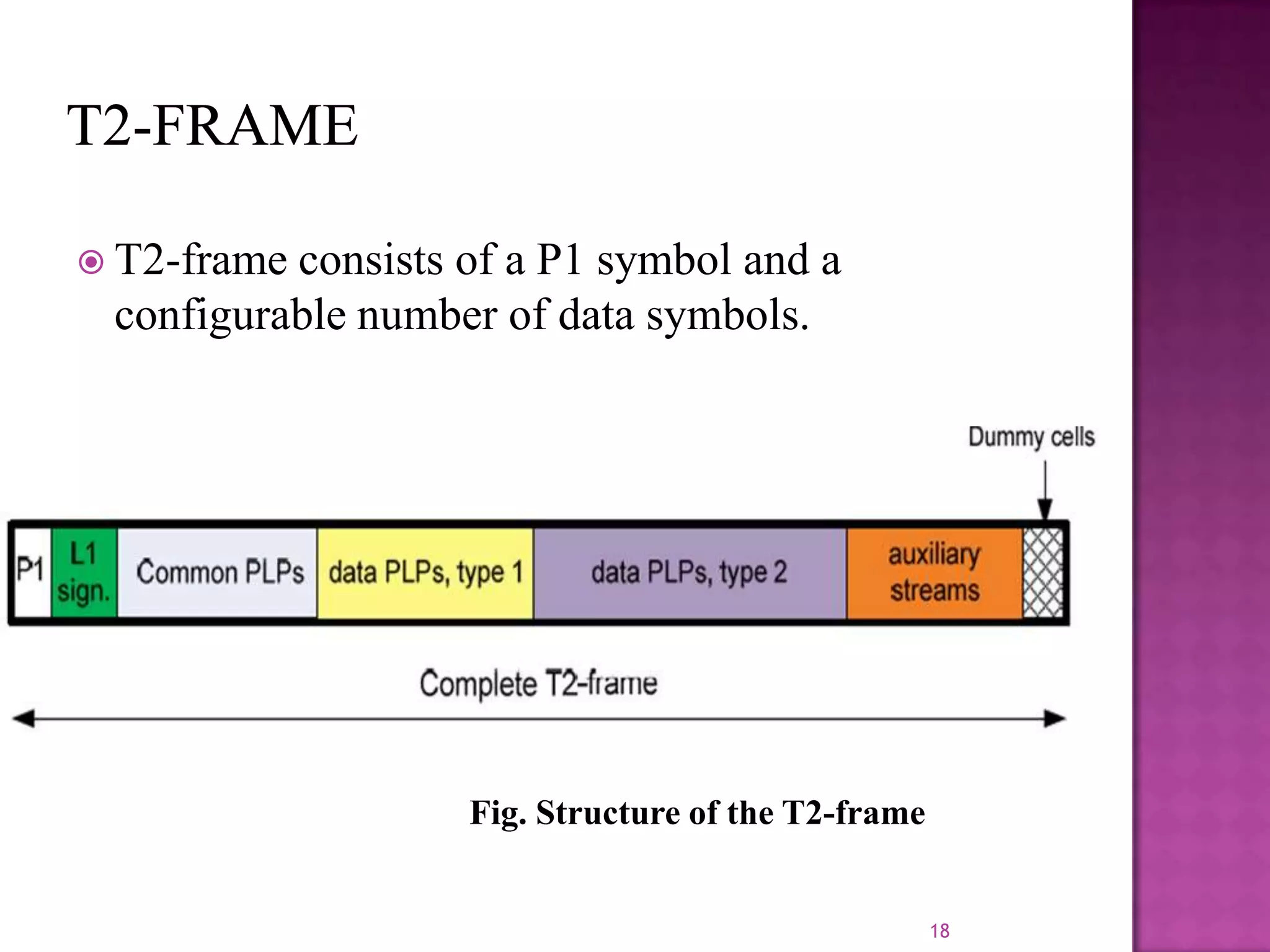
 T2-frame

consists of a P1 symbol and a
configurable number of data symbols.

Fig. Structure of the T2-frame
18
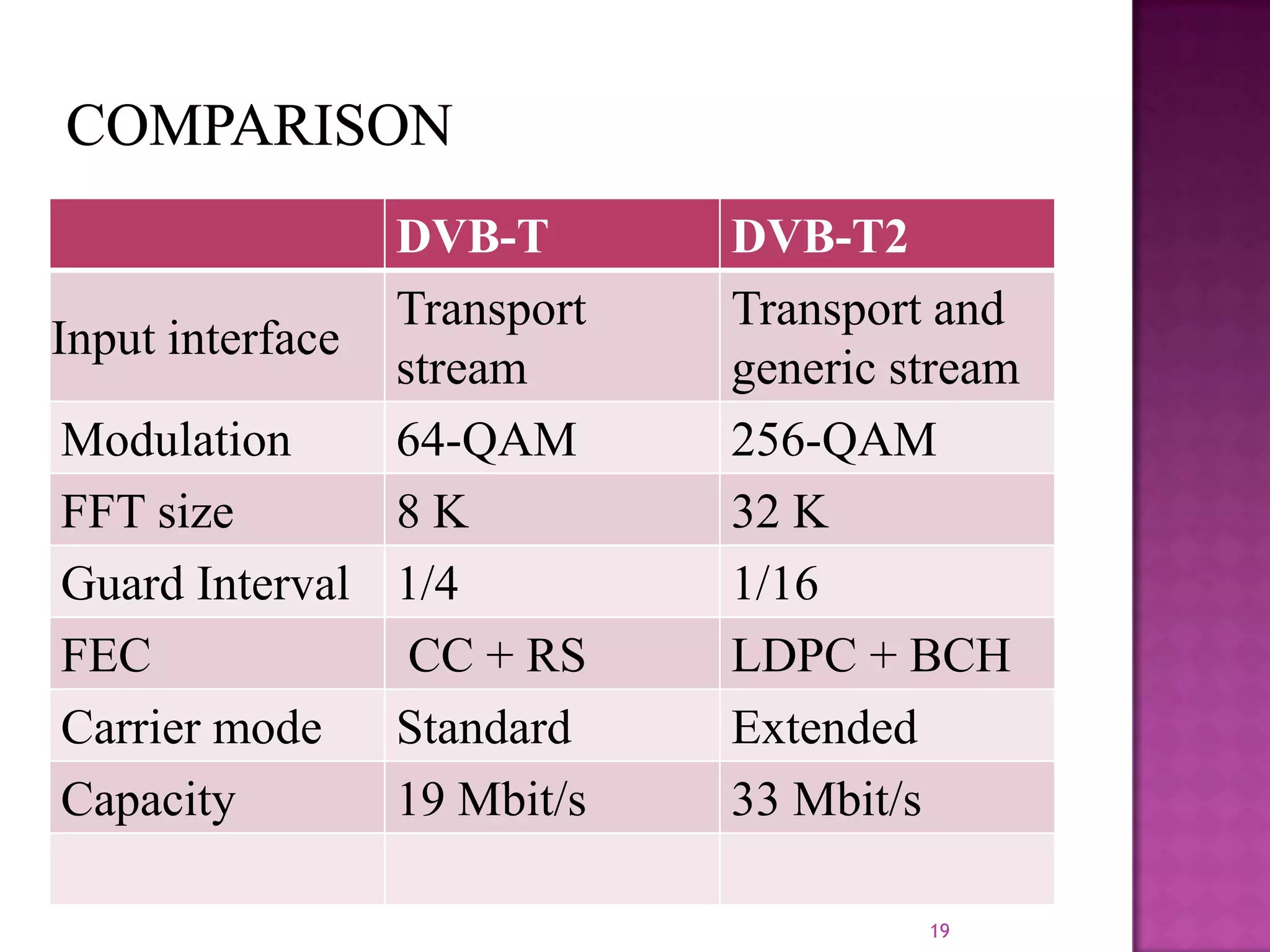
DVB-T
Transport
Input interface
stream
Modulation
64-QAM
FFT size
8K
Guard Interval 1/4
FEC
CC + RS
Carrier mode Standard
Capacity
19 Mbit/s

DVB-T2
Transport and
generic stream
256-QAM
32 K
1/16
LDPC + BCH
Extended
33 Mbit/s
19
 The

availability of the DVB-T2 standard brings
new opportunities for the terrestrial television
delivery platform.

 Broadcasters

consider offering new services on the
DTT platform which would have been difficult
given the limited frequency capacity available in
the VHF and UHF frequency bands.

 It

can be expected that the DVB-T2 standard will
be relevant for many years into the future.
20
21
22

Digital video broadcasting second generationq

  • 1.
  • 2.
     Dvb.  Dvb –t2 history.  Dvb-t2modulator.  Architecture model.  Key technologies.  Comparison.  Conclusion. 2
  • 3.
     Include DVB-S, DVB-S2,DVB-C, DVB-T and DVBT 2.  DVB-T stands for Digital Video Broadcasting – Terrestrial.  These standards define the physical layer and data link layer of the distribution system.  Transmits a compressed digital audio/video stream, using OFDM modulation with concatenated channel coding . 3
  • 4.
     The first countrythat deployed DVB-T2 is the UK, launched in March 2010.  Launched in Italy, Sweden, and Finland in 2010 and 2011.  Outside of Europe DVB-T2 pay-TV services were launched in Zambia, Nigeria, Kenya.  Trials are currently taking place across the globe, it is thought to be installed in India by 2014. 4
  • 5.
    Multiple TS or GS streams Up to255 input streams Input processing Bit interleaved coding & modulation COFDM generation Input preprocessor( s) Frame builder 5
  • 6.
  • 7.
     Enable the transportof data independent of its structure.  Both the allocated capacity and the robustness can be adjusted.  Two general modes are defined. Fig. Different PLP's occupying different time slices 7
  • 8.
     Most simple modecan be viewed as a straightforward extension of DVB-T.  Not sub-divided into multiple PLPs.  Only a single PLP is used, transporting a single transport stream.  The same robustness is applicable to all content. 8
  • 9.
     This more advancedmode of operation applies the concept of multiple physical-layer pipes.  Service -specific robustness.  Offers potentially longer time-interleaving depth as well as the option of power saving in the receiver. Fig. T2- frame for single RF channel, multiple PLP mode (here: 5 9 PLPs)
  • 10.
     The initial symbolsof a DVB-T2 physical-layer frame are preamble symbols.  The frame starts with the highly robust differentially BPSK-modulated P1 symbol, with guard intervals at both ends.  P2 symbols provide all static, configurable and dynamic layer-1 signalling. 10
  • 11.
     Bit interleaver afterFEC based on a LDPC word.  Cell interleaver after mapping based on a FEC frame.  Time interleaver after cell interleaver based on a TI frame.  Frequency interleaver before IFFT based on a symbol 11
  • 12.
  • 13.
     Bit interleaver interleavescode bits in a LDPC word.  Cell interleaver interleaves mapped I Q values in a FEC frame.  Time interleaver is a protection against long impulsive interferers.  Frequency interleaver is a protection against frequency selective interferers (e.g. notches). 13
  • 14.
  • 15.
  • 16.
  • 17.
     Largest entity ofa DVB-T2 system.  Carries T2-frames and may also carry FutureExtension Frame (FEF).  The maximum number of T2-frames in a super frame is 255.  The maximum length of a T2-frame is 250 ms and the maximum length of a FEF part is 250 ms. 17
  • 18.
     T2-frame consists ofa P1 symbol and a configurable number of data symbols. Fig. Structure of the T2-frame 18
  • 19.
    DVB-T Transport Input interface stream Modulation 64-QAM FFT size 8K GuardInterval 1/4 FEC CC + RS Carrier mode Standard Capacity 19 Mbit/s DVB-T2 Transport and generic stream 256-QAM 32 K 1/16 LDPC + BCH Extended 33 Mbit/s 19
  • 20.
     The availability ofthe DVB-T2 standard brings new opportunities for the terrestrial television delivery platform.  Broadcasters consider offering new services on the DTT platform which would have been difficult given the limited frequency capacity available in the VHF and UHF frequency bands.  It can be expected that the DVB-T2 standard will be relevant for many years into the future. 20
  • 21.
  • 22.