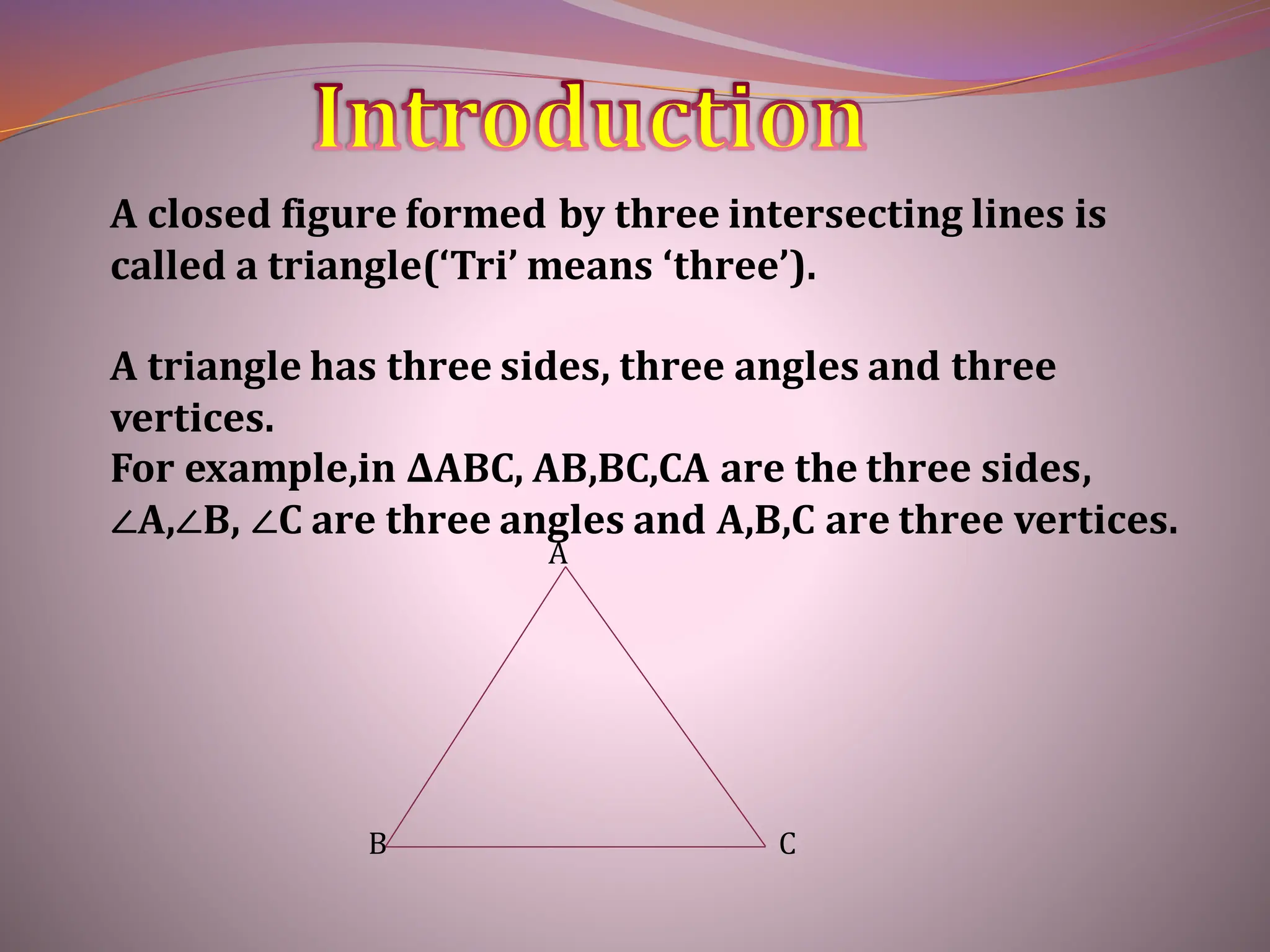
A closed figure formed by three intersecting lines is
called a triangle(‘Tri’ means ‘three’).
A triangle has three sides, three angles and three
vertices.
For example,in ∆ABC, AB,BC,CA are the three sides,
∠A,∠B, ∠C are three angles and A,B,C are three vertices.
A
B C
IN THIS LESSON YOU WILL LEARN :
1
• CONGRUENCE
OF
TRIANGLES.
2
• THE
CRITERIA
FOR THE
CONGRUENCE
OF TWO
TRIANGLES.
3
• SOME
PROPERTIES
OF A
TRIANGLE.
4
INEQUALITIES
IN A TRIANGLE
CONGRUENCE OF TRIANGLES
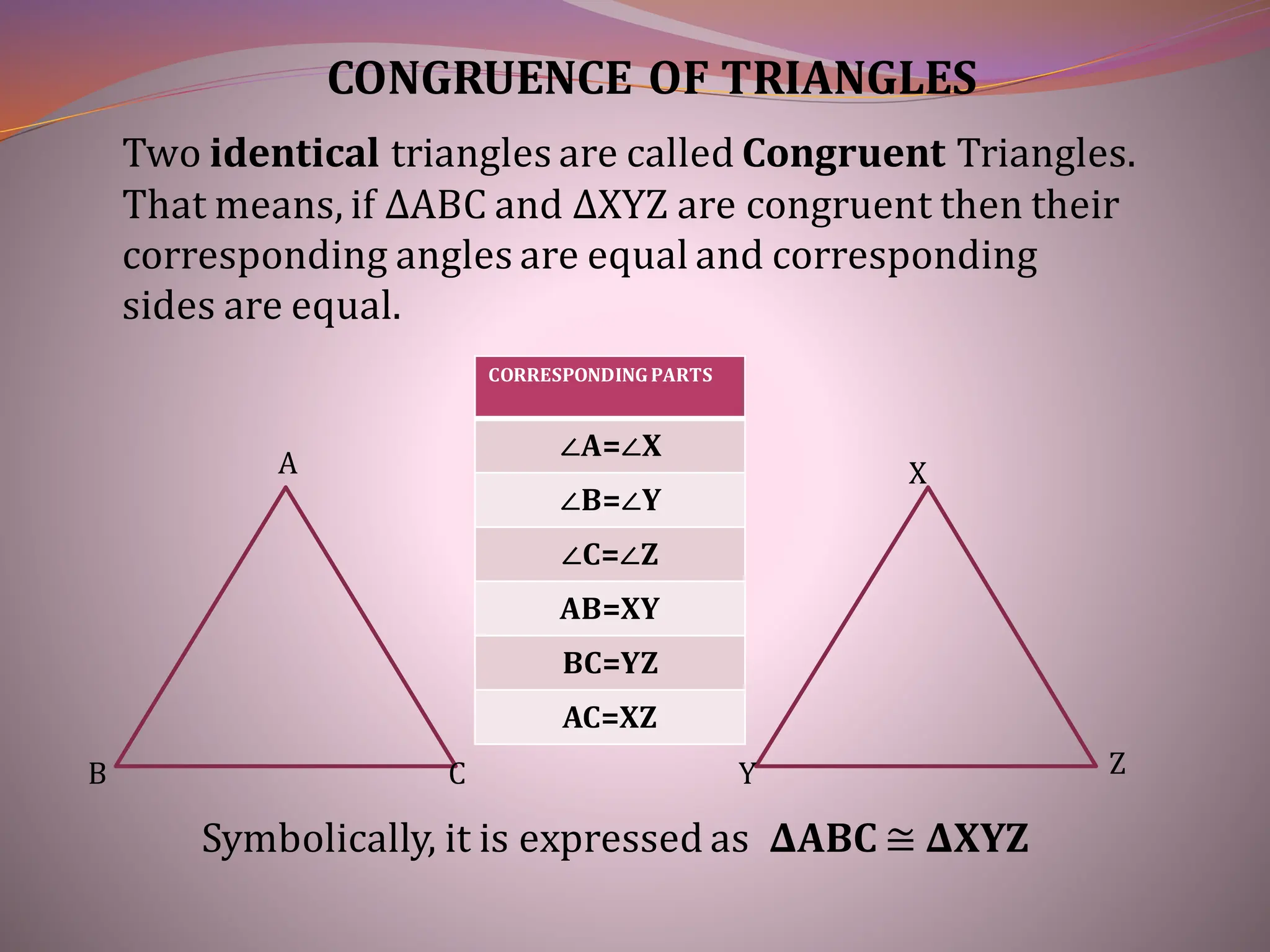
Two identical triangles are called Congruent Triangles.
That means, if ∆ABC and ∆XYZ are congruent then their
corresponding angles are equal and corresponding
sides are equal.
A
B C
X
Y Z
CORRESPONDING PARTS
∠A=∠X
∠B=∠Y
∠C=∠Z
AB=XY
BC=YZ
AC=XZ
Symbolically, it is expressed as ∆ABC ≅ ∆XYZ
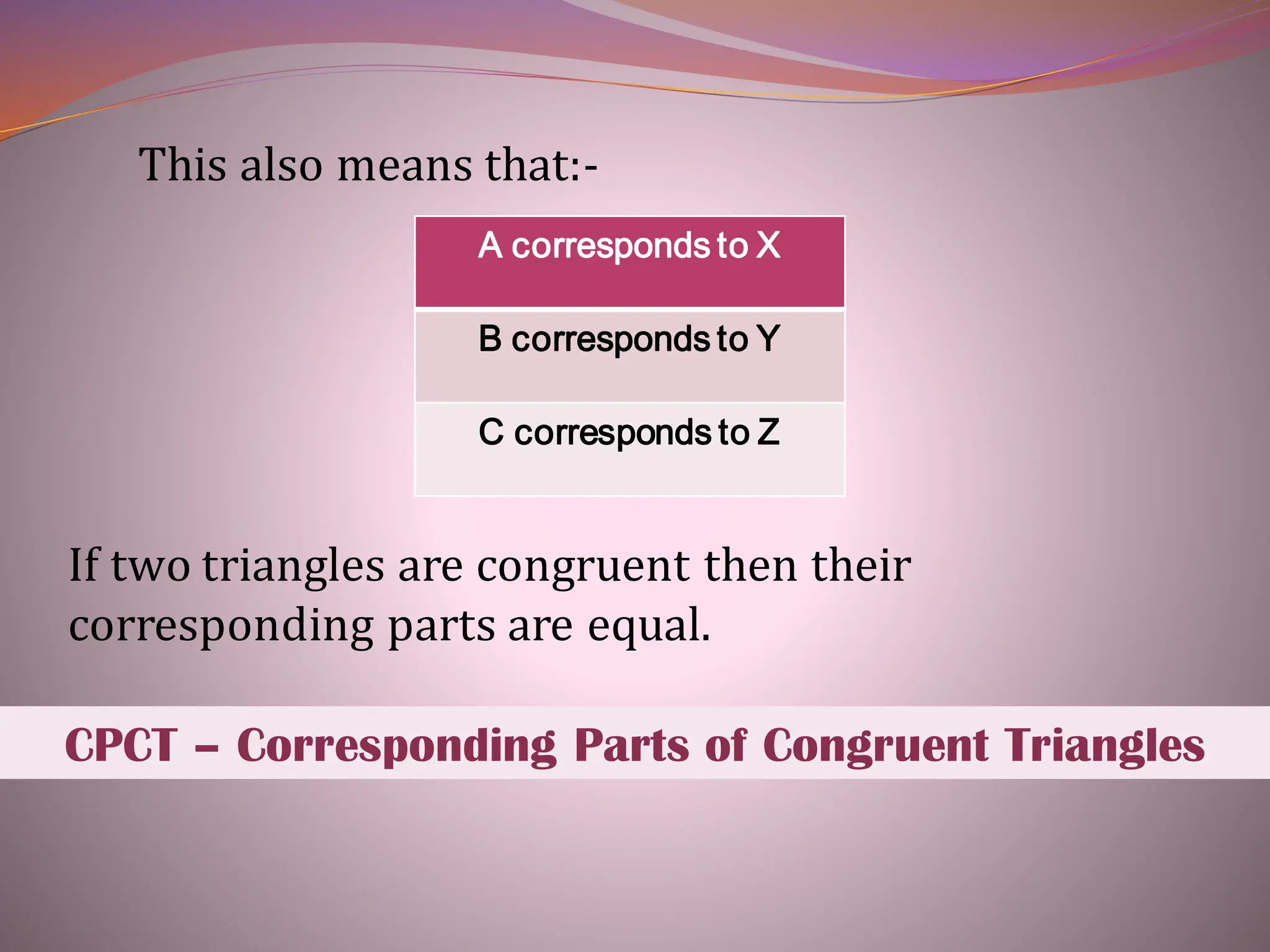
This also means that:-
A corresponds to X
B corresponds to Y
C corresponds to Z
If two triangles are congruent then their
corresponding parts are equal.
CPCT – Corresponding Parts of Congruent Triangles
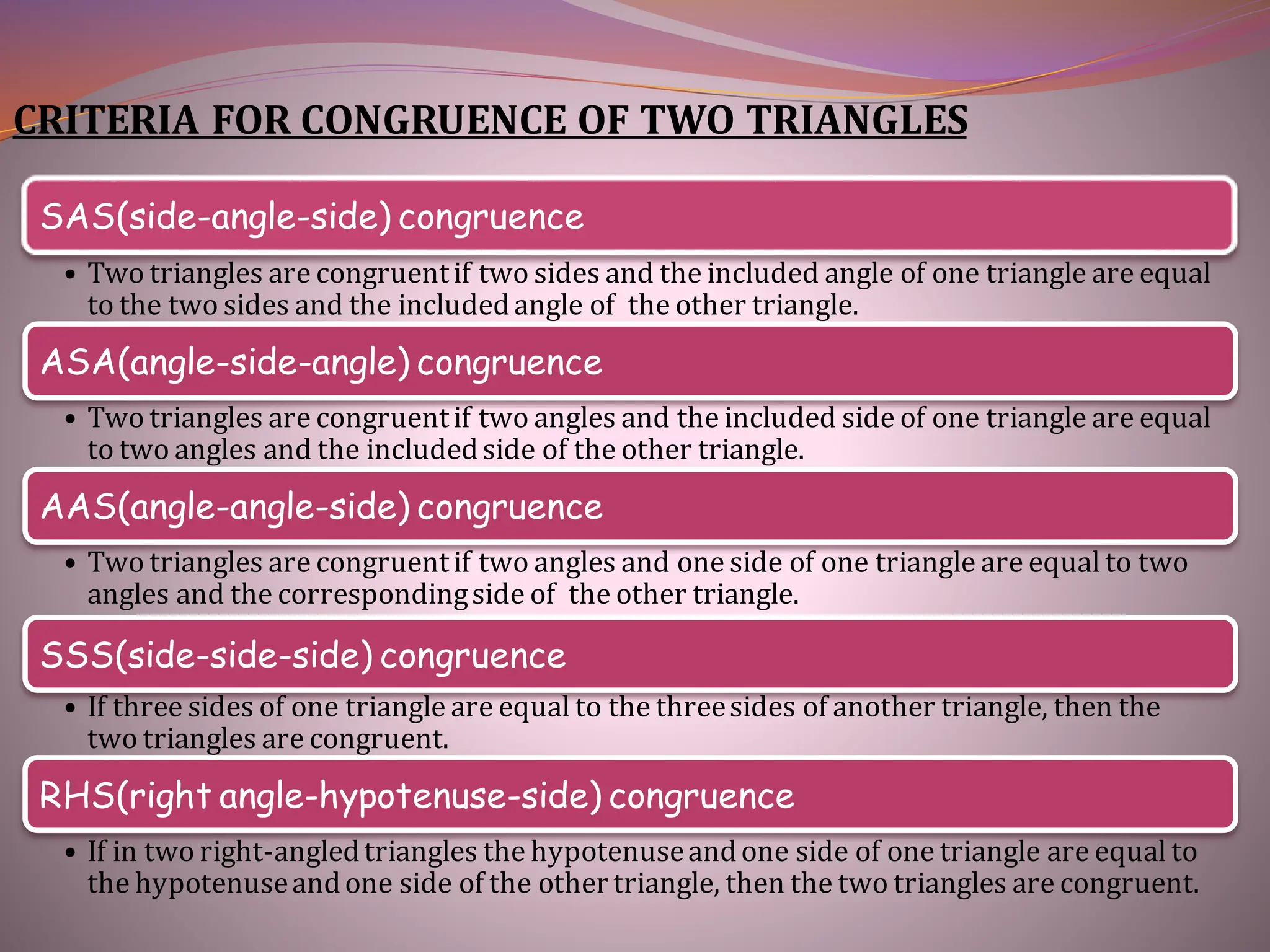
CRITERIA FOR CONGRUENCE OF TWO TRIANGLES
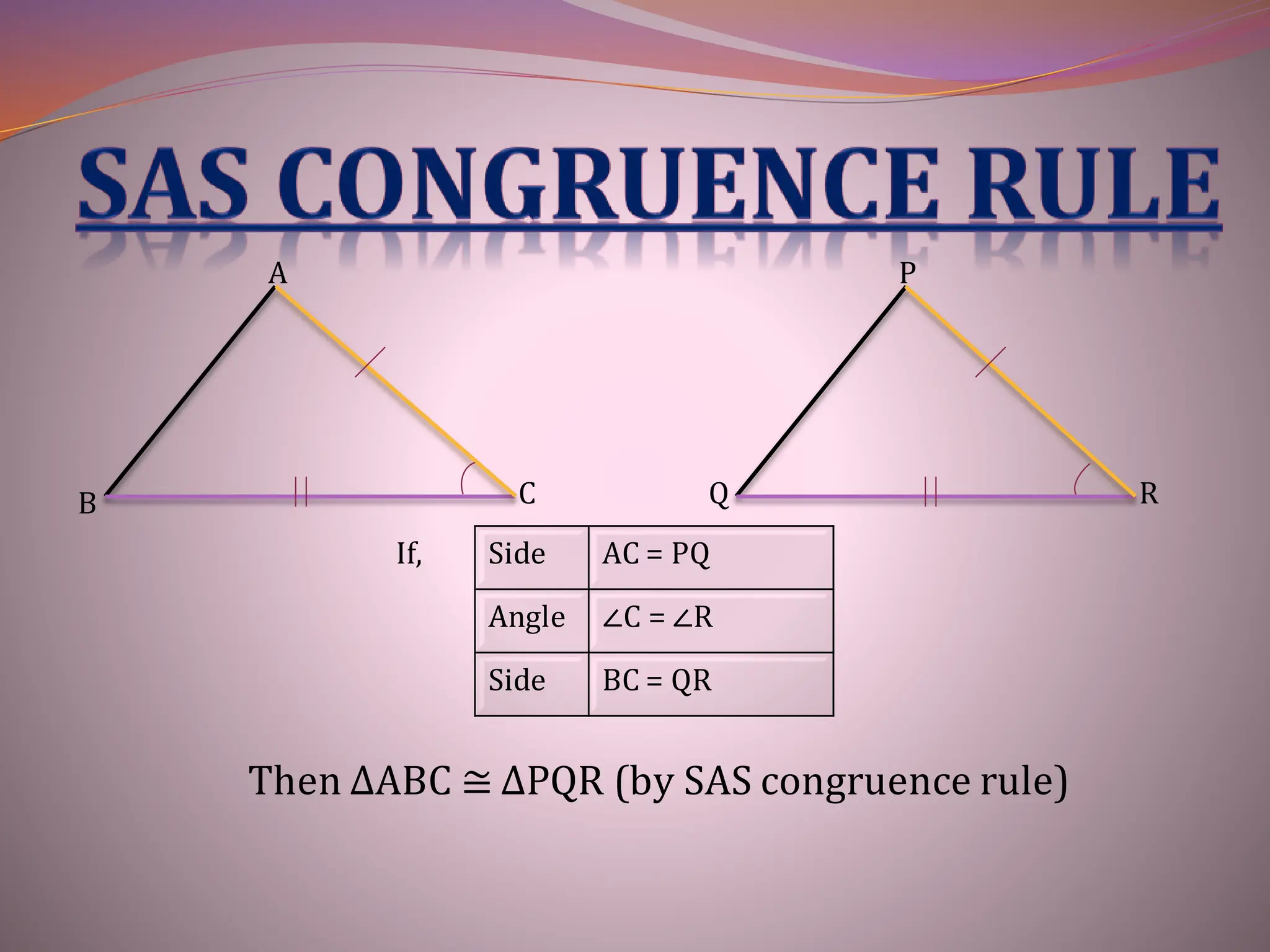
SAS(side-angle-side) congruence
• Two triangles are congruentif two sides and the included angle of one triangle are equal
to the two sides and the includedangle of the other triangle.
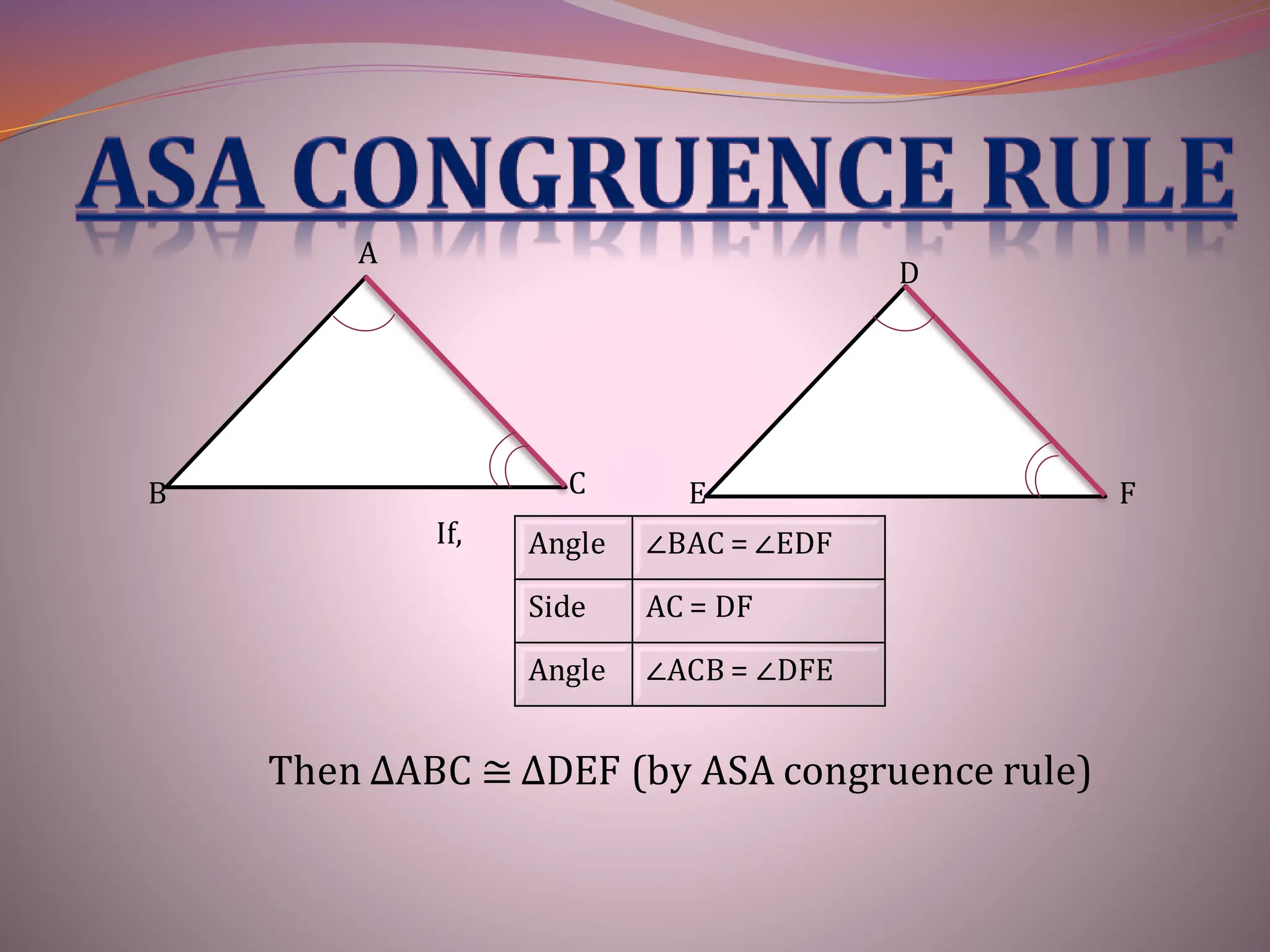
ASA(angle-side-angle) congruence
• Two triangles are congruentif two angles and the included side of one triangle are equal
to two angles and the includedside of the other triangle.
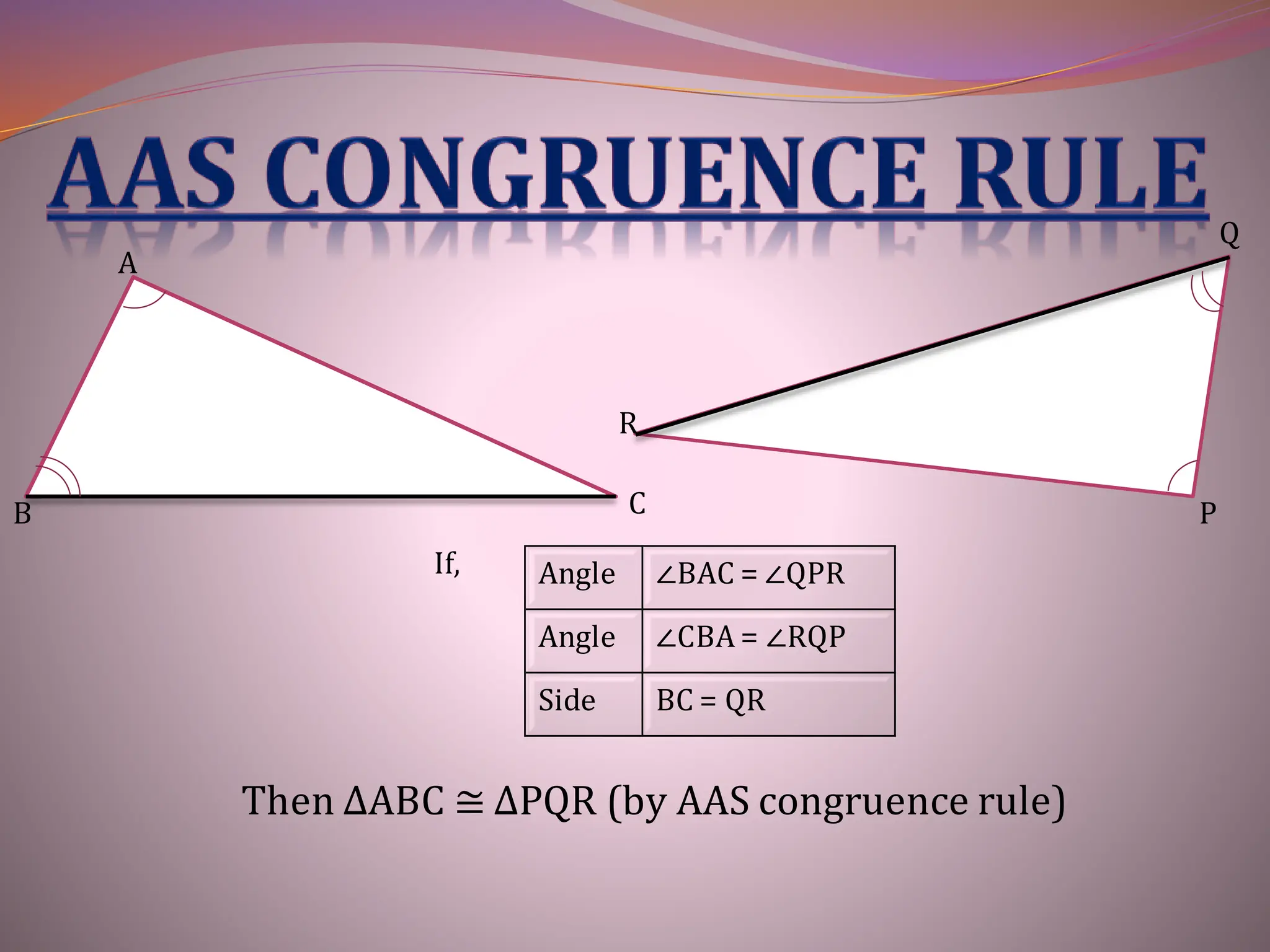
AAS(angle-angle-side) congruence
• Two triangles are congruentif two angles and one side of one triangle are equal to two
angles and the correspondingside of the other triangle.
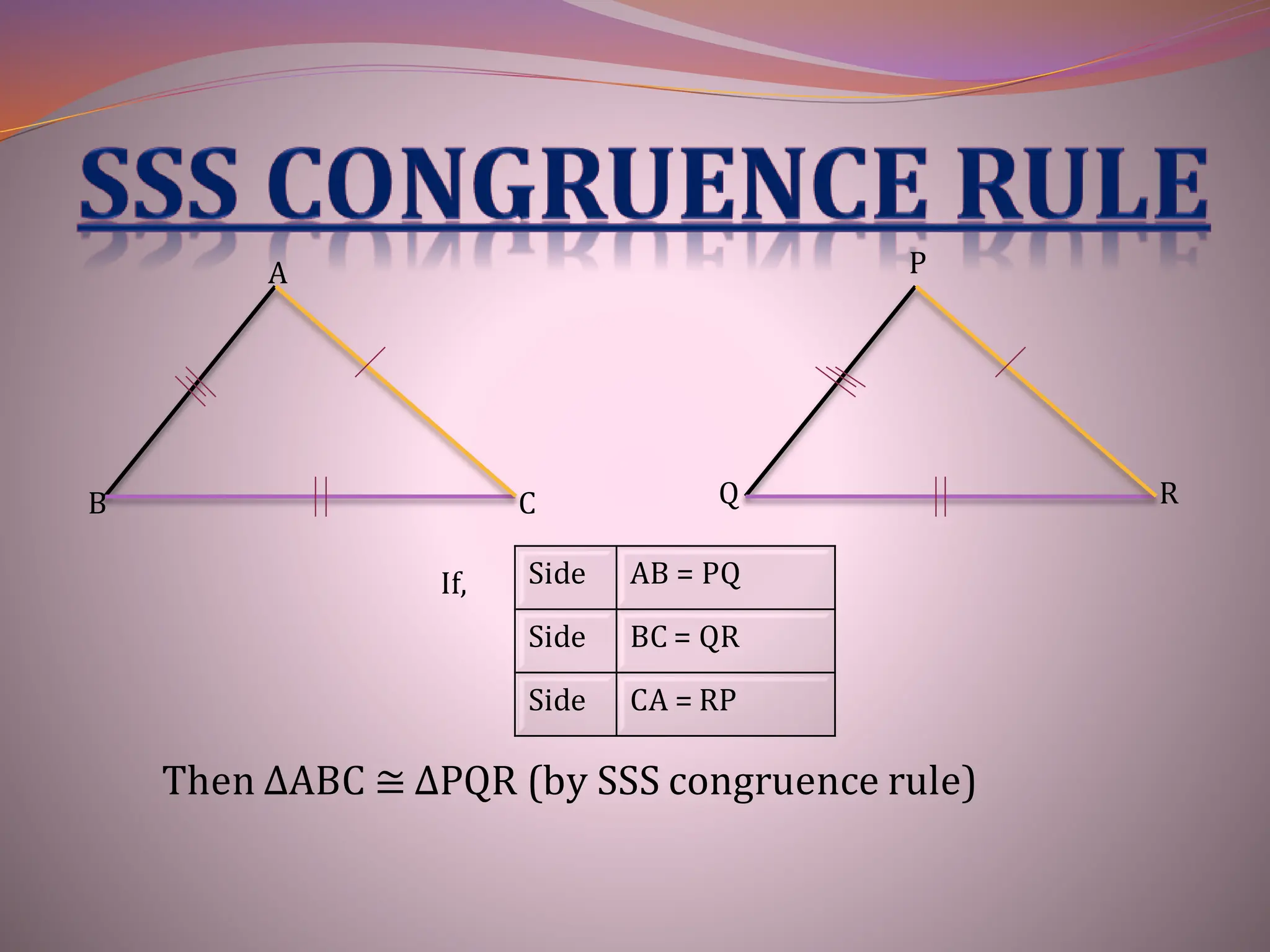
SSS(side-side-side) congruence
• If three sides of one triangle are equal to the threesides of another triangle, then the
two triangles are congruent.
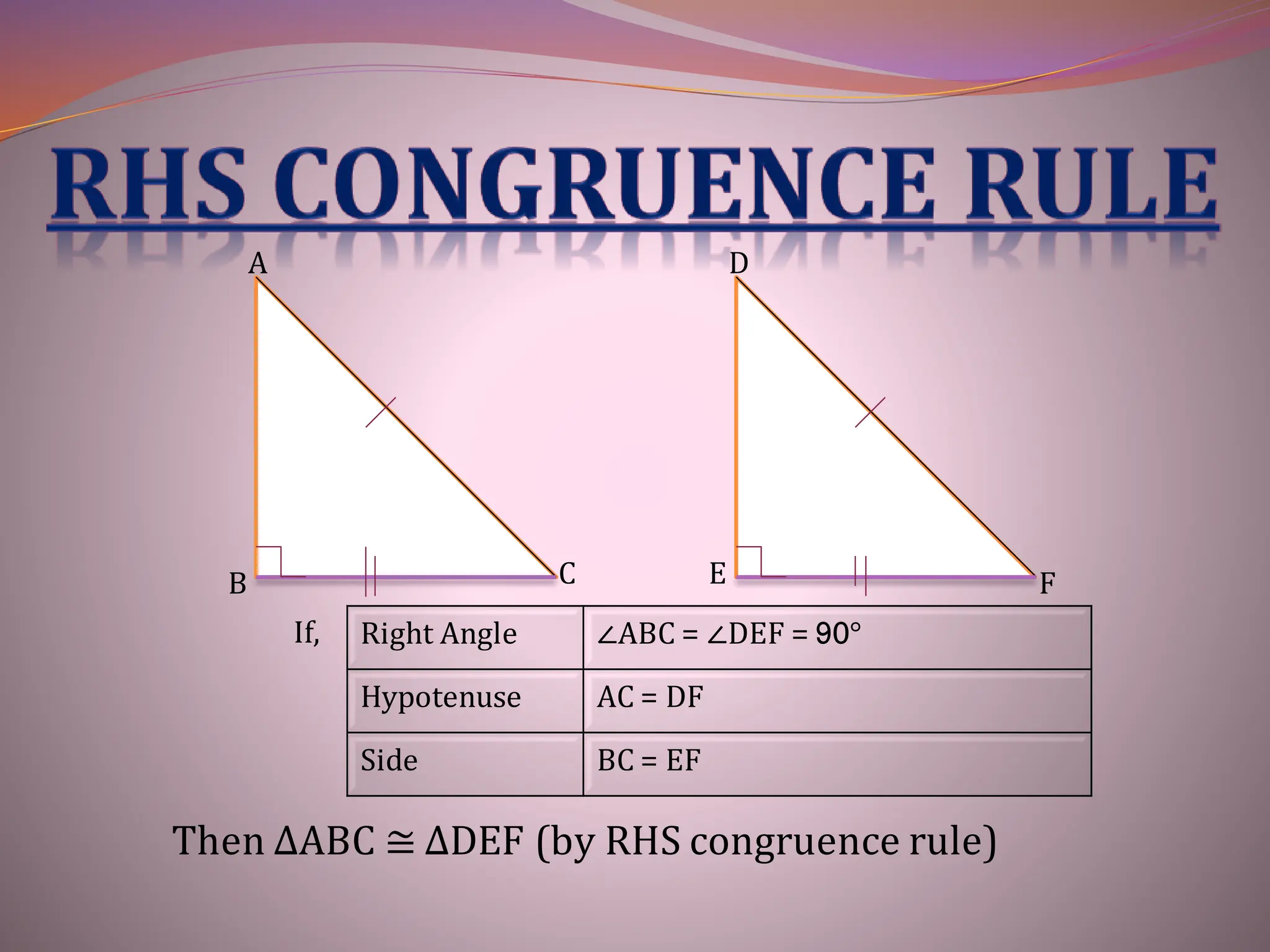
RHS(right angle-hypotenuse-side) congruence
• If in two right-angledtriangles the hypotenuseandone side of one triangle are equal to
the hypotenuseandone side of the othertriangle, then the two triangles are congruent.
A
B C
P
Q R
Side AC = PQ
Angle ∠C = ∠R
Side BC = QR
If,
Then ∆ABC ≅ ∆PQR (by SAS congruence rule)
A
B C
D
E F
If, Angle ∠BAC = ∠EDF
Side AC = DF
Angle ∠ACB = ∠DFE
Then ∆ABC ≅ ∆DEF (by ASA congruence rule)
A
B C P
Q
R
If, Angle ∠BAC = ∠QPR
Angle ∠CBA = ∠RQP
Side BC = QR
Then ∆ABC ≅ ∆PQR (by AAS congruence rule)
If, Side AB = PQ
Side BC = QR
Side CA = RP
A
B C
P
Q R
Then ∆ABC ≅ ∆PQR (by SSS congruence rule)
If, Right Angle ∠ABC = ∠DEF = 90°
Hypotenuse AC = DF
Side BC = EF
A
B C
D
E F
Then ∆ABC ≅ ∆DEF (by RHS congruence rule)
PROPERTIES OF A TRIANGLE
A
B C
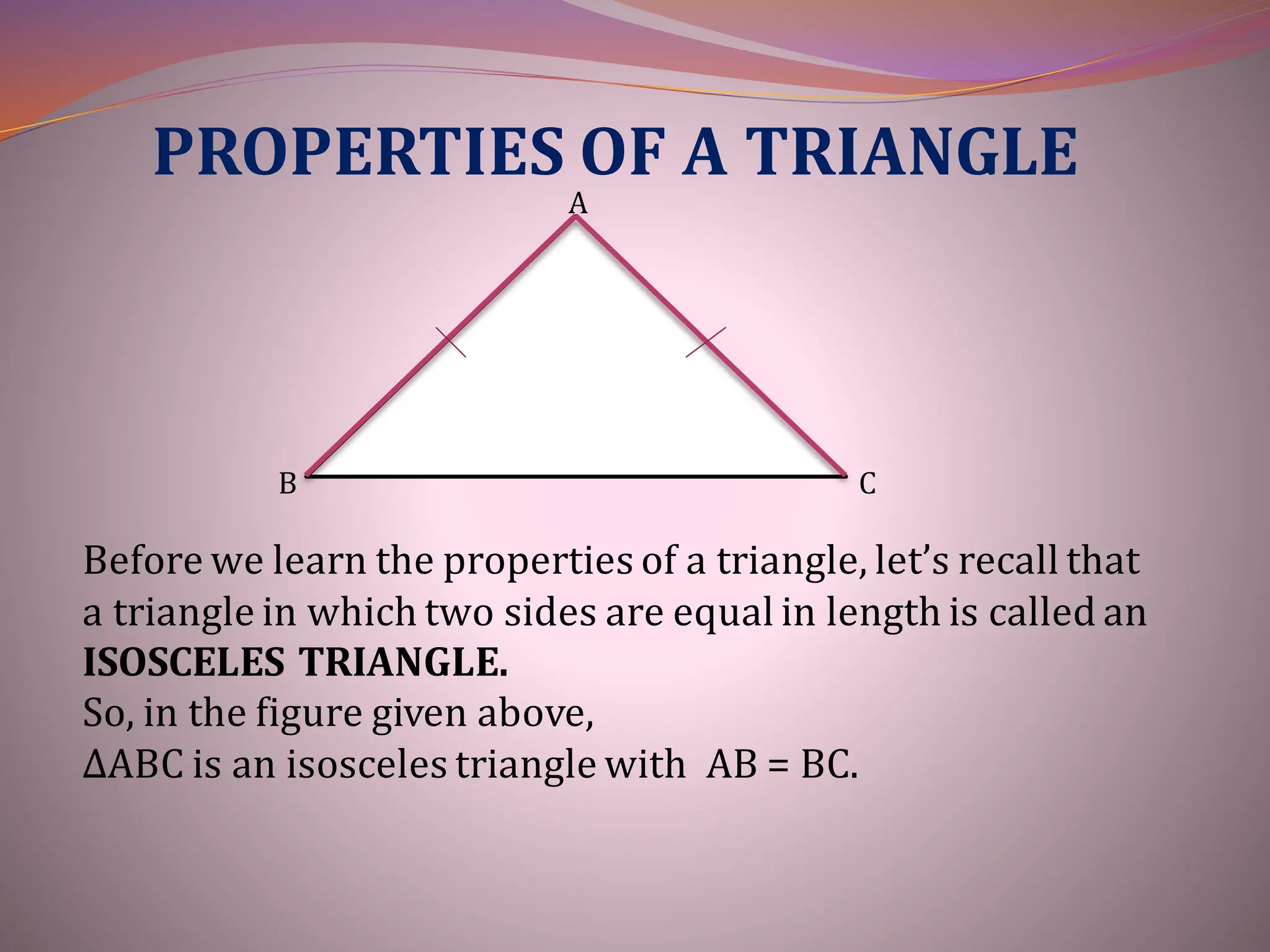
Before we learn the properties of a triangle, let’s recall that
a triangle in which two sides are equal in length is called an
ISOSCELES TRIANGLE.
So, in the figure given above,
∆ABC is an isosceles triangle with AB = BC.
PROPERTY 1
Angles opposite to equal sides of an isosceles
triangle are equal.
B C
A
For example, if ∆ABC is an isosceles triangle with AB = AC,
then ∠C = ∠B [ because angle opposite to side AB is ∠C
and the angle opposite to side AC is ∠B].
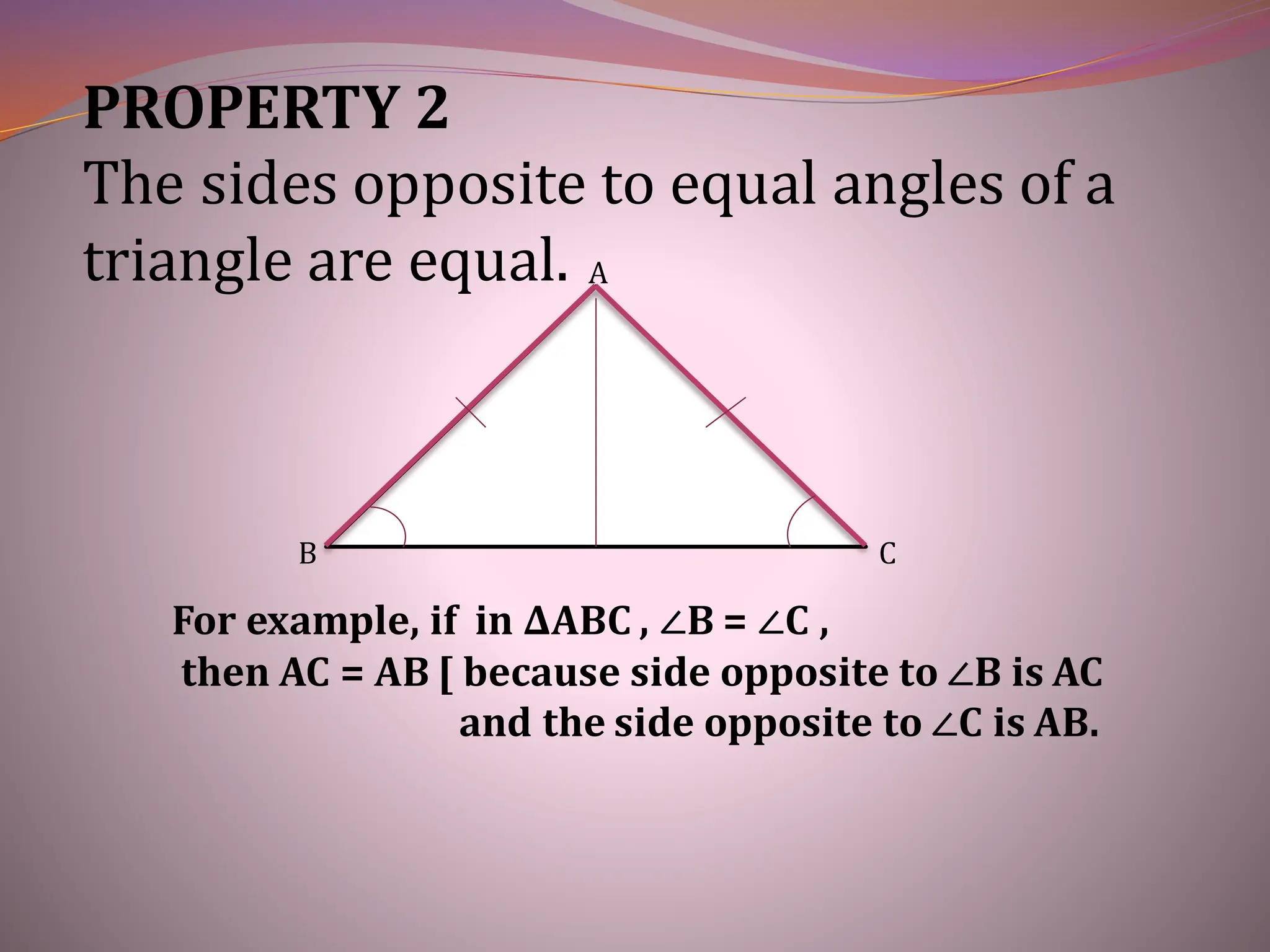
PROPERTY 2
The sides opposite to equal angles of a
triangle are equal.
C
B
A
For example, if in ∆ABC , ∠B = ∠C ,
then AC = AB [ because side opposite to ∠B is AC
and the side opposite to ∠C is AB.
1.If two sides of a triangle are unequal, the angle
opposite to the longer side is larger ( or greater)
In ∆ABC, side BC is longer than side AB [ that is, BC > AB ].
So, ∠A >∠C [ because angle opposite to side BC is ∠A
and the angle opposite to side AB is ∠C].
A
C
B
2. In any triangle, the side opposite to
the larger(greater) angle is longer.
In ∆ABC, ∠C is larger than ∠B [ that is, ∠C > ∠B ].
So, AB > AC [ because side opposite to ∠C is AB and
the side opposite to ∠B is AC ].
C
B
A
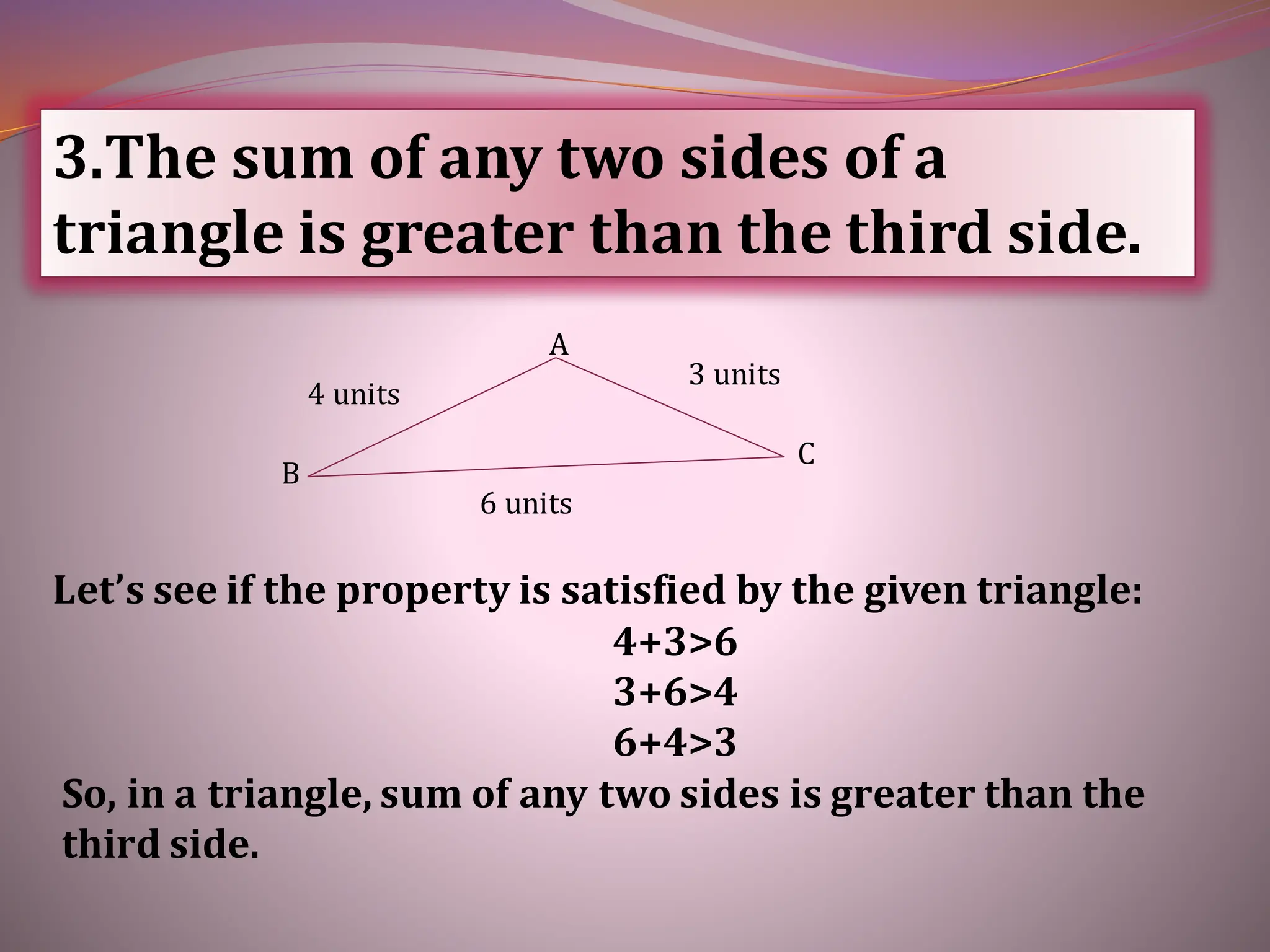
3.The sum of any two sides of a
triangle is greater than the third side.
Let’s see if the property is satisfied by the given triangle:
4+3>6
3+6>4
6+4>3
So, in a triangle, sum of any two sides is greater than the
third side.
6 units
4 units
3 units
C
B
A
SUMMARY
1.Two figures are congruent, if they are of the same shape and size.
2.If two sides and the includedangle of one triangle is equal to the two sides and
the includedangle of the other triangle then the two triangles are congruent
(SAS Congruence Rule).
3.If two angles and the includedside of one triangle are equal to the two angles
and the includedside of other triangle then the two triangles are congruent
(ASA Congruence Rule).
4.If two angles and the one sideof a triangle is equal to the two angles and the
correspondingside of other triangle then the two triangles are congruent
(AAS Congruence Rule).
5.If three sides of a triangle are equal to the three sides of the other triangle then
the two triangles are congruent(SSS Congruence Rule).
6.If in two right-angledtriangles, hypotenuse and one side of a triangle are equal to
the hypotenuseand one side of the other triangle then the two triangles are
congruent(RHS Congruence Rule).
7. Angles oppositeto equal sides of a triangle are equal.
8. Sides opposite to equal angles of a triangle are equal.
9. In a triangle, angle opposite to the longer side is larger
10. In a triangle, side oppositeto the larger angle is longer.
11. Sum of any two sides of triangle is greater than the third side.

class-9-math-triangles_1595671835220.pdf

  • 2.
    A closed figureformed by three intersecting lines is called a triangle(‘Tri’ means ‘three’). A triangle has three sides, three angles and three vertices. For example,in ∆ABC, AB,BC,CA are the three sides, ∠A,∠B, ∠C are three angles and A,B,C are three vertices. A B C
  • 3.
    IN THIS LESSONYOU WILL LEARN : 1 • CONGRUENCE OF TRIANGLES. 2 • THE CRITERIA FOR THE CONGRUENCE OF TWO TRIANGLES. 3 • SOME PROPERTIES OF A TRIANGLE. 4 INEQUALITIES IN A TRIANGLE
  • 4.
    CONGRUENCE OF TRIANGLES Twoidentical triangles are called Congruent Triangles. That means, if ∆ABC and ∆XYZ are congruent then their corresponding angles are equal and corresponding sides are equal. A B C X Y Z CORRESPONDING PARTS ∠A=∠X ∠B=∠Y ∠C=∠Z AB=XY BC=YZ AC=XZ Symbolically, it is expressed as ∆ABC ≅ ∆XYZ
  • 5.
    This also meansthat:- A corresponds to X B corresponds to Y C corresponds to Z If two triangles are congruent then their corresponding parts are equal. CPCT – Corresponding Parts of Congruent Triangles
  • 6.
    CRITERIA FOR CONGRUENCEOF TWO TRIANGLES SAS(side-angle-side) congruence • Two triangles are congruentif two sides and the included angle of one triangle are equal to the two sides and the includedangle of the other triangle. ASA(angle-side-angle) congruence • Two triangles are congruentif two angles and the included side of one triangle are equal to two angles and the includedside of the other triangle. AAS(angle-angle-side) congruence • Two triangles are congruentif two angles and one side of one triangle are equal to two angles and the correspondingside of the other triangle. SSS(side-side-side) congruence • If three sides of one triangle are equal to the threesides of another triangle, then the two triangles are congruent. RHS(right angle-hypotenuse-side) congruence • If in two right-angledtriangles the hypotenuseandone side of one triangle are equal to the hypotenuseandone side of the othertriangle, then the two triangles are congruent.
  • 7.
    A B C P Q R SideAC = PQ Angle ∠C = ∠R Side BC = QR If, Then ∆ABC ≅ ∆PQR (by SAS congruence rule)
  • 8.
    A B C D E F If,Angle ∠BAC = ∠EDF Side AC = DF Angle ∠ACB = ∠DFE Then ∆ABC ≅ ∆DEF (by ASA congruence rule)
  • 9.
    A B C P Q R If,Angle ∠BAC = ∠QPR Angle ∠CBA = ∠RQP Side BC = QR Then ∆ABC ≅ ∆PQR (by AAS congruence rule)
  • 10.
    If, Side AB= PQ Side BC = QR Side CA = RP A B C P Q R Then ∆ABC ≅ ∆PQR (by SSS congruence rule)
  • 11.
    If, Right Angle∠ABC = ∠DEF = 90° Hypotenuse AC = DF Side BC = EF A B C D E F Then ∆ABC ≅ ∆DEF (by RHS congruence rule)
  • 12.
    PROPERTIES OF ATRIANGLE A B C Before we learn the properties of a triangle, let’s recall that a triangle in which two sides are equal in length is called an ISOSCELES TRIANGLE. So, in the figure given above, ∆ABC is an isosceles triangle with AB = BC.
  • 13.
    PROPERTY 1 Angles oppositeto equal sides of an isosceles triangle are equal. B C A For example, if ∆ABC is an isosceles triangle with AB = AC, then ∠C = ∠B [ because angle opposite to side AB is ∠C and the angle opposite to side AC is ∠B].
  • 14.
    PROPERTY 2 The sidesopposite to equal angles of a triangle are equal. C B A For example, if in ∆ABC , ∠B = ∠C , then AC = AB [ because side opposite to ∠B is AC and the side opposite to ∠C is AB.
  • 15.
    1.If two sidesof a triangle are unequal, the angle opposite to the longer side is larger ( or greater) In ∆ABC, side BC is longer than side AB [ that is, BC > AB ]. So, ∠A >∠C [ because angle opposite to side BC is ∠A and the angle opposite to side AB is ∠C]. A C B
  • 16.
    2. In anytriangle, the side opposite to the larger(greater) angle is longer. In ∆ABC, ∠C is larger than ∠B [ that is, ∠C > ∠B ]. So, AB > AC [ because side opposite to ∠C is AB and the side opposite to ∠B is AC ]. C B A
  • 17.
    3.The sum ofany two sides of a triangle is greater than the third side. Let’s see if the property is satisfied by the given triangle: 4+3>6 3+6>4 6+4>3 So, in a triangle, sum of any two sides is greater than the third side. 6 units 4 units 3 units C B A
  • 18.
    SUMMARY 1.Two figures arecongruent, if they are of the same shape and size. 2.If two sides and the includedangle of one triangle is equal to the two sides and the includedangle of the other triangle then the two triangles are congruent (SAS Congruence Rule). 3.If two angles and the includedside of one triangle are equal to the two angles and the includedside of other triangle then the two triangles are congruent (ASA Congruence Rule). 4.If two angles and the one sideof a triangle is equal to the two angles and the correspondingside of other triangle then the two triangles are congruent (AAS Congruence Rule). 5.If three sides of a triangle are equal to the three sides of the other triangle then the two triangles are congruent(SSS Congruence Rule). 6.If in two right-angledtriangles, hypotenuse and one side of a triangle are equal to the hypotenuseand one side of the other triangle then the two triangles are congruent(RHS Congruence Rule). 7. Angles oppositeto equal sides of a triangle are equal. 8. Sides opposite to equal angles of a triangle are equal. 9. In a triangle, angle opposite to the longer side is larger 10. In a triangle, side oppositeto the larger angle is longer. 11. Sum of any two sides of triangle is greater than the third side.