HADAPSAR , PUNE-28
DEPARTMENT OF ZOOLOGY
PROF.IRFANA MULLA
TOPIC - HUMAN RESPIRATION
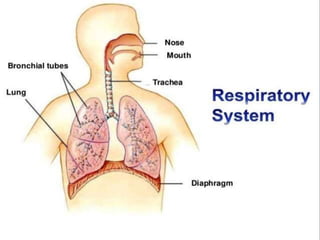
 *When most people think of the respiratory system ,
they naturally focus on the lungs& breathing .
indeed , breathing is a necessary function of the
healthy body . Without lungs taking in air, the cells
of body could not operate properly. however, the
lungs are only one part of the respiratory system.
The respiratory system also include ---
nose,mouth,pharynx,larynx,trachea,bronchi,alveoli,
diaphragm.*
It is a catabolic process in which food is broken down into simpler
form ,in short , Respiration is a biochemical activity which takes
place with in the protoplasm of the cell and results in the liberation
of energy.
A process which involves taking in oxygen into the cell using it for
releasing energy by burning food and then eliminating the waste
products like carbon di oxide and water from body
Breathing
It is a physical process.
It involves lungs.
It provide oxygen to the cell and
releases carbon dioxide.
Respiration
It is a biochemical process.
It involves mitochondria of the cell
where food is oxidized to release
energy.
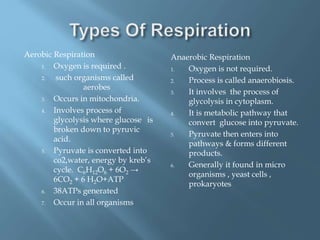
Aerobic Respiration
1. Oxygen is required .
2. such organisms called
aerobes
3. Occurs in mitochondria.
4. Involves process of
glycolysis where glucose is
broken down to pyruvic
acid.
5. Pyruvate is converted into
co2,water, energy by kreb’s
cycle. C6H12O6 + 6O2 →
6CO2 + 6 H2O+ATP
6. 38ATPs generated
7. Occur in all organisms
Anaerobic Respiration
1. Oxygen is not required.
2. Process is called anaerobiosis.
3. It involves the process of
glycolysis in cytoplasm.
4. It is metabolic pathway that
convert glucose into pyruvate.
5. Pyruvate then enters into
pathways & forms different
products.
6. Generally it found in micro
organisms , yeast cells ,
prokaryotes
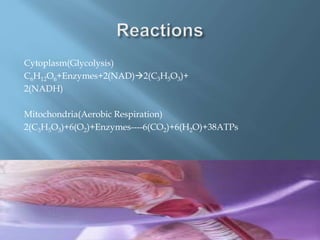
Cytoplasm(Glycolysis)
C6H12O6+Enzymes+2(NAD)2(C3H5O3)+
2(NADH)
Mitochondria(Aerobic Respiration)
2(C3H5O3)+6(O2)+Enzymes----6(CO2)+6(H2O)+38ATPs
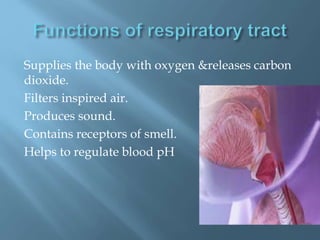
Supplies the body with oxygen &releases carbon
dioxide.
Filters inspired air.
Produces sound.
Contains receptors of smell.
Helps to regulate blood pH
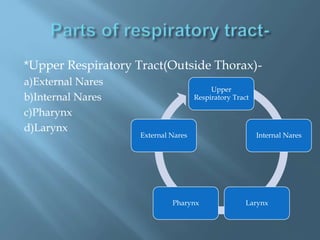
*Upper Respiratory Tract(Outside Thorax)-
a)External Nares
b)Internal Nares
c)Pharynx
d)Larynx
Upper
Respiratory Tract
Internal Nares
Larynx
Pharynx
External Nares
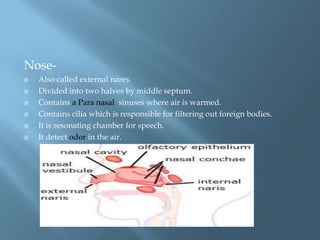
Nose-
 Also called external nares.
 Divided into two halves by middle septum.
 Contains a Para nasal sinuses where air is warmed.
 Contains cilia which is responsible for filtering out foreign bodies.
 It is resonating chamber for speech.
 It detect odor in the air.
 Commonly called as throat.
 It is common passage for both respiratory
system & digestive system.
 Originates posterior to the nasal & oral cavities
& extends inferiorly near the level of
bifurcation of the larynx & esophagus.
 Lines are lined by mucosa & skeletal muscle
That are primarily used for swallowing.
 It force swallowed food into esophagus.
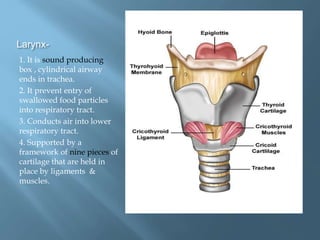
Larynx-
1. It is sound producing
box , cylindrical airway
ends in trachea.
2. It prevent entry of
swallowed food particles
into respiratory tract.
3. Conducts air into lower
respiratory tract.
4. Supported by a
framework of nine pieces of
cartilage that are held in
place by ligaments &
muscles.
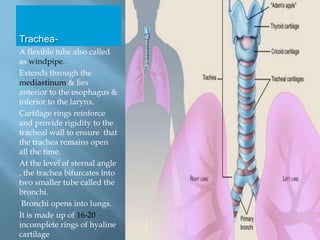
Trachea-
A flexible tube also called
as windpipe.
Extends through the
mediastinum & lies
anterior to the esophagus &
inferior to the larynx.
Cartilage rings reinforce
and provide rigidity to the
tracheal wall to ensure that
the trachea remains open
all the time.
At the level of sternal angle
, the trachea bifurcates into
two smaller tube called the
bronchi.
Bronchi opens into lungs.
It is made up of 16-20
incomplete rings of hyaline
cartilage
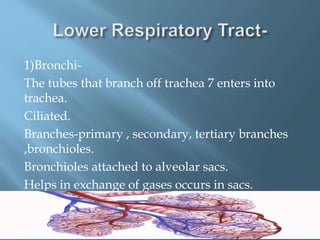
1)Bronchi-
The tubes that branch off trachea 7 enters into
trachea.
Ciliated.
Branches-primary , secondary, tertiary branches
,bronchioles.
Bronchioles attached to alveolar sacs.
Helps in exchange of gases occurs in sacs.
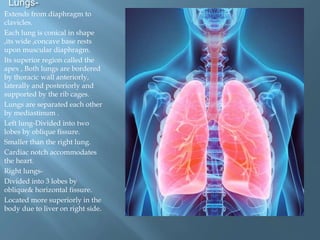
Lungs-
Extends from diaphragm to
clavicles.
Each lung is conical in shape
,its wide ,concave base rests
upon muscular diaphragm.
Its superior region called the
apex , Both lungs are bordered
by thoracic wall anteriorly,
laterally and posteriorly and
supported by the rib cages.
Lungs are separated each other
by mediastinum .
Left lung-Divided into two
lobes by oblique fissure.
Smaller than the right lung.
Cardiac notch accommodates
the heart.
Right lungs-
Divided into 3 lobes by
oblique& horizontal fissure.
Located more superiorly in the
body due to liver on right side.
THANK YOU

Human respiration by Prof. Irfana Mulla.

  • 1.
    HADAPSAR , PUNE-28 DEPARTMENTOF ZOOLOGY PROF.IRFANA MULLA TOPIC - HUMAN RESPIRATION
  • 2.
     *When mostpeople think of the respiratory system , they naturally focus on the lungs& breathing . indeed , breathing is a necessary function of the healthy body . Without lungs taking in air, the cells of body could not operate properly. however, the lungs are only one part of the respiratory system. The respiratory system also include --- nose,mouth,pharynx,larynx,trachea,bronchi,alveoli, diaphragm.*
  • 3.
    It is acatabolic process in which food is broken down into simpler form ,in short , Respiration is a biochemical activity which takes place with in the protoplasm of the cell and results in the liberation of energy. A process which involves taking in oxygen into the cell using it for releasing energy by burning food and then eliminating the waste products like carbon di oxide and water from body
  • 4.
    Breathing It is aphysical process. It involves lungs. It provide oxygen to the cell and releases carbon dioxide. Respiration It is a biochemical process. It involves mitochondria of the cell where food is oxidized to release energy.
  • 5.
    Aerobic Respiration 1. Oxygenis required . 2. such organisms called aerobes 3. Occurs in mitochondria. 4. Involves process of glycolysis where glucose is broken down to pyruvic acid. 5. Pyruvate is converted into co2,water, energy by kreb’s cycle. C6H12O6 + 6O2 → 6CO2 + 6 H2O+ATP 6. 38ATPs generated 7. Occur in all organisms Anaerobic Respiration 1. Oxygen is not required. 2. Process is called anaerobiosis. 3. It involves the process of glycolysis in cytoplasm. 4. It is metabolic pathway that convert glucose into pyruvate. 5. Pyruvate then enters into pathways & forms different products. 6. Generally it found in micro organisms , yeast cells , prokaryotes
  • 6.
  • 8.
    Supplies the bodywith oxygen &releases carbon dioxide. Filters inspired air. Produces sound. Contains receptors of smell. Helps to regulate blood pH
  • 9.
    *Upper Respiratory Tract(OutsideThorax)- a)External Nares b)Internal Nares c)Pharynx d)Larynx Upper Respiratory Tract Internal Nares Larynx Pharynx External Nares
  • 10.
    Nose-  Also calledexternal nares.  Divided into two halves by middle septum.  Contains a Para nasal sinuses where air is warmed.  Contains cilia which is responsible for filtering out foreign bodies.  It is resonating chamber for speech.  It detect odor in the air.
  • 11.
     Commonly calledas throat.  It is common passage for both respiratory system & digestive system.  Originates posterior to the nasal & oral cavities & extends inferiorly near the level of bifurcation of the larynx & esophagus.  Lines are lined by mucosa & skeletal muscle That are primarily used for swallowing.  It force swallowed food into esophagus.
  • 12.
    Larynx- 1. It issound producing box , cylindrical airway ends in trachea. 2. It prevent entry of swallowed food particles into respiratory tract. 3. Conducts air into lower respiratory tract. 4. Supported by a framework of nine pieces of cartilage that are held in place by ligaments & muscles.
  • 13.
    Trachea- A flexible tubealso called as windpipe. Extends through the mediastinum & lies anterior to the esophagus & inferior to the larynx. Cartilage rings reinforce and provide rigidity to the tracheal wall to ensure that the trachea remains open all the time. At the level of sternal angle , the trachea bifurcates into two smaller tube called the bronchi. Bronchi opens into lungs. It is made up of 16-20 incomplete rings of hyaline cartilage
  • 14.
    1)Bronchi- The tubes thatbranch off trachea 7 enters into trachea. Ciliated. Branches-primary , secondary, tertiary branches ,bronchioles. Bronchioles attached to alveolar sacs. Helps in exchange of gases occurs in sacs.
  • 15.
    Lungs- Extends from diaphragmto clavicles. Each lung is conical in shape ,its wide ,concave base rests upon muscular diaphragm. Its superior region called the apex , Both lungs are bordered by thoracic wall anteriorly, laterally and posteriorly and supported by the rib cages. Lungs are separated each other by mediastinum . Left lung-Divided into two lobes by oblique fissure. Smaller than the right lung. Cardiac notch accommodates the heart. Right lungs- Divided into 3 lobes by oblique& horizontal fissure. Located more superiorly in the body due to liver on right side.
  • 16.